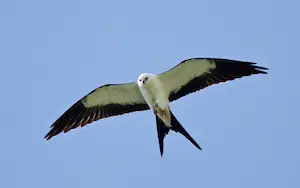
Florida Birds of Prey: A Field Guide to the State’s Hawks, Eagles, Owls, Kites, and Falcons
Florida is home to more than twenty regularly occurring birds of prey, ranging from the Bald Eagle (Haliaeetus leucocephalus) to the snail-eating, federally endangered Everglade Snail Kite (Rostrhamus sociabilis). Few states in the eastern United States offer raptor watching this varied, and fewer still hold so many species that occur almost nowhere else north of the tropics.
The reason is geography. Florida is a long, low peninsula that sits at the southern end of the Atlantic Flyway, the eastern migratory highway that funnels birds between northern breeding grounds and the tropics. Its mix of subtropical wetlands, pine flatwoods, dry prairie, and more than 1,300 miles of coastline supports year-round resident raptors, large numbers of wintering hawks and falcons, and a handful of warm-weather specialists that breed nowhere else in the country.
Key Takeaways
- Florida holds one of the densest concentrations of nesting Bald Eagles in the lower 48 states, with an estimated 1,500 nesting pairs monitored by the Florida Fish and Wildlife Conservation Commission.
- The Everglade Snail Kite is the only population of its species in the United States, is federally endangered, and feeds almost exclusively on apple snails.
- The Short-tailed Hawk (Buteo brachyurus) is a tropical raptor whose entire United States breeding population is centered in Florida.
- The best season for raptor variety is fall through spring, when migrants arrive; Swallow-tailed Kites are the great exception, returning to breed in February and March and departing by late summer.
- The Crested Caracara (Caracara plancus), sometimes called the Mexican eagle, survives on Florida’s dry prairie north and west of Lake Okeechobee and is federally protected in the state.
At a Glance: Florida’s Birds of Prey
The table below lists the species profiled in this guide along with several less common raptors that occur in the state. Sizes are given as body length. Seasonal status describes when the bird is typically present in Florida.
| Species | Scientific name | Length | When present | Where to find | Primary prey or note |
|---|---|---|---|---|---|
| Bald Eagle | Haliaeetus leucocephalus | 71 to 96 cm (28 to 38 in) | Resident, nests Oct to May | Lakes, rivers, coasts statewide | Fish, waterfowl, carrion |
| Osprey | Pandion haliaetus | 54 to 58 cm (21 to 23 in) | Resident plus winter migrants | Coasts, lakes, rivers | Live fish |
| Swallow-tailed Kite | Elanoides forficatus | 50 to 68 cm (20 to 27 in) | Breeding, Feb to Aug | Wooded wetlands, river swamps | Insects, tree frogs, small reptiles |
| Snail Kite | Rostrhamus sociabilis | 36 to 48 cm (14 to 19 in) | Resident | Marshes of central and south Florida | Apple snails |
| Mississippi Kite | Ictinia mississippiensis | 30 to 37 cm (12 to 15 in) | Breeding and migration, spring to fall | Panhandle and north Florida woodlands | Large flying insects |
| White-tailed Kite | Elanus leucurus | 35 to 43 cm (14 to 17 in) | Rare resident, local | Open grassland, south Florida | Small mammals |
| Red-shouldered Hawk | Buteo lineatus | 43 to 61 cm (17 to 24 in) | Resident | Wet woodlands, suburbs statewide | Reptiles, amphibians, small mammals |
| Red-tailed Hawk | Buteo jamaicensis | 45 to 65 cm (18 to 26 in) | Resident plus winter migrants | Open country, roadsides | Rodents, rabbits, reptiles |
| Broad-winged Hawk | Buteo platypterus | 33 to 44 cm (13 to 17 in) | Migrant, peak fall | Forest, migration corridors | Small vertebrates, insects |
| Short-tailed Hawk | Buteo brachyurus | 39 to 44 cm (15 to 17 in) | Resident, uncommon | Woodland edges, central Florida | Small birds |
| Cooper’s Hawk | Astur cooperii | 37 to 47 cm (14.6 to 18.5 in) | Resident plus winter migrants | Woodlands, suburbs, backyards | Birds, small mammals |
| Sharp-shinned Hawk | Accipiter striatus | 24 to 34 cm (9.4 to 13.4 in) | Winter migrant | Woodlands, feeders | Small songbirds |
| Northern Harrier | Circus hudsonius | 41 to 52 cm (16 to 20 in) | Winter migrant | Marshes, prairie, fields | Small mammals, birds |
| Crested Caracara | Caracara plancus | 50 to 65 cm (20 to 26 in) | Resident, local | Dry prairie north of Lake Okeechobee | Carrion, small animals |
| American Kestrel | Falco sparverius | 22 to 31 cm (8.7 to 12.2 in) | Resident race plus winter migrants | Open fields, fence wires | Insects, small vertebrates |
| Merlin | Falco columbarius | 24 to 30 cm (9.4 to 11.8 in) | Winter migrant | Coasts, open country | Small birds |
| Peregrine Falcon | Falco peregrinus | 36 to 49 cm (14 to 19 in) | Migrant and winter | Coasts, Keys, cities | Birds taken in flight |
| Great Horned Owl | Bubo virginianus | 46 to 63 cm (18 to 25 in) | Resident | Woodlands, suburbs statewide | Mammals, birds, reptiles |
| Barred Owl | Strix varia | 43 to 50 cm (17 to 20 in) | Resident | Swamps, wet woodlands | Small mammals, amphibians |
| Eastern Screech-Owl | Megascops asio | 16 to 25 cm (6.3 to 9.8 in) | Resident | Woodlands, parks, suburbs | Insects, small vertebrates |
| American Barn Owl | Tyto furcata | 32 to 40 cm (13 to 16 in) | Resident | Open country, farmland | Rodents |
| Burrowing Owl | Athene cunicularia | 19 to 25 cm (7.5 to 9.8 in) | Resident, local | Prairie, pastures, vacant lots | Insects, small vertebrates |
| Short-eared Owl | Asio flammeus | 34 to 43 cm (13 to 17 in) | Rare winter migrant | Marshes, open ground | Small mammals |
| Northern Saw-whet Owl | Aegolius acadicus | 18 to 21 cm (7.1 to 8.3 in) | Very rare winter | Far north Florida | Small mammals |
| Golden Eagle | Aquila chrysaetos | 70 to 84 cm (28 to 33 in) | Very rare winter | Open and remote habitat | Mammals, birds |
| Black Vulture | Coragyps atratus | 56 to 74 cm (22 to 29 in) | Resident | Statewide, often in flocks | Carrion |
| Turkey Vulture | Cathartes aura | 64 to 81 cm (25 to 32 in) | Resident plus winter influx | Statewide | Carrion |
Why Florida Holds Such Raptor Diversity
Florida’s raptor variety comes from its position, its climate, and its mosaic of habitats. As a peninsula reaching toward the tropics, the state lies along the Atlantic Flyway and acts as both a wintering ground and a migration bottleneck. Birds moving south in autumn concentrate down the peninsula and out along the Florida Keys, where land narrows to a thin chain pointing toward Cuba and the Caribbean.
The state’s subtropical climate also lets several tropical and warm-temperate species reach the northern edge of their range here. The Short-tailed Hawk, Snail Kite, and Crested Caracara are essentially tropical American birds whose United States footholds depend on Florida’s mild winters and specialized habitats.
Habitat diversity completes the picture. Freshwater marshes and the Everglades support wetland hunters such as the Snail Kite and Northern Harrier. Pine flatwoods, cypress swamps, and river floodplains hold Bald Eagles, Red-shouldered Hawks, Barred Owls, and breeding Swallow-tailed Kites. Remnant dry prairie north of Lake Okeechobee shelters the Crested Caracara, Florida Burrowing Owl, and Southeastern American Kestrel. The long coastline draws Ospreys and concentrates migrating falcons.
The Main Raptor Groups in Florida
Florida’s birds of prey fall into several natural groups: the fish-eating Osprey in its own family; the eagles; the kites; the hawks, which include the agile bird-hunting accipiters and the broad-winged, soaring buteos; the harriers; the falcons and the falcon-family Crested Caracara; the owls, which are nocturnal hunters; and the vultures.
A note on the vultures is useful at the outset. New World vultures are not classified among the true diurnal raptors, and recent taxonomy places them in their own order. They are, however, traditionally grouped with birds of prey, fill an overlapping scavenging niche, and are included here because most readers expect to find them in a guide to Florida’s raptors.
Eagles and the Osprey
Bald Eagle (Haliaeetus leucocephalus)
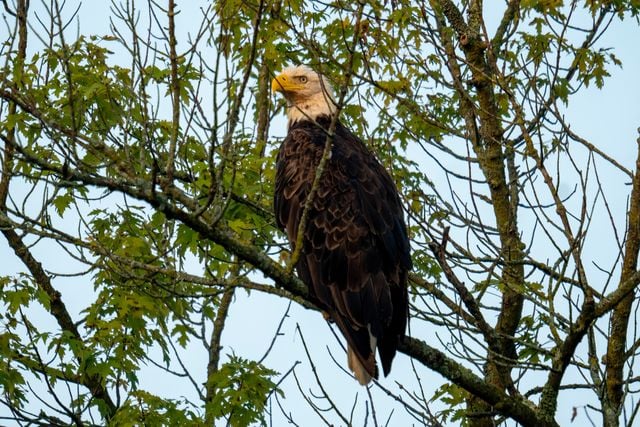
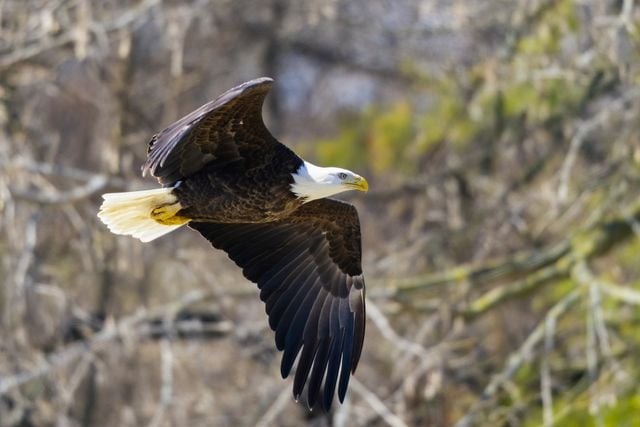
The Bald Eagle is Florida’s largest resident bird of prey and one of its great conservation successes. Adults are unmistakable, with a dark brown body, white head and tail, and a heavy yellow bill; the white head is not acquired until the bird is four or five years old, so younger eagles are mottled brown and white and are often mistaken for other large raptors. Length runs from 71 to 96 cm (28 to 38 in), with a wingspan of roughly 1.8 to 2.3 m (5.9 to 7.5 ft).
Florida supports one of the densest concentrations of nesting Bald Eagles in the lower 48 states. Nearly all nests sit within a short distance of water, and most Florida pairs lay eggs between December and early January, an early schedule compared with northern populations. Eagles take fish, waterfowl, and carrion, and they readily pirate fish from Ospreys. Look for them around large lakes, river systems, reservoirs, and the coast.
Osprey (Pandion haliaetus)
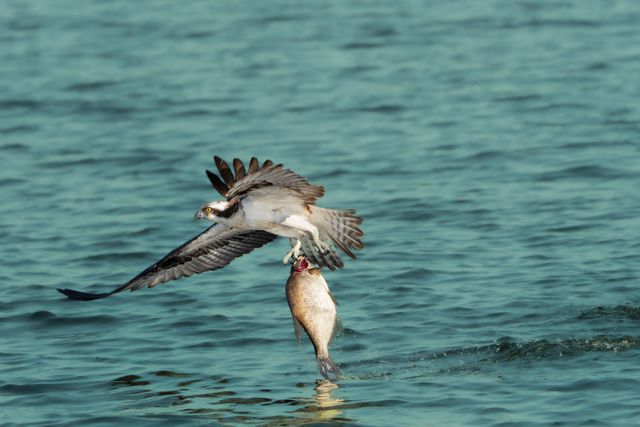
The Osprey is a large, fish-eating raptor placed in a family of its own, distinct from the hawks and eagles. It is brown above and white below, with a white head crossed by a dark eye stripe, and long, crooked wings that show a dark “wrist” patch in flight. Length is 54 to 58 cm (21 to 23 in), with a wingspan near 1.5 to 1.8 m (59 to 71 in).
Ospreys are superbly adapted fishers. A reversible outer toe and rough, spiny pads on the soles of the feet let them grip slippery prey, which they carry head-forward to reduce drag. They hover over open water, then plunge feet-first to seize fish near the surface. Florida hosts both resident breeders and additional wintering birds. Ospreys nest on snags, channel markers, utility poles, and artificial platforms, and they are among the easiest raptors to watch along Florida’s coasts, rivers, and lakes.
The Kites
Swallow-tailed Kite (Elanoides forficatus)
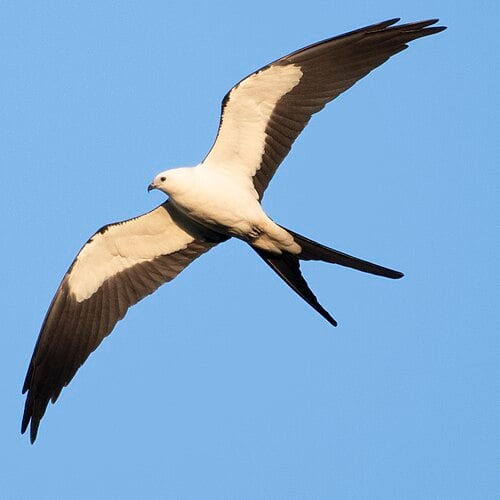
The Swallow-tailed Kite is widely considered the most graceful raptor in North America. It is boldly patterned in glossy black and white, with long, pointed wings and a deeply forked tail that it twists like a rudder while it wheels and glides, often without a single wingbeat. Length runs from 50 to 68 cm (20 to 27 in), with a wingspan of about 1.2 m (48 in).
This is a long-distance migrant that breeds in Florida and a few other Deep South states, then winters in South America. Birds return in February and March and depart by late summer, so the kite is a warm-season visitor rather than a year-round resident. It nests high in tall trees near open wetlands and river swamps and feeds on the wing, snatching large insects, tree frogs, lizards, and nestling birds from the canopy. Florida holds a large share of the United States breeding population.
Snail Kite (Rostrhamus sociabilis)
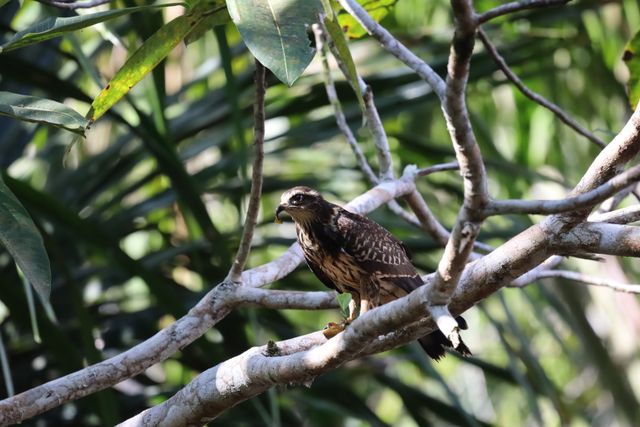
The Snail Kite is one of Florida’s most specialized and most closely watched raptors. The Florida population, long known as the Everglade Snail Kite, is the only one in the United States and is federally endangered. Adult males are slate gray with a black head and a white patch at the base of a squared tail; females and young birds are brown and heavily streaked. The deeply hooked, slender bill is built for one job. Length is 36 to 48 cm (14 to 19 in), with a wingspan near 1.1 m (45 in).
The Snail Kite glides low and slow over open marsh, hunting freshwater apple snails, which make up nearly its entire diet. That extreme specialization ties the bird’s fortunes directly to wetland water levels and snail abundance. The species is best seen in the marshes of central and south Florida, including the Lake Okeechobee region, the Kissimmee chain of lakes, and parts of the Everglades.
Mississippi Kite (Ictinia mississippiensis)
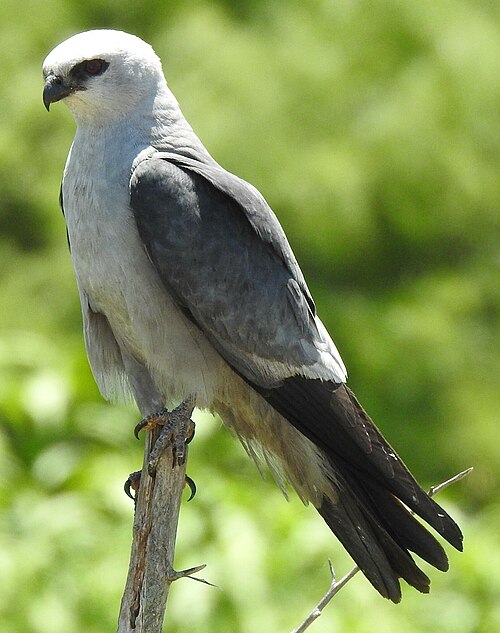
The Mississippi Kite is a small, elegant gray raptor that hunts large insects on the wing, circling and swooping with buoyant ease. Adults are pale gray on the head and underparts, darker gray above, with a black tail. Length runs from 30 to 37 cm (12 to 15 in), with a wingspan near 0.8 m (31 in).
In Florida this kite is mainly a bird of the Panhandle and the northern part of the peninsula, present from spring through early fall before migrating to South America. It often nests in loose colonies and has adapted to shade trees in towns in parts of its range. Dragonflies, cicadas, and other large flying insects form the bulk of its diet, frequently caught and eaten in midair.
The Hawks and the Harrier
Red-shouldered Hawk (Buteo lineatus)
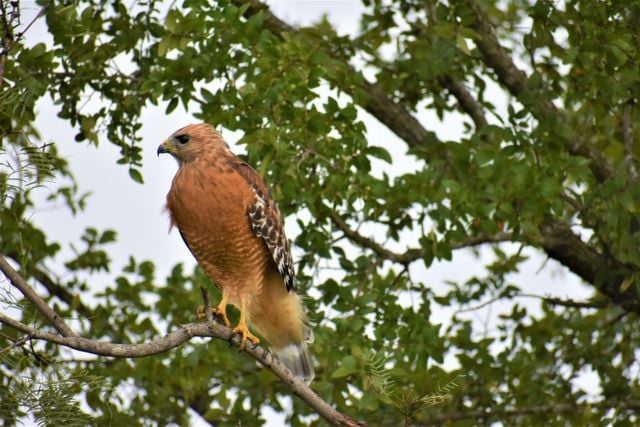
The Red-shouldered Hawk is among the most common and conspicuous raptors in Florida, and it is often heard before it is seen. Its clear, repeated whistled call carries through wet woodlands, and Blue Jays imitate it closely. Adults show reddish, barred underparts, boldly checkered black and white wings, and a banded tail. Length runs from 43 to 61 cm (17 to 24 in), with a wingspan near 1.0 m.
Where this hawk has grown scarce across much of the forested East, Florida populations remain visible and appear to tolerate open and suburban habitats well. Red-shouldered Hawks favor wet woodlands, hammocks, cypress edges, and tree-lined neighborhoods, where they hunt from perches for reptiles, amphibians, large insects, and small mammals. For many Floridians this is the default backyard hawk.
Red-tailed Hawk (Buteo jamaicensis)

The Red-tailed Hawk is the most widespread large hawk in North America and a familiar sight on Florida roadsides and over open country. It is bulky and broad-winged, built for effortless soaring. Adults usually show the trademark brick-red upper tail, though body plumage varies from pale to dark. Length runs from 45 to 65 cm (18 to 26 in), with a wingspan of roughly 1.1 to 1.3 m.
In Florida, resident Red-tailed Hawks are joined in winter by migrants from the north. They hunt rodents, rabbits, and reptiles, typically from an exposed perch such as a utility pole, fence post, or tall snag overlooking a field. Open habitats, pastures, prairie edges, and highway margins are the most reliable places to find them.
Short-tailed Hawk (Buteo brachyurus)
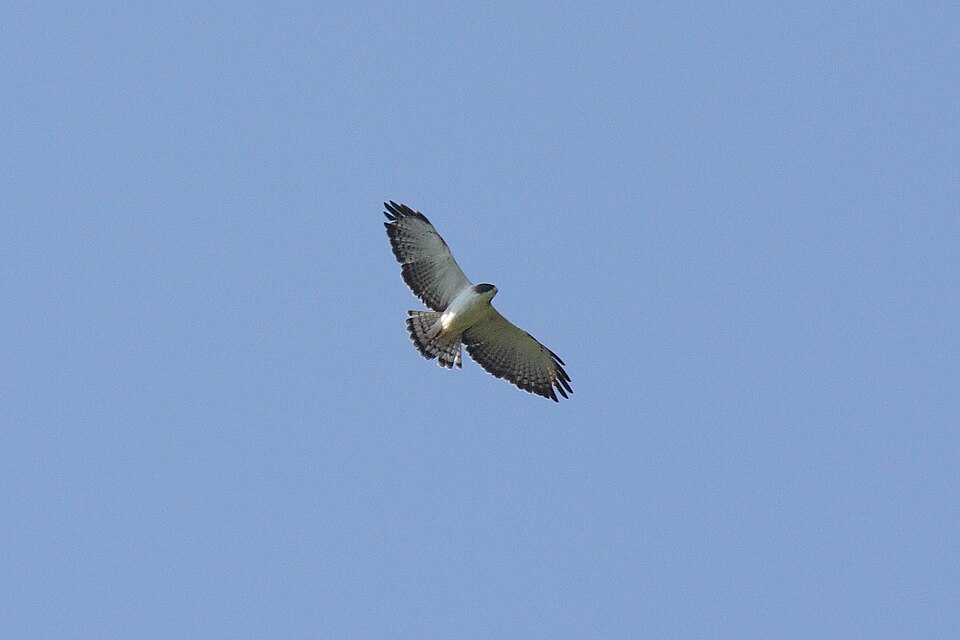
The Short-tailed Hawk is a Florida specialty and one of the most sought-after raptors in the state. This small tropical buteo barely enters the United States, and its breeding population north of the tropics is concentrated in Florida. It occurs in two color forms: a dark morph that is sooty brown overall and a light morph with clean white underparts. Length runs from 39 to 44 cm (15 to 17 in).
Even in Florida the species is uncommon and easy to miss. It rarely perches in the open, and when hunting it soars very high, then drops on unsuspecting small birds, which form the core of its diet. This reliance on birds is unusual among the buteos, most of which take mammals and reptiles. Scattered pairs nest along woodland edges in the central peninsula, and the bird is often detected as a distant silhouette riding a thermal.
Cooper’s Hawk (Astur cooperii)

The Cooper’s Hawk is a medium-sized, bird-hunting accipiter and an increasingly common sight in Florida’s wooded suburbs. Recent taxonomic work moved the species from the genus Accipiter into the resurrected genus Astur, so current references list it as Astur cooperii. Adults are blue-gray above with fine reddish barring below, a dark cap, and a long, rounded, banded tail. Length runs from 37 to 47 cm (14.6 to 18.5 in), with females notably larger than males.
Built for agile pursuit through cover, the Cooper’s Hawk ambushes birds from a hidden perch, then accelerates in a fast, low attack. Backyard feeders that draw doves and songbirds frequently draw this hawk as well, which is a natural part of a functioning yard ecosystem. It can be tricky to separate from the smaller Sharp-shinned Hawk, a point addressed in the comparison table below.
Northern Harrier (Circus hudsonius)

The Northern Harrier is a slim, long-winged, long-tailed raptor of open marshes and fields, and a regular winter visitor to Florida. It was formerly treated as one species with the Eurasian Hen Harrier but is now recognized as Circus hudsonius. All ages show a distinctive white rump patch. Males are gray above and pale below; females and young birds are brown. Length runs from 41 to 52 cm (16 to 20 in).
The harrier hunts with a low, tilting, buoyant flight, quartering back and forth just above the vegetation. An owl-like facial disk helps it locate prey by sound as well as sight, an unusual trait among hawks. In Florida, watch for harriers from fall through spring over freshwater and coastal marshes, dry prairie, and weedy fields.
The Caracara and the Falcons
Crested Caracara (Caracara plancus)

The Crested Caracara is a striking, long-legged member of the falcon family that behaves more like a vulture than a falcon. It has a black cap and crest, a bare orange-red face, a pale neck, and bold black and white plumage, and it spends much of its time on the ground. Length runs from 50 to 65 cm (20 to 26 in), with a wingspan near 1.2 m (48 in). Although related to the true falcons, it is slow and deliberate in flight rather than a fast aerial hunter.
In the United States the caracara occurs mainly near the Mexican border and in Florida, where a relict population persists on the dry prairie north and west of Lake Okeechobee. This Florida population is federally protected as threatened, owing largely to the loss of native dry prairie. Caracaras feed heavily on carrion, often joining vultures at roadkill, and also take small animals.
American Kestrel (Falco sparverius)

The American Kestrel is the smallest and most colorful falcon in North America, about the size of a Mourning Dove. Males have a rusty back and tail, slate-blue wings, and bold black facial markings; females are warmer rufous overall. Length runs from 22 to 31 cm (8.7 to 12.2 in), with a wingspan of roughly 51 to 61 cm (20 to 24 in).
Two groups of kestrels occur in Florida. A non-migratory resident race, the Southeastern American Kestrel, nests in the state and is listed as state threatened; it is joined each winter by migrants from farther north. Kestrels hunt from wires and exposed perches and hover over fields on rapidly beating wings before dropping on insects and small vertebrates. They nest in tree cavities and readily use nest boxes, which is an important tool for supporting the resident population.
Peregrine Falcon (Falco peregrinus)

The Peregrine Falcon is the fastest of Florida’s raptors and one of the fastest animals on Earth. In a hunting stoop, a steep power-dive onto flying prey, it can exceed 320 km per hour (200 mph). Adults are slate-gray above and pale below with fine barring, and they show a distinctive dark “helmet” or sideburn pattern on the face. Length runs from 36 to 49 cm (14 to 19 in), with a wingspan near 1.0 to 1.1 m.
Peregrines pass through Florida in numbers during migration and linger through winter, particularly along the coast and down the Keys, where migrating songbirds and shorebirds offer abundant prey. The species was seriously endangered in the mid-twentieth century because of the pesticide DDT, then recovered after the chemical was banned and captive-bred birds were released. Coastal points and the Keys in autumn are the most reliable places to see one in action.
The Owls
Great Horned Owl (Bubo virginianus)
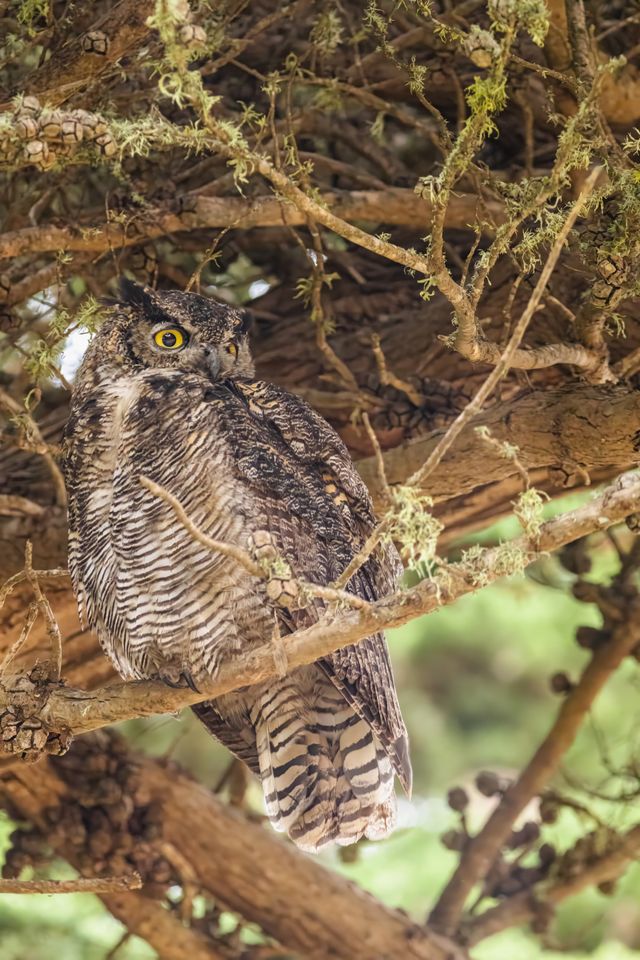
The Great Horned Owl is Florida’s largest and most powerful resident owl, equipped with prominent ear tufts, a rusty facial disk, and a deep, far-carrying hoot. Length runs from 46 to 63 cm (18 to 25 in), with a wingspan of roughly 1.0 to 1.5 m. Despite its size it is silent in flight, thanks to soft-edged feathers that muffle sound.
This is an aggressive and adaptable predator that takes prey as varied as rabbits, rodents, birds, snakes, and even skunks. It nests very early in the year, often taking over an old hawk or eagle nest rather than building its own. Great Horned Owls live throughout Florida in woodlands, hammocks, and wooded suburbs, and the male’s series of low hoots is a familiar sound on winter nights.
Barred Owl (Strix varia)

The Barred Owl is the characteristic owl of Florida’s swamps and wet woodlands, named for the barred and streaked pattern of its plumage. It has dark eyes, a rounded head with no ear tufts, and a rich, rhythmic hooting often rendered as who cooks for you, who cooks for you all. Length runs from 43 to 50 cm (17 to 20 in), with a wingspan near 1.0 m.
Slightly smaller and far less aggressive than the Great Horned Owl, the Barred Owl will call and even hunt during the day, especially in deep shade. It favors cypress swamps, river floodplains, and mature hardwood hammocks, where it hunts small mammals, amphibians, reptiles, and large insects. In suitable habitat it is one of the most frequently heard owls in the state.
Burrowing Owl (Athene cunicularia)

The Burrowing Owl is a small, long-legged, ground-dwelling owl of open country and a beloved Florida specialty. Unlike other owls it nests underground, in a burrow it digs itself or adopts, and it is often active in daylight, standing sentry at the burrow entrance and bobbing when alarmed. Length runs from 19 to 25 cm (7.5 to 9.8 in). The resident Florida subspecies is listed as state threatened.
Burrowing Owls favor short, open ground such as dry prairie, pastures, golf courses, airfields, and vacant urban lots. South Florida communities, most famously Cape Coral, host large urban populations that have become local conservation icons, with marked and protected burrows in residential neighborhoods. The owls hunt insects, small reptiles, amphibians, and rodents, often near their burrows.
The Vultures
Black Vulture (Coragyps atratus)
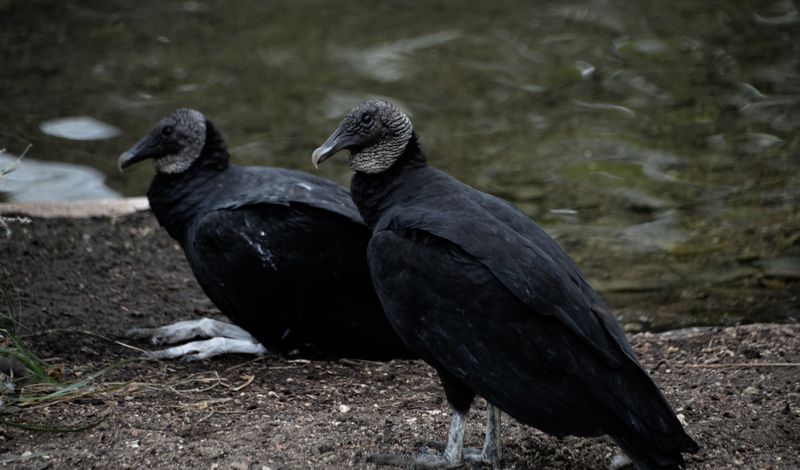
The Black Vulture is an abundant scavenger across Florida, usually seen in flocks soaring on broad wings or gathered at carrion. It is all black with a bare gray head and shows pale patches near the wingtips in flight. In flight it flaps more often than the Turkey Vulture, with quick beats followed by short glides. Length runs from 56 to 74 cm (22 to 29 in).
Black Vultures are social and assertive at food, often driving the larger-winged Turkey Vulture off a carcass. They rely heavily on sight, and frequently follow Turkey Vultures to locate food. Highly adaptable, they are common around landfills, highways, and rural areas throughout the state.
Turkey Vulture (Cathartes aura)
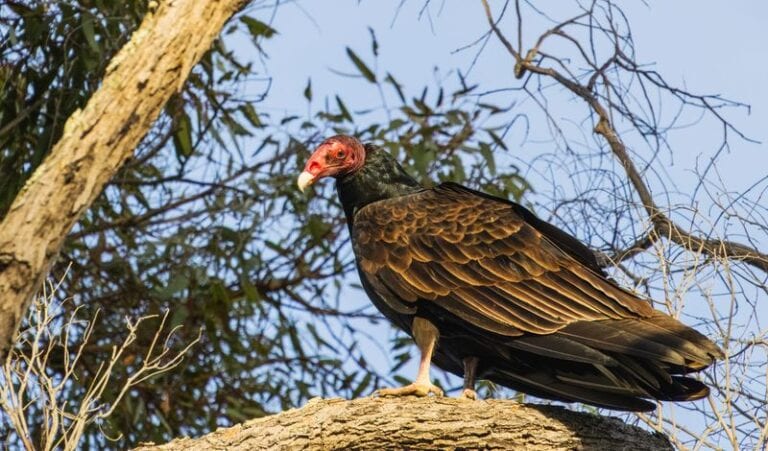
The Turkey Vulture is the more numerous of Florida’s two vultures and a constant presence overhead, rocking and teetering on long wings held in a shallow V. Adults have a bare red head; in flight the two-toned underwing, dark in front and silvery behind, is distinctive. Length runs from 64 to 81 cm (25 to 32 in), with a wingspan of roughly 1.6 to 1.8 m.
Unusually among birds, the Turkey Vulture has a well-developed sense of smell and can locate carrion by odor, even when it is hidden beneath the forest canopy. Resident Florida birds are joined by large numbers of wintering vultures from the north. Both vulture species perform an essential cleanup role, removing carcasses and limiting the spread of disease.
Telling the Look-Alikes Apart
A few Florida raptor pairs cause repeated confusion. The table below summarizes the most useful field marks.
| Confused pair | Key differences |
|---|---|
| Cooper’s Hawk vs Sharp-shinned Hawk | Cooper’s is larger, often crow-sized, with a rounded, white-tipped tail and a relatively large head that projects beyond the wings in flight. The Sharp-shinned is smaller, with a squared tail and a small head; it can look almost neckless. Size overlaps because female Sharp-shinneds approach male Cooper’s, so judge shape and proportion, not size alone. |
| Black Vulture vs Turkey Vulture | The Turkey Vulture has a red head, long wings held in a shallow V, a rocking flight, and a two-toned underwing. The Black Vulture has a gray head, shorter wings held flat, frequent flapping, and pale patches only near the wingtips. |
| Red-shouldered Hawk vs Red-tailed Hawk | The Red-shouldered is slimmer, with reddish barred underparts, checkered wings, and a strongly banded tail. The Red-tailed is bulkier, with a pale chest, a dark belly band, and a brick-red upper tail in adults. Voice differs sharply: the Red-shouldered gives a repeated whistle, the Red-tailed a harsh, descending scream. |
What to See When
Raptor watching in Florida changes with the seasons. The table below offers a general guide.
| Season | What to look for |
|---|---|
| Winter (December to February) | Peak diversity. Resident hawks, eagles, and owls are joined by wintering Northern Harriers, Sharp-shinned Hawks, Merlins, and additional Red-tailed Hawks and Ospreys. Bald Eagles are on nests. |
| Spring (March to May) | Swallow-tailed Kites return and become conspicuous over wooded wetlands. Mississippi Kites arrive in the north. Wintering raptors depart. Eagles fledge young. |
| Summer (June to August) | The warm-season specialists dominate: Swallow-tailed and Mississippi Kites, Short-tailed Hawks, resident Red-shouldered Hawks, and nesting Ospreys. Overall diversity is lowest. |
| Fall (September to November) | Migration. Broad-winged Hawks, Peregrine Falcons, American Kestrels, and other migrants move down the peninsula and out along the Keys. Swallow-tailed Kites depart early in this window. |
Notable Places to See Florida’s Raptors
Florida offers excellent raptor watching across its regions. A handful of sites stand out.
The Audubon Center for Birds of Prey in Maitland, just north of Orlando on the shore of Lake Sybelia, is a raptor rehabilitation and education facility that has operated since 1979. Its Raptor Trauma Clinic treats more than 700 sick, injured, or orphaned raptors each year, and the center keeps non-releasable ambassador birds, including Bald Eagles, a Snail Kite, and a Short-tailed Hawk, that visitors can view up close.
Kissimmee Prairie Preserve State Park, on the headwaters of the Everglades north of Lake Okeechobee, protects one of the largest remaining tracts of Florida dry prairie and is among the best places to look for Crested Caracaras and Burrowing Owls. The broader Lake Okeechobee and Kissimmee chain of lakes region is also the stronghold of the Snail Kite.
Everglades National Park and the surrounding marshes hold Snail Kites, Short-tailed Hawks, Northern Harriers, and abundant vultures. Cape Coral, in southwest Florida, is famous for its urban Burrowing Owls. Along the coasts, Ospreys and Bald Eagles are easy to find around lakes, rivers, and estuaries statewide.
In autumn, the Florida Keys funnel migrating raptors toward the tropics, and the Florida Keys Hawkwatch at Curry Hammock State Park records more migrating Peregrine Falcons than anywhere else on Earth, including a world-record single-day count of 1,506 birds on October 10, 2015.
How to Support Raptors at Home
You do not attract birds of prey with a feeder the way you would songbirds, but you can make your property and community more welcoming to them and safer for the raptors already present.
The single most important step is to avoid second-generation rodenticides. Rat and mouse poisons move up the food chain, and raptors that eat poisoned rodents can sicken and die from secondary poisoning. Snap traps and habitat management are safer alternatives that protect the very predators that control rodents for free.
Nest structures help several species. Properly built and placed boxes support American Kestrels, Eastern Screech-Owls, and American Barn Owls, and waterside platforms attract nesting Ospreys. Native plantings that support insects, reptiles, amphibians, and small mammals build the prey base that raptors depend on. Keeping cats indoors reduces competition and prey loss, and it protects the cats as well.
Florida law gives raptors strong protection. Bald Eagles are safeguarded under the Bald and Golden Eagle Protection Act, and it is illegal to feed them or to disturb an active nest. If you find an injured raptor, contact the Florida Fish and Wildlife Conservation Commission or a licensed wildlife rehabilitator rather than attempting to handle the bird yourself.
Conservation: A Snapshot of Florida’s Raptors
Florida’s birds of prey include both celebrated recoveries and species under continuing pressure. The Bald Eagle is the clearest success. After the pesticide DDT pushed populations to historic lows in the mid-twentieth century, protection and DDT’s ban allowed a strong rebound; the eagle was removed from the federal endangered species list in 2007 and from Florida’s imperiled list in 2008, and the state now supports an estimated 1,500 nesting pairs while the bird remains protected under federal law.
The Everglade Snail Kite tells a more complicated and current story. Tied almost entirely to apple snails and to wetland water levels, the Florida population crashed from roughly 3,000 birds around the turn of the century to fewer than 800 by the late 2000s during severe droughts. An invasive South American apple snail, larger and hardier than the native species, then provided an unexpected new food source, and the kite population rebounded to roughly 3,000 adults by 2023 as the birds adapted to handle the bigger prey. That recovery has since proven fragile. Abnormally dry springs in 2024 and 2025 produced very poor nesting, with only about 30 successful nests reported statewide in 2025 and no successful nests in the historic Everglades and Lake Okeechobee strongholds, and Audubon Florida reported the population estimate falling to around 2,000 birds in 2025, with a lower figure expected for 2026. The kite’s fate remains closely linked to Everglades restoration and the timing of water deliveries across the system.
Several of Florida’s grassland and prairie raptors are stressed by the loss of native dry prairie to agriculture and development. The Crested Caracara is federally threatened in its Florida range, and both the Florida Burrowing Owl and the resident Southeastern American Kestrel are listed by the state as threatened. Beyond habitat loss, raptors across the state face vehicle strikes, electrocution, rodenticide poisoning, and nest disturbance, the same threats that fill the caseload at rehabilitation centers such as the Audubon Center for Birds of Prey.
Frequently Asked Questions
What is the most common bird of prey in Florida?
The Red-shouldered Hawk is among the most common and conspicuous true raptors across most of Florida, especially in wet woodlands and suburbs, where it is often heard before it is seen. If vultures are included, the Black Vulture and Turkey Vulture are even more numerous, and Ospreys are very common near water.
What is the largest bird of prey in Florida?
The Bald Eagle is Florida’s largest bird of prey, reaching a wingspan of about 1.8 to 2.3 m (5.9 to 7.5 ft). The Golden Eagle is comparable in size but is only a very rare visitor to the state.
What is the rarest or most specialized raptor in Florida?
The Everglade Snail Kite is Florida’s most famous rarity. It is federally endangered, represents the only population of its species in the United States, and feeds almost exclusively on apple snails. The Short-tailed Hawk is another scarce Florida specialty whose United States breeding range is centered in the state.
When do Swallow-tailed Kites arrive in Florida?
Swallow-tailed Kites return to Florida to breed in February and March after wintering in South America, and most depart again by late summer. They are therefore a warm-season bird, most conspicuous over wooded wetlands and river swamps from spring into mid-summer.
Are vultures considered birds of prey in Florida?
Vultures are traditionally grouped with birds of prey and are included in most raptor guides, but New World vultures are not classified among the true diurnal raptors and are now placed in their own order. Florida has two resident species, the Black Vulture and the Turkey Vulture, both important scavengers.
What is the smallest falcon in Florida?
The American Kestrel is the smallest falcon in Florida and in North America, roughly the size of a Mourning Dove at 22 to 31 cm (8.7 to 12.2 in) long. Florida has both a resident race, the state-threatened Southeastern American Kestrel, and wintering migrants from the north.
Conclusion
From the soaring Bald Eagle and the plunging Osprey to the snail-eating Everglade Snail Kite and the prairie-dwelling Crested Caracara, Florida’s birds of prey reflect the state’s unusual blend of subtropical climate, abundant wetlands, and migratory geography. The peninsula offers resident hawks and owls year-round, a winter influx of northern migrants, and a small group of tropical specialists found almost nowhere else in the country.
That richness is also a responsibility. Conservation stories such as the Bald Eagle’s recovery and the Snail Kite’s uncertain fortunes show how closely these predators track the health of Florida’s habitats and the choices people make about water, land, and chemicals. Whether you are watching a Red-shouldered Hawk from your own yard or scanning the Keys for migrating Peregrines, Florida rewards anyone who takes the time to look up.
To go deeper on individual groups, see the companion guides to the owls of Florida, the hawks of Florida, and Florida’s backyard and water birds.
Works Cited
- Florida Fish and Wildlife Conservation Commission. “Bald Eagle.” https://myfwc.com/wildlifehabitats/wildlife/bald-eagle/
- Florida Fish and Wildlife Conservation Commission. “Bald Eagle Management.” https://myfwc.com/wildlifehabitats/wildlife/bald-eagle/management/
- Florida Fish and Wildlife Conservation Commission. “Everglade Snail Kite.” https://myfwc.com/wildlifehabitats/profiles/birds/raptors-and-vultures/everglade-snail-kite/
- Florida Fish and Wildlife Conservation Commission. “Imperiled Species Management Plan.” https://myfwc.com/wildlifehabitats/wildlife/plan/
- Florida Fish and Wildlife Conservation Commission. “Habitats.” https://myfwc.com/conservation/value/fwcg/habitats/
- U.S. Fish and Wildlife Service. “Everglade Snail Kite (Rostrhamus sociabilis plumbeus).” https://www.fws.gov/species/everglade-snail-kite-rostrhamus-sociabilis-plumbeus
- U.S. Fish and Wildlife Service Environmental Conservation Online System. “Everglade snail kite.” https://ecos.fws.gov/ecp/species/7713
- Audubon Florida. “Snail Kite Population Showing Strain in Dry Years.” https://www.audubon.org/florida/news/snail-kite-population-showing-strain-dry-years
- National Audubon Society, Center for Birds of Prey. “Meet Our Ambassador Birds / Florida’s Raptors.” https://www.audubon.org/cbop/explore/birds
- National Audubon Society. “About the Audubon Center for Birds of Prey.” https://www.audubon.org/cbop/about-us
- Audubon Florida. “Raptor Trauma Clinic at Center for Birds of Prey.” https://www.audubon.org/florida/projects/raptor-trauma-clinic-center-birds-of-prey
- Florida Birding Trail. “Audubon Center for Birds of Prey.” https://floridabirdingtrail.com/site/audubon-center-for-birds-of-prey/
- American Ornithological Society. “66th Supplement to the Check-list of North American Birds.” https://americanornithology.org/66th-supplement-to-checklist-of-north-american-birds-publishes/
- Cornell Lab of Ornithology, Clements Checklist. “Updates and Corrections, August 2017.” https://www.birds.cornell.edu/clementschecklist/august-2017/updates-corrections-august-2017/
- Cornell Lab of Ornithology, Birds of the World. “Cooper’s Hawk (Astur cooperii).” https://birdsoftheworld.org/bow/species/coohaw/cur/introduction
- Cornell Lab of Ornithology, Birds of the World. “Crested Caracara (Caracara plancus), Systematics.” https://birdsoftheworld.org/bow/species/y00678/cur/systematics
- Cornell Lab of Ornithology, All About Birds. “Short-tailed Hawk, Overview.” https://www.allaboutbirds.org/guide/Short-tailed_Hawk/overview
- eBird, Cornell Lab of Ornithology. “2024 Taxonomy Update” (Barn Owl three-way split). https://ebird.org/news/2024-taxonomy-update
- Florida Birding Trail. “Curry Hammock State Park.” https://floridabirdingtrail.com/site/curry-hammock-state-park/
- Florida Keys Hawkwatch. “1506 Peregrine Falcons in 1 Day Count, New World Record.” https://floridakeyshawkwatch.com/2015/10/11/1506-peregrine-falcons-in-1-day-count-new-world-record/
- Cape Coral Friends of Wildlife. “Burrowing Owl.” https://ccfriendsofwildlife.org/wildlife/burrowing-owl/
- National Audubon Society. “Burrowing Owl, Audubon Field Guide.” https://www.audubon.org/field-guide/bird/burrowing-owl