Shore Birds of Jekyll Island, Georgia: A Field Guide to the Golden Isles Coast
Jekyll Island ranks among the most productive coastal birding sites in Georgia, with more than 300 species recorded across its beaches, tidal flats, marshes, and maritime forest. For shorebird watchers, the southern tip of the island is the headline destination, a place where thousands of plovers, sandpipers, terns, and skimmers gather on a rising tide.
This barrier island sits squarely on the Atlantic Flyway, the great migratory corridor that funnels birds along the eastern seaboard between Arctic breeding grounds and wintering areas as far south as South America. That position, combined with a rare mix of undisturbed sand spits and sheltered salt marsh, is why a half-mile walk to Jekyll Point can put a dozen or more shorebird species in front of you in a single morning.
Key Takeaways
- Jekyll Island has recorded more than 300 bird species, the highest total of any single birding site in Georgia, according to the National Audubon Society.
- The southern end of the island is the prime shorebird location, and the best viewing is in the morning on a rising tide that has not yet peaked.
- The American Oystercatcher (Haematopus palliatus), a large black-and-white shorebird with a bright red-orange bill, is the island’s signature beach-nesting species.
- Wilson’s Plover (Anarhynchus wilsonia) nests on Jekyll’s south end each spring and summer, and the Jekyll Island Authority monitors every nest the birds lay.
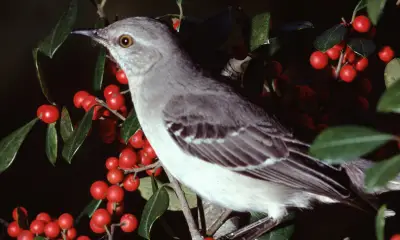
- The state bird of Georgia is the Brown Thrasher (Toxostoma rufum), a woodland songbird found in the island’s interior scrub rather than on the beach.
Shore Birds of Jekyll Island at a Glance
The table below lists the shore and coastal birds profiled in this guide, followed by other notable species you may encounter. Sizes are given as total body length unless noted. Seasonal status reflects typical occurrence on the Georgia coast.
| Species | Scientific name | Size (length) | When present | Where to find | Diet and feeding niche |
|---|---|---|---|---|---|
| American Oystercatcher | Haematopus palliatus | 42 to 50 cm (16.5 to 19.7 in) | Year-round | South end, sandbars, oyster reefs | Clams, oysters, marine mollusks |
| Wilson’s Plover | Anarhynchus wilsonia | 18 to 20 cm (7.1 to 7.9 in) | Spring and summer (breeds) | South-end dunes and upper beach | Fiddler crabs, marine invertebrates |
| Piping Plover | Charadrius melodus | 15 to 18 cm (5.9 to 7.1 in) | Fall through spring | Open beach and tidal flats | Worms, insects, small crustaceans |
| Semipalmated Plover | Charadrius semipalmatus | 17 to 20 cm (6.7 to 7.9 in) | Migration and winter | Mudflats and wet beach | Worms, small invertebrates |
| Black-bellied Plover | Pluvialis squatarola | 25 to 30 cm (10 to 12 in) | Fall through spring | Flats, beach, causeway marsh | Marine worms, mollusks, crustaceans |
| Sanderling | Calidris alba | 18 to 20 cm (7.1 to 7.9 in) | Fall through spring (some summer) | Wave-washed beach | Small crustaceans, marine worms |
| Ruddy Turnstone | Arenaria interpres | 22 to 25 cm (8.7 to 9.8 in) | Fall through spring | Wrack lines, jetties, oyster rakes | Invertebrates under debris and shells |
| Red Knot | Calidris canutus | 23 to 27 cm (9.1 to 10.6 in) | Spring and fall migration | South-end flats, sandbars | Small mollusks, crustaceans, eggs |
| Willet | Tringa semipalmata | 33 to 41 cm (13 to 16 in) | Year-round | Beach, marsh edge, flats | Crabs, mollusks, marine worms |
| Marbled Godwit | Limosa fedoa | 41 to 51 cm (16 to 20 in) | Fall through spring | South-end flats and sandbars | Invertebrates probed from mud |
| Hudsonian Whimbrel | Numenius hudsonicus | 37 to 47 cm (15 to 19 in) | Migration, some winter | Causeway marsh, mudflats | Fiddler crabs, marine invertebrates |
| Black Skimmer | Rynchops niger | 40 to 50 cm (16 to 20 in) | Spring through fall, some winter | South-end roosts, open water | Small fish, skimmed at the surface |
| Royal Tern | Thalasseus maximus | 43 to 53 cm (17 to 21 in) | Year-round, peak warm months | Beaches, sandbars, nearshore water | Small fish caught by plunge-diving |
| Least Tern | Sternula antillarum | 21 to 24 cm (8.3 to 9.4 in) | Spring and summer (breeds) | Open sand near the south end | Small fish and invertebrates |
| Brown Pelican | Pelecanus occidentalis | 100 to 137 cm (39 to 54 in) | Year-round | Nearshore water, sandbars, pilings | Fish caught by plunge-diving |
| Laughing Gull | Leucophaeus atricilla | 36 to 42 cm (14 to 17 in) | Year-round, peak spring to fall (breeds) | Beaches, marsh, south-end roosts | Fish, crustaceans, insects, refuse |
| Ring-billed Gull | Larus delawarensis | 43 to 54 cm (17 to 21 in) | Fall through spring | Beaches, flats, parking areas | Omnivorous; fish, scraps, invertebrates |
| American Herring Gull | Larus smithsonianus | 56 to 66 cm (22 to 26 in) | Fall through spring | Beaches, sandbars, nearshore water | Fish, invertebrates, carrion, refuse |
| Great Black-backed Gull | Larus marinus | 64 to 79 cm (25 to 31 in) | Fall through spring | Beaches, sandbars, open water | Fish, carrion, other birds, refuse |
| Bonaparte’s Gull | Chroicocephalus philadelphia | 28 to 36 cm (11 to 14 in) | Winter | Nearshore water, inlets, bays | Small fish and invertebrates from the surface |
| Wood Stork | Mycteria americana | 85 to 115 cm (33 to 45 in) | Spring through fall | Causeway marsh, ponds, impoundments | Fish caught by touch in shallow water |
| Roseate Spoonbill | Platalea ajaja | 71 to 86 cm (28 to 34 in) | Summer | Causeway marsh, ponds | Small fish and invertebrates, sieved |
| White Ibis | Eudocimus albus | 56 to 71 cm (22 to 28 in) | Year-round | Marsh, lawns, ponds | Crayfish, crabs, insects probed from mud |
| Dunlin | Calidris alpina | 16 to 22 cm (6.3 to 8.7 in) | Fall through spring | Mudflats, wet beach | Invertebrates probed from mud |
| Short-billed Dowitcher | Limnodromus griseus | 25 to 29 cm (9.8 to 11.4 in) | Migration and winter | Mudflats, causeway marsh | Invertebrates probed with sewing-machine motion |
| Semipalmated Sandpiper | Calidris pusilla | 13 to 15 cm (5.1 to 5.9 in) | Migration | Mudflats, wet sand | Small invertebrates |
| Greater Yellowlegs | Tringa melanoleuca | 29 to 33 cm (11.4 to 13 in) | Fall through spring | Marsh pools, flats | Small fish and invertebrates |
| Clapper Rail | Rallus crepitans | 32 to 41 cm (13 to 16 in) | Year-round | Salt marsh | Crabs, snails, marine invertebrates |
| Tricolored Heron | Egretta tricolor | 56 to 76 cm (22 to 30 in) | Year-round | Marsh edge, ponds | Small fish stalked in shallow water |
| Painted Bunting | Passerina ciris | 12 to 14 cm (4.7 to 5.5 in) | Spring and summer (breeds) | Maritime scrub, campground feeders | Seeds and insects |
| Bald Eagle | Haliaeetus leucocephalus | 70 to 102 cm (28 to 40 in) | Year-round | Causeway power poles, shoreline | Fish, waterbirds, carrion |
| Osprey | Pandion haliaetus | 54 to 58 cm (21 to 23 in) | Year-round, peak spring to fall | Marsh, nearshore water | Fish caught in feet-first dives |
Why Jekyll Island Holds Such Diversity
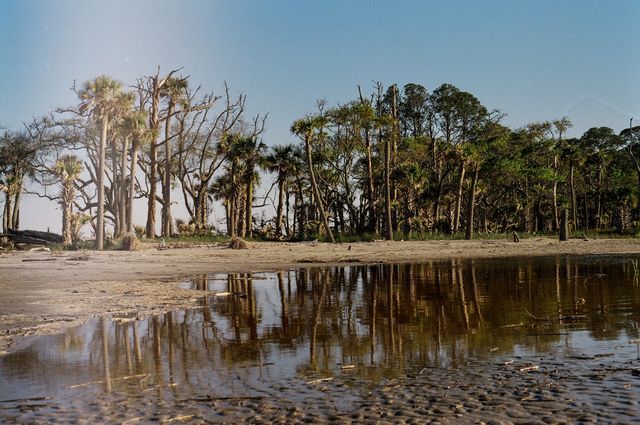
Jekyll Island is a barrier island of roughly seven miles (about eleven kilometers) of length on the southern Georgia coast, part of the chain known as the Golden Isles. Its richness comes from the way several habitats meet within a short distance of one another. Wide ocean beaches and shifting sandbars give shorebirds open ground to feed and rest. Behind them lie dunes, a band of more than a thousand acres (over 400 hectares) of maritime forest, and freshwater ponds. Surrounding the island are the extensive salt marshes of Glynn County, the tidal wetlands that the poet Sidney Lanier celebrated in the nineteenth century.
The island’s location on the Atlantic Flyway is the second key factor. Twice each year, vast numbers of shorebirds pass along the coast between Arctic and subarctic nesting grounds and wintering areas in the southern United States, the Caribbean, and South America. Georgia’s barrier beaches and mudflats serve as critical refueling stops, places where birds rebuild fat reserves for the next leg of journeys that can span thousands of miles. Jekyll is one of eighteen sites on Georgia’s Colonial Coast Birding Trail and is recognized as an Important Bird Area for the concentrations it supports.
Tide governs nearly everything for the shorebird watcher here. At low tide, birds disperse widely across exposed flats and can be distant and scattered. As the water rises, it pushes feeding birds toward the upper beach and concentrates them at high-tide roosts, where large mixed flocks gather. A survey of Jekyll’s beaches conducted through a Georgia Sea Grant fellowship counted more than 18,000 individual shorebirds across 16 species and found that the greatest abundance occurs in the morning on the south end as the tide is rising but not yet high.
The Island’s Signature Shorebird: The American Oystercatcher
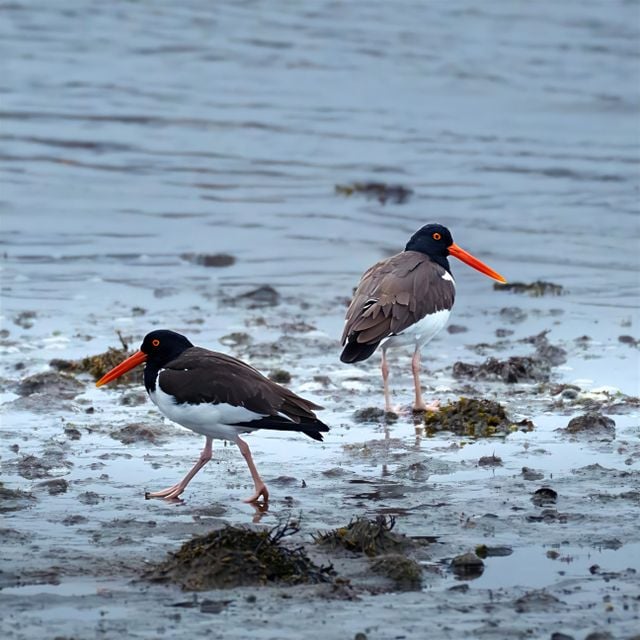
The American Oystercatcher (Haematopus palliatus) is Jekyll Island’s signature shorebird, a large, unmistakable wader with a black head, dark brown back, white underparts, a pale yellow eye ringed in red-orange, and a long, blade-like, red-orange bill. It is a year-round resident of the island’s beaches, sandbars, and oyster reefs, and it nests on the undisturbed south end.
This bird is built around a single specialized task. Its heavy bill is a tool for prying, hammering, and cutting open clams, oysters, and other shellfish, a diet so particular that the species lives only in the narrow ecological zone of barrier beaches and intertidal shellfish beds. In winter the south beach can host a roost of more than a hundred oystercatchers waiting out high water together. Pairs are loud and conspicuous during courtship, pacing the sand side by side and giving piping calls that rise in tempo. The Cornell Lab of Ornithology lists the American Oystercatcher as a Yellow Alert Tipping Point species, meaning it has lost more than half its population over the past fifty years even as recent trends have steadied.
Plovers and Oystercatchers of the Open Beach
These are the birds of the dry and damp sand above the waterline, hunters that run, pause, and pluck rather than probe.
Wilson’s Plover (Anarhynchus wilsonia)
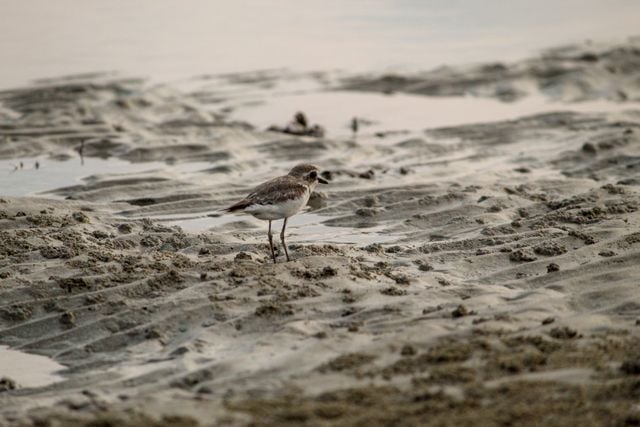
Wilson’s Plover is a medium-small plover, roughly 18 to 20 cm (7.1 to 7.9 in) long, distinguished from its relatives by an unusually large, heavy black bill and pale pinkish legs. The upperparts are sandy brown, the underparts white, with a single dark breast band. This is one of Jekyll’s most important breeding shorebirds. The island’s south end is its primary nesting ground in spring and summer, and nesting areas are typically roped off and posted with signs. The species favors fiddler crabs, which it hunts on open flats and marsh edges. The Cornell Lab of Ornithology lists Wilson’s Plover as a Red Alert Tipping Point species, its highest category of conservation concern, with a U.S. breeding population estimated at roughly 8,600 birds, which makes Jekyll’s nesting colony regionally significant. Watch in early summer for adults shepherding tiny, well-camouflaged chicks across the upper beach.
Piping Plover (Charadrius melodus)

The Piping Plover is a small, pale, sand-colored plover, about 15 to 18 cm (5.9 to 7.1 in) long, with orange legs and, in nonbreeding plumage, a stubby dark bill and faint partial breast band. Its coloring matches dry sand so closely that the bird can vanish against the beach until it moves. Piping Plovers do not breed in Georgia, but they winter and migrate along its coast, and Jekyll’s flats are reliable wintering habitat from fall into spring. The species is federally protected, listed as threatened in its Atlantic Coast and Great Plains populations and endangered in the Great Lakes population. Quiet observation from a distance is essential, as wintering birds need undisturbed time to feed and rest.
Black-bellied Plover (Pluvialis squatarola)
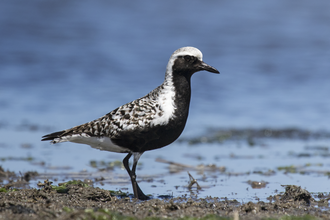
The Black-bellied Plover is the largest plover on the island, about 25 to 30 cm (10 to 12 in) long, with a stout build, large dark eye, and short stout bill. In the breeding plumage occasionally seen in spring, it shows the striking jet-black face and belly that give it its name. In the gray nonbreeding plumage of fall and winter, look instead for the diagnostic black patches under the wings, the so-called black wingpits, visible in flight. It feeds on the open flats and along the causeway marsh, taking marine worms, small mollusks, and crustaceans, often standing motionless before darting forward.
Semipalmated Plover (Charadrius semipalmatus)
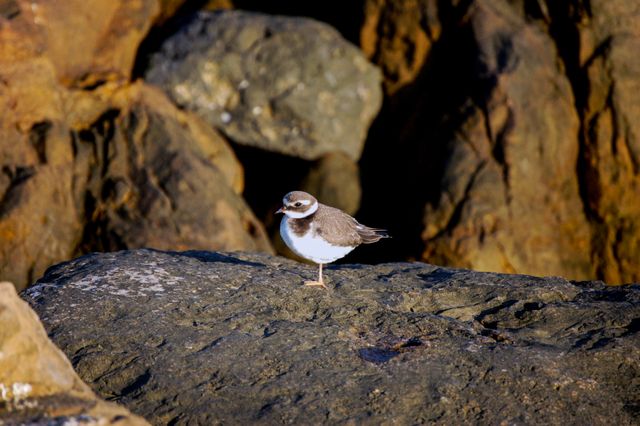
The Semipalmated Plover is a small, neat plover, 17 to 20 cm (6.7 to 7.9 in) long, resembling a miniature, browner version of the unrelated Killdeer with a single dark breast band rather than two. It has a short bill, orange at the base, and orange legs. The name refers to the partial webbing between its toes. A common migrant and winter visitor on Jekyll’s mudflats and wet beach, it forages by the classic plover method of run, stop, and peck, taking small worms and invertebrates from the surface.
Sandpipers and Probers of the Tideline
These birds work the wet sand and mud, many of them probing for food they cannot see.
Sanderling (Calidris alba)
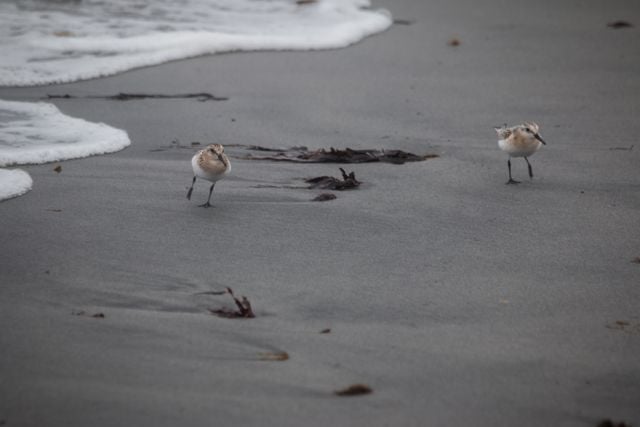
The Sanderling is the small, pale sandpiper that most beach visitors notice first, about 18 to 20 cm (7.1 to 7.9 in) long, famous for chasing the retreating edge of each wave on blurring black legs and then fleeing the next. In nonbreeding plumage it is the palest of the small sandpipers, nearly white below with a clean gray back. It lacks a hind toe, an adaptation for its fast running. Sanderlings are present on Jekyll’s beaches for much of the year, most numerous from fall through spring, snatching small crustaceans and marine worms exposed by the surf.
Ruddy Turnstone (Arenaria interpres)
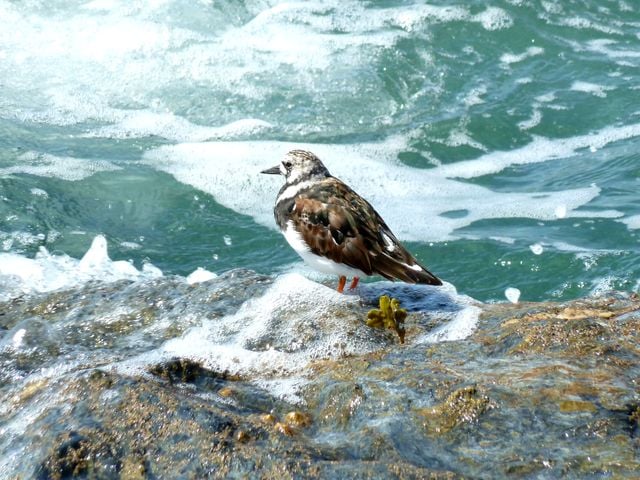
The Ruddy Turnstone is a stocky, short-legged shorebird, 22 to 25 cm (8.7 to 9.8 in) long, named for its habit of flipping over shells, seaweed, and debris to reach the invertebrates beneath. Even in the muted nonbreeding plumage of winter it shows a patterned dark bib, orange legs, and, in flight, a bold black-and-white pattern across the back and wings. It favors structured surfaces such as wrack lines, jetties, and oyster rakes rather than open sand. Its bright harlequin breeding plumage appears on birds passing through in spring.
Red Knot (Calidris canutus)
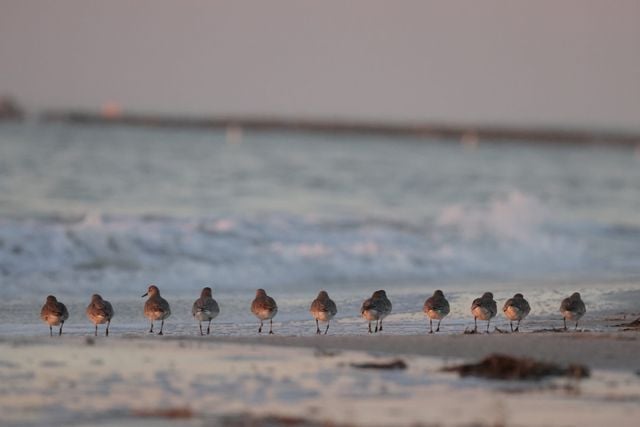
The Red Knot is a medium-sized, dumpy sandpiper, 23 to 27 cm (9.1 to 10.6 in) long, gray and nondescript in winter but flushed with brick-red underparts in the breeding plumage of birds moving through in spring. It is best known for one of the longest migrations of any bird, between the Arctic and the southern tip of South America. The rufa subspecies that uses the Atlantic Coast is federally listed as threatened, having declined sharply as a key food source, horseshoe crab eggs, was depleted at staging areas farther north. Jekyll’s south-end flats and sandbars host Red Knots chiefly during spring and fall migration, when undisturbed roosting and feeding habitat is most valuable to them.
Willet (Tringa semipalmata)
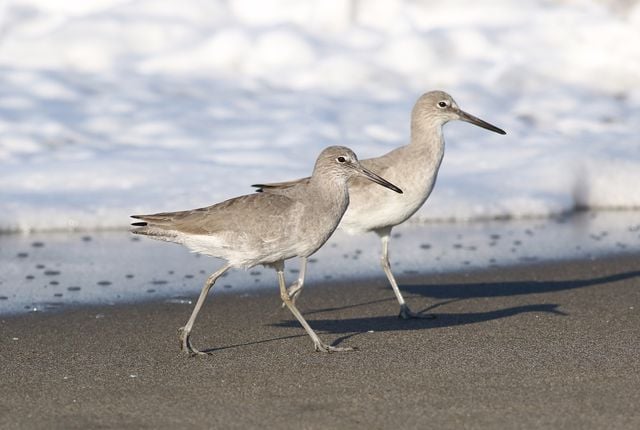
The Willet is a large, plain gray shorebird, 33 to 41 cm (13 to 16 in) long, easily overlooked at rest until it flies and flashes a startling black-and-white pattern across the wings. The eastern form breeds in the salt marshes of the Georgia coast, so Willets are present on Jekyll year-round, nesting in the marsh and feeding along the beach, marsh edge, and flats. Its loud, ringing calls, often rendered as pill-will-willet, carry across the marsh in the breeding season. It takes crabs, mollusks, and marine worms, probing and picking across a range of surfaces.
Marbled Godwit (Limosa fedoa)
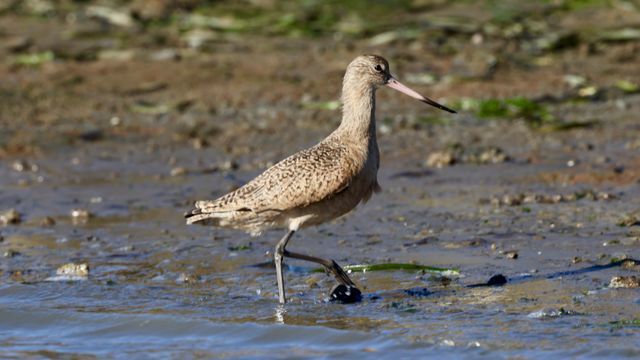
The Marbled Godwit is a large, cinnamon-toned shorebird, 41 to 51 cm (16 to 20 in) long, with a very long, slightly upturned bill that is pink at the base and dark at the tip. It probes deep into sand and mud for buried invertebrates, reaching prey that shorter-billed birds cannot. A regular visitor to Jekyll’s south-end flats and sandbars from fall through spring, it is often seen resting in tight groups at high tide alongside other large shorebirds. It is listed among the island’s local specialties.
Hudsonian Whimbrel (Numenius hudsonicus)
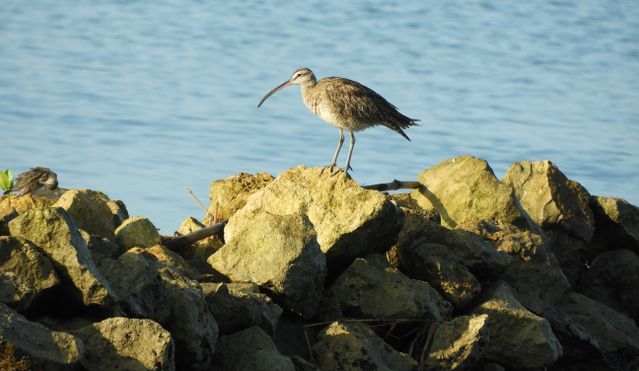
The Hudsonian Whimbrel is a large brown shorebird, 37 to 47 cm (15 to 19 in) long, with a long, smoothly downcurved bill and a boldly striped crown. Until recently it was treated as part of a single species called the Whimbrel, but the 2025 eBird and Clements taxonomy split the Whimbrel into the Hudsonian Whimbrel of the Americas and the Eurasian Whimbrel of the Old World. On Jekyll it is most often seen on the causeway marsh and adjacent mudflats during migration, with some birds lingering through winter. It uses its curved bill to extract fiddler crabs and other invertebrates from burrows in the mud. Before the split, the Whimbrel was assessed by the 2025 State of the Birds report as a Tipping Point species, having lost more than half of its population over the past fifty years.
Terns, Skimmers, and Seabirds
These long-winged birds feed over water, many of them gathering on the same south-end sandbars where the shorebirds roost.
Black Skimmer (Rynchops niger)
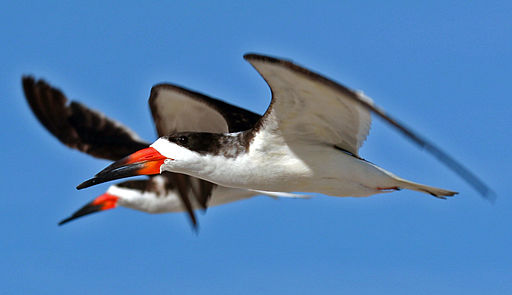
The Black Skimmer is one of the most distinctive birds on the coast, 40 to 50 cm (16 to 20 in) long, black above and white below, with a striking red-and-black bill in which the lower mandible is noticeably longer than the upper. It feeds by flying low and fast with that long lower bill slicing the water’s surface, snapping the bill shut the instant it touches a fish. Skimmers loaf in dense, tightly packed flocks on the south-end sand, all facing into the wind, and they nest in colonies on Georgia beaches and sandbars. They are most numerous from spring through fall, with some present in milder winters.
Royal Tern (Thalasseus maximus)

The Royal Tern is a large, elegant tern, 43 to 53 cm (17 to 21 in) long, pale gray above and white below, with a heavy orange bill and a shaggy black crest that recedes to a ragged black patch behind the eye for much of the year. It is a familiar presence on Jekyll’s beaches and sandbars throughout the year, plunge-diving for small fish in the surf and nearshore water. Royal Terns nest in dense colonies on Georgia’s offshore bars and dredge islands, and they often rest among Black Skimmers and other terns at the south-end roost.
Least Tern (Sternula antillarum)

The Least Tern is the smallest tern in North America, just 21 to 24 cm (8.3 to 9.4 in) long, pale gray and white with a black cap, a white forehead, and a yellow bill tipped in black. It hovers and plunges for small fish with quick, buoyant wingbeats. Least Terns nest on open sand and have used Jekyll and nearby beaches as breeding sites in spring and summer. The species is vulnerable to disturbance, and chicks, which cannot regulate their own temperature when young, depend on shaded undisturbed nests, so posted nesting areas should be given a wide berth.
Brown Pelican (Pelecanus occidentalis)
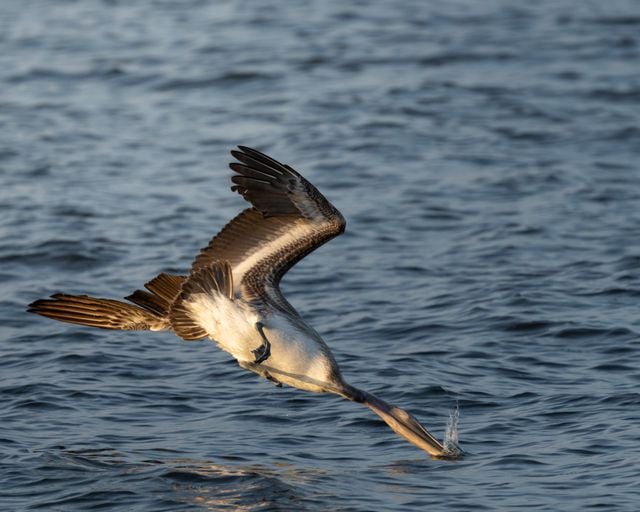
The Brown Pelican is the unmistakable heavyweight of the Georgia coast, 100 to 137 cm (39 to 54 in) long with a wingspan of roughly two meters (about 6.5 ft). It is regularly seen gliding in single file low over the waves or plunge-diving headfirst for fish, a feeding method unique among North American pelicans. Once severely depleted by the pesticide DDT, the Brown Pelican recovered strongly after that chemical was banned and was removed from the federal endangered species list in 2009. Today it is a common year-round sight along Jekyll’s shoreline, on sandbars, and on pilings and dock posts.
Gulls of the Beach and Tideline
Gulls are a defining part of Jekyll’s coastal scene and one of its most rewarding. The south end in particular repays careful scanning, because the common species gather in numbers that occasionally hide a rarity. Learning the handful of regular gulls first makes the odd visitor far easier to pick out.
Laughing Gull (Leucophaeus atricilla)
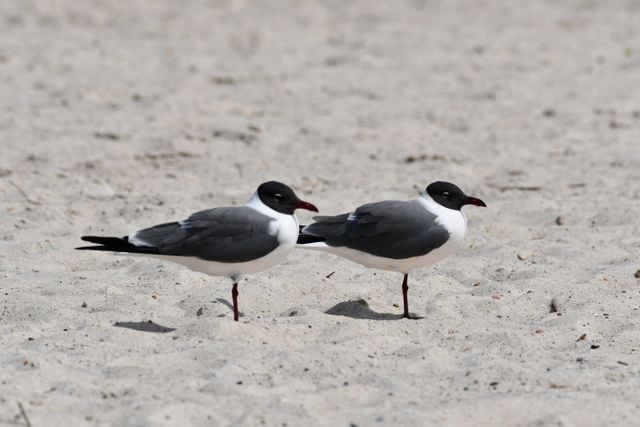
The Laughing Gull is the most abundant gull on the Georgia coast through the warmer months, a medium-sized gull about 36 to 42 cm (14 to 17 in) long. The breeding adult is unmistakable, with a full black hood, a dark gray back, a deep red bill, and dark reddish legs. In winter the hood is lost, leaving a white head with gray smudging behind the eye and a dark bill. Its rolling, laughing call gives the species its name and is a constant sound of the summer beach. Laughing Gulls breed in colonies on regional beaches and dredge islands, and they feed on small fish, crustaceans, insects, and horseshoe crab eggs. They are bold opportunists, at times landing on a Brown Pelican’s head to snatch fish from its bill pouch.
Ring-billed Gull (Larus delawarensis)
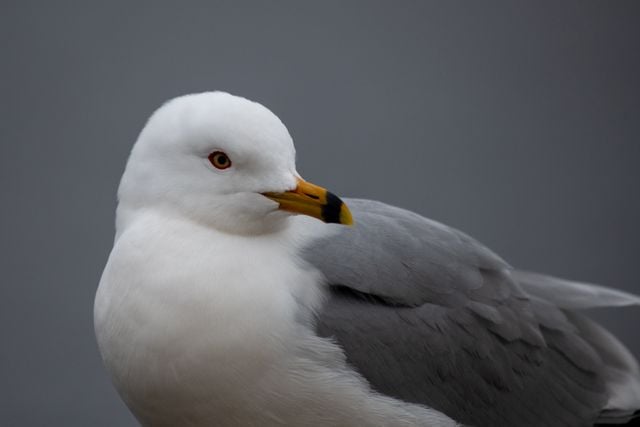
The Ring-billed Gull is the common gull of the cooler months, a medium-sized bird of 43 to 54 cm (17 to 21 in) with a clean gray back, white head and underparts, yellow legs, a pale eye, and a yellow bill marked with a neat black ring. It reaches full adult plumage in its third winter, so brown-mottled younger birds are frequent. One of the most familiar gulls in North America, it is a tireless opportunist, equally at home on the beach, in parking lots, and around picnic areas. On Jekyll it is most numerous from fall through spring, often mixing with Laughing Gulls along the shore and on the flats.
American Herring Gull (Larus smithsonianus)
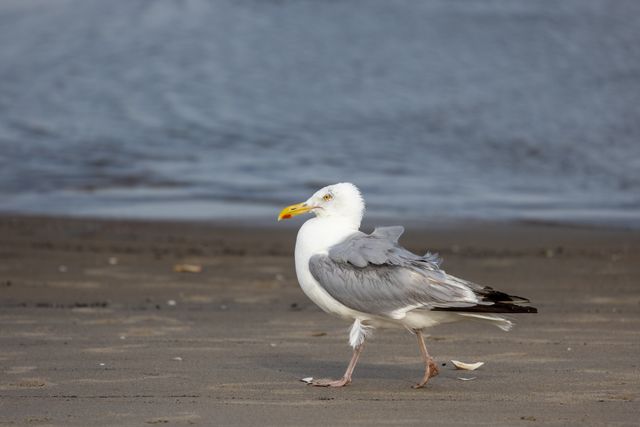
The American Herring Gull is the default large gull of winter, a heavy, beefy bird 56 to 66 cm (22 to 26 in) long with a wingspan of about 120 to 150 cm (47 to 59 in). The adult has a pale gray back, pink legs, a pale eye, and a thick yellow bill with a red spot, taking four years to reach that plumage through a confusing series of brown immature stages. Its taxonomy is in flux: the eBird and Clements checklist split the Herring Gull complex in 2024 and now treats the North American bird as a full species, the American Herring Gull (Larus smithsonianus), while the American Ornithological Society has not yet adopted the split and continues to treat it as a subspecies of the Herring Gull (Larus argentatus). On Jekyll, look for it along the beach and on sandbars from fall through spring.
Great Black-backed Gull (Larus marinus)
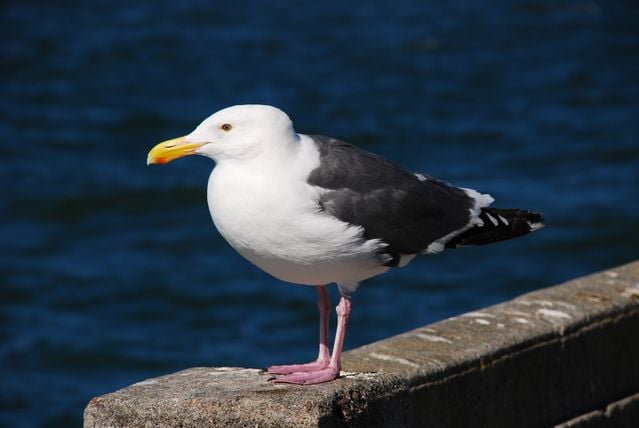
The Great Black-backed Gull is the largest gull in the world, a commanding bird 64 to 79 cm (25 to 31 in) long with a wingspan that can approach 1.7 m (about 5.5 ft). The adult has a jet-black back and wings, a white head and underparts, pink legs, and a massive yellow bill with a red spot. It sits at the top of the gull world, an aggressive scavenger and predator that takes fish, carrion, refuse, and the eggs and young of other birds. Its breeding range has expanded steadily southward along the Atlantic Coast over the past century. On the Georgia coast it is less numerous than farther north but is a regular winter presence among the larger gull flocks.
Bonaparte’s Gull (Chroicocephalus philadelphia)
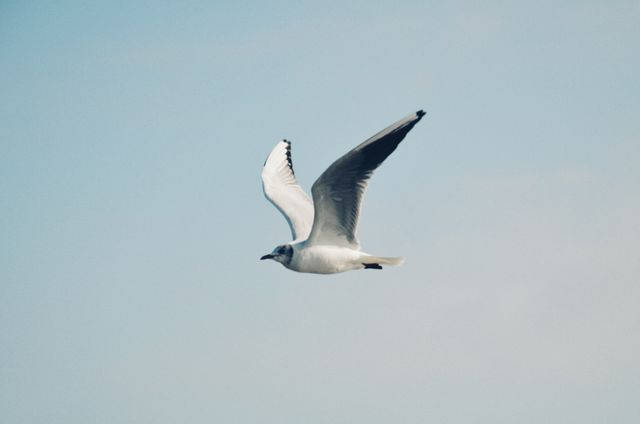
Bonaparte’s Gull is a small, delicate, almost tern-like gull, just 28 to 36 cm (11 to 14 in) long, with a thin black bill and buoyant flight. In the breeding plumage seen on a few spring birds it shows a slaty-black hood, while winter birds have a white head marked only by a dark spot behind the eye. In flight it flashes a clean white wedge along the outer wing, a useful mark at a distance. It is a winter visitor to Jekyll’s nearshore waters, inlets, and bays, where it picks small fish and invertebrates daintily from the surface. Uniquely among North American gulls, it nests in trees in the northern boreal forest.
Beyond these regulars, Jekyll’s gull flocks reward patience. The Lesser Black-backed Gull (Larus fuscus), once a genuine rarity on this coast, now appears in small numbers most winters, and true vagrants such as the Glaucous Gull (Larus hyperboreus) have turned up at the south end. Sorting through a resting flock for an out-of-place bird is one of the quiet pleasures of winter birding here. For a fuller treatment of gull identification across the Southeast, see the companion guide to the gull family noted at the end of this article.
Wading Birds of the Marsh and Flats
The salt marsh and freshwater ponds add a second cast of long-legged birds to the island’s coastal lineup.
Wood Stork (Mycteria americana)
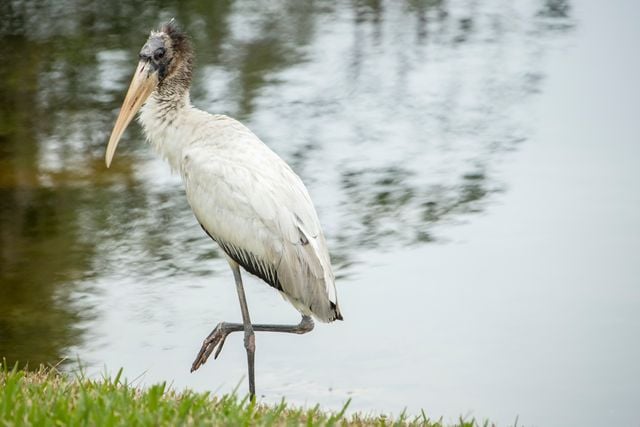
The Wood Stork is a very large wading bird, 85 to 115 cm (33 to 45 in) tall with a wingspan of around 150 to 165 cm (about 5 to 5.5 ft), white-bodied with black flight feathers and a bare, dark, scaly head and neck. It is the only stork that breeds in the United States. Wood Storks feed by touch, sweeping a partly open bill through shallow water and snapping it shut the moment it contacts a fish. On Jekyll they are seen over the causeway marsh, ponds, and impoundments, mainly from spring through fall. In a major recovery milestone, the U.S. Fish and Wildlife Service removed the Southeast U.S. population of the Wood Stork from the federal list of threatened and endangered wildlife, effective March 12, 2026, after the breeding population rebounded to an estimated 10,000 to 14,000 nesting pairs.
The remaining wading birds of the marsh, including the Roseate Spoonbill, White Ibis, Tricolored Heron, and various egrets and herons, are summarized in the table above. For a closer look at the long-legged birds of the Georgia coast, see the heron and egret guide noted at the end of this article.
Look-Alikes: Telling Confusing Pairs Apart
Several of Jekyll’s shorebirds are easily confused. The table below highlights the most reliable field marks for the pairs that trip up observers most often.
| Pair | Quickest way to tell them apart |
|---|---|
| Wilson’s Plover vs. Semipalmated Plover | Wilson’s has a large, heavy all-black bill and pinkish legs; Semipalmated has a small orange-based bill and orange legs and is smaller overall. |
| Piping Plover vs. Sanderling | Piping is a plover that runs, stops, and pecks on dry sand with orange legs and a stubby bill; Sanderling is a sandpiper with black legs that chases waves and has a longer, straighter bill. |
| Marbled Godwit vs. Hudsonian Whimbrel | The godwit’s long bill turns slightly upward and is pink at the base; the whimbrel’s bill curves downward and the bird shows a boldly striped crown. |
| Ring-billed Gull vs. American Herring Gull | The Ring-billed is distinctly smaller, with yellow legs and a neat black ring on a slim yellow bill; the American Herring is much bulkier, with pink legs and a red spot on a heavy bill. |
What to See and When
Jekyll offers worthwhile birding in every season, but the cast of birds changes through the year. The table below outlines the broad seasonal pattern for the coastal species covered here.
| Season | Shorebird and coastal highlights |
|---|---|
| Spring (March to May) | Northbound migration peaks; Red Knots and other migrants refuel on the south-end flats; Wilson’s Plovers and Least Terns return to nest; Roseate Spoonbills begin to appear. |
| Summer (June to August) | Breeding season for Wilson’s Plover, Least Tern, Black Skimmer, and Willet; nesting areas posted on the south end; Wood Storks and spoonbills work the marsh; quieter for migrant shorebirds. |
| Fall (September to November) | Southbound migration brings large mixed shorebird flocks; raptor migration peaks in October, when Peregrine Falcons occasionally hunt the south end on easterly winds. |
| Winter (December to February) | Large wintering flocks of Sanderlings, plovers, and Dunlin; American Oystercatcher roosts of a hundred or more; large gull flocks worth scanning for rarities; sea ducks, loons, and Northern Gannet offshore; Saltmarsh and Nelson’s Sparrows in the causeway marsh. |
Notable Birding Locations on Jekyll Island
Jekyll concentrates its best birding into a handful of well-defined spots, most of them reachable on foot or by bike.
The south end of the island is the premier shorebird site and the place where the largest mixed flocks gather. Access is on foot from the St. Andrews Picnic Area and Beach or from the Glory Beach boardwalk at the Jekyll Island Soccer Complex, with the walk to Jekyll Point running a little more than half a mile (roughly one kilometer) from either trailhead. The St. Andrews route is not passable at higher tides, so it is wise to consult a tide chart and to plan a visit for a rising tide in the morning. Posted Wilson’s Plover and seabird nesting areas in spring and summer should be given a wide berth. In winter, the resting flocks here are also the best place on the island to scan large gulls for an unusual visitor.
The Jekyll Island Causeway and the area around the Jekyll Island Welcome Center provide the island’s best salt-marsh birding without leaving your car for long. A two-story wildlife observation platform behind the Welcome Center overlooks the marsh, and at the right tide it can hold Whimbrels, Black-bellied Plovers, American Avocets, and concentrations of shorebirds. The causeway marsh is also among the most accessible places in Georgia to find Saltmarsh and Nelson’s Sparrows in winter, and Wood Storks, Ospreys, and summer Roseate Spoonbills are regular here.
Driftwood Beach, on the island’s north end, is known for its weathered, photogenic skeleton trees and for terns, plovers, Sanderlings, and Painted Buntings in the adjacent scrub. Amphitheater Pond, near the middle of the island, is a dependable spot for wading birds, and Horton Pond holds freshwater species and other wildlife. The campground feeders are a reliable place to find Painted Buntings, Indigo Buntings, and other songbirds in the warmer months.
How to Watch Responsibly and Protect Beach-Nesting Birds
Shorebirds and seabirds spend their lives on a narrow strip of sand that they share with people, and human disturbance is one of the most serious threats they face. Eggs and chicks are camouflaged and easy to overlook or step on, and birds flushed repeatedly from nests or roosts burn energy they cannot spare. The Georgia Department of Natural Resources asks beachgoers to follow a few straightforward practices.
Avoid posted nesting sites and give resting flocks a wide berth rather than walking through them. Where dogs are permitted, keep them leashed, and note that pets are excluded by law from key nesting areas including Jekyll’s south end. Walk below the high-tide line where practical, and remove trash, which attracts predators such as raccoons and crows that prey on eggs and chicks. Observing from a distance with binoculars or a spotting scope lets you watch natural behavior without forcing birds to flee.
For visitors who keep feeders at the campground or who garden on the island, native plantings, a clean water source, and seed feeders stocked with black-oil sunflower and white millet will draw Painted Buntings and other resident and migrant songbirds. Keeping feeders clean and well maintained reduces the spread of disease, and the same wide-berth principle applies to any beach walk during the spring and summer nesting season.
Conservation on the Georgia Coast
Jekyll Island is not only a place to watch shorebirds but an active site for protecting them. The Jekyll Island Authority maintains a long-running shorebird monitoring program, tracking nearly every Wilson’s Plover nest laid on the island each season and following how many chicks hatch and fledge. The work is difficult: of roughly several dozen nests and an estimated hundred eggs in a given year, only a fraction of chicks typically survive predators, high spring tides, and disturbance to fledging.
Several species on this list carry conservation concern. The American Oystercatcher is a Tipping Point species that has lost more than half its population over fifty years. The rufa Red Knot and the Atlantic Coast Piping Plover are federally protected as threatened, and both depend on the kind of undisturbed staging and wintering habitat that Jekyll’s south end provides. As migratory birds, all of Georgia’s shorebirds and seabirds are protected under the federal Migratory Bird Treaty Act.
Recent work has strengthened protection along this coast. In early 2026, Birds Georgia received grants from the Georgia Ornithological Society to restore and manage about 15 acres (roughly 6 hectares) of imperiled coastal dune and maritime grassland habitat on Jekyll Island, and to help implement Georgia’s updated Bird Island Rule, which expands seasonal closures and dog restrictions at critical offshore nesting sites in partnership with the Georgia Department of Natural Resources. The Wood Stork’s removal from the federal endangered species list, effective March 12, 2026, after decades of wetland conservation lifted its breeding population to an estimated 10,000 to 14,000 pairs, stands as one of the region’s clearest conservation success stories, even as the species will continue to be tracked under a ten-year post-delisting monitoring plan.
Frequently Asked Questions
What is the most common shorebird on Jekyll Island?
The Sanderling is among the most frequently encountered shorebirds on Jekyll’s open beaches, recognized by its habit of chasing the edge of each wave on the wet sand. American Oystercatchers and Willets are also reliable year-round, and large mixed flocks of plovers and sandpipers gather on the south end, especially on a rising tide.
What is the state bird of Georgia?
The state bird of Georgia is the Brown Thrasher (Toxostoma rufum), a long-tailed, reddish-brown songbird known for its rich, varied song. It is a bird of thickets and woodland edges rather than the beach, so on Jekyll you are more likely to find it in the maritime scrub and gardens than along the shoreline.
When is the best time to see shorebirds on Jekyll Island?
The best shorebird viewing is in the morning on the south end as the tide is rising but has not yet reached its peak, which concentrates feeding birds toward the upper beach. Migration in spring and fall brings the greatest variety, while winter delivers the largest flocks of wintering Sanderlings, plovers, and oystercatchers.
When do Painted Buntings arrive on Jekyll Island?
Painted Buntings typically arrive on the Georgia coast in April and remain through summer to breed, making spring and early summer the prime time to find them. Look and listen for them in the island’s maritime scrub, around Driftwood Beach, and at the campground feeders.
What is the largest bird seen on Jekyll Island?
Among the large coastal birds, the Brown Pelican and the Wood Stork are the most imposing, the pelican with a wingspan of roughly two meters (about 6.5 ft) and the Wood Stork standing up to about 115 cm (45 in) tall. Bald Eagles, regularly seen perched on the causeway power poles, are another of the island’s largest birds.
Do I need a permit or fee to go birding on Jekyll Island?
Jekyll Island charges a daily parking fee per vehicle, with an annual pass available, and there is no separate birding permit. The causeway pull-offs and Welcome Center platform are free to use, and the south-end beaches are reached on foot from public parking areas.
Conclusion
Jekyll Island earns its reputation as one of Georgia’s finest birding destinations through a rare combination of geography and care. Its position on the Atlantic Flyway draws migrants by the thousand, its mix of beach, sandbar, marsh, and forest supports an unusually broad cast of species, and its undisturbed south end gives shorebirds the space they need to nest, rest, and refuel. A morning spent walking to Jekyll Point on a rising tide, scope in hand, can reveal oystercatchers, plovers, godwits, skimmers, and terns within a short stretch of sand.
The same island that offers this spectacle is also working to sustain it, through nest monitoring, habitat restoration, and protected nesting areas. Watching from a respectful distance is the simplest way every visitor can contribute. To go deeper, explore the companion guides to the herons and egrets of the Georgia coast, the gulls and terns of the Southeast, and the songbirds of the maritime forest, each of which carries the story of these birds beyond the shoreline.
Works Cited
National Audubon Society. “Birding in Georgia.” https://www.audubon.org/magazine/birding-georgia
Georgia Department of Natural Resources, Wildlife Resources Division. “Give Beach-Nesting Birds Space: How and Why.” https://georgiawildlife.com/give-beach-nesting-birds-space-how-and-why
Georgia Birding and Wildlife Trails. “Jekyll Island: South End Beach.” https://georgiabirdingtrails.com/jekyll-island-south-end-beach
Georgia Birding and Wildlife Trails. “Jekyll Island: Causeway.” https://georgiabirdingtrails.com/jekyll-island-causeway
Jekyll Island Foundation. “Shorebirds.” https://jekyllislandfoundation.org/about/for-the-record/shorebirds/
Jekyll Island Authority. “Bird Watchers.” https://www.jekyllisland.com/magazine/bird-watchers/
Jekyll Island Club Resort. “Nature and Ecology.” https://www.jekyllclub.com/resort-activities/nature-and-ecology/
eBird. “Jekyll Island–South Beach, Glynn, Georgia, United States.” https://ebird.org/hotspot/L589195
Cornell Lab of Ornithology, All About Birds. “American Oystercatcher Life History.” https://www.allaboutbirds.org/guide/American_Oystercatcher/lifehistory
Cornell Lab of Ornithology, All About Birds. “Wilson’s Plover Life History.” https://www.allaboutbirds.org/guide/Wilsons_Plover/lifehistory
Cornell Lab of Ornithology, All About Birds. “Hudsonian Whimbrel Overview.” https://www.allaboutbirds.org/guide/Hudsonian_Whimbrel/overview
American Ornithological Society. “Sixty-fifth Supplement to the American Ornithological Society’s Check-list of North American Birds.” https://academic.oup.com/auk/article/141/3/ukae019/7716004
eBird. “2024 eBird Taxonomy Update” (Herring Gull complex split). https://science.ebird.org/en/use-ebird-data/the-ebird-taxonomy/2024-ebird-taxonomy-update
National Audubon Society. “Audubon Field Guide” (species measurements). https://www.audubon.org/bird-guide
U.S. Fish and Wildlife Service. “Wood Stork Delisted.” https://www.fws.gov/press-release/2026-02/wood-stork-delisted
Federal Register. “Removal of the Southeast U.S. Distinct Population Segment of the Wood Stork From the List of Endangered and Threatened Wildlife.” https://www.federalregister.gov/documents/2026/02/10/2026-02588/endangered-and-threatened-wildlife-and-plants-removal-of-the-southeast-us-distinct-population
Savannah Business Journal. “Birds Georgia Receives Two GOS Grants for Coastal Bird Conservation.” https://www.savannahbusinessjournal.com/news/agribusiness/feb-23—birds-georgia-receives-two-gos-grants-for-coastal-bird-conservation/article_4fbfc60c-89f9-4f1d-8dd2-fecc96737a3b.html
American Birding Guides. “Birding Georgia.” https://americanbirdingguides.com/state/georgia/