Birds in Michigan: A Complete Guide to Identification, Hotspots, and Conservation
Michigan is home to 466 recorded bird species as of 2025, according to the Michigan Bird Records Committee, a diversity built on the state’s two peninsulas, four bordering Great Lakes, and habitats ranging from boreal spruce bog to jack pine barren to open wetland. Few inland states offer this range of birding experience within a single day’s drive.
That diversity owes itself to geography. Michigan sits at the convergence of two migratory flyways, the Mississippi and the Atlantic, and its shoreline funnels migrating waterfowl, raptors, and songbirds along predictable routes each spring and fall. Backyard feeder watchers and destination birders alike have reason to pay attention here, whether the goal is a first glimpse of a Black-capped Chickadee at a suburban feeder or a pilgrimage to see the rare, jack pine dependent Kirtland’s Warbler on its native breeding ground.
Key Takeaways
- Michigan supports 466 recorded bird species as of 2025, per the Michigan Bird Records Committee.
- The American Robin (Turdus migratorius) has been Michigan’s official state bird since 1931.
- Michigan lies within both the Mississippi and Atlantic flyways, making it a major migration corridor.
- Ruby-throated Hummingbirds typically arrive in Michigan between late April and mid-May.
- Nearly all of the world’s Kirtland’s Warblers nest in young jack pine forest in Michigan’s northern Lower Peninsula.
Birds of Michigan at a Glance
| Species | Scientific name | Size | When present | Where to find | Best feeder food |
|---|---|---|---|---|---|
| American Robin | Turdus migratorius | 23 to 28 cm (9 to 11 in) | Year-round | Lawns, parks, statewide | Mealworms, chopped fruit |
| Blue Jay | Cyanocitta cristata | 23 to 30 cm (9 to 12 in) | Year-round | Woodlands, suburbs | Peanuts, sunflower seed |
| Black-capped Chickadee | Poecile atricapillus | 12 to 15 cm (5 to 6 in) | Year-round | Mixed and deciduous woods, feeders | Sunflower seed, suet |
| Tufted Titmouse | Baeolophus bicolor | Small, chickadee relative | Year-round | Lower Peninsula woodlands | Sunflower seed, suet |
| Mourning Dove | Zenaida macroura | 31 cm (12 in) | Year-round, some migrate | Open country, roadsides | Millet, cracked corn |
| Downy Woodpecker | Dryobates pubescens | 14 to 18 cm (5.5 to 7.1 in) | Year-round | Woodlands, suburbs | Suet |
| Hairy Woodpecker | Dryobates villosus | 18 to 26 cm (7.1 to 10.2 in) | Year-round | Mature forest | Suet |
| Red-bellied Woodpecker | Melanerpes carolinus | 24 cm (9.4 in) | Year-round | Eastern woodlands, suburbs | Suet, peanuts |
| Pileated Woodpecker | Dryocopus pileatus | 40 to 49 cm (16 to 19 in) | Year-round | Mature forest with dead trees | Suet |
| Northern Cardinal | Cardinalis cardinalis | 21 to 23 cm (8 to 9 in) | Year-round | Thickets, suburban yards | Sunflower seed |
| Dark-eyed Junco | Junco hyemalis | 13 to 17 cm (5 to 6.5 in) | Winter | Statewide, ground beneath feeders | Millet, cracked corn |
| Pine Siskin | Spinus pinus | Small finch | Irruptive winter visitor | Conifers, thistle feeders | Nyjer seed |
| Snow Bunting | Plectrophenax nivalis | Small, sparrow sized | Winter | Open fields, Great Lakes shorelines | Millet, scattered on ground |
| European Starling | Sturnus vulgaris | Medium, glossy black | Year-round, non-native | Farmland, urban areas | Suet |
| Brown-headed Cowbird | Molothrus ater | Medium blackbird | Spring through fall | Open country, woodland edge | Mixed seed |
| American Crow | Corvus brachyrhynchos | 40 to 53 cm (16 to 21 in) | Year-round | Statewide | Not feeder dependent |
| Ruby-throated Hummingbird | Archilochus colubris | 7 to 9 cm (2.8 to 3.5 in) | Late April to fall | Gardens, woodland edge | Sugar water, 4 parts water to 1 part sugar |
| Red-tailed Hawk | Buteo jamaicensis | 45 to 65 cm (18 to 26 in) | Year-round | Open country, roadsides | N/A |
| Bald Eagle | Haliaeetus leucocephalus | 70 to 102 cm (28 to 40 in) | Year-round | Near large lakes and rivers | N/A |
| Great Blue Heron | Ardea herodias | 97 to 137 cm (38 to 54 in) | Spring through fall, some winter | Wetlands, shorelines statewide | N/A |
| Great Egret | Ardea alba | Large, white wading bird | Spring through fall | Southern Michigan wetlands | N/A |
| Sandhill Crane | Antigone canadensis | 100 to 120 cm (39 to 47 in) | Spring through fall | Wetlands, open fields | N/A |
| Piping Plover | Charadrius melodus | 18 cm (7 in) | Spring through summer | Great Lakes sand beaches | N/A |
| Least Sandpiper | Calidris minutilla | Small shorebird | Migration | Mudflats, shorelines | N/A |
| Lesser Yellowlegs | Tringa flavipes | Medium shorebird | Migration | Wetland margins | N/A |
| Common Tern | Sterna hirundo | Medium, slender | Spring through fall | Great Lakes colonies | N/A |
| American Black Duck | Anas rubripes | Medium dabbling duck | Year-round, more in winter | Marshes, rivers | N/A |
| Northern Pintail | Anas acuta | Medium dabbling duck | Migration | Open wetlands | N/A |
| Long-tailed Duck | Clangula hyemalis | Small diving duck | Winter | Great Lakes open water | N/A |
| Trumpeter Swan | Cygnus buccinator | 140 to 170 cm (4.6 to 5.6 ft) | Year-round, reintroduced | Lakes and marshes | N/A |
| Spruce Grouse | Canachites canadensis | 40 to 45 cm (15.7 to 17.7 in) | Year-round | Upper Peninsula boreal forest | N/A |
| Kirtland’s Warbler | Setophaga kirtlandii | 13 to 15 cm (5 to 6 in) | May through July | Northern Lower Peninsula jack pine | N/A |
| Golden-winged Warbler | Vermivora chrysoptera | Small warbler | May through August | Shrubby regenerating habitat | N/A |
| Blue-winged Warbler | Vermivora cyanoptera | Small warbler | May through August | Shrubby field edges | N/A |
| Common Yellowthroat | Geothlypis trichas | Small warbler | Spring through fall | Marsh edges, brush | N/A |
| Hooded Warbler | Setophaga citrina | Small warbler | Spring through summer | Southern Michigan forest understory | N/A |
| Connecticut Warbler | Oporornis agilis | Small warbler | Migration, rare breeder | Boreal bog | N/A |
| Least Flycatcher | Empidonax minimus | Small flycatcher | Spring through fall | Open woodland | N/A |
| Black-billed Cuckoo | Coccyzus erythropthalmus | Medium, slender | Spring through fall | Woodland edge | N/A |
| Eastern Whip-poor-will | Antrostomus vociferus | Medium nightjar | Spring through fall | Open woodland | N/A |
Geography and the Flyways That Shape Michigan Birding
Michigan’s bird diversity traces directly to its shape. The state is split into the Upper Peninsula and Lower Peninsula, bordered by four of the five Great Lakes, Superior, Michigan, Huron, and Erie, giving it more freshwater coastline than any inland state in the country.
That coastline does double duty as habitat and highway. According to The Nature Conservancy, Michigan sits within both the Mississippi Flyway and the Atlantic Flyway, meaning migratory traffic reaches the state from two directions each spring and fall. The Mississippi Flyway carries the bulk of the state’s migrants, following the Great Lakes basin north from the Gulf of Mexico, while the Atlantic Flyway influence is strongest along the state’s eastern shorelines, including the Lake Erie marshes of the southeast.
Habitat diversity compounds this advantage. The Upper Peninsula holds extensive boreal forest, spruce and tamarack bog, and jack pine barrens, conditions that support northern specialties such as Spruce Grouse and Boreal Chickadee rarely found farther south. The northern Lower Peninsula’s sandy outwash plains, planted and managed in young jack pine, form the core breeding range of the Kirtland’s Warbler. Southern Michigan trades conifers for hardwood forest, farmland, and the state’s most extensive coastal marshes, drawing shorebirds, waterfowl, and wading birds in numbers that rival any site in the Midwest.
Michigan’s State Bird: The American Robin

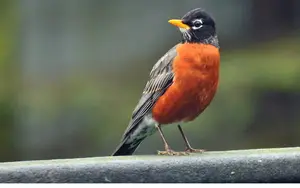
The American Robin (Turdus migratorius) has served as Michigan’s official state bird since 1931, chosen after a statewide public vote organized by the Michigan Audubon Society. It remains one of the most familiar and widely distributed songbirds in the state, present in every county throughout the year.
The robin’s selection followed a 1929 poll in which the Michigan Audubon Society asked residents to name the bird that gave them the greatest joy. Roughly 190,000 votes were cast; the robin won with nearly a quarter of the total, edging out the Black-capped Chickadee for second place. The state legislature formalized the choice in 1931 through a resolution describing the robin as the best known and best loved bird in Michigan.
The decision has never been entirely uncontested. Advocates have periodically proposed replacing the robin with the Black-capped Chickadee, prized for staying through the harsh Michigan winter rather than migrating, or with the Kirtland’s Warbler, a species found almost nowhere else on earth. Neither campaign has succeeded, and the robin, gray backed with a rust orange breast, remains the bird most Michiganders associate with the turn from winter to spring, even though many robins now overwinter in the state when berries remain available.
Adult robins measure 23 to 28 cm (9 to 11 in) in length with a wingspan of 31 to 41 cm (12 to 16 in) and weigh about 77 g (2.7 oz) on average. They feed on earthworms, insects, and invertebrates through the warmer months and shift toward fruit and berries in fall and winter. A well-known behavioral quirk, robins pulling worms from suburban lawns after a rain, remains one of the most recognizable sights in Michigan backyards.
Common Backyard Birds
Blue Jay (Cyanocitta cristata)
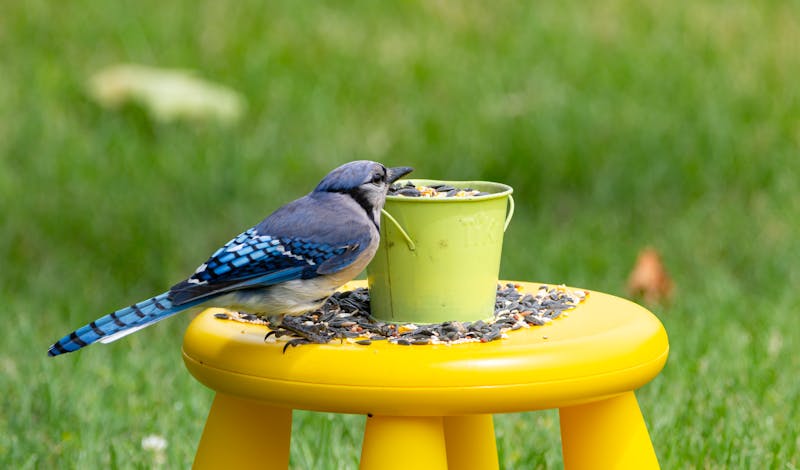
The Blue Jay is large, loud, and unmistakable, with a blue crest, black necklace, and white wing bars set against a blue gray back. Adults measure 23 to 30 cm (9 to 12 in) in length with a wingspan of 33 to 43 cm (13 to 17 in) and weigh 70 to 100 g (2.5 to 3.5 oz). Blue Jays favor oak and beech woodlands but adapt readily to suburban yards, where they visit feeders for peanuts and sunflower seed and cache acorns by the hundreds each fall. Their vocal range includes a convincing imitation of a Red-shouldered Hawk’s call. Most Michigan Blue Jays remain year round, though some migrate south in variable numbers.
Black-capped Chickadee (Poecile atricapillus)

Michigan’s most cheerfully persistent winter presence, the Black-capped Chickadee is small and round headed, with a black cap and bib set against white cheeks and a gray back. It measures 12 to 15 cm (5 to 6 in) in length, spans 15 to 20 cm (6 to 8 in) across the wings, and weighs a mere 9 to 14 g (0.3 to 0.5 oz). Chickadees cache thousands of individual food items each autumn and can remember the locations for weeks, a feat tied to seasonal regrowth in the brain’s memory center. They favor mixed and deciduous woods but are quick to discover backyard suet and sunflower feeders, often traveling in winter flocks alongside nuthatches and kinglets.
Mourning Dove (Zenaida macroura)

Slim bodied and small headed with a long, tapered tail, the Mourning Dove is named for its soft, lamenting call. Adults measure about 31 cm (12 in) in length, span 37 to 45 cm (14.6 to 17.7 in) across the wings, and weigh roughly 128 g (4.5 oz) on average. Mourning Doves feed almost entirely on seeds, foraging on bare ground beneath feeders, and are among the most prolific breeders of any North American bird, raising up to six broods a year in favorable conditions. Most remain in Michigan year round, though some move south in the coldest months.
Red-bellied Woodpecker (Melanerpes carolinus)
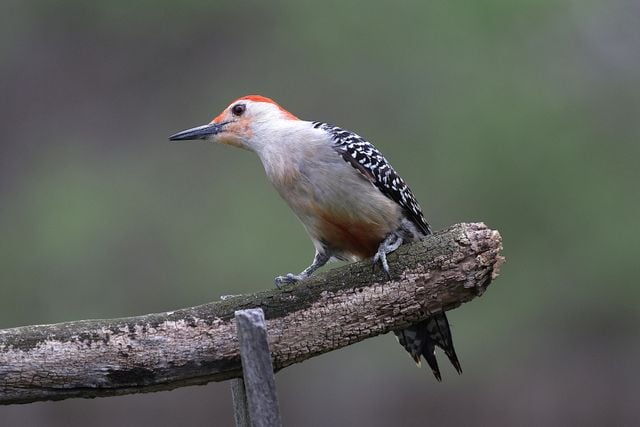
Despite its name, the faint red wash on this woodpecker’s lower belly is rarely visible in the field; the more reliable mark is the solid red cap and nape on males, with females showing red only on the nape. Adults measure 24 cm (9.4 in) in length, span 33 to 42 cm (13 to 16.5 in), and weigh 56 to 91 g (2 to 3.2 oz). Red-bellied Woodpeckers forage on tree trunks and limbs for insects, nuts, and fruit, and readily visit suet feeders. The species has expanded its range northward across Michigan in recent decades and is now a familiar year-round resident in wooded suburbs statewide.
Northern Cardinal (Cardinalis cardinalis)
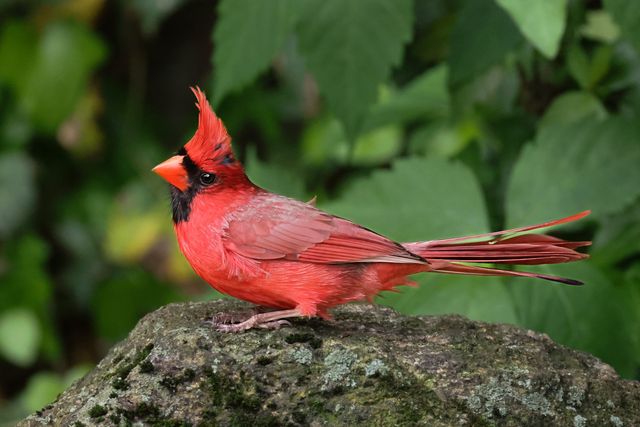
The male Northern Cardinal, entirely red with a black face mask and a prominent crest, is one of the few truly unmistakable birds in Michigan and a favorite of new birders. Adults measure 21 to 23 cm (8 to 9 in) in length, span 25 to 31 cm (9 to 12 in), and weigh 42 to 48 g (1.5 to 1.7 oz). Females share the crest and a heavy pink bill but wear warm buffy brown plumage with red highlights. Cardinals do not migrate, remaining paired on territory through the winter, and their whistled cheer, cheer, cheer is often one of the first bird songs heard at dawn. Feeders stocked with sunflower seed have helped the species expand its range steadily north into Michigan over the past century.
Birds of Prey
Red-tailed Hawk (Buteo jamaicensis)

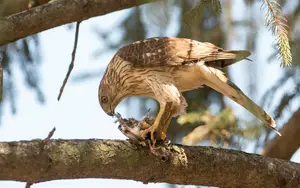
The most frequently seen hawk in Michigan, the Red-tailed Hawk is a bulky, broad-winged buteo often spotted perched on highway light poles or soaring in wide circles over open fields. Adults measure 45 to 65 cm (18 to 26 in) in length, span 110 to 145 cm (43 to 57 in), and weigh 690 to 1,600 g (1.5 to 3.5 lb), with females noticeably larger than males. The reddish brown tail that gives the species its name is the most reliable field mark on adults. Red-tailed Hawks hunt primarily rodents and other small mammals from elevated perches and are equally at home in farmland, roadside corridors, and city parks. One banded in Michigan in 1981 was recovered alive at over 30 years old, among the oldest Red-tailed Hawks ever documented.
Bald Eagle (Haliaeetus leucocephalus)
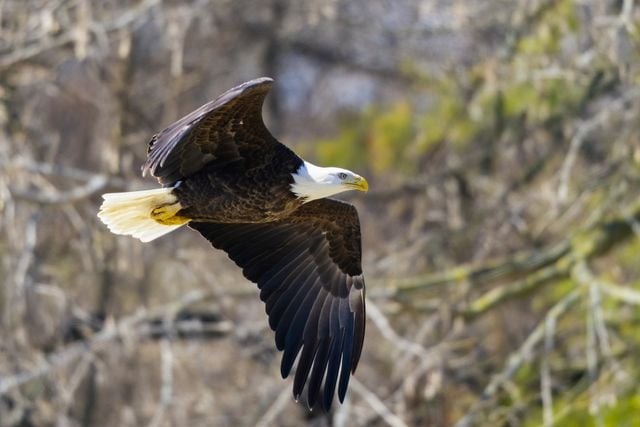
Michigan’s Bald Eagle population tells one of the state’s defining conservation stories, and a still unfolding one. Adults measure 70 to 102 cm (28 to 40 in) in length, span 180 to 230 cm (5.9 to 7.5 ft), and weigh 3 to 6.3 kg (6.6 to 14 lb), with the white head and tail against a dark brown body appearing only after four to five years of age. Bald Eagles nest near large lakes and rivers, building enormous stick nests that are reused and enlarged year after year, and feed primarily on fish supplemented with waterfowl and carrion. State aerial surveys tracked nesting pairs growing from about 52 in 1961 to roughly 835 by 2017 and close to 1,000 by 2022, one of the most complete recoveries of any Michigan bird species, credited largely to the 1972 ban on DDT. Since 2022, however, researchers affiliated with the University of Maryland and the Wings Over Water Research Institute have documented the loss of more than 400 breeding pairs to highly pathogenic avian influenza, and field crews reported an unusually difficult 2026 nesting season, with empty and damaged nests more widespread than in decades of monitoring.
Water and Wetland Birds
Great Blue Heron (Ardea herodias)
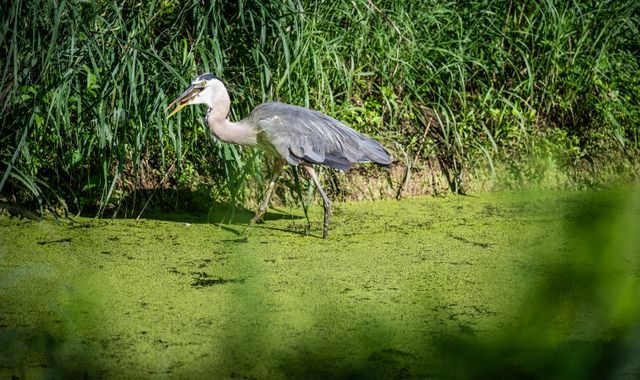
The largest heron in North America, the Great Blue Heron stands motionless in shallow water for long stretches before striking at fish with a rapid thrust of its dagger-like bill. Adults measure 97 to 137 cm (38 to 54 in) in length, span 168 to 201 cm (66 to 79 in), and weigh 2.1 to 2.5 kg (4.6 to 5.5 lb). Despite the name, the plumage reads more gray than blue in most light, set off by a black stripe over the eye. Great Blue Herons nest colonially in trees near water and hunt alone, taking fish, frogs, and even small mammals across marshes, rivers, and lakeshores statewide. Most Michigan birds move south for winter, though individuals may linger wherever open water persists.
Sandhill Crane (Antigone canadensis)
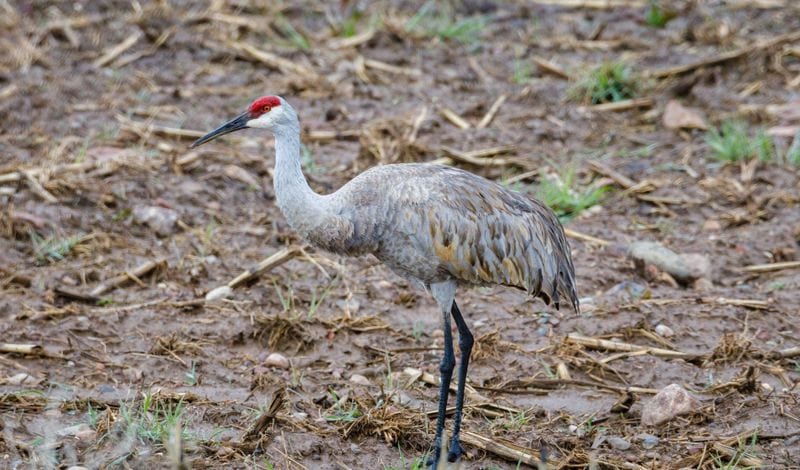
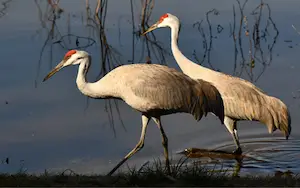
Tall, gray bodied, and crowned with a patch of bare red skin, the Sandhill Crane announces itself with a rolling, bugling call audible from a mile or more away, produced by an unusually long, coiled windpipe. Adults stand 100 to 120 cm (39 to 47 in) tall with a wingspan of 180 to 200 cm (71 to 79 in); males typically weigh around 5.4 kg (12 lb) and females around 4.3 kg (9.5 lb). Once a scarce breeder in Michigan, Sandhill Cranes have rebounded substantially and now nest throughout the state’s wetlands and open fields, forming large staging flocks in late summer and early fall before most migrate to Florida for the winter. Their elaborate courtship dance, involving leaping, bowing, and wing spreading, is among the most striking spectacles in Michigan birding.
Piping Plover (Charadrius melodus)

Small, sand colored, and remarkably well camouflaged against the beaches where it nests, the Piping Plover breeds only on Great Lakes shorelines and nowhere else in the world. Adults measure about 18 cm (7 in) in length, span roughly 38 cm (15 in), and weigh about 65 g (2.3 oz). The Great Lakes population was reduced to as few as 12 nesting pairs by 1990 and remains federally endangered, but sustained recovery work has pushed the population to a record 88 pairs in 2025, with Sleeping Bear Dunes National Lakeshore alone hosting more than a third of the total. Each bird is individually leg banded, allowing researchers to track survival and nest site loyalty across a lifespan that can exceed 15 years.
Woodland and Grassland Specialties
Pileated Woodpecker (Dryocopus pileatus)

The largest woodpecker regularly found in North America, the Pileated Woodpecker is crow sized, mostly black, with a flaming red crest and bold white stripes down the neck. Adults measure 40 to 49 cm (16 to 19 in) in length, span 66 to 75 cm (26 to 30 in), and weigh 250 to 350 g (8.8 to 12.3 oz). Pileated Woodpeckers excavate large, rectangular holes in dead and dying trees in pursuit of carpenter ants, which can make up more than half their diet, and the abandoned cavities later shelter owls, ducks, and other cavity nesting species. Once scarce in Michigan following widespread logging, the species has recovered steadily as mature forest has returned and is now a resident of wooded areas statewide, including large city parks with sufficient tree cover.
Spruce Grouse (Canachites canadensis)

A boreal forest specialist found almost exclusively in the Upper Peninsula, the Spruce Grouse is famous among birders for its calm, almost motionless behavior around observers, earning it the folk name fool hen. Adults measure 40 to 45 cm (15.7 to 17.7 in) in length, span 58 to 63 cm (22.8 to 24.8 in), and weigh 450 to 750 g (15.9 oz to 1.65 lb); males show gray plumage with a black throat, white markings, and a red comb over each eye. Spruce Grouse shift almost entirely to eating conifer needles in winter, a diet few other birds can process. In Michigan, the species is listed as a species of special concern and is most reliably found along quiet back roads near Whitefish Point and the Yellow Dog Plains west of Marquette.
Kirtland’s Warbler (Setophaga kirtlandii)
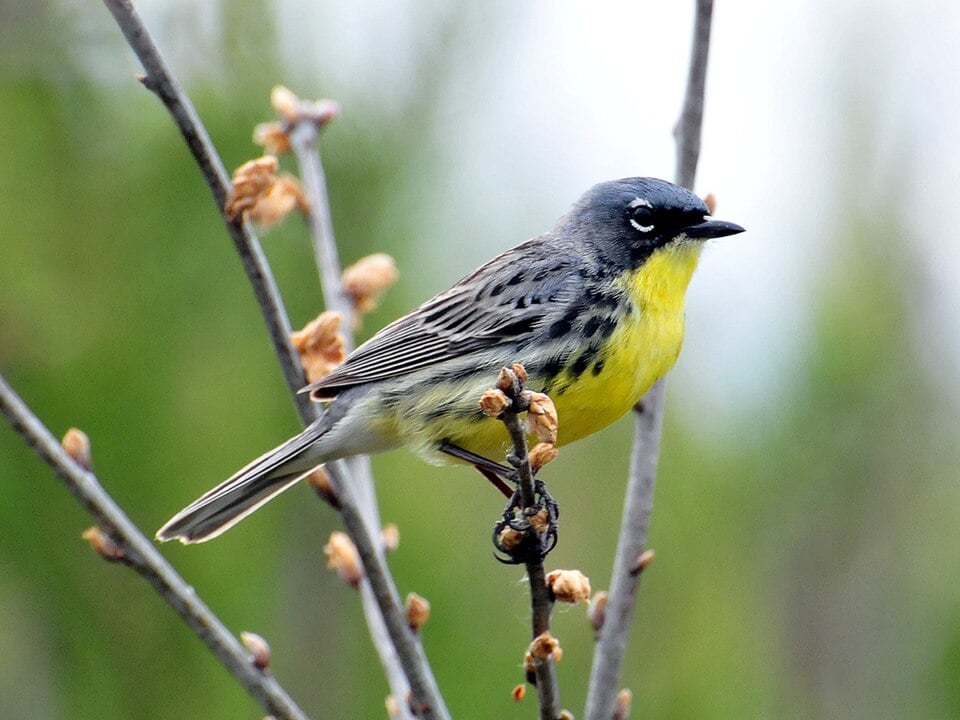
Gray above with a yellow breast and a habit of pumping its tail while perched, the Kirtland’s Warbler nests almost nowhere but Michigan, requiring dense young jack pine stands between roughly six and twenty years old for breeding. Adults measure 13 to 15 cm (5 to 6 in) in length, span 20 to 23 cm (8 to 9 in), and weigh 14 to 17 g (0.5 to 0.6 oz). Nearly the entire global population breeds in a corridor of Michigan’s northern Lower Peninsula between Grayling and Oscoda, with a small number in the eastern Upper Peninsula, Wisconsin, and Ontario. The species winters in the Bahamas. Once reduced to fewer than 200 breeding pairs, the Kirtland’s Warbler was removed from the federal endangered species list in 2019 after decades of jack pine habitat management and Brown-headed Cowbird control, one of the signature success stories of the Endangered Species Act, though its population has since required renewed attention, discussed further below.
Notable Migrants
Ruby-throated Hummingbird (Archilochus colubris)
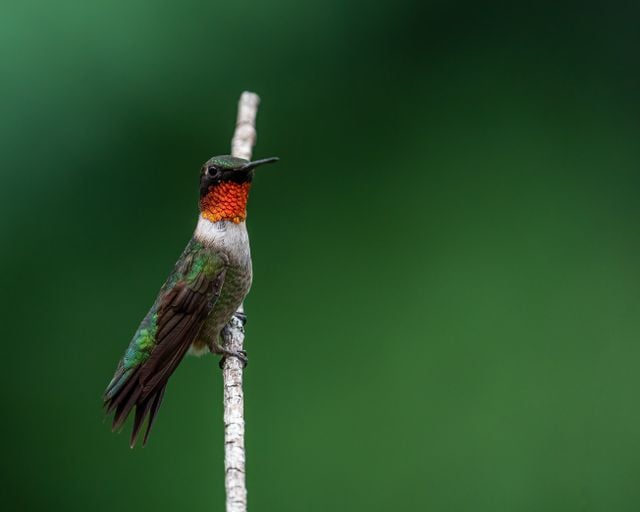
The only hummingbird species that regularly breeds east of the Great Plains, the Ruby-throated Hummingbird is tiny even by hummingbird standards, measuring 7 to 9 cm (2.8 to 3.5 in) in length, spanning 8 to 11 cm (3 to 4.3 in), and weighing just 2 to 6 g (0.1 to 0.2 oz). Males show an iridescent ruby throat patch that can appear nearly black depending on the angle of light, while females lack the patch and are slightly larger. Ruby-throated Hummingbirds winter from Mexico to Central America and typically arrive back in Michigan between late April in the southern counties and mid-May farther north, favoring red tubular flowers and sugar water feeders maintained without red dye.
Dark-eyed Junco (Junco hyemalis)

Known affectionately as the snowbird, the Dark-eyed Junco arrives in Michigan as autumn deepens and departs again each spring, making it one of the state’s most reliable seasonal markers in reverse of the robin. Adults measure 13 to 17 cm (5 to 6.5 in) in length, span 18 to 25 cm (7 to 10 in), and weigh 18 to 30 g (0.6 to 1.1 oz). Michigan’s wintering juncos belong mostly to the slate colored form, uniformly dark gray above with a crisp white belly and flashing white outer tail feathers visible in flight. Juncos forage on the ground beneath feeders, favoring millet and cracked corn, and breed in Canada’s boreal forest and the state’s northernmost conifer stands before retreating south again each fall.
Common Look-Alikes
Several species pairs cause frequent confusion for newer birders in Michigan. The table below highlights the clearest field marks for telling each pair apart.
| Species pair | How to tell them apart |
|---|---|
| Downy Woodpecker vs. Hairy Woodpecker | The Downy is smaller, roughly 14 to 18 cm (5.5 to 7.1 in), with a stubby bill about one third the length of its head and black barring on its white outer tail feathers. The Hairy is noticeably larger, roughly 18 to 26 cm (7.1 to 10.2 in), with a bill nearly as long as its head and plain white outer tail feathers. |
| Golden-winged Warbler vs. Blue-winged Warbler | The Golden-winged Warbler is silvery gray with a black throat and mask and yellow patches on the crown and wing. The Blue-winged Warbler is yellow-olive overall with blue-gray wings and a black eyeline. The two hybridize where their ranges overlap across mid-Michigan, producing distinctive Brewster’s and Lawrence’s warbler forms. |
| Great Blue Heron vs. Sandhill Crane | Both are tall, long-legged, gray birds often mistaken for one another at a distance. Herons fly with the neck folded back into an S-shape and hunt by standing still in shallow water. Cranes fly with the neck extended straight out and are more often seen walking through open fields and wet meadows than wading. |
What to See When: A Seasonal Guide
| Season | What to look for | Where |
|---|---|---|
| Spring (March to May) | Waterfowl push north along the Great Lakes shoreline, Sandhill Cranes return to breeding wetlands, warbler migration peaks in mid-May, and Ruby-throated Hummingbirds arrive | Tawas Point, Pointe Mouillee, Sleeping Bear Dunes |
| Summer (June to August) | Peak nesting season for backyard species, Kirtland’s Warblers singing on territory, Piping Plover chicks fledging on Great Lakes beaches | Northern Lower Peninsula jack pine, Sleeping Bear Dunes |
| Fall (September to November) | Raptor migration peaks, Sandhill Cranes stage in large flocks before departing, Dark-eyed Juncos and other sparrows arrive for winter | Whitefish Point, inland crane staging wetlands |
| Winter (December to February) | Snow Buntings and irruptive winter finches such as Pine Siskins appear, Bald Eagles concentrate near open water, feeder birds are most visible | Statewide, especially near unfrozen rivers and lakes |
Notable Birding Locations
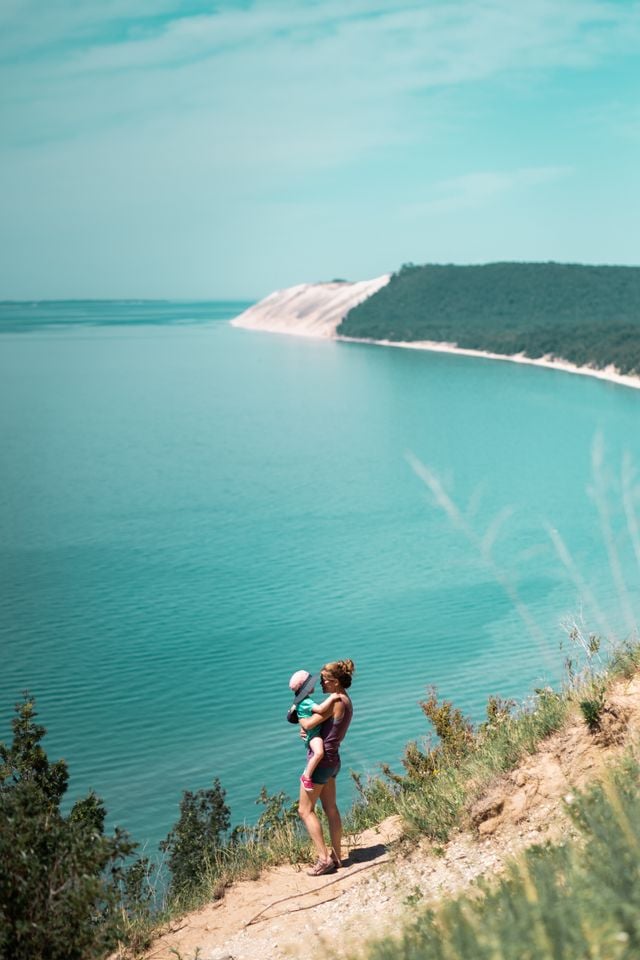
Whitefish Point, on Lake Superior in the eastern Upper Peninsula, is Michigan’s premier migration hotspot. Operated by Michigan Audubon, the Whitefish Point Bird Observatory has recorded more than 340 species and runs daily spring counts of raptors, owls, and waterbirds.
Tawas Point State Park, a narrow sand spit into Lake Huron nicknamed the Cape Cod of the Midwest, concentrates migrating warblers, shorebirds, and raptors each spring and fall, with nearly 300 species recorded in and around the park.
Sleeping Bear Dunes National Lakeshore, on Lake Michigan, is the core breeding stronghold for the federally endangered Great Lakes Piping Plover, with dune, forest, and shoreline habitat in a single park.
Seney National Wildlife Refuge, a 95,238-hectare (235,000-acre) wetland complex in the central Upper Peninsula, hosts breeding Trumpeter Swans, Common Loons, and Sandhill Cranes.
Pointe Mouillee State Game Area, a wetland at the mouth of the Huron River on Lake Erie, ranks among the premier shorebird and waterfowl viewing sites in the Midwest.
The W.K. Kellogg Bird Sanctuary near Battle Creek, operated by Michigan State University since 1927, offers close, accessible viewing of Trumpeter Swans on Wintergreen Lake alongside raptor enclosures and pollinator gardens.
How to Attract Birds to Your Yard
Feeder choice depends on the species being targeted. Black oil sunflower seed draws the widest range of visitors, including chickadees, cardinals, and woodpeckers, while nyjer seed favors finches and siskins, and suet is especially effective for woodpeckers in colder months. Millet and cracked corn scattered on the ground or on a low platform suit ground feeding species such as Mourning Doves and Dark-eyed Juncos. Hummingbird feeders should use a simple sugar water mixture of one part white sugar to four parts water, with no red dye, changed every few days in warm weather.
Water is often the single most effective addition to a Michigan yard. A birdbath or shallow moving water source attracts species that never visit seed feeders at all, and a heated bath can be a lifeline during the coldest months.
Native plantings do double duty as food and shelter. Serviceberry, dogwood, and native oak support both fruit-eating birds and the insects that many species rely on to feed their young, while dense shrubs and evergreens provide cover from predators and winter wind. Leaving standing dead trees where safe to do so benefits cavity nesting species from chickadees to Pileated Woodpeckers.
Feeder hygiene matters for bird health as much as bird numbers. The Michigan Department of Natural Resources recommends cleaning feeders and birdbaths regularly with a diluted bleach solution, avoiding ground scattering of seed near areas frequented by waterfowl, and temporarily removing feeders if sick or dead birds are observed nearby, precautions tied to periodic outbreaks of highly pathogenic avian influenza in the state’s wild bird populations. Unusual bird die-offs can be reported to the DNR’s Eyes in the Field program.
Conservation in Michigan: Two Stories in Progress
Michigan’s most distinctive conservation story belongs to the Kirtland’s Warbler, and it is a story still being written. After being federally listed as endangered in 1967 and reduced to fewer than 200 breeding pairs by the 1970s, decades of jack pine habitat management and Brown-headed Cowbird control drove a remarkable recovery, and the species was removed from the endangered species list in 2019 with a global population above 2,000 pairs. A 2025 census by the Kirtland’s Warbler Conservation Team, however, found the global population had fallen to 1,522 pairs, 1,477 in Michigan, 33 in Ontario, and 12 in Wisconsin, down from 2,245 in 2021, a decline of roughly 32 percent. Michigan still holds about 97 percent of the world’s population. The cause is largely structural: decades of habitat creation left much of the state’s jack pine too old for nesting, since the warbler depends on stands between about six and twenty years of age. The Michigan Department of Natural Resources, U.S. Forest Service, and partner organizations have since launched a ten-year plan to harvest younger jack pine stands earlier and expand prescribed fire, aiming to keep the population above the 1,000-pair recovery threshold while the age structure of the forest resets. The next full rangewide census is scheduled for 2029.
The Great Lakes Piping Plover tells a more uniformly encouraging story so far. Listed as federally endangered in 1986 after the population fell to as few as 12 nesting pairs, the Great Lakes population reached a record 88 pairs in 2025, its fourth consecutive record year, still short of the 150-pair recovery goal but trending steadily upward. Sleeping Bear Dunes National Lakeshore remains the population’s core stronghold, and a captive rearing program at the University of Michigan Biological Station has helped rescue and release chicks from storm-damaged or abandoned nests, adding meaningfully to the population’s growth.
Both stories illustrate the same underlying lesson: recovery under the Endangered Species Act is rarely a finish line. Continued habitat management, monitoring, and public cooperation, particularly around beach closures and leash requirements during plover nesting season, remain essential to keeping either species stable over the long term.
Frequently Asked Questions
What is the most common backyard bird in Michigan?
According to Project FeederWatch data from the Cornell Lab of Ornithology, the Black-capped Chickadee tops Michigan’s feeder rankings, present at roughly 87 percent of the state’s count sites during recent winter surveys. The Northern Cardinal (84 percent) and Dark-eyed Junco (83 percent) follow close behind.
What is Michigan’s state bird?
The American Robin (Turdus migratorius) has been Michigan’s official state bird since 1931, chosen through a statewide public vote organized by the Michigan Audubon Society.
When do hummingbirds arrive in Michigan?
Ruby-throated Hummingbirds, the only hummingbird species that regularly breeds in Michigan, typically arrive between late April in southern counties and mid-May in the north. Hanging feeders a week or two before the expected arrival date helps ensure early migrants find a reliable food source.
What is the largest bird in Michigan?
By weight, the Trumpeter Swan holds the title as North America’s heaviest native flying bird, with males weighing up to about 13 kg (28 lb) and a wingspan reaching 2.4 m (8 ft). Extirpated from the state by the mid-1800s, Trumpeter Swans were reintroduced beginning in the 1980s and now number in the thousands statewide.
What is the best time of year to go birding in Michigan?
Spring migration, mid-April through May, and fall migration, September through October, offer the greatest diversity as birds move along the state’s two flyways. Late May brings peak warbler migration, while September and October are strongest for raptor and waterfowl movement.
Where is the best place to see birds in Michigan?
The answer depends on interest. Whitefish Point is unmatched for raptor and owl migration, Sleeping Bear Dunes is the place to see nesting Piping Plovers, and Pointe Mouillee offers the state’s finest shorebird and waterfowl viewing. Nearly every region of Michigan holds a wetland, park, or preserve worth visiting during migration season.
Conclusion
Michigan’s position at the meeting point of two flyways, layered onto a landscape that ranges from Upper Peninsula boreal forest to southern hardwood and marsh, gives the state a bird list that few inland regions can match. The species covered here, from feeder regulars like the Black-capped Chickadee to conservation icons like the Kirtland’s Warbler and Piping Plover, represent only a starting point. Deeper dives into the state’s owls, hummingbirds, woodpeckers, and waterfowl reward a closer look, as does a season spent watching how the same backyard changes character from the arrival of the first robin in late winter to the departure of the last junco in spring. Whether the goal is identifying the birds already visiting a backyard feeder or planning a trip to one of the hotspots described above, Michigan offers a full calendar of birding worth returning to year after year.
Works Cited
Michigan Bird Records Committee. “Michigan Checklist.” Accessed 2026. https://mibirdrecords.com/michigan-checklist/
State of Michigan. “State Facts and Symbols.” Michigan.gov. https://www.michigan.gov/som/about-michigan/state-facts-and-symbols
The Nature Conservancy. “A Tale of Two Flyways.” https://www.nature.org/en-us/about-us/where-we-work/united-states/michigan/stories-in-michigan/migratory-birds-flyways/
Michigan Department of Natural Resources. “Kirtland’s Warbler Conservation Team Addresses Decline in Songbird’s Population.” July 28, 2025. https://www.michigan.gov/dnr/about/newsroom/releases/2025/07/28/kirtlands-warbler-conservation-team-addresses-decline-in-population
Cornell Lab of Ornithology. “Kirtland’s Warbler Delisted After 47 Years of Conservation Work.” All About Birds, Living Bird. https://www.allaboutbirds.org/news/kirtlands-warbler-delisted-after-47-years-of-conservation-work/
Cornell Lab of Ornithology. “Kirtland’s Warbler Overview.” All About Birds. https://www.allaboutbirds.org/guide/Kirtlands_Warbler/overview
Michigan Department of Environment, Great Lakes, and Energy. “Going the Distance for Piping Plovers.” April 8, 2026. https://www.michigan.gov/egle/newsroom/mi-environment/2026/04/08/going-the-distance-for-piping-plovers
U.S. Fish and Wildlife Service. “Recovery Plan for the Great Lakes Piping Plover (Charadrius melodus).” 2003. https://ecos.fws.gov/docs/recovery_plan/030916a.pdf
Whitefish Point Bird Observatory. Michigan Audubon. https://wpbo.org/
State of Michigan. “Tawas Point State Park.” Michigan.gov Recreation Search. https://www.michigan.gov/recsearch/parks/tawaspoint
U.S. Fish and Wildlife Service. “Seney National Wildlife Refuge.” https://www.fws.gov/refuge/seney
Michigan Department of Natural Resources. “Pointe Mouillee State Game Area.” https://www.michigan.gov/dnr/things-to-do/hunting/where/wetland-wonders/pointe-mouillee-sga
Michigan State University. “W.K. Kellogg Bird Sanctuary.” https://birdsanctuary.kbs.msu.edu/
Michigan Department of Natural Resources. “DNR Suspects Bird Flu in Recent Lower Michigan Waterfowl Die-Offs.” February 11, 2025. https://www.michigan.gov/dnr/about/newsroom/releases/2025/02/11/dnr-suspects-bird-flu-in-recent-lower-michigan-waterfowl-die-offs
National Audubon Society. “Blue Jay.” Audubon Field Guide. https://www.audubon.org/field-guide/bird/blue-jay
National Audubon Society. “Black-capped Chickadee.” Audubon Field Guide. https://www.audubon.org/field-guide/bird/black-capped-chickadee
National Audubon Society. “Mourning Dove.” Audubon Field Guide. https://www.audubon.org/field-guide/bird/mourning-dove
National Audubon Society. “Red-bellied Woodpecker.” Audubon Field Guide. https://www.audubon.org/field-guide/bird/red-bellied-woodpecker
National Audubon Society. “Northern Cardinal.” Audubon Field Guide. https://www.audubon.org/field-guide/bird/northern-cardinal
Cornell Lab of Ornithology. “Red-tailed Hawk Overview.” All About Birds. https://www.allaboutbirds.org/guide/Red-tailed_Hawk/overview
National Audubon Society. “Bald Eagle.” Audubon Field Guide. https://www.audubon.org/field-guide/bird/bald-eagle
National Audubon Society. “Great Blue Heron.” Audubon Field Guide. https://www.audubon.org/field-guide/bird/great-blue-heron
National Park Service. “Sandhill Crane.” https://www.nps.gov/articles/000/sandhill-crane.htm
National Audubon Society. “Pileated Woodpecker.” Audubon Field Guide. https://www.audubon.org/field-guide/bird/pileated-woodpecker
National Audubon Society. “Spruce Grouse.” Audubon Field Guide. https://www.audubon.org/field-guide/bird/spruce-grouse
American Bird Conservancy. “Birds of Michigan: Top 15 Birds to See in the Great Lakes State.” https://abcbirds.org/news/michigan-birds/
National Audubon Society. “Ruby-throated Hummingbird.” Audubon Field Guide. https://www.audubon.org/field-guide/bird/ruby-throated-hummingbird
Cornell Lab of Ornithology. “Dark-eyed Junco Overview.” All About Birds. https://www.allaboutbirds.org/guide/Dark-eyed_Junco/overview
National Audubon Society. “American Robin.” Audubon Field Guide. https://www.audubon.org/field-guide/bird/american-robin
National Audubon Society. “How to Tell a Hairy Woodpecker From a Downy Woodpecker.” Audubon Magazine. https://www.audubon.org/magazine/how-tell-hairy-woodpecker-downy-woodpecker
Cornell Lab of Ornithology. “Golden-winged Warbler Overview.” All About Birds. https://www.allaboutbirds.org/guide/Golden-winged_Warbler/overview
Michigan Natural Features Inventory. “Vermivora chrysoptera (Golden-winged Warbler).” Michigan State University. https://mnfi.anr.msu.edu/species/description/11160/Vermivora-chrysoptera
Michigan Natural Features Inventory. “Canachites canadensis (Spruce Grouse).” Michigan State University. https://mnfi.anr.msu.edu/species/description/10957/Canachites-canadensis
Cornell Lab of Ornithology. “Trumpeter Swan Overview.” All About Birds. https://www.allaboutbirds.org/guide/Trumpeter_Swan/overview
U.S. Forest Service, Huron-Manistee National Forests. “Kirtland’s Warbler Habitat.” https://www.fs.usda.gov/r09/huron-manistee/animals-plants/animals/kirtlands-warbler-habitat
Bridge Michigan (Great Lakes News Collaborative). “Michigan Bald Eagle Success Story Faces New Threats.” https://bridgemi.com/michigan-environment-watch/michigan-bald-eagle-success-story-faces-new-threats/
Stacker, sourced from Cornell Lab of Ornithology Project FeederWatch data. “Most Commonly Seen Birds in Michigan.” https://stacker.com/stories/michigan/most-commonly-seen-birds-michigan