Backyard Birds in Virginia
Backyard Birds in Virginia

The Commonwealth of Virginia ranks among the most rewarding places for birding in the eastern United States, with nearly 500 species recorded within its borders. The birds of Virginia reflect a remarkable convergence of habitats, from the salt marshes and barrier islands of the Eastern Shore to the high ridgelines of the Blue Ridge Mountains and Appalachian Mountains. This diversity makes the state a destination for both casual nature lovers watching feeders from a kitchen window and serious enthusiasts traveling to coastal hotspots in search of migratory birds. This guide profiles the most common backyard birds, the raptors and large birds that command the skies, the shorebirds and coastal species of the tidewater, and the neotropical migrants that pass through each year. It also surveys the best birding locations and offers practical guidance on how to attract birds to your own yard.
Introduction to the Birds of Virginia
Virginia hosts an extraordinary range of bird life. According to the Virginia Avian Records Committee of the Virginia Society of Ornithology, the official state checklist contained 494 species as of December 2025, a figure that places Virginia among the top tier of states for avian diversity in eastern North America (Virginia Society of Ornithology, 2025). More than 400 species are observed with some regularity, and over 200 species breed within the state.
This abundance is a direct consequence of geography. Virginia stretches from the Atlantic coast across the coastal plain and Piedmont to the Blue Ridge Mountains and the ridges and valleys of the Appalachian Mountains in western Virginia. Each of these provinces supports a distinct community of birds, and the overlap of northeastern and southeastern ranges within the Commonwealth means that species typical of New England and species typical of the Deep South can both be found here.
Why Virginia Is a Premier Birding Destination
Virginia sits squarely along the Atlantic Flyway, one of the major north-south corridors that migratory birds follow between their northern breeding grounds and their southern wintering grounds. During spring and fall, hundreds of thousands of birds funnel through the state, pausing to rest and refuel.
The state’s topography concentrates this movement. The Blue Ridge Mountains and the broader Appalachian Mountains form ridgelines that migrating raptors use as travel highways, riding updrafts southward in early autumn. The coastal Eastern Shore, a narrow peninsula bounded by the Chesapeake Bay and the Atlantic Ocean, acts as a natural bottleneck that funnels southbound birds toward its tip. The mix of northeastern and southeastern species, combined with coastal, montane, and wetland habitats, gives Virginia one of the highest bird diversities among states in the eastern United States, a status the Virginia Department of Wildlife Resources attributes to the state’s geographic position, topography, and climate (Virginia Department of Wildlife Resources, 2025).
Most Common Backyard Birds in Virginia
The following species are among the most common birds that visit yards, gardens, and feeders across the Commonwealth. Each profile notes the scientific name, physical description, habitat, behavior, diet, and methods for attracting the bird.
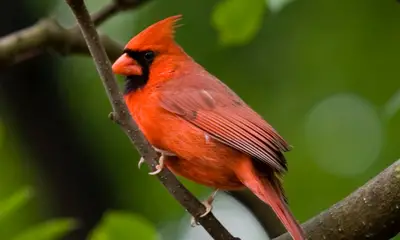
Northern Cardinal (Cardinalis cardinalis)

The Northern Cardinal is the state bird of Virginia, a designation the General Assembly adopted in 1950, and a symbol shared with six other states: Illinois, Indiana, Kentucky, North Carolina, Ohio, and West Virginia (Wikipedia, 2025). The male is a brilliant scarlet red with a black mask and a pronounced crest, while the female is a warm buffy-brown with reddish accents on the wings, tail, and crest. Both sexes carry a heavy, cone-shaped orange-red bill suited to cracking seeds. The species measures 21 to 23 centimeters (8.3 to 9.1 inches) in length.
Cardinals favor forest edges, old fields, shrubby habitats, and suburban gardens, and they are among the most abundant breeders throughout the Commonwealth. Unusually among North American songbirds, both the male and the female sing (Cornell Lab of Ornithology, 2025). The diet is omnivorous, consisting largely of seeds and fruits supplemented by insects. To attract cardinals, offer black oil sunflower seeds, which they particularly favor, and leave shrubby undergrowth where pairs may nest. Cardinals do not migrate and remain colorful through the winter, providing a vivid presence against snowy backyards.
Red-winged Blackbird (Agelaius phoeniceus)
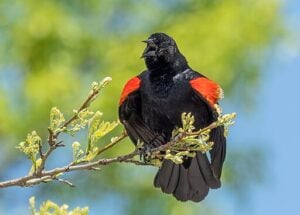
The Red-winged Blackbird is one of the most abundant birds in North America; bird-counting censuses have led to claims that it is the most abundant living land bird on the continent (Wikipedia, 2025). The glossy black male displays scarlet-and-yellow shoulder patches, or epaulets, that he can puff up during display or conceal at rest, while the female is a streaky brown bird that resembles a large sparrow (Cornell Lab of Ornithology, 2025). Adults measure roughly 17 to 23 centimeters (6.7 to 9 inches) in length.
These birds breed in cattail marshes, wet fields, and along soggy roadsides, and outside the breeding season they gather in immense flocks with grackles, cowbirds, and starlings. Males are notably aggressive in defense of their nesting territories, sometimes attacking much larger animals. The diet is roughly three-quarters seeds and one-quarter insects. Red-winged Blackbirds will visit yards for mixed grains and seeds, which they prefer to take from the ground or from platform feeders.
Downy Woodpecker (Dryobates pubescens)
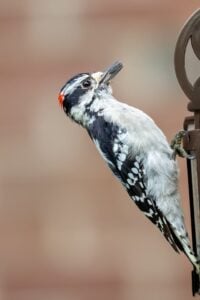
The Downy Woodpecker is the smallest woodpecker in North America and one of the most familiar backyard birds in Virginia. It has white underparts, a black-and-white patterned back, and a small bill relative to its body; males show a small red spot on the back of the head. Found in deciduous woods, suburban backyards, parks, and orchards, the Downy adapts readily to human-altered landscapes.
The diet consists largely of insects gleaned from bark, supplemented by seeds and berries. To attract Downy Woodpeckers, offer suet, sunflower seeds, and peanuts; they will even sip sugar water from hummingbird feeders (Cornell Lab of Ornithology, 2025). Their call is a high-pitched whinny that descends in pitch toward the end.
Red-bellied Woodpecker (Melanerpes carolinus)
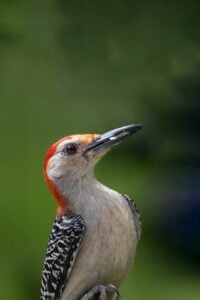
The Red-bellied Woodpecker is a pale, medium-sized woodpecker of eastern forests, immediately recognized by its boldly barred black-and-white back and a bright red cap that extends from the bill to the nape in males and across the nape in females. The name refers to a faint reddish wash on the belly that is rarely visible in the field. The bird measures about 24 centimeters (9.4 inches) in length with a wingspan of 33 to 42 centimeters (13 to 16.5 inches).
This adaptable, omnivorous species inhabits forests, swamps, parks, and backyards, and it has expanded its range northward in recent years (Audubon, 2025). It is an opportunistic feeder, taking insects, nuts, fruits, seeds, and occasionally small vertebrates including frogs and small fish. A Red-bellied Woodpecker can extend its barbed, sticky tongue nearly two inches past the tip of its bill to extract prey from crevices (Cornell Lab of Ornithology, 2025). Suet, sunflower seeds, and peanuts will draw it to feeders, where it is among the more dominant visitors.
Pileated Woodpecker (Dryocopus pileatus)
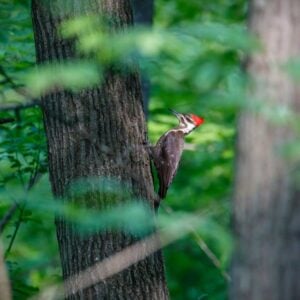
The Pileated Woodpecker is the largest woodpecker commonly found in Virginia, a crow-sized bird reaching up to 48 centimeters (19 inches) in length with a wingspan near 76 centimeters (30 inches). It is mostly black with bold white stripes on the face and neck and a flaming red triangular crest; males show an additional red stripe on the cheek.
This striking bird inhabits large, mature forests with abundant dead and fallen trees, where it excavates distinctive rectangular holes in search of its preferred food, carpenter ants, along with wood-boring beetle larvae. It supplements this diet with fruits and nuts. Although it requires mature woodland, the Pileated Woodpecker will visit suet feeders in yards adjacent to forest. Its loud, ringing call carries through the woods, and its drumming is deep and resonant.
American Robin (Turdus migratorius)
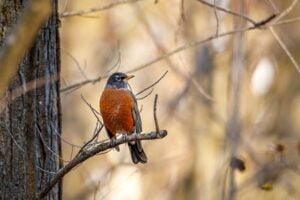
The American Robin is one of the most widely recognized birds in the United States, a thrush with a warm reddish-orange breast, a dark gray back and head, and a yellow bill. Robins are found across lawns, parks, gardens, and wooded areas throughout Virginia year-round, though many people notice them most in early spring.
Robins forage on the ground for earthworms and insects in warmer months and shift to fruits and berries in fall and winter, when they may form large roving flocks. They are not typical feeder birds but will visit for mealworms and fruit, and they readily use yards planted with berry-producing native shrubs and trees. The species has long held a place in regional culture; Virginia passed a law protecting robins in 1912, making it a misdemeanor to kill the birds or destroy their nests and eggs (Cardinal News, 2026).
American Crow (Corvus brachyrhynchos)
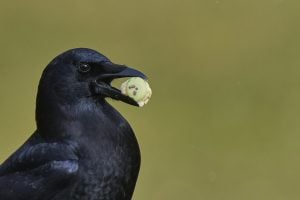
The American Crow is a large, all-black bird with long, broad wings, a broad tail, and a stout black bill. In good light, dark purple and blue iridescence is visible on its plumage. First described scientifically in 1822, the species belongs to the family Corvidae within the order Passeriformes, the perching birds (AvianBliss, 2025). It can be distinguished from the larger Common Raven by its smaller size, fan-shaped rather than wedge-shaped tail, and familiar cawing rather than a deep croak.
Crows are among the most intelligent of all birds. Research published in Nature Communications has documented their use of stone tools, their capacity for problem-solving, and their ability to recognize and remember individual human faces, with their forebrain neuronal counts rivaling those of great apes (Nature Communications, 2023). They live in complex family groups, communicate through a large vocabulary of caws, rattles, and clicks, and gather in communal roosts that can number in the thousands. They are omnivorous and highly adaptable, foraging for carrion, fruit, seeds, insects, and small animals, and they build bulky stick nests high in trees. Crows thrive in open areas, agricultural land, woodlands, and urban settings alike.
Eastern Bluebird (Sialia sialis)

The Eastern Bluebird is a member of the thrush family and a beloved backyard bird. Males are a vivid blue above with a rusty-orange breast, while females are a softer gray-blue with paler orange tones. The species was named by Carl Linnaeus in the mid-1700s and is found in Virginia year-round, often overwintering in thickets (Fairfax County, 2025).
Bluebirds are secondary cavity nesters, meaning they nest in cavities but cannot excavate their own and instead depend on holes created by woodpeckers or on nest boxes. Their diet is roughly 70 percent insects, supplemented by invertebrates and berries, and they feed from flat surfaces rather than traditional hanging feeders. Beginning in the early 1900s, Eastern Bluebird populations declined sharply because of habitat loss, pesticide use, and competition from introduced cavity nesters, the House Sparrow and the European Starling. The formation of the North American Bluebird Society in 1978 and the establishment of nest box trails reversed this decline, and the species has made a strong comeback (Loudoun Wildlife Conservancy, 2025). Mounting a properly designed nest box with a predator guard in open habitat is the best way to host bluebirds.
Ruby-throated Hummingbird (Archilochus colubris)
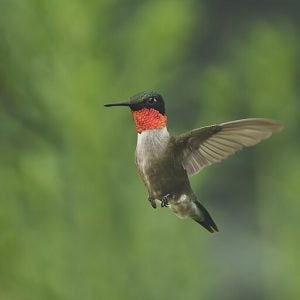
The Ruby-throated Hummingbird is the only breeding hummingbird in eastern North America. This tiny bird measures just 7 to 9 centimeters (2.8 to 3.5 inches) in length. The adult male displays an iridescent ruby throat that can appear black in poor light, with a metallic green back and a forked black tail; the female is golden-green above and whitish below with a plain throat (Audubon, 2025).
Ruby-throated Hummingbirds summer in gardens, woodland edges, and parks, feeding primarily on nectar from red and orange tubular flowers and on small insects and spiders. They are remarkable migrants: many cross the Gulf of Mexico in a single nonstop flight of up to 500 miles, and the species winters chiefly in Mexico and Central America, as far south as Panama. The hummingbird family originated and diversified in South America before some populations expanded northward to exploit the seasonal abundance of the temperate zone. To attract them, set out nectar feeders filled with sugar water, avoiding red dye, and plant native nectar sources such as trumpet honeysuckle and cardinal flower.
Baltimore Oriole (Icterus galbula)

The Baltimore Oriole is a striking songbird of open woodlands, forest edges, and backyards. The adult male is a brilliant orange and black with a bold white wing bar, while females range from yellowish to orange with blotchy black markings. The species measures roughly 18 to 20 centimeters (7 to 8 inches) in length.
Orioles arrive in Virginia in late spring, typically by late April, after wintering in Florida, the Caribbean, Central America, and the northern tip of South America (Cornell Lab of Ornithology, 2025). They weave distinctive hanging, bag-like nests suspended from thin branches. To attract Baltimore Orioles, hang halved oranges from trees and offer small amounts of grape jelly and sugar water; Cornell Lab cautions that jelly should be offered only in small amounts so it does not soil the birds’ feathers.
Rose-breasted Grosbeak (Pheucticus ludovicianus)
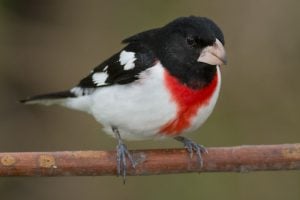
The Rose-breasted Grosbeak is a stocky, large-billed member of the cardinal family. The breeding male is boldly patterned in black and white with a brilliant rose-red chevron across the breast, while the female is heavily streaked brown and white with a bold facial pattern, resembling an oversized sparrow or finch. The bird measures about 8 inches long with a wingspan near 12.5 inches.
In Virginia the Rose-breasted Grosbeak is a common transient, arriving in late April and departing by October as it passes through on spring and fall migration (Avian Report, 2025). It favors forested and semi-open woodland and consumes large quantities of insects, supplemented by seeds and fruits such as elderberries and blackberries. To attract grosbeaks during migration, offer black oil sunflower seeds on platform or hopper feeders; they also visit oriole feeders for grape jelly and oranges.
Pine Siskin (Spinus pinus)
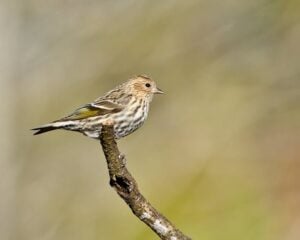
The Pine Siskin is a small, streaky finch with subtle yellow edging in the wings and tail and a sharply pointed bill. Unlike many backyard birds, the Pine Siskin is an irruptive winter visitor, appearing in Virginia in highly variable numbers from year to year depending on the seed crop in the boreal forests to the north. In some winters thousands descend the Atlantic coast, while in others they are nearly absent.
Pine Siskins travel in flocks and feed on small seeds, particularly favoring nyjer (thistle) seed and hulled sunflower at feeders. Their presence is often unpredictable, making a winter flock of siskins a welcome surprise for backyard birders.
Common Grackle (Quiscalus quiscula)
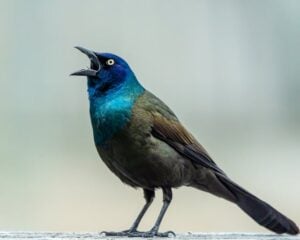
The Common Grackle is a lanky blackbird that looks as though it has been slightly stretched, with a long tail, long legs, and a long, slightly down-curved bill. From a distance the bird appears black, but in good light it reveals a glossy iridescent blue head and a bronze body, with a striking pale yellow eye (Cornell Lab of Ornithology, 2025). It belongs to the blackbird family, Icteridae, and not to the crow family, despite occasional confusion.
Grackles inhabit open and semi-open country, marshes, agricultural fields, parks, and suburbs, often gathering in large, noisy flocks. They are highly opportunistic feeders, taking grains, seeds, acorns, fruits, insects, and even small fish and other birds. In Virginia they often arrive in large flocks in late winter as an early sign of spring. At feeders they are aggressive and dominant, sometimes displacing smaller songbirds.
House Sparrow (Passer domesticus)
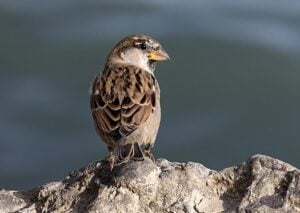
The House Sparrow is a small, stocky bird introduced to North America from Europe. Males have a gray crown, a black bib, and chestnut markings, while females and juveniles are a plainer brown with streaked backs. The species is closely associated with human structures and gathers in noisy groups in urban and suburban areas.
House Sparrows are not native and are not protected under the Migratory Bird Treaty Act. As aggressive cavity nesters, they compete with native species such as the Eastern Bluebird for nest sites, and managing their presence is an important part of operating bluebird nest box trails. They feed readily on grains, seeds, and scraps and are among the most widespread birds in developed landscapes worldwide.
Red-eyed Vireo (Vireo olivaceus)
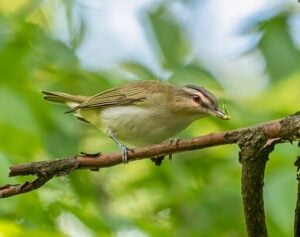
The Red-eyed Vireo is a small songbird, olive-green above and white below, with a gray crown bordered in black, a pale eyebrow stripe, and a dark line through a reddish eye. Like other vireos, it has a fairly thick bill with a small hooked tip. The sexes look alike.
This bird is a common breeder in the deciduous and mixed forests of Virginia, where it forages high in the canopy for insects and, later in the season, fruit. It is far more often heard than seen, singing its persistent, robin-like phrases through the heat of the day from the treetops. The Red-eyed Vireo is a neotropical migrant that winters in South America, and its tireless summer song is one of the characteristic sounds of Virginia’s wooded areas.
Raptors and Large Birds of Virginia
Virginia supports a rich community of birds of prey and other large birds, several of which represent notable conservation success stories.
Bald Eagle (Haliaeetus leucocephalus)
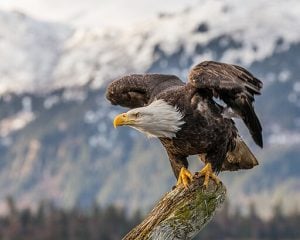
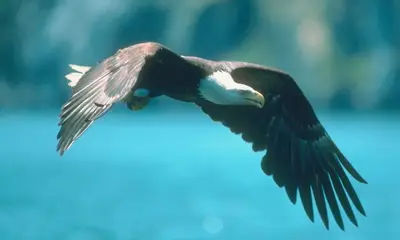
The Bald Eagle is the national bird of the United States and one of Virginia’s most celebrated conservation triumphs. Adults are unmistakable, with a dark brown body, a white head and tail, and a heavy yellow bill. After the pesticide DDT devastated populations in the mid-twentieth century, Bald Eagle numbers in the lower 48 states fell to a low of 417 nesting pairs in 1963 before recovering to an estimated 71,400 nesting pairs by 2020 following the banning of DDT and decades of protection (American Bird Conservancy, 2025). According to Virginia Department of Wildlife Resources biologist Jeff Cooper, there are now at least 1,500 breeding pairs in the coastal plain of Virginia alone, up from only 363 confirmed nests in 2001 (Potomac Conservancy, 2025).
Bald Eagles favor habitats near water, where they take fish, waterfowl, and carrion. They build enormous stick nests, mate for life, and often return to the same nest year after year. The James and Potomac rivers, the Chesapeake Bay, and refuges such as Mason Neck are excellent places to observe them.
Peregrine Falcon (Falco peregrinus)
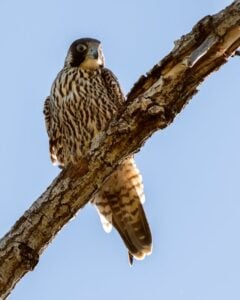
The Peregrine Falcon is renowned as the fastest animal on the planet, capable of reaching speeds exceeding 180 miles per hour in its hunting dives. Native to the cliffs of Virginia’s Allegheny and Blue Ridge Mountains, the falcon was extirpated as a nesting species in the state by the mid-1960s because of DDT poisoning (Virginia Department of Wildlife Resources, 2025). Beginning in 1978 on the Eastern Shore, the Virginia Department of Wildlife Resources led a restoration effort using a technique called hacking, in which young falcons aged three to six months are reared in protective boxes and released.
Today many Virginia peregrines nest on artificial structures such as bridges, smokestacks, and tall buildings; a well-known pair nests atop the Riverfront Plaza building in downtown Richmond and is monitored by a live camera. Because the species has not fully recovered in its historic mountain range, it remains listed as a threatened species under Virginia’s Endangered Species Act and is considered a Tier I Species of Greatest Conservation Need. Peregrines hunt other birds in midair and can be observed at coastal sites such as Kiptopeke State Park during fall migration.
Red-shouldered Hawk (Buteo lineatus)
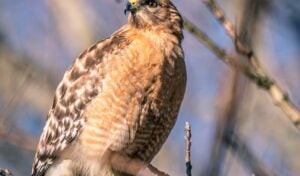
The Red-shouldered Hawk is a medium-sized hawk with broad, rounded wings and barred reddish-peachy underparts, a strongly banded black-and-white tail, and checkered wings. The bird measures roughly 41 to 61 centimeters (16 to 24 inches) in length. In flight, translucent crescents near the wingtips help identify the species at a distance (Cornell Lab of Ornithology, 2025).
This hawk is typically a sign of tall woods and water, inhabiting bottomland hardwood forests, flooded deciduous swamps, and riverine parks. It hunts from perches below the canopy, taking small mammals, lizards, snakes, amphibians, and crayfish. Its loud, whistled “kee-aah” call is a distinctive sound of the forest, frequently imitated by Blue Jays. Red-shouldered Hawks nest along the wetland margins at sites such as Huntley Meadows Park in Northern Virginia.
Broad-winged Hawk (Buteo platypterus)
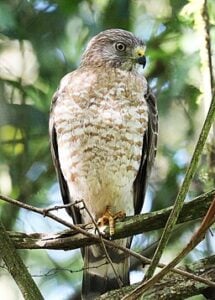
The Broad-winged Hawk is a small, stocky raptor with broad wings, a large head, and a short tail marked with bold black-and-white bands. It measures 33 to 44 centimeters (13 to 17 inches) in length. Adults are brown above with reddish barring below and show pale underwings edged in dark.
This hawk is most famous for its spectacular fall migration. Each autumn, hundreds of thousands of Broad-winged Hawks leave the northern forests for South America, gathering in swirling flocks called kettles that can contain thousands of circling birds (Cornell Lab of Ornithology, 2025). These kettles are a prime attraction at Virginia hawk-watch sites along the Blue Ridge in mid-September. The species winters in forests from southern Mexico to Brazil and Bolivia. During the breeding season it hunts small mammals, amphibians, and insects from forest perches.
Great Blue Heron (Ardea herodias)
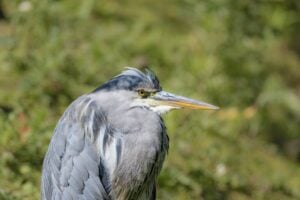
The Great Blue Heron is the largest heron in North America, standing roughly four feet tall with a body length of 97 to 137 centimeters (38 to 54 inches) and a wingspan of 167 to 201 centimeters (66 to 79 inches), yet weighing only five to six pounds owing to its hollow bones. It is blue-gray overall with long legs, a sinuous neck, and a thick, dagger-like bill. In flight it curls its neck into a tight S shape and trails its legs well beyond the tail.
Great Blue Herons wade slowly or stand motionless in shallow water, peering for prey. They eat nearly anything within striking distance, including fish, amphibians, reptiles, small mammals, insects, and other birds, often impaling larger fish on their bills (Cornell Lab of Ornithology, 2025). They nest colonially in heronries that can contain hundreds of nests. In Virginia they are found statewide but are most common in the coastal plain; the Great Marsh at Mason Neck National Wildlife Refuge holds one of the largest rookeries in the state, and the birds are plentiful at Huntley Meadows Park (Virginia Department of Wildlife Resources, 2025).
Barn Owl (Tyto alba)
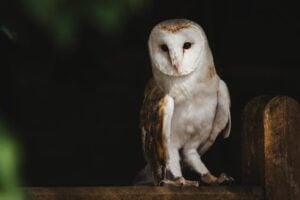
The Barn Owl is a pale, ghostly owl with a distinctive heart-shaped facial disk, golden-buff upperparts, and white underparts. Unlike most owls, it lacks ear tufts and has dark eyes. It is among the most widespread owls in the southeast region and inhabits open country, farmland, and marshes, often nesting in barns, silos, tree cavities, and nest boxes.
Barn Owls hunt at night, using exceptional hearing to locate small mammals, especially voles and mice, across open areas and grasslands. They are valued for their role in controlling rodent populations, and their nocturnal, secretive habits make them more often heard than seen. The Barn Owl is considered a species of conservation concern in parts of the Southeast because of the loss of open grassland habitat and suitable nest sites (USGS, 2025).
Northern Saw-whet Owl (Aegolius acadicus)
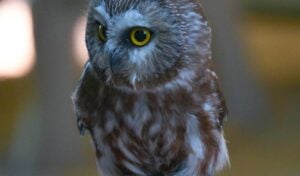
The Northern Saw-whet Owl is the smallest owl in eastern North America, a bird about the size of an American Robin weighing less than six ounces, with a rounded head, a catlike face, and bright yellow eyes. It can be distinguished from the Eastern Screech-Owl by its rounded facial disk, distinctive facial V pattern, lack of ear tufts, and broad vertical streaking on the breast (Virginia Department of Wildlife Resources, 2025).
In Virginia the saw-whet breeds at the highest elevations of the Blue Ridge Mountains and southwestern Appalachian Mountains, usually within or near spruce forests, nesting in tree cavities and abandoned woodpecker holes. It feeds primarily on small mammals, especially deer mice. The male’s persistent, high-pitched “toot” call carries through the forest from late March into June. Highly nocturnal and secretive, the species is poorly understood in the state, and the Second Virginia Breeding Bird Atlas made gathering data on its breeding distribution a priority.
Shorebirds and Coastal Species
Virginia’s barrier islands, salt marshes, and tidal flats support a distinctive community of shorebirds and coastal species, particularly along the Eastern Shore.
American Oystercatcher (Haematopus palliatus)
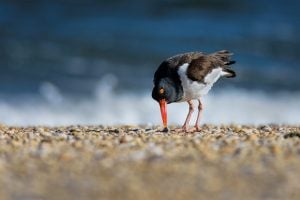
The American Oystercatcher is a large, conspicuous shorebird, instantly recognized by its bright red-orange bill, black head, dark back, white underparts, and red-rimmed golden eye. The bird is about 18 inches in length, and in flight it shows diagonal white wing patches and a white rump (BWD Magazine, 2025).
This species is a favorite among birders visiting Virginia’s Eastern Shore. It nests and forages on barrier islands, salt marshes, and other coastal areas, using its heavy bill to pry open bivalve mollusks; ribbed mussels are a favorite food in Virginia. The oldest known American Oystercatcher, banded in Virginia in 1989, was recovered in Florida in 2012 at nearly 24 years of age (Virginia Bird Atlas, 2025). Eastern oystercatchers winter in flocks from Virginia south along the Atlantic and Gulf coasts.
Glossy Ibis (Plegadis falcinellus)
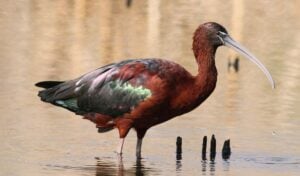
The Glossy Ibis is a medium-sized wading bird that appears dark from a distance but reveals a rich chestnut body with iridescent green and bronze sheen in good light. It has a long, down-curved bill and long legs, well suited to probing the mud of coastal marshes and shallow water.
The Glossy Ibis forages in the shallow salt or fresh water of marshes, flooded fields, ponds, and estuaries, taking invertebrates and small aquatic animals. It nests in colonies, often in association with herons and egrets, building its nest on the ground or in shrubs over water. The expansive marshes of Virginia’s Eastern Shore, including those around Tangier Island, provide habitat for this elegant species (Virginia Department of Wildlife Resources, 2025).
Neotropical Migrants and Seasonal Visitors

Many of Virginia’s most sought-after birds are neotropical migrants, species that breed in North America but spend the winter in the tropics. Their seasonal movements are among the great spectacles of the natural year.
Cerulean Warbler (Setophaga cerulea)
The Cerulean Warbler is a small, sky-blue songbird of the forest canopy and one of the most imperiled migratory songbirds in North America. The male is a brilliant cerulean blue above with a white throat and a narrow dark breast band. The species breeds in mature deciduous forests, and more than 80 percent of its population nests in the Appalachian Mountains; it is the only globally threatened neotropical migratory songbird that winters exclusively in South America, primarily in the Andean forests of Colombia and Venezuela (American Bird Conservancy, 2025).
Cerulean Warbler numbers have declined by nearly 70 percent since 1966, driven by habitat loss on both the breeding and wintering grounds (Cornell Lab of Ornithology, 2025). The bird remains a breeding species in Shenandoah National Park, where it was once far more common. Conservation efforts, including land protection in Colombia coordinated by the American Bird Conservancy and its partners, aim to stabilize the species across its full range.
Baltimore Oriole Migration Patterns
The Baltimore Oriole exemplifies the rhythm of neotropical migration. Arriving in Virginia by late April, it spends only the breeding months in the state before departing as early as July for wintering grounds in Florida, the Caribbean, Central America, and the northern tip of South America (Cornell Lab of Ornithology, 2025). This brief residency makes the oriole’s bright spring arrival a keenly anticipated event for backyard birders, who can extend the birds’ stay with oranges and grape jelly.
Broad-winged Hawk Migration in Early September
The Broad-winged Hawk’s migration is one of the defining events of early autumn in Virginia. Beginning in late August and peaking in mid-September, broad-wings stream southward along the ridges of the Blue Ridge Mountains in great kettles. Hawk-watch sites such as Rockfish Gap at the northern terminus of the Blue Ridge Parkway and Harvey’s Knob Overlook draw observers hoping to witness the spectacle (Virginia Department of Wildlife Resources, 2025). The birds are bound for wintering grounds in Central and South America, undertaking a journey that satellite tracking has shown can average roughly 4,350 miles to northern South America.
Notable Birding Locations in Virginia
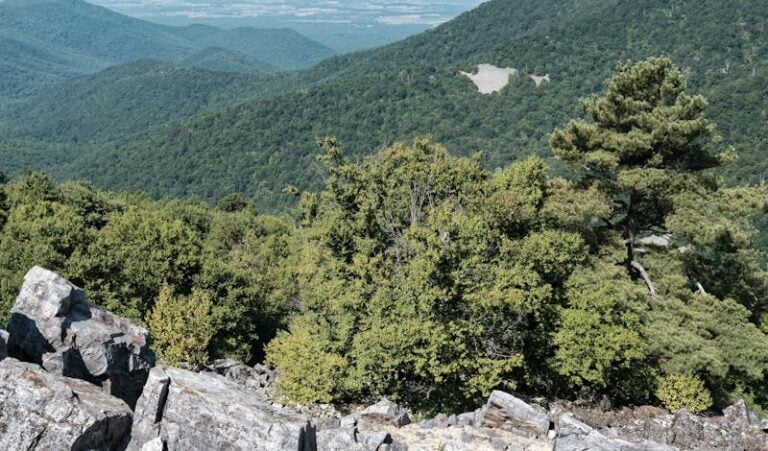
Virginia offers an exceptional array of birding destinations, many of them linked through the Virginia Bird and Wildlife Trail, a network of more than 600 sites maintained by the Virginia Department of Wildlife Resources.
Shenandoah National Park
Shenandoah National Park, in the Blue Ridge Mountains, protects nearly 200 bird species across forests that cover 95 percent of its area. Roughly half of the documented species breed within the park, including no fewer than 18 species of warbler, among them the brightly colored Cerulean Warbler (Travel Experience Live, 2025). Skyline Drive and locations such as Big Meadows and Hawksbill Mountain offer access to montane species including the Carolina Chickadee, ruby-throated hummingbird, barred owl, and a wide variety of breeding warblers.
Blue Ridge Parkway
The Blue Ridge Parkway winds through the mountains of western Virginia, offering scenic, high-elevation birding across its many overlooks and trailheads. The Parkway and adjoining national forest lands host nesting neotropical migrants at high elevations, including Canada, chestnut-sided, black-throated blue, and Blackburnian warblers, as well as veery, rose-breasted grosbeak, and ruffed grouse (Virginia Department of Wildlife Resources, 2025). The nearby Warbler Road, descending from Sunset Field Overlook toward the James River, is celebrated for its concentration of breeding warblers from late April through May. Rockfish Gap, at the Parkway’s northern end, is a noted fall hawk-watch where the broad-winged hawk is the most abundant migrant.
Chincoteague National Wildlife Refuge
Chincoteague National Wildlife Refuge, on the Eastern Shore, is among the most heavily visited refuges in the national system and one of the nation’s premier sites for accessible wildlife viewing. More than 320 species use the refuge regularly during migration, and at least 100 species are present at any given time (Virginia Department of Wildlife Resources, 2025). Chincoteague NWR ranks as one of the country’s top five shorebird migration staging areas east of the Rocky Mountains, drawing huge concentrations of migrating shorebirds in spring when spawning horseshoe crabs provide a crucial food source. The refuge’s beaches host nesting American Oystercatchers, least terns, black skimmers, and the threatened piping plover, while its salt marshes shelter herons, egrets, and clapper rails.
Kiptopeke State Park
Kiptopeke State Park, a 536-acre site on the Chesapeake Bay at the southern tip of the Eastern Shore, is one of the finest fall migration sites in the Americas. The unique topography of the Delmarva Peninsula funnels migrating raptors toward the park’s hawk-watch platform, which has operated since 1977 under the Coastal Virginia Wildlife Observatory (BirdWatching, 2025). Counters here record some of the highest numbers of migrating falcons in North America, including American Kestrel, Merlin, and Peregrine Falcon, along with Broad-winged Hawks and Bald Eagles; in exceptional seasons the count has exceeded 30,000 birds of prey. The total species list for the park exceeds 300 birds, and a long-running bird-banding study documented more than 350,000 birds over five decades before concluding in 2012.
Huntley Meadows Park (Northern Virginia)
Huntley Meadows Park, in Fairfax County, is a hidden gem of Northern Virginia birding. Its centerpiece is a large beaver-created freshwater marsh surrounded by deciduous woodlands, and more than 200 bird species have been recorded across its roughly 1,500 acres (Fairfax County Tourism, 2025). A half-mile boardwalk and observation tower provide views of red-winged blackbirds, great blue herons, egrets, waterfowl, and, with luck, rarer visitors such as the Glossy Ibis. Red-shouldered Hawks nest along the wetland margins, and the park hosts free Monday morning bird walks for visitors of all skill levels.
Virginia Beach Coastal Areas
The coastal areas of Virginia Beach, at the southern mouth of the Chesapeake Bay, offer rich birding across beaches, dunes, and bald cypress swamps. Sites such as Back Bay National Wildlife Refuge and First Landing State Park are excellent in spring, when many warblers and other neotropical migrants pass through, and the southern coastal plain here contains some of the northernmost bald cypress swamps on the East Coast (Fat Birder, 2025). The region supports great blue herons, egrets, shorebirds, and a host of wintering waterfowl.
How to Attract Backyard Birds in Virginia

Creating a welcoming backyard is one of the best ways to enjoy the birds of Virginia at close range. A thoughtful combination of food, water, plantings, and nest sites will draw a wide variety of species.
Bird Feeders and Food Types
Different foods attract different birds. Black oil sunflower seeds appeal to the broadest range of species, including cardinals, woodpeckers, and grosbeaks. Suet, dense beef fat offered in a cage feeder, is a favorite of woodpeckers such as the Downy, Red-bellied, and Pileated, especially in cooler months. Nyjer (thistle) seed in a tube feeder draws finches including the Pine Siskin and American Goldfinch. Offering a variety of feeder types and foods will maximize the diversity of visitors.
Water Sources
A clean, reliable source of water is as valuable as food, and a birdbath will attract many species that do not visit feeders, including robins and warblers. Moving or dripping water is especially appealing. Birdbaths should be shallow and cleaned regularly to prevent the spread of disease.
Native Plantings
Native plants provide the most sustainable food source for birds, offering insects, seeds, fruit, and nectar throughout the seasons. Native nectar plants such as trumpet honeysuckle and cardinal flower attract ruby-throated hummingbirds, while berry-producing shrubs such as elderberry and serviceberry support grosbeaks, robins, and many others. The Southwest Virginia Wildlife Center notes that native plantings provide more habitat and nutrition than feeders and are less likely to transmit disease between birds (WDBJ, 2021).
Nest Boxes for Cavity Nesters
Properly designed nest boxes support cavity nesters such as the Eastern Bluebird, which cannot excavate their own holes. Boxes should be mounted on poles fitted with predator guards, placed in open habitat at least 20 feet from tree canopies, and monitored regularly during the breeding season. Because introduced House Sparrows and European Starlings aggressively compete for these cavities, managing them is an essential part of operating a successful nest box trail, as the Virginia Bluebird Society advises (Virginia Bluebird Society, 2025).
DWR Guidance on Safe Feeding
The Virginia Department of Wildlife Resources recommends several practices to keep feeder birds healthy. Feeders and birdbaths should be cleaned at least once a week and disinfected with a 10 percent bleach solution, then rinsed and air-dried (Virginia Department of Wildlife Resources, 2025). The agency advises wearing disposable gloves when handling feeders, filling feeders only with what will be consumed within the cleaning cycle, and removing feeders for at least two weeks if sick or dead birds appear. In areas of high bear activity, the DWR recommends taking feeders down, and it discourages ground feeding, which can spread disease and attract unwanted animals.
Bird Identification Skills for Beginners
Developing strong bird identification skills deepens the enjoyment of birding and rewards patience and practice. Beginners should focus on a few key features. Note the bird’s size and shape relative to a familiar reference such as a robin or sparrow, and observe the shape of the bill, tail, and wings. Pay attention to color patterns on the head, back, wings, and belly, and watch behavior, since some birds hop, others walk, and others creep along tree trunks. Habitat offers an important clue, because where a bird is seen often narrows the possibilities.
Sounds are frequently the best clue, particularly in dense forest where birds are heard before they are seen. Recording songs and calls, or learning them with a mobile application, sharpens identification considerably. Beginners should also remember that many birds change appearance with the seasons; the American Goldfinch, for example, is bright yellow in summer and dull olive in winter. Keeping notes or photographs and reporting sightings to platforms such as eBird both improves personal skills and contributes to the broader scientific record.
Wildlife Conservation and the Second Virginia Breeding Bird Atlas
Bird conservation in Virginia is anchored by one of the most ambitious citizen science efforts in the state’s history. The Second Virginia Breeding Bird Atlas, a partnership of the Virginia Department of Wildlife Resources, the Virginia Society of Ornithology, and the Conservation Management Institute at Virginia Tech, surveyed breeding birds across the entire Commonwealth (Virginia Department of Wildlife Resources, 2025). Over five field seasons from 2016 through 2020, more than 1,400 trained volunteers collected over five million field observations, compiling one of the largest baseline data sets ever assembled on the state’s breeding birds.
The first phase of results, published on October 31, 2025, presents species accounts for 203 breeding species, each with photographs taken in Virginia, along with information on methods and a preliminary analysis of findings (Northern Virginia Bird Alliance, 2025). A second phase, scheduled for early 2026, will add technical analysis and content on Virginia’s geography, habitats, and the role of the Atlas in conservation. By comparing its findings with those of the First Atlas, conducted from 1985 to 1989, the project reveals how bird distributions have shifted over three decades in response to habitat change, climate change, and other pressures.
The Atlas serves a vital purpose. The Cornell Lab of Ornithology has estimated that North American bird populations have declined by nearly three billion birds since 1970 (Virginia Society of Ornithology, 2025). The Virginia Department of Wildlife Resources identifies 80 avian Species of Greatest Conservation Need in its Wildlife Action Plan, representing the state’s highest priorities for protection. At the same time, the recovery of species such as the Bald Eagle, Osprey, Peregrine Falcon, and Wild Turkey demonstrates that targeted management practices can reverse declines. The Atlas provides the data needed to guide land acquisition, habitat management, and research for years to come.
Conclusion
The birds of Virginia are a living reflection of the Commonwealth’s extraordinary geographic diversity, from the salt marshes and barrier islands of the Eastern Shore to the spruce-clad summits of the Blue Ridge Mountains. The familiar Northern Cardinal at a backyard feeder, the swirling kettles of Broad-winged Hawks over a mountain gap in early September, the brilliant orange of a Baltimore Oriole newly arrived from the tropics, and the ghostly call of a Northern Saw-whet Owl in a high mountain forest all belong to the same rich tapestry. Virginia’s position along the Atlantic Flyway, its mix of northeastern and southeastern species, and its wealth of protected birding locations make it one of the finest places to watch birds in eastern North America. Whether one is hanging a first nest box, cleaning a feeder according to DWR guidance, or contributing observations to the Second Virginia Breeding Bird Atlas, every birder plays a part in the conservation of this natural heritage. By learning to identify and appreciate these species, and by supporting the habitats they depend upon, the people of Virginia help ensure that the Commonwealth remains a haven for birds for generations to come.
Works Cited
- American Bird Conservancy. (2025). Birds of Virginia: Raptors. https://abcbirds.org/news/birds-of-virginia-raptors/
- American Bird Conservancy. (2025). Cerulean Warbler. https://abcbirds.org/birds/cerulean-warbler/
- Audubon. (2025). Ruby-throated Hummingbird. https://www.audubon.org/field-guide/bird/ruby-throated-hummingbird
- Audubon. (2025). Red-bellied Woodpecker. https://www.audubon.org/field-guide/bird/red-bellied-woodpecker
- Avian Report. (2025). 50 Virginia Backyard Feeder Birds: ID and Sound Guide. https://avianreport.com/virginia-feeder-birds-id-sound-guide/
- AvianBliss. (2025). American Crow: Identification, Behavior and Intelligence. https://avianbliss.com/american-crow/
- BirdWatching. (2025). Kiptopeke State Park, Cape Charles, Virginia. https://www.birdwatchingdaily.com/hotspots/122-kiptopeke-state-park-cape-charles-virginia/
- BWD Magazine. (2025). 10 Highlight Birds in Virginia. https://bwdmagazine.com/travel/regions/10-birds-virginia/
- Cardinal News. (2026). Beyond the cardinal numbers: Have you heard about the state bird? https://cardinalnews.org/2026/03/16/have-you-heard-about-the-state-bird-beyond-the-cardinal-numbers/
- Cornell Lab of Ornithology. (2025). Northern Cardinal Overview, All About Birds. https://www.allaboutbirds.org/guide/Northern_Cardinal/overview
- Cornell Lab of Ornithology. (2025). Red-winged Blackbird Overview, All About Birds. https://www.allaboutbirds.org/guide/Red-winged_Blackbird/overview
- Cornell Lab of Ornithology. (2025). Downy Woodpecker Overview, All About Birds. https://www.allaboutbirds.org/guide/Downy_Woodpecker/overview
- Cornell Lab of Ornithology. (2025). Red-bellied Woodpecker Overview, All About Birds. https://www.allaboutbirds.org/guide/Red-bellied_Woodpecker/overview
- Cornell Lab of Ornithology. (2025). Common Grackle Overview, All About Birds. https://www.allaboutbirds.org/guide/Common_Grackle/overview
- Cornell Lab of Ornithology. (2025). Northern Saw-whet Owl Overview, All About Birds. https://www.allaboutbirds.org/guide/Northern_Saw-whet_Owl/overview
- Cornell Lab of Ornithology. (2025). Declining Numbers of Cerulean Warblers, All About Birds. https://www.allaboutbirds.org/news/declining-numbers-of-cerulean-warblers/
- Fairfax County. (2025). Eastern Bluebirds, A Story of Successful Conservation. https://www.fairfaxcounty.gov/soil-water-conservation/eastern-bluebirds-story-successful-conservation
- Fairfax County Tourism. (2025). Huntley Meadows Park: A Birdwatcher’s Paradise. https://www.fxva.com/blog/post/birding-at-huntley-meadows/
- Fat Birder. (2025). Birds, Birding Trips and Birdwatching in Commonwealth of Virginia. https://fatbirder.com/world-birding/north-america/united-states-of-america/commonwealth-of-virginia/
- Loudoun Wildlife Conservancy. (2025). Bluebird Trails/Nestbox Monitoring. https://loudounwildlife.org/citizen-science/bluebird-trailsnestbox-monitoring/
- Nature Communications. (2023). American crows that excel at tool use activate neural circuits distinct from less talented individuals. https://www.nature.com/articles/s41467-023-42203-8
- Northern Virginia Bird Alliance. (2025). Updating the Virginia Breeding Bird Atlas. https://www.nvbirdalliance.org/news/updating-the-virginia-breeding-bird-atlas
- Potomac Conservancy. (2025). With help from local communities, bald eagles are soaring across the Potomac region again. https://potomac.org/blog/2025/2/bald-eagle-recovery-interview
- Travel Experience Live. (2025). Shenandoah National Park Wildlife Viewing Guide. https://www.travel-experience-live.com/shenandoah-national-park-wildlife-viewing-guide/
- U.S. Fish & Wildlife Service. (2025). Chincoteague National Wildlife Refuge. https://www.fws.gov/refuge/chincoteague
- U.S. Fish & Wildlife Service. (2025). Birding at Chincoteague. https://www.fws.gov/refuge/chincoteague/visit-us/activities/birding
- USGS. (2025). Owls. https://pubs.usgs.gov/publication/5210483
- Virginia Bird Atlas. (2025). American Oystercatcher Species Account. http://vabirdatlas.org/species-account/american-oystercatcher/
- Virginia Bluebird Society. (2025). Nest Box Monitoring Protocol. https://www.virginiabluebirds.org/nest-box-monitoring-protocol
- Virginia Department of Wildlife Resources. (2025). Birding Basics. https://dwr.virginia.gov/wildlife-watching/birding-basics/
- Virginia Department of Wildlife Resources. (2025). Virginia Bird and Wildlife Trail. https://dwr.virginia.gov/vbwt/
- Virginia Department of Wildlife Resources. (2025). Raptors. https://dwr.virginia.gov/wildlife/raptors/
- Virginia Department of Wildlife Resources. (2025). Safe Bird Feeding. https://dwr.virginia.gov/wildlife/safe-bird-feeding/
- Virginia Department of Wildlife Resources. (2025). The 2nd Virginia Breeding Bird Atlas. https://dwr.virginia.gov/wildlife/virginia-breeding-bird-atlas/
- Virginia Department of Wildlife Resources. (2025). Kiptopeke State Park. https://dwr.virginia.gov/vbwt/sites/kiptopeke-state-park/
- Virginia Department of Wildlife Resources. (2025). Chincoteague National Wildlife Refuge. https://dwr.virginia.gov/vbwt/sites/chincoteague-national-wildlife-refuge/
- Virginia Department of Wildlife Resources. (2025). The Northern Saw-whet Owl: Virginia’s Other Small Owl. https://dwr.virginia.gov/blog/the-northern-saw-whet-owl-virginias-other-small-owl/
- Virginia Society of Ornithology. (2025). Official State Checklist. https://www.virginiabirds.org/offical-state-checklist
- WDBJ. (2021). Wildlife Center says feeding birds is okay again, but with limits. https://www.whsv.com/2021/08/04/wildlife-center-says-feeding-birds-is-okay-again-with-limits/
- Wikipedia. (2025). Northern cardinal. https://en.wikipedia.org/wiki/Northern_cardinal
- Wikipedia. (2025). Red-winged blackbird. https://en.wikipedia.org/wiki/Red-winged_blackbird