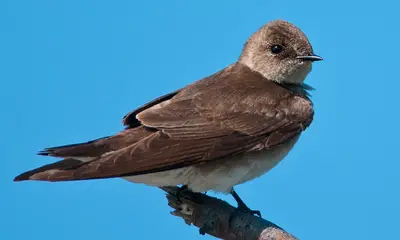
Birds of Virginia: A Field Guide to the Commonwealth’s Common Species
Virginia is home to 494 recorded bird species, a total documented as of December 2025 by the Virginia Avian Records Committee of the Virginia Society of Ornithology. That figure places the Commonwealth of Virginia among the most bird-rich states in eastern North America, a distinction it owes to its position along the Atlantic Flyway and to a landscape that gathers coastal, lowland, and mountain habitats within a single state border.
From the barrier islands and coastal marshes of the Eastern Shore to the high ridgelines of the Blue Ridge Mountains and the broader Appalachian Mountains to the west, Virginia compresses a remarkable range of ecosystems into a few hundred miles. This topographic variety, combined with the state’s temperate seasons, supports year-round residents, winter visitors, and a steady passage of migratory birds and neotropical migrants that move through Virginia between northern breeding grounds and wintering grounds farther south.
Key Takeaways
- Virginia’s state bird is the Northern Cardinal (Cardinalis cardinalis), designated by the General Assembly on January 25, 1950.
- As of December 2025, the Virginia Avian Records Committee recognizes 494 species on the official state list, one of the highest totals in the eastern United States.
- The richest season for variety is spring migration, mainly April and May, when warblers and other neotropical migrants move north through Virginia along the Atlantic Flyway.
- Chincoteague National Wildlife Refuge, on the Eastern Shore, ranks among the premier birding destinations in the Commonwealth, drawing large numbers of migrating shorebirds and waterfowl.
- The Bald Eagle is Virginia’s signature conservation success, rebounding from under 50 breeding pairs in 1977 to more than 2,000 pairs today, concentrated along the Chesapeake Bay and its tidal rivers.
At a Glance: Common Birds of Virginia
| Species | Scientific name | Size (length) | When present | Where to find | Best feeder food |
|---|---|---|---|---|---|
| Northern Cardinal | Cardinalis cardinalis | 21 to 23 cm (8.3 to 9.1 in) | Year-round | Shrubby edges, yards statewide | Black oil sunflower, safflower |
| American Robin | Turdus migratorius | 23 to 28 cm (9.1 to 11.0 in) | Year-round | Lawns, woodlands, parks | Fruit, mealworms |
| Carolina Chickadee | Poecile carolinensis | 10 to 12 cm (3.9 to 4.7 in) | Year-round | Woods, suburbs (lowlands) | Sunflower, suet |
| Tufted Titmouse | Baeolophus bicolor | 14 to 16 cm (5.5 to 6.3 in) | Year-round | Deciduous woods, yards | Sunflower, peanuts |
| Carolina Wren | Thryothorus ludovicianus | 12 to 14 cm (4.7 to 5.5 in) | Year-round | Brushy tangles, gardens | Suet, mealworms |
| Blue Jay | Cyanocitta cristata | 25 to 30 cm (9.8 to 11.8 in) | Year-round | Oak woods, neighborhoods | Peanuts, sunflower |
| Red-bellied Woodpecker | Melanerpes carolinus | 23 to 27 cm (9.0 to 10.5 in) | Year-round | Mature wooded areas, yards | Suet, sunflower |
| Downy Woodpecker | Dryobates pubescens | 14 to 17 cm (5.5 to 6.7 in) | Year-round | Woodlots, suburbs | Suet, sunflower |
| Eastern Bluebird | Sialia sialis | 16 to 21 cm (6.3 to 8.3 in) | Year-round | Open areas, field edges | Mealworms, nest boxes |
| Mourning Dove | Zenaida macroura | 23 to 34 cm (9 to 13 in) | Year-round | Open ground, feeders | Cracked corn, millet |
| Northern Mockingbird | Mimus polyglottos | 21 to 26 cm (8.3 to 10.2 in) | Year-round | Hedgerows, towns | Fruit, suet |
| American Crow | Corvus brachyrhynchos | 40 to 53 cm (16 to 21 in) | Year-round | Fields, woods, towns | Not a typical feeder bird |
| American Goldfinch | Spinus tristis | 11 to 14 cm (4.3 to 5.5 in) | Year-round | Weedy fields, feeders | Nyjer, sunflower hearts |
| House Finch | Haemorhous mexicanus | 13 to 14 cm (5.1 to 5.5 in) | Year-round | Towns, suburbs | Sunflower, nyjer |
| House Sparrow | Passer domesticus | 14 to 18 cm (5.5 to 7.1 in) | Year-round (introduced) | Cities, farms | Millet, cracked corn |
| Red-winged Blackbird | Agelaius phoeniceus | 17 to 24 cm (6.7 to 9.4 in) | Year-round | Marshes, wet fields | Mixed seed |
| Common Grackle | Quiscalus quiscula | 28 to 34 cm (11 to 13 in) | Year-round | Fields, towns | Mixed seed |
| Ruby-throated Hummingbird | Archilochus colubris | 7 to 9 cm (2.8 to 3.5 in) | Spring to fall | Gardens, forest edges | Sugar water, nectar plants |
| Pileated Woodpecker | Dryocopus pileatus | 40 to 49 cm (16 to 19 in) | Year-round | Mature forest | Suet (occasionally) |
| Eastern Towhee | Pipilo erythrophthalmus | 17 to 23 cm (6.7 to 9.1 in) | Year-round | Brushy understory | Ground-scattered seed |
| Baltimore Oriole | Icterus galbula | 17 to 19 cm (6.7 to 7.5 in) | Spring and summer | Open woods, riversides | Orange halves, jelly |
| Rose-breasted Grosbeak | Pheucticus ludovicianus | 18 to 22 cm (7.1 to 8.7 in) | Migration, mountain summer | Forest edges | Sunflower |
| Red-tailed Hawk | Buteo jamaicensis | 45 to 65 cm (18 to 26 in) | Year-round | Roadsides, open country | Not a feeder bird |
| Red-shouldered Hawk | Buteo lineatus | 43 to 61 cm (17 to 24 in) | Year-round | Wet woods, suburbs | Not a feeder bird |
| Cooper’s Hawk | Accipiter cooperii | 37 to 47 cm (14.6 to 18.5 in) | Year-round | Woodlots, feeder areas | Hunts feeder birds |
| American Kestrel | Falco sparverius | 22 to 31 cm (8.7 to 12.2 in) | Year-round | Open fields, wires | Not a feeder bird |
| Bald Eagle | Haliaeetus leucocephalus | 70 to 102 cm (28 to 40 in) | Year-round | Rivers, Chesapeake Bay | Not a feeder bird |
| Osprey | Pandion haliaetus | 54 to 58 cm (21 to 23 in) | Spring to fall | Rivers, bays, coast | Not a feeder bird |
| Barred Owl | Strix varia | 43 to 51 cm (17 to 20 in) | Year-round | Mature wet woods | Not a feeder bird |
| Great Horned Owl | Bubo virginianus | 46 to 63 cm (18 to 25 in) | Year-round | Woods, edges | Not a feeder bird |
| Great Blue Heron | Ardea herodias | 91 to 137 cm (36 to 54 in) | Year-round | Marshes, shallow water | Not a feeder bird |
| Canada Goose | Branta canadensis | 76 to 110 cm (30 to 43 in) | Year-round | Ponds, fields | Not recommended to feed |
| American Oystercatcher | Haematopus palliatus | 40 to 44 cm (15.7 to 17.3 in) | Spring to fall | Barrier island beaches | Not a feeder bird |
Why Virginia Holds Such Diversity: Geography and Flyway
Virginia’s bird life reflects its physical geography, which steps down in bands from the Atlantic coast to the western mountains. Moving east to west, the state crosses five major regions: the Coastal Plain or Tidewater, including the Eastern Shore of the Delmarva Peninsula; the rolling Piedmont; the Blue Ridge Mountains; the Ridge and Valley province that holds the Shenandoah Valley; and the high Appalachian Plateau in the far southwest. Each band carries its own bird community, from beach-nesting shorebirds to high-elevation forest songbirds.
Layered over this geography is the Atlantic Flyway, the eastern migration corridor of North America. The U.S. Fish and Wildlife Service lists Virginia among the member states of the flyway, which is bordered by the Atlantic Ocean to the east and the Appalachian Mountains to the west and funnels enormous numbers of birds along the coast each spring and fall. The Virginia Department of Wildlife Resources notes that the Commonwealth holds one of the highest bird diversities of any state in the eastern United States, a product of its geographic position, topography, and climate. Virginia’s barrier islands form a critical section of that flyway, hosting more than 100,000 migrating shorebirds each spring.
The Northern Cardinal: Virginia’s State Bird
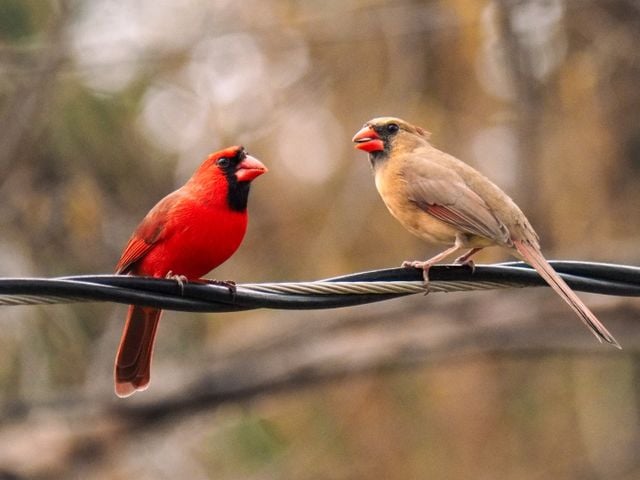
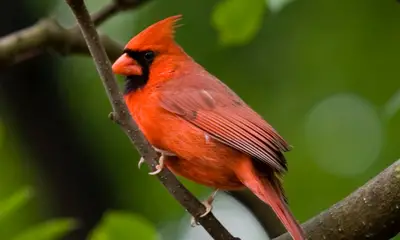
The Northern Cardinal (Cardinalis cardinalis) is the official state bird of Virginia, a year-round resident found in every region from the coast to the mountains. The General Assembly adopted it as the Commonwealth’s official bird on January 25, 1950, and it remains one of the most recognizable birds in the state.
Males wear brilliant red plumage set off by a black face mask and a tall crest, while females show warm tan and olive tones with red highlights in the wings, tail, and crest. Both sexes carry a heavy, cone-shaped orange-red bill suited to cracking seeds, and both sing, which is uncommon among North American songbirds. Cardinals favor shrubby edges between woodland and open ground, and they adapt readily to gardens and hedgerows. They hold territory year-round and maintain strong pair bonds, and during the breeding season males defend their patch vigorously, sometimes attacking their own reflection in a window. The diet centers on seeds and fruit, supplemented with insects during nesting. At feeders, cardinals favor black oil sunflower and safflower, and a few well-placed shrubs will usually draw a resident pair within sight of the house.
Common Backyard Birds
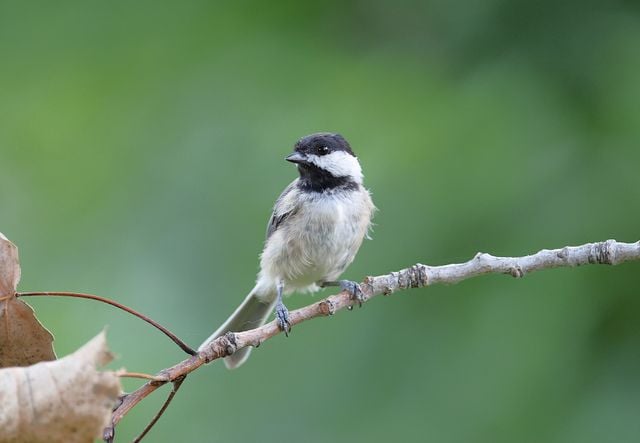
These are the species most Virginians see first, the everyday birds of feeders, lawns, and wooded areas across the state.
American Robin (Turdus migratorius)
The American Robin is among the most familiar birds in Virginia, a gray-backed thrush with a warm orange breast that feeds on lawns by sight, pausing and tilting to locate earthworms. Robins are present year-round, though they become more conspicuous in late winter when males begin their clear, caroling song at dawn. In colder months they shift to fruit and gather in large, roving flocks that strip berry-laden trees and shrubs. They nest on ledges and in tree forks, often near houses, and frequently raise two or three broods in a season. Although many people treat the robin as a sign of spring, the species winters throughout the Commonwealth wherever fruit is available, so a January robin flock is no surprise.
Carolina Chickadee (Poecile carolinensis)
The Carolina Chickadee is the small, black-capped, black-bibbed bird that animates Virginia feeders across most of the state. It is easily known by its quick movements and its buzzy chicka-dee-dee-dee call. In the higher elevations of western Virginia and the Blue Ridge Mountains, the closely related Black-capped Chickadee (Poecile atricapillus) replaces it, and the two can be difficult to separate where their ranges meet. Carolina Chickadees are cavity nesters that readily accept nest boxes, and they often lead the mixed feeding flocks of titmice, nuthatches, and woodpeckers that move through woodlots in winter. They take sunflower seeds one at a time, carrying each to a branch to hammer it open, and they cache food for later, a habit that helps them through lean weeks.
Tufted Titmouse (Baeolophus bicolor)
The Tufted Titmouse is a soft gray bird with a pointed crest, large dark eyes, and a peach wash along the flanks. Its clear, whistled peter-peter-peter song carries through wooded neighborhoods for much of the year. Titmice travel with chickadees in winter flocks and share their boldness at feeders, where they favor sunflower seeds and peanuts. Like chickadees, they are cavity nesters and will use nest boxes, lining the cup with soft material that sometimes includes hair gathered from live mammals. They are curious and vocal, and a patient observer who learns the titmouse’s scolding notes will often find a hidden owl or other predator that the flock has discovered first.
Carolina Wren (Thryothorus ludovicianus)
The Carolina Wren is a rich russet bird with a bold white eyebrow stripe and a short tail held cocked upward. Despite its small size, it delivers a remarkably loud, rolling teakettle-teakettle song, and a single male can seem to fill a whole yard with sound. Carolina Wrens haunt brush piles, tangled gardens, and woodland understory, probing crevices for insects and spiders. They are non-migratory and sensitive to hard winters, so their numbers rise and fall with the severity of the season. Inventive nesters, they will tuck a domed nest into hanging baskets, garage shelves, mailboxes, and other sheltered nooks around homes, which endears them to many Virginia gardeners.
Blue Jay (Cyanocitta cristata)
The Blue Jay is a large, crested songbird in blue, white, and black, loud and intelligent, and a constant presence in oak woods and neighborhoods. Jays produce a wide range of calls, including a convincing imitation of Red-shouldered Hawk and Red-tailed Hawk screams that can clear a feeder in seconds. They are important players in forest ecology because they cache acorns in the ground, and the seeds they fail to recover help regenerate oak woodlands. Bold and social, Blue Jays travel in loose family groups and announce the movements of hawks and owls with persistent mobbing calls. At feeders they favor peanuts and sunflower, and they will dominate a tray when they arrive.
Red-bellied Woodpecker (Melanerpes carolinus)
The Red-bellied Woodpecker is a common woodpecker of Virginia’s mature wooded areas and shaded yards, named for a faint pink wash on the belly that is hard to see in the field. The more obvious marks are the boldly barred black-and-white back and, on males, a red cap and nape. Its rolling churr call is one of the characteristic sounds of southern woodlands. These adaptable birds glean insects from bark, take fruit and nuts, and visit feeders for suet and sunflower. As cavity nesters, they excavate holes in dead limbs and trunks, creating nest sites that many other species later use. Their range has expanded northward in recent years, and they are now a fixture across most of the Commonwealth.
Downy Woodpecker (Dryobates pubescens)
The Downy Woodpecker is the smallest woodpecker in Virginia, a compact black-and-white bird with a short, delicate bill; males show a small red patch at the back of the head. It closely resembles the larger Hairy Woodpecker, and separating the two is a classic identification challenge covered in the look-alike table below. Downies are active and acrobatic, working small branches and weed stems that heavier woodpeckers cannot use. They readily visit feeders for suet and black oil sunflower, especially in winter, and they join the mixed flocks of chickadees and titmice that range through woodlots. Their sharp pik note and short, even drumming are reliable clues to their presence.
Birds of Prey
Virginia’s raptors range from the enormous Bald Eagle to the robin-sized American Kestrel. Several appear in the table above; three of the most frequently seen receive fuller profiles here, and readers who want the full sweep of the state’s owls and hawks can follow the dedicated spoke guides.
Red-tailed Hawk (Buteo jamaicensis)
The Red-tailed Hawk is the raptor most Virginians notice, a large, broad-winged buteo that perches on roadside poles and soars over open country on rising thermals. Adults show the brick-red tail that gives the species its name, along with a pale chest crossed by a darker band of streaking on the belly. Red-tails hunt small mammals from a perch or while soaring, dropping onto voles, mice, and rabbits in fields and along highway margins. Their hoarse, descending scream is so evocative that filmmakers routinely dub it over footage of other birds, including eagles. Pairs build bulky stick nests in tall trees and often reuse the same territory for many years.
Bald Eagle (Haliaeetus leucocephalus)
The Bald Eagle is one of Virginia’s great conservation stories and an increasingly common sight along the state’s rivers, reservoirs, and the Chesapeake Bay. Adults are unmistakable, with a dark brown body, white head and tail, and a heavy yellow bill; juveniles are mottled brown and white and take about five years to gain full adult plumage. Virginia supported under 50 breeding pairs in 1977, but after the national ban on DDT and decades of protection the species recovered, was removed from the federal endangered species list in 2007 and from Virginia’s state list in 2013, and now numbers more than 2,000 breeding pairs statewide, with the highest concentration in the Chesapeake Bay tidal area. Eagles take fish from shallow water, scavenge carrion, and pirate prey from Ospreys. Winter brings additional birds to open water below dams and along major rivers, where dozens may gather.
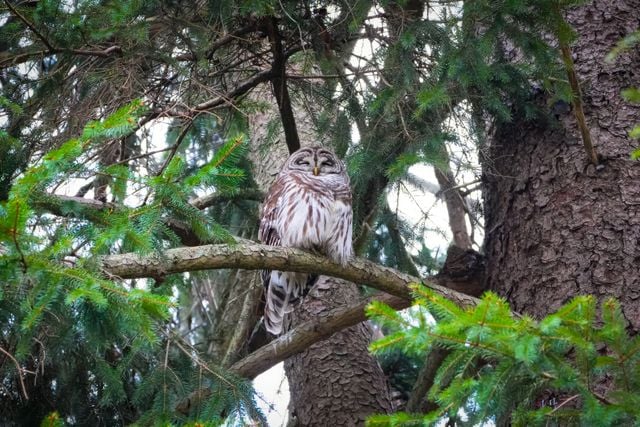
Barred Owl (Strix varia)
The Barred Owl is the owl most often heard in Virginia’s wet woodlands, famous for a rhythmic hooting that sounds like the phrase who cooks for you, who cooks for you all. Large and round-headed with no ear tufts, it has dark eyes and vertical brown streaking on the belly that distinguish it from the yellow-eyed Great Horned Owl. Barred Owls hunt from low perches at dusk and through the night, taking small mammals, amphibians, and the occasional crayfish near water. They nest in tree cavities and old hawk nests, and they call readily during late winter as pairs renew territories. Increasingly, they turn up in older suburban neighborhoods with large trees, and they will sometimes call in daylight.
Water and Wetland Birds
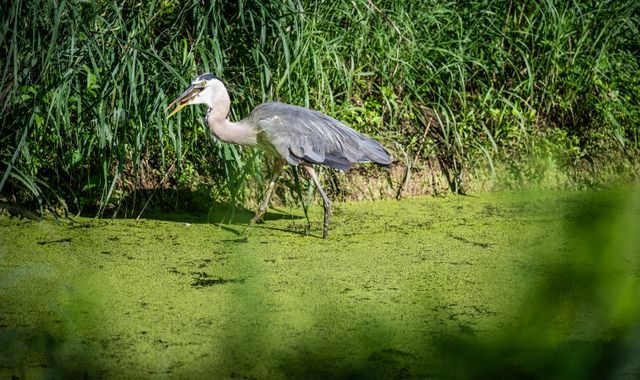
Virginia’s marshes, rivers, impoundments, and coastal flats hold a deep roster of waterbirds. Two of the most widespread and recognizable are profiled here; many more, from the Glossy Ibis of the coastal marshes to wintering ducks, appear in the at-a-glance table and in the wetland spoke guide.
Great Blue Heron (Ardea herodias)
The Great Blue Heron is the tall, blue-gray wading bird that stands motionless in shallow water along nearly every Virginia waterway. Standing up to about 1.3 m (4.5 ft) tall, it hunts by patience, spearing fish, frogs, and small mammals with a sudden thrust of its dagger-like bill. In flight it folds its neck into an S and trails its long legs behind, beating broad wings slowly. Great Blue Herons nest colonially in tall trees, sometimes in rookeries of dozens of nests near rivers and bays, and these colonies are conspicuous before the leaves emerge in spring. The species is present year-round in Virginia, lingering through winter wherever open water allows it to feed.
Canada Goose (Branta canadensis)
The Canada Goose is the familiar brown-bodied goose with a black neck and a white chin strap, abundant on ponds, golf courses, and farm fields across the Commonwealth. Virginia hosts two distinct groups: migratory birds that breed in the far north and winter here, and a large resident population that nests locally and stays all year. Geese graze on grass and waste grain and are strong swimmers and fliers, moving in noisy V-formations that mark the changing seasons. Resident flocks have grown numerous in suburban Northern Virginia and elsewhere, and while they delight some observers, wildlife agencies generally discourage feeding them, since handouts concentrate birds and degrade water quality.
Woodland and Grassland Specialties

Beyond the feeder regulars, Virginia’s forests and open lands hold birds that reward a closer look and a short drive from the yard.
Pileated Woodpecker (Dryocopus pileatus)
The Pileated Woodpecker is the largest woodpecker in Virginia, a crow-sized bird in black and white with a flaming red crest. It chisels distinctive rectangular holes into dead and dying trees as it hunts carpenter ants and beetle larvae, and the size of its excavations and its loud, ringing call announce its presence in mature forest. Once associated mainly with deep woods, the Pileated has adapted to wooded suburbs with large trees and now turns up more widely than it did decades ago. As a powerful cavity excavator, it creates roost and nest holes that wood ducks, owls, and other species later occupy, making it an important architect of the forest community.
Eastern Bluebird (Sialia sialis)
The Eastern Bluebird is a small thrush of open areas with scattered perches, the male brilliant blue above with a rusty breast, the female a softer gray-blue. Bluebirds hunt insects by dropping from a low perch onto the ground, and they switch to fruit and berries in winter, when many remain in Virginia rather than migrating. The species declined in the twentieth century as nest sites disappeared and introduced competitors spread, but a sustained campaign of nest box programs across the state has driven a strong recovery. Today bluebirds grace fence rows, field edges, parks, and golf courses, and a properly placed and monitored box is one of the most reliable ways to host a nesting pair.
Notable Migrants

Spring and fall transform Virginia as long-distance travelers pour through. These neotropical migrants breed in North America and winter in the tropics, and their passage is the highlight of the birding year.
Ruby-throated Hummingbird (Archilochus colubris)
The Ruby-throated Hummingbird is the only hummingbird that breeds regularly in Virginia, a tiny, iridescent green bird that males set off with a brilliant red throat. Ruby-throats typically return to Virginia from mid-April through early May and depart from late August through September, with the earliest arrivals reaching the Hampton Roads region between April 1 and April 15. They feed on flower nectar and small insects, and they readily visit sugar-water feeders mixed at four parts water to one part plain sugar, with no dye. Native plants such as trumpet vine, coral honeysuckle, cardinal flower, and bee balm draw them reliably. Western strays, chiefly the Rufous Hummingbird, occasionally appear at feeders in late fall, which is one good reason to leave a clean feeder up into November.
Baltimore Oriole (Icterus galbula)
The Baltimore Oriole is a flame-orange and black songbird of open woodlands, riversides, and shade trees, the female and young birds a more subdued yellow-orange. Orioles arrive in spring, announce themselves with a rich, flutelike whistle from the treetops, and weave a remarkable hanging, pouch-shaped nest suspended from the tips of high branches. They feed on insects, fruit, and nectar, and they can be coaxed into yards in late April and May with orange halves and grape jelly. Most Baltimore Orioles pass through or breed and then depart for Central America by early fall, so the window to enjoy them is a seasonal pleasure rather than a year-round one.
Look-Alikes: Telling Confusing Pairs Apart
Virginia hosts several species pairs that trip up new and experienced birders alike. The table below summarizes the most useful field marks for three of the most common.
| Pair | Quick separation |
|---|---|
| Downy vs. Hairy Woodpecker | Downy is smaller with a short, stubby bill roughly a third the width of the head; Hairy is larger with a long, chisel-like bill nearly as long as the head is wide. |
| Cooper’s vs. Sharp-shinned Hawk | Cooper’s is larger with a rounded, white-tipped tail and a relatively large head that projects ahead of the wings; Sharp-shinned is smaller with a square-tipped tail and a small head. |
| House Finch vs. Purple Finch | House Finch males show orange-red concentrated on the head and chest with brown-streaked flanks; Purple Finch males look more uniformly raspberry-washed, including the back, with cleaner sides. |
What to See When: A Seasonal Guide
Virginia rewards birders in every season, but the cast of characters changes through the year.
| Season | What to look for |
|---|---|
| Spring (March to May) | Peak warbler and songbird migration along the Atlantic Flyway; orioles, grosbeaks, and vireos arrive; herons begin nesting. |
| Summer (June to August) | Breeding residents on territory; Ruby-throated Hummingbirds at feeders; coastal terns and oystercatchers nesting on barrier beaches. |
| Fall (September to November) | Hawk migration builds, peaking with broad-winged kettles in mid-September; sparrows and finches return; shorebirds linger on the coast. |
| Winter (December to February) | Bald Eagles gather along open rivers; waterfowl crowd the Chesapeake and coastal bays; juncos, White-throated Sparrows, and Northern Saw-whet Owls move south into the state. |
Notable Birding Locations
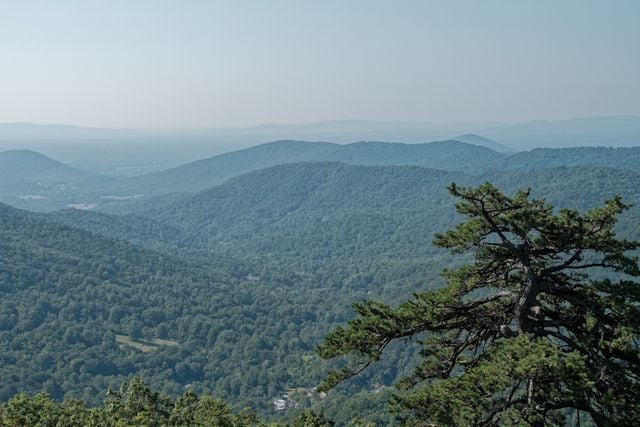
Virginia’s network of refuges, parks, and the Virginia Bird and Wildlife Trail makes the Commonwealth a great place to watch birds in every region. A handful of standout destinations follow.
Chincoteague National Wildlife Refuge, on the Eastern Shore, is one of the most celebrated birding sites in the state. Administered by the U.S. Fish and Wildlife Service and established in 1943 to protect migratory birds, the refuge has recorded more than 320 species using its marshes, beaches, and impoundments during migration, and it once ranked second in shorebird diversity among 450 sites in the International Shorebird Survey. Thousands of snow geese winter here, and the refuge staff protect nesting piping plovers, American oystercatchers, and least terns.
Kiptopeke State Park, at the southern tip of the Eastern Shore, is a famous migration funnel. Its species list exceeds 300 birds, spring and fall songbird migrations produce large numbers of wood warblers, and its elevated Hawkwatch platform ranks among the finest sites in the Americas to view migrating birds of prey. The Coastal Virginia Wildlife Observatory has operated the Kiptopeke Hawkwatch since 1977 and also studies Northern Saw-whet Owls and Prothonotary Warblers there. American Kestrels, Ospreys, Cooper’s Hawks, Merlins, and Peregrine Falcons all pass the platform each fall.
Back Bay National Wildlife Refuge, near Virginia Beach, protects barrier-island and freshwater-marsh habitat that fills with wintering wildfowl and migrating shorebirds.
Huntley Meadows Park, in Fairfax County, is the premier wetland in Northern Virginia. Its marshes host summering bitterns, night-herons, and rails, all viewable from an accessible boardwalk close to Washington.
Shenandoah National Park, strung along the Blue Ridge, offers the state’s signature mountain birding. Forests cover roughly 95 percent of the park, the National Park Service species list approaches 200 birds, and breeding warblers, vireos, and thrushes fill the high ridges through summer. Park biologists note that the declining Cerulean Warbler can still be found here, and the adjacent Blue Ridge Parkway offers further mountain birding.
Great Dismal Swamp National Wildlife Refuge, in the southeast near the North Carolina line, protects nearly 113,000 acres of bottomland forest, the largest intact remnant of a swamp that once exceeded a million acres. More than 200 bird species occur here, including 35 kinds of warblers, and most birders visit during spring migration from mid-April to mid-May to find breeding Prothonotary, Swainson’s, Kentucky, and hooded warblers.
How to Attract Birds to Your Virginia Yard
The best ways to bring birds to a Virginia yard combine food, water, cover, and native plantings. A tube or hopper feeder filled with black oil sunflower seed will draw cardinals, chickadees, titmice, finches, and woodpeckers; nyjer in a fine-mesh feeder pulls in American Goldfinches and, in irruption years, Pine Siskins; and a suet cake supports woodpeckers and wrens through winter. Sugar water at a four-to-one ratio serves Ruby-throated Hummingbirds from spring through early fall.
Water matters as much as food. A clean, shallow birdbath, ideally with a dripper or mover, attracts species that never visit feeders. For nesting, well-built and well-monitored boxes serve Eastern Bluebirds, Carolina Chickadees, and Tufted Titmice, all cavity nesters that struggle to find natural sites in tidy landscapes. Native plantings do the most lasting good: oaks support the caterpillars that nearly all songbirds feed their young, while serviceberry, dogwood, coral honeysuckle, and cardinal flower provide fruit and nectar.
One practical note for Virginia: feeders concentrate birds, which can spread disease, so feeders and baths should be cleaned regularly, and during any songbird mortality event or avian influenza advisory it is wise to check current guidance from the Virginia Department of Wildlife Resources, which periodically recommends taking feeders down to protect local birds.
Conservation in Virginia
Virginia’s bird conservation rests on a strong base of data and a set of vivid recovery stories. The Second Virginia Breeding Bird Atlas, a partnership of the Virginia Department of Wildlife Resources, the Virginia Society of Ornithology, and the Conservation Management Institute at Virginia Tech, gathered more than 5.5 million records across over 200 breeding species during its 2016 to 2020 field work, producing the most detailed map yet of where the state’s birds nest.
That data informs the Virginia Wildlife Action Plan, which designates Species of Greatest Conservation Need. Among them is the Cerulean Warbler, a sky-blue songbird of mature Appalachian forest. Partners in Flight data show its populations fell 72 percent between 1970 and 2014, declines the plan ties to loss of breeding habitat. Forest songbirds like the Cerulean face additional pressure from brood parasitism, as Brown-headed Cowbirds lay their eggs in the nests of other species, leaving host parents to raise cowbird young at the expense of their own.
Two recoveries show what focused work can achieve. The Bald Eagle’s return from under 50 Virginia breeding pairs in 1977 to more than 2,000 today, after federal delisting in 2007 and removal from the state list in 2013, is the most visible. Less famous but equally striking is the Red-cockaded Woodpecker, a federally endangered pine specialist. By 2002 only two breeding pairs survived in Virginia, both at Piney Grove Preserve in Sussex County, which The Nature Conservancy had acquired in 1998. Through prescribed fire, forest thinning, artificial cavities, and translocation, the population has since grown by 14 new breeding groups over the two decades following the start of management in 2002, with recent growth accelerating as the population becomes self-sustaining and birds begin to spread onto neighboring public land.
The coast carries its own priorities. Virginia’s barrier islands support breeding American Oystercatchers along with the federally threatened Piping Plover, monitored by the Department of Wildlife Resources together with The Nature Conservancy and the U.S. Fish and Wildlife Service. National groups such as the American Bird Conservancy work alongside these state and federal partners on habitat protection across the flyway.
Frequently Asked Questions
What is the most common backyard bird in Virginia?
The Northern Cardinal is one of the most commonly reported backyard birds in Virginia, seen year-round at feeders and in shrubby yards statewide. Other birds you are very likely to encounter at a Virginia feeder include the Carolina Chickadee, Tufted Titmouse, Mourning Dove, and American Robin. All are present throughout the year, so a single well-stocked feeder usually draws several of them within days.
What is Virginia’s state bird?
Virginia’s state bird is the Northern Cardinal, designated by the General Assembly on January 25, 1950. It is a non-migratory resident found in every region of the state, and the brilliant red male is one of the most recognizable birds in North America. Both males and females sing, which is unusual among songbirds.
When do hummingbirds arrive in Virginia?
Ruby-throated Hummingbirds, the only hummingbird that breeds regularly in Virginia, typically arrive between early and mid-April, reaching the Hampton Roads area around April 1 to 15 and spreading statewide by early May. Most depart again from late August through September, with stragglers into October. Putting a clean sugar-water feeder out by early April is the best way to catch the first arrivals.
What is the largest bird in Virginia?
By wingspan, the Bald Eagle is the largest bird regularly seen in Virginia, reaching about 2.0 to 2.3 m (6.6 to 7.5 ft) from tip to tip. The Great Blue Heron is the tallest, standing up to about 1.3 m (4.5 ft) on its long legs. Both are present year-round and are easiest to find along rivers, lakes, and the Chesapeake Bay.
Where is the best place to go birding in Virginia?
The Eastern Shore is widely regarded as Virginia’s premier birding region, especially Chincoteague National Wildlife Refuge and Kiptopeke State Park during spring and fall migration. For mountain species, Shenandoah National Park and the Blue Ridge Parkway are the top destinations, while Huntley Meadows Park is the best wetland site in Northern Virginia. The Virginia Bird and Wildlife Trail links hundreds of additional sites across the state.
Conclusion
From the Northern Cardinal at a backyard feeder to Bald Eagles over the Chesapeake and Cerulean Warblers in the Appalachian canopy, the birds of Virginia trace the full sweep of the Commonwealth’s landscapes. The same geography that lifts the Blue Ridge and spreads the coastal marshes gives Virginia a bird list approaching 500 species and a front-row seat on the Atlantic Flyway. Whether you are filling a first feeder, walking the boardwalk at Huntley Meadows, or standing on the Hawkwatch platform at Kiptopeke as the raptors stream south, there is always more to see and a clear reason to protect the habitats that make it possible. For deeper dives, follow our companion guides to the state’s small birds, large birds, owls, and backyard feeder species, each of which expands on a corner of the story told here.
Works Cited
- Virginia Society of Ornithology, Virginia Avian Records Committee. The Official State Checklist (effective December 2025). https://www.virginiabirds.org/offical-state-checklist
- U.S. Fish and Wildlife Service. Migratory Bird Program Administrative Flyways. https://www.fws.gov/partner/migratory-bird-program-administrative-flyways
- Virginia Department of Wildlife Resources. The 2nd Virginia Breeding Bird Atlas. https://dwr.virginia.gov/wildlife/virginia-breeding-bird-atlas/
- Virginia Bird Atlas. Bald Eagle Species Account. https://vabirdatlas.org/species-account/bald-eagle/
- The Center for Conservation Biology. Virginia Bald Eagle Survey. https://ccbbirds.org/what-we-do/research/species-of-concern/virginia-eagles/
- NETSTATE. Virginia State Bird, Northern Cardinal. https://www.netstate.com/states/symb/birds/va_cardinal.htm
- U.S. Fish and Wildlife Service. Chincoteague National Wildlife Refuge. https://www.fws.gov/refuge/chincoteague
- Virginia Department of Wildlife Resources. Chincoteague National Wildlife Refuge. https://dwr.virginia.gov/vbwt/sites/chincoteague-national-wildlife-refuge/
- Virginia Department of Wildlife Resources. Kiptopeke State Park. https://dwr.virginia.gov/vbwt/sites/kiptopeke-state-park/
- Coastal Virginia Wildlife Observatory. https://vawildliferesearch.org/about-us-cvwo-overview
- U.S. Fish and Wildlife Service. Great Dismal Swamp National Wildlife Refuge. https://www.fws.gov/refuge/great-dismal-swamp
- Virginia Department of Wildlife Resources. Great Dismal Swamp National Wildlife Refuge. https://dwr.virginia.gov/vbwt/sites/great-dismal-swamp-national-wildlife-refuge/
- National Park Service. Shenandoah National Park, Birds. https://www.nps.gov/shen/learn/nature/birds.htm
- Virginia Department of Wildlife Resources. Catching the Blue Streak: Following the Cerulean Warbler. https://dwr.virginia.gov/blog/catching-the-blue-streak-following-the-cerulean-warbler-on-its-trans-continental-migration/
- Virginia Department of Wildlife Resources. Red-cockaded Woodpecker. https://dwr.virginia.gov/wildlife/information/red-cockaded-woodpecker/
- The Center for Conservation Biology. The Resurgence of Red-Cockaded Woodpeckers in Virginia. https://ccbbirds.org/2025/02/05/the-resurgence-of-red-cockaded-woodpeckers-in-virginia/
- The Nature Conservancy in Virginia. Red-Cockaded Recovery. https://www.nature.org/en-us/about-us/where-we-work/united-states/virginia/stories-in-virginia/red-cockaded-woodpecker-recovery/
- The Cornell Lab of Ornithology. All About Birds. https://www.allaboutbirds.org