Types of Birds With Long Beaks: 12 Long-Billed Species and How to Spot Them
Some birds carry a tool on their face that you cannot miss. A heron’s dagger, a pelican’s pouch, a curlew’s impossibly long curve: the bill is often the first thing you notice, and frequently the fastest way to put a name to the bird. If you have spotted a long-billed bird and want to know what it was, or you are simply curious about why so many birds wear such extravagant beaks, this guide is for you.
A long beak is a feeding tool rather than a family trait, and it has evolved independently in many unrelated bird groups, each lengthening the bill to reach food that a shorter bill could not. That is why the birds below look so different from one another. A spoonbill and a hummingbird share almost nothing except the principle that a longer bill opens a door to food other birds cannot touch.
This article profiles twelve of the most notable and most likely-to-be-seen long-billed birds worldwide, from the herons and pelicans you may meet at a local wetland to the showstoppers of the tropics and the Andes. We explain how each bird’s bill works, where to find it, and how to tell the easily confused ones apart.
At a glance
- Long bills are built for reach, and across the birds in this guide it is used to spear, scoop, probe, sweep, sip, or grope for food.
- The Australian pelican (Pelecanus conspicillatus) holds the record for the longest bill of any living bird at 34 to 47 cm (13 to 18.5 in), per Guinness World Records, while the sword-billed hummingbird (Ensifera ensifera) is the only bird whose bill is longer than its own body.
- In North America, the long-billed birds you are most likely to encounter are the great blue heron, the belted kingfisher, and the American white pelican.
- Many long-billed birds find food by touch rather than sight, which lets skimmers and wood storks forage in murky water or even after dark.
- Most herons, pelicans, and kingfishers are stable, but the shoebill (Balaeniceps rex) is listed as Vulnerable and the helmeted hornbill is Critically Endangered (IUCN Red List, as of 2026).
Long-Billed Birds at a Glance
| Species | Scientific name | Size (length) | Region | Where the trait shows / key field mark | Sexes differ? |
|---|---|---|---|---|---|
| Great Blue Heron | Ardea herodias | 97 to 137 cm (38 to 54 in) | North and Central America | Long, thick, yellow daggerlike bill; flies with neck folded | No |
| American White Pelican | Pelecanus erythrorhynchos | 127 to 180 cm (50 to 70 in) | North America | Massive yellow bill with throat pouch; breeding horn on upper bill | No |
| Belted Kingfisher | Megaceryle alcyon | 28 to 35 cm (11 to 14 in) | North America | Heavy straight bill, shaggy crest; plunge-dives | Yes (female more colorful) |
| Long-billed Curlew | Numenius americanus | 50 to 65 cm (20 to 26 in) | Western North America | Very long downcurved bill, cinnamon wash | Slightly (female bill longer) |
| American Avocet | Recurvirostra americana | 40 to 51 cm (16 to 20 in) | Western North America | Slender upturned bill swept side to side | Slightly (female bill more curved) |
| Black Skimmer | Rynchops niger | about 46 cm (18 in) | Americas | Red-and-black bill, lower half longer than upper | No |
| Roseate Spoonbill | Platalea ajaja | 71 to 86 cm (28 to 34 in) | Southeast US to South America | Flat, spoon-tipped bill; pink body | No |
| Wood Stork | Mycteria americana | 85 to 115 cm (33 to 45 in) | Southeast US, Central and South America | Heavy downcurved bill, bald gray head | No |
| Sword-billed Hummingbird | Ensifera ensifera | 13 to 14 cm (5.1 to 5.5 in) body; bill 8 to 12 cm (3 to 4.7 in) | Andes (Venezuela to Bolivia) | Bill longer than the body | Yes (male bill shorter) |
| Toco Toucan | Ramphastos toco | 55 to 65 cm (22 to 26 in) | South America | Huge orange bill, about a third of total length | No |
| Great Hornbill | Buceros bicornis | 95 to 130 cm (37 to 51 in) | South and Southeast Asia | Massive bill topped by a flat casque | Yes (female smaller casque) |
| Shoebill | Balaeniceps rex | 110 to 150 cm (43 to 59 in) tall | Central and East Africa | Enormous clog-shaped bill with hooked tip | No |
Counts and statuses are noted with their source in each profile below, and conservation summaries follow the IUCN Red List as of 2026.
About the Long Beak: What It Is and Why It Exists
A long beak is a structural feature, which means it is part of a bird’s anatomy rather than a color or a pattern. Understanding what the bill is and what it does turns a simple field mark into a window on the whole bird, and it helps explain why bird beaks vary so much from one species to the next.
A bird’s beak is built in two layers. Underneath lies a bony structure that grows from the skull, and over that bony core sits a sheath of keratin, the same protein found in your fingernails. Biologists call that sheath the rhamphotheca, and like a fingernail it grows continuously and wears down through use (Cellular, Molecular, and Genetic Mechanisms of Avian Beak Development, 2025). Every bird’s beak has two halves: the upper mandible, also called the maxilla, and the lower mandible, the part set into the lower jaw. Some long-billed species also have remarkably long tongues that reach beyond the bill to lap up nectar or seize prey.
The shape of a bird’s beak follows what it eats, one of the clearest illustrations of evolution in the natural world. Across the world of birds you can find nearly every variation: thin beaks for probing, straight beaks for spearing, flat beaks shaped like a spoon, a curved beak for reaching into mud, and the big beaks and massive bills of toucans and hornbills. Beak size and beak shape together tell you how a bird makes its living, because each form opens a different ecological niche, and these different types of beaks are what set the long-billed birds apart.
Length almost always buys reach. A heron uses a sharp beak ending in a sharp point to strike small fish from a distance, a curlew probes deep into mud for buried worms, a hummingbird drinks from flowers with long throats, and a pelican scoops a netful of water and fish. Other long-billed birds sweep up aquatic invertebrates, small crustaceans, and small insects, and a few catch insects on the wing. The reach takes many forms, from the downcurved probe of a curlew to the upturned sweep of an avocet, the straight dagger of a heron or kingfisher, the flat spatula of a spoonbill, the pouched scoop of a pelican, the lopsided slice of a skimmer, and the casque-topped bills of hornbills.
Many of these birds feed by touch rather than sight. Spoonbills, ibises, storks, and skimmers carry sensitive nerve endings near the bill tip and snap shut the instant prey makes contact, which is why some of them can forage in murky water or after dark. A few beak structures do more than gather food. The enormous bill of the toco toucan is laced with blood vessels and works as a radiator, letting the bird shed or conserve body heat by adjusting its blood flow (Tattersall et al., 2009). The kiwi bird of New Zealand takes a different path, carrying its nostrils at the very tip of a long bill so it can smell out food underground.
It also helps to know what a long bill is not. The short, hooked bills of birds of prey such as the bald eagle are built for tearing, and the thick conical bill of a seed-eater like the northern cardinal is built for cracking open seeds. A bird’s beak is a precise tool, and length is just one of many solutions, one that the strong beaks of these waders, divers, and nectar-feeders have turned into something both useful and beautiful.
Great Blue Heron (Ardea herodias)
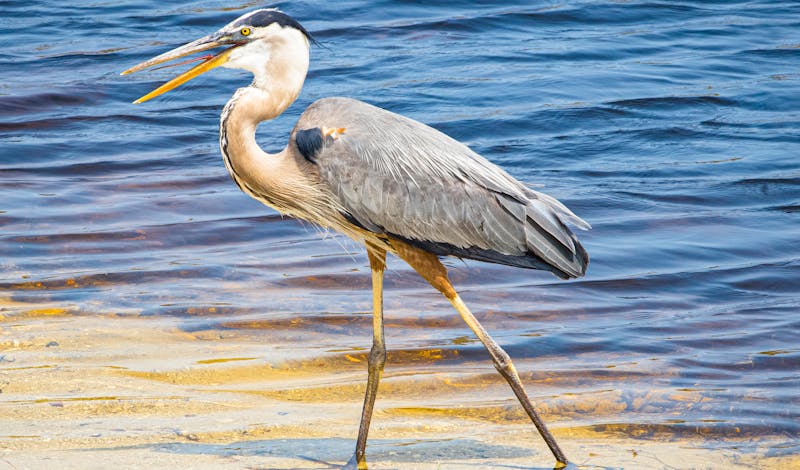
The Great Glue Heron is the long-billed bird most North Americans meet first, a tall, gray-blue wader that stands patiently at the edge of almost any pond, river, or marsh. It measures 97 to 137 cm (38 to 54 in) long with a wingspan of 167 to 201 cm (66 to 79 in), making it the largest heron in North America (Cornell Lab of Ornithology). Its African relative, the goliath heron, is the largest heron in the world.
The bill is the business end of the bird: long, thick, and daggerlike, colored orangish yellow, and ending in a sharp point for spearing or seizing small fish, frogs, and other small animals. The heron hunts by standing motionless or stalking slowly, then striking in a blur. In flight it folds its neck back into an S shape and trails its long legs behind, a silhouette that separates it instantly from cranes and storks.
You can find great blue herons across most of North and Central America, in both fresh and salt water. They are often solitary while foraging and give a harsh, croaking squawk when flushed.
Quick scan: very large gray-blue wader; long, thick yellow bill; flies with neck folded into an S; stands still or stalks in shallows; found near water across most of North America.
American White Pelican (Pelecanus erythrorhynchos)

The American White Pelican is one of the largest birds in North America, a large bird, a snow-white giant with black wingtips and a wingspan near 2.7 m (9 ft). Its body runs 127 to 180 cm (50 to 70 in) long, and the long, heavy yellow-orange bill gives this water bird an almost prehistoric profile. Its clean white plumage and black wingtips make it easy to pick out, while its Australian cousin, the Australian pelican, carries the longest bill of any bird.
That bill carries an expandable throat pouch, which the bird uses to scoop a mouthful of water and fish, then drains before swallowing. Contrary to the cartoon image, pelicans do not store food in the pouch. During breeding season adults grow a strange fibrous plate on the upper bill called a nuptial tubercle, a horn that is shed after nesting and is unique among pelicans (Cornell Lab of Ornithology). Unlike the coastal brown pelican, which plunge-dives from the air, the white pelican feeds cooperatively, with groups herding fish into the shallows.
Look for American white pelicans on inland lakes and wetlands in summer and near southern coastlines in winter, often soaring in steady, wheeling flocks.
Quick scan: huge white bird with black wingtips; long yellow-orange pouched bill; breeding birds grow a horn on the bill; feeds in cooperative groups, does not dive; inland in summer, coastal in winter.
Belted Kingfisher (Megaceryle alcyon)
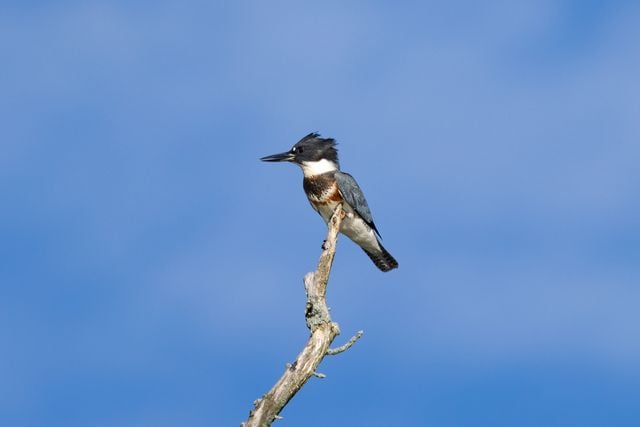
The Belted Kingfisher is the only kingfisher found across most of North America, a stocky, big-headed bird about 28 to 35 cm (11 to 14 in) long with a shaggy crest and a heavy, straight, daggerlike bill. It is powdery blue-gray above and white below.
The bill is built for fishing. A kingfisher perches above clear water or hovers on rapid wingbeats, then plunges headfirst to grab a small fish, returning to a perch to beat and swallow it (Cornell Lab of Ornithology). The kingfisher family spans the globe, from the brilliant common kingfisher of Eurasia to the jewel-toned cerulean kingfisher of Indonesia. In an unusual twist, the female is more colorful than the male, wearing an extra chestnut band across the belly in addition to the blue breast band both sexes share.
Belted kingfishers live near streams, rivers, lakes, and coasts across the continent, nesting in burrows dug into earthen banks. You will often hear the loud, dry rattle before you see the bird patrolling its stretch of water.
Quick scan: stocky blue-gray bird with a shaggy crest; heavy straight bill; plunges headfirst for fish; female has an extra chestnut belly band; loud rattling call near water.
Long-billed Curlew (Numenius americanus)
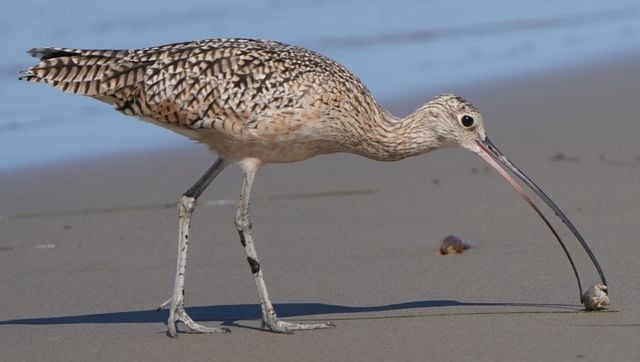
The Long-billed Curlew is the largest shorebird in North America and the owner of the longest bill of any shorebird on the continent. The body runs 50 to 65 cm (20 to 26 in), and the slender, downcurved bill alone measures 11.3 to 21.9 cm (4.5 to 8.6 in), with females carrying noticeably longer bills than males (Cornell Lab of Ornithology).
That long curve is a precision probe. On its coastal wintering grounds the curlew reaches deep into mud and sand for crabs, shrimp, and worms, its primary food source there, while on its prairie breeding grounds it picks grasshoppers from the grass. The bird is a warm cinnamon-buff overall, with bright cinnamon underwings flashing in flight. Its ringing call sounds like cur-lee, rising on the second note.
Long-billed curlews breed in the shortgrass and mixed-grass prairies of the western Great Plains and Great Basin, then winter along the coasts and in interior Mexico.
Quick scan: large cinnamon-washed shorebird; very long downcurved bill; female bill longer than male’s; probes mud and prairie soil; ringing cur-lee call.
American Avocet (Recurvirostra americana)

The American Avocet shows that a long bill need not curve downward. This elegant black-and-white wader, 40 to 51 cm (16 to 20 in) long with a wingspan of 68 to 76 cm (27 to 30 in), carries a slender bill that sweeps upward toward the tip (Cornell Lab of Ornithology).
The avocet feeds with a signature motion called scything, swinging its slightly open, upturned bill side to side through shallow water to catch tiny invertebrates by touch. Females tend to have shorter, more strongly curved bills than males, a subtle but useful detail. In breeding season the head and neck flush a warm rusty cinnamon, fading to grayish white in winter, while the long legs stay a pastel blue-gray.
American avocets breed in shallow wetlands, salt ponds, and alkaline lakes across the western and midwestern United States, then move to coastal and southern wetlands for winter.
Quick scan: striking black-and-white wader on tall blue-gray legs; slender upturned bill; sweeps bill side to side; rusty head and neck in summer; western wetlands and salt ponds.
Black Skimmer (Rynchops niger)
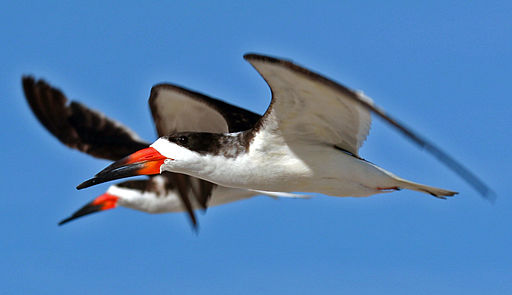
The Black Skimmer owns one of the strangest bills in the bird world, a red-and-black blade in which the lower half is distinctly longer than the upper. About 46 cm (18 in) long, this slim seabird flies low over calm water with that long lower mandible slicing the surface, and the instant it touches a fish the bill snaps shut (Cornell Lab of Ornithology).
Because this is feeding by feel rather than sight, skimmers can forage at dawn, dusk, and even in full darkness, and they are the only birds on Earth that hunt this way. Two more details set them apart: chicks hatch with upper and lower mandibles of equal length, the lower outgrowing the upper only as the bird approaches fledging, and skimmers are the only birds with vertical, catlike pupils, which help cut the glare off bright water and sand.
Black skimmers live along beaches, inlets, and lagoons throughout the Americas, nesting in open colonies on sand.
Quick scan: slim black-and-white seabird with very long wings; red-and-black bill with a longer lower half; skims the water surface to feed; active at dusk and night; coastal beaches of the Americas.
Roseate Spoonbill (Platalea ajaja)
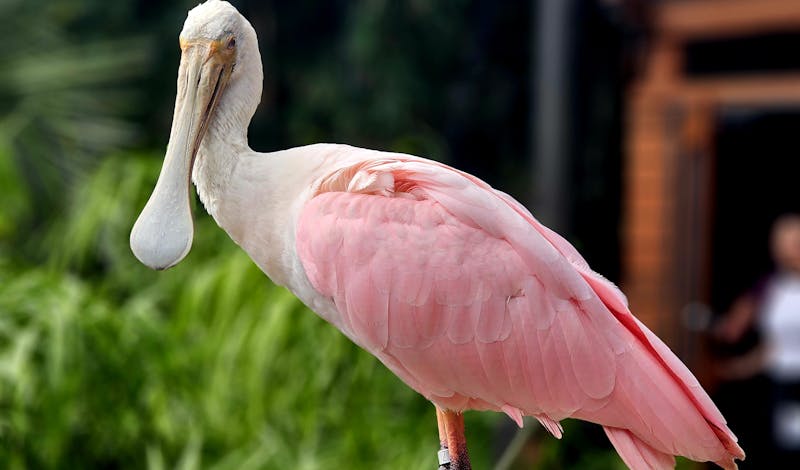
The Roseate Spoonbill turns heads twice, first for its flamingo-pink plumage and again for the flat, gray, spoon-tipped bill that gives it its name. It measures 71 to 86 cm (28 to 34 in) long with a wingspan of 120 to 133 cm (47 to 52 in).
The bill is a tactile tool. The spoonbill wades slowly with the bill partly open, sweeping it side to side, and snaps shut when prey touches the sensitive tip. Its famous color is borrowed rather than built in: carotenoid pigments from the small crustaceans it eats tint the feathers, so a bird on a poor diet looks pale, and chicks hatch with straight, narrow bills that only later widen into the spoon (Cornell Lab of Ornithology).
Roseate spoonbills forage in shallow fresh and salt water along the southeastern United States coast and south through Central and South America, often feeding in flocks alongside egrets and ibises.
Quick scan: unmistakable pink wader; flat, gray, spoon-tipped bill; sweeps bill side to side to feed; color comes from its crustacean diet; coastal Southeast and the American tropics.
Wood Stork (Mycteria americana)
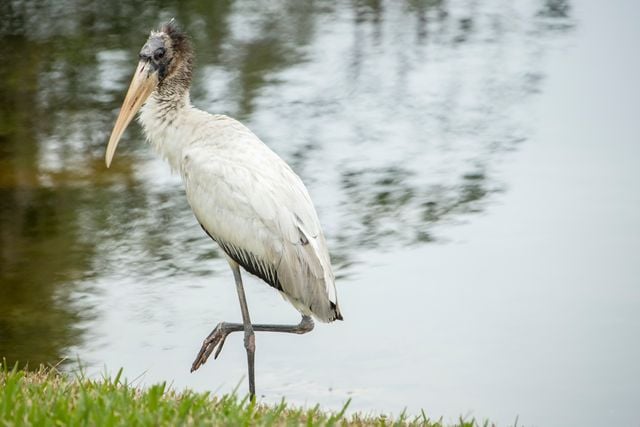
The Wood Stork is the only stork that breeds in the United States and the largest wading bird that does, standing about 1 m (3 ft) tall with a body 85 to 115 cm (33 to 45 in) long. Its white plumage is set off by black flight feathers and a distinctive bald, dark-gray head, topped by a long, heavy, slightly downcurved bill. A much larger relative, the marabou stork of Africa, shares the family’s heavy bill but makes its living mostly by scavenging.
Like its relatives, the wood stork is a tactile feeder. It wades with its open bill in the water, and when a fish makes contact the bill snaps shut in roughly 25 milliseconds, one of the fastest reflexes recorded in any vertebrate (U.S. Fish and Wildlife Service). Birds often forage in groups, heads down, sometimes following one another in a line, and soar to and from feeding areas on broad wings.
Wood storks live in the wetlands of the southeastern United States, especially Florida, Georgia, and the Carolinas, and south through the American tropics. The U.S. population recovered enough to be reclassified from Endangered to Threatened in 2014.
Quick scan: large white wading bird with black flight feathers; bald dark-gray head; heavy downcurved bill; feeds by touch with head down; southeastern wetlands.
Sword-billed Hummingbird (Ensifera ensifera)
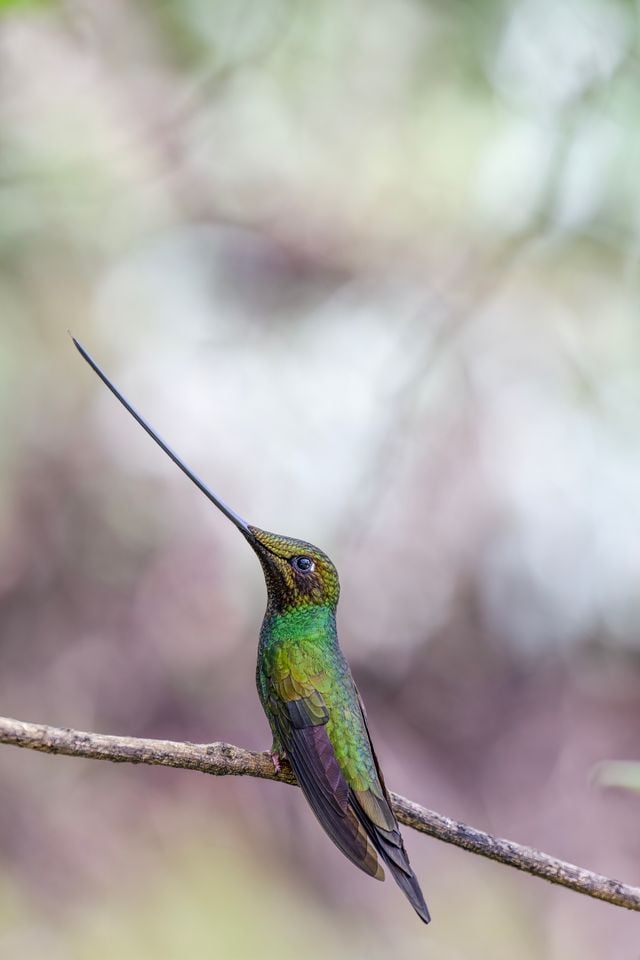
The Sword-billed Hummingbird is the most extreme long-billed bird alive, and the only bird in the world whose bill is longer than its own body, excluding the tail. The bill alone measures roughly 8 to 12 cm (3 to 4.7 in), longer than the bird’s body of about 13 to 14 cm (5.1 to 5.5 in) measured without the bill (Cornell Lab of Ornithology).
That outsized bill is a key to a locked door. It lets the bird drink from long, tubular flowers such as the passionflower Passiflora mixta, blooms too deep for other hummingbirds, and the two have coevolved over time. The bill is so long that the bird cannot use it to preen, so it scratches its feathers clean with its feet, and when perched it holds the bill angled upward to balance the weight. The plumage is metallic green, with males slightly more vivid than females, and the bird also darts out to catch insects and other small insects in flight for protein. Another long-billed Andean nectar specialist, the violet sabrewing, carries a large, gently curved bill of its own.
The sword-billed hummingbird lives in the cloud forests and montane scrub of the Andes, from northern South America in Venezuela south to Bolivia, generally between about 2,500 and 3,500 m elevation.
Quick scan: medium-large hummingbird with a bill longer than its body; metallic green plumage; perches with bill held upward; feeds from long tubular flowers; Andean cloud forests.
Toco Toucan (Ramphastos toco)
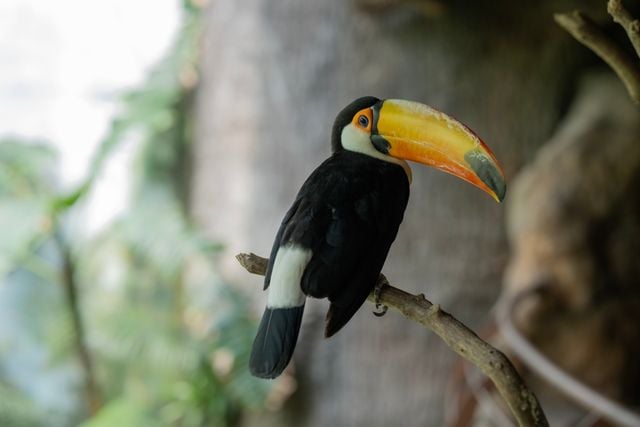
The Toco Toucan is the largest toucan and carries the largest beak relative to body size of any bird. The whole bird runs 55 to 65 cm (22 to 26 in) long, and that famous orange bill, tipped with a black spot, accounts for about a third of its total length.
For all its size, the bill is lightweight, built from a thin keratin shell over a network of bony struts. Research using infrared imaging showed it is also a radiator: laced with blood vessels, it lets the toucan dump or conserve heat by adjusting blood flow, rivaling an elephant’s ears as a thermal window (Tattersall et al., 2009). Day to day, the bird uses the bill to reach and handle fruit, and also to take eggs, insects, and small mammals. Its rainbow-billed cousin, the keel-billed toucan of Central America, is the national bird of Belize.
Toco toucans live across a range of various habitats, including semi-open country, forest edges, and savanna woodlands across much of central and eastern South America, and are listed as Least Concern.
Quick scan: large black bird with a white throat; enormous orange bill with a black tip; bill about a third of body length and used as a heat radiator; semi-open South American habitats.
Great Hornbill (Buceros bicornis)
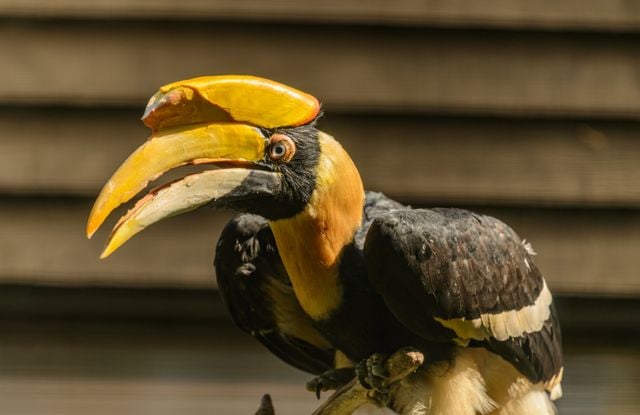
he great hornbill is one of Asia’s most imposing birds, reaching 95 to 130 cm (37 to 51 in) long, with a massive bright yellow bill topped by a flat, forked casque, a hollow helmet of keratin over bone. The casque is larger in males, and the bird’s black-and-white plumage and loud, whooshing wingbeats make it unmistakable in its forest home (IUCN Hornbill Specialist Group).
The bill is mainly a fruit-handling tool, though great hornbills also take small mammals, reptiles, and small birds. Their breeding behavior is remarkable: the female seals herself inside a cavity in a tree trunk behind a wall of mud and droppings, leaving only a narrow slit through which the male passes food while she incubates and the chicks grow.
Great hornbills live in the rainforests of South and Southeast Asia and depend on large old trees for nesting. A close relative, the rhinoceros hornbill of the Malay Peninsula and Borneo, wears a dramatic upturned orange casque. The great hornbill is listed as Vulnerable, mainly because of deforestation and hunting.
Quick scan: very large black-and-white forest bird; huge yellow bill with a flat forked casque; loud whooshing wingbeats; female walls herself into the nest; rainforests of South and Southeast Asia.
Shoebill (Balaeniceps rex)
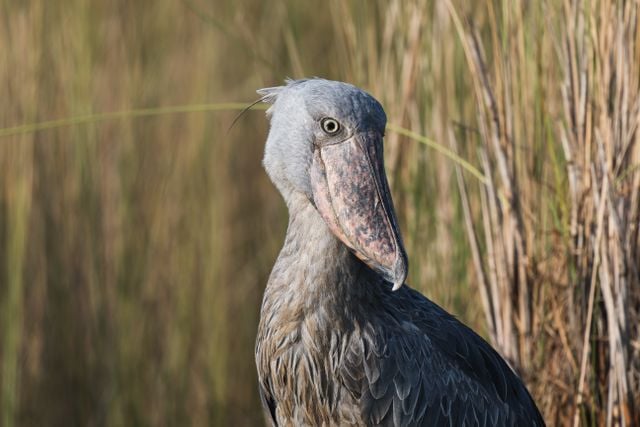
The shoebill saves the most dramatic bill for last. This prehistoric-looking African bird stands 110 to 150 cm (43 to 59 in) tall with a wingspan of 230 to 260 cm (91 to 102 in), and its enormous, broad, deep bill, roughly 20 to 25 cm (8 to 12 in) long, really does resemble a wooden clog, ending in a sharp hook.
That bill is built for seizing large, slippery prey, especially lungfish, in the swamps where the shoebill ambushes from total stillness. Despite the common nickname “shoebill stork,” genetic evidence places it closer to pelicans and herons than to true storks, and it sits in its own family. Birders travel far to see it, drawn by its large size, statuesque calm, and habit of clattering the bill like castanets.
The shoebill lives in the papyrus swamps of central and eastern Africa, from South Sudan to Zambia. It is listed as Vulnerable and declining from wetland loss and disturbance, with a global population estimated at roughly 5,000 to 8,000 birds, of which about 3,300 to 5,300 are mature individuals (BirdLife International).
Quick scan: huge gray swamp bird; broad clog-shaped bill with a hooked tip; stands motionless to ambush lungfish; clatters its bill; papyrus swamps of central and eastern Africa.
How to Tell Confusing Long-Billed Birds Apart
A few of these birds get mixed up with neighbors that share their habitat. Here is how to split the most common confusions.
| You might confuse | Tell them apart by |
|---|---|
| Great Blue Heron vs Sandhill Crane | The heron flies with its neck folded into an S; the crane flies with its neck fully outstretched. The heron stalks the water’s edge, while cranes feed in open fields and grasslands. |
| Wood Stork vs egrets and herons | The wood stork has a bald dark head and a heavy downcurved bill, and it forages head-down by touch. White egrets have feathered heads and straight bills and hunt by sight. |
| Long-billed Curlew vs Whimbrel vs Marbled Godwit | The curlew has the longest, most strongly downcurved bill and no bold head stripes. The whimbrel has a shorter downcurved bill and dark head stripes. The godwit’s long bill turns slightly upward, not down. |
| American Avocet vs Black-necked Stilt | The avocet has an upturned bill and a sturdier, black-and-white patterned body. The stilt has a straight bill, even longer pink-red legs, and a cleaner black-and-white pattern. |
Frequently Asked Questions
What kind of bird has a long beak?
Many unrelated birds have long beaks, including pelicans, herons, storks, spoonbills, ibises, curlews, avocets, skimmers, kingfishers, toucans, hornbills, and some hummingbirds. In each case the long bill is an adaptation for reaching food, whether by spearing, scooping, probing, sweeping, or sipping. The bill shape usually tells you how the bird feeds.
What bird has the longest beak?
The Australian pelican has the longest beak of any living bird, measured at 34 to 47 cm (13 to 18.5 in), with a record near 50 cm (20 in), according to Guinness World Records. Measured relative to body size instead, the record belongs to the sword-billed hummingbird, the only bird whose bill is longer than its own body.
What bird has a beak longer than its body?
The sword-billed hummingbird of the Andes is the only bird with a bill longer than the rest of its body, excluding the tail. It evolved this extreme bill to drink from long, tubular flowers that other hummingbirds cannot reach, and the bill is so long that the bird must preen with its feet rather than its bill.
What are the different types of bird beaks?
Bird beaks come in many shapes, each matched to a food source: long thin beaks for probing mud, straight dagger beaks for spearing fish, flat spoon-shaped beaks for sweeping water, upturned and curved beaks for different reaches, big beaks and large beaks for handling fruit, and the short hooked beaks of birds of prey. Beak shape and beak size are among the most reliable field marks for telling bird species apart.
Why do some birds have long beaks?
Birds evolve long beaks mainly to reach food a shorter bill could not, such as fish struck from a distance, invertebrates buried deep in mud, or nectar at the bottom of a long flower. A few birds use a long bill for other jobs as well, like the toco toucan, which uses its oversized bill to shed body heat. The bill’s exact shape reflects how each species feeds.
What long-billed birds live in North America?
The most familiar long-billed birds in North America include the great blue heron, the American white pelican, the belted kingfisher, the long-billed curlew, the American avocet, the black skimmer, the roseate spoonbill, and the wood stork. Herons and kingfishers turn up near water almost everywhere, while spoonbills and wood storks are concentrated in the southeastern wetlands.
Are any birds with long beaks endangered?
Yes, several are. Many herons, pelicans, and kingfishers are stable and listed as Least Concern, but the shoebill and the great hornbill are both listed as Vulnerable, and the helmeted hornbill is Critically Endangered, largely because of habitat loss and poaching (IUCN Red List, as of 2026).
Conclusion
A long beak is one of the clearest examples in nature of form following function. The birds in this guide are only distantly related, yet each arrived at a similar tool by a different evolutionary route, shaped by the particular food it pursues. Once you learn to read the bill, whether it scoops, spears, probes, sweeps, sips, or gropes, a single field mark starts to tell you how a bird lives.
These birds also remind us how much their futures depend on healthy habitats, from prairie wetlands to papyrus swamps and tropical forests. If you enjoyed this guide, explore our other appearance guides to birds by color and shape, our coastal birding guides for the shorebirds and waders along the Atlantic and Gulf, and our species deep dives on standouts like the brown pelican. The next time you are near water or a forest edge, watch the bills, because they have a great deal to say.
Works Cited
- Cornell Lab of Ornithology. “Great Blue Heron: Identification.” All About Birds. https://www.allaboutbirds.org/guide/Great_Blue_Heron/id
- Cornell Lab of Ornithology. “American White Pelican: Overview.” All About Birds. https://www.allaboutbirds.org/guide/American_White_Pelican/overview
- Cornell Lab of Ornithology. “American White Pelican: Identification.” All About Birds. https://www.allaboutbirds.org/guide/American_White_Pelican/id
- Cornell Lab of Ornithology. “Belted Kingfisher: Overview.” All About Birds. https://www.allaboutbirds.org/guide/Belted_Kingfisher/overview
- Cornell Lab of Ornithology. “Long-billed Curlew: Overview.” All About Birds. https://www.allaboutbirds.org/guide/Long-billed_Curlew/overview
- Wikipedia. “Long-billed curlew.” https://en.wikipedia.org/wiki/Long-billed_curlew
- Cornell Lab of Ornithology. “American Avocet: Identification.” All About Birds. https://www.allaboutbirds.org/guide/American_Avocet/id
- Wikipedia. “American avocet.” https://en.wikipedia.org/wiki/American_avocet
- Cornell Lab of Ornithology. “Black Skimmer: Overview.” All About Birds. https://www.allaboutbirds.org/guide/Black_Skimmer/overview
- Cornell Lab of Ornithology. “Roseate Spoonbill: Overview.” All About Birds. https://www.allaboutbirds.org/guide/Roseate_Spoonbill/overview
- Cornell Lab of Ornithology. “Wood Stork: Overview.” All About Birds. https://www.allaboutbirds.org/guide/Wood_Stork/overview
- U.S. Fish and Wildlife Service. “Species Profile for Wood Stork (Mycteria americana).” https://ecos.fws.gov/ecp/species/8477
- Cornell Lab of Ornithology. “Sword-billed Hummingbird.” Birds of the World. https://birdsoftheworld.org/bow/species/swbhum1/cur/introduction
- Tattersall, G. J., Andrade, D. V., and Abe, A. S. (2009). “Heat Exchange from the Toucan Bill Reveals a Controllable Vascular Thermal Radiator.” Science 325 (5939): 468 to 470. https://www.science.org/doi/10.1126/science.1175553
- IUCN Hornbill Specialist Group. “Great hornbill.” https://iucnhornbills.org/great-hornbill/
- Animal Diversity Web. “Buceros bicornis (great hornbill).” https://animaldiversity.org/accounts/Buceros_bicornis/
- Animal Diversity Web. “Ramphastos toco (Toco toucan).” https://animaldiversity.org/accounts/Ramphastos_toco/
- Wikipedia. “Shoebill.” https://en.wikipedia.org/wiki/Shoebill
- BirdLife International. “Shoebill.” https://www.birdlife.org/birds/shoebill/
- Guinness World Records. “Longest bills.” https://www.guinnessworldrecords.com/world-records/longest-bills
- Tokita, M., et al. (2025). “Cellular, Molecular, and Genetic Mechanisms of Avian Beak Development and Evolution.” https://pmc.ncbi.nlm.nih.gov/articles/PMC11777486/