Osprey: Mythology, Habitat, Diet, and More
“I think he’ll be to Rome / As is the osprey to the fish, who takes it / By sovereignty of nature.” William Shakespeare, Coriolanus
| Attribute | Detail |
|---|---|
| Common name | Osprey (also called fish hawk, sea hawk, or river hawk) |
| Scientific name | Pandion haliaetus |
| Order | Accipitriformes |
| Family | Pandionidae |
| Length | 50 to 66 cm (20 to 26 in) |
| Wingspan | 127 to 180 cm (50 to 71 in) |
| Range | Every continent except Antarctica; a nonbreeding migrant only in South America |
| Primary habitat | Shallow, fish-rich waters: coasts, rivers, lakes, reservoirs, and marshes |
| Conservation status (IUCN) | Least Concern (2021 assessment), population increasing |
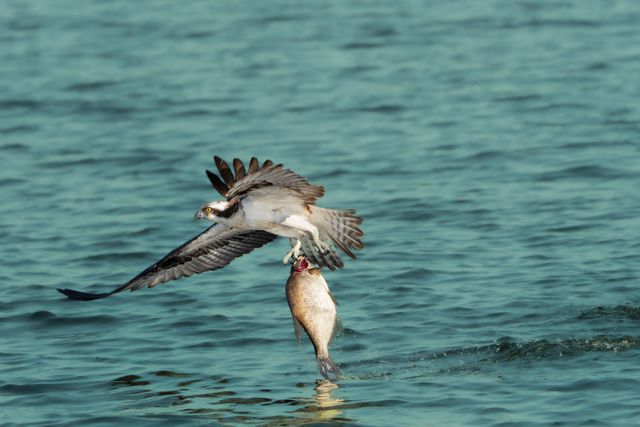
The Osprey (Pandion haliaetus) is a large, fish-eating raptor found near open water across nearly the entire globe, and it is the only hawk in North America that lives almost exclusively on live fish. You have likely seen one without knowing its name: a long-winged, white-bellied bird hovering above a river or estuary, then folding and plunging feet-first into the water before rising again with a fish gripped beneath it.
This guide covers the whole story of the Osprey, from the tangled Greek myth behind its scientific name to the closable nostrils and reversible toes that make it such a precise angler. Along the way it looks at where Ospreys live, how they raise their young, what they eat, how they sound, and how a species nearly lost to pesticides became one of conservation’s clearest success stories.
Key Takeaways
- The Osprey is a globally distributed bird of prey that hunts live fish, found on every continent except Antarctica.
- It is the sole living member of the family Pandionidae, set apart from all other hawks and eagles by adaptations built entirely around catching fish.
- In flight it shows long, narrow wings with a distinctive kink at the wrist, a white belly, dark wrist patches, and a white head crossed by a dark eye stripe.
- Across cultures the Osprey has long stood for keen vision, fidelity, and mastery of the water, from a Confucian poem on courtship to Shakespeare’s image of natural dominion.
- Once devastated by the pesticide DDT, the Osprey rebounded after the 1972 U.S. ban and is now rated Least Concern by the IUCN, with numbers still rising.
Mythology, Symbolism, and Cultural Significance
The Osprey has fascinated people wherever rivers and coasts meet, and several of the world’s oldest literary traditions reach for it as a symbol of vision, devotion, and natural command.
The bird’s scientific name carries a strange and slightly mangled myth. When the French zoologist Marie Jules César Savigny established the genus Pandion in 1809, he reached into Greek legend for Pandion, a mythical king of Athens. As told by the Roman poet Ovid in his Metamorphoses (first century), the saga around Pandion’s family ends with several characters transformed into birds. In the related tale of Nisus, a king whose daughter Scylla betrays him, Nisus is changed into a sea eagle (often identified with the Osprey) and condemned to pursue her across the sky forever. Savigny’s choice has puzzled later writers, since the figure actually turned into a fishing raptor in the myth was not Pandion himself, but the name stuck and remains the only genus the Osprey occupies.
In China, the Osprey opens the oldest anthology of Chinese verse. The first poem of the Shijing (the Classic of Poetry), known as “Guan ju” (關雎) and dated to roughly the seventh century BC, begins with the cry of ospreys calling on a river islet. Traditional Confucian commentators, beginning with the Han-era Mao School, read the paired ospreys as an emblem of proper courtship and marital harmony, a model of devotion between a noble man and a virtuous woman. The poem has been studied and memorized for more than two thousand years, which makes the Osprey one of the most enduring bird symbols in Chinese literature.
European folklore took a more practical interest in the bird’s hunting. A medieval belief held that fish were so transfixed by the Osprey that they rolled belly-up in surrender, an idea Shakespeare drew on in Coriolanus (written around 1605 to 1608), where Aufidius predicts that the hero will take Rome “as is the osprey to the fish, who takes it / By sovereignty of nature.”
In heraldry the Osprey is usually drawn as a white “sea-eagle,” frequently clutching a fish, and it has carried associations of clear sight and abundance. In more recent times it has become a broad emblem of conservation and of healthy waters, appearing on dozens of international postage stamps. In 1994 it was named the provincial bird of Nova Scotia, Canada.
Classification and Physical Characteristics
The Osprey sits alone in its corner of the bird family tree. It is the only living species in the genus Pandion and the only member of the family Pandionidae, distinct enough from the true hawks and eagles that taxonomists place it in a family of its own within the order Accipitriformes.
- Kingdom: Animalia
- Phylum: Chordata
- Class: Aves
- Order: Accipitriformes
- Family: Pandionidae
- Genus: Pandion
- Species: Pandion haliaetus
The species was first described by Carl Linnaeus in 1758 (originally as Falco haliaetus), and the name haliaetus derives from Greek roots meaning, fittingly, “sea eagle.” Four subspecies are generally recognized, separated by geography: P. h. carolinensis across North America and the Caribbean, P. h. haliaetus across Eurasia and North Africa, the non-migratory P. h. ridgwayi of the Caribbean, and P. h. cristatus of Australasia. (A note for the precise: the Australasian bird, the Eastern Osprey, is treated by some authorities, including the IOC World Bird List, as a full species, Pandion cristatus. The eBird/Clements taxonomy followed here keeps it as a subspecies of a single, worldwide Osprey.)
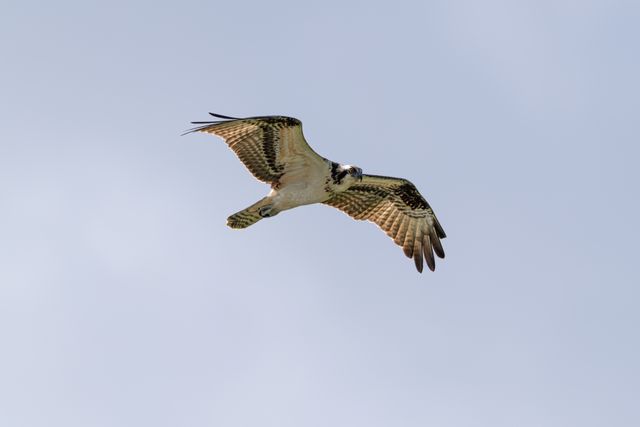
In the field, the Osprey is a large, slim raptor. Adults measure roughly 50 to 66 cm (20 to 26 in) in length, with a wingspan of about 127 to 180 cm (50 to 71 in) and a weight near 0.9 to 2.1 kg (2.0 to 4.6 lb). Females average a little larger than males. The plumage is boldly two-toned: dark chocolate-brown above and clean white below, with a white head crossed by a broad dark stripe running back through the yellow eye. Many birds, females especially, show a faint brown “necklace” across the breast.
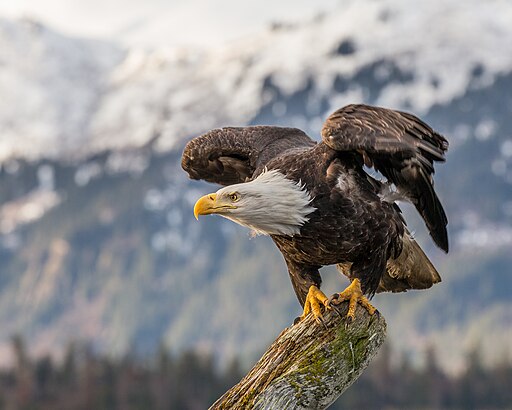
The flight profile is one of the most reliable ways to name an Osprey at a distance. The long, narrow wings carry a pronounced kink at the wrist, so that from below the bird often forms a shallow M or gull-like bow, marked by dark patches at the wrist joints. This silhouette, combined with steady, rowing wingbeats over water, separates it at once from the broad-winged, flat-soaring Bald Eagle (Haliaeetus leucocephalus), with which it is most often confused. The eagle is bulkier, soars on flat wings, and as an adult shows a fully white head and tail rather than the Osprey’s masked face and white underparts.
Habitat and Distribution
The Osprey lives near water, and almost any water with fish will do. Its range is genuinely cosmopolitan, spanning every continent except Antarctica, and it occupies an unusually broad sweep of habitats for so specialized a feeder, from boreal forest lakes and salt marshes to mangrove islets and tropical lagoons. In South America the bird appears only as a nonbreeding visitor.
Whatever the setting, the requirements are consistent. An Osprey needs shallow water holding an accessible supply of fish, typically within about 19 km (12 mi) of the nest, along with an open, elevated, predator-safe place to build, and, in northern climates, an ice-free season long enough for the young to fledge. In North America, breeding birds range from Alaska and New England south to Mexico, while year-round residents hold the Gulf Coast, Florida, and the Caribbean.
Many populations are strongly migratory. Northern breeders move south in autumn to winter on fish-rich rivers, lakes, and coasts in subtropical and tropical regions, returning the following spring as waters warm and fish rise within reach. Tropical and subtropical populations, by contrast, tend to stay put year-round.
Breeding, Nesting, and Family Life
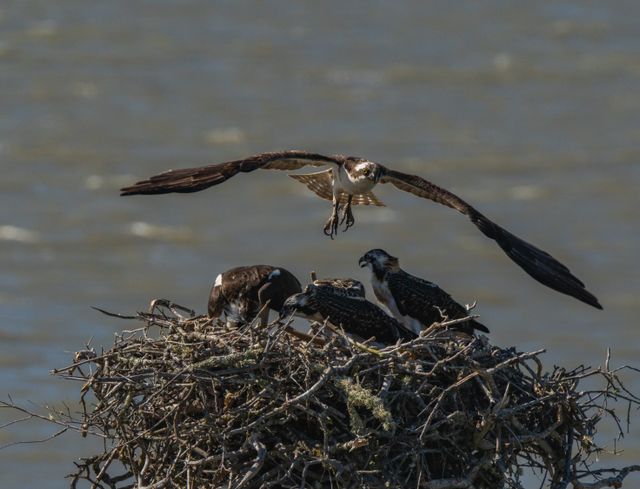
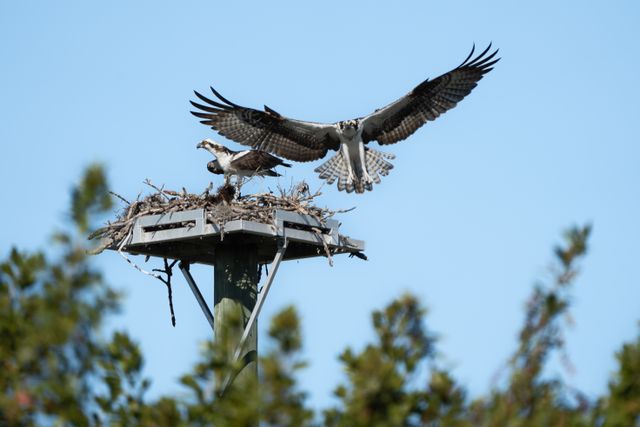
Ospreys are devoted nest-builders, and a pair will often return to the same site year after year, adding to it each season. The male usually arrives first and selects the spot, favoring open surroundings with a wide, sturdy base safe from climbing predators such as raccoons. Nests sit atop snags, broken treetops, cliffs, and increasingly on human-built structures: utility poles, channel markers, and the purpose-built platforms that have become central to the species’ recovery.
The nest is a bulky mass of sticks lined with bark, grass, vines, algae, and whatever flotsam comes to hand. The male fetches most of the material, sometimes snapping dead branches off trees in passing flight, and the female arranges it. A first-year nest on a platform may be modest, under 0.8 m (2.5 ft) across, but after generations of reuse a nest can grow into an enormous structure up to 3 to 4 m (10 to 13 ft) deep and 1 to 1.8 m (3 to 6 ft) wide, large enough for a person to sit inside.
During courtship the male performs a striking aerial display sometimes called the “sky-dance” or “fish-flight,” hovering and swooping high above the nest with legs dangling, often clutching a fish or a stick, while calling repeatedly. A clutch holds one to four eggs, cream to pinkish and blotched with reddish brown, and the pair raises a single brood per year. Incubation runs about 36 to 42 days, and the young remain in the nest for roughly 50 to 55 days before fledging. Most Ospreys do not begin breeding until they are around three to five years old.
Diet and Foraging
The Osprey is a fish specialist to a degree matched by almost no other raptor. Live fish make up about 99 percent of its diet, drawn from more than eighty species across both fresh and salt water. Caught fish usually run about 15 to 33 cm (6 to 13 in) long and weigh between roughly a third and two-thirds of a pound, though the largest catch on record weighed about 1.1 kg (2.5 lb). On rare occasions an Osprey will take a bird, snake, vole, muskrat, or salamander, but these are exceptions to an overwhelmingly piscine menu.
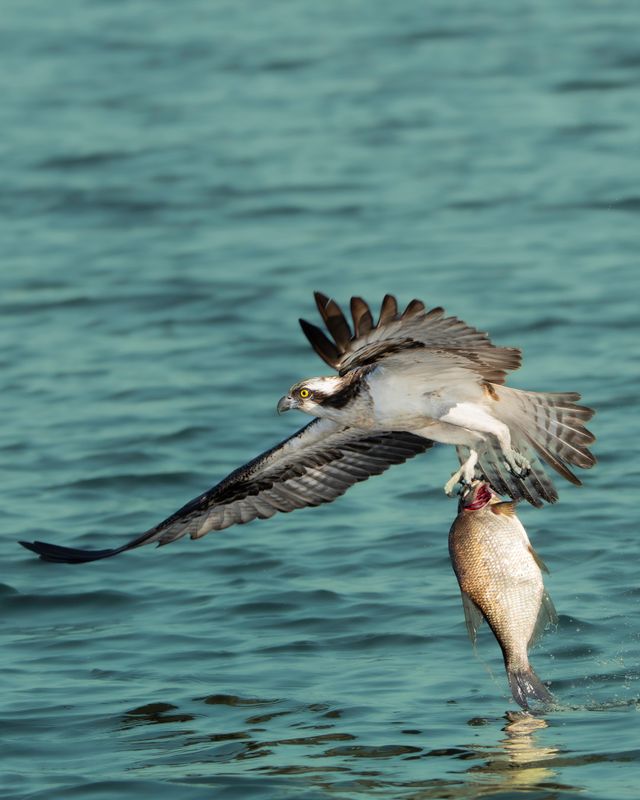
The hunt itself is a spectacle. An Osprey typically quarters back and forth or hovers 10 to 30 m (about 30 to 100 ft) above the surface, watching, then plunges feet-first, sometimes briefly disappearing underwater before laboring back into the air. Because it can reach only the top meter or so of water, the bird is restricted to shallow zones and to fish that school near the surface. Once airborne, it shakes off the water and turns its catch head-forward to cut wind resistance, a tidy habit birders sometimes call “packing a lunch.” Ospreys are remarkably effective: studies have found them landing a fish on at least one dive in four, and in the best conditions as often as seven dives in ten.
Communication and Vocalization
The Osprey’s voice is higher and more plaintive than its size suggests. The most familiar sound is a series of short, clear whistles, often described in writing as cheep cheep or yewk yewk, given in slow, well-spaced succession when a bird is at ease. When the pace quickens and sharpens into an urgent, rising scream, it usually signals alarm, a response to a predator or to an unfamiliar Osprey approaching the nest. Pairs use a range of these calls to coordinate at the nest through courtship, incubation, and the feeding of young.
Recording: Doug Hynes, XC671347, CC BY-SA 4.0 (recorded in Canada).
Built to Fish: The Osprey’s Hunting Adaptations
If the Osprey reads like a hawk redesigned from the feet up for fishing, that is essentially what it is. No other raptor in its range has gone so far down this single path, and the bird’s anatomy is a catalogue of fishing tools.
The feet do most of the work. Unlike other hawks, the Osprey can swivel its outer toe backward, so that it grips a fish with two toes in front and two behind, a pincer hold that closes from both sides. The undersides of the toes are studded with short, sharp spines called spicules that bite into slick scales, and the talons are long, strongly curved, and unusually rounded for extra purchase. Together these features lock onto prey so firmly that, on rare occasions, an Osprey that misjudges a fish heavier than itself can be dragged under before it can let go.
The rest of the body is tuned to the plunge. The Osprey’s nostrils are long, slit-like, and can close on contact with the water, keeping it out of the airways during a dive. Its plumage is dense and lightly oiled, shedding water quickly so the bird is not waterlogged when it lifts off. The long, kinked wings give the lift needed to haul a heavy, dripping fish clear of the surface. The result is a hunter of real precision, and it is precisely this specialization, the diet of live fish and the ability to dive for it, that sets the Osprey apart from every other hawk on the continent.
Champion Migrants
The Osprey is also one of the world’s great long-distance travelers, and the rise of satellite tracking over the past few decades has turned its migrations into some of the best-documented journeys in the bird world.
Northern breeders are true marathoners. A bird that nests in the far north and winters south of the equator may cover extraordinary distances over its life; by one estimate from Cornell’s Birds of the World, an individual living fifteen to twenty years might fly more than 200,000 km (about 124,000 mi) in the course of its travels. Young Ospreys are especially impressive, since juveniles make their first trans-oceanic crossings alone, without adult guidance, navigating largely on inherited instinct.
These movements help explain the bird’s near-global footprint. The same species that fishes a Scottish loch in summer may winter in West Africa, while a bird raised on a North American coast may travel deep into South America. Long after they were celebrated in myth and verse, Ospreys remain reliable heralds of the seasons, their return to northern shorelines each spring a dependable sign that winter has loosened its grip.
Conservation Status
The Osprey is one of conservation’s signature comebacks. As of the 2021 IUCN Red List assessment, it is classified as Least Concern with an increasing population, and Partners in Flight has estimated a global breeding population of around 1.2 million birds, rating the species low on its scale of continental concern (PIF, 2021). North American Breeding Bird Survey data show steady growth of roughly 1.9 percent per year between 1966 and 2019.
That recovery followed a genuine crisis. From the early 1950s into the 1970s, the pesticide DDT accumulated in the food chain and thinned the birds’ eggshells so severely that many eggs failed; along the coast between New York City and Boston, for example, about 90 percent of breeding pairs disappeared. Research on Ospreys and other affected raptors helped build the case against persistent pesticides, and after the United States banned DDT in 1972, populations rebounded strongly. The Osprey became, and remains, a living emblem of what such bans can achieve.
Threats have not vanished. The loss of natural nest trees to shoreline development and logging continues, although artificial platforms have offset much of that pressure. A growing and grimmer hazard is entanglement: adults weave discarded baling twine, fishing line, and other plastic into their nests, where it can wrap around and injure or trap nestlings. Contaminants in some watersheds also remain a concern. Where the species is in trouble, it tends to be inland and local rather than global, and several U.S. states still afford it protection.
How to Attract or Observe Ospreys
Ospreys are not backyard-feeder birds, but they are among the easier large raptors to find and welcome, because they follow the fish. The single most effective way to attract a nesting pair is to provide a safe, elevated nest site near open water. In many regions, landowners and conservation groups erect tall nesting platforms beside lakes, rivers, and estuaries, and Ospreys take to them readily, especially where natural sites are scarce.
To observe them, head for shallow, productive water from spring through fall: a reservoir, a tidal river, a salt marsh, or a coastal bay. A boat, dock, or raised vantage point can offer excellent views of birds hunting. Watch for the hover-and-plunge, listen overhead for the high whistling calls, and look for the kinked-wing silhouette patrolling the shoreline. If you maintain a platform, one practical kindness matters above all: keep loose twine, fishing line, and plastic out of reach, since nesting adults gather exactly this material and it is a leading cause of nestling injury.
Frequently Asked Questions
What does it mean when you see an osprey?
Across several traditions the Osprey has symbolized keen vision, mastery of the water, and faithful partnership. The paired ospreys that open China’s ancient Classic of Poetry stood for devotion and proper courtship, while European writers from Shakespeare onward used the bird as an image of natural command. Today it is widely read as a sign of healthy water and successful conservation. These are cultural and traditional meanings rather than scientific facts about the bird.
Are ospreys aggressive or dangerous to people?
Ospreys are not dangerous to humans and rarely show interest in anything other than fish. They will, however, vigorously defend the immediate area around their nest, diving and calling at intruders, including people who climb too close. The sensible approach is simply to admire active nests from a respectful distance, particularly during the breeding season.
Do ospreys migrate?
Many ospreys migrate, though not all. Northern breeders are long-distance migrants that winter in subtropical and tropical regions and return north each spring, sometimes covering thousands of kilometers each way. Populations in warmer climates, such as Florida and the Caribbean, are often year-round residents.
What do ospreys eat?
Ospreys eat fish almost exclusively, and live fish make up roughly 99 percent of their diet. They take more than eighty species across fresh and salt water, usually fish around 15 to 33 cm (6 to 13 in) long. Only very rarely do they take other prey such as birds, snakes, or small mammals.
How long do ospreys live?
Wild ospreys commonly live around seven to ten years, though many survive considerably longer once past the risky first year. The oldest known wild Osprey on record was at least 25 years and 2 months old, a bird banded in Virginia in 1973 and recovered in 1998.
What is the difference between an osprey and a bald eagle?
The two are often confused, but several features separate them. The Osprey is smaller and slimmer, with a white belly, a white head crossed by a dark eye stripe, and long wings held with a kink at the wrist; the Bald Eagle is bulkier, soars on flat wings, and as an adult has a solid white head and tail with a dark body. Behavior helps too, since the Osprey hovers and plunges for fish while the eagle often perches and scavenges or steals catches, sometimes from Ospreys themselves.
Where do ospreys build their nests?
Ospreys build large stick nests in open, elevated places safe from ground predators. Natural sites include dead treetops, snags, and cliffs, but the birds readily use human-made structures such as utility poles, channel markers, and dedicated nesting platforms. The same nest is often reused and enlarged for many years.
Conclusion
Few birds wear their way of life so plainly as the Osprey. Everything about it, the reversible toe and barbed footpads, the closable nostrils and oiled feathers, the long kinked wings and the high whistling call over open water, points back to a single elegant purpose: catching fish, and doing it better than any other hawk alive. That focus has carried the species onto every continent but one and into the literature of cultures separated by oceans and millennia, from a Confucian ode on devotion to Shakespeare’s image of effortless dominion.
It is also a bird worth feeling hopeful about. Brought low by DDT within living memory, the Osprey climbed back to become a symbol of recovery, and it now patrols shorelines in greater numbers than it has in generations. To watch one hover, fold, and rise streaming with water and a fish in its grip is to see both a superb predator and a quiet conservation victory at once.
If you would like to find one near the coast, our guides to the birds of Folly Beach, South Carolina, and Jekyll Island, Georgia, point you to shorelines where Ospreys are a familiar sight, and our wider guides to identifying birds of prey can help you tell the fish hawk from the eagles it so often shares the sky with.
Works Cited
- Cornell Lab of Ornithology. “Osprey Overview.” All About Birds. https://www.allaboutbirds.org/guide/Osprey/overview
- Cornell Lab of Ornithology. “Osprey Life History.” All About Birds. https://www.allaboutbirds.org/guide/Osprey/lifehistory
- Cornell Lab of Ornithology. “Osprey Identification.” All About Birds. https://www.allaboutbirds.org/guide/Osprey/id
- Bierregaard, R. O., A. F. Poole, M. S. Martell, P. Pyle, and M. A. Patten. “Osprey (Pandion haliaetus).” Birds of the World, Cornell Lab of Ornithology. https://birdsoftheworld.org/bow/species/osprey/cur/introduction
- BirdLife International. 2021. “Pandion haliaetus.” The IUCN Red List of Threatened Species 2021. https://www.iucnredlist.org/species/22694938/206628879
- National Audubon Society. “Osprey.” Audubon Field Guide. https://www.audubon.org/field-guide/bird/osprey
- National Wildlife Federation. “Osprey.” Wildlife Guide. https://www.nwf.org/Educational-Resources/Wildlife-Guide/Birds/Osprey
- Florida Fish and Wildlife Conservation Commission. “Osprey.” https://myfwc.com/wildlifehabitats/profiles/birds/raptors-and-vultures/osprey/
- New Jersey Department of Environmental Protection. “Osprey.” https://dep.nj.gov/dsr/environmental-trends/osprey/
- Kirschbaum, K., and N. Watson. “Pandion haliaetus.” Animal Diversity Web, University of Michigan. https://animaldiversity.org/accounts/Pandion_haliaetus/
- Ovid. Metamorphoses, Book 8 (the story of Nisus and Scylla), translated by A. S. Kline. Poetry in Translation. https://www.poetryintranslation.com/PITBR/Latin/Metamorph8.php
- Folger Shakespeare Library. Coriolanus, Act 4, Scene 7. https://www.folger.edu/explore/shakespeares-works/coriolanus/read/4/7/
- Legge, James (trans.). “Guan Ju,” in The She King (Book of Poetry), 1871. Chinese Text Project. https://ctext.org/book-of-poetry/guan-ju