Guide to Species of Tit Birds
Types of Tit Birds: A Guide to the Tits, Chickadees, and Titmice
The tits are a family of small, lively woodland birds, the Paridae, with roughly 55 to 65 species spread across Europe, Asia, Africa, and North America. They are the acrobats of the bird feeder: round-bodied, short-billed, endlessly curious, and quick to learn. In Europe and Africa we call them tits, while in North America the same family gives us the chickadees and titmice. Whatever the local name, these are among the most familiar and best loved small birds in the Northern Hemisphere.
My introduction to this family of birds came not at a feeder, but on the nature trails near where I live. Hiking the woodlands of South Carolina, I have learned to recognize two sounds that almost always travel together: the quick, emphatic “chick a dee dee dee” of a Carolina Chickadee working the branches overhead, and the clear, whistled “peter peter peter” of a Tufted Titmouse somewhere just out of sight in the canopy. Those two birds, both members of the Paridae family covered in this guide, have turned routine hikes into something different for me. They pulled me into paying closer attention to which birds I was hearing and made me much more present with the sounds of the woods. Over time I have also realized that the Carolina Chickadee is everywhere once you start looking, from nesting in the signs of local grocery stores to flitting around the garden centers at Home Depot and Lowes.
This guide explains what unites the family, surveys its major branches, and points you toward deeper reading on individual species. We will look at the true tits of Eurasia, the chickadees and titmice of the Americas, the African tits, and a few odd one-of-a-kind species, then close with a clear-eyed look at which members are thriving and which are in trouble. Along the way you will also meet a few birds that carry the name “tit” but belong to entirely separate families.
Key Takeaways
- The true tit family (Paridae) contains roughly 55 to 65 species, the exact count depending on the authority, found across Eurasia, Africa, and North America, with none native to South America or Australia.
- Members share a compact body, short stout bill, strong feet, and remarkable problem-solving intelligence, and most are cavity nesters that readily use nest boxes.
- Among the smallest are the fire-capped and yellow-browed tits at around 10 cm (3.9 in), while the largest is the sultan tit at 20 to 21 cm (7.9 to 8.3 in).
- North American members are called chickadees and titmice; Eurasian and African members are called tits.
- Most tits are of Least Concern, but a handful, including the white-naped tit of India and the willow tit in the United Kingdom, have declined sharply and now carry conservation concern.
What Defines a Tit
Tits are small passerines, or perching birds, built for a busy, acrobatic life among twigs and foliage. Across the family the body length runs from about 10 cm to 21 cm (3.9 to 8.3 in), though most familiar species cluster around 11 to 14 cm (4.3 to 5.5 in). They are compact and round-headed, with short rounded wings, strong legs, and sturdy toes that let them hang upside down beneath a branch to reach insects and seeds (The Editors of Encyclopaedia Britannica, 2025).
A short, stout bill
The defining tool of a tit is its short, stout bill, well suited to a mixed diet. In the breeding season these birds are mainly insectivorous, gleaning caterpillars, beetles, aphids, and spiders from leaves and bark, which makes them valuable natural controllers of garden and forest pests. Outside the breeding season many shift toward seeds, nuts, and berries (Winkler et al., 2020).
Intelligence and a famous memory
Tits are among the most intelligent of small birds, and the family has split into two distinct cognitive strategies. Food-hoarding members, including the chickadees and the willow and marsh tits, are spatial-memory specialists. The black-capped chickadee is the champion, storing thousands of items in separate spots and recalling the locations using an enlarged memory center in the brain; every autumn it grows fresh neurons there, replacing old ones to keep its mental map current (Cornell Lab of Ornithology, n.d.-a; Brodin, 2025). Non-hoarding species such as the great tit and blue tit take the other path, excelling instead at innovation and learning by watching others. The great tit in particular is famous for solving novel feeding puzzles and for spreading new foraging tricks through a population (Brodin, 2025).
Caching, vocal codes, and social flocks
Most tits are hole-nesting birds, using natural tree cavities, old woodpecker holes, or nest boxes, and lining them with moss, fur, and plant down. They are also highly vocal. The “chick-a-dee” call that gives the North American birds their name is a sophisticated alarm system: the more “dee” notes a chickadee adds, the more dangerous the predator it has spotted, and a separate thin, high “seet” warns of a raptor in flight (University of Washington, 2005; Cornell Lab of Ornithology, n.d.-b). In autumn and winter many tits gather into small flocks, and these flocks often form the noisy core of mixed-species foraging groups that other woodland birds follow for safety (Earth Life, 2026; Winkler et al., 2020).
Distribution and habitat
True tits occur across Europe, Asia, Africa, and North America, and reach high into the Himalayas and the Tibetan Plateau. They are absent as natives from South America, Australia, and Antarctica. Most species favor woodland, from boreal conifer forest to temperate deciduous woods, but many are remarkably adaptable birds that thrive in parks, hedgerows, and suburban gardens wherever there are trees and bird feeders (Wildlife Journal Junior, n.d.; The Editors of Encyclopaedia Britannica, 2025).
At a Glance: The Major Tit Groups
[IMAGE: a blue tit and a great tit together at a feeder]
| Group | Where found | Approx. number of species | Size range (length) | Standout trait | Conservation picture |
|---|---|---|---|---|---|
| Great, blue, and relatives (Parus, Cyanistes, Lophophanes, Periparus) | Europe, Asia, North Africa | 25 or more | 10 to 14 cm (3.9 to 5.5 in) | Bold colors, garden familiarity | Mostly Least Concern; a few declining |
| Chickadees (Poecile) | North America, northern Eurasia | 12 to 15 (7 in North America) | 11 to 15 cm (4.3 to 5.9 in) | “Chick-a-dee” alarm calls, food caching | Mostly Least Concern |
| Titmice (Baeolophus) | North America, Mexico | 5 | 12 to 16 cm (4.7 to 6.3 in) | Pointed, raisable crest | Least Concern |
| African tits (Melaniparus) | Sub-Saharan Africa | 14 to 15 | 11 to 15 cm (4.3 to 5.9 in) | Often dark, savanna and woodland birds | Mostly Least Concern |
| One-of-a-kind tits (Melanochlora, Sylviparus, Cephalopyrus, Pseudopodoces) | Asia | 4 (one species each) | 10 to 21 cm (3.9 to 8.3 in) | Family size and habitat extremes | Least Concern |
Note: scientists differ on the exact species total because some lineages, such as the penduline tits, are sometimes folded into the Paridae and sometimes split out, and because genera have been repeatedly revised. Encyclopaedia Britannica gives about 55 species, Animal Diversity Web 59, and the current IOC World Bird List sits near the upper end of the range, so this guide uses a span of roughly 55 to 65 (The Editors of Encyclopaedia Britannica, 2025; Animal Diversity Web, n.d.; Winkler et al., 2020).
The Major Tit Subgroups
The family splits naturally into a few branches: the bright Eurasian tits most people picture first, the North American chickadees and titmice, the African tits, and a small set of unusual species that each sit alone in their own genus. Each section below profiles a few representative species and links onward to fuller accounts.
The great, blue, and Eurasian true tits

This is the heart of the family for European and Asian readers: the colorful, feeder-loving tits of woodland, park, and garden. Several were once lumped together in the genus Parus, but modern genetic work has split them into several genera, including Parus, Cyanistes, Periparus, and Lophophanes (Discover Wildlife, 2023). They are small birds, mostly black, white, blue, green, and yellow, and many are common birds across their range.
The great tit (Parus major) is the largest of the European tits, around 14 cm (5.5 in) long, with a black head, white cheeks, yellow underparts, and a black stripe down the breast that is broader in males (Discover Wildlife, 2023). The Eurasian blue tit (Cyanistes caeruleus) is smaller, about 12 cm (4.7 in) with an 11 g (0.4 oz) body, wearing a blue cap, blue wings and tail, a yellow breast, and a white face crossed by a dark eye line (The Wildlife Trusts, n.d.-a). The coal tit (Periparus ater) is one of the smallest, around 11 to 12 cm (4.3 to 4.7 in), recognized by the white patch on its black nape and its two white wing bars; it favors coniferous forests (eBird, n.d.; The Wildlife Trusts, n.d.-b). The crested tit (Lophophanes cristatus) carries a small pointed crest and, in Britain, is largely confined to old Scots pine forest.
Most of these species are of Least Concern and several are increasing, helped by garden bird tables and nest boxes. To go deeper, see our species Deep Dives on the great tit and the Eurasian blue tit.
Chickadees

Chickadees are the North American branch of the family, small, dark-capped, white-cheeked birds named for the “chick-a-dee” call. The genus Poecile holds about 12 to 15 species worldwide, of which seven occur in North America; the European and Asian members are called tits rather than chickadees (Encyclopedia.com, n.d.-a). They are famous for two things: caching food and a sophisticated alarm system in which more “dee” notes signal a more dangerous predator (University of Washington, 2005).
The black-capped chickadee (Poecile atricapillus) is the best known, about 12 to 15 cm (4.7 to 5.9 in), with a black cap and bib, white cheeks, and gray back. The Carolina chickadee (Poecile carolinensis) replaces it across the southeastern United States and looks very similar. The mountain chickadee (Poecile gambeli) of western conifer forests shows a white eyebrow stripe, while the chestnut-backed chickadee (Poecile rufescens) of the Pacific coast has warm rufous on its back. The boreal chickadee (Poecile hudsonicus) is a brown-capped bird of northern coniferous forests (Encyclopedia.com, n.d.-b; Cornell Lab of Ornithology, n.d.-a).
All North American chickadees are currently of Least Concern. For more, see our Deep Dive on the black-capped chickadee.
Titmice

Titmice are the crested North American tits, all in the genus Baeolophus, with five species. Each can raise or lower a pointed crest, and as a group they average a little larger than the chickadees they often flock with in winter months (Encyclopedia.com, n.d.-a; BirdWatching, 2024).
The tufted titmouse (Baeolophus bicolor) is the largest and most widespread, 14 to 16 cm (5.5 to 6.3 in), gray above and pale below with peach-washed flanks, and is a common feeder bird across the eastern United States (Cornell Lab of Ornithology, n.d.-c). The black-crested titmouse (Baeolophus atricristatus) of Texas and Mexico is similar but wears a black crest, and the two are so closely related that they were long treated as one species. The oak titmouse (Baeolophus inornatus) is a plain gray-brown bird of California oak woodland, and the very similar juniper titmouse (Baeolophus ridgwayi) lives in the dry pinyon-juniper country of the interior West; the two were split from a single “plain titmouse” in 1996 (BirdWatching, 2024). The small bridled titmouse (Baeolophus wollweberi), about 12 to 15 cm (4.7 to 5.9 in), wears a striking black-and-white facial pattern and lives in southwestern mountain woodlands (Audubon, n.d.).
All five titmice are of Least Concern. See our Deep Dive on the tufted titmouse for a fuller account.
African tits
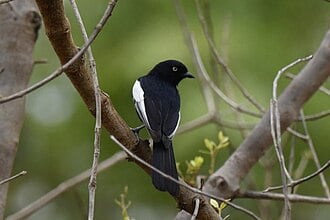
Sub-Saharan Africa holds its own branch of the family, about 14 to 15 species in the genus Melaniparus, moved out of the old genus Parus after a 2013 genetic study (Johansson et al., 2013; oiseaux-birds, n.d.). Many are darker than their northern relatives, dressed in grey, black, and white for savanna, dry woodland, and forest rather than the bright colors of the Eurasian species (Earth Life, 2026; oiseaux-birds, n.d.).
Roughly half are strongly dark, all black or black and white. The dusky tit (Melaniparus funereus) of equatorial rainforest is almost entirely black, relieved only by deep red eyes, and the southern black tit (Melaniparus niger) is a black woodland bird of southern Africa. The boldly pied white-shouldered black tit (Melaniparus guineensis) of West and Central African woodland is recognized by its striking white eyes. The remaining African species are paler grey and white birds, among them the grey tit (Melaniparus afer) of southern Africa (oiseaux-birds, n.d.).
All the species described here are of Least Concern, though several have small or patchy ranges. A dedicated subgroup page for the African tits is planned.
One-of-a-kind tits
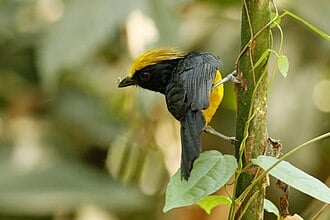
A few tits are so distinctive that each sits alone in its own genus, and together they mark the size and habitat extremes of the family. The sultan tit (Melanochlora sultanea) of southern and southeastern Asia is the largest member, 20 to 21 cm (7.9 to 8.3 in) and up to about 49 g (1.7 oz), unmistakable in glossy black with a bright yellow crest and yellow underparts (oiseaux-birds, n.d.; Guinness World Records, 2017). At the other end sit the family’s smallest species. The dull greenish yellow-browed tit (Sylviparus modestus) of Himalayan forests, about 9 to 10 cm (3.5 to 3.9 in), is generally cited as the smallest in length, while the fire-capped tit (Cephalopyrus flammiceps) is just as tiny at about 10 cm (3.9 in) and among the lightest at roughly 7 g (0.25 oz), the breeding male flushed with orange and scarlet on the face (Encyclopedia.com, n.d.-a; oiseaux-birds, n.d.; Wikipedia contributors, n.d.-a).
The most surprising member is the ground tit (Pseudopodoces humilis) of the Tibetan Plateau. With its long, downcurved bill and habit of running across open ground and nesting in burrows, it was long mistaken for a small member of the crow family. Molecular studies later confirmed it as a true tit, the only one adapted to the treeless, high-altitude steppe of the plateau (James et al., 2003).
All four are currently of Least Concern.
Birds called “tit” that are not true tits
Several familiar birds carry the name “tit” but belong to separate families. The long-tailed tits (family Aegithalidae), about seven species, are tiny, fluffy, long-tailed birds that weave domed nests from moss, lichen, and cobwebs; the long-tailed tit (Aegithalos caudatus) has a tail nearly half its total length (BTO, n.d.-a; Encyclopedia.com, n.d.-c). The penduline tits (family Remizidae) are needle-billed weavers of hanging bag nests. The bearded tit, better called the bearded reedling (Panurus biarmicus), is a reed-bed bird now placed in its own family, Panuridae, with no close living relatives (Wikipedia contributors, n.d.-b). These are covered here only so you can place them; they are not members of the Paridae.
Conservation Threats
Most tits are common and adaptable, but the family is not uniformly secure, and a few species illustrate how quickly woodland specialists can decline.
Habitat loss is the central pressure. The white-naped tit (Machlolophus nuchalis), endemic to India, is listed as Vulnerable on the IUCN Red List. Its dry thorn-scrub forest is being cleared for fuelwood, charcoal, agriculture, and grazing, and invasive plants are taking over remaining patches, leaving it scarce and declining across a fragmented range (RoundGlass Sustain, n.d.; Springer Nature, 2025).
Declines can also strike formerly common birds. In the United Kingdom the willow tit (Poecile montanus) has suffered one of the steepest declines of any resident bird, falling by more than 80 percent in recent decades, and it has been Red-listed since 2022. The closely related marsh tit (Poecile palustris) has also been Red-listed in the UK, even though both species remain globally of Least Concern across their wider Eurasian range. The drivers appear to include the deterioration and drying of damp woodland, loss of suitable nest sites, and competition and nest predation from other species (BTO, n.d.-b; BTO, n.d.-c). Climate change adds further pressure on narrow-range specialists; modeling of the white-naped tit projects a severe contraction of suitable habitat in western India under future scenarios (Springer Nature, 2025).
The encouraging side is that tits respond well to habitat care. Providing nest boxes, protecting mature and deadwood-rich woodland, maintaining woodland connectivity, and keeping feeders and bird tables clean to limit disease all help these birds. Because tits are so visible and so willing to use gardens, they are also excellent subjects for citizen-science monitoring through projects run by organizations such as the BTO and Cornell Lab.
Frequently Asked Questions
How many species of tits are there?
The true tit family, Paridae, contains roughly 55 to 65 species, with the exact count depending on the authority and on whether closely related groups are included. Encyclopaedia Britannica gives about 55, while the current IOC World Bird List sits near the upper end of that range (The Editors of Encyclopaedia Britannica, 2025; Winkler et al., 2020).
What is the largest tit?
The largest member of the family is the sultan tit (Melanochlora sultanea) of southern and southeastern Asia, reaching 20 to 21 cm (7.9 to 8.3 in) and up to about 49 g (1.7 oz). It is unmistakable, with glossy black plumage, yellow underparts, and a bright yellow crest (oiseaux-birds, n.d.; Guinness World Records, 2017).
What is the smallest tit?
Among the smallest are the yellow-browed tit (Sylviparus modestus) and the fire-capped tit (Cephalopyrus flammiceps), both around 9 to 10 cm (3.5 to 3.9 in). The fire-capped tit weighs only about 7 g (0.25 oz), roughly the weight of a few paperclips (Encyclopedia.com, n.d.-a; Wikipedia contributors, n.d.-a).
What is the difference between a tit, a chickadee, and a titmouse?
They are all members of the same family, the Paridae; the names simply reflect geography and appearance. Eurasian and African members are called tits, North American members without crests are called chickadees, and the crested North American members are called titmice (The Editors of Encyclopaedia Britannica, n.d.).
Do tits and chickadees migrate?
Most do not. The great majority of tits are resident, sedentary birds that stay on or near their territory year round, which is one reason feeders and nest boxes attract them so reliably. A few northern species, such as the boreal chickadee and the grey-headed chickadee, make short-distance or irruptive movements in hard winters rather than true long migrations (Brodin, 2025; FatBirder, 2025).
Are tits intelligent?
Yes. Tits are quick learners and skilled problem solvers, and the family is split between two talents: food-caching species are spatial-memory specialists, while non-hoarders like the great tit are innovators that learn by watching one another. The black-capped chickadee can remember thousands of hidden food items and even grows fresh memory neurons each autumn (Cornell Lab of Ornithology, n.d.-a; Brodin, 2025).
Are there any tits native to North America?
Yes. North America has the chickadees, in the genus Poecile, and the titmice, in the genus Baeolophus, which together include species such as the black-capped chickadee and the tufted titmouse. The blue tit and great tit, by contrast, are Eurasian birds and do not occur naturally in North America (Cornell Lab of Ornithology, n.d.-a; Audubon, n.d.).
Conclusion
From the burrow-digging ground tit of the Tibetan Plateau to the yellow-crested sultan tit of Asian forests, and from the garden blue tit of Europe to the seed-caching chickadees of North America, the tits are a small family with an outsized presence in the lives of people who watch birds. They share a recognizable formula, compact bodies, short stout bills, busy intelligence, and a habit of turning up wherever there are trees, yet within that formula they have spread across four continents and adapted to deserts, mountains, savannas, and suburbs.
Most members are thriving, but the steep declines of the willow tit in Britain and the white-naped tit in India are reminders that even familiar groups contain specialists that need our care. Protecting woodland, offering nest boxes, and joining citizen-science counts are simple ways to help. To go further, follow the links to our deeper guides on chickadees, titmice, and individual species, and the next time a little crested or blue-capped bird lands on your feeder, you will know exactly which branch of this remarkable family it belongs to.
Works Cited
Animal Diversity Web. (n.d.). Paridae: Chickadees and titmice. University of Michigan Museum of Zoology. Retrieved from https://animaldiversity.org/accounts/Paridae/
Audubon. (n.d.). Bridled titmouse. National Audubon Society. Retrieved from https://www.audubon.org/field-guide/bird/bridled-titmouse
BirdWatching. (2024, October 6). Identifying North America’s five titmouse species. Retrieved from https://www.birdwatchingdaily.com/birds/kenn-kaufmans-id-tips/identifying-north-americas-five-titmouse-species/
British Trust for Ornithology. (n.d.-a). Paridae: Tits. Retrieved from https://bto.org/understanding-birds/bird-families-world/paridae-tits
British Trust for Ornithology. (n.d.-b). Willow tit. Retrieved from https://www.bto.org/learn/about-birds/birdfacts/willow-tit
British Trust for Ornithology. (n.d.-c). Marsh tit. Retrieved from https://www.bto.org/learn/about-birds/birdfacts/marsh-tit
Brodin, A. (2025). Food hoarders and non-hoarders in Paridae: A cognition perspective. Retrieved from https://www.ncbi.nlm.nih.gov/pmc/articles/PMC12350420/
Cornell Lab of Ornithology. (n.d.-a). Black-capped chickadee overview. All About Birds. Retrieved from https://www.allaboutbirds.org/guide/Black-capped_Chickadee/overview
Cornell Lab of Ornithology. (n.d.-b). Black-capped chickadee sounds. All About Birds. Retrieved from https://www.allaboutbirds.org/guide/Black-capped_Chickadee/sounds
Cornell Lab of Ornithology. (n.d.-c). Tufted titmouse identification. All About Birds. Retrieved from https://www.allaboutbirds.org/guide/Tufted_Titmouse/id
Discover Wildlife. (2023, November 20). Great tit facts: Size, diet, habitat and what they look like. Retrieved from https://www.discoverwildlife.com/animal-facts/birds/facts-about-great-tits
Earth Life. (2026, April 10). Tits, chickadees and titmice. Retrieved from https://earthlife.net/chickadees/
eBird. (n.d.). Coal tit Periparus ater. Cornell Lab of Ornithology. Retrieved from https://ebird.org/species/coatit2
Encyclopedia.com. (n.d.-a). Titmice and chickadees (Paridae). Grzimek’s Animal Life Encyclopedia. Retrieved from https://www.encyclopedia.com/environment/encyclopedias-almanacs-transcripts-and-maps/titmice-and-chickadees-paridae
Encyclopedia.com. (n.d.-b). Tit family. Retrieved from https://www.encyclopedia.com/science/encyclopedias-almanacs-transcripts-and-maps/tit-family-0
Encyclopedia.com. (n.d.-c). Long-tailed titmice (Aegithalidae). Grzimek’s Animal Life Encyclopedia. Retrieved from https://www.encyclopedia.com/environment/encyclopedias-almanacs-transcripts-and-maps/long-tailed-titmice-aegithalidae
FatBirder. (2025). Paridae: Tits and chickadees. Retrieved from https://fatbirder.com/ornithology/paridae-tits-and-chickadees/
Guinness World Records. (2017, September 13). Largest titmouse. Retrieved from https://www.guinnessworldrecords.com/world-records/494303-largest-titmouse
James, H. F., Ericson, P. G. P., Slikas, B., Lei, F.-M., Gill, F. B., & Olson, S. L. (2003). Pseudopodoces humilis, a misclassified terrestrial tit (Paridae) of the Tibetan Plateau: Evolutionary consequences of shifting adaptive zones. Ibis, 145(2), 185 to 202. https://doi.org/10.1046/j.1474-919X.2003.00170.x
Johansson, U. S., Ekman, J., Bowie, R. C. K., Halvarsson, P., Ohlson, J. I., Price, T. D., & Ericson, P. G. P. (2013). A complete multilocus species phylogeny of the tits and chickadees (Aves: Paridae). Molecular Phylogenetics and Evolution, 69(3), 852 to 860. https://doi.org/10.1016/j.ympev.2013.06.019
oiseaux-birds. (n.d.). Family Paridae: Tits, chickadees and titmice. Retrieved from https://www.oiseaux-birds.com/page-family-paridae.html
RoundGlass Sustain. (n.d.). White-naped tit: Whistler in the bush. Retrieved from https://roundglasssustain.com/species/white-naped-tit
Springer Nature. (2025). Assessing climate change impact on the distribution of the endemic white-naped tit (Machlolophus nuchalis). Journal of Ornithology. Retrieved from https://link.springer.com/article/10.1007/s10336-025-02340-x
The Editors of Encyclopaedia Britannica. (2025). Paridae. Encyclopaedia Britannica. Retrieved from https://www.britannica.com/animal/Paridae
The Editors of Encyclopaedia Britannica. (n.d.). Chickadee. Encyclopaedia Britannica. Retrieved from https://www.britannica.com/animal/chickadee
The Wildlife Trusts. (n.d.-a). Blue tit. Retrieved from https://www.wildlifetrusts.org/wildlife-explorer/birds/tits-crests-and-warblers/blue-tit
The Wildlife Trusts. (n.d.-b). Coal tit. Retrieved from https://www.wildlifetrusts.org/wildlife-explorer/birds/tits-crests-and-warblers/coal-tit
University of Washington. (2005, June 23). Chickadees’ alarm-calls carry information about size, threat of predator. UW News. Retrieved from https://www.washington.edu/news/2005/06/23/chickadees-alarm-calls-carry-information-about-size-threat-of-predator/
Wikipedia contributors. (n.d.-a). Fire-capped tit. Retrieved from https://en.wikipedia.org/wiki/Fire-capped_tit
Wikipedia contributors. (n.d.-b). Bearded reedling. Retrieved from https://en.wikipedia.org/wiki/Bearded_reedling
Wildlife Journal Junior. (n.d.). Paridae: Tits, chickadees, titmice. New Hampshire PBS. Retrieved from https://nhpbs.org/wild/paridae.asp
Winkler, D. W., Billerman, S. M., & Lovette, I. J. (2020). Tits, chickadees, and titmice (Paridae), version 1.0. In Birds of the World. Cornell Lab of Ornithology. Retrieved from https://birdsoftheworld.org/bow/species/parida1/cur/species