Different Types of Parrot Birds
A Complete Guide to the World’s Parrot Groups
Parrots are one of the most recognizable and most threatened bird groups on Earth. There are roughly 389 living parrot species (order Psittaciformes), found across the tropics and subtropics of Central and South America, Africa, southern Asia, Australasia, and many ocean islands. They share a hooked bill, an upright stance, and zygodactyl feet (two toes pointing forward and two back), and they range from the towering Hyacinth Macaw to the sparrow-sized Buff-faced Pygmy Parrot. This guide surveys the major parrot groups, what unites them, how they differ, and where each one stands today.
Key Takeaways
- There are approximately 389 living parrot species worldwide, all within the order Psittaciformes, divided into three superfamilies and four broad groups.
- The largest parrot by length is the Hyacinth Macaw, reaching about 1 m (3.3 ft); the smallest is the Buff-faced Pygmy Parrot at roughly 8 cm (3.1 in).
- Parrots are defined by a strong hooked bill, an upright posture, and zygodactyl feet that make them agile climbers and skilled food handlers.
- The greatest diversity of parrots is found in Australasia and South America, with cockatoos centered on Australia and the surrounding islands.
- Parrots are among the most endangered bird groups on the planet: roughly one in three species is threatened with extinction, and at least 16 species have already been lost.
Introduction
There are around 389 living parrot species, and they live across nearly every tropical and subtropical region on Earth, from the Amazon basin to the savannas of Africa to the alpine slopes of New Zealand. They come in remarkably different sizes, from birds smaller than a sparrow to others the length of your arm, yet every parrot shares a recognizable set of traits, which is why a macaw and a budgerigar still read as cousins at a glance. These unique birds are the subject of this guide, your orientation to the whole family.
Growing up, my first real introduction to parrots was a rescued African Grey named Soyo, who had been taken from her nest far too young and ended up in our Southeastern home instead of the forests she deserved. She was incredibly smart; she would chat with my dad while he cooked, and once, when he was bent over fixing the refrigerator, she let out a perfectly timed wolf whistle that cracked us all up. I loved her, but even as a kid I felt a little guilty, because a bird that sharp and full of life seemed like she should have been out in the wild, not spending her days inside our house.
Below, we cover what defines a parrot, then walk through the major subgroups: the macaws, the Amazon parrots, the African Greys, the cockatoos, the Lories and Lorikeets, the New Zealand parrots, and the broad-tailed and Old World parrots that include Budgerigars and Lovebirds. We also look at the parrots native to the United States and Northern Mexico. For each group, you will find a few representative species and a path to go deeper. We close with the conservation picture, which is where parrots most urgently need our attention.
What Defines a Parrot
Parrots form the order Psittaciformes, a lineage so distinct that ornithologists place it on its own major branch of the bird family tree. Despite coming in various sizes and a huge range of colors, a handful of shared features unite the whole order.
The hooked bill
Every parrot has a strong, downward-curving bill with a mobile upper mandible that hinges where it meets the skull. This gives parrots remarkable leverage and precision, letting them crack hard nuts, pry open seeds, and manipulate objects almost like a third limb. The Hyacinth Macaw’s bill can exert enough force to open palm nuts that would defeat most other animals.
Zygodactyl feet
Parrots have strong legs and zygodactyl feet, meaning two toes point forward and two point backward. This arrangement, shared with woodpeckers and a few other groups, makes parrots exceptional climbers and allows many species to grip food in one foot and raise it to the bill, much as a person uses a hand.
Intelligence and long life
Parrots have brain-to-body size ratios comparable to primates, and some species show problem-solving and tool-use abilities that rival those of chimpanzees (BirdLife International, 2025). Palm Cockatoos even craft drumsticks from branches to beat rhythms on hollow trees during courtship, one of the very few documented cases of an animal making a tool to produce sound. Larger-brained parrots also tend to be long-lived, with some macaws reaching their seventies or eighties.
Where parrots live
Parrots have a broadly pantropical distribution, with the greatest concentration of species in Australasia and South America (BirdLife International, 2025). Most inhabit tropical and subtropical forests, but the family has adapted to an astonishing range of habitats: palm swamps and flooded grasslands, dry savanna and open woodland, mangroves, mountain forest, and even the alpine zones of New Zealand’s South Island. A handful, such as the Ground Parrot of Australia, nest on the ground where suitable tree hollows are scarce.
The Major Parrot Groups at a Glance
The table below summarizes the principal parrot groups covered in this guide. Counts and conservation notes reflect sources current as of 2025 and 2026.
| Group | Where found | Approx. number of species | Size range | Standout trait | Conservation picture |
|---|---|---|---|---|---|
| Macaws | Mexico, Central and South America | 19 (incl. extinct) across 6 genera | 30 to 100 cm (12 to 39 in) | Largest parrots, long tails, vivid color | Several critically endangered; some extinct in the wild |
| Amazon parrots | Mexico to South America, Caribbean | About 30 | 25 to 45 cm (10 to 18 in) | Stocky green parrots, strong mimics | Many threatened; several island endemics critical |
| African greys | West and Central Africa | 2 | About 28 to 33 cm (11 to 13 in) | Exceptional vocal learning | Both species endangered |
| Cockatoos | Australia, New Guinea, Indonesia, Philippines | 21 | 30 to 60 cm (12 to 24 in) | Mobile crests, mostly white, grey, or black | Nearly half threatened with extinction |
| Lories and lorikeets | Australasia, Pacific islands | About 53 to 56 | 13 to 31 cm (5 to 12 in) | Brush-tipped tongues for nectar | Mostly stable; some island species endangered |
| New Zealand parrots | New Zealand | 3 | 46 to 64 cm (18 to 25 in) | Ancient lineage; includes flightless Kakapo | All three threatened; Kakapo critically endangered |
| Broad-tailed and Old World parrots | Africa, Asia, Australasia | Many (incl. budgerigar, lovebirds) | 13 to 36 cm (5 to 14 in) | Huge variety; familiar small parrots | Mostly stable; some critically endangered outliers |
| Native US parrots | United States, northern Mexico | 2 native (both lost from the US) | 30 to 45 cm (12 to 18 in) | The only parrots native to the US | One extinct, one extirpated from the US |
The Major Parrot Subgroups
Parrots fall into three superfamilies (the true parrots, the cockatoos, and the New Zealand parrots) and are often described in four broad ecological groups. The subgroups below are the ones most readers are looking for. Each entry gives a quick overview and a few representative species, with paths to go deeper.
Macaws
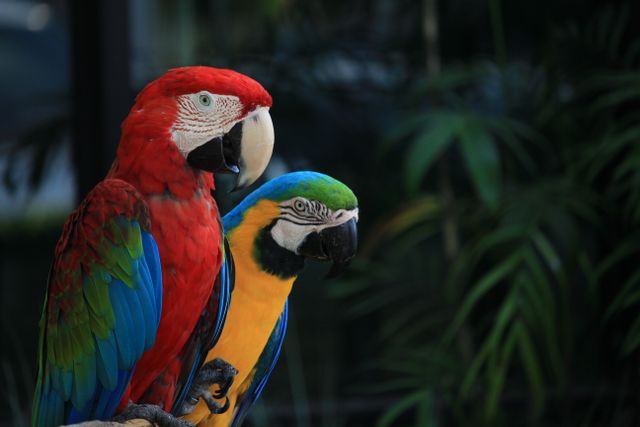
Macaws are the large New World parrots, known for their long tails and bright colors, that most people picture first when they hear the word “parrot.” There are 19 recognized species (including extinct and critically endangered ones) spread across six genera: Ara, Anodorhynchus, Cyanopsitta, Primolius, Orthopsittaca, and Diopsittaca (World Parrot Trust, 2026). They are native to Mexico, Central America, and South America, mostly in forests, and are known for bold coloration, powerful beaks, and loud, raucous calls. In places such as southern Peru, large groups gather at riverbank clay licks, where eating the clay is thought to help neutralize toxins from their plant diet (BirdLife International, 2025).
Representative species:
- Hyacinth Macaw (Anodorhynchus hyacinthinus), about 100 cm (3.3 ft) long, is the world’s largest flying parrot, a striking bird whose deep cobalt-blue plumage makes it unmistakable in the palm swamps and flooded grasslands of central South America. It is listed as Vulnerable on the IUCN Red List (World Parrot Trust, 2026).
- Scarlet Macaw (Ara macao) is a brilliant red, yellow, and blue parrot of Central and South American forests and one of the most widely recognized macaws.
- Lear’s Macaw (Anodorhynchus leari) is a slate-blue species from northeastern Brazil that recovered from roughly 60 birds in 1983 to nearly 1,700 today through sustained conservation work (World Parrot Trust, 2026).
- Red-shouldered Macaw (Diopsittaca nobilis), at roughly 30 to 35 cm (12 to 14 in), is one of the smallest macaws, showing how much size varies within the group.
Several macaws are among the rarest birds on Earth. The Spix’s Macaw (Cyanopsitta spixii) is listed as Extinct in the Wild, with captive-bred birds released in 2022 and 2025 in an effort to re-establish it, while the Glaucous Macaw (Anodorhynchus glaucus) is probably extinct (World Parrot Trust, 2026). For a fuller treatment, see our dedicated guide to the types of macaws.
Amazon Parrots
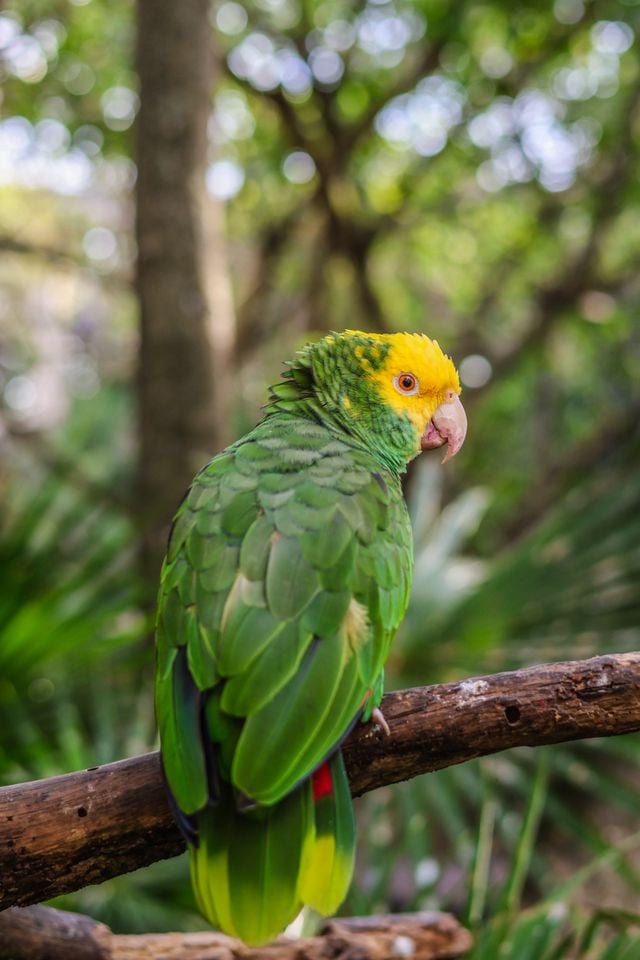
Amazon parrots are the stocky, predominantly green parrots of the genus Amazona, comprising roughly 30 species native to the tropical and subtropical regions of Mexico, Central America, South America, and several Caribbean islands (Cornell Lab of Ornithology, 2020). They are medium to large birds, typically 25 to 45 cm (10 to 18 in) long, with green plumage set off by bright flashes of red, yellow, or blue on the head and wings. Social interaction is central to their lives: they gather in noisy flocks and are among the most accomplished mimics in the parrot world.
Representative species:
- Yellow-headed Amazon (Amazona oratrix), a large, vivid green parrot with a yellow head, prized historically for its talking ability and now under heavy pressure in the wild.
- Puerto Rican Amazon (Amazona vittata), a Caribbean island endemic and one of the most endangered parrots anywhere, with fewer than 50 individuals in some wild populations and the focus of decades of intensive recovery work (IFAW, 2025).
- Yellow-naped Amazon (Amazona auropalliata), a green parrot with a yellow nape band and a celebrated talker, now Critically Endangered after losing more than 90 percent of its population in three generations to deforestation and trapping (IUCN, 2021).
- Blue-fronted Amazon (Amazona aestiva), a widespread South American species recognizable by the blue wash above its bill.
The Amazon parrots illustrate the conservation crisis in miniature. Of the 36 Amazona species assessed by the IUCN, five are Endangered and four are Critically Endangered, and two more, the Guadeloupe and Martinique Amazons, are already extinct, driven by habitat loss and illegal capture (IFAW, 2025). A related New World standout is the Hawk-headed Parrot (Deroptyus accipitrinus), an Amazon-rainforest species that raises a dramatic fan of dark red and blue neck feathers when alarmed, unlike any other parrot (World Parrot Trust, 2026). The Amazon parrots and their neighbors range from medium-sized parrots of about 25 cm (10 in) up to noticeably larger parrots, a reminder of how much variety the New World holds. For more, see our Amazon parrot guide.
African Greys
The African greys are two closely related parrots of the genus Psittacus, native to the forests of West and Central Africa. The Grey Parrot (Psittacus erithacus) and its smaller relative are not as colorful as many parrots, but these grey, red-tailed birds are widely regarded as the most accomplished vocal learners among all wild parrots. African grey parrots are medium-sized, roughly 28 to 33 cm (11 to 13 in) long, and the famous research subject Alex, studied by Irene Pepperberg, learned a working vocabulary of well over a hundred words and appeared to grasp concepts behind them.
The two species are:
- Grey Parrot (Psittacus erithacus), the Congo grey, the larger and paler of the two, with a bright red tail.
- Timneh Parrot (Psittacus timneh), a smaller, darker West African bird with a maroon tail, formerly treated as a subspecies and now recognized as a full species (Cornell Lab of Ornithology, n.d.).
Both species are listed as Endangered on the IUCN Red List and are protected under CITES Appendix I. The Grey Parrot was uplisted to Endangered in 2018 because the scale of annual trapping for the international pet trade, combined with rapid habitat loss, was pushing it toward extinction (World Land Trust, 2025). Between 1982 and 2014, more than 1.3 million wild-caught grey parrots entered international trade. For a deeper look, see our African Grey Parrot deep dive.

Cockatoos
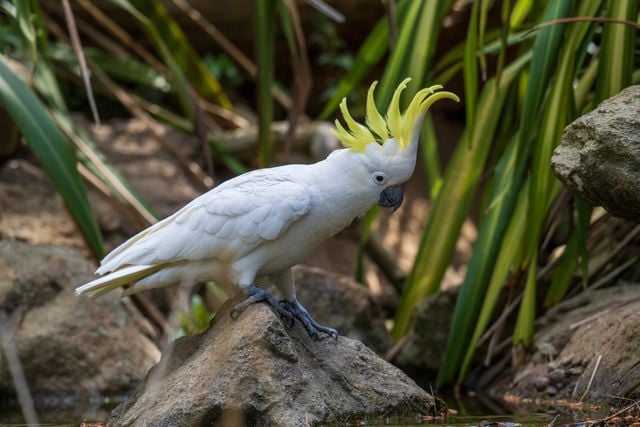
Cockatoos are the crested parrots of the family Cacatuidae, large parrots of the Australo-Papuan region almost all of which sport distinctive crests (Cornell Lab of Ornithology, 2020). There are 21 species, recognizable by the mobile crests on the top of their heads and their curved bills. The cockatoos include some of the largest parrots: the Palm Cockatoo is a big, heavy-bodied bird, though the family also runs down to the small Cockatiel. Their plumage tends toward white, grey, or black rather than the bright greens of other parrots, often with splashes of color in the crest, cheeks, or tail. The family is centered on Australasia: 11 species occur only in Australia, while others range through New Guinea, Indonesia, the Philippines, and the Solomon Islands.
Representative species:
- Sulphur-crested Cockatoo (Cacatua galerita), a large white cockatoo with a sweeping yellow crest, so abundant in parts of Australia that it is sometimes treated as an agricultural pest.
- Galah (Eolophus roseicapilla), a pink-and-grey cockatoo found across most of Australia.
- Palm Cockatoo (Probosciger aterrimus), a large smoky-black bird of New Guinea and far northern Australia, famous for crafting drumsticks to beat rhythms on hollow trees (BirdLife International, 2025).
- Cockatiel (Nymphicus hollandicus), the smallest cockatoo and an early offshoot of the lineage, a slim grey bird of the Australian interior.
The conservation picture is sobering: nearly half of all cockatoo species are threatened with extinction (BirdLife International, 2025). The Red-vented Cockatoo of the Philippines, for example, is Critically Endangered. See our complete guide to types of cockatoos for the full survey.
Lories and Lorikeets
Lories and lorikeets are the nectar-feeding parrots of the tribe Loriini, within the family Psittaculidae, and they are among the most colorful parrots in the world. They are specially adapted for feeding on nectar, using a brush-tipped tongue covered in fine papillae to sweep up pollen and nectar from flowers (Cornell Lab of Ornithology, 2020). This colorful group numbers roughly 53 to 56 species across about a dozen genera, distributed through Australia, New Guinea, Indonesia, and the islands of the Pacific. Because they move pollen between blossoms, they are important pollinators across their range. The names overlap, but species with longer tapering tails are generally called lorikeets, while shorter-tailed species are called lories.
Representative species:
- Rainbow Lorikeet (Trichoglossus moluccanus), a bird whose colorful plumage of blue, green, orange, and yellow makes it one of the most recognizable parrots of eastern Australia, often seen feeding in flowering trees.
- Ultramarine Lorikeet (Vini ultramarina), a small blue species endemic to the Marquesas Islands and listed as Endangered, threatened by introduced rats.
- Goldie’s Lorikeet (Psitteuteles goldiei), a small green-and-red highland species from New Guinea.
Most lories and lorikeets are currently of Least Concern, though several island endemics are vulnerable or endangered due to their tiny ranges and introduced predators (Britannica, 2026). For more, see our lories and lorikeets guide.

New Zealand Parrots
The New Zealand parrots are an ancient and remarkable lineage that forms its own superfamily, Strigopoidea, and genetic evidence shows it is sister to all other parrots (Cornell Lab of Ornithology, 2020). Only three species survive, all endemic to New Zealand, and all are threatened. They are larger parrots, ranging from about 46 to 64 cm (18 to 25 in), and their evolutionary isolation has produced behaviors found nowhere else in the order.
The three species are:
- Kea (Nestor notabilis), the world’s only alpine parrot, an olive-green, intensely curious bird of the South Island mountains renowned for tool use and problem-solving. It is listed as Vulnerable.
- New Zealand Kaka (Nestor meridionalis), a forest-dwelling, canopy-feeding relative of the kea, listed as Endangered.
- Kakapo (Strigops habroptilus), the only flightless parrot and the heaviest in the world, a nocturnal, moss-green, ground-dwelling bird with a booming lek mating display. It is Critically Endangered, with only 236 individuals as of 2026 (Wikipedia contributors, 2026).
The Kakapo’s recovery is one of conservation’s most intensively managed efforts: nearly wiped out by introduced predators, the surviving birds were moved to predator-free offshore islands and are monitored individually. For the full story, see our New Zealand parrots guide.

Broad-tailed and Old World Parrots
Beyond the headline groups, an enormous diversity of parrots falls within the Old World lineages of the family Psittaculidae, ranging across Africa, Asia, and Australasia. Alongside the lories, this family includes the colonial-breeding lovebirds (Agapornis), the bark-feeding pygmy-parrots, and the broad-tailed parrots of Australia (Cornell Lab of Ornithology, 2020). This is where many of the world’s most familiar small birds in the parrot family sit, alongside some critically endangered specialists. It also holds the smallest parrots of all, the pygmy-parrots of New Guinea. These smaller birds show that the parrot body plan works at almost any scale.
Representative species:
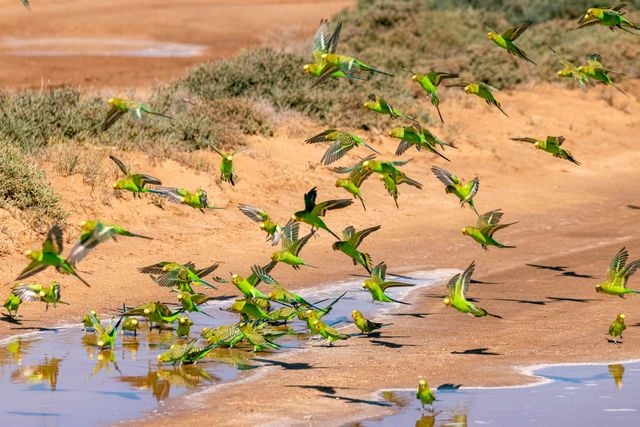
- Budgerigar (Melopsittacus undulatus), the small, nomadic green-and-yellow parrot of the Australian interior and one of the most numerous parrots on Earth.
- Rosy-faced Lovebird (Agapornis roseicollis), one of nine African lovebird species, small, social, and brightly colored.
- Swift Parrot (Lathamus discolor), a fast-flying, migratory broad-tailed parrot in its own genus, breeding in Tasmania and wintering on the Australian mainland. Despite a brush-tipped tongue that superficially resembles a lorikeet’s, it is a broad-tailed parrot, not a lory; the similarity is the result of convergent evolution around a nectar diet (Cornell Lab of Ornithology, 2026). It is Critically Endangered, threatened by logging of its breeding habitat and predation by introduced sugar gliders.
- Eclectus Parrot (Eclectus roratus), notable for extreme color difference between the sexes, the male bright green and the female red and blue.
This catch-all category spans some of the most stable parrots and some of the most imperiled. See our Old World parrots overview to explore further.
Parrots of the United States and Northern Mexico
Most people are surprised to learn that the United States once had its own native parrots. The contiguous US was originally home to just two species, and both have been lost from the country (United States Department of Agriculture, n.d.). Their stories, alongside the parrots that live wild in the US today, make this one of the most instructive corners of the whole family.
The native and neighboring species include:
- Carolina Parakeet (Conuropsis carolinensis), a green, yellow, and orange parrot roughly 33 cm (13 in) long that ranged across the eastern and central US, as far north as New York. It was the only parrot native to the eastern United States and is now extinct; the last known bird died in 1918, with the species officially declared extinct in 1939 (JSTOR Daily, n.d.). Hunting for crop protection and the feather trade, disease, and habitat loss all played a part.
- Thick-billed Parrot (Rhynchopsitta pachyrhyncha), a stocky green parrot with a red forehead and a curved beak built for pine nuts, native to the mountain pine forests of northern Mexico and formerly ranging into Arizona and New Mexico. Hunting drove it out of the US by around the 1920s, and a reintroduction effort in Arizona in the 1980s did not establish a lasting population (United States Department of Agriculture, n.d.). About 1,700 birds remained in Mexico as of 2018, where the species is endangered.
- Maroon-fronted Parrot (Rhynchopsitta terrisi), the Thick-billed Parrot’s only close relative, a large green bird with a maroon brow restricted to the cliffs and pine forests of the Sierra Madre Oriental in northeastern Mexico. Fewer than 2,500 mature birds survive, and it too is endangered (BirdLife International, 2025). These maroon-fronted parrots are a reminder that the family’s troubles do not stop at the US border.
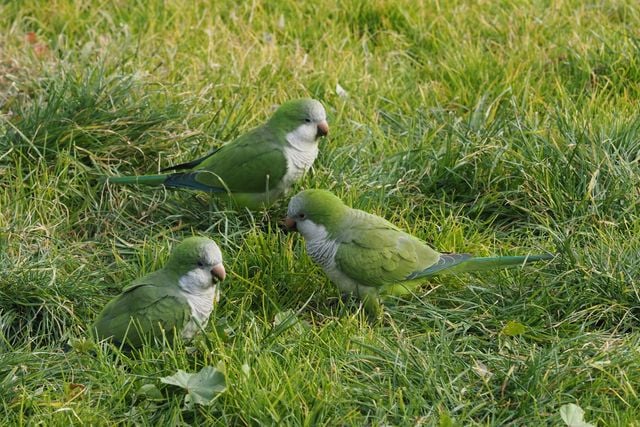
The US is not entirely without wild parrots today, though the current ones arrived by a different route. Escaped and released cage birds have established naturalized populations across the country: a long-term study using eBird and Christmas Bird Count data recorded 56 parrot species in the wild across 43 states between 2002 and 2016, with 25 species breeding (Uehling, Tallant, and Pruett-Jones, 2019). The most widespread is the Monk Parakeet (Myiopsitta monachus), a hardy South American species that builds large communal stick nests and tolerates cold well enough to persist through northern winters. Naturalized Red-crowned Parrots (Amazona viridigenalis), themselves endangered in their native northeastern Mexico, are another of the most commonly seen.
Why So Many Parrots Are in Trouble
Parrots are one of the most threatened bird families on Earth, and the reasons are worth understanding in their own right. Three pressures stand out, and they often compound one another.
Habitat destruction is the largest. As tropical forests are cleared for logging and agriculture, parrots lose both the food trees they forage in and the old, hollow-bearing trees they need to nest. Many species depend on a small number of tree cavities, so the loss of mature forest hits their breeding directly.
The pet trade is the second great pressure. Parrots are trapped from the wild in enormous numbers to supply international trade, and the most intelligent and colorful species are often the most heavily targeted. The African Grey Parrot is a stark example: more than 1.3 million wild-caught birds entered international trade between 1982 and 2014, a major reason the species is now endangered (World Land Trust, 2025). Illegal trade continues even where commercial trade is banned, and trapping does damage beyond the birds removed, since many die in transit. Responsible bird owners increasingly choose captive-bred birds from reputable sources rather than wild-caught ones, which reduces this pressure at its source.
The third pressure falls hardest on island species. Parrots that evolved on islands without ground predators, such as the Kakapo, are devastated when rats, cats, and stoats arrive, because they have no defenses against them. This is why so many of the world’s most endangered parrots are island endemics, and why predator-free islands have become central to their recovery.
The encouraging news is that targeted action works. Habitat protection, trapping controls under CITES, and intensive species recovery have pulled birds like Lear’s Macaw back from the brink. Conservation is difficult and slow, but the recoveries that have happened show it is far from hopeless.

Frequently Asked Questions
How many species of parrots are there?
There are approximately 389 living parrot species, all within the order Psittaciformes (BirdLife International, 2025). Counts in other sources range from about 387 to 410 depending on how recently extinct species and unresolved taxonomic splits are handled. All parrots fall into three superfamilies: the true parrots, the cockatoos, and the New Zealand parrots.
What is the largest parrot?
The Hyacinth Macaw (Anodorhynchus hyacinthinus) is the largest flying parrot, reaching about 1 m (3.3 ft) from head to tail and weighing up to 1.7 kg (3.7 lb) (BirdLife International, 2025). The flightless Kakapo of New Zealand is heavier still, at up to roughly 4 kg (8.8 lb), making it the heaviest parrot, though not the longest.
What is the smallest parrot?
Among the smallest parrots, the very smallest is the Buff-faced Pygmy Parrot (Micropsitta pusio), which measures about 8 cm (3.1 in) long and weighs around 10 g (0.35 oz) on average (BirdLife International, 2025). These tiny, green New Guinea birds feed partly on fungi and lichens and have never been successfully kept in captivity.
Are there any parrots native to the United States?
The United States had two native parrot species, but both have been lost from the country. The Carolina Parakeet of the eastern US is extinct, and the Thick-billed Parrot of northern Mexico, which once ranged into Arizona and New Mexico, was extirpated from the US by the 1920s and now survives only in Mexico (United States Department of Agriculture, n.d.). Wild parrots seen in the US today, such as the Monk Parakeet, are naturalized descendants of escaped cage birds.
Where do parrots live?
Parrots live across the tropics and subtropics of the Americas, Africa, southern Asia, and Australasia, plus many Pacific and Caribbean islands (BirdLife International, 2025). The greatest diversity is found in South America and Australasia. Most species inhabit tropical and subtropical forests, but parrots also occupy savanna, mangrove, desert fringe, and alpine habitats.
Which parrot is the most intelligent?
Several parrots rank among the most intelligent birds, with the African Grey Parrot, the Kea, and the Palm Cockatoo frequently singled out (BirdLife International, 2025). African greys are exceptional vocal learners, keas are renowned for tool use and problem-solving in the wild, and palm cockatoos craft tools to make sounds. Across the order, parrots have brain-to-body ratios comparable to primates.
Are parrots endangered?
Parrots are one of the most threatened bird groups on Earth, with roughly one in three species at risk of extinction (BirdLife International, 2025). At least 16 species have already been lost, and nearly half of all cockatoo species are now endangered species. The three principal threats are habitat destruction, hunting, and trapping for the pet trade.
Conclusion
For all their variety, parrots are unmistakably a single family: the hooked bill, the climbing feet, the keen intelligence, and the social life run from the giant macaws of the Amazon to the budgerigars of the Australian outback. Understanding the major groups, the macaws, the Amazons, the African greys, the cockatoos, the lories and lorikeets, the New Zealand parrots, the broad-tailed and Old World parrots, and the lost native parrots of the United States, is the best way to make sense of nearly 400 species at once.
It is also the best way to understand what is at stake. Parrots are among the most endangered birds on the planet, and the same qualities that make them so captivating, their intelligence, their beauty, their sociability, are part of what has put so many of them under pressure. The encouraging news is that focused conservation works: the recovery of Lear’s Macaw and the careful, individual stewardship of the Kakapo show what is possible when habitats are protected and threats are managed. To go deeper into any of these groups, follow the links above to our dedicated guides, where each story, and each species, gets the full attention it deserves.
Works Cited
BirdLife International. (2025, March 11). Everything you need to know about parrots. BirdLife International. https://www.birdlife.org/news/2025/03/11/everything-you-need-to-know-about-parrots/
BirdLife International. (2025). Species factsheet: Maroon-fronted Parrot Rhynchopsitta terrisi. BirdLife DataZone. https://datazone.birdlife.org/species/factsheet/maroon-fronted-parrot-rhynchopsitta-terrisi
Britannica, T. Editors of Encyclopaedia. (2026, May 5). Lorikeet. Encyclopaedia Britannica. https://www.britannica.com/animal/lorikeet
Cornell Lab of Ornithology. (2020). Cockatoos (Cacatuidae), version 1.0. Birds of the World. https://birdsoftheworld.org/bow/species/cacatu2/cur/introduction
Cornell Lab of Ornithology. (2020). Old World Parrots (Psittaculidae), version 1.0. Birds of the World. https://birdsoftheworld.org/bow/species/psitta4/cur/introduction
Cornell Lab of Ornithology. (2020). New Zealand Parrots (Strigopidae), version 1.0. Birds of the World. https://birdsoftheworld.org/bow/species/strigo1/cur/introduction
Cornell Lab of Ornithology. (2026). Swift Parrot (Lathamus discolor), version 2.0. Birds of the World. https://birdsoftheworld.org/bow/species/swipar1/cur/introduction
Cornell Lab of Ornithology. (n.d.). African Grey Parrot: Species in decline. Bird Academy, The Cornell Lab. https://academy.allaboutbirds.org/african-grey-parrot-species-in-decline/
IFAW. (2025, June 4). 19 of the world’s most endangered birds in 2025. International Fund for Animal Welfare. https://www.ifaw.org/international/journal/most-endangered-birds
IUCN. (2021). Amazona auropalliata: Yellow-naped Amazon. The IUCN Red List of Threatened Species. https://www.iucnredlist.org/species/22686342/180373727
JSTOR Daily. (n.d.). The thick-billed parrot is not extinct, not yet. JSTOR Daily. https://daily.jstor.org/the-thick-billed-parrot-is-not-extinct-not-yet/
One Earth. (n.d.). Hyacinth macaw: The largest parrot in the world. One Earth. https://www.oneearth.org/species-of-the-week-hyacinth-macaw/
Uehling, J. J., Tallant, J., and Pruett-Jones, S. (2019). Status of naturalized parrots in the United States. University of Chicago. https://news.uchicago.edu/story/escaped-pet-parrots-are-now-naturalized-23-us-states-study-finds
United States Department of Agriculture, Animal and Plant Health Inspection Service. (n.d.). Naturalized parrots in the United States. USDA National Wildlife Research Center. https://digitalcommons.unl.edu/icwdm_usdanwrc/2037/
World Land Trust. (2025, December 12). Grey Parrot. World Land Trust. https://www.worldlandtrust.org/species/grey-parrot/
World Parrot Trust. (2026). Hawk-headed Parrot. World Parrot Trust. https://parrots.org/encyclopedia/hawk-headed-parrot/
World Parrot Trust. (2026). Hyacinth Macaw conservation. World Parrot Trust. https://www.parrots.org/projects/hyacinth-macaw
World Parrot Trust. (2026). Lear’s Macaw research. World Parrot Trust. https://parrots.org/projects/lears-macaw-research/
World Parrot Trust. (2026). Spix’s Macaw: Finding the last wild bird. World Parrot Trust. https://www.parrots.org/projects/spixs-macaw