
Shore Birds of Folly Beach, South Carolina: A Coastal Birding Guide
Folly Beach, a barrier island just south of Charleston, ranks among South Carolina’s richest coastal birding destinations, with more than 270 species recorded at its premier site alone. The island sits along the Atlantic Flyway, the great migratory corridor that funnels millions of birds along the eastern seaboard, and its mix of ocean beach, tidal inlet, salt marsh, and maritime forest concentrates an unusually diverse cast of shorebirds, seabirds, and wading birds into a few square miles.
That variety is the appeal. On a single low-tide walk you might watch a Brown Pelican plunge offshore, step around a nesting Wilson’s Plover in the dunes, and pick a federally threatened Red Knot out of a feeding flock. This guide orients you to what lives here, where to find it, and when, and it points toward the conservation work that keeps these populations going. It serves as a hub for Folly Beach birding and links out to the deeper, narrower guides covering individual groups.
Key Takeaways
- Folly Beach holds more than 270 recorded bird species at Lighthouse Inlet Heritage Preserve, according to eBird data summarized by Visit Folly Beach, and 212 species at the south-end Folly Beach County Park.
- South Carolina’s state bird is the Carolina Wren (Thryothorus ludovicianus), designated in 1948, though the shoreline itself belongs to shorebirds, terns, and wading birds.
- The island sits on the Atlantic Flyway, making it a major stopover for migrating shorebirds, with peak diversity in spring (April to May) and fall (September to October).
- Lighthouse Inlet Heritage Preserve, at the northeast tip of the island, is the single best birding location and a recognized Audubon hotspot.
- The federally threatened rufa Red Knot (Calidris canutus) depends on South Carolina beaches during spring migration, making the island part of a hemisphere-spanning conservation story.
At a Glance: Birds of Folly Beach
The table below lists the species profiled in full below, followed by other birds you are likely to encounter on or around the island. Most shorebirds and seabirds are not feeder birds; the final column notes feeder food only where it applies.
At a Glance: Birds of Folly Beach
The table below lists the species profiled in full below, followed by other birds you are likely to encounter on or around the island. Most shorebirds and seabirds are not feeder birds; the final column notes feeder food only where it applies.
| Species | Scientific name | Size (length) | When present | Where to find | Best feeder food |
|---|---|---|---|---|---|
| Brown Pelican | Pelecanus occidentalis | 100 to 137 cm (39 to 54 in) | Year-round | Ocean, inlet, pier pilings | Not a feeder bird |
| American Oystercatcher | Haematopus palliatus | 42 to 50 cm (16.5 to 19.7 in) | Year-round | Oyster reefs, sand flats, inlet | Not a feeder bird |
| Wilson’s Plover | Charadrius wilsonia | 18 to 20 cm (7.1 to 7.9 in) | Spring and summer (breeds) | Open beach and dunes | Not a feeder bird |
| Piping Plover | Charadrius melodus | 17 to 18 cm (6.7 to 7.1 in) | Fall to spring (winters) | Inlet sand flats | Not a feeder bird |
| Black-bellied Plover | Pluvialis squatarola | 27 to 30 cm (10.6 to 11.8 in) | Mostly fall to spring | Beach, mudflats | Not a feeder bird |
| Sanderling | Calidris alba | 18 to 20 cm (7.1 to 7.9 in) | Mostly fall to spring | Surf line | Not a feeder bird |
| Ruddy Turnstone | Arenaria interpres | 22 to 25 cm (8.7 to 9.8 in) | Migration and winter | Wrack line, rock groin | Not a feeder bird |
| Willet | Tringa semipalmata | 36 to 40 cm (14.2 to 15.7 in) | Year-round | Beach, marsh edge | Not a feeder bird |
| Red Knot | Calidris canutus | 23 to 27 cm (9.1 to 10.6 in) | Mainly spring migration | Inlet flats, tide line | Not a feeder bird |
| Royal Tern | Thalasseus maximus | 43 to 53 cm (17 to 21 in) | Year-round, peaks warm months | Inlet, sandbars, surf | Not a feeder bird |
| Least Tern | Sternula antillarum | 21 to 24 cm (8.3 to 9.4 in) | Spring and summer (breeds) | Open beach, sandbars | Not a feeder bird |
| Black Skimmer | Rynchops niger | 40 to 50 cm (15.7 to 19.7 in) | Spring to fall, some winter | Inlet, sandbars | Not a feeder bird |
| Laughing Gull | Leucophaeus atricilla | 36 to 42 cm (14.2 to 16.5 in) | Year-round, fewer in winter | Everywhere along shore | Not a feeder bird |
| Ring-billed Gull | Larus delawarensis | 43 to 54 cm (17 to 21 in) | Fall to spring, scarce in summer | Beach, inlet, parking areas | Not a feeder bird |
| Great Blue Heron | Ardea herodias | 97 to 137 cm (38 to 54 in) | Year-round | Marsh, tidal creeks | Not a feeder bird |
| Great Egret | Ardea alba | 80 to 104 cm (31 to 41 in) | Year-round | Marsh, flats, ponds | Not a feeder bird |
| Snowy Egret | Egretta thula | 56 to 66 cm (22 to 26 in) | Year-round | Marsh, tide pools | Not a feeder bird |
| White Ibis | Eudocimus albus | 56 to 69 cm (22 to 27 in) | Year-round | Marsh, lawns, flats | Not a feeder bird |
| Painted Bunting | Passerina ciris | 12 to 14 cm (4.7 to 5.5 in) | Late April to August (breeds) | Maritime thickets, scrub | White millet |
| Semipalmated Plover | Charadrius semipalmatus | 17 to 19 cm (6.7 to 7.5 in) | Migration and winter | Mudflats, beach | Not a feeder bird |
| Dunlin | Calidris alpina | 16 to 20 cm (6.3 to 7.9 in) | Fall to spring | Mudflats, surf line | Not a feeder bird |
| Short-billed Dowitcher | Limnodromus griseus | 25 to 29 cm (9.8 to 11.4 in) | Migration and winter | Mudflats, marsh pools | Not a feeder bird |
| Marbled Godwit | Limosa fedoa | 42 to 48 cm (16.5 to 18.9 in) | Mostly fall to spring | Inlet flats | Not a feeder bird |
| Caspian Tern | Hydroprogne caspia | 48 to 56 cm (18.9 to 22 in) | Migration, some summer | Inlet, sandbars | Not a feeder bird |
| Sandwich Tern | Thalasseus sandvicensis | 36 to 43 cm (14 to 17 in) | Spring to fall | Inlet, sandbars | Not a feeder bird |
| Forster’s Tern | Sterna forsteri | 33 to 38 cm (13 to 15 in) | Year-round, peaks cooler months | Marsh, inlet | Not a feeder bird |
| Northern Gannet | Morus bassanus | 84 to 94 cm (33 to 37 in) | Late fall to early spring | Offshore, visible from beach | Not a feeder bird |
| American Herring Gull | Larus smithsonianus | 56 to 66 cm (22 to 26 in) | Mostly fall to spring | Beach, inlet, jetties | Not a feeder bird |
| Great Black-backed Gull | Larus marinus | 64 to 79 cm (25 to 31 in) | Winter (uncommon) | Beach, inlet | Not a feeder bird |
| Lesser Black-backed Gull | Larus fuscus | 51 to 67 cm (20 to 26 in) | Winter (scarce) | Beach, inlet | Not a feeder bird |
| Bonaparte’s Gull | Chroicocephalus philadelphia | 28 to 36 cm (11 to 14 in) | Mostly winter | Open water off the beach | Not a feeder bird |
| Double-crested Cormorant | Nannopterum auritum | 70 to 90 cm (28 to 35 in) | Year-round, peaks winter | Inlet, pilings, jetties | Not a feeder bird |
| Tricolored Heron | Egretta tricolor | 58 to 66 cm (23 to 26 in) | Year-round | Tidal creeks, marsh | Not a feeder bird |
| Little Blue Heron | Egretta caerulea | 56 to 74 cm (22 to 29 in) | Year-round | Marsh, pools | Not a feeder bird |
| Clapper Rail | Rallus crepitans | 35 to 48 cm (14 to 19 in) | Year-round | Salt marsh (heard often) | Not a feeder bird |
| Osprey | Pandion haliaetus | 54 to 58 cm (21 to 23 in) | Mostly spring to fall | Marsh, inlet, nest platforms | Not a feeder bird |
| Boat-tailed Grackle | Quiscalus major | 26 to 37 cm (10.2 to 14.6 in) | Year-round | Marsh edge, parking lots, yards | Cracked corn, mixed seed |
Why Folly Beach Holds So Many Birds
Folly Island is a barrier island, a long ridge of sand lying parallel to the mainland and separated from it by salt marsh and tidal creeks. Barrier islands are dynamic by nature, reshaped constantly by tides, longshore currents, and storms, and that restlessness is exactly what produces good bird habitat. The island stacks several distinct environments side by side: open ocean beach, a productive tidal inlet at each end, expanses of Spartina salt marsh on the back side, and a band of maritime forest and shrub thicket along the higher ground.
Each habitat supports a different community. Sand flats and the surf line feed plovers, sandpipers, and oystercatchers. The inlets concentrate terns, skimmers, and gulls that loaf on exposed bars at low tide. The marsh shelters herons, egrets, ibis, and secretive rails. The maritime thickets host songbirds, most famously the Painted Bunting, and serve as a migrant trap where exhausted travelers drop in to rest and refuel.
Layered on top of this geography is the Atlantic Flyway. This flyway is one of four broad north-south migration routes across North America, and it carries shorebirds, waterfowl, and songbirds between Arctic and tropical regions. Folly Beach functions as both a destination and a waystation along it. The northeast end of the island, where the beach, dunes, marsh, and forest meet at Lighthouse Inlet, ranks among the leaders in total bird species recorded anywhere in South Carolina.
The State Bird: Carolina Wren
South Carolina’s official state bird is the Carolina Wren (Thryothorus ludovicianus), a small, rust-brown songbird with a bold white eyebrow stripe and a voice far larger than its body. The state legislature designated it in 1948, repealing an earlier 1939 designation of the Northern Mockingbird. Lawmakers favored the wren because its name carries “Carolina,” because it is a permanent resident in every part of the state, and because it sings nearly year-round.

You will not find the Carolina Wren on the open beach, but it is common in the maritime forest and shrubby edges of Folly Island, as well as in island yards and gardens. Measuring roughly 12 to 14 cm (4.7 to 5.5 in), it forages low in tangles and brush piles for insects and spiders. Its ringing song is often written as tea-kettle, tea-kettle, tea-kettle, and a single male may repeat it thousands of times in a day. Both sexes give scolding alarm calls, but only the male sings to defend territory.
Shorebirds of the Sand and Flats
These are the birds most people picture when they imagine a beach: long-legged, fast-moving foragers that work the surf line, the wrack, and the exposed flats at low tide. Folly Beach is a stronghold for several, and a critical stopover for others.
American Oystercatcher (Haematopus palliatus)
The American Oystercatcher is unmistakable, a heavy, boldly patterned shorebird with a black head, dark brown back, white belly, pale pink legs, and a long, blade-like red-orange bill. It measures about 42 to 50 cm (16.5 to 19.7 in) in length with a wingspan near 76 to 86 cm (30 to 34 in).
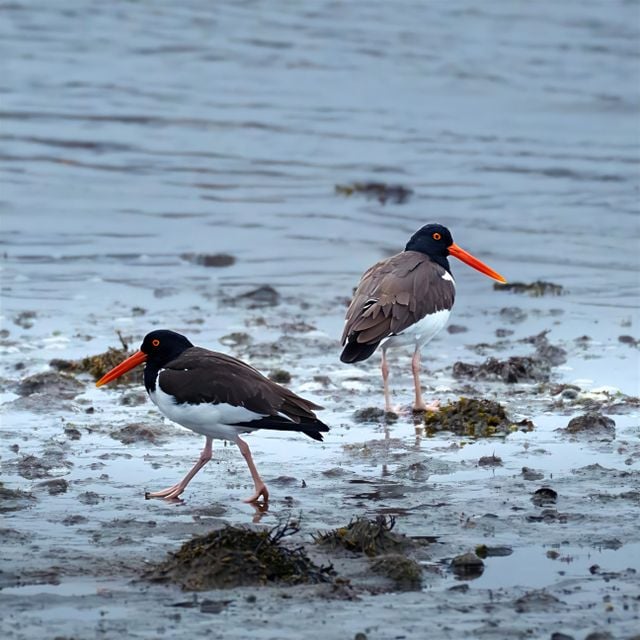
True to its name, it specializes in shellfish, using that chisel of a bill to pry or hammer open oysters, clams, and mussels along reefs and tidal flats. Pairs nest in shallow scrapes on open sand above the tide line. The species lives only in a narrow coastal zone and is sensitive to beach disturbance, which is why Cornell lists it as a Yellow Alert Tipping Point species of conservation concern. Folly’s oyster reefs and inlet flats are reliable places to find it year-round.
Wilson’s Plover (Charadrius wilsonia)
Wilson’s Plover is a stocky, single-banded plover of open sand, larger-billed than most of its relatives, measuring about 18 to 20 cm (7.1 to 7.9 in). It is sandy brown above and white below, with a thick black bill suited to its preferred prey of fiddler crabs.
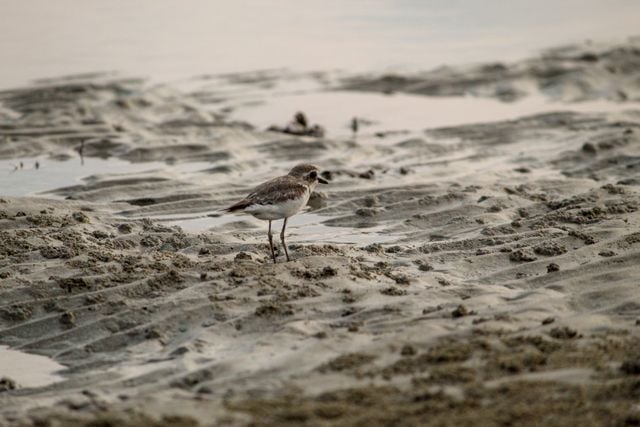
This is a signature breeding bird of Folly Beach. It nests directly on the open beach and in the dunes, where its eggs and chicks are superbly camouflaged and dangerously easy to step on. Portions of Lighthouse Inlet Heritage Preserve are protected specifically as nesting habitat for this species. From spring through early summer, walking the waterline rather than the dry upper beach is the simplest way to avoid crushing a hidden nest.
Piping Plover (Charadrius melodus)
The Piping Plover is a small, pale plover the color of dry sand, about 17 to 18 cm (6.7 to 7.1 in) long, with orange legs and, in breeding plumage, a narrow dark breast band. Its sandy tones make it easy to overlook on the upper beach.

Folly Island does not host nesting Piping Plovers, but the inlet flats serve as a migratory stopover and winter roosting site for this federally protected species. Birds that breed on the Atlantic coast and Great Lakes funnel south, and some spend the colder months here. Their presence is one reason dogs are prohibited at Lighthouse Inlet and why posted areas should be given a wide berth, since a single disturbance can flush wintering birds from the limited high-quality flats they depend on.
Black-bellied Plover (Pluvialis squatarola)
The Black-bellied Plover is the largest of the regular plovers here, about 27 to 30 cm (10.6 to 11.8 in), with a stout bill and a hunched, watchful posture. In breeding plumage it sports the striking black face and belly that give it its name; in the nonbreeding months that most coastal visitors see, it is a muted gray bird.
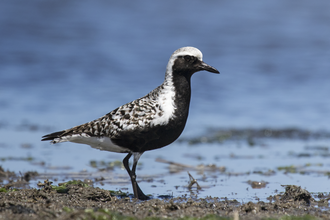
It feeds in the classic plover style, running a few steps, pausing, then snatching a worm or small crab from the surface. A useful field mark in flight is the black “wingpit,” a dark patch where the wing meets the body. Black-bellied Plovers are most numerous from fall through spring, scattered across the beach and tidal flats, often standing apart from the busier flocks of small sandpipers.
Sanderling (Calidris alba)
The Sanderling is the small, pale sandpiper that chases retreating waves and dashes back ahead of the next, working the swash zone at a near sprint. It measures about 18 to 20 cm (7.1 to 7.9 in) and is the palest of the common small sandpipers, frosty gray and white in the nonbreeding plumage typical along Folly’s beaches.
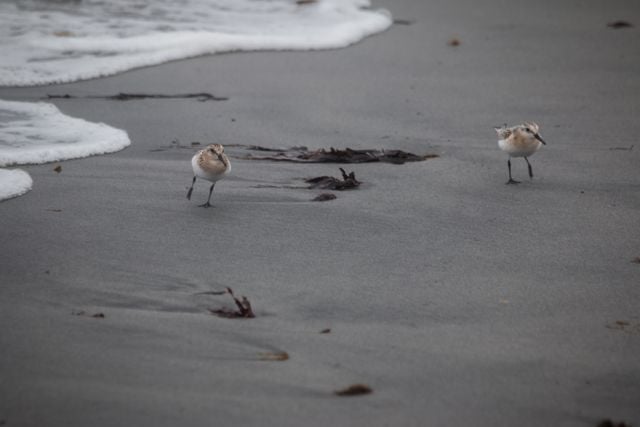
Sanderlings breed in the high Arctic and winter along temperate and tropical coasts worldwide, including South Carolina. They feed on small crustaceans and invertebrates churned up by the surf, probing the wet sand with quick stitching motions. Flocks are most conspicuous from late summer through spring. Their tameness and predictable surf-line behavior make them one of the easiest shorebirds for newcomers to watch closely.
Ruddy Turnstone (Arenaria interpres)
The Ruddy Turnstone is a chunky, short-legged shorebird with a harlequin pattern of black, white, and, in breeding plumage, rich chestnut on the back, about 22 to 25 cm (8.7 to 9.8 in) long. Its slightly upturned bill is a tool, used exactly as the name suggests.
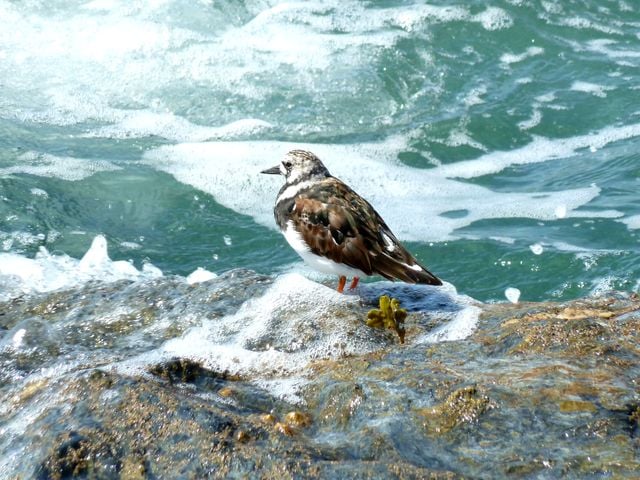
Turnstones forage by flipping over stones, shells, and clumps of seaweed to expose the small animals sheltering beneath, a feeding style that sets them apart from the probing and pecking of other shorebirds. On Folly Beach they favor the wrack line and the rocky groin at the north end, where the structure and tide pools offer the cover-flipping opportunities they exploit. They are present mainly during migration and winter.
Willet (Tringa semipalmata)
The Willet is a large, plain gray-brown shorebird, about 36 to 40 cm (14.2 to 15.7 in) long, that looks unremarkable on the ground until it flushes and reveals a bold black-and-white wing pattern. It carries a straight, sturdy bill and long gray legs.
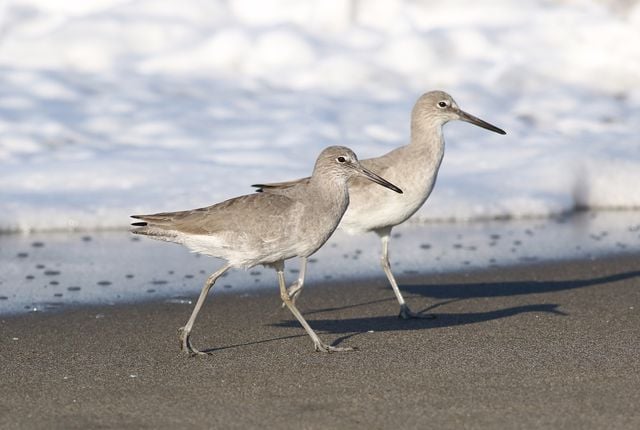
Willets are present year-round on the island, with breeding birds in the salt marsh and additional migrants and winterers along the beach and flats. The eastern breeding population nests in the marsh, and its loud, ringing pill-will-willet call is a defining sound of the Lowcountry shoreline in spring and summer. Outside the breeding season Willets quiet down and spread along the open beach, probing for crabs, worms, and mollusks.
Red Knot (Calidris canutus)
The Red Knot is a medium, robust sandpiper, about 23 to 27 cm (9.1 to 10.6 in) long, that transforms with the seasons. In spring it shows the warm reddish underparts that give it its name; in the nonbreeding plumage more often seen, it is a plain gray bird that can hide easily in a mixed flock.
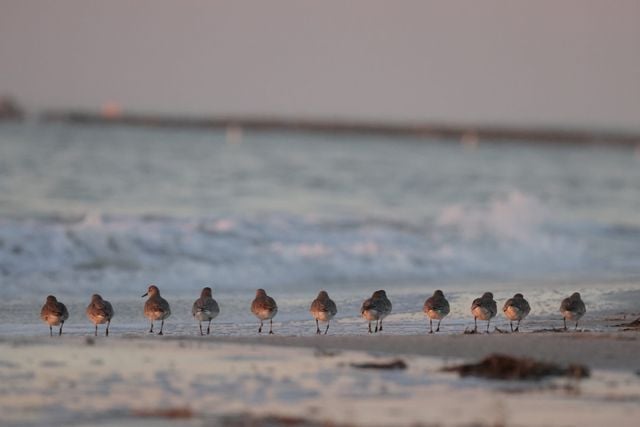
Few birds at Folly Beach carry a larger story. The rufa subspecies of Red Knot is federally listed as threatened, and it undertakes one of the longest migrations of any bird, traveling between the southern tip of South America and the Canadian Arctic. South Carolina’s coast is a vital spring refueling stop, where knots gorge on energy-rich horseshoe crab eggs to fuel the final push north. Watch for them on inlet flats and along the tide line, especially in late spring.
Seabirds: Terns, Skimmers, Gulls, and Pelicans
These are the birds of the open water and the inlet bars, plunge-divers and skimmers and loafers that gather where the ocean meets the sand. Folly’s inlets and the nearby Bird Key seabird colony make the island a regional center for several of them.
Brown Pelican (Pelecanus occidentalis)
The Brown Pelican is the island’s most charismatic seabird, a huge, heavy-billed waterbird measuring roughly 100 to 137 cm (39 to 54 in) in length with a wingspan approaching 2 m (6.5 ft). Adults are gray-brown with a pale head that turns rich yellow and chestnut in the breeding season.

Pelicans patrol just above the waves in tidy single-file lines, then fold and crash bill-first into the water to scoop up fish in their expandable throat pouches. The species is a conservation success story, having recovered after the pesticide DDT devastated its populations in the mid-twentieth century. From the late 1980s through 1994, nearby Bird Key supported the largest nesting colony of Brown Pelicans in the species’ entire range, according to the South Carolina Department of Natural Resources, although the colony has since shifted among the coast’s ever-changing sanctuary islands. Pelicans are present off Folly Beach year-round.
Royal Tern (Thalasseus maximus)
The Royal Tern is a large, elegant tern, about 43 to 53 cm (17 to 21 in) long, pale gray above and white below, with a heavy orange bill and a shaggy black crest that recedes to a black-flecked “bald” forehead outside the breeding season.

Royal Terns hunt by hovering over the surf and inlet, then plunging for small fish. They are highly social, loafing in dense, tightly packed groups on exposed sandbars alongside other terns and skimmers, often facing into the wind. Folly’s inlets reliably hold them year-round, with numbers peaking in the warmer months. They nest colonially on protected sites such as Bird Key rather than on the public beach.
Least Tern (Sternula antillarum)
The Least Tern is the smallest North American tern, about 21 to 24 cm (8.3 to 9.4 in), pale gray and white with a black cap, a white forehead patch, and a yellow bill. Its size and quick, fluttering flight set it apart from larger terns.

Least Terns nest in loose colonies directly on open sand and shell, which puts them in direct competition with beachgoers for the same flat, sunny strands. They breed at Lighthouse Inlet, at the island’s west end beyond the terminal groin, and on Bird Key. Hovering and diving for tiny fish in the shallows, they announce themselves with sharp, scolding calls. Posted nesting areas protect their vulnerable eggs and chicks through the spring and summer breeding season.
Black Skimmer (Rynchops niger)
The Black Skimmer is one of the most distinctive birds on the coast, about 40 to 50 cm (15.7 to 19.7 in) long, black above and white below, with a unique red-and-black bill in which the lower mandible is noticeably longer than the upper.
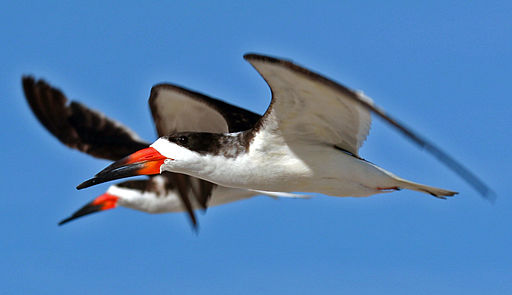
That asymmetrical bill is a precision feeding tool. The skimmer flies low and straight with the long lower mandible slicing the water surface, snapping the bill shut the instant it touches a fish. Skimmers rest in compact flocks on inlet sandbars and breed on protected sites including Bird Key, where they nest alongside Laughing Gulls, Least Terns, and oystercatchers. They are present from spring through fall, with some lingering into winter.
Laughing Gull (Leucophaeus atricilla)
The Laughing Gull is the default gull of the southeastern coast, a medium gull about 36 to 42 cm (14.2 to 16.5 in) long. Breeding adults have a crisp black hood, dark gray back, and red bill; in winter the hood fades to a smudge behind the eye.
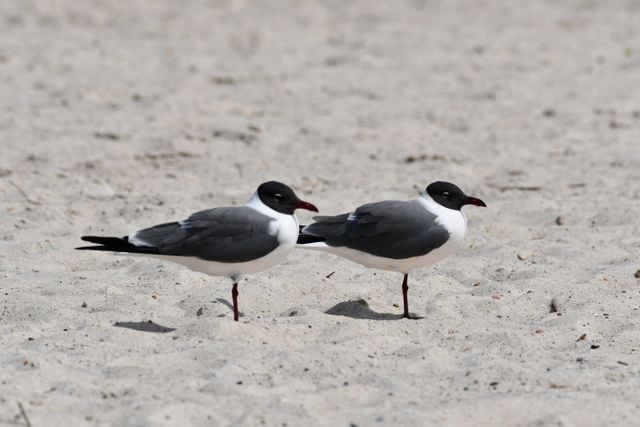
Its name comes from a loud, descending, laugh-like call that is among the most familiar sounds of a Folly Beach summer. Laughing Gulls are abundant and adaptable, feeding on everything from marine invertebrates to scraps, and they nest in large numbers on Bird Key. They are present year-round, though numbers thin in winter as many move farther south. Visitors should resist the urge to feed them, since handouts concentrate gulls and can harm both the birds and nesting neighbors.
Ring-billed Gull (Larus delawarensis)
The Ring-billed Gull is the clean, medium-sized gull many people picture as the classic seagull, about 43 to 54 cm (17 to 21 in) long. The adult has a pale gray back, white head and body, yellow legs, pale eyes, and a yellow bill crossed by a neat black ring near the tip, the mark that gives the bird its name.
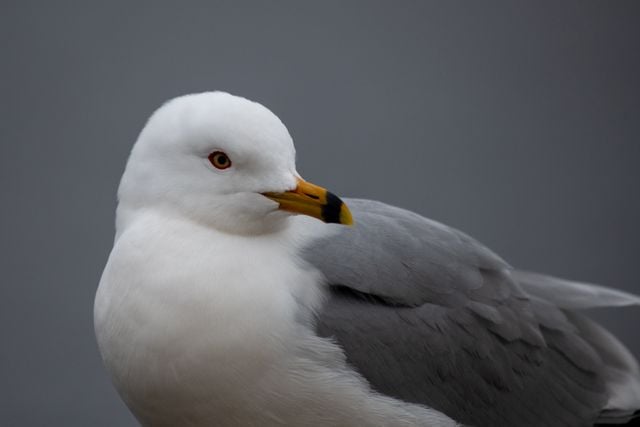
This is largely a cool-season bird at Folly Beach, common from fall through spring and scarce in midsummer. Highly adaptable, it forages along the beach and inlet but also gathers in parking lots and around picnic areas, where it readily scavenges. In winter the white head picks up faint dusky streaking. Its smaller size, ringed bill, and yellow legs separate it from the larger, pink-legged American Herring Gull.
Other Gulls to Know
Three larger gulls and one small one round out the regular cast. The American Herring Gull (Larus smithsonianus), about 56 to 66 cm (22 to 26 in) long, is a hefty winter gull with pink legs, pale eyes, and a heavy yellow bill marked with a red spot. The Great Black-backed Gull (Larus marinus), the largest gull in the world at about 64 to 79 cm (25 to 31 in), is an uncommon but regular winter visitor, identified by its massive size and slaty-black back. The Lesser Black-backed Gull (Larus fuscus) is a slimmer dark-backed gull with yellow legs, scarcer still and seen mostly in winter. Smallest of all is the Bonaparte’s Gull (Chroicocephalus philadelphia), about 28 to 36 cm (11 to 14 in), a buoyant, almost tern-like gull of open coastal water, with a thin black bill and a small black ear spot in nonbreeding plumage.
Wading Birds of the Marsh and Flats
The salt marsh and tidal creeks on the back side of Folly Island support a community of long-legged waders that stalk the shallows for fish, crabs, and other prey. Several are easy to see from causeways, docks, and the marsh edges.
Great Blue Heron (Ardea herodias)
The Great Blue Heron is the largest heron in North America, standing up to about 1.3 m (4.3 ft) tall with a length of 97 to 137 cm (38 to 54 in) and a wingspan that can approach 2 m (6.5 ft). It is blue-gray overall with a heavy yellowish bill and a black plume trailing from the eye.
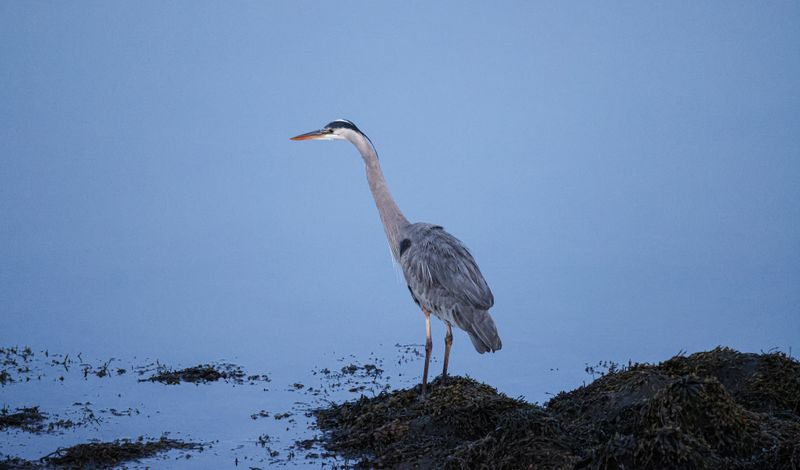
A patient, solitary hunter, it stands motionless in shallow water or along a creek bank before striking with a lightning thrust of its bill. Great Blue Herons take fish, crabs, frogs, and even small mammals and birds. They are present year-round along Folly’s tidal creeks and marsh edges, and their slow, deep wingbeats and trailing legs make them easy to identify in flight even at a distance.
Great Egret (Ardea alba)
The Great Egret is a tall, all-white heron, about 80 to 104 cm (31 to 41 in) long, with a yellow bill and black legs and feet. Its size and elegant lines distinguish it from the smaller white herons of the marsh.
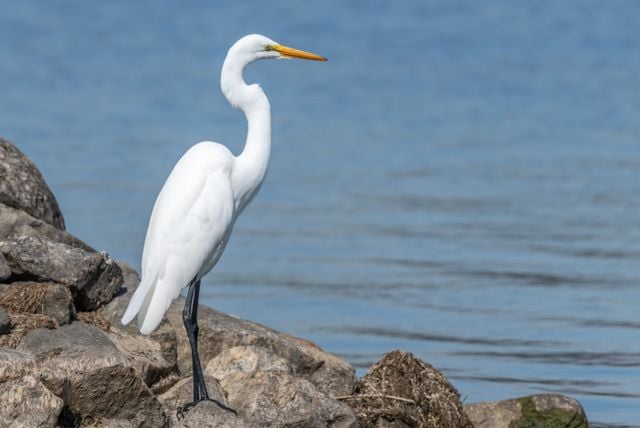
In the breeding season it grows long, lacy plumes across its back, the very feathers that drove the species to the brink during the plume-hunting era of the late nineteenth and early twentieth centuries. Public outrage over that slaughter helped launch the modern bird conservation movement, and the Great Egret became the symbol of the National Audubon Society. Today it is common year-round on Folly Island, hunting fish and crustaceans in marsh pools and along the flats.
Snowy Egret (Egretta thula)
The Snowy Egret is a small, animated white heron, about 56 to 66 cm (22 to 26 in) long, best identified by its slender black bill, black legs, and bright yellow feet, often described as “golden slippers.”
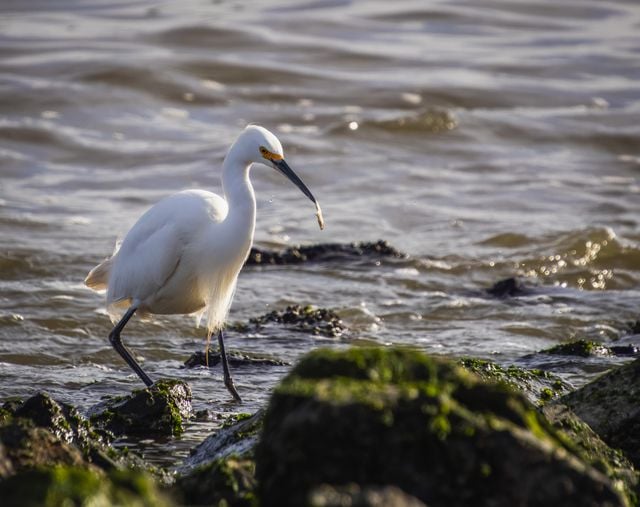
Unlike the stately Great Egret, the Snowy is a restless forager, dashing through the shallows, shuffling its yellow feet to stir up prey, and lunging after fish and shrimp. It too was hunted heavily for its breeding plumes before legal protection allowed populations to recover. Snowy Egrets are common year-round in Folly’s marshes and tide pools, and their active, almost frantic hunting style makes them a pleasure to watch.
White Ibis (Eudocimus albus)
The White Ibis is a striking wading bird, about 56 to 69 cm (22 to 27 in) long, white-bodied with black wingtips and an unmistakable down-curved, reddish-pink bill and matching legs and face. Juveniles are mottled brown and white.

Ibis feed in flocks, probing soft mud and marsh for crabs, crayfish, and insects with that sensitive curved bill. They are a common and sociable sight on Folly Island, working the marsh at low tide and sometimes spilling onto lawns and ballfields. White Ibis nest colonially in the Lowcountry, including historically on Bird Key, and large flocks moving between feeding and roosting sites are a familiar feature of the coastal skyline.
Maritime Forest and Marsh Specialties
Beyond the open shore, Folly’s higher ground and back-marsh support birds that many beach visitors overlook. The standout is a songbird of almost unreal color.
Painted Bunting (Passerina ciris)
The Painted Bunting is among the most spectacular songbirds in North America. The adult male is a riot of color, with a deep blue head, a green back, and a red breast and rump set in distinct, saturated blocks. Females and immatures are a uniform bright yellow-green, an excellent camouflage. The species is small, about 12 to 14 cm (4.7 to 5.5 in), with a stout seed-eating bill.
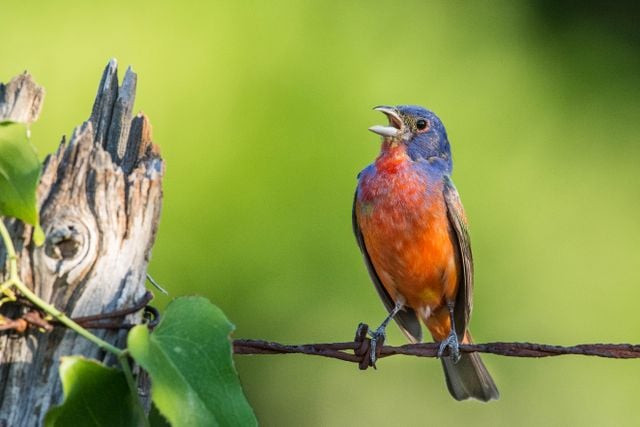
The eastern population breeds along the Atlantic coast from northern Florida into the Carolinas and favors exactly the maritime shrub thickets, brushy edges, and regenerating scrub found on Folly Island. Birds arrive in late April and sing through the summer before departing for Florida and the Caribbean by early fall. Numbers have declined as coastal thicket habitat is lost to development, and males are also targeted by the illegal cage-bird trade. White millet offered near thicket cover is the most reliable way to draw them to a yard.
Tricky Pairs: Telling Look-alikes Apart
A handful of Folly Beach species are regularly confused. The table below gives the field marks that separate the most common pairs.
| Pair | How to tell them apart |
|---|---|
| Snowy Egret vs immature Little Blue Heron | Both are small white herons. The Snowy Egret has a thin black bill and bright yellow feet; the immature Little Blue Heron has a two-toned bill (pale base, dark tip), greenish legs, and dusky wingtips, and it molts to slate-blue adult plumage. |
| Royal Tern vs Caspian Tern | Both are large terns. The Royal Tern has a slimmer orange bill and a white forehead outside breeding season; the larger Caspian Tern has a thick, blood-red bill with a small dark tip and a more heavily streaked dark crown. |
| Wilson’s Plover vs Semipalmated Plover | Wilson’s Plover is larger with a noticeably thick black bill and pinkish legs; the Semipalmated Plover is smaller with a short stubby bill (orange at the base in breeding plumage) and orange legs. |
What to See When
Folly Beach rewards birders in every season, but the cast changes through the year. The table below summarizes the highlights.
| Season | Highlights |
|---|---|
| Spring (March to May) | Peak shorebird migration, including Red Knots refueling on horseshoe crab eggs; Painted Buntings arrive in late April; terns, skimmers, and Wilson’s Plovers begin nesting; Ruby-throated Hummingbirds return. |
| Summer (June to August) | Breeding season for Wilson’s Plover, Least Tern, Black Skimmer, American Oystercatcher, and Painted Bunting; posted nesting areas active; Royal Terns and Laughing Gulls abundant. |
| Fall (September to October) | Heavy southbound shorebird and songbird migration; the maritime forest acts as a migrant trap, with many warbler species recorded; large tern and skimmer flocks on the inlet bars. |
| Winter (November to February) | Wintering Piping and Black-bellied Plovers, Dunlin, and Sanderlings; Northern Gannets and Black Scoters offshore, visible from the beach; large gull and tern roosts in the inlets. |
Notable Birding Locations on and Around Folly Beach
Folly Beach concentrates its best birding at the two ends of the island and on a protected key just offshore.
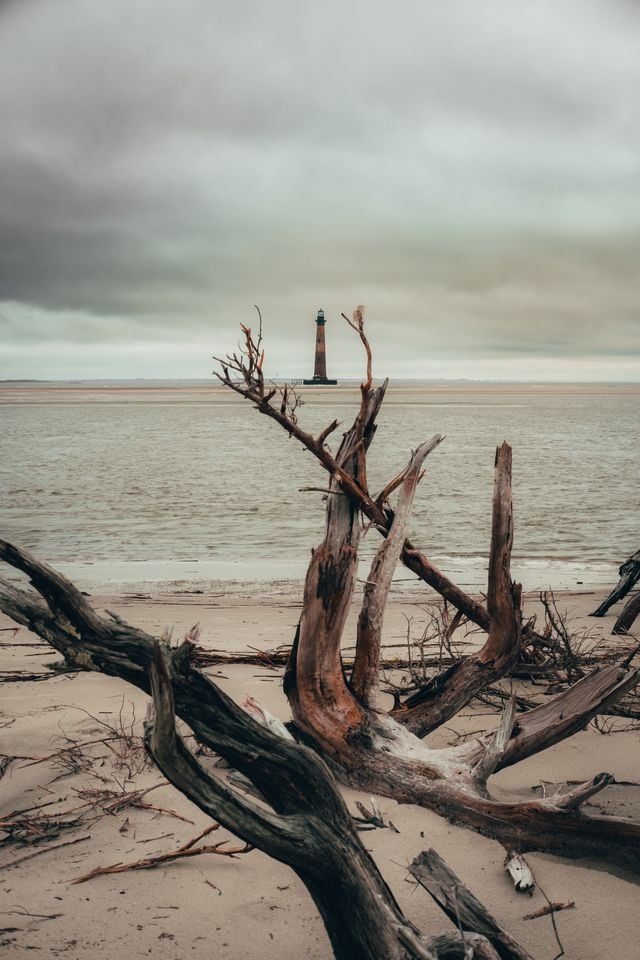
Lighthouse Inlet Heritage Preserve, at the northeast tip of the island, is the premier site. Once a Coast Guard station and a Civil War position, it protects beach, dune, marsh, and maritime forest in one compact area and is recognized as an Audubon birding hotspot, with more than 270 species recorded. It is reached by walking from the East Ashley Avenue beach access. The grassy and scrubby areas hold sparrows and migrant songbirds, while the inlet, sandbars, and rocky groin draw shorebirds, terns, and gulls. The site is best birded at low tide, and pets are not permitted in order to protect nesting and roosting birds.
Folly Beach County Park, at the south and west end of the island, offers a second productive area with 212 recorded species, including the beach beyond the terminal groin where shorebirds nest and feed. An entry fee applies.
Bird Key Stono Seabird Sanctuary lies just offshore between Folly and Kiawah islands, at the convergence of the Folly, Kiawah, and Stono rivers. This ever-shifting sandbar is a vital nesting site for Black Skimmers, Laughing Gulls, Least Terns, White Ibis, American Oystercatchers, Snowy Egrets, and Royal Terns. It is best viewed from a boat at a respectful distance; landing is restricted to protect the colony, and recent erosion has reduced its nesting area.
Sharing the Shore and Birding Your Yard
Because Folly Beach is a working nursery for beach-nesting birds, responsible behavior on the sand is itself a conservation act. From spring through summer, walk along the wet waterline rather than the dry upper beach, where camouflaged eggs and chicks are easily crushed underfoot. Respect posted nesting areas and keep well back; birds calling loudly and dive-bombing are signals that you are too close. Keep dogs out of restricted areas, and avoid flushing roosting flocks, which forces birds to waste energy they need for migration or breeding.
For island residents and visitors with yards near the maritime forest, a few choices make a real difference. Native plantings such as wax myrtle, yaupon holly, and beautyberry provide cover, insects, and berries that coastal birds use. A clean, shallow source of fresh water draws a wide range of species, especially during migration. For the celebrated Painted Bunting, an offering of white millet placed near thicket cover, with a quick escape route to dense shrubs, is the proven approach. Cleaning and refilling hummingbird feeders by mid-March, in line with guidance from Clemson University’s Home and Garden Information Center, readies them for the first returning Ruby-throated Hummingbirds. Nest boxes suit some woodland species but are not relevant to the open-beach nesters, which use only bare sand.
Conservation on the Folly Beach Coast
The defining conservation story on this stretch of coast involves a shorebird and a living fossil. The rufa Red Knot was listed as a threatened species under the federal Endangered Species Act effective January 12, 2015, after its population fell by roughly 70 to 75 percent from the 1980s to the early 2010s. Each spring, knots and other shorebirds depend on energy-rich horseshoe crab eggs to fuel their migration to the Arctic, and South Carolina’s beaches are among the most important stopovers outside Delaware Bay.
That dependence has driven significant legal and policy action in recent years. Litigation brought by conservation groups led to protections limiting the harvest of horseshoe crabs from key South Carolina spawning beaches during the crabs’ spring season, including within Cape Romain National Wildlife Refuge up the coast, with safeguards extending across dozens of beaches. These measures aim to keep enough horseshoe crab eggs on the beach for migrating knots to survive the journey north.
Closer to Folly, beach-nesting birds face a different pressure: the steady loss of safe nesting ground. The South Carolina Department of Natural Resources protects a chain of ephemeral Seabird Sanctuary islands, including Bird Key Stono, that shift and shrink under what biologists call coastal squeeze, the combined effect of moving inlet sands, severe storms, rising seas, and predators. Storms in late 2023, including Hurricane Idalia and a December nor’easter, eroded parts of these islands sharply, and in 2024 the state’s nesting pelicans concentrated almost entirely on Deveaux Bank rather than Bird Key. American Oystercatchers, which Cornell classifies as a Tipping Point species, and beach-nesting terns, skimmers, and plovers all depend on the dwindling supply of undisturbed sand. The agency reports that South Carolina’s coastal bird species have declined by roughly 70 percent over the past several decades, which is why the state’s protected sites, paired with respectful visitor behavior, matter so much.
Frequently Asked Questions
What birds can you see on Folly Beach?
Folly Beach hosts more than 270 recorded bird species, with the greatest variety at Lighthouse Inlet Heritage Preserve. Common sightings include Brown Pelicans, Laughing Gulls, Royal Terns, American Oystercatchers, Willets, Sanderlings, Great and Snowy Egrets, and White Ibis. The maritime forest adds songbirds such as the brilliant Painted Bunting in the warmer months.
Where is the best place to go birding on Folly Beach?
Lighthouse Inlet Heritage Preserve, at the northeast tip of the island, is the best birding location and a recognized Audubon hotspot, with beach, dune, marsh, and maritime forest concentrated in one spot. The south-end Folly Beach County Park is a strong second option, and the offshore Bird Key Stono Seabird Sanctuary can be viewed by boat at a respectful distance.
What is the South Carolina state bird?
The state bird of South Carolina is the Carolina Wren (Thryothorus ludovicianus), designated in 1948. It is a small, energetic, rust-brown songbird with a loud tea-kettle song and is a year-round resident found in the maritime forest and shrubby edges of Folly Island rather than on the open beach.
When do Painted Buntings arrive on the South Carolina coast?
Painted Buntings arrive on the South Carolina coast in late April and remain through August, when they breed in maritime shrub thickets and brushy edges. They depart for Florida and the Caribbean by early fall. White millet offered near dense cover is the best way to attract them.
When do hummingbirds arrive on the South Carolina coast?
Ruby-throated Hummingbirds, the only breeding hummingbird in the region, typically return to the South Carolina coast in mid-to-late March, with numbers building through April. Clemson University’s Home and Garden Information Center recommends having clean feeders out by about March 15 to greet the first arrivals.
What is the largest bird at Folly Beach?
The Brown Pelican is the largest bird most visitors see at Folly Beach, measuring up to about 1.4 m (4.5 ft) long with a wingspan near 2 m (6.5 ft). The Great Blue Heron is the tallest, standing up to roughly 1.3 m (4.3 ft), and the Northern Gannet, seen offshore in winter, is another large seabird, with a wingspan of about 1.7 to 2 m (5.6 to 6.5 ft).
Conclusion
Folly Beach packs an extraordinary range of coastal birds into a small barrier island, from the surf-chasing Sanderlings and reef-prying oystercatchers of the open shore to the terns and skimmers of the inlet bars, the herons and ibis of the marsh, and the jewel-toned Painted Buntings of the maritime thicket. Its position on the Atlantic Flyway makes it both a year-round home and a critical migratory stopover, nowhere more so than for the threatened Red Knot fueling up on its way to the Arctic. Seeing these birds well, and helping them persist, comes down to the same habits: visit at low tide, give nesting and roosting birds room, and learn the species group by group. For deeper coverage, explore the companion guides to Folly Beach shorebirds, terns and seabirds, wading birds, and the maritime forest songbirds.
Works Cited
- Visit Folly Beach. “Birding & Wildlife on Folly Beach, SC.” https://visitfolly.com/birding-wildlife/
- Charleston County Parks and Recreation Commission. “Lighthouse Inlet Heritage Preserve.” https://www.ccprc.com/3149/Lighthouse-Inlet-Heritage-Preserve
- Carolina Bird Club. “Folly Beach Lighthouse Inlet Heritage Preserve (Old Coast Guard Station).” https://www.carolinabirdclub.org/sites/SC/lighthouse_inlet.html
- South Carolina Department of Natural Resources. “Seabird Sanctuaries: Bird Key Stono.” https://www.dnr.sc.gov/birdsanctuaries/birdkeystono.html
- South Carolina Department of Natural Resources. “Temporary complete closure set at Deveaux Bank Seabird Sanctuary.” May 7, 2024. https://dnr.sc.gov/news/2024/May/may7-deveaux.php
- Atlantic Flyway Shorebird Initiative, Share Our Shores. “Folly Beach.” https://sos.atlanticflywayshorebirds.org/folly-beach/
- South Carolina Encyclopedia. “Carolina wren.” https://www.scencyclopedia.org/sce/entries/carolina-wren/
- U.S. Fish and Wildlife Service. “Endangered and Threatened Wildlife and Plants; Threatened Species Status for the Rufa Red Knot.” Federal Register, December 11, 2014. https://www.federalregister.gov/documents/2014/12/11/2014-28338/endangered-and-threatened-wildlife-and-plants-threatened-species-status-for-the-rufa-red-knot
- American Bird Conservancy. “Red Knot.” https://abcbirds.org/birds/red-knot/
- Cornell Lab of Ornithology, All About Birds. “Red Knot Life History.” https://www.allaboutbirds.org/guide/Red_Knot/lifehistory
- Southern Environmental Law Center. “A historic victory for horseshoe crabs in South Carolina.” https://www.selc.org/news/a-historic-victory-for-horseshoe-crabs-in-south-carolina/
- Coastal Conservation League. “Cape Romain case dismissed!” https://coastalconservationleague.org/blog/cape-romain-case-dismissed/
- American Bird Conservancy. “Painted Bunting.” https://abcbirds.org/birds/painted-bunting/
- Cornell Lab of Ornithology, All About Birds. “Painted Bunting Identification.” https://www.allaboutbirds.org/guide/Painted_Bunting/id
- National Audubon Society. “American Oystercatcher.” https://www.audubon.org/field-guide/bird/american-oystercatcher
- National Audubon Society. “Guide to North American Birds” (species field-guide accounts used for measurements). https://www.audubon.org/bird-guide
- Cornell Lab of Ornithology, All About Birds. “American Oystercatcher Overview.” https://www.allaboutbirds.org/guide/American_Oystercatcher/overview
- Cornell Lab of Ornithology, Birds of the World. “Double-crested Cormorant (Nannopterum auritum) Systematics.” https://birdsoftheworld.org/bow/species/doccor/cur/systematics
- Clemson University Cooperative Extension, Home and Garden Information Center. “Now Is the Time to Put Out Hummingbird Feeders.” https://hgic.clemson.edu/17755-2/


