Types of Yellow Birds: A Global Identification Guide
Few colors stop a birder in their tracks like a flash of pure yellow moving through green leaves. Maybe you saw a small golden bird at a feeder, a brilliant yellow head bobbing in a marsh, or a canary-bright shape singing from a hedge, and now you want to know what it was. This guide is built to help you put a name to it, and to enjoy the wonderful variety of yellow birds while you are at it.
Almost every yellow bird you will ever see owes its color to carotenoid pigments in its diet rather than to the structure of its feathers, which is why a healthy, well-fed bird often wears the brightest yellow of all. Yellow birds turn up on every inhabited continent, from the goldfinches and warblers of North America to the golden orioles of Europe and Asia, the wild canaries of the Atlantic islands, and the saffron finches of South America.
Below you will find twelve of the most notable and most recognizable yellow birds in the world, with the field marks that separate them, a look at why birds are yellow in the first place, and a quick guide to telling the trickiest look-alikes apart.
The quick version
Most yellow in birds is pigment, not structure. The yellow comes from carotenoids the bird absorbs from seeds, fruit, and insects, unlike blue, which is produced by the microscopic structure of the feather.
In North America, the bird you are most likely to be looking at is the American Goldfinch (Spinus tristis), a small finch whose breeding males are almost entirely yellow with a black cap and wings.
Yellow often appears on only part of the body or only on the male. Yellow-headed Blackbirds wear yellow only on the head and chest, and in many species, such as the goldfinches and the Eurasian Golden Oriole, the female is a far duller greenish bird.
Yellow birds are global. Notable examples include the Eurasian Golden Oriole (Oriolus oriolus) across Europe and Asia, the Yellowhammer (Emberiza citrinella) in Eurasian farmland, and the Atlantic Canary (Serinus canaria), the wild ancestor of the familiar cage canary.
Some yellow birds are in trouble. The Evening Grosbeak (Coccothraustes vespertinus) is now listed as Vulnerable on the IUCN Red List, and the Yellowhammer has declined sharply across the United Kingdom, where it sits on the national Red List.
At a Glance: Twelve Yellow Birds
| Species | Scientific name | Size | Region | Where the yellow shows / key field mark | Sexes differ? |
|---|---|---|---|---|---|
| American Goldfinch | Spinus tristis | 11 to 13 cm (4.3 to 5.1 in) | North America | Whole body yellow; black cap and wings on breeding male | Yes, and by season |
| Yellow Warbler | Setophaga petechia | 12 to 13 cm (4.7 to 5.1 in) | North America to northern South America | Entirely yellow; male has reddish breast streaks | Slightly |
| Western Tanager | Piranga ludoviciana | 16 to 19 cm (6.3 to 7.5 in) | Western North America | Yellow body, black wings, red-orange head on male | Yes |
| Prothonotary Warbler | Protonotaria citrea | 13 to 14 cm (5.1 to 5.5 in) | Southeastern United States | Golden head and underparts, blue-gray wings | Slightly |
| Evening Grosbeak | Coccothraustes vespertinus | 17 to 21 cm (6.7 to 8.3 in) | Northern North America | Yellow body and forehead, big pale bill, white wing patches | Yes |
| Audubon’s Oriole | Icterus graduacauda | 20 to 23 cm (8 to 9 in) | South Texas, Mexico, Belize | Lemon-yellow body with an all-black hood | No |
| Yellow-headed Blackbird | Xanthocephalus xanthocephalus | 21 to 26 cm (8.3 to 10.2 in) | Western North America | Golden head and chest on an otherwise black bird | Yes |
| Western Meadowlark | Sturnella neglecta | 16 to 26 cm (6.5 to 10 in) | Western and central North America | Bright yellow underparts crossed by a black V | No |
| Eurasian Golden Oriole | Oriolus oriolus | 24 to 25 cm (9.4 to 9.8 in) | Europe, Asia, Africa | Brilliant yellow body with black wings on male | Yes |
| Yellowhammer | Emberiza citrinella | 16 to 16.5 cm (6.3 to 6.5 in) | Europe and western Asia | Yellow head and underparts, chestnut rump | Yes |
| Atlantic Canary | Serinus canaria | 12.5 to 13.5 cm (4.9 to 5.3 in) | Macaronesia (Atlantic islands) | Yellow-green, brightest on face and breast | Slightly |
| Saffron Finch | Sicalis flaveola | About 13 to 14 cm (5.1 to 5.5 in) | South America | Bright yellow with an orange forecrown on male | Slightly |
Sizes and statuses reflect sources current as of 2026. Scientific names follow eBird/Clements.
About Yellow Plumage: Why Birds Are Yellow
Yellow in birds is almost always a pigment color, produced by carotenoids. According to the Cornell Lab of Ornithology, carotenoids are made by plants, and birds acquire them only by eating those plants or by eating insects that have eaten them. A goldfinch cracking thistle seed and a warbler gleaning caterpillars are both gathering the raw material for their own color.
When researchers examined three classic yellow songbirds, the Yellow Warbler, the Common Yellowthroat, and the Evening Grosbeak, they found that all three build their yellow plumage from a single carotenoid called lutein (McGraw et al., 2003). Because the bird cannot manufacture this pigment and has to find it in food, the brightness of its yellow can act as an honest signal of how well it is feeding, which is part of why yellow features so often in courtship and why males are usually the brighter sex.
This is what separates yellow from blue. Blue feathers are structural, created by microscopic structures that scatter light, so no bird can simply eat its way to a brighter blue. Yellow, orange, and red are pigment colors that travel from the plate into the plumage. Define one term here: sexual dimorphism just means the two sexes look different, which is extremely common among yellow birds, since the yellow that helps a male attract a mate would make a nesting female dangerously conspicuous.
Yellow has evolved again and again across unrelated families because it is useful for the same reasons everywhere. The birds in this guide come from at least six different families, and the trait reaches far beyond them, into the weavers of Africa, the white-eyes of Asia and the Pacific, and the honeyeaters of Australasia. Yellow is one of the bird world’s truly global colors.
American Goldfinch (Spinus tristis)

The American Goldfinch is the bird most North American readers picture when they hear “yellow bird,” and for good reason. A breeding male is yellow across almost his entire body, set off by a black forehead, black wings marked with white wing bars, and a black tail. This is also a species where the yellow is both seasonal and sex-linked: females are a softer olive-yellow, and in winter both sexes fade to a drab buff-brown, since the goldfinch is the only North American finch to molt all its body feathers twice a year. It measures 11 to 13 cm (4.3 to 5.1 in) long with a wingspan of 20 to 22 cm (8 to 9 in), per the National Audubon Society.
Goldfinches are birds of weedy fields, floodplains, roadsides, and backyards across most of the continent, and they are common feeder visitors, especially in winter when they flock to nyjer and sunflower seed. Listen for the bouncy po-ta-to-chip call they give in their undulating flight.
Quick scan: mostly yellow body; black cap and wings on the male; small conical bill; bounding flight with a chirpy call; North America.
Yellow Warbler (Setophaga petechia)

If a small bird looks yellow all over, with no strong markings except perhaps fine reddish streaks down the breast, the Yellow Warbler is the prime suspect. It is the most thoroughly yellow of the North American wood-warblers, a family of small, restless, insect-eating songbirds. Both sexes are yellow, though males are brighter and show those rusty breast streaks; the plain yellow face makes the dark eye stand out like a bead. It measures 12 to 13 cm (4.7 to 5.1 in) long with a wingspan of 16 to 20 cm (6.3 to 8 in), per Audubon.
This is one of the most widely distributed warblers in the Americas, nesting from near the Arctic Circle south to Mexico and wintering as far as northern South America. Look for it in streamside willows, wet thickets, and woodland edges, where the male sings a bright, sweet song often written as sweet sweet sweet I’m so sweet.
Quick scan: yellow all over; faint reddish breast streaks on the male; small thin warbler bill; willows and wet edges; widespread across the Americas.
Western Tanager (Piranga ludoviciana)
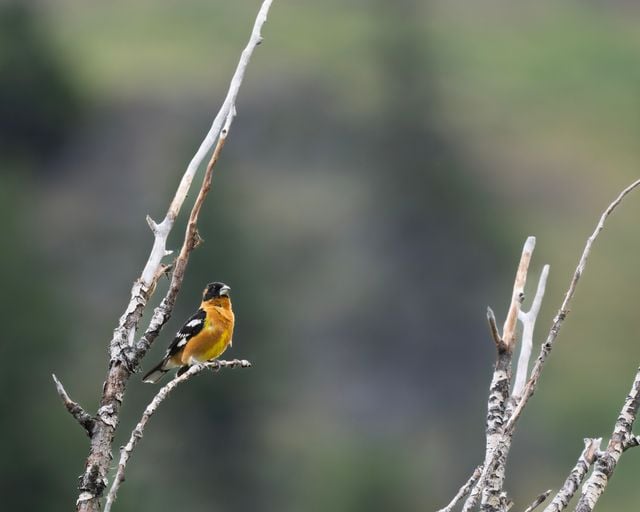
The Western Tanager delivers one of the most striking color combinations on the continent: a bright yellow body, jet-black wings and tail, and a flaming red-orange head on the breeding male. The yellow covers the underparts, rump, and nape, while the red of the head, like the yellow, comes from pigment in the bird’s food. Females and immatures are a more subdued yellow-green and lack the red head, so a plain yellowish tanager high in a conifer is most likely a female. It measures roughly 16 to 19 cm (6.3 to 7.5 in) long with a wingspan of about 28 to 30 cm (11 to 11.8 in).
Western Tanagers breed in coniferous and mixed forests across the West, farther north than any other tanager, reaching into northwestern Canada, and they winter from Mexico to Central America. They forage high and deliberately in the canopy, which can make them surprisingly hard to spot for such a vivid bird. Despite once being grouped with the tropical tanagers, this species belongs to the cardinal family, Cardinalidae.
Quick scan: yellow body with black wings; red-orange head on the breeding male; stout pale bill; western conifer forests; female yellow-green.
Prothonotary Warbler (Protonotaria citrea)

The Prothonotary Warbler glows an almost luminous golden-yellow over its head and underparts, offset by blue-gray wings and a beady black eye on a solid yellow face. It is a heavy-bodied warbler with a big head and bill, and both sexes are golden, with females only slightly paler. It measures 13 to 14 cm (5.1 to 5.5 in) long with a wingspan of 22 to 24 cm (8.7 to 9.4 in), per Audubon.
This is a bird of southeastern swamps, flooded bottomland forests, and wooded edges of slow rivers, and it is unusual among eastern warblers in nesting inside tree cavities, sometimes taking to nest boxes set over water. Its population has declined with the loss of forested wetlands, and Partners in Flight lists it as a species of high conservation concern, so a sighting is always worth savoring.
Quick scan: glowing golden head and underparts; blue-gray wings; white under the tail; southeastern wooded swamps; nests in cavities.
Evening Grosbeak (Coccothraustes vespertinus)
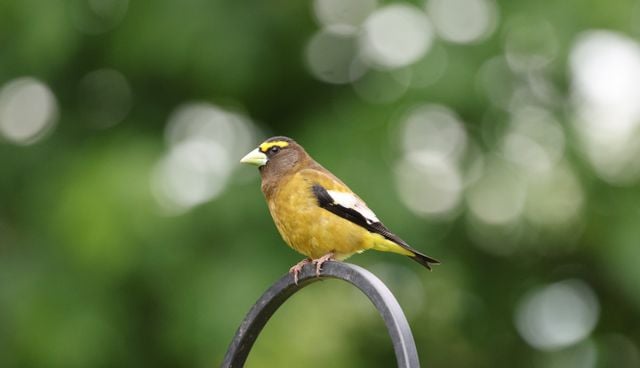
The Evening Grosbeak is the heavyweight yellow bird of the northern forests, a chunky finch with an oversized pale bill. On the male, yellow runs from a bold yellow forehead and eyebrow down the body, contrasting with a darker head and large white wing patches that flash in flight. Females are grayer, with only a wash of yellow. It measures 17 to 21 cm (6.7 to 8.3 in) long with a wingspan of 30 to 36 cm (11.8 to 14.2 in), per Audubon.
Once a familiar winter visitor at feeders across much of the continent, this finch has declined dramatically, and it is now listed as Vulnerable on the IUCN Red List. Project FeederWatch data documented the proportion of sites reporting the species falling by half over eighteen years, which makes a flock of these big golden finches at a winter feeder a genuinely special sight today.
Quick scan: bulky finch; huge pale bill; yellow forehead and body on the male; bold white wing patches; northern and mountain forests.
Audubon’s Oriole (Icterus graduacauda)
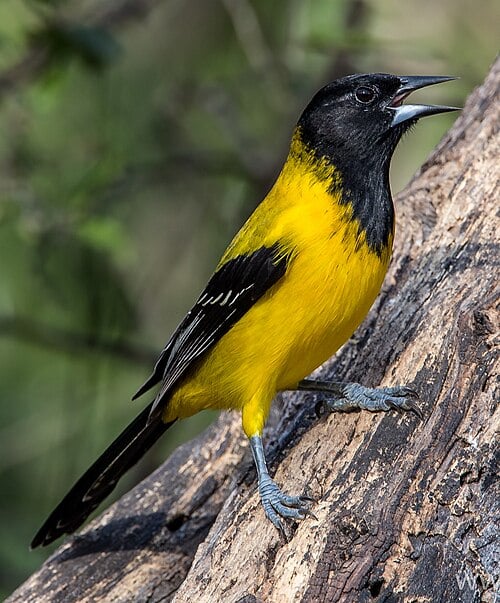
Audubon’s Oriole shows yellow over the entire body, sharply set against an all-black hood, black wings, and a black tail. It is the only North American oriole with a fully black head on a yellow body, and unusually for an oriole, the two sexes look alike and both sing. It measures 20 to 23 cm (8 to 9 in) long with a wingspan of 30 to 33 cm (12 to 13 in), per Audubon.
This is a shy, retiring bird of southern Texas, eastern and southern Mexico, and the northern edge of Central America, including parts of Belize, where it forages quietly in dense brush and woodland. You will often hear its slow, slurred, almost hesitant whistles before you see the bird, with a pair sometimes answering each other back and forth.
Quick scan: yellow body with a black hood; black wings and tail; both sexes alike; slow whistled song; south Texas and Mexico.
Yellow-headed Blackbird (Xanthocephalus xanthocephalus)
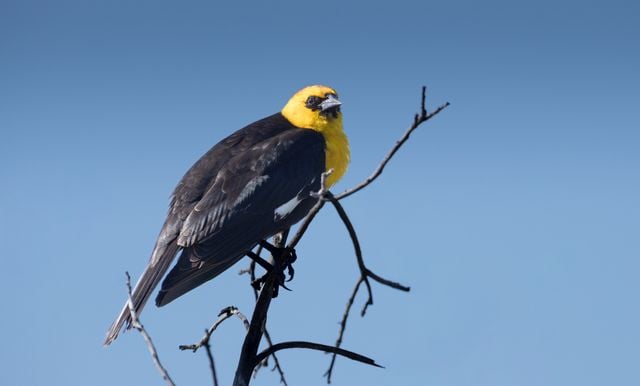
Here the yellow is concentrated in one bold place. The male Yellow-headed Blackbird is a black bird with a brilliant golden-yellow head and chest and a white wing patch, a pattern impossible to confuse with anything else. Females are browner and duller, with yellow restricted to the face and throat. It measures 21 to 26 cm (8.3 to 10.2 in) long with a wingspan of 42 to 44 cm (16.5 to 17.3 in).
Look for these birds in western and prairie marshes, where they nest in noisy colonies over standing water among the cattails and bulrushes. The song is famously unmusical, a harsh, grating scrape that sounds a bit like a rusty hinge, and the scientific name simply means “yellow head.”
Quick scan: black body with a golden head and chest; white wing patch; harsh scraping song; western marshes; female browner.
Western Meadowlark (Sturnella neglecta)
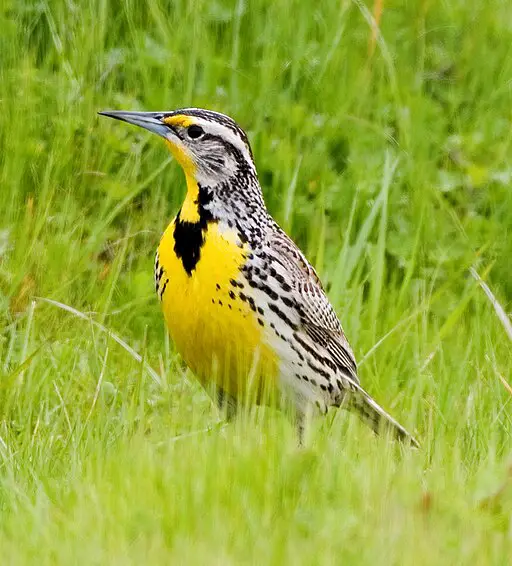
The Western Meadowlark wears its yellow on the underparts, a vivid lemon breast and belly crossed by a sharp black V, while the upperparts are cryptically streaked brown for camouflage in the grass. Both sexes look alike. It measures about 16 to 26 cm (6.5 to 10 in) long, a stout, short-tailed bird of open country.
This is a signature bird of grasslands, meadows, and pastures across the West and Midwest, more often heard than seen as the male delivers his rich, flutelike, bubbling song from a fence post or weed stalk. Grassland birds as a group have declined steeply with the loss of native prairie, which makes the meadowlark’s song an increasingly precious sound of open country. John James Audubon gave it the name neglecta because earlier explorers had overlooked this common bird.
Quick scan: bright yellow underparts; bold black V on the chest; streaky brown back; flutelike song; western and midwestern grasslands.
Eurasian Golden Oriole (Oriolus oriolus)
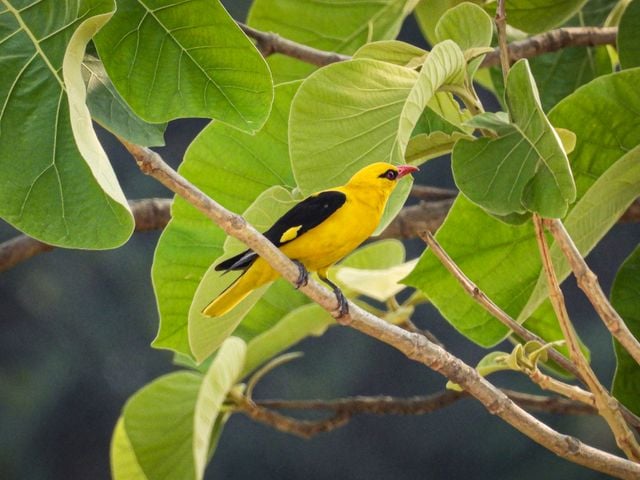
Beyond North America, one of the world’s most spectacular yellow birds is the Eurasian Golden Oriole. The male is a brilliant golden-yellow over the whole body, with black wings and tail and a striking reddish bill, while the female is a much drabber greenish bird, a textbook case of sexual dimorphism. It is roughly the size of a Common Blackbird, about 24 to 25 cm (9.4 to 9.8 in) long, with a wingspan of around 44 to 47 cm (17.3 to 18.5 in).
For all their brightness, golden orioles are famously hard to see, spending most of their time high in the leafy canopy of broadleaf woods, orchards, and riverside trees. They breed across Europe and into western Asia and winter in sub-Saharan Africa, and they are most often detected by the male’s gorgeous fluting whistle, often written as wee-lo. The IUCN lists the species as Least Concern across its very large range. Note that the similar Indian Golden Oriole (Oriolus kundoo) is now treated as a separate species.
Quick scan: brilliant yellow body with black wings on the male; reddish bill; fluting whistle; canopy of European and Asian woodlands; female greenish.
Yellowhammer (Emberiza citrinella)
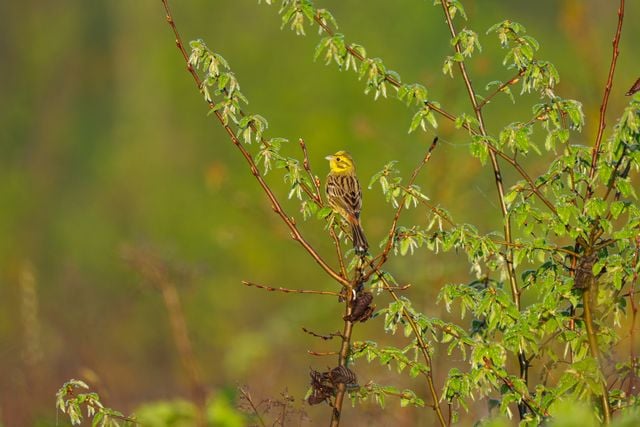
The Yellowhammer is a bunting in which the male’s yellow is concentrated on a bright yellow head and underparts, contrasting with a streaked brown back, a warm chestnut rump, and white outer tail feathers that flash in flight. Females are duller and more heavily streaked. It measures 16 to 16.5 cm (6.3 to 6.5 in) long with a wingspan of 23 to 29.5 cm (9.1 to 11.6 in).
A classic bird of open farmland, hedgerows, and heath across Europe and western Asia, the Yellowhammer is often seen singing from the top of a bush, delivering a rhythm traditionally remembered as “a little bit of bread and no cheese.” Although it is still listed as Least Concern globally, it has declined sharply in parts of its western range: in the United Kingdom its population fell by about 61 percent between 1967 and 2020, per the RSPB, and it now sits on the UK Red List of Birds of Conservation Concern.
Quick scan: yellow head and underparts on the male; chestnut rump; streaked brown back; sings from hedge tops; European and Asian farmland.
Atlantic Canary (Serinus canaria)
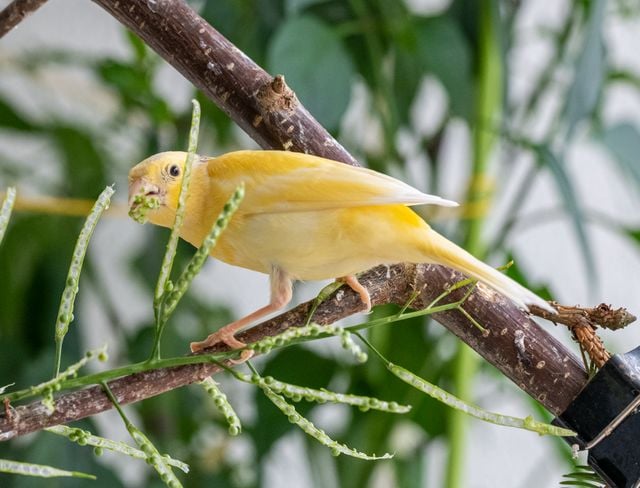
The Atlantic Canary is the wild ancestor of the familiar cage canary, and the wild bird is more subtle than its domesticated descendants. Its plumage is mostly yellow-green, brightest and clearest yellow on the face, forehead, and breast, with grayish-green, streaked upperparts. Males tend to be brighter and yellower than the greyer females. It measures about 12.5 to 13.5 cm (4.9 to 5.3 in) long.
This small finch is native to Macaronesia, the Atlantic island groups of the Canary Islands, the Azores, and Madeira, where it is common in orchards, gardens, copses, and other semi-open country from the coast to the hills. Its song is a long, silvery, twittering ramble, and it is the natural symbol of the Canary Islands. Interestingly, the islands were named first, after the dogs once kept there, and the bird took its name from the islands rather than the other way around. The IUCN lists it as Least Concern.
Quick scan: yellow-green finch; brightest yellow on face and breast; streaked back; long twittering song; Atlantic islands.
Saffron Finch (Sicalis flaveola)
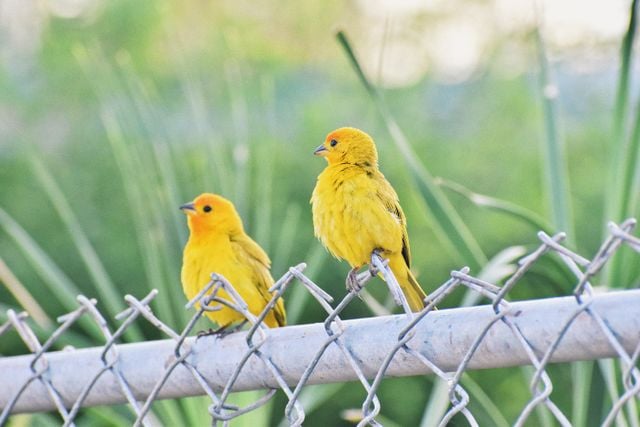
The Saffron Finch rounds out our global tour with a burst of South American yellow. The male is a rich, warm yellow overall, deepening to a distinctive orange forecrown that separates it from most other yellow finches, while the female is a duller version of the same. It measures about 13 to 14 cm (5.1 to 5.5 in) long.
Despite local nicknames like “native canary” and “roof canary,” the Saffron Finch is not closely related to the true canary at all; it belongs to the tanager family, Thraupidae. It is common in open and semi-open lowlands across much of South America outside the Amazon Basin, from Colombia to northern Argentina, and it has been introduced well beyond that range, including to Hawaii, Panama, and Puerto Rico, so North American readers occasionally encounter it on the islands. The IUCN lists it as Least Concern.
Quick scan: warm yellow body; orange forecrown on the male; conical finch bill; open South American lowlands; introduced to Hawaii and elsewhere.
How to Tell the Trickiest Yellow Birds Apart
A few yellow birds are confused far more often than the rest. Here is how to separate the most common mix-ups.
American Goldfinch versus Lesser Goldfinch (Spinus psaltria): both are small yellow finches, but the Lesser Goldfinch is smaller, often shows a green or black back rather than a clean yellow one, and the male keeps a black cap year round, whereas the breeding male American Goldfinch has only a small black forehead.
A small all-yellow bird: goldfinch or warbler? Goldfinches have short, thick, conical seed-cracking bills and an undulating flight with a chirpy call. Warblers like the Yellow Warbler have thin, pointed insect-eating bills and tend to flit through foliage. Bill shape is the fastest tell.
Yellow Warbler versus Wilson’s Warbler (Cardellina pusilla): both are bright yellow, but a male Wilson’s Warbler wears a neat black cap, and Wilson’s lacks the reddish breast streaks of a male Yellow Warbler.
A plain yellow-green bird in the West: this is often a female Western Tanager rather than a warbler or finch. Note the larger size, the stout pale bill, and the grayish wings with pale wing bars.
Golden bird in Europe: a brilliant yellow bird with solid black wings high in the canopy is a male Eurasian Golden Oriole, while a yellow-headed bird singing low from a hedge with a chestnut rump is a Yellowhammer.
Frequently Asked Questions
What kind of bird is bright yellow?
Many birds are bright yellow, and the most likely candidate depends on where you are. In North America the usual suspects are the American Goldfinch, the Yellow Warbler, and the Western Tanager, while in Europe a brilliant yellow bird is often a Eurasian Golden Oriole or a Yellowhammer. The fastest way to narrow it down is to note the bill shape, the size, and exactly where on the body the yellow appears.
What is the most common yellow bird in North America?
The American Goldfinch is the most common and familiar yellow bird across most of North America. Breeding males are almost entirely yellow with a black cap and black wings, and they are frequent visitors to backyard feeders, especially in winter when they gather in flocks for nyjer and sunflower seed.
Why are some birds yellow?
Birds are yellow because of carotenoid pigments they absorb from their diet, since they cannot manufacture these colors themselves. Seed-eaters and insect-eaters take in carotenoids from plants or from insects that fed on plants, then deposit them in their feathers. Because the pigment has to be earned through good feeding, a brighter yellow can signal a healthier bird, which is why males are often the more colorful sex.
Is a small yellow bird a goldfinch or a warbler?
Check the bill. Goldfinches have short, thick, conical bills built for cracking seeds, and they fly in a bouncy, undulating line with a chirpy call. Warblers such as the Yellow Warbler have thin, pointed bills for catching insects and tend to move quickly through foliage. That single difference resolves most goldfinch versus warbler questions.
What is the yellow bird in Europe?
The two most iconic yellow birds in Europe are the Eurasian Golden Oriole and the Yellowhammer. The Golden Oriole is a canopy bird with a brilliant yellow body and black wings, usually heard before it is seen, while the Yellowhammer is a farmland bunting with a yellow head and underparts that sings from the tops of hedges and bushes.
Are yellow birds rare?
Most yellow birds are common and widespread, so seeing one is usually nothing unusual. A few, however, have become much harder to find: the Evening Grosbeak is now listed as Vulnerable on the IUCN Red List, and the Yellowhammer has declined steeply in the United Kingdom, where it sits on the national Red List.
Conclusion
Yellow is one of the most rewarding colors to chase in the bird world, partly because it shows up in so many unrelated birds and partly because the same simple chemistry, carotenoid pigments drawn from food, links a goldfinch in a North American backyard to a golden oriole in a European wood and a saffron finch in a South American field. Once you start noticing where the yellow sits, on the whole body, just the head, only the underparts, or only the male, identification gets a great deal easier.
If you enjoyed this guide, you might like our companion appearance guides to other colors and field marks, and if you want to know which yellow birds turn up in your own state or region, our location guides can point you to the species you are most likely to see close to home. For the standout birds profiled here, the individual species deep dives go further into their lives and conservation.
Works Cited
Cornell Lab of Ornithology. “How Birds Make Colorful Feathers.” Bird Academy. https://academy.allaboutbirds.org/how-birds-make-colorful-feathers/
McGraw, K. J., et al. (2003). “Lutein-based plumage coloration in songbirds is a consequence of selective pigment incorporation into feathers.” https://pubmed.ncbi.nlm.nih.gov/12892761/
National Audubon Society. “American Goldfinch.” Audubon Field Guide. https://www.audubon.org/field-guide/bird/american-goldfinch
National Audubon Society. “Northern Yellow Warbler.” Audubon Field Guide. https://www.audubon.org/field-guide/bird/northern-yellow-warbler
National Audubon Society. “Western Tanager.” Audubon Field Guide. https://www.audubon.org/field-guide/bird/western-tanager
Cornell Lab of Ornithology. “Western Tanager Identification.” All About Birds. https://www.allaboutbirds.org/guide/Western_Tanager/id
Oiseaux-Birds. “Western Tanager (Piranga ludoviciana).” https://www.oiseaux-birds.com/card-western-tanager.html
National Audubon Society. “Prothonotary Warbler.” Audubon Field Guide. https://www.audubon.org/field-guide/bird/prothonotary-warbler
Cornell Lab of Ornithology. “Prothonotary Warbler Life History.” All About Birds. https://www.allaboutbirds.org/guide/Prothonotary_Warbler/lifehistory
National Audubon Society. “Evening Grosbeak.” Audubon Field Guide. https://www.audubon.org/field-guide/bird/evening-grosbeak
National Audubon Society. “Audubon’s Oriole.” Audubon Field Guide. https://www.audubon.org/field-guide/bird/audubons-oriole
Cornell Lab of Ornithology. “Yellow-headed Blackbird Overview.” All About Birds. https://www.allaboutbirds.org/guide/Yellow-headed_Blackbird/overview
Cornell Lab of Ornithology. “Western Meadowlark Overview.” All About Birds. https://www.allaboutbirds.org/guide/Western_Meadowlark/overview
Royal Society for the Protection of Birds. “Golden Oriole.” https://www.rspb.org.uk/birds-and-wildlife/golden-oriole
Oiseaux-Birds. “Eurasian Golden Oriole (Oriolus oriolus).” https://www.oiseaux-birds.com/card-eurasian-golden-oriole.html
Royal Society for the Protection of Birds. “Yellowhammer.” https://www.rspb.org.uk/birds-and-wildlife/yellowhammer
MadeiraBirds. “Atlantic Canary (Serinus canaria).” https://www.madeirabirds.com/atlantic-canary-serinus-canaria
Cornell Lab of Ornithology / eBird. “Saffron Finch (Sicalis flaveola).” https://ebird.org/species/saffin
BirdLife International. “Saffron Finch (Sicalis flaveola) Factsheet.” Data Zone. https://datazone.birdlife.org/species/factsheet/saffron-finch-sicalis-flaveola