Types of Red Birds: How to Identify the World’s Most Striking Red Species
You spotted a flash of red and now you want a name for it. That is one of the most common ways people fall into birding, because red is the color that stops us in our tracks, whether it is a cardinal against fresh snow or a tanager glowing in the green of a summer canopy.
Here is the orientation worth keeping in mind as you read: unlike blue and most purple in birds, red is almost always true pigment rather than a trick of light. Red birds get their color from carotenoids in their food, the same family of red pigments found in berries and crustaceans, which means a bird’s red can be as much about its diet as its species. That single fact will help you understand why a “red” bird might look orange, why only the males of many species are bright, and why the intensity varies from one individual to the next.
This guide profiles a curated set of the most notable and most likely encountered red birds worldwide, from backyard favorites like the Northern Cardinal and House Finch to the unmistakable Scarlet Ibis and Scarlet Macaw of the tropics. For each one, you will find where the red actually shows on the body, how to tell it from look-alikes, and the field marks that settle the identification.
What to know first
- Red in birds is almost always pigment, not structure: most red birds get their color from carotenoids in their diet, which is why intensity varies and why many appear orange or yellow when their food is low in pigment.
- In most red species the bright color belongs mainly to adult males, while females wear browns, grays, or olive tones, so the sex of the bird matters as much as the species when you identify it.
- The red bird a North American is most likely to see is the Northern Cardinal (Cardinalis cardinalis), a year-round resident across the eastern and central United States.
- The only entirely red bird in North America is the male Summer Tanager (Piranga rubra); the famous Scarlet Tanager male wears red only on the body, with jet-black wings.
- The most intensely red birds on Earth are tropical: the Scarlet Ibis (Eudocimus ruber) and Scarlet Macaw (Ara macao) draw their color from carotenoid-rich diets in South and Central America.
Red Birds at a Glance
Use this table to narrow things down fast by size, region, and where the red appears. Sizes are given as length, and conservation context appears in the profiles below.
| Species | Scientific name | Size | Region | Where the red shows / key field mark | Sexes differ? |
|---|---|---|---|---|---|
| Northern Cardinal | Cardinalis cardinalis | 21 to 23 cm (8.3 to 9.1 in) | Eastern and central North America | Entire male; pointed crest and black face mask | Yes |
| Summer Tanager | Piranga rubra | 17 to 19 cm (6.7 to 7.5 in) | Southern US to South America | Entire male, wings included; no black | Yes |
| Scarlet Tanager | Piranga olivacea | 16 to 19 cm (6.3 to 7.5 in) | Eastern US, winters South America | Body red, wings and tail jet black (breeding male) | Yes |
| House Finch | Haemorhous mexicanus | 12.5 to 15 cm (5 to 6 in) | North America | Head, throat, and upper breast of male | Yes |
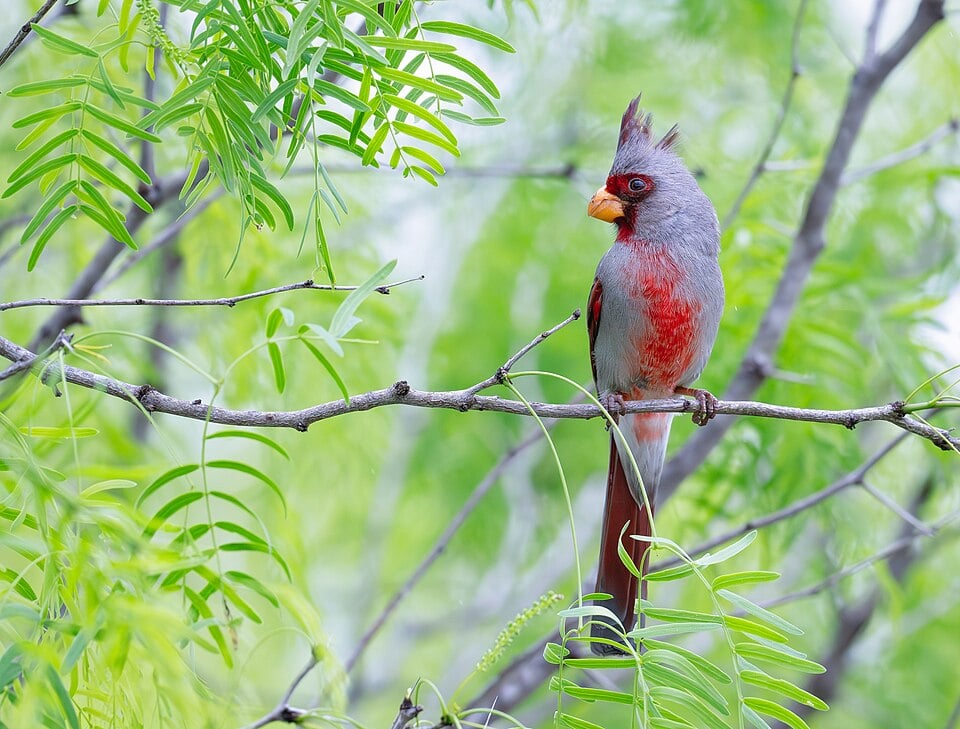
| Pyrrhuloxia | Cardinalis sinuatus | about 21 cm (8.3 in) | Southwestern US, northern Mexico | Face, crest, and breast stripe over gray body | Yes (subtle) |
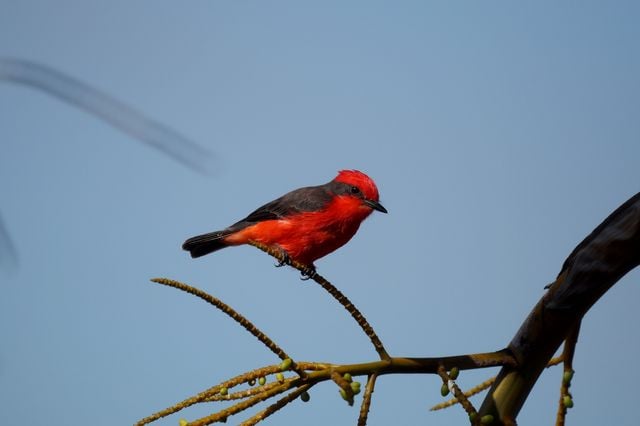
| Vermilion Flycatcher | Pyrocephalus rubinus | 13 to 14 cm (5.1 to 5.5 in) | Southwestern US through South America | Crown and underparts of male; dark mask | Yes |
| Red Crossbill | Loxia curvirostra | 14 to 16 cm (5.8 to 6.4 in) | North America and Eurasia | Whole male brick red; crossed bill | Yes |
| Pine Grosbeak | Pinicola enucleator | 21 to 25 cm (8.3 to 9.8 in) | Boreal North America and Eurasia | Head, breast, and rump pinkish red (male) | Yes |
| Red-headed Woodpecker | Melanerpes erythrocephalus | 19 to 23 cm (7.5 to 9.1 in) | Eastern and central US | Entire head only; black-and-white body | No |
| American Robin | Turdus migratorius | 20 to 28 cm (8 to 11 in) | North America | Breast and belly, orange-red | Yes (subtle) |
| Scarlet Ibis | Eudocimus ruber | 55 to 63 cm (22 to 25 in) | Northern South America, Trinidad | Entire body scarlet; black wingtips | No |
| Scarlet Macaw | Ara macao | 81 to 96 cm (32 to 36 in) | Southern Mexico to Amazonia | Body red; yellow and blue wings | No |
About the Color Red in Birds
Red coloration in birds is mostly a story about pigments and diet, and understanding it makes every red bird easier to read. The reds, oranges, and yellows in feathers come from carotenoids, the same pigments that color carrots, tomatoes, and the shells of small crustaceans. Birds cannot manufacture these pigments themselves. Instead, they take in yellow carotenoids through their food and convert many of them into red ketocarotenoids inside the body before depositing the finished color into growing feathers.
This is the key difference between red and the cooler colors. Blue feathers and most purple feathers are produced by structural color, meaning microscopic feather structures that scatter light, which is why a blue jay or a purple martin is not actually carrying blue or purple pigment. Red is different. It is genuine pigment, which is why a red bird’s brightness depends so directly on what it eats. Researchers have even identified a gene, CYP2J19, that helps convert yellow dietary carotenoids into red ones in many bird species (Lopes et al., 2016).
Because the raw material comes from food, color can vary within a single species. The House Finch is the classic case: depending on the carotenoid content of its diet during the molt, a male can range from pale yellow to deep red, and females tend to prefer the reddest males they can find. In that sense a bright red male is sending an honest signal, advertising that he is healthy and good at finding pigment-rich food.
That signal also explains why the red so often belongs to males. In many species only adult males are brightly colored, a pattern called sexual dimorphism, while females wear subtler browns, grays, and olive tones that help them stay hidden on the nest. So when you are trying to identify a red bird, always ask not just what species it is, but whether you are looking at a male, a female, or a young bird still growing into its color.
Northern Cardinal (Cardinalis cardinalis)

Size: 21 to 23 cm (8.3 to 9.1 in)
The Northern Cardinal is the red bird most people picture first, and the male wears red almost everywhere: a brilliant all-over crimson set off by a pointed crest and a black face mask around a heavy orange-red bill. The female is a warm grayish tan with red accents in the crest, wings, and tail, and shares the same crest and bill, so she is well worth learning too. The red here is carotenoid pigment, and because cardinals do not molt into a dull plumage, the male stays vivid through winter, which is part of why he shows up so often on Christmas cards and in winter’s snowy backyards.
Cardinals are year-round residents across the eastern and central United States, and the species has expanded its range northward for well over a century, helped along by bird feeders stocked with sunflower seeds. They have also been introduced to Hawaii and parts of southern California. The Northern Cardinal is the official state bird of seven states, including North Carolina and West Virginia.
Listen for a loud, ringing whistle often written as cheer cheer cheer or birdie birdie birdie, and a sharp metallic chip. Both sexes sing, which is unusual among songbirds.
Quick scan:
- Entirely red male with a pointed crest and black face mask
- Warm tan female with red highlights and the same crest
- Heavy orange-red conical bill
- Year-round resident at feeders, especially for sunflower seeds
- Loud ringing whistles from both sexes
Summer Tanager (Piranga rubra)

Size: 17 to 19 cm (6.7 to 7.5 in)
The adult male Summer Tanager is the only entirely red bird in North America, a soft, rosy strawberry red with no black anywhere, which is the quickest way to separate it from the Scarlet Tanager. The color is held year-round rather than just in the breeding season, and the bird carries a stout pale bill and no crest. Female and immature Summer Tanagers are a warm mustard yellow, and young males can be patchy yellow and red as they molt into adult color.
Summer Tanagers breed in open woodlands across the southern and eastern United States, favoring oak and pine, and they migrate to Central America and northern South America for winter. They are bee and wasp specialists, catching stinging insects in flight and beating them against a branch to remove the stinger before eating them.
The song is sweet and robin-like, and the call is a distinctive dry pit-ti-tuck.
Quick scan:
- Male entirely rosy red, wings included, with no black
- Mustard-yellow female and patchy young males
- Stout pale bill, no crest
- Southern and eastern US woodlands in the breeding season
- Specialist hunter of bees and wasps
Scarlet Tanager (Piranga olivacea)

Size: 16 to 19 cm (6.3 to 7.5 in)
In the breeding season the male Scarlet Tanager is unforgettable: a blood-red body set against jet-black wings and tail, one of the most dazzling sights in an eastern forest. That black-and-red contrast is the field mark, and it is the cleanest way to tell this bird from the all-red Summer Tanager. The red is seasonal, though. After breeding the male molts into a yellow-green plumage, keeping only the black wings, before migrating to northwestern South America. Females are olive-yellow year-round with darker wings.
Scarlet Tanagers breed in mature deciduous forests of the eastern United States and southeastern Canada, and they often stay high in the canopy where the brilliant color can be surprisingly hard to spot.
Listen for a burry, robin-like song and a distinctive chick-burr call note, which is often how birders locate them.
Quick scan:
- Breeding male red with jet-black wings and tail
- Olive-yellow female with dark wings
- Red is seasonal; fall males turn yellow-green
- Mature eastern deciduous forest, high in the canopy
- Burry song and a sharp chick-burr call
House Finch (Haemorhous mexicanus)

Size: 12.5 to 15 cm (5 to 6 in)
The House Finch is the small red bird most likely to turn up at a feeder, and on the male the red is concentrated on the head, throat, and upper breast, over a streaky brown body and a notched tail. This is the species that shows the diet-and-color link most vividly: depending on the carotenoids in its food, a male can be deep red, orange, or even yellowish, so do not be thrown if your “red” finch looks orange. Females lack red entirely and are plain brown with blurry streaking.
House Finches range across North America. Western populations are native, while eastern birds descend largely from a small number of cage birds released near New York in 1940, after which the species spread rapidly. They are sociable, often moving in small flocks, and readily eat sunflower seeds.
The song is a long, lively warble, often ending in a buzzy note.
Quick scan:
- Male red on the head, throat, and upper breast only
- Color varies from red to orange to yellow with diet
- Plain brown, blurry-streaked female
- Common feeder bird across North America, often in small flocks
- Long warbling song
Pyrrhuloxia (Cardinalis sinuatus)
Size: about 21 cm (8.3 in)
Often called the desert cardinal, the Pyrrhuloxia is what you get when you take a cardinal and trade most of the red for crisp gray. The male is gray overall with red showing on the face, crest, and a stripe down the breast, plus reddish tones in the wings and tail, and it carries a stubby, parrotlike yellow bill rather than the cardinal’s orange one. Females show even less red. This is a close relative of the Northern Cardinal and the two can occur together, so the bill shape and the gray body are your best clues.
Pyrrhuloxias are habitat specialists of desert scrub in the southwestern United States, including southern Arizona and New Mexico, and northern Mexico. In winter they gather in foraging flocks.
The song is a ringing, cardinal-like series of whistles, with sharp chip notes from both sexes.
Quick scan:
- Gray body with red face, crest, and breast stripe
- Stubby yellow, curved bill (not orange)
- Female even grayer with little red
- Desert scrub of the Southwest and northern Mexico
- Ringing whistles like a Northern Cardinal
Vermilion Flycatcher (Pyrocephalus rubinus)
Size: 13 to 14 cm (5.1 to 5.5 in)
The male Vermilion Flycatcher is a tiny ember of a bird, with a brilliant red-orange crown and underparts set against a dark brown mask and back. The red sits on the head and underparts, and on a bird this small, perched out in the open, the effect of that fiery red plumage is striking. Females are entirely different, gray-brown above with a salmon-red blush low on the belly, so the sexes look almost like two species.
This flycatcher barely reaches the southwestern United States, where it breeds in desert riparian areas of southern Arizona, New Mexico, and Texas, but it is widespread from Mexico through much of South America. It perches on shrub tops and fences and sallies out to catch flying insects in midair.
Courting males perform a fluttering flight display and may present a female with a showy insect such as a butterfly.
Quick scan:
- Tiny male with red-orange crown and underparts and a dark mask
- Gray-brown female with a salmon blush below
- Perches in the open, sallies for flying insects
- Desert riparian areas of the Southwest, common farther south
- Fluttering courtship flight display
Red Crossbill (Loxia curvirostra)

Size: 14 to 16 cm (5.8 to 6.4 in)
The male Red Crossbill is brick red over the whole body with darker wings, but the trait that truly sets this bird apart is structural rather than colorful: the tips of its bill cross over each other, a specialized tool for prying seeds out of unopened conifer cones. Females are yellowish to olive instead of red. If you see a chunky, short-tailed finch working a pine or spruce cone with an oddly twisted bill, this is your bird.
Red Crossbills live in coniferous forests across North America and Eurasia. Because conifers seed unpredictably, the birds wander widely and may breed in almost any month when food is abundant. North America holds many call types that specialize on different conifers and may eventually be split into separate species.
Listen for sharp, metallic call notes from chattering flocks near the tops of trees.
Quick scan:
- Male brick red overall with darker wings
- Crossed bill tips for opening conifer cones
- Yellowish to olive female
- Coniferous forests; wanders widely in search of cone crops
- Metallic flight calls from treetop flocks
Pine Grosbeak (Pinicola enucleator)

Size: 21 to 25 cm (8.3 to 9.8 in)
The Pine Grosbeak is the largest of the red finches, a plump, robin-sized bird in which the male is washed in soft pinkish red across the head, breast, and rump over gray underparts, with a short, stubby bill. Females and immatures swap the red for warm yellow or russet tones. The combination of large size, round body, and rosy color is distinctive among finches.
Pine Grosbeaks breed in the boreal and mountain conifer forests of northern North America and Eurasia, and they are famously tame and slow-moving. In some winters they irrupt south of their normal range, dropping in on sunflower seed feeders and the berries of mountain ash, which is when many birders in the northern states get to see them.
The song is a rich warble, and the birds travel in small flocks in winter.
Quick scan:
- Large, plump finch with pinkish-red male plumage
- Stubby bill and round-headed shape
- Yellow or russet female and immatures
- Boreal and mountain forests; irrupts south some winters
- Tame, slow-moving, often in small winter flocks
Red-headed Woodpecker (Melanerpes erythrocephalus)
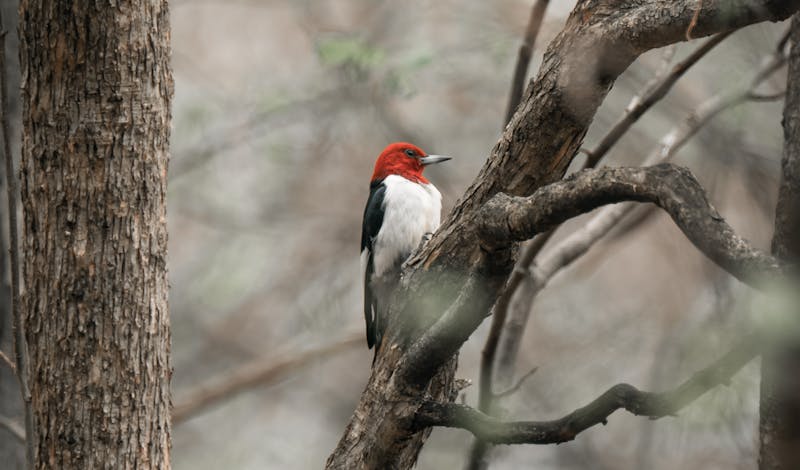
Size: 19 to 23 cm (7.5 to 9.1 in)
Here the red is confined entirely to the head. The Red-headed Woodpecker has a completely crimson head set against a snow-white body and half-black, half-white wings, a combination so bold it has earned the nickname flying checkerboard. Crucially, the sexes look alike, so unlike most birds in this guide you do not need to worry about which one you are seeing. Do not confuse it with the Red-bellied Woodpecker, which shows red only on the crown and nape and has a black-and-white barred back.
Red-headed Woodpeckers live in open woodlands, pine savannas, and scattered timber across the eastern and central United States. They catch insects in flight and store food in bark crevices, an unusual habit among woodpeckers. This species has declined severely over the past half-century because of habitat loss, making it a species of conservation concern.
The call is a raspy, scratchy weah.
Quick scan:
- Entirely red head on a black-and-white body
- Sexes identical
- Catches insects in flight and caches food
- Open eastern and central US woodlands and savannas
- Declining; a conservation concern
American Robin (Turdus migratorius)

Size: 20 to 28 cm (8 to 11 in)
If the red you saw was actually a warm orange-red on the breast and belly of a larger, gray-backed bird hopping across a lawn, you almost certainly saw an American Robin. This is the classic redbreast, and the bird was in fact named by early colonists after the unrelated European robin. The orange-red sits on the underparts, the back and head are gray to blackish, and there is a broken white eye-ring. Females are a little paler than males, but the sexes are broadly similar.
The American Robin is one of the most widespread and familiar birds in North America, at home in forests, fields, parks, and yards. It is the largest North American thrush, and its rich caroling is among the earliest songs of the spring dawn.
In fall and winter robins gather in roaming flocks and switch from earthworms to red berries and other fruit.
Quick scan:
- Orange-red breast and belly, gray back, dark head
- Broken white eye-ring
- Largest North American thrush
- Lawns, parks, forests, and fields across the continent
- Rich caroling song, often before dawn
Scarlet Ibis (Eudocimus ruber)
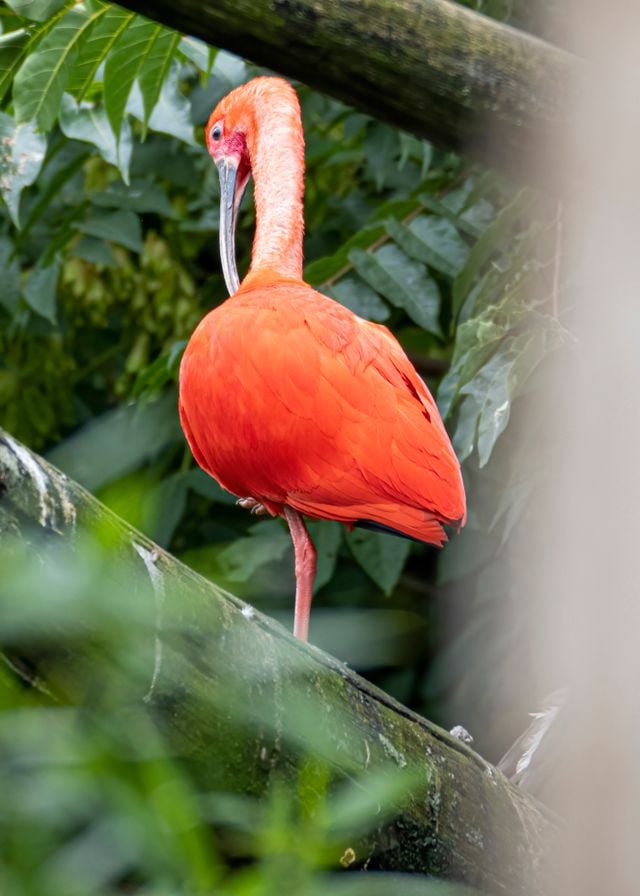
Size: 55 to 63 cm (22 to 25 in)
The Scarlet Ibis is arguably the reddest bird on the planet, a wading bird whose entire body glows brilliant scarlet, broken only by black tips on the longest wing feathers. The color comes from carotenoids in the crabs and other crustaceans it probes from coastal mud with its long, curved bill, and it is so diet-dependent that young birds, which start out gray and brown, take roughly two years to develop the full red. The sexes look alike, with males averaging slightly larger.
This species lives in the wetlands and mangroves of northern South America and is one of the two national birds of Trinidad and Tobago, where it appears on the coat of arms. Although it remains widespread and is assessed as Least Concern, it has stopped breeding on parts of Trinidad in recent decades, a decline linked to disturbance, pollution, and poaching.
These are social birds that forage and roost in large flocks, an unforgettable sight pouring across a tropical sky at dusk.
Quick scan:
- Entire body brilliant scarlet with black wingtips
- Long, curved bill for probing mud
- Gray-brown young that redden over about two years
- Wetlands and mangroves of northern South America
- Social; gathers in large flocks
Scarlet Macaw (Ara macao)

Size: 81 to 96 cm (32 to 36 in)
The Scarlet Macaw is the giant of this guide, a large parrot more than half of whose length is its long, tapering tail. The body is vivid red, with broad bands of yellow and blue across the wings and a patch of bare white facial skin, making it unmistakable. The sexes look alike. As with the other red birds here, the red comes from dietary pigments, concentrated in a bird that feeds on fruits, seeds, and nuts in the rainforest canopy.
Scarlet Macaws range from southern Mexico through Central America and across much of the Amazon basin. The species is assessed as Least Concern overall, but populations are decreasing, and the northern subspecies has been lost from most of its former range in Mexico and Central America. Habitat loss and capture for the wild bird trade are the main threats, and community-led conservation projects have helped restore some local populations.
Their calls are loud, throaty roars that carry far across the forest, and they are often seen flying in pairs or small flocks.
Quick scan:
- Large red parrot with yellow and blue wing bands
- Very long, tapering tail and bare white face
- Sexes identical
- Rainforest from southern Mexico to Amazonia
- Loud roaring calls; flies in pairs or small groups
Look-Alikes and How to Tell Them Apart
A few red birds are genuinely easy to mix up. Here is how to separate the most commonly confused groups.
The all-red songbirds. The male Summer Tanager is rosy red everywhere, including the wings, while the breeding male Scarlet Tanager has a red body with jet-black wings and tail. The male Northern Cardinal is also entirely red but is the only one of the three with a pointed crest and a black face mask. In the southwestern pine and oak woodlands, the Hepatic Tanager adds a fourth red option, a brick-red bird best separated by its darker, grayer bill.
The red finches. On a male House Finch the red is limited to the head, throat, and upper breast over a brown, streaky body. The Purple Finch is a cleaner, more even raspberry color washed across the whole head and breast, famously likened to a sparrow dipped in raspberry juice, and it favors forests over feeders. The Red Crossbill is a deeper brick red all over and has the unmistakable crossed bill. Out West, Cassin’s Finch is a paler pink-red relative of the Purple Finch.
The cardinals. The Northern Cardinal is mostly red with an orange bill; the Pyrrhuloxia, or desert cardinal, is mostly gray with red accents and a stubby yellow bill; and in northern South America the Vermilion Cardinal (Cardinalis phoeniceus), about 19 cm (7.5 in), is a brilliant red bird with a tall spiky crest. The introduced Red-crested Cardinal of Hawaii looks cardinal-like with its red head but is actually a tanager, with a gray back and white underparts.
The red heads. If only the head is red, check the body. An all-black-and-white body means a Red-headed Woodpecker; a yellow body with black wings means a male Western Tanager (Piranga ludoviciana), 16 to 19 cm (6.3 to 7.5 in), whose red is restricted to the face and head.
Frequently Asked Questions
What kind of bird is bright red?
The most likely bright red bird depends on where you are, but in North America a bright red bird with a crest is almost always a male Northern Cardinal, while an all-red bird without a crest is likely a Summer Tanager, and a red bird with black wings is a Scarlet Tanager. In the tropics, the brilliant scarlet of a Scarlet Ibis or Scarlet Macaw is unmistakable.
Why are some birds red?
Most birds are red because of carotenoid pigments they obtain from their food and then convert into red compounds before depositing them in their feathers. Birds cannot make red from scratch, so a bright red male is often signaling that he is healthy and skilled at finding pigment-rich food, which is why females of many species prefer the reddest males.
What is the most common red bird in North America?
The Northern Cardinal is the most common and familiar red bird across the eastern and central United States. It does not migrate, stays brightly colored all winter, and readily visits feeders, which makes it the red bird most people see most often.
Are red birds rare?
Most red birds are not rare. Familiar species like the Northern Cardinal, House Finch, and American Robin are abundant, and many are assessed as Least Concern. A few, however, face real pressures, including the declining Red-headed Woodpecker and the dwindling northern populations of the Scarlet Macaw.
Why does my red bird look orange?
A red bird often looks orange because its color comes from carotenoid pigments in its diet, and a diet lower in those pigments produces oranger or yellower feathers. This is especially common in House Finches, where the same species can range from deep red to pale yellow depending on what the bird has been eating.
What is the reddest bird in the world?
The Scarlet Ibis is often called the reddest bird in the world, glowing brilliant scarlet from head to tail thanks to a diet rich in red crustaceans. Among land birds, the male Summer Tanager is the only entirely red bird in North America, and the Scarlet Macaw is the most vivid of the large parrots.
Conclusion
Red is the color that pulls people into birding, and once you know what to look for, the category opens up beautifully. The same underlying chemistry, carotenoid pigments gathered from food, lights up a cardinal at a snowy feeder, a tanager in the summer canopy, a crossbill on a pine cone, and an ibis over a mangrove swamp. From there, the identification comes down to a few simple questions: where on the body is the red, is this a male or a female, and what is the size, region, and bill telling you.
If you enjoyed this guide, explore our companion appearance guides to blue birds and yellow birds, and if you want to know which of these species occur near you, see our location guides such as red birds in California and red birds in Texas. For the species that earn a closer look, our Northern Cardinal and Scarlet Tanager deep dives go further still.
Works Cited
- Lopes, R. J., et al. “Genetic Basis for Red Coloration in Birds.” Current Biology, vol. 26, no. 11, 2016. https://www.cell.com/current-biology/fulltext/S0960-9822(16)30401-8
- Smithsonian Institution. “When Is a Blue Bird Not Blue?” https://www.si.edu/stories/when-blue-bird-not-blue
- Cornell Lab of Ornithology. “Northern Cardinal Overview.” All About Birds. https://www.allaboutbirds.org/guide/Northern_Cardinal/overview
- Halkin, S. L., D. P. Shustack, M. S. DeVries, J. M. Jawor, and S. U. Linville. “Northern Cardinal (Cardinalis cardinalis), version 2.0.” Birds of the World, Cornell Lab of Ornithology, 2021. https://birdsoftheworld.org/bow/species/norcar/cur/introduction
- Cornell Lab of Ornithology. “Summer Tanager Overview.” All About Birds. https://www.allaboutbirds.org/guide/Summer_Tanager/overview
- National Audubon Society. “Summer Tanager.” Audubon Field Guide. https://www.audubon.org/field-guide/bird/summer-tanager
- Cornell Lab of Ornithology. “Scarlet Tanager Overview.” All About Birds. https://www.allaboutbirds.org/guide/Scarlet_Tanager/overview
- Mowbray, T. B. “Scarlet Tanager (Piranga olivacea), version 1.0.” Birds of the World, Cornell Lab of Ornithology, 2020. https://birdsoftheworld.org/bow/species/scatan/cur/introduction
- Cornell Lab of Ornithology. “House Finch Overview.” All About Birds. https://www.allaboutbirds.org/guide/House_Finch/overview
- Cornell Lab of Ornithology. “House Finch Identification.” All About Birds. https://www.allaboutbirds.org/guide/House_Finch/id
- Cornell Lab of Ornithology. “Purple Finch Overview.” All About Birds. https://www.allaboutbirds.org/guide/Purple_Finch/overview
- Cornell Lab of Ornithology. “Pyrrhuloxia Overview.” All About Birds. https://www.allaboutbirds.org/guide/Pyrrhuloxia/overview
- Cornell Lab of Ornithology. “Vermilion Flycatcher Overview.” All About Birds. https://www.allaboutbirds.org/guide/Vermilion_Flycatcher/overview
- National Audubon Society. “Vermilion Flycatcher.” Audubon Field Guide. https://www.audubon.org/field-guide/bird/vermilion-flycatcher
- Cornell Lab of Ornithology. “Red Crossbill Life History.” All About Birds. https://www.allaboutbirds.org/guide/Red_Crossbill/lifehistory
- Cornell Lab of Ornithology. “Pine Grosbeak Overview.” All About Birds. https://www.allaboutbirds.org/guide/Pine_Grosbeak/overview
- Cornell Lab of Ornithology. “Red-headed Woodpecker Overview.” All About Birds. https://www.allaboutbirds.org/guide/Red-headed_Woodpecker/overview
- National Audubon Society. “American Robin.” Audubon Field Guide. https://www.audubon.org/field-guide/bird/american-robin
- American Bird Conservancy. “American Robin.” https://abcbirds.org/birds/american-robin/
- One Earth. “Meet the Scarlet Ibis: The Stunning Bird of South America’s Mangroves.” https://www.oneearth.org/species-of-the-week-scarlet-ibis/
- Sainz-Borgo, C. “Scarlet Ibis (Eudocimus ruber), version 2.0.” Birds of the World, Cornell Lab of Ornithology, 2025. https://birdsoftheworld.org/bow/species/scaibi/cur/introduction
- The Wildlife Society. “USFWS to List Scarlet Macaw Subspecies as Endangered.” https://wildlife.org/usfws-to-list-scarlet-macaw-subspecies-as-endangered/
- Animal Diversity Web, University of Michigan. “Ara macao (scarlet macaw).” https://animaldiversity.org/accounts/Ara_macao/
- Rodriguez-Ferraro, A. “Vermilion Cardinal (Cardinalis phoeniceus), version 2.0.” Birds of the World, Cornell Lab of Ornithology, 2024. https://birdsoftheworld.org/bow/species/vercar1/cur/introduction
- Cornell Lab of Ornithology. “Western Tanager Identification.” All About Birds. https://www.allaboutbirds.org/guide/Western_Tanager/id