Brown Pelican: Symbolism, Habitat, Diet, and Conservation
The Brown Pelican (Pelecanus occidentalis) is a large, dark seabird of the American coastlines, instantly recognizable by its oversized bill, its enormous throat pouch, and its habit of plunging headfirst into the sea to feed. It is the smallest of the world’s living pelican species and the only one that hunts by diving from the air, a behavior shared with just one relative, the Peruvian Pelican. Squadrons of these birds glide low over the surf along the southern and western shores of North America, rising and falling in graceful single file as they patrol the waves.
A pelican gliding six inches off the wave face, wingtip nearly clipping the water, is one of those sights that looks choreographed even though it’s just efficient flying. This piece covers the bird’s surprisingly deep religious symbolism, how to identify it, where it lives and breeds, how it hunts, and the conservation story that turned it from a near-extinction case into one of the best comeback stories in American wildlife management — with extra attention to its strong ties to Florida and the Gulf Coast, where it’s practically a mascot.
Quick Facts
| Attribute | Detail |
|---|---|
| Common name | Brown Pelican |
| Scientific name | Pelecanus occidentalis |
| Order | Pelecaniformes |
| Family | Pelecanidae |
| Length | 100 to 137 cm (39 to 54 in) |
| Wingspan | About 2 to 2.3 m (6.5 to 7.5 ft) |
| Weight | 2 to 5 kg (4.4 to 11 lb) |
| Range | Coasts of the Americas, along the Atlantic, Gulf, and Pacific |
| Primary habitat | Estuaries and shallow coastal marine waters |
| Conservation status (IUCN) | Least Concern |
Key Takeaways
The Brown Pelican is a large coastal seabird of the Americas, found year-round in estuaries and shallow marine waters along the Atlantic, Gulf, and Pacific shores.
Its signature behavior is the plunge dive, a steep, headfirst plunge from as high as 20 m (about 65 ft) that stuns small fish on impact before the bird scoops them into its expandable pouch.
In Christian tradition the pelican became a symbol of self-sacrifice and the Eucharist, an image known as the “pelican in her piety,” and the species is the official state bird of Louisiana.
After pesticide contamination nearly eliminated it from the United States, the Brown Pelican recovered and was removed from the federal endangered species list in 2009, one of the signal successes of the Endangered Species Act.
The IUCN lists the species as Least Concern with an increasing population, though oil spills, fishing-gear entanglement, and the erosion of coastal nesting islands remain real threats.
Mythology, Symbolism, and Cultural Significance
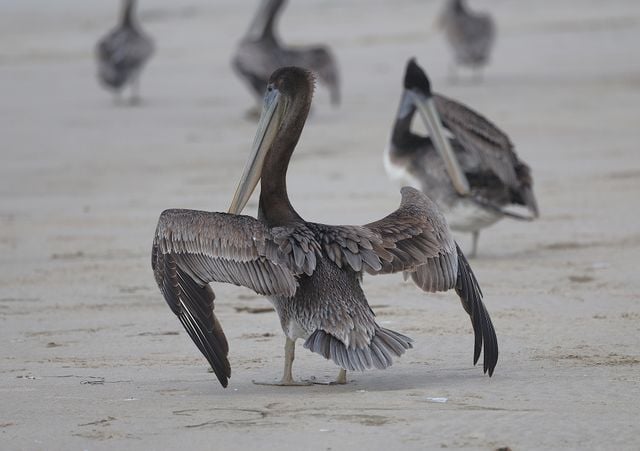
Few birds carry as long a symbolic history as the pelican. The most enduring image comes from early Christian thought, where the pelican became an emblem of sacrificial love. The legend traces to the Physiologus, a Greek compendium of animal lore generally dated to the second century and later translated across Europe and the Middle East. According to that text, a mother pelican revives her dead young after three days by piercing her own breast and letting her blood fall over them, dying in the act (Physiologus, 2nd century). Medieval writers read this as an allegory of Christ, whose blood was understood to redeem humanity.
The motif acquired a formal name in Christian art, the “pelican in her piety,” showing a parent bird wounding its breast above a brood of chicks. Scholars at the J. Paul Getty Museum trace how the image spread through illuminated manuscripts, stained glass, altar carvings, and decorative metalwork across medieval and Renaissance Europe (Getty Museum, 2020). The theologian Thomas Aquinas invoked the bird directly in the hymn Adoro te devote, addressing Christ as “Pie pelicane,” the tender or merciful pelican. After the Feast of Corpus Christi was established in 1311, the symbol gained still greater force as a figure for the Eucharist (Art and Theology, 2025).
The legend most likely grew from a real observation misread at a distance. When a pelican empties its pouch or presses its long bill against its chest to feed regurgitated fish to its young, an onlooker can easily mistake the gesture for self-wounding, an impression sometimes reinforced by a reddish tinge on the bill during breeding (Kenneth Spencer Research Library, 2017). The behavior is ordinary parental feeding, but the symbolic reading endured for well over a thousand years.
That symbolism carried directly into American civic life. The pelican has appeared on the seal of Louisiana for more than two centuries, depicted as a mother bird tearing at her breast to feed three chicks, an image rooted in the Christian iconography described above (National Maritime Historical Society, 2020). Louisiana adopted the pelican on its state flag in 1912, has long been nicknamed the Pelican State, and in 1966 named the Brown Pelican its official state bird, the only state to designate a seabird in that role (States Symbols USA; NETSTATE). The choice was striking in its timing, since pesticide poisoning had driven nesting pelicans from the Louisiana coast by the mid-1960s, so the state honored the bird during its near-absence rather than its abundance.
Classification and Physical Characteristics
The Brown Pelican belongs to the order Pelecaniformes and the family Pelecanidae, the pelicans. The species was formally described by Carl Linnaeus in 1766. Its full taxonomy runs as follows.
| Rank | Classification |
|---|---|
| Kingdom | Animalia |
| Phylum | Chordata |
| Class | Aves |
| Order | Pelecaniformes |
| Family | Pelecanidae |
| Genus | Pelecanus |
| Species | Pelecanus occidentalis |
Five subspecies are currently recognized, including the eastern bird (Pelecanus occidentalis carolinensis) of the Atlantic and Gulf coasts and the California bird (Pelecanus occidentalis californicus) of the Pacific. The Peruvian Pelican (Pelecanus thagus), once treated as a Pacific race of the Brown Pelican, is now classified as a separate species on the basis of its much larger size and distinct range.
In the field the Brown Pelican is difficult to mistake. It is a massive, stocky seabird with a long neck, very long and broad wings that bow noticeably in a glide, and an enormous bill fitted with a stretchy throat pouch, called a gular pouch, used to capture fish. Adults are gray-brown overall, with a blackish-brown belly. Outside the breeding season the head is white, often with a pale yellow wash on the crown, and the neck is white. In breeding condition the back and sides of the neck turn a rich, dark reddish-brown, and the bare facial skin and pouch brighten. Immature birds are duller, gray-brown above including the head and neck, with a pale whitish belly (Cornell Lab of Ornithology; National Audubon Society).
Adults measure roughly 100 to 137 cm (39 to 54 in) in length, span about 2 to 2.3 m (6.5 to 7.5 ft) across the wings, and weigh 2 to 5 kg (4.4 to 11 lb), with males averaging larger than females (Animal Diversity Web). The bill alone reaches 25 to 38 cm (10 to 15 in). The gular pouch can hold a remarkable volume of water, up to roughly 10 liters (about 2.6 gallons) according to the Cornell Lab, several times the capacity of the bird’s stomach.
The only realistic confusion in North America is with the American White Pelican (Pelecanus erythrorhynchos). The two are easily separated. The Brown Pelican is darker overall, smaller, strictly coastal, and feeds by diving from the air, while the American White Pelican is white with black flight feathers, frequents inland and coastal waters, and feeds cooperatively by herding fish at the surface.
Habitat and Distribution
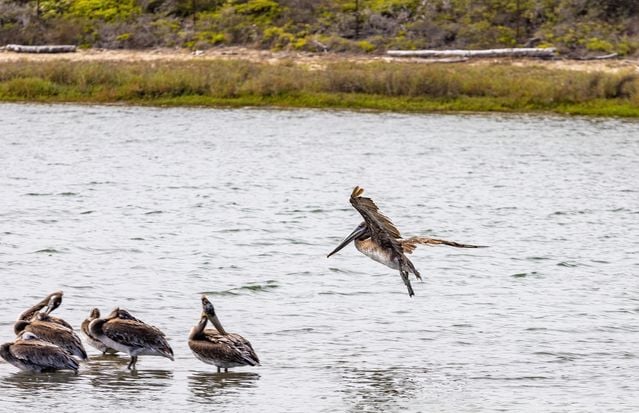
The Brown Pelican is a bird of saltwater, found year-round in estuaries, bays, and shallow coastal marine waters and only very rarely seen on inland freshwater lakes. Its range stretches along the Atlantic coast of the Americas, the Gulf of Mexico, and the Pacific coast, from the southern United States south to northern South America, with populations in the Caribbean and the Galapagos Islands as well (Cornell Lab of Ornithology).
On the Atlantic and Gulf coasts the species breeds chiefly on barrier islands, natural islands within estuaries, and islands built from dredged material, while in Florida and southern Louisiana it relies primarily on mangrove islets. On the Pacific coast it nests on dry, rocky offshore islands. When not feeding or nesting, pelicans rest in groups on sandbars, pilings, jetties, breakwaters, and offshore rocks, and they are a familiar sight loafing around fishing piers and docks.
The species is largely resident, with many birds remaining near their breeding areas through the year. After the breeding season, however, numbers disperse, and individuals may wander well north of the breeding range, reaching as far as British Columbia on the Pacific and New York on the Atlantic (Cornell Lab of Ornithology).
Florida holds a special place in the species’ story and its present range. The state supports major resident populations in its estuaries and mangrove systems, and its Indian River Lagoon is home to Pelican Island, the site that launched federal wildlife protection in the United States, discussed below.
Breeding, Nesting, and Family Life
Brown Pelicans are highly social and nest in colonies, sometimes called rookeries, that can number into the thousands of pairs. They breed on islands free of mammalian predators and permanent human presence, a requirement that makes secluded coastal islands essential to their reproduction (National Audubon Society).
Courtship and nest building reverse the usual division of labor seen in many birds. A male selects and defends a nest site, sometimes holding it for weeks before a female accepts him, after which the pair remains monogamous for the season. The male then gathers nesting material while the female builds the nest, which ranges from a simple ground scrape to a substantial stick structure placed on the ground, on cliffs, or in low trees and mangroves (National Audubon Society).
The clutch is usually three eggs, sometimes two to four, and the eggs are chalky white, becoming nest-stained over time. Both sexes share incubation, which lasts roughly 28 to 30 days. The species incubates in an unusual way, warming the eggs beneath the webbing of its feet rather than against a bare brood patch, in effect standing on them. This method is effective but carries a hazard, since an adult flushed suddenly from the nest can crack the eggs underfoot (Cornell Lab of Ornithology; National Audubon Society).
The young hatch naked and helpless, a condition described as altricial, and acquire down within about ten days. Both parents feed the chicks regurgitated fish. Young pelicans take their first flights at roughly nine to twelve weeks and become independent somewhat later, reaching breeding age at about two to three years.
Diet and Foraging
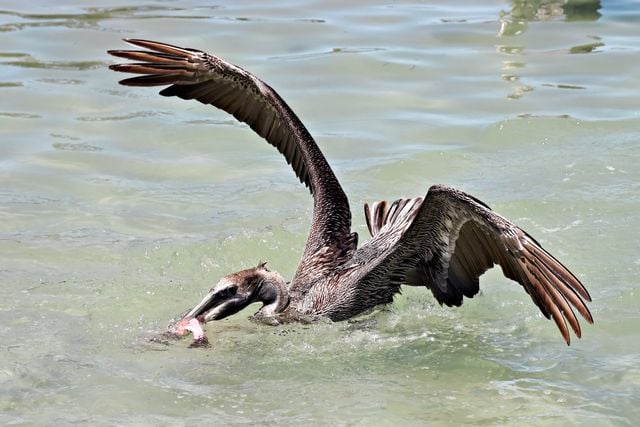
The Brown Pelican feeds almost entirely on small schooling fish that gather near the surface. Across its range these include menhaden, mullet, anchovies, herring, silversides, and sailfin mollies, with northern anchovy and Pacific sardine especially important on the West Coast (Cornell Lab of Ornithology; U.S. Fish and Wildlife Service). An adult can consume on the order of 1.8 kg (about 4 lb) of fish in a day.
The bird typically forages over estuaries and shallow ocean waters within about 19 km (12 mi) of shore, though it sometimes ranges farther out. It locates prey from the air, then captures it through the plunge dive described in the next section. After surfacing, a pelican points its bill downward to drain the water it has scooped up, then tips its head back to swallow the fish. This pause is an opportunity for thieves: gulls frequently try to snatch fish from the pouch, sometimes perching on a pelican’s head to do so. Pelicans are themselves opportunists, trailing fishing boats and gathering at piers in hope of an easy meal (Cornell Lab of Ornithology).
Communication and Vocalization
Adult Brown Pelicans are largely silent. Away from the colony they make little sound, and the species lacks the varied songs of many smaller birds. On the nesting grounds adults give low grunts, while nestlings are considerably noisier, producing a range of squawks and calls as they beg for food (National Audubon Society).
The Plunge Dive: Anatomy of a Spectacular Hunter
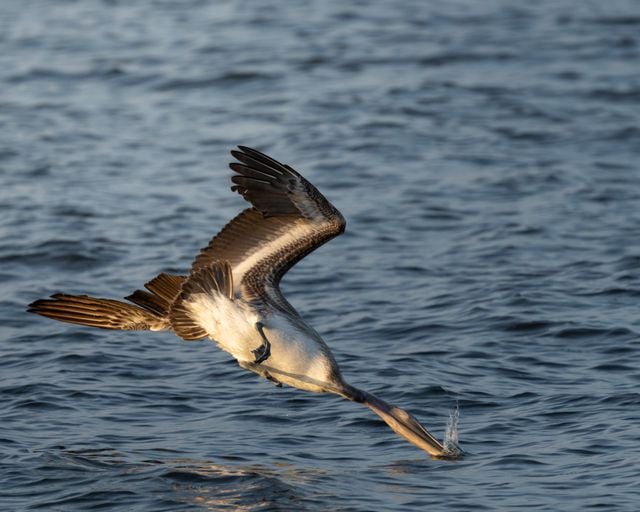
The Brown Pelican’s defining trait is the way it hunts. It is one of only two pelican species, alongside the Peruvian Pelican, that captures fish by plunge diving, a dramatic headfirst dive from the air rather than by herding prey at the surface as other pelicans do (Encyclopaedia Britannica).
A foraging pelican spots a fish from above and dives from as high as 20 m (about 65 ft), folding its wings and twisting its body to the left as it drops. That twist is not for show. It helps shield the bird’s trachea and esophagus, which sit on the right side of the neck, from the force of impact (Cornell Lab of Ornithology). The bird hits the water hard enough to stun small fish, and a network of air sacs beneath the skin cushions the blow and helps it bob back to the surface. As it strikes, the throat pouch balloons outward, trapping fish along with a large volume of water that the bird then drains before swallowing.
This combination of aerial search, high-speed entry, and a built-in dip net is rare among birds and makes the Brown Pelican a riveting subject to watch from any beach or pier. From a distance the splashes can resemble the spout of a small whale, and where one pelican dives, others often wheel in to plunge at the same school.
From the Brink: The Brown Pelican’s Conservation Comeback
The Brown Pelican is one of the clearest conservation success stories in American history, and its recovery unfolded over more than a century.
The first threat was the plume trade. In the late nineteenth and early twentieth centuries, birds were slaughtered in enormous numbers to supply feathers for women’s hats, and pelicans were also killed for their pouches and wing bones. The destruction of Florida’s bird colonies helped galvanize early conservationists. On March 14, 1903, persuaded by figures such as the ornithologist Frank Chapman and the warden Paul Kroegel, President Theodore Roosevelt set aside Florida’s Pelican Island, in the Indian River Lagoon, as the first federal bird reservation, the seed of what became the National Wildlife Refuge System (U.S. Fish and Wildlife Service; U.S. Department of the Interior, 2009). The Migratory Bird Treaty Act of 1918 added further legal protection, and the species was harmed again after the First World War when commercial fishermen, blaming pelicans for declining catches, killed them by the thousands.
The gravest threat arrived with synthetic pesticides. From the 1940s onward, the chemical DDT accumulated in the fish that pelicans ate and caused the birds to lay thin-shelled eggs that broke under the weight of incubating parents. Reproduction collapsed. Nesting ceased on the Louisiana coast around 1961, and populations crashed across the Gulf and Pacific. Rachel Carson’s 1962 book Silent Spring brought the dangers of unrestricted pesticide use to national attention (Carson, 1962). The Brown Pelican was declared endangered in 1970, and the United States banned most uses of DDT in 1972.
Recovery followed the ban. Louisiana reintroduced pelicans from Florida in a program that ran from 1968 to 1980, and as DDT cleared from the food chain, productivity climbed. The Atlantic and northern Gulf populations were removed from the endangered species list in 1985, and the species reached pre-pesticide numbers by the late 1990s. On December 17, 2009, the U.S. Fish and Wildlife Service announced the full delisting of the Brown Pelican, by then numbering more than 650,000 birds across Florida, the Gulf and Pacific coasts, the Caribbean, and Latin America (U.S. Fish and Wildlife Service, 2009). Less than a year later, the 2010 Deepwater Horizon oil spill struck the Gulf Coast, oiling many pelicans and underscoring how exposed even a recovered species remains.
Conservation Status
The Brown Pelican is currently assessed as Least Concern on the IUCN Red List, with an increasing population trend (BirdLife International). The most widely cited figure remains the U.S. Fish and Wildlife Service estimate of more than 650,000 birds at the time of the 2009 delisting (U.S. Fish and Wildlife Service, 2009). The species is no longer protected under the Endangered Species Act, but it continues to receive protection under the Migratory Bird Treaty Act.
Real threats persist despite the recovery. Because pelicans breed, roost, and feed near shipping channels, they are highly vulnerable to oil spills. They become entangled in discarded fishing line and hooks, a frequent cause of injury around piers. Coastal habitat loss is a serious concern, particularly in Louisiana, where breeding islands are eroding rapidly. As top marine predators dependent on schooling fish, pelicans are also sensitive to shifts in prey: on the Pacific coast, crashes in sardine and anchovy stocks have driven nesting failures and episodes of mass starvation in recent years. Disturbance at colonies is an added risk, since startled adults may abandon or accidentally destroy nests (National Audubon Society; U.S. Fish and Wildlife Service).
Where and How to Observe Brown Pelicans
The Brown Pelican is among the easiest large seabirds to watch, since it favors the same beaches, jetties, estuaries, and fishing piers that people frequent. Look for huge birds gliding low over the water in single file, often near gulls and cormorants, and watch for the explosive splash of a dive. After a dive, scan the surface for the bird draining its pouch, or for others circling to plunge at the same spot. Jetties, mudflats, and estuaries are reliable places to find groups resting between feeding bouts.
Responsible viewing matters for this species. The most important guideline is simple: do not feed wild pelicans. Handouts draw birds toward boats, piers, and discarded tackle, where they are far more likely to swallow hooks or become tangled in monofilament fishing line. Anglers can help significantly by retrieving cut line and disposing of it properly. Keep a respectful distance from nesting islands and rookeries, since a flushed adult can lose its eggs or chicks in the panic of a sudden departure. Observation from a distance, with binoculars or a spotting scope, protects both the birds and the experience.
Frequently Asked Questions
What does a brown pelican symbolize?
The pelican is best known as a Christian symbol of self-sacrifice and the Eucharist, expressed in the medieval image of the “pelican in her piety,” in which a parent bird appears to wound its breast to feed its young. The symbolism arose from a misread feeding behavior recorded in the second-century Physiologus and endured for more than a thousand years in European art and theology.
Why is the brown pelican Louisiana’s state bird?
The Brown Pelican became Louisiana’s official state bird in 1966, formalizing an emblem the state had used for more than two centuries. The pelican had appeared on the Louisiana state seal and flag, tied to the Christian image of a nurturing mother bird, which gave rise to the Pelican State nickname long before the formal designation.
How do brown pelicans catch fish?
Brown Pelicans hunt by plunge diving, spotting fish from the air and dropping headfirst from as high as 20 m (about 65 ft). The impact stuns small fish near the surface, and the bird scoops them into its expandable throat pouch, drains the water, and swallows the catch.
Were brown pelicans ever endangered?
Yes. The Brown Pelican was listed as endangered in the United States in 1970 after the pesticide DDT caused widespread eggshell thinning and reproductive failure. Following the 1972 DDT ban and decades of recovery, it was removed from the federal endangered species list in 2009.
What do brown pelicans eat?
Brown Pelicans eat mostly small schooling fish, including menhaden, mullet, anchovies, herring, and silversides, with anchovy and sardine especially important on the Pacific coast. An adult may eat around 1.8 kg (about 4 lb) of fish per day.
How long do brown pelicans live?
Brown Pelicans are long-lived seabirds, and banding records document individuals surviving well over 30 years, with the oldest known bird reported at about 43 years (Audubon; banding records). Most birds live far shorter lives, as survival in the first years is low.
Where can you see brown pelicans in Florida?
Brown Pelicans are common year-round along Florida’s coasts, in estuaries, around mangrove islands, and at fishing piers and jetties. The Indian River Lagoon, home to Pelican Island National Wildlife Refuge, is one of the most historically significant places to observe the species.
Conclusion
The Brown Pelican is at once an ancient symbol and a modern triumph. For more than a thousand years it carried a message of sacrifice in Christian art, and for more than two centuries it has stood at the center of Louisiana’s identity. As a living bird it is unforgettable, the only dark pelican of the Americas and one of just two that hunt by hurling themselves into the sea. Its near loss to the plume trade and to DDT, and its return from the brink, make it a lasting example of what wildlife protection can accomplish and a reminder of how quickly a recovered species can be tested again. To watch a squadron of pelicans skim the waves, then peel off one by one to dive, is to see all of that history folded into a single, graceful act.
To continue exploring the coastal birds that share the pelican’s world, visit our guide to the shorebirds of Florida and our broader Florida birding hub, where the state’s estuaries, beaches, and mangrove islands come into fuller view.
Works Cited
- Cornell Lab of Ornithology. “Brown Pelican Overview, Identification, and Life History.” All About Birds. https://www.allaboutbirds.org/guide/Brown_Pelican
- Shields, M. (2020). “Brown Pelican (Pelecanus occidentalis), version 1.0.” Birds of the World. Cornell Lab of Ornithology. https://birdsoftheworld.org/bow/species/brnpel/cur/introduction
- National Audubon Society. “Brown Pelican.” Audubon Field Guide. https://www.audubon.org/field-guide/bird/brown-pelican
- National Audubon Society. “Brown Pelican.” Audubon Gulf Restoration. https://www.audubon.org/gulf-restoration/brown-pelican
- National Audubon Society. “10 Fun Facts About the Brown Pelican.” https://www.audubon.org/magazine/10-fun-facts-about-brown-pelican
- U.S. Fish and Wildlife Service. “Brown Pelican (Pelecanus occidentalis).” https://www.fws.gov/species/brown-pelican-pelecanus-occidentalis
- U.S. Fish and Wildlife Service (2009). “Brown Pelican Populations Recovered, Removed from Endangered Species List.” https://www.fws.gov/press-release/2009-11/brown-pelican-populations-recovered-removed-endangered-species-list
- U.S. Department of the Interior (2009). “Brown Pelican Populations Recovered, Removed from Endangered Species List.” https://www.doi.gov/news/pressreleases/2009_11_11_release
- Federal Register (2009). “Removal of the Brown Pelican From the Federal List of Endangered and Threatened Wildlife.” https://www.federalregister.gov/documents/2009/11/17/E9-27402/endangered-and-threatened-wildlife-and-plants-removal-of-the-brown-pelican-pelecanus-occidentalis
- Florida Fish and Wildlife Conservation Commission. “Brown Pelican.” https://myfwc.com/wildlifehabitats/profiles/birds/shorebirdsseabirds/brown-pelican/
- Animal Diversity Web, University of Michigan Museum of Zoology. “Pelecanus occidentalis (brown pelican).” https://animaldiversity.org/accounts/Pelecanus_occidentalis/
- Encyclopaedia Britannica. “Pelican.” https://www.britannica.com/animal/pelican
- BirdLife International. “Brown Pelican Pelecanus occidentalis Species Factsheet.” IUCN Red List / BirdLife DataZone. https://datazone.birdlife.org/species/factsheet/brown-pelican-pelecanus-occidentalis
- J. Paul Getty Museum (2020). “The Pelican, Self-Sacrificing Mother Bird of the Medieval Bestiary.” The Iris. https://blogs.getty.edu/iris/the-pelican-self-sacrificing-mother-bird-of-the-medieval-bestiary/
- Art and Theology (2025). “The Vulning Pelican as an Allegory of Christ.” https://artandtheology.org/2025/04/08/vulning-pelican-allegory-of-christ/
- Kenneth Spencer Research Library, University of Kansas (2017). “The Pelican in Her Piety.” https://blogs.lib.ku.edu/spencer/the-pelican-in-her-piety/
- National Maritime Historical Society (2020). “Brown Pelicans.” Sea History for Kids. https://seahistory.org/sea-history-for-kids/brown-pelicans/
- State Symbols USA. “Louisiana State Bird: Brown Pelican.” https://statesymbolsusa.org/symbol-official-item/louisiana/state-bird/brown-pelican
- NETSTATE. “Louisiana State Bird, Brown Pelican (Pelecanus occidentalis).” https://www.netstate.com/states/symb/birds/la_brown_pelican.htm
- Audubon North Carolina (2015). “Quest for Banded Birds: The 18-Year Journey of a Brown Pelican.” https://nc.audubon.org/news/quest-banded-birds-18-year-journey-brown-pelican