Types of Sea Gulls in North America: A Field Guide to the Continent’s Gulls
Key Takeaways
- Gulls are mid-sized to large seabirds in the family Laridae, with roughly 50 species worldwide and about two dozen occurring regularly across North America (as of the 2024 eBird/Clements checklist).
- The Great Black-backed Gull (Larus marinus) is the largest gull in the world, while the Little Gull (Hydrocoloeus minutus) is the smallest.
- Most gulls share a robust build, webbed feet, a stout bill hooked at the tip, long pointed wings, and salt-excreting glands that allow them to drink seawater.
- Despite the popular name “seagull,” many gulls spend their lives far inland around lakes, rivers, farmland, and cities, and the term is not a true taxonomic group.
- Familiar gulls such as the Ring-billed Gull remain abundant, but several northern specialists, including the Black-legged Kittiwake and the Ivory Gull, are declining as the Arctic warms.
A Quick Word on “Seagulls”
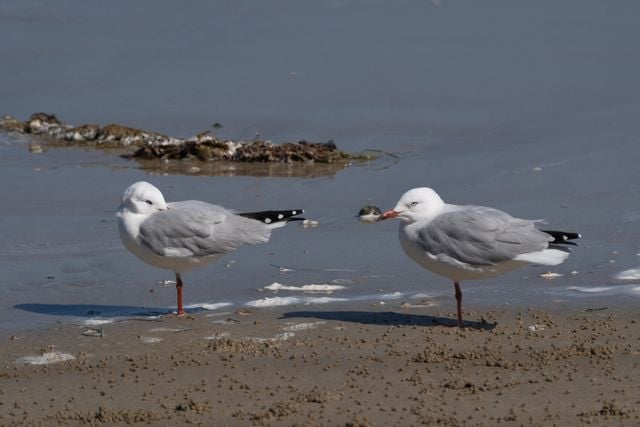
There is no single bird called a “seagull.” The word is a popular catch-all for the family of birds that ornithologists simply call gulls, and it can be a little misleading, because a great many gulls rarely visit the sea at all. The Ring-billed Gull that begs for fries in a parking lot in Kansas and the Franklin’s Gull that follows a tractor across the prairie are every bit as much gulls as the birds wheeling over a fishing pier in Maine.
So when people search for “types of sea gulls,” what they are really after is the wonderful variety within the gull family. That is exactly what this guide covers: what makes a gull a gull, how many kinds live in North America, and how the major groups differ from one another.
I have loved the Carolina coast for as long as I can remember. My grandmother lived on an island right on the water, and every summer we would spend a few weeks at her place. The beach held the kind of magic that only a child fully understands. Some days we would take a few slices of bread down to the beach with us to feed the sea gulls. Within moments dozens of gulls would wheel in around us, hovering and calling and jostling for a scrap. To me they were simply the seagulls, and that swirl of wings overhead was pure joy.
I understand now that bread is not the gift to a gull that it feels like to a delighted child, and these days I keep my sandwiches to myself. But that early fascination never left me, and it is a good part of why I am still watching gulls all these years later.
Gulls belong to the family Laridae, which also contains the terns, skimmers, and noddies. Within that family, the gulls form the subfamily Larinae. Worldwide there are about 50 gull species (as of the 2024 eBird/Clements checklist). Standard references recognize roughly two dozen occurring regularly in North America, with several more recorded as rare visitors and vagrants. This article surveys the continent’s gulls in three broad groups, then points you toward deeper reading on the species that interest you most.
What Defines a Gull
Gulls are easy to recognize as a group even when individual species give birders headaches. A handful of shared traits unites them.
Build and bill
Most gulls have a sturdy, full-chested body, long and narrow wings built for tireless soaring, and webbed feet for swimming and walking. The bill is typically stout and slightly hooked at the tip, well suited to a diet that ranges from fish and crabs to scraps and carrion. Larger species, such as the Great Black-backed Gull, carry heavy, powerful bills, while the smallest gulls have slender, almost tern-like ones.
Plumage that changes with age
One reason gulls confuse so many people is that they change appearance over several years. Large gulls generally take about four years, passing through four plumage cycles, before they reach clean adult colors. Smaller gulls usually mature in two to three years. A single flock can therefore hold birds of wildly different patterns that all belong to the same species.
Salt glands
Gulls possess specialized glands above the eyes, called supraorbital salt glands, that filter excess salt from the bloodstream. The salty fluid drips from the nostrils and off the tip of the bill, which is why a gull can drink seawater that would dehydrate most land animals, including us. This adaptation is part of what lets gulls thrive on open coasts and far out at sea.
Intelligence and opportunism
Gulls are resourceful, curious, and quick to learn. The larger species in particular show complex social behavior, and several have been documented using tools or stealing food from other birds, a habit known as kleptoparasitism (one animal robbing another of its catch). This adaptability is a major reason gulls have moved so successfully into human-altered landscapes such as harbors, landfills, and city rooftops.
Where gulls live
Gulls are found worldwide but reach their greatest diversity in the temperate and Arctic regions of the Northern Hemisphere. In North America they occur on both coasts, throughout the Great Lakes, across the interior plains and deserts, and along the edge of the Arctic pack ice. Some species are tied closely to the ocean, foraging far offshore in what is called pelagic habitat (the open sea, away from the coast), while others are equally at home on a freshwater reservoir a thousand kilometers from saltwater.

North American Gull Groups at a Glance
The table below summarizes the three groups covered in this guide. Sizes are given as the range across the representative species profiled in each group.
| Group | Where found in North America | Approx. species (regular) | Size range | Standout trait | Conservation picture |
|---|---|---|---|---|---|
| Large white-headed gulls (Larus) | Both coasts, Great Lakes, interior lakes and landfills | About 10 to 12 | 43 to 79 cm (17 to 31 in) | Big, powerful generalists; the world’s largest gulls | Mostly stable; several abundant |
| Hooded gulls (Leucophaeus and Chroicocephalus) | Atlantic and Gulf coasts, prairies, interior wetlands | About 4 to 5 | 28 to 46 cm (11 to 18 in) | Dark hood in breeding season; buoyant flight | Generally stable; a few localized concerns |
| Kittiwakes and Arctic specialists (Rissa, Xema, Hydrocoloeus, Pagophila, Rhodostethia) | Northern oceans, Arctic coasts and tundra, pelagic waters | About 6 | 28 to 43 cm (11 to 17 in) | Highly pelagic or High Arctic; tern-like grace | Mixed; kittiwakes and Ivory Gull declining |
The Major Gull Groups
North America’s gulls do not fall into tidy official subgroups the way some bird families do, but birders and ornithologists find it useful to think of them in three practical clusters: the big “white-headed” gulls of the genus Larus, the smaller “hooded” gulls that develop dark heads in summer, and a set of specialists adapted to the open ocean and the High Arctic. Here is a tour of each.
Large White-headed Gulls (Genus Larus)
These are the birds most people picture when they hear “seagull”: large, gray-backed, white-headed gulls with pink or yellowish legs and a red spot on the lower bill. They are powerful generalists that scavenge, hunt, and steal with equal enthusiasm, and they include the largest gulls on Earth. North America hosts roughly eight to ten species that breed or winter regularly, plus several scarce visitors.
The American Herring Gull (Larus smithsonianus) is the archetypal large gull of the continent, common along the Atlantic coast, the Great Lakes, and parts of the interior. Adults measure about 56 to 66 cm (22 to 26 in) long with a wingspan of 120 to 150 cm (47 to 59 in) and weigh roughly 800 to 1,250 g (1.8 to 2.8 lb), per the National Audubon Society. In 2024, ornithologists split the widespread Herring Gull complex into four species, recognizing the North American population as the American Herring Gull, a change that reflects how genetically tangled this group remains.
The Great Black-backed Gull (Larus marinus) is the largest gull in the world. According to the Cornell Lab of Ornithology, it reaches 71 to 79 cm (28 to 31 in) in length with a wingspan of 152 to 167 cm (60 to 66 in) and a mass of 1,300 to 2,000 g (2.9 to 4.4 lb). A coastal bird of the North Atlantic, it is a formidable predator and pirate, capable of swallowing smaller birds whole and routinely robbing other seabirds of their meals.
The Ring-billed Gull (Larus delawarensis) is probably the gull most North Americans actually see, since it gathers by the hundreds at lakes, fields, beaches, and shopping centers across the continent. It is a medium-sized gull, about 43 to 54 cm (17 to 21 in) long with a wingspan near 120 to 130 cm (47 to 51 in) and a weight of 330 to 530 g (12 to 19 oz), per Audubon, and it is easily told by the neat black ring around its yellow bill.
The California Gull (Larus californicus) nests around interior lakes of the West and winters along the Pacific coast. Intermediate in size between the Ring-billed and the American Herring Gull, it runs about 49 to 65 cm (19 to 26 in) long with a wingspan of 130 to 150 cm (51 to 59 in) and a weight of 600 to 1,200 g (1.3 to 2.6 lb), according to Audubon. It holds a place in regional history as the bird credited with saving Mormon settlers’ crops from a grasshopper plague in 1848.
Other large white-headed gulls round out the group, including the dark-backed Western Gull (Larus occidentalis) of the Pacific coast, the pale Glaucous-winged Gull (Larus glaucescens) of the Northwest, the frosty Glaucous Gull (Larus hyperboreus) and Iceland Gull (Larus glaucoides) of the far north, and the Near Threatened Heermann’s Gull (Larus heermanni), an unusual dark gray gull of which roughly 90 to 95 percent of the world population nests on a single island, Isla Rasa, in the Gulf of California, per the Cornell Lab of Ornithology.
Conservation: most large white-headed gulls are listed as Least Concern and several are abundant, though some regional populations have shifted with changes in fisheries and landfill management. Heermann’s Gull is the notable exception, ranked Near Threatened because of its tiny breeding range.
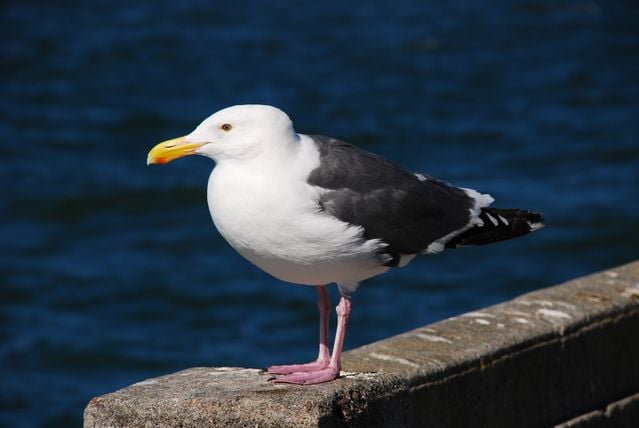
To go deeper, see the dedicated guide to large white-headed gulls and the species deep dives for the American Herring Gull and the Ring-billed Gull.
Hooded Gulls (Genera Leucophaeus and Chroicocephalus)
The hooded gulls are smaller, more delicate birds that grow a dark chocolate or black hood during the breeding season and lose most of it in winter. They fly with a light, buoyant, almost tern-like motion and tend to feed on insects, small fish, and invertebrates rather than scavenging at dumps. North America has roughly four to five species in this cluster.
The Laughing Gull (Leucophaeus atricilla) is the classic black-hooded gull of Atlantic and Gulf coast beaches, named for its loud, cackling call. The New York Natural Heritage Program describes it as a medium-sized gull about 40 to 46 cm (16 to 18 in) long with a wingspan averaging roughly 102 cm (40 in). In summer its jet-black head and deep red bill make it one of the easier gulls to name.
The Franklin’s Gull (Leucophaeus pipixcan) is its prairie counterpart, sometimes called the “prairie dove,” nesting in large colonies in marshes of the northern Great Plains. Audubon gives its length as about 33 to 38 cm (13 to 15 in), wingspan 76 to 89 cm (30 to 35 in), and weight 200 to 350 g (7 to 12 oz). It is slightly smaller and rounder-headed than the Laughing Gull, with bold white spots breaking up its black wingtips.
The Bonaparte’s Gull (Chroicocephalus philadelphia) is one of the smallest and most graceful gulls on the continent, and unusually for a gull it nests in trees rather than on the ground. According to Audubon, it measures about 28 to 36 cm (11 to 14 in) long with a wingspan of 86 to 99 cm (34 to 39 in) and a weight of 180 to 300 g (6.3 to 11 oz). It rarely scavenges, instead picking insects and small fish from the water with tern-like ease.
The closely related Black-headed Gull (Chroicocephalus ridibundus), a Eurasian species, occurs in small numbers in eastern North America and rounds out this group.
Conservation: the hooded gulls are generally stable and listed as Least Concern, though colonial nesters like the Franklin’s Gull can be sensitive to wetland drainage and shifting water levels, which can force colonies to relocate from year to year.
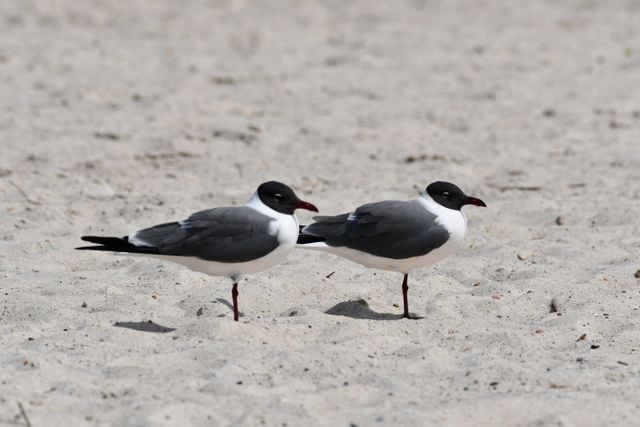
For more, see the hooded gulls subgroup page and the species deep dive on the Bonaparte’s Gull.
Kittiwakes and Arctic Specialists (Genera Rissa, Xema, Hydrocoloeus, Pagophila, and Rhodostethia)
This final cluster gathers the gull family’s true ocean wanderers and far-northern specialists. Several belong to single-species genera, and many spend the non-breeding season entirely at sea or along the Arctic ice edge. They are among the most beautiful and least familiar gulls in North America, and they include both the smallest gull in the world and some of the most rapidly changing populations.
The Black-legged Kittiwake (Rissa tridactyla) is the most numerous of these, a clean-cut ocean gull that nests in dense, noisy colonies on sheer sea cliffs and spends the rest of the year far offshore. Audubon gives its size as about 38 to 43 cm (15 to 17 in) long with a wingspan of 90 to 110 cm (35 to 43 in) and a weight of 320 to 510 g (11 to 18 oz). Its black legs and ink-dipped wingtips set it apart, and its nasal call gives the bird its name.
The Sabine’s Gull (Xema sabini) is a small, fork-tailed Arctic breeder with one of the most striking wing patterns of any gull, a bold tricolor of gray, white, and black. It measures about 33 to 36 cm (13 to 14 in) long, per the National Audubon Society, with long, pointed wings and a shallowly forked tail that give it a tern-like silhouette. After breeding on remote tundra, it migrates thousands of kilometers to winter in rich upwelling waters off South America and southern Africa.
The Little Gull (Hydrocoloeus minutus) is the smallest gull in the world, as confirmed by the Cornell Lab of Ornithology. Primarily a Eurasian species, it maintains a small breeding presence around the Great Lakes and Hudson Bay and turns up elsewhere as a scarce visitor, often among flocks of Bonaparte’s Gulls. It runs only about 28 cm (11 in) long, roughly the size of a robin, per the National Audubon Society, with rounded wingtips and a buoyant, tern-like flight, and adults show distinctive charcoal underwings.
Three more specialists complete the group: the Red-legged Kittiwake (Rissa brevirostris), a Vulnerable Bering Sea endemic that nests on only a few island groups; the Ivory Gull (Pagophila eburnea), a ghostly, all-white scavenger of the High Arctic pack ice; and the Ross’s Gull (Rhodostethia rosea), a small, wedge-tailed gull with a rosy breast that achieved almost mythical status among birders before it was found nesting near Churchill, Manitoba, in 1980.
Conservation: this group carries the heaviest conservation concerns among North American gulls. The Black-legged Kittiwake has been listed as Vulnerable on the IUCN Red List since 2018, after global populations fell by roughly 40 percent over three generations, and the Red-legged Kittiwake is likewise Vulnerable. The Ivory Gull is ranked Near Threatened, with warming seas, shrinking sea ice, and pollution identified as primary threats. The Sabine’s Gull and Ross’s Gull are currently listed as Least Concern, though their remote ranges make them difficult to monitor.
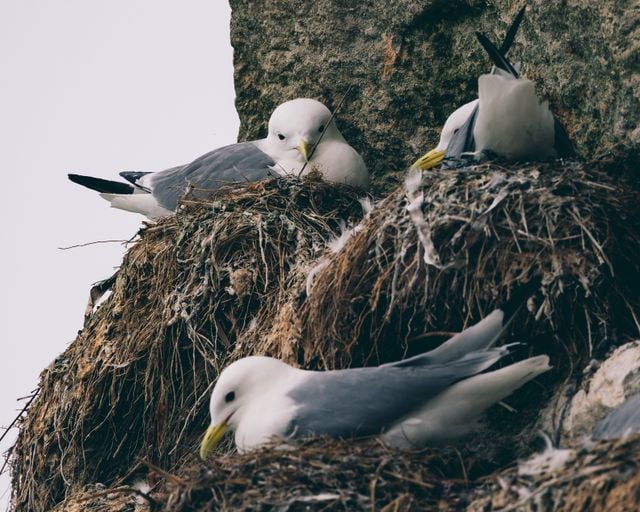
To learn more, see the kittiwakes and Arctic gulls subgroup page and the species deep dives on the Black-legged Kittiwake and the Ivory Gull.
Frequently Asked Questions
How many types of gulls are there in North America?
Roughly two dozen gull species occur regularly in North America, with several more recorded as rare visitors and vagrants. Worldwide there are about 50 gull species in the subfamily Larinae, part of the larger family Laridae that also includes terns, skimmers, and noddies.
What is the largest gull?
The Great Black-backed Gull (Larus marinus) is the largest gull in the world and in North America. According to the Cornell Lab of Ornithology, it reaches 71 to 79 cm (28 to 31 in) in length, spans 152 to 167 cm (60 to 66 in) across the wings, and weighs up to about 2,000 g (4.4 lb).
What is the smallest gull?
The Little Gull (Hydrocoloeus minutus) is the smallest gull in the world, a fact confirmed by the Cornell Lab of Ornithology. It measures only about 25 to 30 cm (10 to 12 in) long, with delicate, rounded wings and a graceful, tern-like flight.
Is there a difference between a gull and a seagull?
“Seagull” is an informal popular term, while “gull” is the name biologists actually use, and the two refer to the same birds. There is no single species called a seagull, and many gulls live far from the ocean, around inland lakes, rivers, farmland, and cities.
Why do gulls gather inland and around parking lots?
Gulls are intelligent, opportunistic feeders that readily exploit human-altered landscapes such as landfills, farm fields, and shopping centers. Several common species, including the Ring-billed Gull, are not tied to the coast at all and thrive on the abundant food and open space these places provide.
Are gulls threatened or declining?
Most familiar North American gulls are listed as Least Concern, and some, such as the Ring-billed Gull, are abundant. Several northern and oceanic specialists are a different story: the Black-legged Kittiwake and Red-legged Kittiwake are listed as Vulnerable, and the Ivory Gull is Near Threatened, with a warming Arctic among the leading concerns.
Conclusion
For all the trouble they give birders trying to age and identify them, gulls are one of the most rewarding families to get to know. From the burly Great Black-backed Gull patrolling an Atlantic harbor to the dainty Little Gull flickering over a Great Lakes marsh, they span an enormous range of size, habitat, and behavior, united by a shared toolkit of long wings, salt glands, sharp minds, and remarkable adaptability.
That adaptability has carried many gulls into our cities and along our shorelines, but it should not lull us into thinking the whole family is secure. The quiet declines of the kittiwakes and the Ivory Gull are reminders that even abundant-seeming birds depend on healthy oceans and a stable climate. Learning to tell one gull from another is the first step toward noticing those changes and caring about them.
Wherever you are in North America, there is almost certainly a gull nearby worth a second look. From here, follow the links into the large white-headed gulls, the hooded gulls, and the kittiwakes and Arctic specialists, or dive into a single species, to keep exploring the family behind the name “seagull.”
Works Cited
- Cornell Lab of Ornithology. “American Herring Gull Overview.” All About Birds. https://www.allaboutbirds.org/guide/American_Herring_Gull/overview
- Cornell Lab of Ornithology. “American Herring Gull Identification.” All About Birds. https://www.allaboutbirds.org/guide/American_Herring_Gull/id
- Cornell Lab of Ornithology. “Systematics: American Herring Gull (Larus smithsonianus).” Birds of the World. https://birdsoftheworld.org/bow/species/amhgul1/cur/systematics
- Cornell Lab of Ornithology. “Identification: Great Black-backed Gull (Larus marinus).” Birds of the World. https://birdsoftheworld.org/bow/species/gbbgul/cur/identification
- Cornell Lab of Ornithology. “Ring-billed Gull Identification.” All About Birds. https://www.allaboutbirds.org/guide/Ring-billed_Gull/id
- Cornell Lab of Ornithology. “Little Gull Overview.” All About Birds. https://www.allaboutbirds.org/guide/Little_Gull/overview
- Cornell Lab of Ornithology. “Sabine’s Gull Overview.” All About Birds. https://www.allaboutbirds.org/guide/Sabines_Gull/overview
- Cornell Lab of Ornithology. “Appearance: Franklin’s Gull (Leucophaeus pipixcan).” Birds of the World. https://birdsoftheworld.org/bow/species/fragul/cur/appearance
- Cornell Lab of Ornithology. “Introduction: Heermann’s Gull (Larus heermanni).” Birds of the World. https://birdsoftheworld.org/bow/species/heegul/cur/introduction
- National Audubon Society. “American Herring Gull.” Audubon Field Guide. https://www.audubon.org/field-guide/bird/american-herring-gull
- National Audubon Society. “Ring-billed Gull.” Audubon Field Guide. https://www.audubon.org/field-guide/bird/ring-billed-gull
- National Audubon Society. “California Gull.” Audubon Field Guide. https://www.audubon.org/field-guide/bird/california-gull
- National Audubon Society. “Franklin’s Gull.” Audubon Field Guide. https://www.audubon.org/field-guide/bird/franklins-gull
- National Audubon Society. “Bonaparte’s Gull.” Audubon Field Guide. https://www.audubon.org/field-guide/bird/bonapartes-gull
- National Audubon Society. “Black-legged Kittiwake.” Audubon Field Guide. https://www.audubon.org/field-guide/bird/black-legged-kittiwake
- National Audubon Society. “Red-legged Kittiwake.” Audubon Field Guide. https://www.audubon.org/field-guide/bird/red-legged-kittiwake
- National Audubon Society. “Ivory Gull.” Audubon Field Guide. https://www.audubon.org/field-guide/bird/ivory-gull
- National Audubon Society. “Ross’s Gull.” Audubon Field Guide. https://www.audubon.org/field-guide/bird/rosss-gull
- National Audubon Society. “Little Gull.” Audubon Field Guide. https://www.audubon.org/field-guide/bird/little-gull
- National Audubon Society. “Sabine’s Gull.” Audubon Field Guide. https://www.audubon.org/field-guide/bird/sabines-gull
- New York Natural Heritage Program. “Laughing Gull Guide.” https://guides.nynhp.org/laughing-gull/
- NOAA Arctic Program. “Ivory Gull: Status, Trends and New Knowledge.” Arctic Report Card. https://arctic.noaa.gov/report-card/report-card-2019/ivory-gull-status-trends-and-new-knowledge/
- BirdLife International. “Ross’s Gull (Rhodostethia rosea) Species Factsheet.” Datazone. https://datazone.birdlife.org/species/factsheet/rosss-gull-rhodostethia-rosea
- Solman, Victor E. F. “Gulls.” USDA Wildlife Services / Prevention and Control of Wildlife Damage Handbook. https://digitalcommons.unl.edu/icwdm_usdanwrc/320/
- American Birding Association. “Listing and Taxonomy.” https://www.aba.org/listing-taxonomy/