South Carolina Birds: A Complete Guide to the Palmetto State’s Birdlife
South Carolina is home to 453 bird species accepted by the South Carolina Bird Records Committee, of which 445 are documented as Definitive, as of the committee’s 2023 annual report. From the spruce-scented ridges of the Blue Ridge to the salt marshes and barrier islands of the Lowcountry, the Palmetto State packs a wide variety of habitats into a compact footprint, and that variety is the reason its bird list runs so long.
The state sits squarely on the Atlantic Flyway, the great north-to-south migratory corridor that funnels waterfowl, shorebirds, and songbirds along the eastern seaboard each spring and fall. A backyard feeder in Greenville and a tidal flat near Charleston can host strikingly different species of birds on the same morning. This guide orients you to the species you are most likely to see, where and when to find them, and how to invite them into your own backyard, from the most familiar birds at the feeder to the specialties of the coast. It then points you toward deeper articles on the groups that deserve a closer look.
Key Takeaways
- South Carolina’s official state list holds 453 species, 445 of them Definitive, per the South Carolina Bird Records Committee’s 2023 annual report.
- The Carolina Wren (Thryothorus ludovicianus) has been the South Carolina state bird since 1948.
- The Northern Cardinal is among the most frequently reported backyard feeder birds across the state and is present year round.
- Huntington Beach State Park near Murrells Inlet is widely regarded as the single best birding location in South Carolina, with more than 300 species recorded.
- The red-cockaded woodpecker (Dryobates borealis), a longleaf pine specialist with strongholds in South Carolina, was downlisted from federally endangered to threatened in October 2024 after decades of recovery work.
At a Glance: Common Birds of South Carolina
The table below lists the species profiled in this guide along with other frequently encountered South Carolina birds. Species marked resident are present year round; seasonal notes indicate when migrants and winter visitors are most likely.
| Species | Scientific name | Size (length) | When present | Where to find | Best feeder food |
|---|---|---|---|---|---|
| Northern Cardinal | Cardinalis cardinalis | 21 to 23 cm (8.3 to 9.1 in) | Resident | Yards, woodland edges statewide | Black oil sunflower seeds |
| Carolina Wren | Thryothorus ludovicianus | 12.5 to 14 cm (4.9 to 5.5 in) | Resident | Brushy yards, thickets statewide | Suet, mealworms |
| Carolina Chickadee | Poecile carolinensis | 11.5 to 13 cm (4.5 to 5.1 in) | Resident | Woodlands, feeders statewide | Sunflower seeds, suet |
| Tufted Titmouse | Baeolophus bicolor | 14 to 16 cm (5.5 to 6.3 in) | Resident | Mixed woods, feeders statewide | Sunflower seeds, peanuts |
| Red-bellied Woodpecker | Melanerpes carolinus | 23 to 27 cm (9.1 to 10.6 in) | Resident | Woodlands, suburbs statewide | Suet, sunflower seeds |
| Downy Woodpecker | Dryobates pubescens | 14 to 18 cm (5.5 to 7.1 in) | Resident | Woodlands, feeders statewide | Suet, sunflower seeds |
| Blue Jay | Cyanocitta cristata | 25 to 30 cm (9.8 to 11.8 in) | Resident | Oak woods, suburbs statewide | Peanuts, sunflower seeds |
| Brown-headed Nuthatch | Sitta pusilla | 10 to 11 cm (3.9 to 4.3 in) | Resident | Pine woods, Coastal Plain and Sandhills | Sunflower seeds, suet |
| American Goldfinch | Spinus tristis | 11 to 14 cm (4.3 to 5.5 in) | Resident, peaks in winter | Weedy fields, feeders | Nyjer (thistle) seed |
| Eastern Bluebird | Sialia sialis | 16 to 21 cm (6.3 to 8.3 in) | Resident | Open country, nest boxes | Mealworms |
| American Robin | Turdus migratorius | 20 to 28 cm (7.9 to 11.0 in) | Resident, flocks in winter | Lawns, woodland edges | Fruit, mealworms |
| Mourning Dove | Zenaida macroura | 23 to 34 cm (9.1 to 13.4 in) | Resident | Open ground, feeders statewide | Cracked corn, millet |
| Northern Mockingbird | Mimus polyglottos | 22 to 26 cm (8.7 to 10.2 in) | Resident | Suburbs, hedgerows statewide | Fruit, suet |
| White-breasted Nuthatch | Sitta carolinensis | 13 to 14 cm (5.1 to 5.5 in) | Resident | Hardwood forests | Sunflower seeds, suet |
| Pileated Woodpecker | Dryocopus pileatus | 40 to 49 cm (15.8 to 19.3 in) | Resident | Mature forests statewide | Suet |
| Eastern Towhee | Pipilo erythrophthalmus | 17 to 23 cm (6.8 to 9.1 in) | Resident | Brushy edges, thickets | Millet, ground seed |
| Red-shouldered Hawk | Buteo lineatus | 43 to 61 cm (16.9 to 24.0 in) | Resident | Wooded wetlands, suburbs | Not a feeder bird |
| Cooper’s Hawk | Astur cooperii | 37 to 50 cm (14.6 to 19.7 in) | Resident | Woodlands, suburbs | Hunts feeder birds |
| Bald Eagle | Haliaeetus leucocephalus | 70 to 102 cm (27.6 to 40.2 in) | Resident | Lakes, rivers, coast | Not a feeder bird |
| Osprey | Pandion haliaetus | 54 to 58 cm (21.3 to 22.8 in) | Breeding, spring to fall | Coast, lakes, large rivers | Not a feeder bird |
| Swallow-tailed Kite | Elanoides forficatus | 50 to 68 cm (19.7 to 26.8 in) | Breeding, spring to summer | Lowcountry river swamps | Not a feeder bird |
| Great Blue Heron | Ardea herodias | 97 to 137 cm (38.2 to 53.9 in) | Resident | Marshes, ponds, shorelines | Not a feeder bird |
| Great Egret | Ardea alba | 80 to 104 cm (31.5 to 40.9 in) | Resident, peaks in summer | Marshes, impoundments | Not a feeder bird |
| Wood Stork | Mycteria americana | 83 to 115 cm (32.7 to 45.3 in) | Breeding, spring to fall | Lowcountry swamps, impoundments | Not a feeder bird |
| Brown Pelican | Pelecanus occidentalis | 100 to 137 cm (39.4 to 53.9 in) | Resident on coast | Beaches, inlets, jetties | Not a feeder bird |
| Black Skimmer | Rynchops niger | 40 to 50 cm (15.8 to 19.7 in) | Breeding, spring to fall | Beaches, sandbars | Not a feeder bird |
| Red-cockaded Woodpecker | Dryobates borealis | 18 to 23 cm (7.1 to 9.1 in) | Resident | Mature longleaf pine forests | Not a feeder bird |
| Painted Bunting | Passerina ciris | 12 to 14 cm (4.7 to 5.5 in) | Breeding, late March to August | Coastal thickets, Lowcountry | White millet |
| Wild Turkey | Meleagris gallopavo | 100 to 125 cm (39.4 to 49.2 in) | Resident | Woodlands, field edges statewide | Cracked corn |
| Ruby-throated Hummingbird | Archilochus colubris | 7 to 9 cm (2.8 to 3.5 in) | Breeding, mid March to fall | Gardens, woodland edges | Nectar (sugar water) |
| Yellow-rumped Warbler | Setophaga coronata | 12 to 14 cm (4.7 to 5.5 in) | Winter visitor | Wax myrtle thickets, woods | Suet, bayberry |
| Rose-breasted Grosbeak | Pheucticus ludovicianus | 18 to 22 cm (7.1 to 8.7 in) | Migration, spring and fall | Woodland edges, feeders | Sunflower seeds |
| Dark-eyed Junco | Junco hyemalis | 14 to 16 cm (5.5 to 6.3 in) | Winter visitor | Yards, woodland floors | Millet, ground seed |
| White-throated Sparrow | Zonotrichia albicollis | 16 to 18 cm (6.3 to 7.1 in) | Winter visitor | Brushy edges, feeders | Millet, ground seed |
| Red-winged Blackbird | Agelaius phoeniceus | 18 to 24 cm (7.1 to 9.4 in) | Resident | Marshes, fields, feeder edges | Mixed seed, cracked corn |
| Common Grackle | Quiscalus quiscula | 28 to 34 cm (11.0 to 13.4 in) | Resident | Open areas, fields, lawns | Cracked corn, mixed seed |
| Wood Duck | Aix sponsa | 47 to 54 cm (18.5 to 21.3 in) | Resident | Wooded swamps, ponds | Not a feeder bird |
| Purple Martin | Progne subis | 18 to 20 cm (7.1 to 7.9 in) | Breeding, spring to summer | Open areas near martin housing | Not a feeder bird |
| Sandhill Crane | Antigone canadensis | 100 to 122 cm (39.4 to 48.0 in) | Winter and migration | Wetlands and fields, inner Coastal Plain | Not a feeder bird |
| Peregrine Falcon | Falco peregrinus | 36 to 49 cm (14.2 to 19.3 in) | Migration and winter | Coast, cliffs, cities | Not a feeder bird |
| House Sparrow | Passer domesticus | 15 to 17 cm (5.9 to 6.7 in) | Resident (introduced) | Urban and suburban areas | Mixed seed, cracked corn |
| Pine Siskin | Spinus pinus | 11 to 14 cm (4.3 to 5.5 in) | Irruptive winter visitor | Woodlands, feeders | Nyjer (thistle) seed |
| Northern House Wren | Troglodytes aedon | 11 to 13 cm (4.3 to 5.1 in) | Winter visitor | Brushy edges, thickets | Suet, mealworms |
Why South Carolina Holds So Much Bird Diversity
South Carolina’s bird richness follows directly from its geography. Geographers generally divide the state into three major physiographic provinces, the Blue Ridge in the northwest, the central Piedmont, and the broad Atlantic Coastal Plain, often subdivided further into five regions: the Mountains, the Piedmont, the Sandhills, the Coastal Plain, and the Coast.
The Blue Ridge, the smallest region, rises to roughly 1,083 m (3,553 ft) at Sassafras Mountain on the North Carolina border and supports cool-forest breeders such as the Black-throated Blue Warbler, Veery, and Common Raven that are scarce or absent elsewhere in the state. The Piedmont, a plateau of rolling hills and clay soils clothed in oak-hickory deciduous forests, gives way at the fall line to the Coastal Plain, where a long, arid belt of ancient dunes known as the Sandhills holds fire-maintained longleaf pine. These pine woodlands are the habitat that supports the red-cockaded woodpecker, the Brown-headed Nuthatch, and Bachman’s Sparrow.
Seaward, the Coastal Plain flattens into river swamps, the ACE Basin estuary, and the Sea Islands, a chain of barrier islands stretching south from Charleston. This coast is where the Atlantic Flyway concentrates its traffic. Tidal flats and impoundments host thousands of shorebirds and wading birds, and the maritime scrub of the Lowcountry is the eastern heartland of the breeding Painted Bunting. Because the Sandhills act as a partial ecological barrier, a number of species occur on only one side of the fall line, which is part of why the combined list is so long.
The Carolina Wren: South Carolina’s State Bird
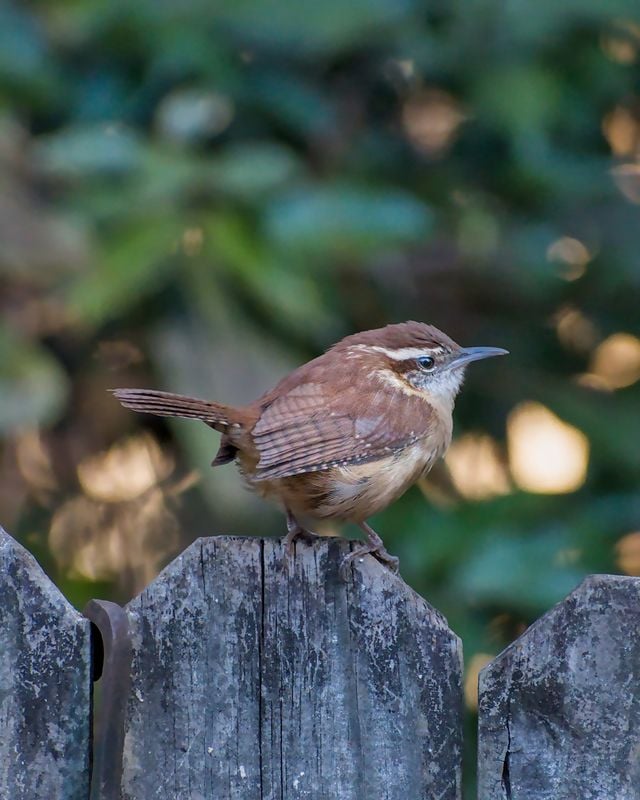
The Carolina Wren (Thryothorus ludovicianus), sometimes called the Great Carolina Wren, has been the official state bird of South Carolina since 1948, when it replaced the Northern Mockingbird in that role. It is a small, rich reddish-brown wren with a bold white stripe over each eye and a habit of cocking its tail upright, a permanent resident across the eastern United States and one of the most vocal birds in any Palmetto State yard.
What the Carolina Wren lacks in size it makes up in volume. The male sings a loud, rolling phrase often written as teakettle-teakettle-teakettle, repeated through the year rather than only in spring. Pairs stay together on territory year round and nest in an extraordinary variety of nooks, from hanging plants and mailboxes to coat pockets in an open shed. The species favors brushy gardens, woodland edges, and swamp thickets, and it readily takes suet and mealworms at feeders. For a fuller account of its biology, voice, and nesting habits, see the dedicated Carolina Wren guide.
Common Backyard Birds
These are the residents most South Carolinians meet first, at the feeder, in the hedge, or singing from a porch rail.
Northern Cardinal (Cardinalis cardinalis)
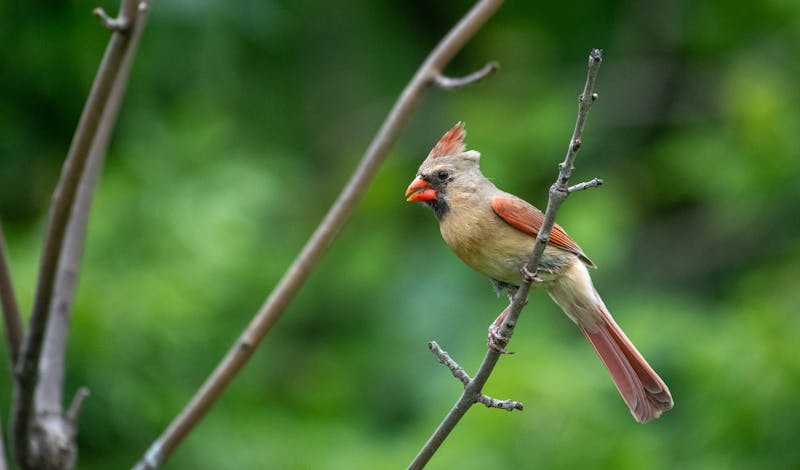
The Northern Cardinal is among the most reported backyard birds in South Carolina and is present in every region year round. The male is unmistakable, a crested bird in brilliant red with a black face mask, while the female is a warm tan with red highlights in the wings, tail, and crest. Adults measure 21 to 23 cm (8.3 to 9.1 in) in length.
Cardinals favor woodland edges, thickets, and suburban shrubbery, and they are among the first birds at a feeder in the morning and the last to leave at dusk. Their diet centers on seeds, supplemented heavily with insects during the breeding season, and they take black oil sunflower seeds eagerly from platform and hopper feeders. The clear, slurred whistle, often rendered birdie-birdie-birdie or cheer-cheer-cheer, carries well across a yard. A dense native shrub layer offers the cover and nest sites they prefer.
Carolina Chickadee (Poecile carolinensis)
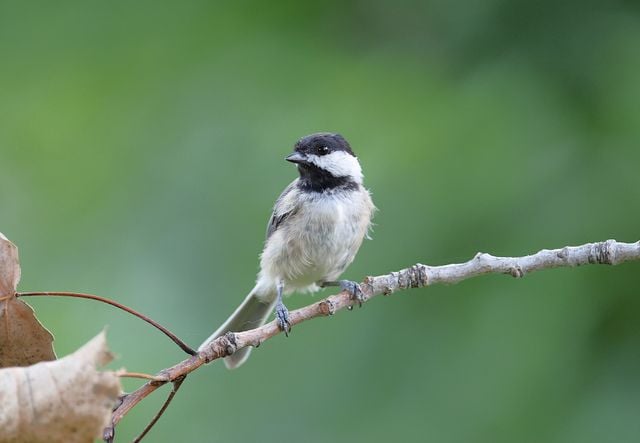
The Carolina Chickadee is the small, black-capped, black-throated feeder bird of the South Carolina backyard, present statewide all year. It is tiny, 11.5 to 13 cm (4.5 to 5.1 in) long, with gray upperparts and pale underparts, and it moves through trees in quick, acrobatic hops.
This species is the southeastern counterpart to the Black-capped Chickadee of cooler regions, and the two do not normally overlap within the state. Carolina Chickadees often lead the loose, mixed foraging flocks of winter that also draw in titmice, nuthatches, and kinglets. They cache seeds for later retrieval, favor sunflower seeds and suet, and readily accept nest boxes. The call is a quick, buzzy chick-a-dee-dee-dee, with the number of terminal notes tending to rise when the bird is agitated.
Tufted Titmouse (Baeolophus bicolor)
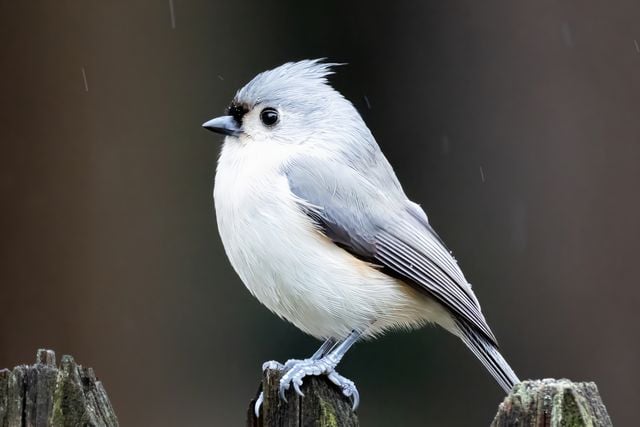
The Tufted Titmouse is a soft-gray, crested songbird with large dark eyes and a peach-tinged flank, present year round across South Carolina. At 14 to 16 cm (5.5 to 6.3 in), it is slightly larger than a chickadee and frequently travels in the same winter flocks.
Titmice are bold and curious at feeders, where they take a single sunflower seed or peanut, carry it to a branch, and hammer it open while holding it underfoot. They nest in tree cavities and nest boxes, lining the cup with soft material that sometimes includes hair plucked from live mammals. The ringing, whistled song is usually written peter-peter-peter. Like chickadees, they benefit from mature trees and a steady supply of sunflower seeds and suet.
Red-bellied Woodpecker (Melanerpes carolinus)

The Red-bellied Woodpecker is the most common woodpecker at South Carolina feeders and a year-round resident statewide. Despite the name, the red is most obvious on the crown and nape; the faint reddish wash on the belly is hard to see in the field. The back shows a black-and-white ladder pattern, and adults measure 23 to 27 cm (9.1 to 10.6 in).
This woodpecker is a vocal presence in woodlands and suburbs alike, giving a rolling churr and a sharper cha-cha-cha. It forages along trunks and large limbs for insects but also takes fruit, nuts, and seeds, and it is a frequent visitor to suet cages and sunflower feeders. Red-bellied Woodpeckers excavate nest cavities in dead or dying wood, so leaving a standing snag where it is safe to do so supports both this species and the cavity nesters that reuse old holes.
Blue Jay (Cyanocitta cristata)

The Blue Jay is a large, crested, blue-and-white songbird with a black necklace and a long tail, present across South Carolina throughout the year. At 25 to 30 cm (9.8 to 11.8 in), it is one of the most conspicuous birds at any oak-rich feeder, both for its size and its volume.
Blue Jays are intelligent and social, and they cache acorns and other nuts in the ground, a habit that helps disperse oaks across the landscape. They are well known for mimicking the calls of hawks, which can briefly clear a feeder of smaller birds. Their natural diet leans heavily on acorns, beechnuts, and insects, and at feeders they favor whole peanuts and sunflower seeds, often on a platform that can hold their weight. A noisy, screaming jay-jay announces their arrival well before they land.
Brown-headed Nuthatch (Sitta pusilla)
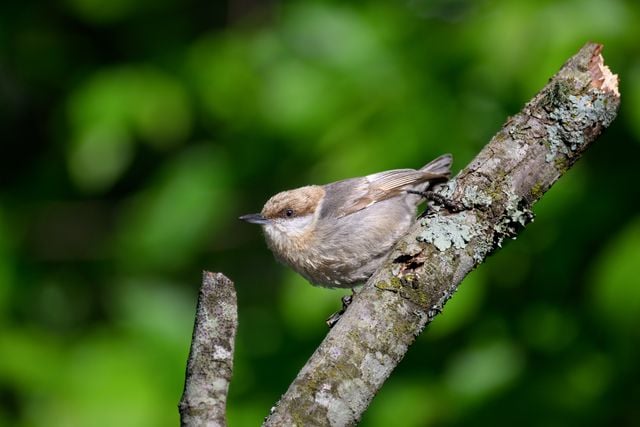
The Brown-headed Nuthatch is a tiny pine-woodland specialist of the Coastal Plain and Sandhills, present year round wherever mature pines stand. It is the smallest of South Carolina’s three nuthatches, just 10 to 11 cm (3.9 to 4.3 in), with a brown cap, gray-blue back, and white underparts.
This sociable little bird gives a distinctive squeaky call often compared to a rubber duck, and it moves head-first down pine trunks in the upside-down style typical of nuthatches. It is one of the few North American birds known to use a tool, sometimes prying up bark with a flake of wood held in the bill. These small birds often move through the pines in small groups, and they readily take sunflower seeds and suet near pine stands and will accept small-entrance nest boxes. Their fortunes are closely tied to the same open pine forests that support the red-cockaded woodpecker.
Birds of Prey
South Carolina supports a strong cast of birds of prey, from forest hawks to coastal fish-eaters, each armed with a hooked bill and sharp talons for seizing prey.
Red-shouldered Hawk (Buteo lineatus)
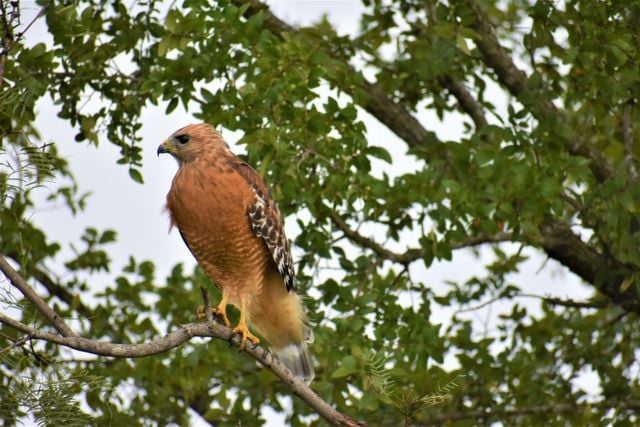
The Red-shouldered Hawk is the most frequently seen woodland hawk in much of South Carolina, a year-round resident of wet forests, river bottoms, and leafy suburbs. Adults show reddish shoulders and barred rufous underparts, with bold black-and-white bands across the tail and translucent crescents near the wingtips in flight. Length runs 43 to 61 cm (16.9 to 24.0 in).
This hawk hunts from a perch, dropping onto frogs, snakes, small mammals, and large insects, and it is especially associated with wooded swamps and bottomland hardwoods. Its loud, repeated kee-aah scream is a familiar woodland sound, and Blue Jays imitate it convincingly. Where mature trees border water, Red-shouldered Hawks often nest within sight of houses, becoming one of the more approachable large raptors in the state.
Bald Eagle (Haliaeetus leucocephalus)
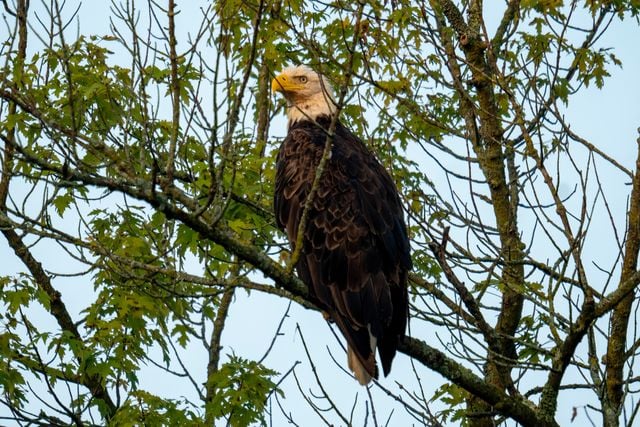
The Bald Eagle is a year-round resident of South Carolina’s lakes, large rivers, and coast, and one of conservation’s clearest success stories. The adult is unmistakable, a massive dark-bodied raptor with a white head and tail; immatures are mottled brown and white and take several years to reach full adult plumage. Body length is 70 to 102 cm (27.6 to 40.2 in), with a wingspan of 1.8 to 2.3 m (5.9 to 7.5 ft).
Eagles concentrate near reservoirs such as Lake Marion and along the coastal plain rivers, where they take fish, waterfowl, and carrion, and they regularly steal catches from Ospreys. Pairs build enormous stick nests reused and enlarged over many years. Once devastated by the pesticide DDT, the Bald Eagle has rebounded strongly since that chemical was banned, and Huntington Beach State Park is among the reliable places to watch one patrol the causeway.
Swallow-tailed Kite (Elanoides forficatus)
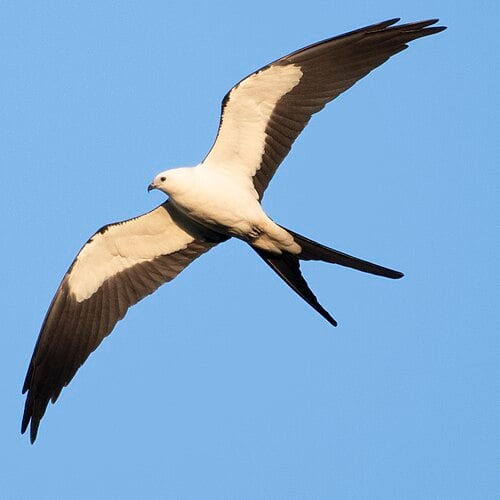
The Swallow-tailed Kite is among the most elegant birds that breed in South Carolina, a striking black-and-white raptor with a long, deeply forked tail, present from spring into late summer. It measures 50 to 68 cm (19.7 to 26.8 in) in length and seems almost weightless on the wing.
This kite is a Lowcountry specialty, nesting in tall trees along river swamps and floodplain forests before departing for South America in late summer. It hunts on the wing with extraordinary grace, snatching large insects, small reptiles, and nestling birds from the canopy and often eating in flight. Watching a group of Swallow-tailed Kites course over a coastal river on a summer afternoon is one of the signature birding experiences of the South Carolina coast.
Water and Wetland Birds
The coast, the river swamps, and the managed impoundments hold some of the state’s most memorable birds.
Great Blue Heron (Ardea herodias)
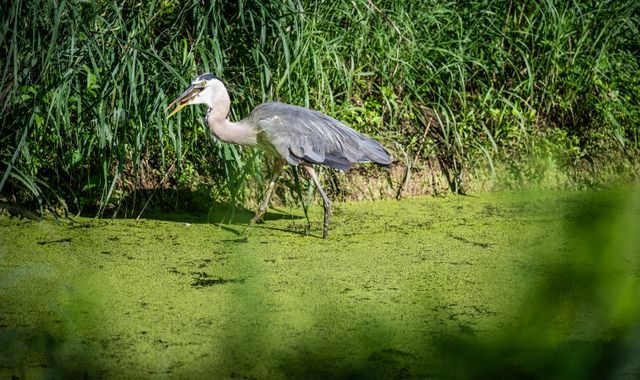
The Great Blue Heron is the tall, blue-gray wading bird seen along nearly every South Carolina shoreline, marsh, and farm pond, present year round. Standing more than a meter high with a length of 97 to 137 cm (38.2 to 53.9 in), it is the largest heron in North America.
This patient hunter stalks the shallows with slow, deliberate steps, then strikes with a quick thrust of the dagger-shaped bill to seize fish, frogs, and small reptiles. In flight it folds its neck into a tight S and trails its long legs behind. Great Blue Herons nest colonially in large trees near water, and a single bird standing motionless at the edge of a tidal creek is one of the most familiar sights in the Lowcountry.
Wood Stork (Mycteria americana)
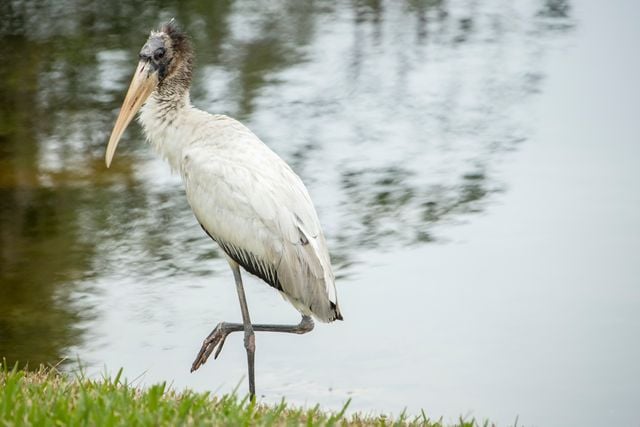
The Wood Stork is a large, bald-headed wading bird of the Lowcountry swamps and impoundments, present chiefly from spring through fall. It stands 83 to 115 cm (32.7 to 45.3 in) tall, with white plumage, black flight feathers, and a heavy, down-curved bill, and the dark, scaly skin of its head gives it a prehistoric look up close.
Wood Storks feed by touch, sweeping a partly open bill through shallow water and snapping it shut on contact with prey, which makes them dependent on concentrated fish in drying pools. The species was federally listed as endangered in 1984, reclassified to threatened in 2014, and removed from the federal list of endangered and threatened wildlife in 2026, after the southeastern breeding population, which includes important colonies in South Carolina, more than doubled across four decades of recovery. The birds remain protected under the Migratory Bird Treaty Act and sensitive to the timing and depth of wetland water levels.
Brown Pelican (Pelecanus occidentalis)
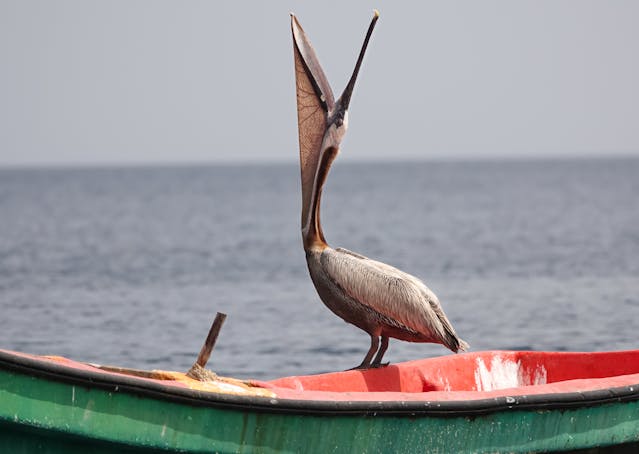
The Brown Pelican is the iconic seabird of the South Carolina coast, a year-round resident of beaches, inlets, and jetties. It is large and heavy-billed, 100 to 137 cm (39.4 to 53.9 in) long, with a wingspan of roughly 2.0 to 2.3 m (6.6 to 7.5 ft), and it flies in stately lines low over the surf.
Unlike the white pelicans that fish cooperatively from the surface, the Brown Pelican plunge-dives, folding its wings and crashing bill-first into the water to scoop fish into its expandable pouch. Like the Bald Eagle, it suffered steep declines from DDT in the mid-twentieth century and has recovered strongly since. Coastal sandbars and dredge-spoil islands provide the undisturbed nesting colonies the species needs, and protecting those islands remains central to its continued success.
Woodland and Grassland Specialties
Two species stand out for the way they anchor South Carolina’s most distinctive habitats.
Red-cockaded Woodpecker (Dryobates borealis)

The red-cockaded woodpecker is a longleaf pine specialist and one of South Carolina’s flagship conservation species, a non-migratory resident of mature open pine forests. It is a small black-and-white woodpecker, 18 to 23 cm (7.1 to 9.1 in) long, with a black cap, large white cheek patch, and a barred back; the tiny red streak that gives the bird its name is rarely visible on the male.
This woodpecker is unique among North American woodpeckers in excavating its nest and roost cavities in living pines, a process that can take years and depends on old trees softened by heart-rot fungus. Birds live in cooperative family groups that maintain clusters of cavity trees, and they require the open, grassy understory produced by frequent low-intensity fire. Francis Marion National Forest and Carolina Sandhills National Wildlife Refuge hold important South Carolina populations. The species is discussed further in the conservation section below.
Painted Bunting (Passerina ciris)
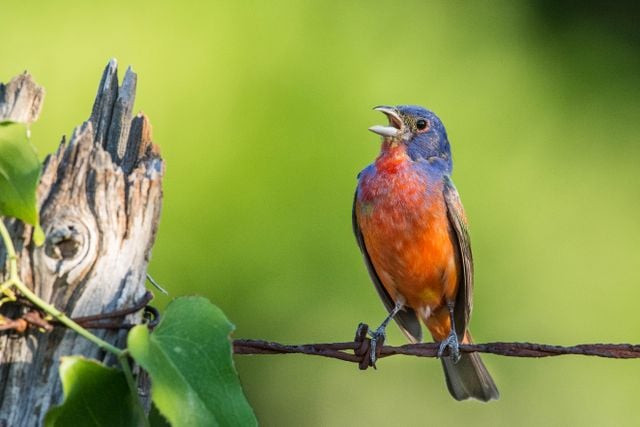
The Painted Bunting is the most dazzling songbird that breeds in South Carolina, present along the coast from late March through August. The adult male is unlike any other North American bird, with a blue head, green back, and red underparts in bold, saturated blocks; females and immatures are a uniform bright yellow-green. Length is 12 to 14 cm (4.7 to 5.5 in).
The Lowcountry sea islands and coastal scrub form the core of the eastern breeding population, and the species favors dense thickets and brushy edges near salt marsh and maritime forest. Males deliver a sweet, beautiful song, a rapid warble, from exposed perches at dawn. Painted Buntings take white millet readily, best offered on a platform or in a tube feeder away from larger birds, and a backyard of dense native shrubs near the coast has a real chance of hosting one. The eastern population is a species of conservation concern owing to coastal habitat loss.
Notable Migrants
Two species illustrate the seasonal turnover that the Atlantic Flyway brings.
Ruby-throated Hummingbird (Archilochus colubris)
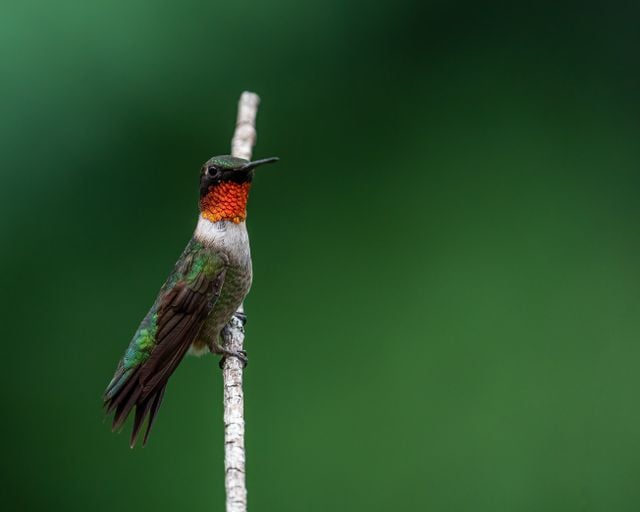
The Ruby-throated Hummingbird is the only hummingbird that breeds in South Carolina and the species nearly every nectar feeder hosts in summer. It is minute, 7 to 9 cm (2.8 to 3.5 in) long, metallic green above and pale below; the male shows a brilliant ruby-red throat that can look black until the light catches it.
Birds typically return from Central American wintering grounds beginning in mid March along the coast, with arrivals spreading into the Upstate through early April; males generally precede females. They feed on flower nectar and small insects and defend feeders aggressively. A simple solution of one part white sugar to four parts water, with no dye, kept clean and changed often, will draw them in, and a few tubular native flowers such as trumpet honeysuckle or cardinal flower help even more. Most depart southward by October.
Yellow-rumped Warbler (Setophaga coronata)

The Yellow-rumped Warbler is the most abundant wintering warbler in South Carolina, present in large numbers from fall through early spring. In winter plumage it is a streaky brownish bird, 12 to 14 cm (4.7 to 5.5 in) long, but always shows the bright yellow rump patch that gives rise to a long-standing birders’ nickname.
What allows this warbler to winter so far north of most of its relatives is its ability to digest the waxy fruit of wax myrtle and bayberry, abundant in the Coastal Plain. Flocks move restlessly through thickets and woodland edges, giving a sharp check call, and they will occasionally take suet at feeders. As spring approaches, males molt into a crisp gray, black, and yellow breeding plumage before heading north to nest.
Look-Alikes: Telling Confusing Species Apart
Sharpening your bird identification skills often comes down to a handful of South Carolina species pairs that cause repeated confusion. The table below highlights the most reliable distinctions.
| Pair | Key difference |
|---|---|
| Downy vs Hairy Woodpecker | The Downy is smaller with a short, stubby bill roughly a third the width of its head; the Hairy is larger with a long, stout bill nearly as long as its head is wide. |
| Cooper’s vs Sharp-shinned Hawk | The Cooper’s Hawk is larger with a rounded tail tip and a relatively large head that projects well past the wings in flight; the Sharp-shinned Hawk is smaller with a squared tail and a small head. |
| House vs Purple Finch | The male House Finch shows red concentrated on the head and breast with brown-streaked flanks; the male Purple Finch looks washed in raspberry red across the head, back, and breast with cleaner flanks. Females of both are brown and streaked in different shades. |
What to See When: A Seasonal Guide
South Carolina rewards birders in every season, but the cast changes substantially through the year.
| Season | Highlights |
|---|---|
| Spring (March to May) | Painted Buntings and Ruby-throated Hummingbirds return; neotropical migrant songbirds move through; herons and egrets begin nesting; Swallow-tailed Kites arrive in the Lowcountry. |
| Summer (June to August) | Breeding season peaks; Painted Buntings sing along the coast; Wood Storks and wading birds gather at drying impoundments; seabirds and terns nest on barrier islands. |
| Fall (September to November) | Southbound shorebird and songbird migration; raptors move along ridgelines and the coast; the first wintering sparrows and warblers arrive. |
| Winter (December to February) | Waterfowl concentrate on lakes and coastal impoundments; Yellow-rumped Warblers, Dark-eyed Juncos, and White-throated Sparrows are common; loons and sea ducks appear offshore. |
Notable Birding Locations
South Carolina’s best birding is concentrated on the coast, but rewarding sites span the state of South Carolina.
Huntington Beach State Park, near Murrells Inlet just south of Myrtle Beach, is widely regarded as the premier birding destination in South Carolina and a great place to start, with more than 300 species recorded across its beach, salt marsh, freshwater lagoon, and maritime forest. The causeway offers close views of wading birds, waterfowl, and a resident Bald Eagle, and winter brings sea ducks, loons, and the occasional rarity.
Cape Romain National Wildlife Refuge, near Awendaw, protects more than 66,000 acres of barrier islands, salt marsh, and estuary north of Charleston. Reached largely by boat, its small islands and sandbars are a stronghold for shorebirds, including the threatened Piping Plover and the Red Knot, along with nesting seabirds and American Oystercatchers.
Folly Beach, just south of Charleston, packs an outsized variety of coastal birds onto a single barrier island. At its northeast end, the Lighthouse Inlet Heritage Preserve, recognized as an Audubon birding hotspot and one of the most species-rich sites in the state, draws migrant songbirds and sparrows to its maritime scrub, Painted Buntings in summer, and nesting Wilson’s Plovers, American Oystercatchers, Willets, and Least Terns along its beach and inlet sandbars. Off the island’s southwest end, the Bird Key Stono Seabird Sanctuary is a vital nesting island for Black Skimmers, Royal Terns, and Brown Pelicans, best viewed from a distance so the colonies are not disturbed.
Congaree National Park, near Columbia, preserves the largest remaining tract of old-growth bottomland hardwood forest in the Southeast. Its boardwalk and trails are excellent for Prothonotary and Swainson’s Warblers, Barred Owls, and Pileated Woodpeckers, particularly during spring migration.
Bear Island Wildlife Management Area, within the ACE Basin, is renowned for wintering waterfowl, wading birds, and rails across its managed wetlands. Santee National Wildlife Refuge, along Lake Marion, draws large concentrations of waterfowl and wintering Bald Eagles.
In the Upstate, Caesars Head and Table Rock State Parks offer mountain birding and a celebrated fall hawk migration, when thousands of Broad-winged Hawks stream past the escarpment in September.
How to Attract Birds to Your South Carolina Yard
A few well-chosen elements will turn an ordinary yard into reliable bird habitat, and stocking backyard bird feeders with the favorite foods of local species is one of the best ways to draw a variety of birds to your own backyard.
Food matters most for variety. Black oil sunflower seed in a hopper or tube feeder draws the most common feeder birds, among them cardinals, chickadees, titmice, nuthatches, and finches. Suet supports woodpeckers and wrens, especially in cooler months. Nyjer (thistle) seed attracts goldfinches, white millet brings in sparrows, doves, and coastal Painted Buntings, and a clean nectar feeder serves hummingbirds from spring through fall.
Water is the single most underused attractant. A shallow birdbath kept clean and refreshed, ideally with the sound or movement of dripping water, will draw species that never visit a feeder, including warblers and thrushes.
Native plantings provide natural food sources and shelter that feeders cannot. Wax myrtle, American beautyberry, native viburnums, and oaks supply berries, seeds, and the insect prey that nearly all songbirds feed to their young. A layered structure of canopy trees, understory shrubs, and groundcover offers nesting cover and foraging space across many species.
Nest boxes help cavity nesters such as Eastern Bluebirds, Carolina Chickadees, Brown-headed Nuthatches, and Carolina Wrens, provided the entrance hole is sized for the target species and the box is placed away from heavy disturbance. The South Carolina Department of Natural Resources encourages keeping feeders and baths clean to keep wild birds healthy and limit disease transmission, and it advises taking feeders down temporarily if signs of illness appear among visiting birds.
Conservation in South Carolina
South Carolina’s most prominent bird conservation story is the recovery of the red-cockaded woodpecker. In October 2024, the U.S. Fish and Wildlife Service downlisted the species from federally endangered to threatened, with the change taking effect on November 25, 2024. The Service reported that the number of active red-cockaded woodpecker clusters rangewide had risen from 5,627 in 2003 to more than 7,800, the result of five decades of habitat restoration on public and private land.
That recovery rests on the longleaf pine ecosystem, which once covered vast stretches of the Southeast and was reduced to a small fraction of its historical extent by logging, development, and fire suppression. Restoring it depends on prescribed fire, which maintains the open, grassy understory the woodpecker requires, and on installing artificial cavities that let new family groups establish faster than the birds could excavate on their own. South Carolina sites such as Francis Marion National Forest and Carolina Sandhills National Wildlife Refuge have been central to this work, which also benefits the Brown-headed Nuthatch, Bachman’s Sparrow, and Northern Bobwhite. Conservation groups have noted that the species remains dependent on active management and vulnerable to hurricanes and the longer-term pressures of climate change, so the downlisting of this once endangered species marks progress rather than a finished recovery.
Along the coast, the eastern Painted Bunting is a focus of monitoring because of habitat loss in the developing Lowcountry, where shrub-nesting songbirds also contend with nest parasitism by Brown-headed Cowbirds, and long-running point counts in coastal reserves have tracked its breeding numbers in recent years. Together, these efforts show how much of South Carolina’s birdlife depends on the careful stewardship of fire-maintained pine forests, coastal scrub, and wetland systems. Local organizations, including the Carolina Bird Club, whose South Carolina Bird Records Committee maintains the official state list, support this work through nature study, citizen-science counts, and field trips that connect residents with the state’s birdlife.
Frequently Asked Questions
What is the most common backyard bird in South Carolina?
The Northern Cardinal is among the most commonly reported backyard birds in South Carolina and is present statewide all year. Carolina Chickadees, Tufted Titmice, Carolina Wrens, and Mourning Doves are also near-universal feeder visitors. The exact ranking shifts by season and location, but cardinals are a fixture of nearly every yard and the most common bird at many feeders.
What is the South Carolina state bird?
The state bird of South Carolina is the Carolina Wren (Thryothorus ludovicianus), designated in 1948. It is a small reddish-brown wren known for its loud, rolling song and its habit of nesting in unexpected places around homes and gardens. It is a year-round resident throughout the state.
When do hummingbirds arrive in South Carolina?
Ruby-throated Hummingbirds typically return to South Carolina beginning in mid March along the coast, with arrivals reaching the Upstate by early April. Males generally arrive ahead of females. Putting out a clean nectar feeder by mid March gives you the best chance of catching the first arrivals.
What is the largest bird in South Carolina?
Among regularly occurring South Carolina birds, the Bald Eagle and the Great Blue Heron are the largest by length and wingspan, and the Wild Turkey is the heaviest woodland bird. On the coast, the Brown Pelican and Wood Stork are also very large. The Bald Eagle’s wingspan can approach 2.3 m (7.5 ft).
Where is the best place to go birding in South Carolina?
Huntington Beach State Park near Murrells Inlet is widely considered the best single birding location in South Carolina, with more than 300 species recorded. For wading birds and shorebirds, Cape Romain National Wildlife Refuge and the ACE Basin are outstanding, while Congaree National Park is the premier site for forest songbirds.
Are Painted Buntings found in South Carolina?
Yes. South Carolina’s Lowcountry coast is the core of the eastern Painted Bunting’s breeding range. The birds are present from late March through August, favoring dense coastal thickets and brushy edges, and they readily visit feeders stocked with white millet near the coast.
Conclusion
South Carolina’s long bird list is a direct reflection of its landscape, a compact state that runs from mountain forest to barrier island and sits on one of the continent’s great migratory highways. The same morning can offer a cardinal at the feeder, a Swallow-tailed Kite over a river swamp, and a Painted Bunting singing from coastal scrub. Whether your interest is the birds at your window or the rarities of the outer islands, the Palmetto State rewards close attention in every season.
This guide is a starting point. To go deeper, follow the links to focused articles on South Carolina’s owls, raptors, and waterbirds, to a guide to the backyard birds of South Carolina, and to the dedicated profile of the state bird, the Carolina Wren. Each builds on the foundation laid out here.
Works Cited
- South Carolina Bird Records Committee, Carolina Bird Club. “Official list of the birds of South Carolina.” https://www.carolinabirdclub.org/brc/checklist_of_South_Carolina_birds.html
- U.S. Fish and Wildlife Service. “Downlisting of Red-cockaded Woodpecker from Endangered to Threatened.” October 24, 2024. https://www.fws.gov/press-release/2024-10/downlisting-red-cockaded-woodpecker-endangered-threatened
- U.S. Fish and Wildlife Service. “Wood Stork Delisted.” February 9, 2026. https://www.fws.gov/press-release/2026-02/wood-stork-delisted
- Federal Register. “Reclassification of the Red-Cockaded Woodpecker From Endangered to Threatened With a Section 4(d) Rule.” October 25, 2024. https://www.federalregister.gov/documents/2024/10/25/2024-23786/endangered-and-threatened-wildlife-and-plants-reclassification-of-the-red-cockaded-woodpecker-from
- National Audubon Society. “Birding South Carolina.” https://www.audubon.org/magazine/birding-south-carolina
- South Carolina State Parks. “Birding.” https://southcarolinaparks.com/see-and-do/wildlife/birding
- South Carolina Encyclopedia. “Animals.” https://www.scencyclopedia.org/sce/entries/animals/
- South Carolina Encyclopedia. “Sassafras Mountain.” https://www.scencyclopedia.org/sce/entries/sassafras-mountain/
- Encyclopaedia Britannica. “South Carolina: Plant and animal life.” https://www.britannica.com/place/South-Carolina/Plant-and-animal-life
- Bird Watcher’s Digest. “Ecoregions of South Carolina.” https://bwdmagazine.com/travel/regions/ecoregions-south-carolina/
- North Inlet-Winyah Bay National Estuarine Research Reserve. “Painted Bunting Breeding Survey.” https://northinlet.sc.edu/wp-content/uploads/2023/05/Painted-Bunting-Breeding-Survey-in-North-Inlet_2023.pdf