Types of Flightless Birds: A Guide to Earth’s Grounded Birds
Key Takeaways
- Roughly 60 species of flightless birds survive today, spread across about 12 bird families, and most belong to just three groups: penguins, rails, and the ostrich and its relatives.
- Flightlessness is not a single family trait. It evolved independently many times, which is why a 1.5 metre (5 foot) penguin and a 13 centimetre (5 inch) island rail can both be grounded for entirely different reasons.
- The largest flightless bird is the common ostrich (Struthio camelus), which can stand up to 2.8 metres (9.2 feet) tall, and the smallest is the Inaccessible Island rail (Laterallus rogersi), at about 13 to 15 centimetres (5 to 6 inches).
- New Zealand holds the world’s greatest concentration of flightless birds, a legacy of an ancient landscape that evolved with almost no native land mammals.
- About half of all living flightless birds are considered threatened, mainly because birds adapted to a predator-free world are highly vulnerable to introduced mammals and habitat loss.
A World of Birds That Walk, Run, and Swim
Flightless birds are birds that have lost the ability to fly, having descended from flying ancestors and traded the air for a life on land or in the water. About 60 species live today, scattered across roughly 12 families and found on every continent except, as breeding residents, North America. They range from the towering ostrich of the African plains to penguins porpoising through Antarctic seas, and from secretive island rails to a single nocturnal parrot clinging on in New Zealand.
What unites them is not ancestry but circumstance. Flight is one of the most demanding things an animal can do, and under the right conditions evolution has repeatedly let it go. This guide surveys the major groups of flightless birds, what binds each of them together, and where they live, then points you toward deeper reading on the species that most capture the imagination.
What Defines a Flightless Bird
A flightless bird is defined by what it has given up rather than what it shares with its neighbours. Because flightlessness has arisen separately in groups as different as ducks, parrots, and grebes, the unifying features are a set of repeated solutions to the same problem, a pattern biologists call convergent evolution, meaning unrelated lineages arriving at similar traits.
Wings, Bones, and the Missing Keel
The clearest signature of flightlessness is the wing. In grounded birds the wings are typically short, reduced, or vestigial, a term for a structure that has shrunk and lost its original function. The flightless cormorant carries wings about one third the size needed to lift a bird of its proportions, while the kiwi’s wings are so tiny they are barely visible beneath its hair-like plumage.
The breastbone tells the same story. Flying birds anchor their powerful flight muscles to a deep ridge on the sternum called the keel. In the large flightless land birds known as ratites, a name drawn from the Latin ratis, meaning raft, for their flat and keel-less breastbone, that ridge is greatly reduced or absent. Freed from the weight limits that flight imposes, many flightless birds also grow heavier, with denser bones and, in the running species, exceptionally strong legs built for speed or defense. Penguins are the exception that proves the rule. They keep a strong keel because they still effectively fly, only underwater, using their flipper-like wings to power through the sea.
Why Birds Give Up Flight
Birds lose flight when the benefits of staying airborne no longer outweigh its enormous energy costs. The most common path runs through islands. On remote islands and predator-free islands without ground-dwelling mammals, birds face little danger on the forest floor, and natural selection gradually favours individuals that invest less in costly flight muscles and more in feeding, growing, and breeding. Over generations the wings shrink and the birds stay put.
A second path is aquatic. Penguins, the flightless cormorant, and the flightless grebes all abandoned aerial flight in favour of swimming and diving, where stubby, muscular wings or powerful feet are far more useful than long flight feathers. The ratites represent a third and more debated story. Their flightlessness is ancient and tied to their evolutionary history across the southern continents rather than to recent island life, and genetic studies published in the last two decades suggest the group lost flight more than once.
Where Flightless Birds Live
Flightless birds are overwhelmingly a Southern Hemisphere story. Their strongholds are South America, Africa, Australia, New Guinea, Antarctica and its surrounding seas, and above all New Zealand, whose flightless birds, including kiwis, the takahe, the weka, and the kakapo, evolved over millions of years with no native land predators. Many others cling to single remote islands in the Indian Ocean, the South Atlantic, and the Galapagos Islands.
This geography is also a warning. A 2020 study published in Science Advances estimated that of the roughly 581 bird species driven extinct since humans began spreading across the globe, about 166 were flightless or nearly so, including the dodo of Mauritius, the giant moa of New Zealand, and the elephant birds of Madagascar. The birds that walk, it turns out, have always been the most exposed when new threats arrive.
At a Glance: The Major Groups of Flightless Birds
| Group | Where found | Approx. living species | Size range (length or height) | Standout trait | Conservation picture |
|---|---|---|---|---|---|
| Ostriches | Africa | 2 | 2.1 to 2.8 m (7 to 9.2 ft) | Largest and fastest birds on land | One species secure, one vulnerable |
| Rheas | South America | 2 | 1 to 1.5 m (3.3 to 5 ft) | South America’s largest birds | Both near threatened |
| Emus and cassowaries | Australia, New Guinea | 4 | 1.2 to 1.9 m (4 to 6.2 ft) | Casque-crowned rainforest giants | Mostly stable, some regional concern |
| Kiwis | New Zealand | 5 | 25 to 45 cm (10 to 18 in) | Nostrils at the bill tip, keen smell | Ranges from near threatened to critically endangered |
| Penguins | Southern Hemisphere | 18 | 30 cm to 1.2 m (12 in to 4 ft) | Wings reshaped into swimming flippers | Several species declining sharply |
| Flightless rails | Islands worldwide | Several | 13 to 65 cm (5 to 26 in) | Includes the smallest flightless bird | Many threatened, some recovering |
| Flightless waterfowl | South America, subantarctic islands | Several | 35 to 84 cm (14 to 33 in) | Paddle-wheel running across water | Mostly stable, one vulnerable |
| One-of-a-kind flightless birds | New Zealand, Galapagos, the Andes | 3 profiled | 30 cm to 1 m (12 in to 3.3 ft) | Lone grounded members of flying families | Vulnerable to critically endangered |
Species counts and conservation categories reflect current sources as of 2025 and 2026 and follow the assessments cited at the end of this guide.
The Major Groups of Flightless Birds
Flightless birds fall into a handful of recognizable groups. The largest and most familiar are the ratites, the great running birds of the southern continents, but the full picture includes penguins, island rails, a scattering of flightless waterfowl, and a few one-of-a-kind species that are the only grounded members of otherwise airborne families. Each group below gives a brief overview and a few representative species, with links to fuller accounts where they exist.
Ostriches
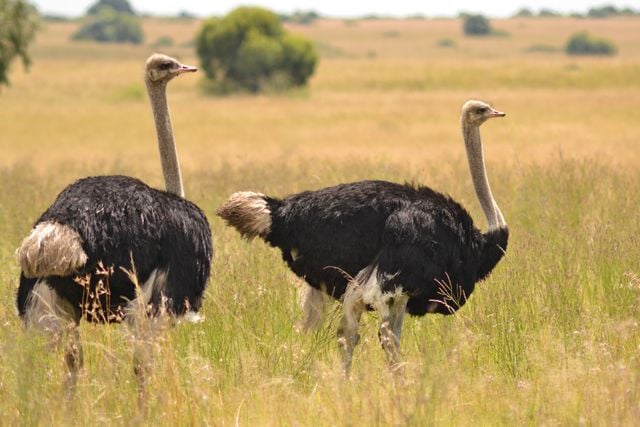
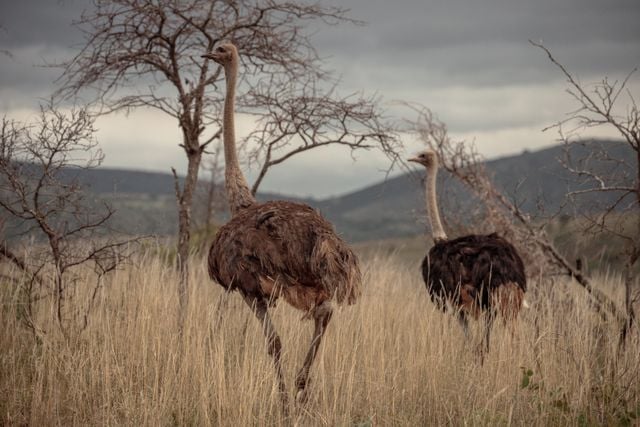
Ostriches are the largest living birds and the most familiar of all flightless species. The group contains just two species in the genus Struthio, both native to Africa, where they roam semiarid plains and open woodland on long, powerful legs tipped with only two toes per foot, an adaptation for running.
The common ostrich (Struthio camelus) is the headline act. Males can stand up to 2.8 metres (9.2 feet) tall and weigh as much as 156 kilograms (340 pounds), making this not only the largest flightless bird but the largest bird of any kind. It is also the fastest bird on land, capable of sprinting at around 70 kilometres per hour (43 miles per hour), and it lays the largest egg of any living bird, averaging about 1.4 kilograms (3 pounds). As of recent assessments the common ostrich is listed as Least Concern, reflecting its broad range across sub-Saharan Africa.
The Somali ostrich (Struthio molybdophanes), recognized as a full species by BirdLife International in 2014, is nearly as large and is distinguished by the bluish-grey skin of its neck and thighs. It is confined to the Horn of Africa and is assessed as Vulnerable, as habitat pressure and hunting have reduced its numbers.
Rheas
Rheas are the largest birds of South America and the New World counterparts to the ostrich, though they are smaller and belong to their own family, Rheidae. They favour open grassland and scrub from Brazil south into Patagonia, where their strong legs carry them at speed across wide country.
The greater rhea (Rhea americana) stands up to about 1.5 metres (5 feet) tall and weighs between roughly 20 and 40 kilograms (44 to 88 pounds). The smaller Darwin’s rhea, also called the lesser rhea (Rhea pennata), reaches around 1 metre (3.3 feet) and lives in the high, cold grasslands of the Altiplano and Patagonia. Both species are assessed as Near Threatened, with populations declining across much of their range as grassland is converted to farmland and the birds are hunted for meat, feathers, and eggs.
Emus and Cassowaries
The emu and the three cassowaries make up the family Casuariidae, large flightless birds of Australia and New Guinea with shaggy, double-layered plumage that hangs more like coarse hair than typical feathers.
The emu (Dromaius novaehollandiae) is the second tallest living bird after the ostrich, reaching up to 1.9 metres (6.2 feet) and around 60 kilograms (132 pounds). It ranges widely across mainland Australia in stable numbers and is assessed as Least Concern.
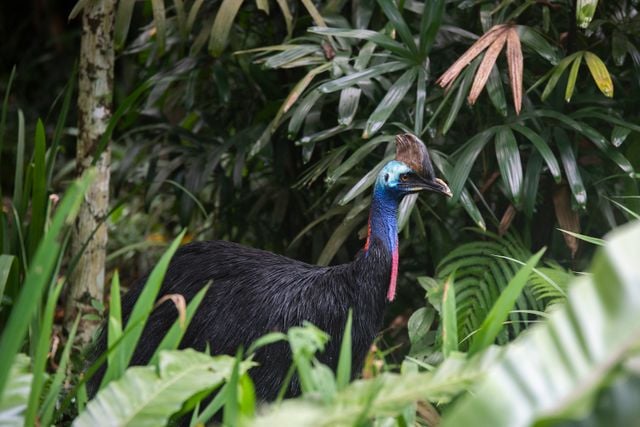
The cassowaries are the rainforest specialists. The southern cassowary (Casuarius casuarius), the largest of the three, stands roughly 1.5 to 1.8 metres (5 to 6 feet) tall and is crowned with a tall, helmet-like casque of keratin over bone. It carries a dagger-like inner claw up to about 12 centimetres (5 inches) long. The southern cassowary is sometimes sensationalized as the world’s most dangerous bird, but it is in reality a shy forest animal whose rare conflicts with people are almost always linked to wildlife feeding. Far more important is its ecological role as a keystone seed disperser, swallowing large rainforest fruits and spreading their seeds across New Guinea and northeastern Australia. The northern cassowary (Casuarius unappendiculatus) and the smaller, highland dwarf cassowary (Casuarius bennetti) round out the genus. All three are assessed as Least Concern globally, though Australia lists its southern cassowary population as endangered.
Kiwis
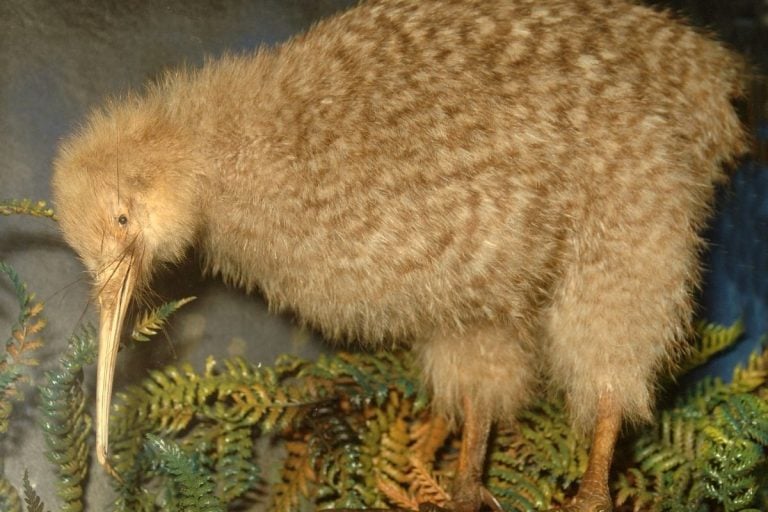
Kiwis are small, rotund, nocturnal birds endemic to New Zealand and unlike any other bird on Earth. Five species make up the genus Apteryx, ranging from about 25 to 45 centimetres (10 to 18 inches) in length. Their wings are reduced almost to nothing, their feathers are loose and hair-like, and they hunt by probing soil and leaf litter with an exceptional sense of smell, aided by nostrils placed unusually at the very tip of the long bill. Females lay an egg that is enormous in proportion to their body, among the largest relative egg sizes of any bird.
The North Island brown kiwi (Apteryx mantelli) is the most widespread and is assessed as Vulnerable. The great spotted kiwi (Apteryx haastii), the largest of the five, is also Vulnerable, while the little spotted kiwi (Apteryx owenii), the smallest at around 1 kilogram (2.2 pounds), survives mainly on predator-free reserves and is listed as Near Threatened. The rarest, the rowi (Apteryx rowi), is Critically Endangered and depends on intensive management. Across all species the central threat is the same, namely introduced stoats, cats, and dogs that prey on eggs and chicks.
Penguins
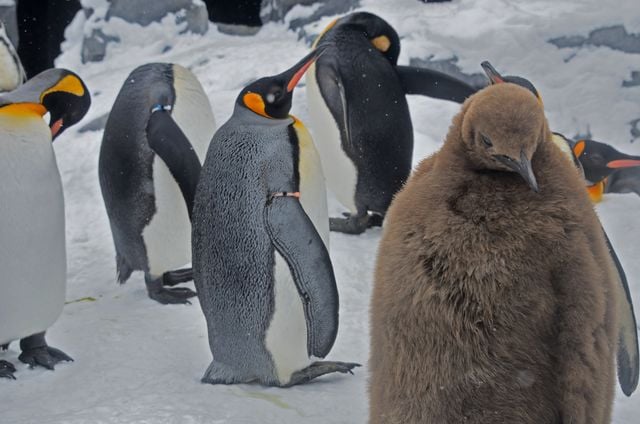
Penguins are the most thoroughly aquatic of all flightless birds, and every one of the world’s penguin species is grounded in the air while supremely capable in the sea. The International Ornithologists’ Union recognizes 18 species in the family Spheniscidae, almost all of them living in the Southern Hemisphere, with only the Galapagos penguin straying north to the equator. Their wings have become stiff flippers, their bones are dense, and their countershaded plumage camouflages them from predators above and below.
The emperor penguin (Aptenodytes forsteri) is the largest, standing around 1.1 to 1.2 metres (3.7 to 4 feet) tall and weighing up to about 40 kilograms (88 pounds). It breeds on Antarctic sea ice through the polar winter and is the world’s deepest-diving bird. The king penguin (Aptenodytes patagonicus) is the second largest and breeds on subantarctic islands in vast, noisy colonies. At the other extreme, the little penguin (Eudyptula minor) of Australia and New Zealand stands only about 30 to 33 centimetres (12 to 13 inches) tall. Conservation concern is rising across the group. The emperor penguin was uplisted to Endangered in April 2026 as shrinking Antarctic sea ice disrupts its breeding, and the African penguin (Spheniscus demersus) has been moved to Critically Endangered after steep population declines.
Flightless Rails
Rails, family Rallidae, are ground-dwelling marsh and forest birds found on nearly every landmass, and they have produced more flightless species than any other group. Again and again a flying rail has colonized a remote island, found no land predators, and over generations given up flight. This makes flightless rails both wonderfully diverse and tragically fragile.
The Inaccessible Island rail (Laterallus rogersi) is the smallest living flightless bird in the world, measuring only about 13 to 15.5 centimetres (5 to 6 inches) and weighing 34 to 49 grams (1.2 to 1.7 ounces). It lives nowhere but tiny Inaccessible Island in the South Atlantic and is assessed as Vulnerable purely because its entire population sits in one place. In New Zealand, the takahe (Porphyrio hochstetteri) is a heavy, iridescent blue-green rail once thought extinct until its dramatic rediscovery in 1948; the national population has climbed back to roughly 500 birds through decades of work. Its smaller relative the weka (Gallirallus australis) remains a familiar, inquisitive presence in parts of the country. The most celebrated rail of all may be the Guam rail (Gallirallus owstoni), known locally as the ko’ko’. Driven to extinction in the wild by the invasive brown tree snake, it became, after the California condor, only the second bird species ever brought back from Extinct in the Wild, and its status was upgraded to Critically Endangered in 2019.
Flightless Waterfowl
A small number of ducks have also abandoned flight, almost all of them in the cold coastal waters of southern South America. The standouts are the steamer ducks, genus Tachyeres, heavy-bodied sea ducks named for their habit of churning across the water surface with thrashing wings and feet, like an old paddle-wheel steamboat. Of the four species, three are flightless.
The Fuegian steamer duck, also called the flightless steamer duck (Tachyeres pteneres), is the largest and ranges along the rocky coasts from southern Chile to Tierra del Fuego. The Falkland steamer duck (Tachyeres brachypterus) measures about 61 to 74 centimetres (24 to 29 inches) and is one of only two birds endemic to the Falkland Islands. The white-headed or Chubut steamer duck (Tachyeres leucocephalus), described as recently as 1981 and endemic to a narrow stretch of Argentine coast, is the rarest and is assessed as Vulnerable. Beyond South America, New Zealand’s subantarctic Campbell teal (Anas nesiotis) is a tiny flightless duck that was feared extinct until a remnant population was found on rat-free Dent Island in 1975, then carefully bred and returned to a cleared Campbell Island.
One-of-a-Kind Flightless Birds
A final cluster of species are the lone flightless members of families that otherwise fly, each an evolutionary one-off worth knowing on its own terms.
The kakapo (Strigops habroptilus) is the world’s only flightless parrot, a nocturnal, moss-green, ground-dwelling bird sometimes called the owl parrot. It is also the heaviest parrot, weighing up to about 4 kilograms (9 pounds), and uses its short wings only to parachute down from trees. Critically Endangered and the focus of one of the most intensive recovery programmes ever attempted, its population has been nursed up from just 51 birds in 1995 to around 235 as of early 2026, according to New Zealand’s Department of Conservation, with a record breeding season that year expected to lift the count further. The flightless cormorant (Nannopterum harrisi), endemic to the Galapagos Islands, is the only one of the world’s roughly 40 cormorant species that cannot fly; at 89 to 100 centimetres (35 to 39.5 inches) it is also the largest, and a 2022 count placed its population at about 2,085 birds, with a status of Vulnerable. Finally, the Titicaca grebe (Rollandia microptera), also known as the short-winged grebe, is a flightless diver confined to Lake Titicaca and nearby Andean lakes of Peru and Bolivia, where it is assessed as Endangered, chiefly because of drowning in fishing nets.

Frequently Asked Questions
How many species of flightless birds are there?
About 60 species of flightless birds are alive today, distributed across roughly 12 bird families. Most belong to a few major groups, namely the penguins, the rails, and the ratites such as ostriches and their relatives. The exact number shifts slightly as taxonomists revise species boundaries.
What is the largest flightless bird?
The common ostrich (Struthio camelus) is the largest flightless bird and the largest living bird overall. Males can reach up to 2.8 metres (9.2 feet) in height and weigh as much as 156 kilograms (340 pounds). It is also the fastest bird on land.
What is the smallest flightless bird?
The smallest flightless bird in the world is the Inaccessible Island rail (Laterallus rogersi), which measures only about 13 to 15.5 centimetres (5 to 6 inches) and weighs as little as 34 grams (1.2 ounces). It lives solely on Inaccessible Island in the remote South Atlantic.
Why did some birds lose the ability to fly?
Birds lose flight when its high energy cost stops paying off. On predator-free islands, ground-dwelling birds face little danger and natural selection favours investing in feeding and breeding over costly flight muscles. Aquatic birds such as penguins took a different route, reshaping their wings for swimming. Because these pressures recur, flightlessness has evolved independently many times.
Where do most flightless birds live?
Flightless birds are concentrated in the Southern Hemisphere, with major populations in Africa, South America, Australia, New Guinea, Antarctica and its seas, and remote islands. New Zealand holds the greatest concentration of all, a result of its long history with almost no native land mammals. No flightless birds are native to North America.
Are flightless birds endangered?
About half of all living flightless birds are considered threatened with extinction. Their ground-bound lifestyle, often evolved in the absence of predators, leaves them acutely vulnerable to introduced mammals such as rats, cats, and stoats, as well as to habitat loss. Several, including the Guam rail and the kakapo, are also the subjects of remarkable conservation recoveries.
Conclusion
Flightless birds are not a single branch of the family tree but a recurring experiment, the same answer that evolution has reached over and over wherever flight stopped being worth its cost. That is why this group can hold the towering ostrich and the mouse-sized island rail, the deep-diving penguin and the moss-green kakapo, all at once. Each one is a record of a particular place and a particular set of pressures, written in shortened wings and strengthened legs.
It is also why these birds need us. Adapted to worlds without ground predators, they have proven heartbreakingly easy to lose, yet stories like the Guam rail and the kakapo show that careful, sustained effort can pull a species back from the edge. To go deeper, follow the links above into our fuller accounts of penguins, kiwis, the kakapo, and the other grounded birds, and consider how the simple act of noticing them is the first step toward protecting them.
Works Cited
- Cornell Lab of Ornithology, Birds of the World, Inaccessible Island Rail
- Science Advances study summarized by the authors in The Conversation, “Flightless birds were more common before human-driven extinctions”
- Current Biology, primer on “Flightless birds”
- Encyclopaedia Britannica, Emperor penguin
- Encyclopaedia Britannica, Steamer duck
- Australian Antarctic Program, Emperor penguin
- African Wildlife Foundation, Ostrich
- Galapagos Conservancy, The World’s Only Flightless Cormorant Is Endemic to Galapagos
- National Aviary, Leading the Way for a Guam Rail Comeback
- Mongabay Kids, Southern cassowary
- PMC, “Multiple losses of flight and recent speciation in steamer ducks”
- Wikipedia, Titicaca grebe
- Wikipedia, Flightless cormorant
- Wikipedia, Tallest extant birds