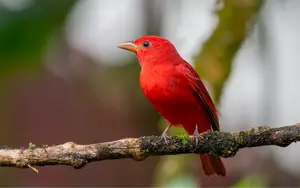
Backyard Birds in Illinois

Ask a birder from somewhere else what Illinois has, and the answer usually comes back as corn. That’s the reputation. It’s also badly incomplete. The state runs close to 400 miles from the Lake Michigan shoreline down to the cypress and tupelo swamps along the Cache River, and a warbler heading north in April crosses a surprising amount of different country to get from one end to the other.
The Illinois Ornithological Society’s official state list stood at 459 species in its 2024 update. Most of those will never come near a feeder, obviously. The backyard list is still deeper than people expect, though: cardinals and chickadees all year, juncos and White-throated Sparrows from October into April, Rose-breasted Grosbeaks stopping in for a week or two in May. Then there are the birds a feeder can’t deliver. Bald Eagles gather below the locks on the Mississippi in January. Long lines of Sandhill Cranes pass over the Chicago suburbs in late fall, calling the whole way, and people who have lived there for decades still stop in parking lots to look up.
This guide works through it roughly the way a year of watching does. It starts in the yard with the state bird, then moves out to raptors, wetlands, the scraps of prairie that are left, and the places worth the drive.
Illinois at a Crossroads: Geography and the Mississippi Flyway
The diversity of Illinois birds is no accident of geography. The state lies in the heart of the Mississippi Flyway, one of four major north–south migration routes in North America. Well-watered and uninterrupted by mountain ranges, this corridor follows the Mississippi River and funnels migrating birds between northern breeding grounds and southern wintering areas. An estimated 40 percent of the continent’s waterfowl and shorebirds travel along the flyway each year (U.S. Fish & Wildlife Service, n.d.).
The state’s habitats are equally varied. Northern Illinois is defined by the Lake Michigan shoreline, glacial wetlands, and the dense development of greater Chicago. Central Illinois is dominated by agricultural lands and the remnants of the tallgrass prairie that once covered the region. Southern Illinois grows wilder again, with the forested ridges of the Shawnee Hills, bottomland swamps, and the broad floodplains of the Mississippi, Illinois, and Ohio rivers. This range of wetland areas, wooded areas, open fields, and grassy areas gives the state plenty of habitats and explains why so many different species pass through or settle here.
The Northern Cardinal: Illinois’s State Bird

No bird is more closely tied to the state than the Northern Cardinal (Cardinalis cardinalis). Illinois schoolchildren chose the cardinal, and the General Assembly made the designation official in 1929, making Illinois the first of seven states to claim it (Illinois Department of Natural Resources, n.d.).
The male is unmistakable: bright red plumage, a pointed crest, a black face mask, and a stout reddish bill built for cracking seeds. The female wears subtler warm brown tones with red accents on the wings and tail. Both sexes carry the distinctive crest and measure roughly 7.5 to 9 inches (19 to 23 cm) in length (Illinois Department of Natural Resources, n.d.). The cardinal’s clear, whistled phrases – often rendered as cheer-cheer-cheer or birdie-birdie-birdie – ring out across neighborhoods throughout the year.
Cardinals are a common, permanent resident statewide and one of the easiest birds to attract to a yard. They do not migrate, which makes them a reliable and welcome splash of color during the gray winter months. As granivores, they favor sunflower seed but will also take fruit and insects (University of Illinois College of Veterinary Medicine, 2020).
Common Backyard Birds of Illinois
For most residents, the gateway to birding is the backyard. The common backyard birds of Illinois are a mix of year-round residents and seasonal visitors, and many will readily visit bird feeders stocked with sunflower seed, suet, and nyjer.
Year-Round Residents

Several species can be found in Illinois in every season. The Black-capped Chickadee (Poecile atricapillus) is a tiny, acrobatic favorite, easily known by its black cap and bib and its cheerful chick-a-dee-dee call. The Blue Jay (Cyanocitta cristata) is a bold, crested bird with white cheeks and striking blue, black, and white markings; these large, intelligent birds will mob hawks and owls and alert the whole neighborhood to a predator’s presence (Birdwatching Central, 2024).
Among the small birds, the House Finch (Haemorhous mexicanus) shows red on the head and breast of the male, while females are plain gray-brown with streaking. The introduced House Sparrow (Passer domesticus) and the iridescent European Starling (Sturnus vulgaris) are two of the most adaptable birds in the state, thriving wherever people live. The American Goldfinch (Spinus tristis), Illinois’s most colorful finch, turns brilliant lemon-yellow in the breeding season.
Two woodpeckers are feeder regulars. The Downy Woodpecker (Dryobates pubescens) is the smallest woodpecker in North America, a black-and-white bird with a short bill that appears on nearly every winter survey in the state. Its slightly larger relative, the Red-bellied Woodpecker (Melanerpes carolinus), shows a bold red cap and a finely barred back. Both are at home in wooded areas and suburban yards alike.
Larger residents include the American Crow (Corvus brachyrhynchos), a glossy, all-black, highly social bird known for its intelligence, and the Mourning Dove (Zenaida macroura), a soft gray-brown bird with a long, tapered tail. The Carolina Wren (Thryothorus ludovicianus), a rich rusty wren with an outsized voice, is more common in southern Illinois but has been expanding northward.
Winter Visitors
As the weather cools, a new cast arrives. The Dark-eyed Junco (Junco hyemalis), often called the “snowbird,” is a small slate-gray sparrow with a pale bill and flashing white outer tail feathers visible in flight. The American Tree Sparrow(Spizelloides arborea) and the White-throated Sparrow (Zonotrichia albicollis), the latter sporting bold white stripes on the crown and a clear Oh-sweet-Canada-Canada song, join flocks of native Song Sparrows (Melospiza melodia) feeding in brushy edges and beneath feeders.
Seasonal Songbirds
In the warmer months the chorus expands. The American Robin (Turdus migratorius), with its brick-orange breast, is a familiar sight on lawns across the state, and the Eastern Bluebird (Sialia sialis) has rebounded strongly thanks to nest-box programs, now appearing on far more winter surveys than it did a generation ago (Audubon, 2024). One species to watch warily is the Brown-headed Cowbird (Molothrus ater), a brood parasite that lays its eggs in the nests of other birds, leaving unsuspecting hosts to raise its young.
Birds of Prey

Illinois supports an impressive cast of raptors, the birds of prey that sit at the top of many food chains. They range across the state’s open areas, agricultural lands, and wooded ridges.
The most frequently seen is the Red-tailed Hawk (Buteo jamaicensis), a broad-winged, soaring hawk often perched on fence posts and highway poles along open fields. The closely related Red-shouldered Hawk (Buteo lineatus) prefers wet woodlands, while the Broad-winged Hawk (Buteo platypterus) is best known for the great migratory flocks, sometimes called “kettles”, that stream south in autumn. The Northern Harrier (Circus hudsonius) is a slim, low-coursing hawk of marshes and grasslands, identified by its white rump patch and owl-like facial disk.
Faster fliers include the Peregrine Falcon (Falco peregrinus), a powerful raptor with long, pointed wings and large eyes that was once extirpated as a breeding bird in Illinois and has since been successfully reintroduced, now nesting on city skyscrapers and river bluffs (Illinois Ornithological Society, 2024). After dark, the diminutive Northern Saw-whet Owl(Aegolius acadicus) moves through the state during migration, a secretive, robin-sized owl that often goes undetected.
Towering over them all is the Bald Eagle (Haliaeetus leucocephalus), the national bird and a conservation success story explored in detail below.
Wetland and Water Birds
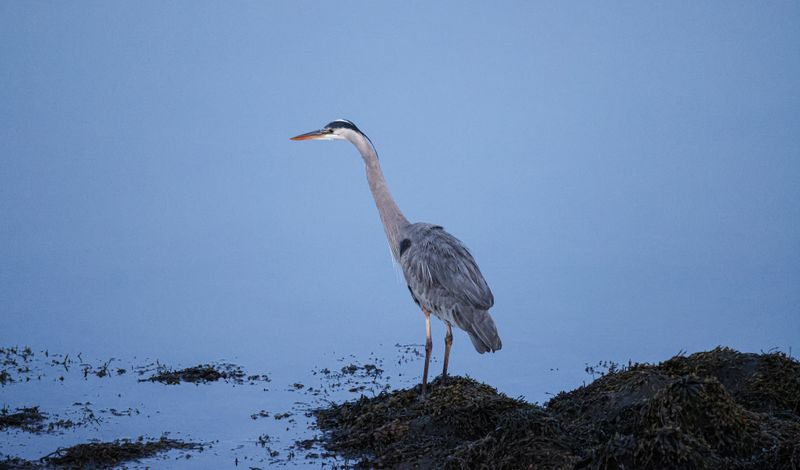
The rivers, lakes, marshes, and restored wetland habitats of Illinois host a wealth of water birds, many of which gather in large flocks during migration.
Among the most abundant of all Illinois birds is the Red-winged Blackbird (Agelaius phoeniceus). One of the first songbird migrants to return each year – often by late January or early February – the glossy black male flashes brilliant red-and-yellow shoulder patches and delivers a gurgling conk-a-ree from cattails and fence posts. Females are streaky brown and resemble large sparrows. The species is common and abundant throughout the state, nesting low among reeds in wetland areas (Wildlife Illinois, 2018).
The Great Blue Heron (Ardea herodias) is the state’s largest wading bird, a tall, slate-gray hunter that stalks fish and frogs in the shallows and nests colonially in tall trees near water. In late summer, the American White Pelican (Pelecanus erythrorhynchos) – one of North America’s largest birds, with a wingspan approaching 9 feet (2.7 m) – passes through in impressive numbers, with hundreds to several thousand staging at wetland refuges along the Illinois River (BWD Magazine, n.d.).
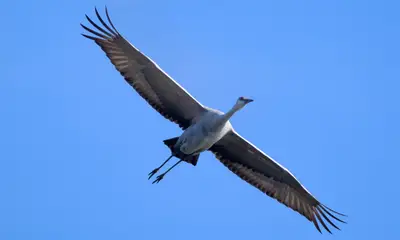
Perhaps the most stirring of the state’s water birds is the Sandhill Crane (Antigone canadensis). These ancient, long-legged birds stand up to 4 feet (1.2 m) tall with a wingspan nearing 7 feet (2.1 m), and their rolling, trumpeting calls carry for miles. Thousands migrate through Illinois from mid-September through November, and a small but growing number now breed in the wetlands of Lake and McHenry counties in the northeast (Rove.me, 2024; The Nature Conservancy, n.d.).
Woodland and Grassland Specialties

Beyond the backyard and the water’s edge, Illinois holds a number of habitat specialists worth seeking out.
The Pileated Woodpecker (Dryocopus pileatus), nearly the size of a crow with a flaming red crest, is the largest woodpecker in the state and a prize sighting in the mature forests and bottomlands of the south. It depends on dead trees, where it chisels distinctive rectangular cavities in search of carpenter ants and other small insects. In the same southern swamps lives the Prothonotary Warbler (Protonotaria citrea), a glowing golden bird of flooded forest that is one of the few warblers to nest in tree cavities.
In more open country, the Wild Turkey (Meleagris gallopavo) has made a dramatic comeback and is now a common sight at woodland edges and in agricultural lands statewide. The grasslands hold a more fragile treasure: the Greater Prairie-Chicken (Tympanuchus cupido). Once widespread, this species group of grouse now survives in Illinois only in carefully managed prairie reserves, where in spring the male prairie-chickens gather on traditional dancing grounds to boom, stamp, and inflate the orange air sacs on their necks in one of the continent’s great wildlife spectacles.
Seasonal Rhythms: Migration and the Winter Eagle Spectacle

Birding in Illinois changes dramatically with the calendar. Spring migration, peaking in May, brings a flood of warblers, vireos, and shorebirds north along the rivers and lakefront. The breeding season fills woodlands and wetlands with song from late spring into summer. Autumn reverses the flow, sending hawks, sparrows, and waterfowl south, and the cold winter months concentrate hardy residents and northern visitors at feeders and open water.
The signature winter event is the gathering of Bald Eagles along the state’s major rivers. When northern lakes freeze, eagles migrate south from Canada and the Great Lakes states to the open, turbulent water below the locks and dams of the Mississippi River, where stunned fish are easy prey. Approximately 2,000 eagles winter in the Middle Mississippi Valley, one of the largest concentrations anywhere in the continental United States, and as many as 2,500 have been counted along the river near the Quad Cities (Great River Road, n.d.; Visit Quad Cities, n.d.). Eagles weigh 8 to 14 pounds (3.6 to 6.4 kg), and an increasing number now remain to nest in Illinois year-round (WTTW, 2024).
Best Places to See Illinois Birds

The state’s state parks, national wildlife refuges, and forest preserves offer some of the best places in the Midwest to watch birds. A small sampling across the regions:
Northern Illinois and the Lake Michigan shore. The Montrose Point Bird Sanctuary in Chicago, home of the famous “Magic Hedge”, is the single most species-rich birding site in the state, with more than 350 species recorded on a peninsula jutting into Lake Michigan. Farther north, Illinois Beach State Park stretches along the shoreline to the Wisconsin border and hosts a celebrated autumn hawk watch, where observers tally Northern Harriers, Broad-winged Hawks, and Red-shouldered Hawks streaming south (Audubon, 2025). The Morton Arboretum near Lisle is another rewarding destination for woodland species.
Central Illinois. Along the Illinois River, Chautauqua National Wildlife Refuge is a magnet for migrating waterfowl, shorebirds, and American White Pelicans. Starved Rock and Matthiessen State Parks draw large eagle populations in winter, thanks to the nearby Plum Island Eagle Sanctuary, and Carlyle Lake with adjacent Eldon Hazlet State Park is a premier site for geese, ducks, and the occasional rarity.
Southern Illinois. The forested Shawnee National Forest and Giant City State Park offer breeding warblers and woodland specialties, while the bluffs at Pere Marquette State Park and the Mississippi Palisades near Savanna provide dramatic vantage points for winter eagle watching over the Mississippi River (Enjoy Illinois, n.d.). The Union County Refuge in the far south is another reliable eagle destination.
Conservation: Challenges and Successes
The story of Illinois birds is one of both loss and recovery. The greatest ongoing threat is habitat loss: the conversion of native prairie and wetland to agriculture and development has pushed grassland specialists such as the Greater Prairie-Chicken to the brink within the state, and continues to pressure many wetland and woodland species.
Yet there are powerful success stories. The Bald Eagle and the Peregrine Falcon both crashed in the mid-20th century, largely because of the pesticide DDT, which thinned their eggshells. Following the banning of DDT and decades of habitat restoration and reintroduction work, both species have rebounded dramatically and once again breed in Illinois (Wisconsin Watch, 2024; Illinois Ornithological Society, 2024). The expansion of suburban habitat has benefited adaptable birds such as the Northern Cardinal, and bluebird trail projects have helped the Eastern Bluebird recover across the state. These outcomes show that targeted conservation works and that the choices made about land and water directly shape which birds share our landscapes.
Attracting Birds to Your Yard
You do not need to travel to a refuge to enjoy Illinois birds; many of the more common birds will come to you. A few simple steps can turn an ordinary yard into a productive nesting site and feeding station:
- Offer the right food. Black-oil sunflower seed attracts the widest variety of feeder birds, including cardinals, chickadees, finches, and woodpeckers. Suet draws woodpeckers in cold weather, and nyjer (thistle) seed is a favorite of American Goldfinches. Seed scattered on the ground or on a platform feeder will bring in juncos, sparrows, and doves.
- Provide cover and water. Dense shrubs give small birds shelter from predators and weather, and a clean, reliable source of water attracts species that may never visit a feeder.
- Plant native species. Native trees and shrubs supply the insects, fruit, and natural seed that birds depend on, and they support the cup-shaped nest sites many songbirds prefer.
- Keep cats indoors and make windows visible. These two simple measures dramatically reduce the leading human-related causes of backyard bird deaths.
Consistency matters: birds quickly learn where reliable food and water can be found, and a well-tended yard can host dozens of species across the seasons.
A Year of Illinois Birds, Start to Finish
Once someone has watched through a full year here, it starts to have a shape. January is eagles on the river and juncos under the feeder. Late April and May are the hectic weeks, when the Magic Hedge at Montrose Point can hold more warbler species in one morning than a suburban yard sees all year. Summer settles down into Indigo Buntings singing from power lines and Dickcissels buzzing from roadside fences downstate. Then October brings the cranes back overhead and the sparrows back into the brush piles.
None of that requires a trip. Plenty of Illinois birders never go farther than a feeder on the back deck and a patch of coneflower beside it, and they still see the seasons turn through whatever shows up. The ones who do start driving tend to go to the same few places first, for good reason: the river bluffs at Alton or Starved Rock in winter, Midewin National Tallgrass Prairie in June, the lakefront in May.
The comebacks are worth remembering too. Within living memory Bald Eagles had nearly disappeared as a nesting bird in the state, and Peregrine Falcons were gone entirely; today peregrines raise young on Chicago buildings. Grassland birds haven’t had that kind of turnaround, and they are the ones that most need prairie put back on the ground. A strip of little bluestem left standing through the winter isn’t much. It still counts.
Works Cited
Audubon. (2024, January 19). The 123rd Christmas Bird Count in Illinois. National Audubon Society. https://www.audubon.org/news/123rd-christmas-bird-count-illinois
Audubon. (2025, April 22). Birding in Illinois. National Audubon Society. https://www.audubon.org/magazine/birding-illinois
Birdwatching Central. (2024, February 6). 35 backyard birds in Illinois. https://birdwatchingcentral.com/backyard-birds-in-illinois/
BWD Magazine. (n.d.). Ten bird watching hotspots in Illinois. Bird Watcher’s Digest. https://bwdmagazine.com/travel/regions/ten-bird-watching-hotspots-illinois/
Enjoy Illinois. (n.d.). See Illinois’ bald eagles in winter. Illinois Office of Tourism. https://www.enjoyillinois.com/plan-your-trip/seasonal-adventures/winter-in-illinois/see-illinois-bald-eagles-in-winter/
Great River Road. (n.d.). Visitors guide to bald eagles. https://www.greatriverroad.com/eagle-index
Illinois Department of Natural Resources. (n.d.). Northern cardinal. https://dnr.illinois.gov/education/wildaboutpages/wildaboutbirds/wildaboutbirdscardinals/wabnortherncardinal.html
Illinois Ornithological Society. (2024). The birds of Illinois (Illinois Ornithological Records Committee state list, through July 2024). https://www.illinoisbirds.org/the-birds-of-illinois/
Rove.me. (2024, September 5). Sandhill crane migration in Illinois. https://rove.me/to/illinois/sandhill-crane-migration
The Nature Conservancy. (n.d.). Sandhill crane. https://www.nature.org/en-us/get-involved/how-to-help/animals-we-protect/sandhill-crane/
University of Illinois College of Veterinary Medicine. (2020, December 14). The northern cardinal: Illinois state bird. https://vetmed.illinois.edu/vetmed-wildlife-blog/the-northern-cardinal-illinois-state-bird/
U.S. Fish & Wildlife Service. (n.d.). Birding at Upper Mississippi River National Wildlife and Fish Refuge. https://www.fws.gov/refuge/upper-mississippi-river/visit-us/activities/birding
Visit Quad Cities. (n.d.). Bald eagle watching. https://visitquadcities.com/things-to-do/get-outdoors/bald-eagle-watching
Wildlife Illinois. (2018, October 26). Blackbirds. University of Illinois Extension. https://wildlifeillinois.org/identify-wildlife/blackbirds/
Wisconsin Watch. (2024, March 15). Upper Mississippi River eagle watching: How to get the best views. https://wisconsinwatch.org/2024/03/mississippi-river-bald-eagle-wisconsin-minnesota-illinois-upper-midwest/
WTTW. (2024, January 4). Look who’s here: Bald eagle watch is on in Illinois as winter population swells. https://news.wttw.com/2024/01/04/look-who-s-here-bald-eagle-watch-illinois-winter-population-swells
More Birds to Explore
- Northern Cardinal
- Water Birds In Illinois
- Night Birds In Illinois
- Large Birds In Illinois
- Small Birds In Illinois
- Common Birds In Illinois
- Herons In Illinois
- Swallows In Illinois
- Illinois Birds Of Prey
- Illinois Owl Sounds
- Doves In Illinois
- Yellow Birds In Illinois
- Black Birds In Illinois
- Red Birds In Illinois
- Blue Birds In Illinois