Small Birds of Washington State: A Field Guide to the Songbirds, Finches, and Hummingbirds You Will See
Washington state hosts a remarkable variety of small birds, from year-round chickadees and finches to seasonal hummingbirds and warblers, all drawn from a statewide checklist of 531 recorded bird species as of the Washington Bird Records Committee’s Spring 2026 report (Washington Ornithological Society). The great majority of those species are songbirds and other small landbirds, and most of the common birds you are likely to meet at a feeder, on a trail, or in a city park belong to this group.
This guide focuses on the small birds, meaning the sparrows, finches, chickadees, nuthatches, wrens, kinglets, warblers, and hummingbirds that are roughly robin-sized or smaller. Larger and water birds fall outside this guide and are covered in the broader birds of Washington hub: raptors such as the Bald Eagle and Red-tailed Hawk; waterbirds and seabirds such as the Great Blue Heron, Double-crested Cormorant, Glaucous-winged Gull, and Pigeon Guillemot; grassland birds such as the Sharp-tailed Grouse; and the corvids, including the Common Raven, American Crow, Steller’s Jay, and Black-billed Magpie. Washington sits on the Pacific Flyway, the western migratory corridor that runs from the Arctic through Mexico and Central America to South America, so its small-bird community shifts with the seasons. The state’s position also explains its diversity. A reader can move from saltwater shoreline to temperate rainforest, alpine meadow, and arid shrub-steppe within a single day, and each of those habitats supports a different set of small birds.
Key Takeaways
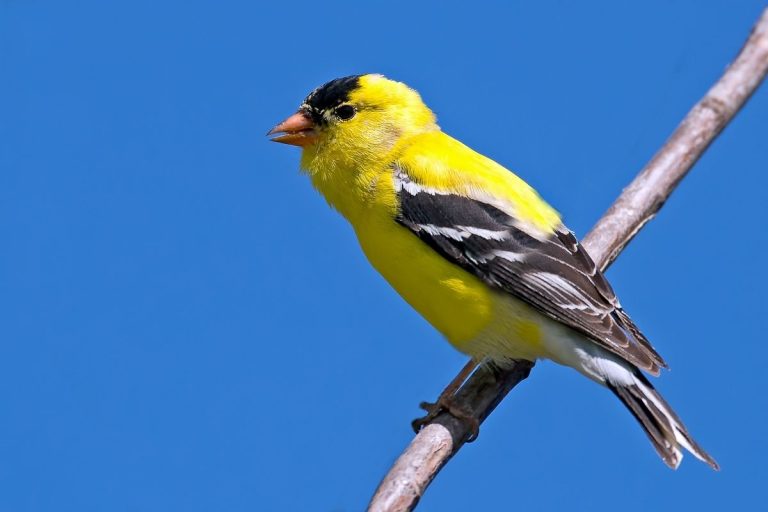
- The Washington state bird is the American Goldfinch (Spinus tristis), known locally as the Willow Goldfinch, designated by the state legislature in 1951.
- Washington’s official checklist stands at 531 species as of the Spring 2026 report from the Washington Bird Records Committee, and small landbirds make up the largest share of that list.
- The Dark-eyed Junco, Black-capped Chickadee, House Finch, and Song Sparrow are among the most frequently reported small birds at Washington feeders and yards.
- Anna’s Hummingbird now lives in western Washington year-round, while the Rufous Hummingbird returns each spring.
- Aerial insectivores such as swallows and swifts are declining sharply in the Puget Sound region, making small birds a meaningful focus for backyard conservation.
Small Birds of Washington at a Glance
The table below lists the small birds profiled in this guide along with several additional species you may encounter at bird feeders and in nearby habitat. Sizes are total length. Seasonal notes describe western Washington lowlands unless stated otherwise, and patterns differ east of the Cascade crest. The American Robin appears near the end as a size benchmark, since birders routinely describe other species as larger or smaller than a robin. The House Sparrow and European Starling are introduced invasive species, listed here only because they are common at feeders.
| Species | Scientific name | Size | When present | Where to find | Best feeder food |
|---|---|---|---|---|---|
| American Goldfinch (Willow Goldfinch) | Spinus tristis | 11 to 13 cm (4.3 to 5.1 in) | Year-round | Weedy fields, gardens, edges | Nyjer, sunflower hearts |
| House Finch | Haemorhous mexicanus | 13 to 14 cm (5.1 to 5.5 in) | Year-round | Towns, suburbs, farms | Black oil sunflower |
| Pine Siskin | Spinus pinus | 11 to 14 cm (4.3 to 5.5 in) | Mostly winter, irruptive | Conifers, feeders | Nyjer, sunflower hearts |
| Black-capped Chickadee | Poecile atricapillus | 12 to 15 cm (4.7 to 5.9 in) | Year-round | Deciduous woods, yards | Black oil sunflower, suet |
| Chestnut-backed Chickadee | Poecile rufescens | 11 to 12 cm (4.3 to 4.7 in) | Year-round | Conifer forest, yards | Sunflower, suet |
| Red-breasted Nuthatch | Sitta canadensis | About 11 cm (4.3 in) | Year-round | Conifer and mixed woods | Sunflower, suet, peanuts |
| Bushtit | Psaltriparus minimus | 11 to 12 cm (4.3 to 4.7 in) | Year-round | Shrubby edges, suburbs | Suet |
| Dark-eyed Junco | Junco hyemalis | 14 to 16 cm (5.5 to 6.3 in) | Year-round, more in winter | Yards, forest floor, edges | Millet, sunflower (ground) |
| Anna’s Hummingbird | Calypte anna | 10 cm (3.9 to 4.3 in) | Year-round | Gardens, parks, feeders | Sugar water (1 to 4) |
| Rufous Hummingbird | Selasphorus rufus | 7 to 9 cm (2.8 to 3.5 in) | Spring to late summer | Forest edges, gardens | Sugar water (1 to 4) |
| Calliope Hummingbird | Selasphorus calliope | 7 to 9 cm (2.8 to 3.5 in) | Spring to summer, eastside | Mountain meadows, foothills | Sugar water (1 to 4) |
| Song Sparrow | Melospiza melodia | 12 to 17 cm (4.7 to 6.7 in) | Year-round | Brushy wetlands, yards | Millet, sunflower (ground) |
| White-crowned Sparrow | Zonotrichia leucophrys | 15 to 16 cm (5.9 to 6.3 in) | Year-round to winter | Hedgerows, open edges | Millet, mixed seed (ground) |
| Golden-crowned Sparrow | Zonotrichia atricapilla | 15 to 18 cm (5.9 to 7.1 in) | Fall to spring | Thickets, gardens | Millet, mixed seed (ground) |
| Spotted Towhee | Pipilo maculatus | 17 to 21 cm (6.7 to 8.3 in) | Year-round | Dense brush, yard edges | Sunflower, millet (ground) |
| Pacific Wren | Troglodytes pacificus | 10 to 11 cm (3.9 to 4.3 in) | Year-round | Damp conifer forest | Rarely visits feeders |
| Bewick’s Wren | Thryomanes bewickii | 13 to 14 cm (5.1 to 5.5 in) | Year-round | Brushy yards, thickets | Suet, mealworms |
| Golden-crowned Kinglet | Regulus satrapa | 8 to 11 cm (3.1 to 4.3 in) | Year-round | Conifer forest | Rarely visits feeders |
| Ruby-crowned Kinglet | Corthylio calendula | 9 to 11 cm (3.5 to 4.3 in) | Fall to spring | Woods, shrubby edges | Suet (occasional) |
| Brown Creeper | Certhia americana | 12 to 14 cm (4.7 to 5.5 in) | Year-round | Mature conifer trunks | Suet (occasional) |
| Yellow-rumped Warbler | Setophaga coronata | 12 to 14 cm (4.7 to 5.5 in) | Spring and fall, some winter | Woods, edges, shorelines | Suet |
| Black-throated Gray Warbler | Setophaga nigrescens | 11 to 13 cm (4.3 to 5.1 in) | Spring to summer | Oak and mixed woods | Rarely visits feeders |
| Wilson’s Warbler | Cardellina pusilla | 10 to 12 cm (3.9 to 4.7 in) | Spring to summer | Willow thickets, riparian | Rarely visits feeders |
| Cedar Waxwing | Bombycilla cedrorum | 14 to 17 cm (5.5 to 6.7 in) | Year-round, wanders | Fruiting trees, edges | Fruit, not seed feeders |
| Black-headed Grosbeak | Pheucticus melanocephalus | 18 to 19 cm (7.1 to 7.5 in) | Spring to summer | Mixed woods, yards | Sunflower |
| Violet-green Swallow | Tachycineta thalassina | 13 to 14 cm (5.1 to 5.5 in) | Spring to summer | Open sky, towns, cliffs | Insects only |
| Barn Swallow | Hirundo rustica | 15 to 19 cm (5.9 to 7.5 in) | Spring to summer | Fields, barns, water | Insects only |
| Downy Woodpecker | Dryobates pubescens | 14 to 17 cm (5.5 to 6.7 in) | Year-round | Woods, yards | Suet, sunflower |
| Brown-headed Cowbird | Molothrus ater | 19 to 22 cm (7.5 to 8.7 in) | Spring to summer | Open and edge habitat | Mixed seed (ground) |
| Red-winged Blackbird | Agelaius phoeniceus | 17 to 23 cm (6.7 to 9.1 in) | Year-round, flocks in winter | Marsh edges, wet fields | Mixed seed (ground) |
| Hairy Woodpecker | Dryobates villosus | 18 to 26 cm (7.1 to 10.2 in) | Year-round | Mature wooded areas | Suet, sunflower, peanuts |
| House Sparrow (introduced) | Passer domesticus | 15 to 17 cm (5.9 to 6.7 in) | Year-round | Towns, farms, feeders | Mixed seed |
| European Starling (introduced) | Sturnus vulgaris | 20 to 23 cm (7.9 to 9.1 in) | Year-round | Towns, fields, lawns | Suet, mixed seed |
| American Robin (size benchmark) | Turdus migratorius | 20 to 28 cm (7.9 to 11 in) | Year-round | Lawns, wooded areas, parks | Fruit, mealworms |
Why Washington Holds So Many Small Birds
Washington’s small-bird diversity is a direct product of its geography. The Cascade Range divides the state into a wet, forested west and a drier east, and that single divide creates two very different bird communities. West of the crest, marine air feeds dense coniferous forests, the evergreen forests of the Olympic temperate rainforest, and the wooded areas and lowlands around Puget Sound. East of the crest lie ponderosa pine forests, the shrub-steppe of the Columbia Basin, and the channeled scablands, all of which support birds adapted to open, arid country.
The state also lies along the Pacific Flyway, one of the four major migratory routes in North America, which the National Audubon Society describes as extending from Arctic breeding grounds south to Latin America. Each spring and fall, this corridor funnels migrant songbirds, including warblers, sparrows, and hummingbirds, through Washington’s valleys and shorelines. Some of these travelers, such as the Rufous Hummingbird, trace a loop up the Pacific coast in spring and back along the Rocky Mountains in late summer, while others follow the Columbia River corridor through the state’s interior. The result is a small-bird community that is partly resident and partly seasonal, with the cast of characters at any feeder or trail changing noticeably across the year.
Washington’s State Bird: The American Goldfinch
Washington’s state bird is the American Goldfinch (Spinus tristis), adopted by the state legislature in 1951 and codified in state law as the official bird of Washington. Schoolchildren first voted for it, and the choice has stuck for more than seven decades.

The American Goldfinch is a small finch, roughly 11 to 13 cm (4.3 to 5.1 in) long and weighing only 11 to 20 g (0.4 to 0.7 oz). Breeding males are unmistakable, with a bright lemon-yellow body, black wings marked by white wing bars, and a small black cap. Females and winter birds are a softer olive to buff, which can puzzle new birders who expect the summer gold year-round. The flight is distinctive, a bouncing, undulating path often accompanied by a sweet call sometimes rendered as po-ta-to-chip.
Washington traditionally calls this bird the Willow Goldfinch, a name that traces to an older taxonomy. The Pacific Coast population was once treated as the subspecies Spinus tristis salicamans, with the species name drawn from the Latin for willow. Modern taxonomy folds that subspecies back into the single species American Goldfinch, so Willow Goldfinch and American Goldfinch refer to the same bird. Goldfinches favor weedy fields, gardens, and roadside edges, and they readily visit feeders stocked with nyjer or sunflower hearts. They nest unusually late in the season, weaving a compact cup-shaped nest timed to the midsummer abundance of seeds.
Common Backyard and Feeder Birds
These are the small birds most Washington residents see first, because they live alongside people and visit feeders throughout the year.
House Finch (Haemorhous mexicanus)
The House Finch is one of the most widespread feeder birds in Washington towns and suburbs. It measures about 13 to 14 cm (5.1 to 5.5 in) long. Males show variable red on the head, throat, and chest, while females and young birds are plain brown with blurry streaking below. The red comes from pigments in the bird’s diet, so its intensity varies from bird to bird.

House Finches are gregarious and noisy, often gathering in small flocks that move between feeders, rooflines, and shrubs. Their song is a long, warbling jumble that ends in a buzzy note. They eat mostly seeds, buds, and fruit, and they take readily to black oil sunflower at feeders. Because they congregate, they are also among the species most affected by feeder-borne disease, which makes feeder hygiene especially important where House Finches are common.
Pine Siskin (Spinus pinus)
The Pine Siskin is a small, streaky finch with yellow edging in the wings and tail and a sharp, pointed bill. It runs about 11 to 14 cm (4.3 to 5.5 in) long. Siskins are easy to overlook as just another brown finch until they flash that yellow in flight or give their rising, buzzy zzzreeee call.

Siskins are irruptive, meaning their numbers swing dramatically from year to year depending on the conifer seed crop in the boreal forest. In some winters they flood Washington feeders in large flocks, and in others they are scarce. They favor nyjer and sunflower hearts and often feed alongside goldfinches. Their habit of crowding feeders in big numbers makes them particularly vulnerable to salmonellosis, the disease behind statewide feeder advisories in recent years.
Black-capped Chickadee (Poecile atricapillus)
The Black-capped Chickadee is a small, round, active bird with a black cap and bib, white cheeks, and soft gray and buff underparts. It measures about 12 to 15 cm (4.7 to 5.9 in). Its clear, whistled fee-bee song and scolding chick-a-dee-dee-deecall are among the most familiar sounds in lowland Washington.

This chickadee favors deciduous and mixed woods, parks, and wooded yards, mostly in the lowlands and at lower elevations. It is a confiding feeder bird that takes black oil sunflower and suet, often grabbing a single seed and flying off to open it elsewhere. Chickadees readily use nest boxes, which makes them an easy and rewarding species for backyard birders to support.
Chestnut-backed Chickadee (Poecile rufescens)
The Chestnut-backed Chickadee is the conifer-loving cousin of the Black-capped, and the two often occur in the same neighborhoods. It is slightly smaller, about 11 to 12 cm (4.3 to 4.7 in), with a rich chestnut back and flanks that set it apart at a glance. Its calls are higher, faster, and more sibilant than those of the Black-capped Chickadee.
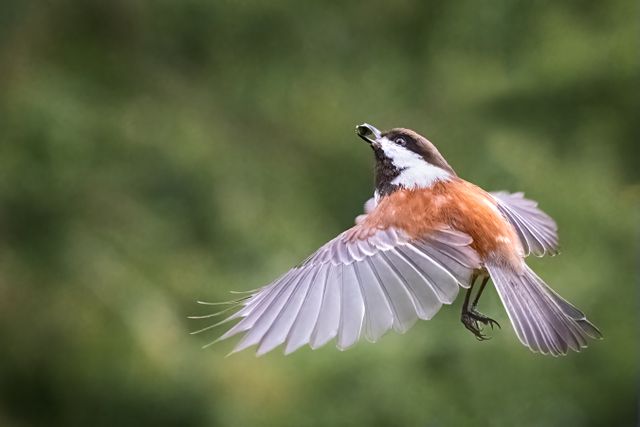
This species is most at home in the moist coniferous forests west of the Cascades and along the coast, though it readily visits feeders in wooded suburbs. Like other chickadees, it travels in mixed flocks in winter, often with kinglets, nuthatches, and creepers. It accepts sunflower seed and suet and will use nest boxes placed in or near conifers. It lines its nest cavity with large amounts of fur gathered from small mammals such as deer, rabbits, and coyotes, even fashioning a fur flap to cover the eggs when the adult leaves.
Red-breasted Nuthatch (Sitta canadensis)
The Red-breasted Nuthatch is a compact, short-tailed bird that creeps headfirst down tree trunks, a habit that separates nuthatches from most other small birds. It is about 11 cm (4.3 in) long, with a blue-gray back, rusty underparts, and a bold black eyeline under a white brow. Its nasal, tin-horn yank yank call carries well through conifer forest.

This nuthatch is a year-round resident of conifer and mixed woods across the state, and its numbers in the lowlands rise in irruption winters. It eats insects and conifer seeds and is a frequent visitor to feeders offering sunflower, peanuts, and suet. Red-breasted Nuthatches nest in cavities and smear sticky conifer resin around the entrance, apparently to deter predators and competitors.
Bushtit (Psaltriparus minimus)
The Bushtit is one of the smallest and lightest songbirds in Washington. These tiny gray birds, about 11 to 12 cm (4.3 to 4.7 in) long, have long tails and stubby bills. Individually they are plain and easy to miss, but they move in small groups that often swell into large groups of twenty or more, sweeping through shrubs and trees in a loose, restless, twittering wave.
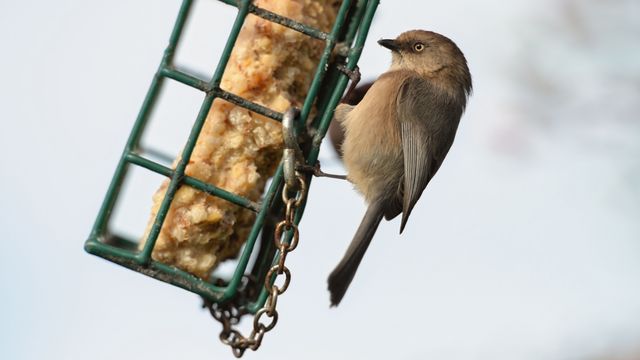
Bushtits are common in shrubby edges, gardens, and suburbs in the lowlands west of the Cascades and in parts of the east. They glean small insects and spiders from foliage and will come to suet feeders, sometimes mobbing them in a cluster. Their pendulous, sock-shaped hanging nest, woven from spider silk, moss, and lichen, is among the most remarkable structures built by any small bird in the state.
Dark-eyed Junco (Junco hyemalis)
The Dark-eyed Junco is among the most frequently reported small birds at Washington feeders, especially in winter. It is a tidy sparrow about 14 to 16 cm (5.5 to 6.3 in) long. The form most common in Washington, often called the Oregon Junco, shows a dark hood, warm brown back and flanks, and a pink bill, with white outer tail feathers that flash in flight.

Juncos forage mostly on the ground, hopping beneath feeders to take spilled seed, and they prefer millet and sunflower offered low or scattered on the ground. They breed in forests and at higher elevations, then spread into yards and lowland edges in large numbers during the winter months. The Dark-eyed Junco is treated as a single species that includes several distinctly plumaged regional forms, a point worth noting because field guides may still show the older group names.
Hummingbirds
Washington supports a small set of hummingbirds, and two of them are common enough that most residents will encounter them.
Anna’s Hummingbird (Calypte anna)
Anna’s Hummingbird is the hummingbird most likely to appear at a western Washington feeder in any month, because it now lives in the region year-round. It is a stocky hummingbird about 10 cm (3.9 to 4.3 in) long. Males show an iridescent rose-pink throat and crown that can look black until the light catches it, while females are green above and grayish below with a small central throat patch.
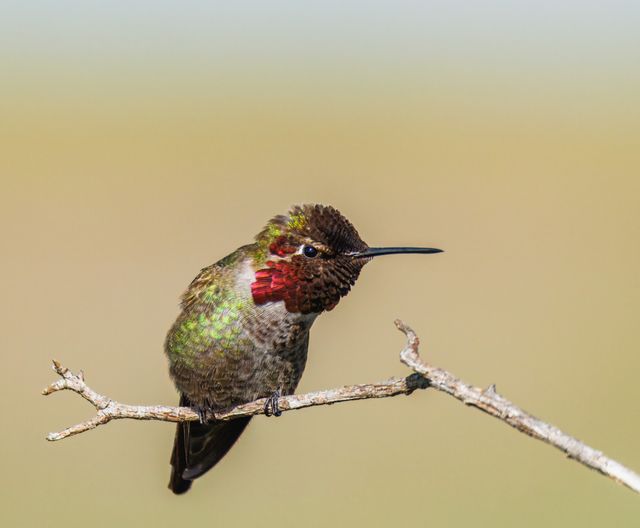
According to the Cornell Lab of Ornithology and the National Park Service, Anna’s Hummingbird expanded north from California beginning in the mid-twentieth century, aided by ornamental flowering plants and year-round feeders. Now a year-round resident of gardens, city parks, and suburban areas, it survives cold nights by entering torpor, a deep, temporary drop in metabolism and body temperature. A clean feeder with a one-to-four sugar-to-water solution, kept from freezing in winter, will reliably draw this species.
Rufous Hummingbird (Selasphorus rufus)
The Rufous Hummingbird is the fiery seasonal counterpart to the resident Anna’s. It is tiny, about 7 to 9 cm (2.8 to 3.5 in) long. Adult males are bright copper-orange with a glittering orange-red throat, while females are green above with rufous flanks and a spotted throat. This species is famously pugnacious, routinely chasing larger birds away from a favored flower patch or feeder.
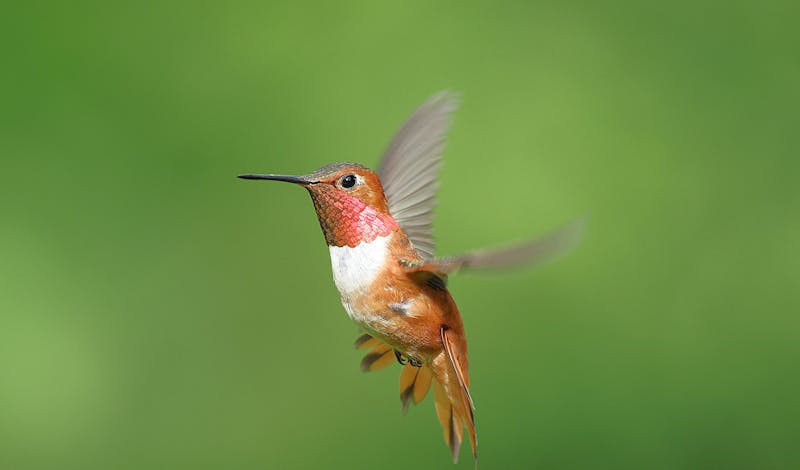
Rufous Hummingbirds return to Washington in late winter and early spring, typically appearing in lowland gardens from late February into March and spreading upslope as the season warms. They undertake one of the longest migrations relative to body size of any bird, looping between the Pacific Northwest and Mexico. Native nectar plants such as red-flowering currant, along with clean sugar-water feeders, help fuel their journey.
Sparrows and Towhees
Washington’s small brown sparrows reward a closer look, and a few are common and distinctive enough to learn quickly.
Song Sparrow (Melospiza melodia)
The Song Sparrow is a widespread, year-round resident found in brushy wetlands, hedgerows, and yard edges across the state. It measures about 12 to 17 cm (4.7 to 6.7 in), and the dark, richly colored birds of western Washington are among the larger and darker forms of this variable species. Look for heavy brown streaking that converges into a central spot on the breast.

The bird is named for its song, a bright, variable series that typically opens with a few clear notes before tumbling into a trill. Song Sparrows forage low in dense cover, scratching for seeds and insects, and they will take millet and sunflower offered on or near the ground. They build a cup nest hidden low in dense vegetation, and they are one of the most reliable singers in Washington, often heard well before they are seen.
White-crowned Sparrow (Zonotrichia leucophrys)
The White-crowned Sparrow is a clean, upright sparrow about 15 to 16 cm (5.9 to 6.3 in) long, its crown marked by bold black and white stripes and set off by a pale pink or orange bill. Young birds wear tan and brown head stripes through their first winter. The species is common in hedgerows, brushy edges, and open areas, with numbers building in migration and winter.

This sparrow has one of the most studied songs of any North American bird, a clear, whistled phrase followed by buzzy or trilled notes that varies by region as a local dialect. White-crowned Sparrows forage on the ground for seeds and insects and will visit feeders for millet and mixed seed scattered low. In western Washington, resident and migratory populations overlap, so the species can be present nearly year-round.
Golden-crowned Sparrow (Zonotrichia atricapilla)
The Golden-crowned Sparrow is a close relative of the White-crowned and a classic Washington winter bird. It is a large sparrow, about 15 to 18 cm (5.9 to 7.1 in) long, with a dusky bill and, in breeding plumage, a black crown framing a golden-yellow forecrown. Winter birds are duller, showing a muted yellow wash on the forehead and a grayer face.
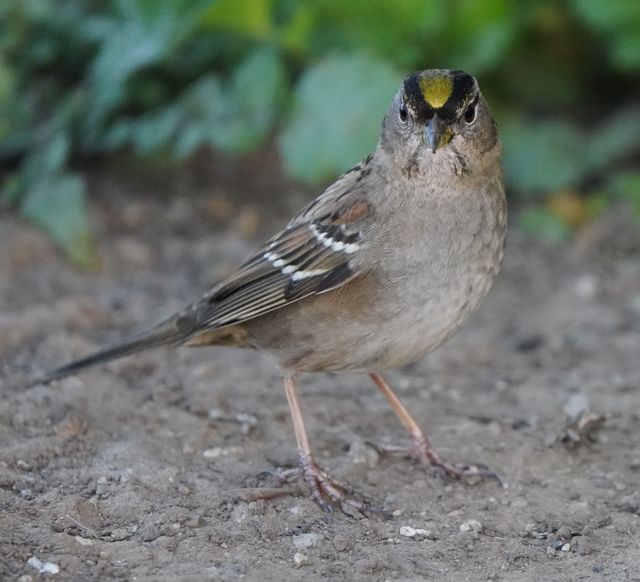
This sparrow breeds far to the north and arrives in Washington in fall, wintering in thickets, gardens, and woodland edges before departing in spring. Its plaintive, descending three-note whistle, often described as oh dear me, is a familiar sound of the cool season. Golden-crowned Sparrows forage on the ground and readily join other sparrows beneath feeders stocked with millet and mixed seed.
Spotted Towhee (Pipilo maculatus)
The Spotted Towhee is a large, boldly marked member of the sparrow family, about 17 to 21 cm (6.7 to 8.3 in) long. Males have a black head and hood and a back spangled with white spots, rufous sides, a white belly, and striking red eyes. The bird is often heard before it is seen, giving a rising, raspy zhreee call or a buzzy, trilled song from deep cover.
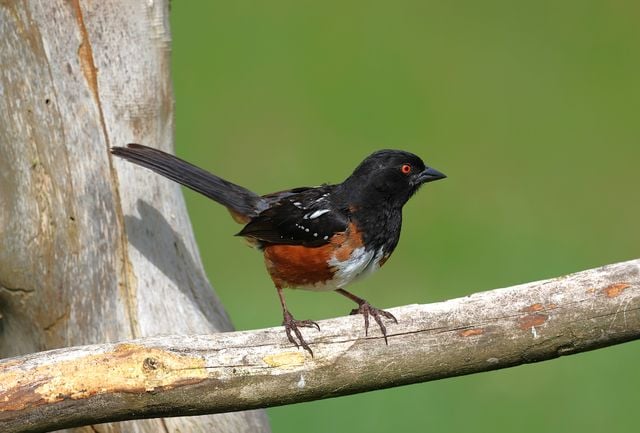
Towhees forage on the ground with a distinctive two-footed backward hop that kicks aside leaf litter to expose seeds and insects. They favor dense brush, blackberry tangles, dense vegetation, and shrubby yard edges throughout much of the state and are year-round residents in the lowlands. They will come to ground-level feeders offering sunflower and millet, usually staying close to protective cover.
Woodland Small Birds
Some of Washington’s smallest and most characteristic songbirds are creatures of the forest, more often heard than seen.
Pacific Wren (Troglodytes pacificus)
The Pacific Wren is a tiny, dark, round-bodied wren about 10 to 11 cm (3.9 to 4.3 in) long, with a stubby cocked tail and intricate brown barring. It lives low in the damp, mossy understory of conifer forests, slipping mouse-like through root tangles and fallen logs. For its size, it produces an astonishingly long and complex song, a rapid cascade of high trills that can last several seconds.
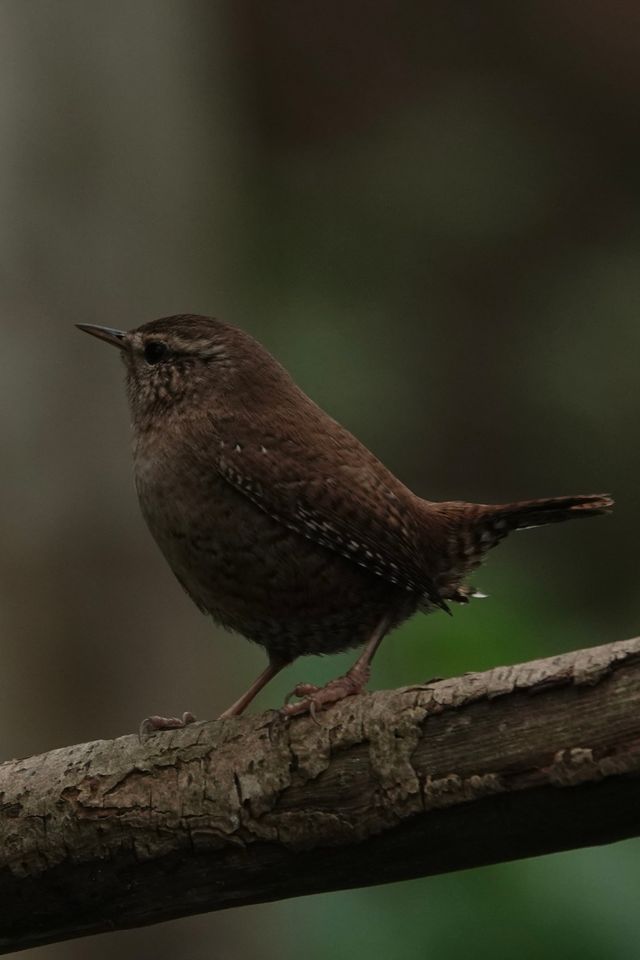
This species is a signature bird of the wet forests west of the Cascades, including the Olympic rainforest, and it occurs in suitable montane forest elsewhere in the state. It feeds almost entirely on insects and spiders gleaned from the forest floor and rarely visits feeders. A reader is far more likely to track one down by following its ringing song into the shadows than to spot it in the open.
Golden-crowned Kinglet (Regulus satrapa)
The Golden-crowned Kinglet is one of the smallest birds in Washington, about 8 to 11 cm (3.1 to 4.3 in) long and weighing only a few grams. It is olive-gray with bold wing bars and a black-bordered crown stripe that is yellow in females and yellow-and-orange in males. Its presence is often given away by thin, very high see-see-see notes drifting down from the conifer canopy.

This kinglet is a year-round resident of coniferous forests, remarkable for surviving Washington’s cold months on a diet of tiny insects and their eggs. It forages restlessly in the outer foliage, often hovering briefly to glean prey, and it joins mixed-species flocks with chickadees and nuthatches in winter. Its close relative the Ruby-crowned Kinglet, now placed in the genus Corthylio, is a common cool-season visitor to lower, shrubbier habitats.
A Notable Migrant: Yellow-rumped Warbler (Setophaga coronata)
The Yellow-rumped Warbler is the warbler a Washington birder is most likely to learn first, because it is common, widespread, and present over more of the year than most warblers. It is about 12 to 14 cm (4.7 to 5.5 in) long. In all plumages it shows a bright yellow rump patch, and breeding birds add yellow on the sides and crown. Washington hosts the yellow-throated Audubon’s form, recognizable by its yellow throat.

This warbler passes through in large numbers during spring and fall migration and lingers into winter in milder lowland areas, unlike most warblers that leave entirely. It can switch from insects in the warm months to berries and waxy fruit in the cold season, a flexibility that lets it stay north when others cannot. Yellow-rumped Warblers occasionally visit suet feeders, especially in cold snaps.
Look-Alike Small Birds: Telling Them Apart
A handful of small-bird pairs cause the most confusion in Washington. The table below highlights the field marks that separate them.
| Confusing pair | Key difference | Quick field mark |
|---|---|---|
| Black-capped vs Chestnut-backed Chickadee | Back color and habitat | Chestnut-backed has a rich chestnut back and prefers conifers; Black-capped has a plain gray back |
| Pine Siskin vs House Finch (female) | Bill shape and wing color | Siskin has a sharp, pointed bill and yellow wing flashes; female House Finch has a stout bill and no yellow |
| Golden-crowned vs Ruby-crowned Kinglet | Crown and face pattern | Golden-crowned has a striped face and yellow or orange crown; Ruby-crowned has a plain face with a white eyering |
| Downy vs Hairy Woodpecker | Overall size and bill length | Downy is small with a short, stubby bill; Hairy is larger with a bill nearly as long as its head, and both wear bold white stripes and white spots |
What to See When: A Seasonal Guide
Washington’s small-bird community changes with the time of year. The table summarizes western Washington lowland patterns; timing runs later at higher elevations and differs east of the Cascades.
| Season | What is happening | Small birds to look for |
|---|---|---|
| Winter | Resident birds plus northern visitors crowd feeders | Dark-eyed Junco, Golden-crowned Sparrow, Pine Siskin, Ruby-crowned Kinglet, Anna’s Hummingbird |
| Spring | Migrants return and song peaks | Rufous Hummingbird, Yellow-rumped Warbler, Wilson’s Warbler, Black-headed Grosbeak, swallows |
| Summer | Breeding season for resident and migrant songbirds | American Goldfinch, Bushtit, Black-throated Gray Warbler, Violet-green Swallow, towhees |
| Fall | Southbound migration and irruptions begin | White-crowned and Golden-crowned Sparrows, kinglets, finches, late warblers |
Where to Find Small Birds in Washington
Small birds turn up almost anywhere with cover and food, but a few well-known sites concentrate them. In the Puget Sound lowlands, Seattle’s Discovery Park and the Union Bay Natural Area, both in King County, combine forest, shrub, and shoreline edge that draw resident and migrant songbirds. The Billy Frank Jr. Nisqually National Wildlife Refuge near Olympia offers riparian and wetland edges rich in sparrows, warblers, and swallows, and the nearby coastal areas of Puget Sound concentrate migrants in spring and fall.
In southwest Washington, Ridgefield National Wildlife Refuge mixes open woodlands and wetland habitat that supports a broad small-bird community. East of the Cascades, the Wenas area is a long-celebrated destination for breeding songbirds in spring, and Turnbull National Wildlife Refuge near Spokane combines ponderosa pine and wetland habitats. The shrub-steppe of the Columbia Basin adds arid-country specialists that are scarce or absent on the wetter west side, which is one reason a complete Washington small-bird list requires birding both sides of the mountains.
How to Attract Small Birds to Your Yard
Small birds respond quickly to a yard that offers food, water, cover, and safe nesting sites. The best way to bring in the widest variety is to combine several food types at well-placed bird feeders with native plants and clean water.
For food, black oil sunflower seeds are the single most useful offering, accepted by chickadees, finches, nuthatches, and towhees. Nyjer in a fine-port feeder draws goldfinches and Pine Siskins, suet supports nuthatches, chickadees, kinglets, woodpeckers, and the occasional warbler, and millet scattered low feeds ground-foraging sparrows, juncos, and Mourning Doves. A dependable food source will also pull in larger, bolder visitors such as the Steller’s Jay. For hummingbirds, a feeder filled with a one-to-four solution of plain white sugar and water, with no dye or honey, will serve both Anna’s and Rufous Hummingbirds.
Water matters as much as food, and a clean birdbath with shallow water or a dripper will attract birds that ignore backyard feeders. Native plantings do double duty by supplying both insects and seeds. Red-flowering currant is a classic hummingbird plant for the Pacific Northwest, and native shrubs and conifers provide the cover small birds need to feel safe. Nest boxes sized for chickadees and nuthatches add breeding habitat where natural cavities are scarce.
Safe feeding is part of responsible backyard birding. During the winter of 2020 to 2021, the Washington Department of Fish and Wildlife responded to a major outbreak of salmonellosis among Pine Siskins and other finches by asking residents to take down feeders temporarily and to clean them thoroughly. The agency’s standing guidance is to clean feeders regularly with a ten percent bleach solution, keep the ground beneath them clean of spilled seed that can draw rodents and other small animals, space feeders apart, and report sick or dead birds. Keeping cats indoors is one of the most effective single actions a household can take to protect small birds.
Conservation: Why Small Birds in Washington Need Attention
Washington’s small birds include both thriving and declining species, and the trends are clearest where long-term local data exist. Research published in the journal Science in 2019 estimated that North America has lost nearly 2.9 billion breeding birds since 1970, a net decline of about 29 percent, with aerial insectivores among the hardest-hit groups. That continental picture has a distinct local signature in Washington.
Birds Connect Seattle, drawing on eighteen years of its volunteer Neighborhood Bird Project counts from 2005 to 2023, reported that aerial insectivores declined faster than any other group of landbirds in the Puget Sound region, at an average of roughly 7 percent per year, with nine of ten analyzed species trending downward. Cliff Swallows fared worst, and Barn Swallows and Vaux’s Swifts also fell steeply over the study period. At the same time, the data show that some adaptable species are increasing, with the Dark-eyed Junco rising sharply in urban areas even as the species declines overall.
The takeaway for residents is that small birds are not only enjoyable to watch but also a practical focus for conservation, and a little natural history makes the stakes clear. Backyard choices add up. Planting native vegetation, reducing pesticide use that removes the insects aerial feeders depend on, keeping cats indoors, and maintaining clean feeders all support the small-bird community at a scale that individuals can influence. Community science programs such as eBird and local bird counts also turn casual observations into the data that scientists, land managers, and decision makers use to act while there is still time.
Frequently Asked Questions
What is the most common backyard bird in Washington state?
The Dark-eyed Junco is one of the most frequently reported backyard birds in Washington, particularly in fall and winter when northern and high-elevation birds move into the lowlands. The Black-capped Chickadee, House Finch, and Song Sparrow are also consistently among the most common backyard birds across the state. These four species of birds turn up at a large share of Washington yards, though exact rankings vary by region and season.
What is the state bird of Washington?
The state bird of Washington is the American Goldfinch (Spinus tristis), known locally as the Willow Goldfinch. The state legislature adopted it as the official state bird in 1951, following a vote by schoolchildren. Males are bright yellow with black wings in summer and fade to a muted olive-brown in winter.
When do hummingbirds arrive in Washington?
Anna’s Hummingbird lives in western Washington year-round and may appear at feeders in any month. The migratory Rufous Hummingbird typically returns to lowland Washington in late winter and early spring, often from late February into March, then moves to higher elevations as the season progresses. Keeping a clean sugar-water feeder out in early spring helps catch the first returning Rufous Hummingbirds.
What is the smallest bird in Washington?
Among the smallest birds in Washington are the hummingbirds and the kinglets. The Calliope Hummingbird, which breeds in the state’s eastern mountains, is the smallest bird in the United States, and the Rufous and Anna’s Hummingbirds are only slightly larger. Among songbirds, the Golden-crowned Kinglet and the Bushtit are the tiniest, each weighing only a few grams.
What are the little brown birds at my feeder in Washington?
Small brown birds at Washington feeders are most often sparrows and finches. Ground-foraging birds with streaked breasts are usually Song Sparrows or Dark-eyed Juncos, while streaky birds with stout bills in the feeder are often female House Finches, and small streaky birds with pointed bills and yellow wing flashes are Pine Siskins. Comparing bill shape, behavior, and any yellow tones is the fastest way to tell them apart.
Conclusion
Washington’s small birds offer an accessible entry point into the state’s broader bird life, from the year-round chickadees and juncos of a suburban yard to the seasonal pulse of hummingbirds and warblers along the Pacific Flyway. The geography that splits Washington into a wet, forested west and an arid east is what gives the state its varied small-bird community, and learning a dozen common species transforms an ordinary walk or window view into something richer. Because some of these birds, especially the aerial insectivores, are declining, the simple acts of planting natives, feeding safely, and recording sightings carry real conservation weight. Readers who want to go deeper can follow this guide into companion articles on Washington’s hummingbirds, backyard feeder birds, woodpeckers such as the larger Northern Flicker, and owls, and into the broader hub on the birds of Washington, a guide to the full range of Washington birds across the state of Washington.
Works Cited
- Washington Ornithological Society. “Washington Bird Records Committee.” https://wos.org/records/
- Washington Ornithological Society. “Washington State Checklist.” https://wos.org/records/checklist/
- Washington State Legislature. “State Symbols: State Bird.” https://leg.wa.gov/learn-and-participate/educational-resources/state-symbols/bird/
- National Audubon Society. “Pacific Flyway.” https://www.audubon.org/climate/survivalbydegrees/flyway/pacific
- Cornell Lab of Ornithology, All About Birds. “Anna’s Hummingbird.” https://www.allaboutbirds.org/guide/Annas_Hummingbird/overview
- National Park Service. “Anna’s Hummingbird.” https://www.nps.gov/articles/anna-s-hummingbird.htm
- National Audubon Society. “Anna’s Hummingbird.” https://www.audubon.org/field-guide/bird/annas-hummingbird
- Birds Connect Seattle. “Aerial Insectivores in Decline: What 18 Years of Neighborhood Bird Project Data Reveals.” https://birdsconnectsea.org/2026/03/20/aerial-insectivores-in-decline-what-18-years-of-neighborhood-bird-project-data-reveals/
- Rosenberg, K. V., et al. “Decline of the North American Avifauna.” Science, 2019. https://www.science.org/doi/10.1126/science.aaw1313
- Washington Department of Fish and Wildlife. “Frequently Asked Questions on Salmonellosis in Wild Birds.” https://wdfw.medium.com/frequently-asked-questions-on-salmonellosis-in-wild-birds-cae47b1c13dd