Birds of Hawaii: A Complete Field Guide to the Birds of Kauai
Kauai, the oldest of the main Hawaiian Islands, has recorded more than 200 bird species, a figure that combines a small but globally important group of endemic forest birds with a large cast of introduced songbirds, returning migrant shorebirds, and some of the most accessible seabird colonies in the United States. Per Avibase’s Kauai checklist, which follows Clements taxonomy and was last reviewed in early 2026, roughly 214 species have been documented on the island, of which about 11 are endemic and 42 are introduced.
The island sits within the Pacific Flyway, the great north-to-south migratory corridor of the western hemisphere, and its position at the northwestern end of the inhabited Hawaiian chain shapes everything a birder sees here. Kauai is nicknamed the Garden Isle for its drenching rainfall and deep green interior, and that wet, eroded landscape, crowned by the Alakai Plateau, holds the last refuge of birds found nowhere else on Earth. This guide orients you to what lives where, when to look, and how Kauai’s birdlife fits into one of the most consequential conservation stories in modern ornithology.
Key Takeaways
- The state bird of Hawaii is the Nene, or Hawaiian Goose (Branta sandvicensis), the world’s rarest goose, which nests on Kauai at sites including Kilauea Point National Wildlife Refuge.
- Kauai has recorded roughly 214 bird species as of early 2026, according to Avibase’s island checklist, while the Hawaiian Islands as a whole hold 355 species as of 2024, per the Hawaii Bird Records Committee.
- The most common birds most visitors encounter are introduced species: the Common Myna, Zebra Dove, Red-crested Cardinal, House Finch, and the island’s famous feral Red Junglefowl.
- Kilauea Point National Wildlife Refuge is the premier birding hotspot, home to one of the largest nesting seabird populations in Hawaii, including Laysan Albatross, Red-footed Booby, and tropicbirds.
- Only eight native forest bird species survive on Kauai today, down from sixteen, and the avian malaria crisis driving that decline is the focus of an active, large-scale mosquito-control program.
At-a-Glance Species Table
| Species | Scientific name | Size | When present | Where to find | Best feeder food |
|---|---|---|---|---|---|
| Nene (Hawaiian Goose) | Branta sandvicensis | 53 to 66 cm (21 to 26 in) | Resident | Kilauea Point, refuges, grasslands | Do not feed (protected) |
| Common Myna | Acridotheres tristis | 23 cm (9 in) | Resident | Towns, parks, lawns | Not recommended (invasive) |
| Zebra Dove | Geopelia striata | 20 to 23 cm (8 to 9 in) | Resident | Lawns, sidewalks, beaches | Cracked corn, millet |
| Spotted Dove | Spilopelia chinensis | 28 to 30 cm (11 to 12 in) | Resident | Gardens, roadsides | Cracked corn, millet |
| Red-crested Cardinal | Paroaria coronata | 19 cm (7.5 in) | Resident | Parks, golf courses, yards | Mixed seed, fruit |
| Northern Cardinal | Cardinalis cardinalis | 21 to 23 cm (8.3 to 9 in) | Resident | Gardens, forest edge | Sunflower seed |
| House Finch | Haemorhous mexicanus | 13 to 14 cm (5 to 5.5 in) | Resident | Towns, dry lowlands | Sunflower, nyjer |
| Warbling White-eye | Zosterops japonicus | 11 cm (4.5 in) | Resident | Gardens, forest, scrub | Nectar, cut fruit |
| White-rumped Shama | Copsychus malabaricus | 23 to 28 cm (9 to 11 in) | Resident | Shaded valleys, forest | Not a typical feeder bird |
| Rose-ringed Parakeet | Psittacula krameri | 40 cm (16 in) | Resident | South and west lowlands | Not recommended (invasive) |
| Red Junglefowl (Moa) | Gallus gallus | Male to 70 cm (28 in) | Resident | Island-wide, even parking lots | Do not feed |
| Java Sparrow (Java rice bird) | Lonchura oryzivora | 15 to 17 cm (6 to 6.5 in) | Resident | Towns, lawns | Millet, rice |
| Scaly-breasted Munia | Lonchura punctulata | 11 cm (4.5 in) | Resident | Grassy fields, edges | Millet |
| House Sparrow | Passer domesticus | 15 to 16 cm (6 in) | Resident | Towns, shopping centers | Mixed seed |
| Western Cattle-Egret | Ardea ibis | 46 to 56 cm (18 to 22 in) | Resident | Pastures, wetlands | Not a feeder bird |
| Kauai Amakihi | Chlorodrepanis stejnegeri | 11 cm (4.3 in) | Resident (endemic) | Kokee, high forest | Not a feeder bird |
| Anianiau | Magumma parva | 10 cm (4 in) | Resident (endemic) | Alakai, high forest | Not a feeder bird |
| Apapane | Himatione sanguinea | 13 cm (5 in) | Resident (endemic) | Kokee ohia forest | Not a feeder bird |
| Iiwi | Drepanis coccinea | 15 cm (6 in) | Resident (endemic) | High Alakai forest | Not a feeder bird |
| Kauai Elepaio | Chasiempis sclateri | 14 cm (5.5 in) | Resident (endemic) | Kokee forest | Not a feeder bird |
| Akekee | Loxops caeruleirostris | 11 cm (4.5 in) | Resident (endemic, critical) | Upper Alakai only | Not a feeder bird |
| Puaiohi | Myadestes palmeri | 17 cm (7 in) | Resident (endemic, rare) | Remote Alakai streams | Not a feeder bird |
| Hawaiian Stilt (Aeo) | Himantopus mexicanus knudseni | 38 to 40 cm (15 to 16 in) | Resident | Wetlands, taro fields | Not a feeder bird |
| Koloa (Hawaiian Duck) | Anas wyvilliana | 41 to 51 cm (16 to 20 in) | Resident | Hanalei, streams, wetlands | Not a feeder bird |
| Hawaiian Coot (Alae keokeo) | Fulica alai | 33 to 39 cm (13 to 15 in) | Resident | Ponds, wetlands | Not a feeder bird |
| Hawaiian Gallinule (Alae ula) | Gallinula galeata sandvicensis | 33 cm (13 in) | Resident | Taro fields, marshes | Not a feeder bird |
| Black-crowned Night-Heron (Aukuu) | Nycticorax nycticorax | 58 to 66 cm (23 to 26 in) | Resident | Wetlands, shorelines | Not a feeder bird |
| Laysan Albatross (Moli) | Phoebastria immutabilis | 81 cm (32 in) | Nov to Jul | Kilauea Point, north shore | Not a feeder bird |
| Red-footed Booby (A) | Sula sula | 71 cm (28 in) | Resident | Kilauea Point cliffs | Not a feeder bird |
| Red-tailed Tropicbird (Koae ula) | Phaethon rubricauda | 76 to 94 cm (30 to 37 in) incl. tail | Feb to Sep | Kilauea Point | Not a feeder bird |
| White-tailed Tropicbird (Koae kea) | Phaethon lepturus | 41 cm (16 in) body | Resident | Waimea Canyon, cliffs | Not a feeder bird |
| Wedge-tailed Shearwater (Uau kani) | Ardenna pacifica | 43 cm (17 in) | Mar to Nov | Coastal cliffs, Kilauea Point | Not a feeder bird |
| Hawaiian Petrel (Uau) | Pterodroma sandwichensis | 41 cm (16 in) | Mar to Nov | Remote interior, offshore at dusk | Not a feeder bird |
| Newell’s Shearwater (Ao) | Puffinus newelli | Medium shearwater | Apr to Nov | Interior ridges, offshore | Not a feeder bird |
| Great Frigatebird (Iwa) | Fregata minor | 89 to 100 cm (35 to 39 in) | Visitor | Coastlines, Kilauea Point | Not a feeder bird |
| Pacific Golden-Plover (Kolea) | Pluvialis fulva | 23 to 28 cm (9 to 11 in) | Aug to Apr | Lawns, fields, golf courses | Not a feeder bird |
| Wandering Tattler (Ulili) | Tringa incana | 26 to 29 cm (10 to 11.5 in) | Aug to Apr | Rocky shorelines | Not a feeder bird |
| Ruddy Turnstone (Akekeke) | Arenaria interpres | 21 to 26 cm (8 to 10 in) | Aug to Apr | Beaches, mudflats | Not a feeder bird |
Why Kauai Holds the Birdlife It Does
Kauai is the geological elder of the main Hawaiian Islands, formed by a single shield volcano roughly five million years ago. Millions of years of rain, wind, and erosion have carved the island into a landscape of deep valleys, knife-edge ridges, sea cliffs, and a high interior plateau, and each of those settings supports a different community of birds.
Three broad zones organize the island’s birdlife. The lowland coast and the dry, sunny south and west, around Poipu, Waimea, and the Mana Plain, hold most of the introduced songbirds, shorebirds wintering on open ground, and the seabird cliffs of the north shore. The wet windward valleys and river mouths, especially around Hanalei and the Kawaiele and Hule’ia wetlands, support Hawaii’s endangered native waterbirds. Above roughly 1,000 meters (3,300 feet), the rainforest of Kokee and the Alakai Plateau shelters the surviving endemic forest birds.
Kauai’s birds belong to the Central Pacific portion of the Pacific Flyway. Long-distance migrants such as the Pacific Golden-Plover and several shorebird species cross open ocean from Arctic breeding grounds to winter here, while the island’s breeding seabirds range thousands of kilometers across the Pacific to feed. Because Kauai lacks the introduced mongoose that devastated ground-nesting birds on other islands, several vulnerable species persist here in numbers that are higher than elsewhere in the chain.
The State Bird: The Nene, or Hawaiian Goose

The Nene (Branta sandvicensis) is the official state bird of Hawaii and the rarest goose in the world. It is a medium-sized goose, descended from the Canada Goose, with a black face and crown, cream-colored cheeks, and a buff neck marked by deep, diagonal furrows of black-tipped feathers. The U.S. Fish and Wildlife Service identifies it as a frequent sight at Kilauea Point National Wildlife Refuge on Kauai.
The Nene is unusually terrestrial for a goose. The state Division of Forestry and Wildlife notes that it has longer legs and reduced webbing between its toes compared with other geese, adaptations that help it walk across hardened lava and rough volcanic ground. It grazes on the leaves, seeds, flowers, and fruits of at least 50 native and non-native plants, and pairs mate for life, nesting on the ground in a shallow, down-lined scrape between roughly October and March.
The Nene’s recovery is one of conservation’s landmark cases. The American Bird Conservancy records that, driven by habitat loss and introduced predators, the wild population fell to about 30 birds by the 1950s before captive breeding and reintroduction reversed the decline, and that roughly 3,800 individuals now live in the wild. On Kauai it favors open grasslands, golf courses, and other grassy areas at low elevation. The species was reclassified from endangered to threatened under the Endangered Species Act in 2019, though the IUCN still lists it as Near Threatened. On Kauai, predator-exclusion fencing at Kilauea Point protects nesting Nene alongside seabirds. Visitors should never feed Nene, and the state warns that cat food left out for feral cats poses a direct danger to them.
Common Backyard and Lowland Birds
Most birds a visitor sees on Kauai’s beaches, lawns, and roadsides are introduced species, many of them released a century ago by garden societies after native lowland songbirds had largely disappeared. They are abundant, approachable, and easy to learn, and most are small birds that thrive in urban areas, parks, and gardens.
Common Myna (Acridotheres tristis)
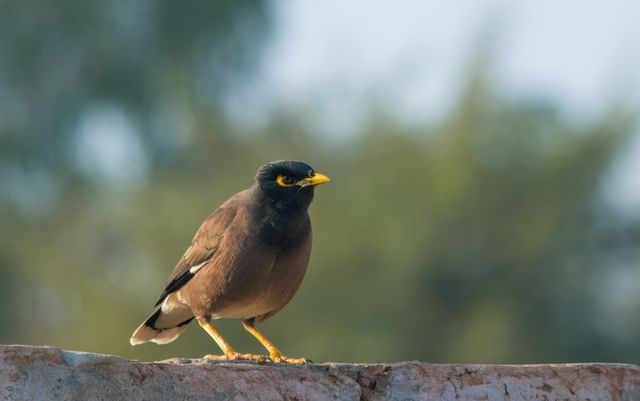
The Common Myna is a brown, robust songbird about 23 cm (9 in) long, with a glossy black head, bright yellow bill, yellow legs, and a bold yellow patch of bare skin behind the eye. White wing patches flash conspicuously in flight. It is among the most visible birds in any Kauai town. Mynas were introduced to Hawaii in the 1860s in a misguided attempt to control crop insects, and they have thrived around people ever since. They are loud, social, and intelligent, foraging in pairs or noisy flocks on lawns, in parking lots, and around outdoor dining areas.
Zebra Dove (Geopelia striata)
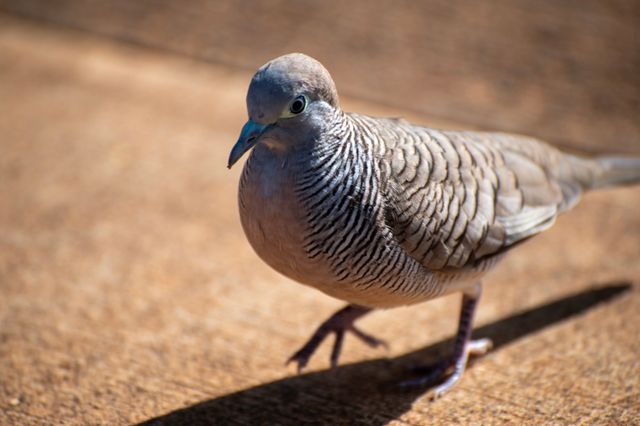
The Zebra Dove is a small, slender, ground-feeding dove roughly 20 to 23 cm (8 to 9 in) long, named for the fine black-and-white barring across its neck and breast. A close look reveals a soft blue-gray face and a faint peach wash on the underparts. Introduced from Southeast Asia in the mid-twentieth century, it is now one of the tamest and most numerous birds on the island, walking unbothered along sidewalks, café floors, and beach paths. Its gentle, rapid cooing is a constant background sound in the lowlands. Zebra Doves forage almost entirely on the ground for small seeds and will visit feeding trays offered with cracked corn or millet.
Red-crested Cardinal (Paroaria coronata)
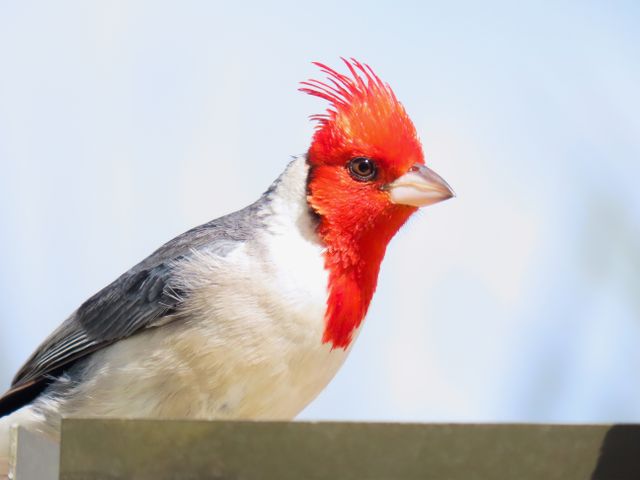
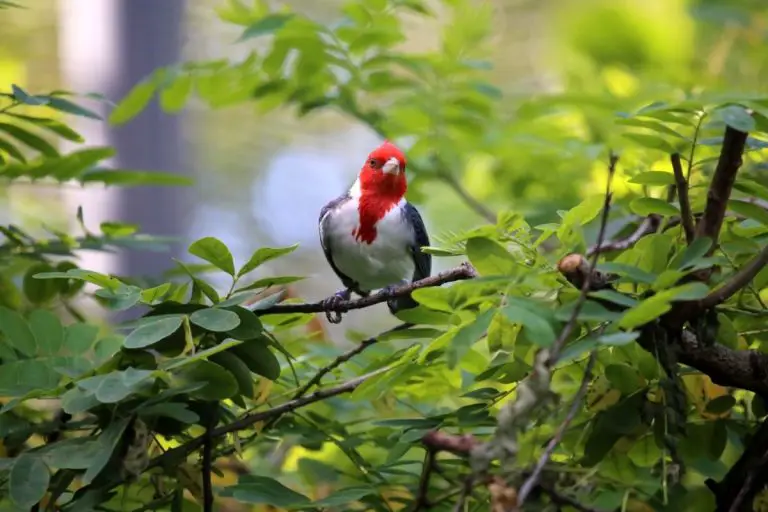
The Red-crested Cardinal is a striking bird about 19 cm (7.5 in) long, with a vivid red head and pointed crest, a gray back, and clean white underparts. It is sometimes called the Brazilian Cardinal, a nod to its South American origin. The Hui Manu Society introduced it to Kauai and Oahu around 1928 to 1931 to bring color back to gardens emptied of native songbirds. It has settled comfortably into parks, golf courses, hotel grounds, and residential neighborhoods, usually seen in pairs or small family groups hopping across short grass. It feeds on seeds, fruit, and insects, and readily takes mixed seed at feeding stations. It has not pushed strongly into native forest, which limits its impact on Kauai’s endemic birds.
Northern Cardinal (Cardinalis cardinalis)

The Northern Cardinal is a familiar North American songbird, 21 to 23 cm (8.3 to 9 in) long, introduced to the Hawaiian Islands beginning in 1929. The male is brilliant red with a black face mask and a stout orange-red bill, while the female is warm brown with red tinges on the crest, wings, and tail. Both sexes wear a prominent crest and sing rich, whistled phrases. On Kauai the Northern Cardinal favors gardens, forest edges, and brushy areas, often staying lower and more concealed than the bolder Red-crested Cardinal. It eats seeds, fruit, and insects and visits feeders stocked with sunflower seed.
White-rumped Shama (Copsychus malabaricus)
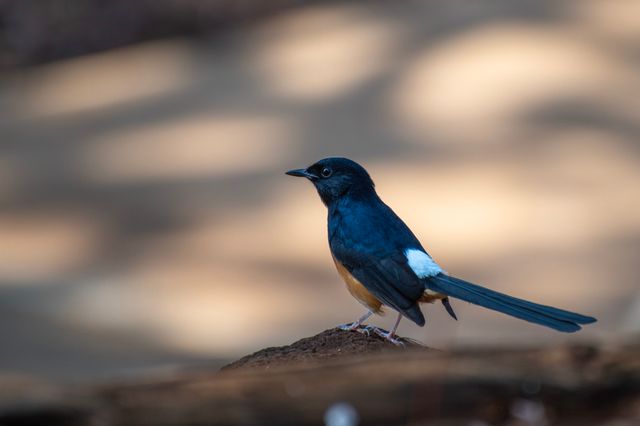
The White-rumped Shama is a slender, long-tailed songbird, roughly 23 to 28 cm (9 to 11 in) including its tail, and one of the finest singers on the island. The male has a glossy blue-black head and back, a rich chestnut breast and belly, and a white rump that flashes as it moves through shaded understory. Native to Southeast Asia, it was first released on Kauai in 1931 by garden enthusiasts seeking ornamental songbirds. It favors shaded valleys and forested gulches, where its loud, fluid, endlessly varied song carries through the trees. Its spread is a mixed blessing, since invasive songbirds can compete with native species for food and space.
Warbling White-eye (Zosterops japonicus)
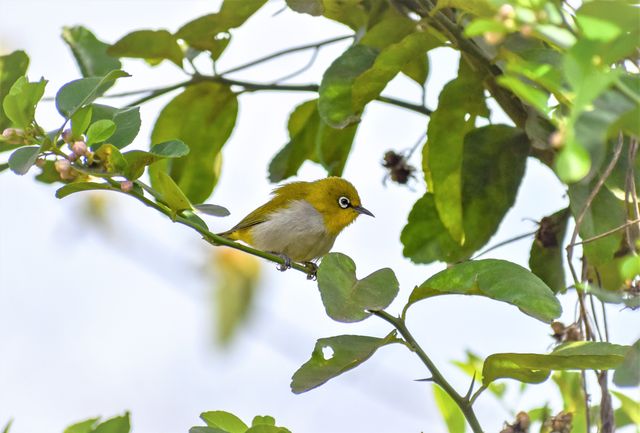
The Warbling White-eye, long known in Hawaii as the Japanese White-eye or mejiro, is a tiny, active songbird about 11 cm (4.5 in) long. It is olive-green above and paler below, with a neat ring of white feathers around each eye that gives the species its name. Introduced from East Asia in the early twentieth century, it is now one of the most numerous land birds across the Hawaiian Islands and occurs from sea-level gardens to high forest on Kauai. It moves in restless flocks, gleaning insects, sipping nectar, and taking small fruit, and its high, sweet twittering is easy to overlook.
Red Junglefowl (Gallus gallus)
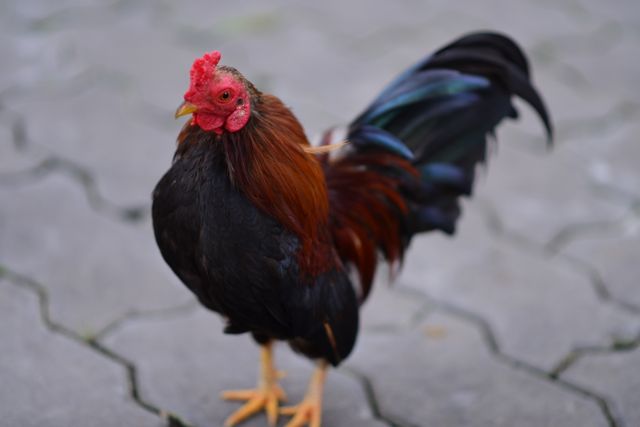
The feral chickens of Kauai are among the island’s most talked-about birds. Roosters can reach about 70 cm (28 in) in length, with iridescent copper, gold, and green-black plumage, a red comb, and long arching tail feathers, while hens are smaller and cryptically brown. These birds are descended in part from Red Junglefowl brought by Polynesian voyagers and in part from domestic chickens, and Kauai’s free-roaming flocks expanded notably after storms damaged coops in past decades. Without the mongoose found on other islands, the population has flourished here. Junglefowl turn up everywhere, from Waimea Canyon overlooks to grocery-store parking lots, scratching for seeds, insects, and scraps. The crowing of roosters, day and night, is a signature sound of the Garden Isle. Visitors should avoid feeding them, as it concentrates birds and encourages aggressive behavior.
Native Forest Birds of the Alakai
Kauai’s endemic forest birds are the rarest and most remarkable birds on the island, and the hardest to see. According to the Kauai Forest Bird Recovery Project, sixteen forest bird species once lived on Kauai, but only eight remain today, six of them found nowhere else in the world. These survivors persist in the high-elevation forests of the Kokee and Alakai region, where cooler temperatures have historically held back the mosquitoes that carry avian disease. Reaching them requires effort, patience, and a sharp ear. For a fuller treatment of all of Kauai’s honeycreepers and where to find them, see the dedicated forest-birds spoke article.
Kauai Amakihi (Chlorodrepanis stejnegeri)
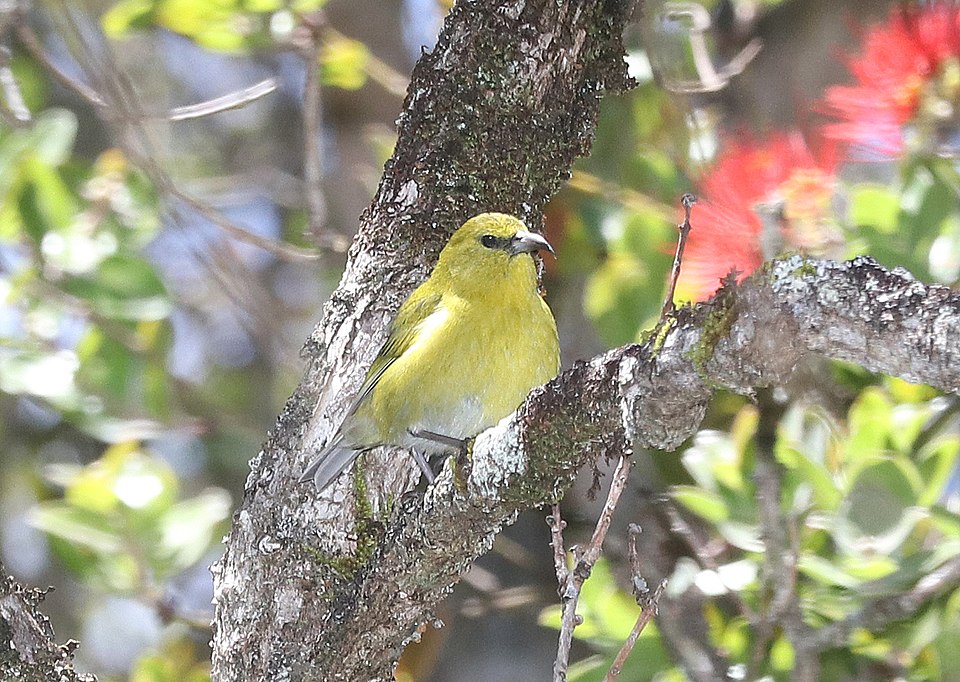
The Kauai Amakihi is a small yellow-green honeycreeper roughly 11 cm (4.3 in) long, with a slightly down-curved bill and dark lores, the area between the eye and the bill. Cornell’s All About Birds describes it as the largest and thickest-billed of the three surviving amakihi species. It forages actively through the canopy and understory, probing bark and foliage for insects and spiders and visiting ohia and other flowers for nectar. Unlike its relatives on Hawaii Island and Oahu, the Kauai Amakihi has not developed resistance to avian malaria, and it is listed as endangered by the IUCN, with a small population of a few thousand birds restricted to higher-elevation forest. Even so, it remains one of the more reliably encountered native forest birds along the trails around Kokee. Listen for its short, trilling song among the ohia.
Apapane (Himatione sanguinea)
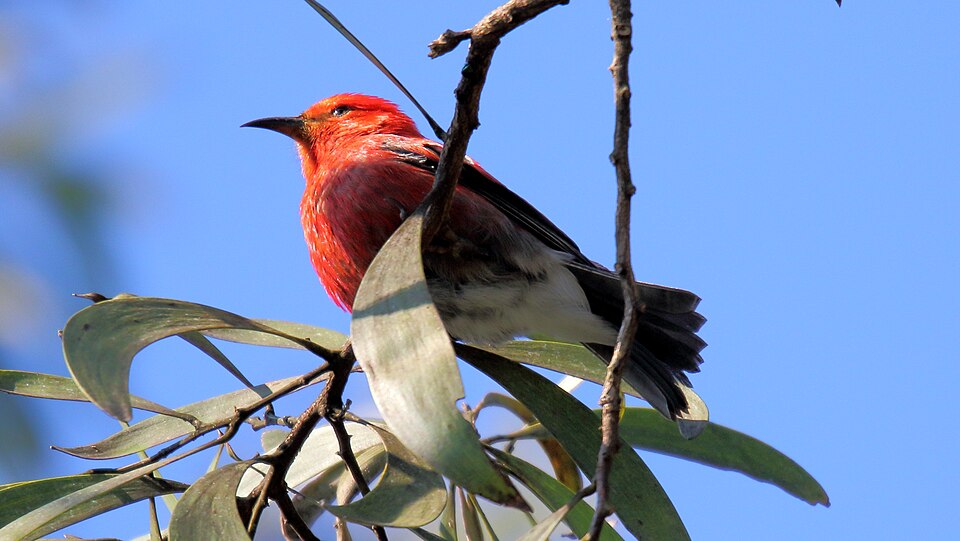
The Apapane is a crimson honeycreeper roughly 13 cm (5 in) long, with black wings and tail and a small patch of white feathers under the tail. It is the most abundant native forest bird in Hawaii and one of the two native forest species the state Division of Forestry and Wildlife considers to be of least concern. On Kauai it gathers wherever ohia trees bloom, sipping nectar from the red lehua blossoms and moving in loose, wandering flocks that track the flowering of the forest. Its wings make a distinctive whir in flight, and its varied song mixes clicks, whistles, and squeaky notes.
Iiwi (Drepanis coccinea)
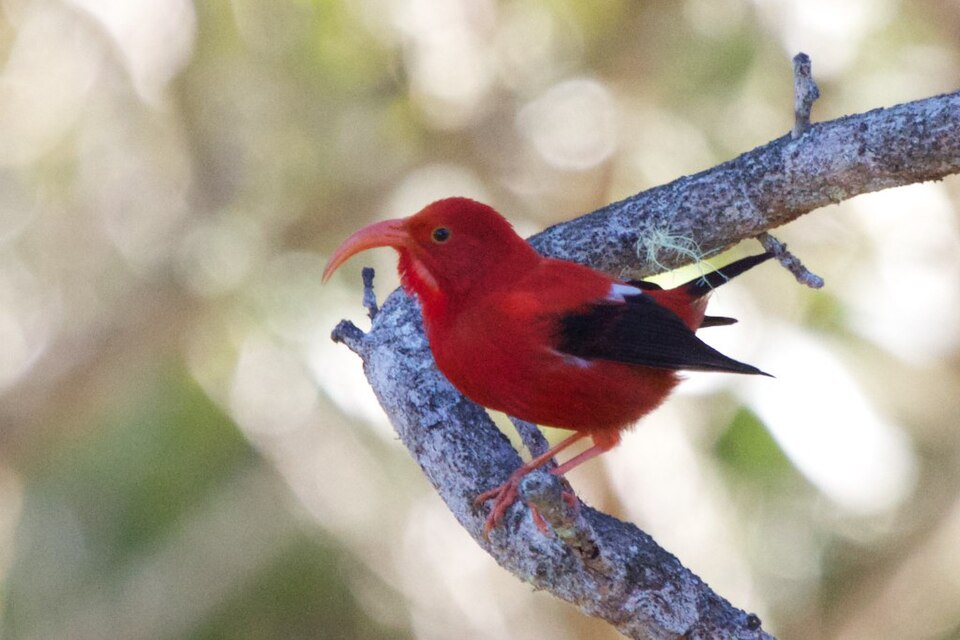
The Iiwi is among the most iconic of all Hawaiian birds, a vermilion honeycreeper about 15 cm (6 in) long with black wings, a black tail, and a long, deeply curved salmon-pink bill evolved to draw nectar from tubular native flowers. The state lists the Iiwi as threatened, and the Kauai Forest Bird Recovery Project counts it among the species it works to protect. The Iiwi is extraordinarily vulnerable to avian malaria, and on Kauai it has retreated to the highest, wettest forest of the Alakai. Its song is a remarkable medley of reedy whistles and mechanical, creaking sounds, often likened to a rusty hinge.
Water and Wetland Birds
Kauai’s wetlands, taro fields, and river valleys support several of Hawaii’s endangered endemic waterbirds. The U.S. Fish and Wildlife Service manages Hanalei National Wildlife Refuge specifically to recover these species, several of which are far easier to see here than their forest-dwelling relatives.
Hawaiian Stilt (Himantopus mexicanus knudseni)
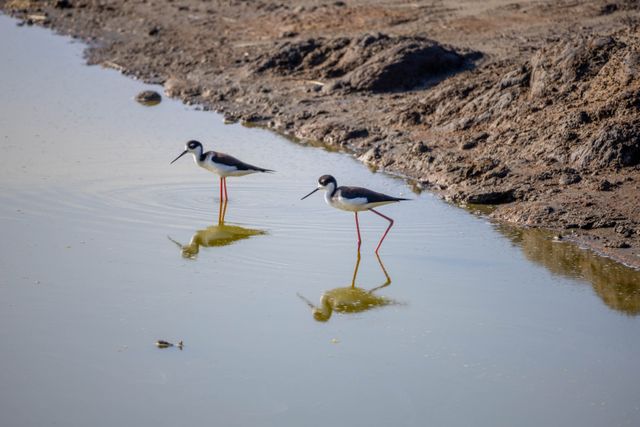
The Hawaiian Stilt, or Aeo, is an elegant wading bird about 38 to 40 cm (15 to 16 in) tall, with crisp black-and-white plumage, a needle-thin black bill, and very long pink legs that trail far behind it in flight. An endemic Hawaiian subspecies of the Black-necked Stilt, it is federally endangered and listed among the conservation-reliant waterbirds that depend on active wetland management. On Kauai it frequents the shallow margins of taro ponds, coastal wetlands, and refuge impoundments, stepping deliberately through the water to pick insects, small crustaceans, and other invertebrates from the surface and mud. Hanalei and the island’s managed wetlands are reliable places to find it.
Koloa, or Hawaiian Duck (Anas wyvilliana)
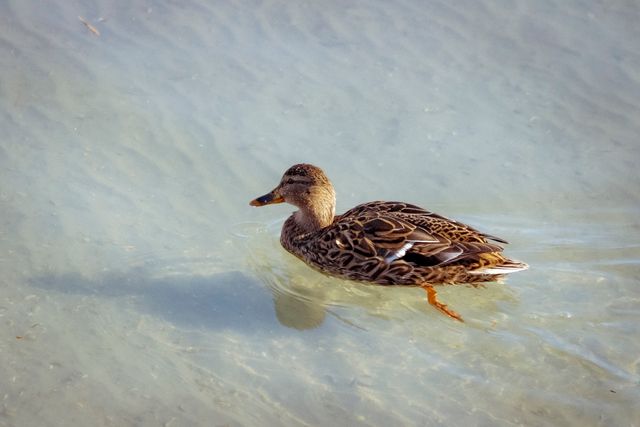
The Koloa maoli, or Hawaiian Duck, is a mottled brown dabbling duck resembling a small, dark female Mallard. The U.S. Fish and Wildlife Service gives the male at about 48 to 51 cm (19 to 20 in) long and the smaller female at about 41 to 43 cm (16 to 17 in). It is endemic to Hawaii and endangered, and Kauai is its stronghold, holding the largest population of genetically pure Koloa in the islands. The U.S. Fish and Wildlife Service established Hanalei National Wildlife Refuge in part to recover it, and traditional kalo, or taro, farming there helps maintain the wet habitat the duck needs. Hybridization with feral Mallards is the species’ central threat, which makes Kauai’s relatively pure population especially valuable. The Koloa feeds by dabbling in shallow water and flooded fields for seeds, aquatic plants, and invertebrates. It is also unusually vulnerable to avian botulism, a recurring hazard in the island’s warm wetlands.
Seabirds of the North Shore Cliffs
Kauai offers some of the most accessible seabird viewing in the country, concentrated at Kilauea Point National Wildlife Refuge, which the U.S. Fish and Wildlife Service describes as holding one of the largest populations of nesting seabirds in Hawaii. The steep cliffs and offshore islet let visitors watch from land birds that are normally seen only far out at sea, which makes the refuge one of the best places in the state for seabirds. Kauai is also the most important stronghold for Hawaii’s only two endemic seabirds, the Hawaiian Petrel (Pterodroma sandwichensis), or Uau, and Newell’s Shearwater (Puffinus newelli), or Ao. Both are sooty above and white below, the shearwater showing a clean white throat and white belly, and both nest in remote interior terrain rather than on the coastal cliffs. Each is endangered or threatened, and both benefit from the predator-free Nihoku restoration site at Kilauea Point.
Laysan Albatross (Phoebastria immutabilis)
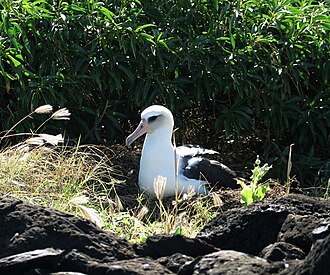
The Laysan Albatross, or Moli, is a large seabird about 81 cm (32 in) long with a wingspan of roughly two meters (6.5 ft), white-bodied with dark upperwings and a smudge of gray around the eye. The U.S. Fish and Wildlife Service reports that migratory Moli typically arrive at Kilauea Point in early November to breed, after navigating across thousands of kilometers of open ocean. On Kauai they are notable for nesting on the main island, including on golf courses and bluff-top neighborhoods, where conservation groups protect the nests. Albatross pairs mate for life and perform elaborate, synchronized courtship dances of bowing, bill-clacking, and sky-pointing. The Moli is a highlight of any Kauai winter visit.
Red-footed Booby (Sula sula)
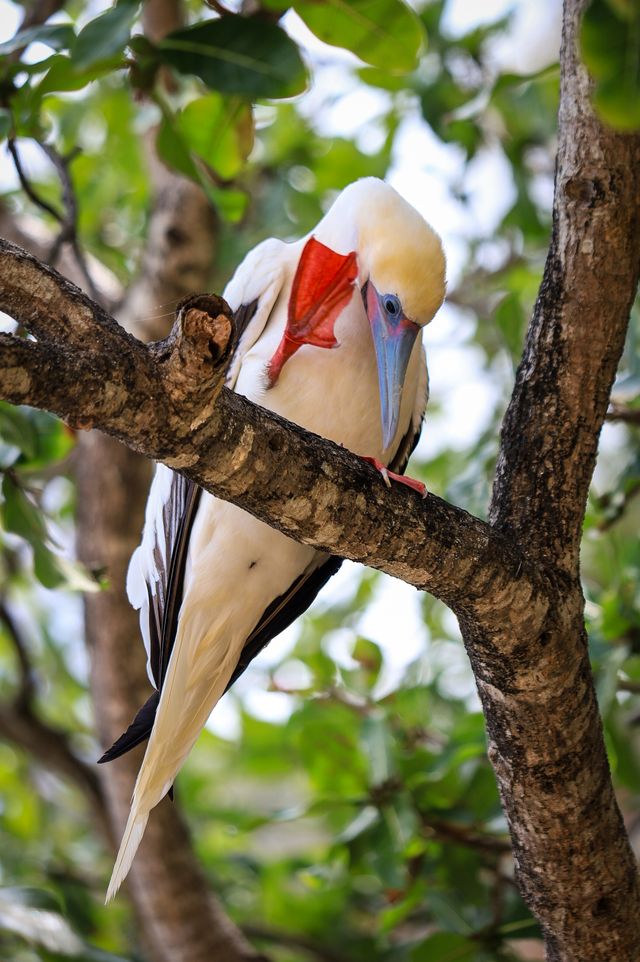
The Red-footed Booby, or A, is the most visible seabird at Kilauea Point and the most abundant booby in Hawaii. It is a slim, long-winged seabird about 71 cm (28 in) long, most often seen here in its white plumage with black wingtips, a blue-based bill, and the bright red feet that give it its name. Unusually among boobies, it nests in trees and shrubs rather than on the ground, and the Friends of Kauai Wildlife Refuges note that it incubates its eggs by covering them with its large, webbed feet. Thousands gather along the refuge cliffs, and returning birds are frequently chased by frigatebirds trying to pirate their catch.
Red-tailed Tropicbird (Phaethon rubricauda)
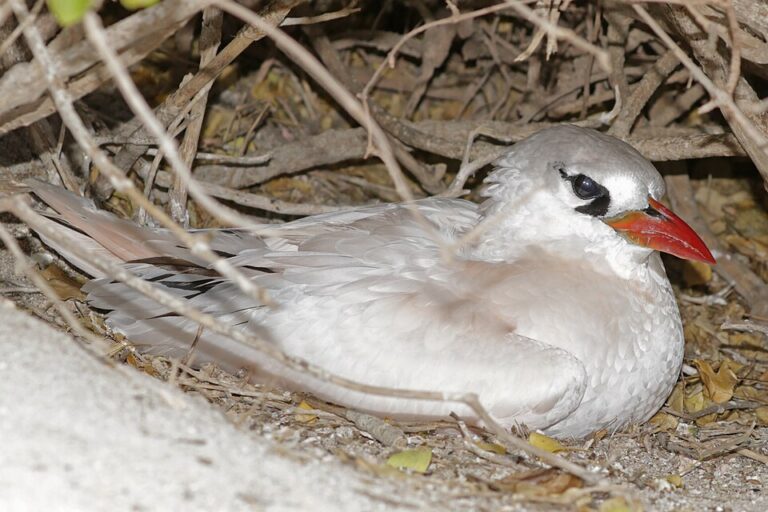
The Red-tailed Tropicbird, or Koae ula, is a striking white seabird measuring 76 to 94 cm (30 to 37 in) including its long, scarlet central tail streamers, per the Audubon field guide, with a stout red bill. The Friends of Kauai Wildlife Refuges describe its breeding season at Kilauea Point as running from roughly February to September, when small groups perform dramatic courtship flights, circling and flying backward while calling with loud, raucous squawks. The red tail streamers and bill against white plumage and blue sky make it a favorite of photographers at the Point. Its close relative the White-tailed Tropicbird, or Koae kea, can be seen soaring along the walls of Waimea Canyon inland.
Notable Migrants
Each year, long-distance migrants cross the open Pacific to winter on Kauai, arriving in late summer and departing in spring. They are among the most dependable native birds for a visitor to see, often on the same lawns and shorelines year after year.
Pacific Golden-Plover (Pluvialis fulva)
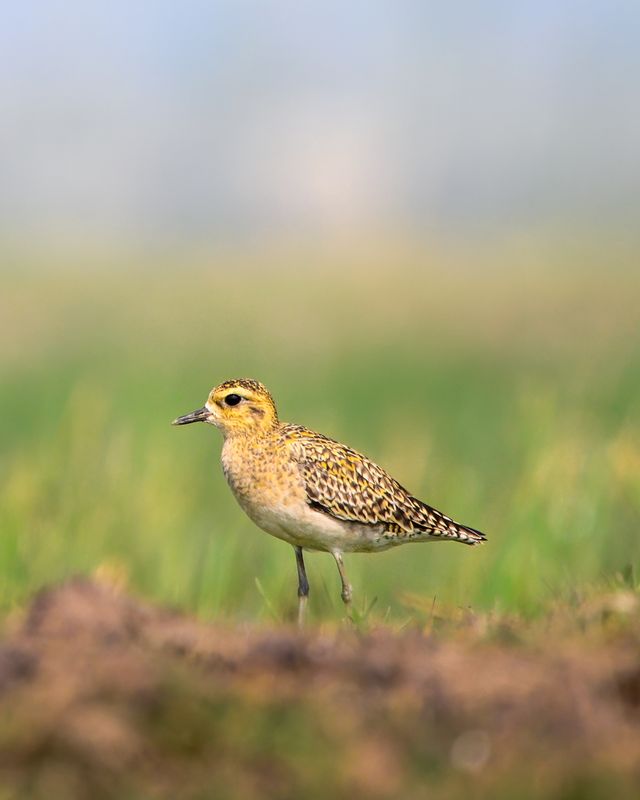
The Pacific Golden-Plover, known and loved in Hawaii as the Kolea, is a medium-sized shorebird 23 to 28 cm (9 to 11 in) long, per the Audubon field guide, with golden-spangled brown upperparts and, by spring, a bold black face and underside. The state Division of Forestry and Wildlife reports that most adults arrive in Hawaii in August, with juveniles following in October, and that spring departures begin in late April. Remarkably, the Kolea flies nonstop across roughly 4,800 kilometers (3,000 miles) of open ocean between Alaska and Hawaii in three to four days. It shows strong site fidelity, returning to the same lawn, park, or golf course each winter and defending that patch from rivals. It feeds on insects such as cockroaches, moths, and caterpillars, located by sight as it runs and pauses across open ground. The Hawaii Audubon Society’s Kolea Count community-science project tracks its yearly return.
Look-Alike Comparison
A few Kauai species are easy to confuse. This table highlights the most common identification challenges.
| Confusable pair | Key difference | Quick field mark |
|---|---|---|
| Red-crested Cardinal vs. Northern Cardinal | Red-crested has gray back and white underparts; Northern male is all red | Body color below the red head |
| Zebra Dove vs. Spotted Dove | Zebra is smaller with neck barring; Spotted is larger with a spotted neck collar | Size and neck pattern |
| Apapane vs. Iiwi | Apapane has a short black bill; Iiwi has a long curved salmon bill | Bill shape and length |
What to See When
Kauai birding is rewarding year-round, but timing improves your odds for particular species.
| Season | Highlights |
|---|---|
| Winter (Nov to Feb) | Laysan Albatross nesting at Kilauea Point; wintering Kolea and shorebirds; Nene nesting; humpback whales offshore |
| Spring (Mar to May) | Tropicbird courtship begins; Kolea molt into breeding plumage and depart by late April; resident landbirds nesting |
| Summer (Jun to Aug) | Albatross chicks fledge; Wedge-tailed Shearwaters on coastal cliffs; first returning Kolea arrive in August |
| Fall (Sep to Oct) | Shorebird arrival peaks; seabird activity continues; settled weather for high-forest birding at Kokee |
Notable Birding Locations
Kilauea Point National Wildlife Refuge, on the island’s northern tip, is the premier birding hotspot on Kauai and one of the best places in the state to see seabirds from land, including Red-footed Boobies, Laysan Albatross, tropicbirds, Great Frigatebirds, and Nene. Reservations are required, and the historic lighthouse and sea cliffs add to the visit.
Kokee State Park and the adjacent Alakai Wilderness Preserve, in the high western interior, hold Kauai’s surviving endemic forest birds. Trails such as the Pihea Trail and the Alakai Swamp Trail give patient, sharp-eyed birders a chance at Apapane, Kauai Amakihi, Anianiau, and, with luck and altitude, Iiwi.
Hanalei National Wildlife Refuge, on the north shore, protects the island’s endangered waterbirds among working taro fields. The refuge interior is closed to the public, but an overlook along Kuhio Highway in Princeville offers views of Koloa, Hawaiian Stilt, Hawaiian Coot, and Hawaiian Gallinule.
Waimea Canyon, on the way up to Kokee, is a reliable spot to watch White-tailed Tropicbirds soaring along the canyon walls, often viewed from above. The Kawaiele Sanctuary and other south and west coast wetlands add further waterbird and shorebird opportunities.
How to Attract Birds to Your Yard on Kauai
Backyard feeding on Kauai centers almost entirely on introduced species, since native forest birds and waterbirds do not visit yards. Offered thoughtfully, a yard can still draw an attractive mix of doves, cardinals, finches, and white-eyes.
For seed-eaters, cracked corn and millet on a tray or the ground will bring in Zebra Doves, Spotted Doves, and Java Sparrows, while sunflower seed attracts House Finches and both cardinal species. Cut fruit and nectar feeders appeal to Warbling White-eyes. A shallow, clean water source for drinking and bathing is one of the most effective draws of all in Kauai’s warm climate, provided it is refreshed regularly to avoid mosquito breeding.
Native plantings benefit birds and the wider ecosystem. Flowering and fruiting native shrubs offer natural food and shelter and reduce reliance on feeders. Crucially, the state asks residents and visitors never to feed Nene or leave pet food outdoors, both because human food harms the geese and because food left for feral cats endangers native birds directly. Keeping cats indoors is among the most important things a Kauai household can do for birds, since feral and free-roaming cats are a leading predator of native species.
Conservation: Racing Avian Malaria on the Alakai Plateau
Kauai is at the center of one of the most urgent bird-conservation efforts in the United States. The island’s endemic forest birds evolved with no resistance to avian malaria, a disease carried by introduced mosquitoes that reached Hawaii in the nineteenth century. For generations, the cool, high forest of the Alakai stayed too cold for mosquitoes and served as a refuge. As average temperatures have risen, mosquitoes have pushed into ever-higher elevations, carrying the disease into the last strongholds of birds that a single infected bite can kill. Avian malaria is the dominant threat, but it compounds older ones: the loss of native habitat to invasive plants and feral ungulates, and introduced natural predators such as feral cats, rats, and barn owls that take native birds, their chicks, and their eggs.
The consequences have been severe. The Kauai Forest Bird Recovery Project reports that the Akikiki, a small gray honeycreeper, is now extinct in the wild, and the state Department of Land and Natural Resources marked the loss with a 2024 announcement describing the species as functionally extinct after a survey found at most a handful of birds remaining. A captive population is maintained by the San Diego Zoo Wildlife Alliance in the hope of an eventual return. The Akekee, another Kauai endemic, has declined just as steeply. In early 2025 the Kauai Forest Bird Recovery Project’s program manager estimated that perhaps fewer than 50 Akekee remained in the wild.
The central response is large-scale mosquito control. A multi-partner effort works to suppress mosquito numbers across the Alakai using two main tools. The Kauai Forest Bird Recovery Project and state Forestry and Wildlife apply Bti, a mosquito-specific bacterial larvicide derived from Bacillus thuringiensis israelensis, to control larvae in wet areas. Alongside it, conservation partners release male mosquitoes carrying a strain of Wolbachia bacteria using the Incompatible Insect Technique, which causes the eggs of wild females that mate with them to fail, gradually shrinking the population. After roughly a decade of planning and permitting, the Kauai Forest Bird Recovery Project and the state Department of Land and Natural Resources carried out the first such release on the Alakai Plateau in February 2025. The Nature Conservancy and other partners describe this kind of work as the best current hope for breaking the avian malaria cycle. The outcome on Kauai will help determine whether its endemic forest birds have a future in the wild.
Frequently Asked Questions
What is the most common backyard bird in Kauai?
The most common backyard birds on Kauai are introduced species, particularly the Common Myna, Zebra Dove, and Red-crested Cardinal. These birds are abundant in towns, parks, and gardens across the island and are the species visitors are most likely to see daily. Native forest birds and waterbirds generally do not visit yards.
What is the state bird of Hawaii?
The state bird of Hawaii is the Nene, or Hawaiian Goose (Branta sandvicensis), an endemic goose and the rarest goose in the world. It was designated the state bird in 1957 and recovered from about 30 wild birds in the 1950s to roughly 3,800 today. On Kauai it nests at sites including Kilauea Point National Wildlife Refuge.
When do birds migrate to Kauai?
The most prominent migrant, the Pacific Golden-Plover, or Kolea, arrives in Hawaii beginning in August, with juveniles following in October, and departs for Alaska in late April. Wintering shorebirds such as the Wandering Tattler and Ruddy Turnstone follow a similar schedule, while Laysan Albatross arrive at Kilauea Point to breed in early November.
What is the largest bird on Kauai?
Among birds seen on Kauai, the Laysan Albatross is the largest by wingspan, reaching roughly two meters (6.5 ft) across, and the Great Frigatebird is comparable in size. On land, the Nene is among the largest resident birds, and feral Red Junglefowl roosters are conspicuous large birds across the island.
Why are there so many chickens on Kauai?
Kauai’s free-roaming chickens descend from a mix of Polynesian-introduced Red Junglefowl and domestic chickens, and their numbers grew after storms damaged coops in past decades. Unlike most Hawaiian islands, Kauai has no mongoose to prey on eggs and chicks, which has allowed the population to flourish island-wide.
Where can I see native Hawaiian forest birds on Kauai?
The best place to see Kauai’s surviving endemic forest birds is the high forest of Kokee State Park and the Alakai Wilderness Preserve. Trails such as the Pihea and Alakai Swamp trails offer chances at the Apapane and Kauai Amakihi, with the rarer Iiwi and Anianiau at higher elevations. Early morning and patience improve your odds.
Conclusion
Kauai presents two very different worlds of birds. In the lowlands, an abundant, approachable cast of introduced songbirds, returning migrant shorebirds, and accessible seabird colonies makes the Garden Isle one of the friendliest places in Hawaii for bird lovers to start watching birds. In the high forest of the Alakai, a tiny remnant of the island’s unique honeycreepers clings to survival against avian disease, in a conservation drama whose outcome carries weight far beyond Kauai. Learning to recognize the Nene, the Kolea, the seabirds of Kilauea Point, and the crimson Apapane connects a visitor to both stories at once. From common backyard Kauai birds to the rarest honeycreepers of the Alakai, the island rewards curiosity at every level. To go deeper, explore the companion guides to Kauai’s native forest birds, the island’s seabirds, and the best birding hotspots on the Garden Isle, and pair this overview with a good field guide and a morning at one of the refuges.
Works Cited
- Avibase, Bird Checklists of the World. “Kauai bird checklist” (Clements 2025). https://avibase.bsc-eoc.org/checklist.jsp?region=UShika
- VanderWerf, E. A., et al. (2025). “Second Report of the Hawaii Bird Records Committee.” Western Field Ornithologists. https://pacificrimconservation.org/wp-content/uploads/2025/10/VanderWerf-et-al-2025-2nd-report-of-HBRC-compressed.pdf
- U.S. Fish and Wildlife Service. “Kilauea Point National Wildlife Refuge.” https://www.fws.gov/refuge/kilauea-point
- U.S. Fish and Wildlife Service. “Hanalei National Wildlife Refuge.” https://www.fws.gov/refuge/hanalei
- Kauai Forest Bird Recovery Project. “Meet the Birds.” https://kauaiforestbirds.org/meet-the-birds-2/
- Kauai Forest Bird Recovery Project. “Mosquito Control.” https://kauaiforestbirds.org/mosquito-control/
- Hawaii Division of Forestry and Wildlife. “Nene.” https://dlnr.hawaii.gov/wildlife/birds/nene/
- Hawaii Division of Forestry and Wildlife. “Kolea.” https://dlnr.hawaii.gov/wildlife/birds/kolea/
- Hawaii Division of Forestry and Wildlife. “Native Birds of Hawaii.” https://dlnr.hawaii.gov/wildlife/birds/
- American Bird Conservancy. “Nene (Hawaiian Goose).” https://abcbirds.org/birds/nene-hawaiian-goose/
- National Audubon Society. “Pacific Golden-Plover.” Audubon Field Guide. https://www.audubon.org/field-guide/bird/pacific-golden-plover
- Friends of Kauai Wildlife Refuges. “Seabirds.” https://www.kauairefuges.org/seabirds
- Office of the Governor of Hawaii / DLNR. “Saying Goodbye to the Last Akikiki in the Wild” (July 1, 2024). https://governor.hawaii.gov/newsroom/dlnr-news-release-saying-goodbye-to-the-last-akikiki-in-the-wild-july-1-2024/
- The Nature Conservancy. “The Race to Save Native Forest Birds in Hawaii.” https://www.nature.org/en-us/what-we-do/our-priorities/protect-water-and-land/land-and-water-stories/saving-native-hawaiian-birds-federal-support/
- Banko, P. C., J. M. Black, and W. E. Banko (2020). “Hawaiian Goose (Branta sandvicensis).” Birds of the World, Cornell Lab of Ornithology (subscription access). https://birdsoftheworld.org/bow/species/hawgoo/cur/introduction
- U.S. Fish and Wildlife Service. “Nene (Branta sandvicensis)” species profile. https://www.fws.gov/species/nene-branta-sandvicensis
- U.S. Fish and Wildlife Service. “Hawaiian Duck (Anas wyvilliana)” species profile. https://www.fws.gov/species/hawaiian-duck-anas-wyvilliana
- U.S. Fish and Wildlife Service, ECOS. “Hawaiian stilt (Himantopus mexicanus knudseni).” https://ecos.fws.gov/ecp/species/2082
- U.S. Fish and Wildlife Service. “Saving Kauai Forest Birds.” https://www.fws.gov/project/saving-kauai-forest-birds
- Cornell Lab of Ornithology, All About Birds. “Iiwi,” “Apapane,” and “Kauai Amakihi” species accounts. https://www.allaboutbirds.org/guide/Iiwi/id; https://www.allaboutbirds.org/guide/Apapane/id; https://www.allaboutbirds.org/guide/Kauai_Amakihi/lifehistory
- National Audubon Society, Audubon Field Guide. “Laysan Albatross,” “Red-footed Booby,” “Red-tailed Tropicbird,” and “Northern Cardinal.” https://www.audubon.org/field-guide/bird/laysan-albatross; https://www.audubon.org/field-guide/bird/red-footed-booby; https://www.audubon.org/field-guide/bird/red-tailed-tropicbird; https://www.audubon.org/field-guide/bird/northern-cardinal
- Hawaii Department of Land and Natural Resources. “Releasing Mosquitoes to Help Kauai’s Forest Birds” (news release, Feb. 14, 2025). https://dlnr.hawaii.gov/blog/2025/02/14/nr25-23/
- The Garden Island. “Program begins releasing mosquitoes on Kauai to protect endangered honeycreepers” (Feb. 25, 2025). https://www.thegardenisland.com/2025/02/25/hawaii-news/program-begins-releasing-mosquitoes-on-kauai-to-protect-endangered-honeycreepers/
- eBird/Clements (Cornell Lab of Ornithology). “Wedge-tailed Shearwater (Ardenna pacifica)” and “Western Cattle-Egret (Ardea ibis)” species pages. https://ebird.org/species/wetshe; https://ebird.org/species/categr1
- U.S. Fish and Wildlife Service. “Hawaiian Petrel (Pterodroma sandwichensis)” species profile. https://www.fws.gov/species/hawaiian-petrel-pterodroma-sandwichensis
- Hawaii Division of Forestry and Wildlife. “Ao (Newell’s Shearwater).” https://dlnr.hawaii.gov/wildlife/birds/ao/