Red Headed Birds in Hawaii: A Field Guide to the Islands’ Crimson-Crowned Species
The red headed birds you are most likely to see in Hawaii are introduced songbirds rather than native ones. Three so-called cardinals lead the list: the Red-crested Cardinal (Paroaria coronata), the Yellow-billed Cardinal (Paroaria capitata), and the true Northern Cardinal (Cardinalis cardinalis), joined by the tiny breeding-plumage Red Avadavat (Amandava amandava). All four arrived from somewhere else, mostly South America and Asia, and all four are now established residents of the lowlands.
Hawaii does have native birds with red on the head, but they are a very different story. The crimson Hawaiian honeycreepers, the ‘I’iwi (Drepanis coccinea) and the ‘Apapane (Himatione sanguinea), are found nowhere else on Earth and survive mainly in high-elevation native forest. Understanding why the common red headed birds are introduced, while the irreplaceable ones cling to the mountaintops, is the heart of this guide.
Key Takeaways
- The most commonly seen red headed bird in Hawaii is the Red-crested Cardinal, an introduced South American species also called the Brazilian Cardinal, now common in parks and yards across the main islands.
- None of Hawaii’s three “cardinals” is native. The Red-crested and Yellow-billed cardinals belong to the tanager family, while the Northern Cardinal is a true cardinal introduced from North America beginning in 1929.
- Hawaii’s only native red headed birds are honeycreepers, chiefly the ‘I’iwi and ‘Apapane, both endemic and both deeply tied to native ‘ohi’a forest.
- The ‘I’iwi is federally listed as threatened, largely because introduced mosquitoes spread avian malaria that can kill roughly nine in ten infected birds.
- The best places to see introduced red headed birds are coastal parks and gardens, while the native crimson honeycreepers require a trip to cool, high-elevation forest reserves.
Red Headed Birds of Hawaii at a Glance
The table below lists the species covered in this guide. The first group are profiled in full. The final two are included because their bright red bills lead many people to search for them as red headed birds, although their plumage tells a different story.
| Species | Scientific name | Origin | Size | Where to find | Best feeder food |
|---|---|---|---|---|---|
| Red-crested Cardinal | Paroaria coronata | Introduced (South America) | About 19 cm (7.5 in) | Parks, lawns, dry open areas, all main islands | Mixed seed, cracked corn on the ground |
| Yellow-billed Cardinal | Paroaria capitata | Introduced (South America) | Slightly smaller than Red-crested | Waterside lowlands, mainly Hawaii Island | Mixed seed near water |
| Northern Cardinal | Cardinalis cardinalis | Introduced (North America) | 21 to 23 cm (8.3 to 9.1 in) | Gardens, thickets, forest edges, all main islands | Black oil sunflower seed |
| Red Avadavat | Amandava amandava | Introduced (Asia) | About 10 cm (4 in) | Grassy fields, marsh edges, especially O’ahu and Kaua’i | Small grass and millet seed |
| ‘I’iwi | Drepanis coccinea | Native, endemic | About 14 cm (5.5 in) | High native forest on Hawaii, Maui, Kaua’i | Not a feeder bird; nectar specialist |
| ‘Apapane | Himatione sanguinea | Native, endemic | About 13 cm (5.1 in) | Native ‘ohi’a forest, all main islands | Not a feeder bird; nectar specialist |
| Java Sparrow | Padda oryzivora | Introduced (Asia) | About 16 cm (6.3 in) | Lowlands, parks, urban edges | Seed, though red bill only, not red head |
| Common Waxbill | Estrilda astrild | Introduced (Africa) | About 11.5 cm (4.5 in) | Grassy fields, mainly O’ahu | Small seed, though red bill only, not red head |
Why Most Red Headed Birds in Hawaii Are Introduced
Hawaii’s bird life is unusual. The Bishop Museum’s checklist of Hawaiian birds, compiled by Robert and Peter Pyle, documents 338 bird species recorded across the archipelago as of its 2017 revision, of which dozens are introduced and many native forms are already extinct. The islands are the most isolated major archipelago on the planet, and that isolation produced an extraordinary set of endemic birds while leaving few of the familiar continental songbirds that people elsewhere associate with the color red.
That gap was filled by people. During the early twentieth century, residents and acclimatization societies deliberately released continental and tropical birds into Hawaii. The most active of these groups, the Hui Manu, introduced a long list of cage birds in the 1920s and 1930s. The Red-crested Cardinal, for example, was released on O’ahu and Kaua’i around 1928 to 1931, according to the Pyle compilation, and spread from there. The Northern Cardinal arrived through a similar effort, including a “Buy-a-Bird” campaign that placed about 163 birds in Hilo in 1929 and 1930.
These introductions are part of why Hawaii now hosts so many red headed species in its towns and parks. They are also a cautionary tale. Introduced birds can compete with native species, and the same era of human movement brought far more damaging invaders, including the mosquitoes that would devastate the native honeycreepers. This guide treats the introduced cardinals as an interesting and now permanent feature of the islands, while keeping the focus on observation and stewardship rather than on celebrating their arrival.
Introduced Cardinals and Finches
Red-crested Cardinal (Paroaria coronata)
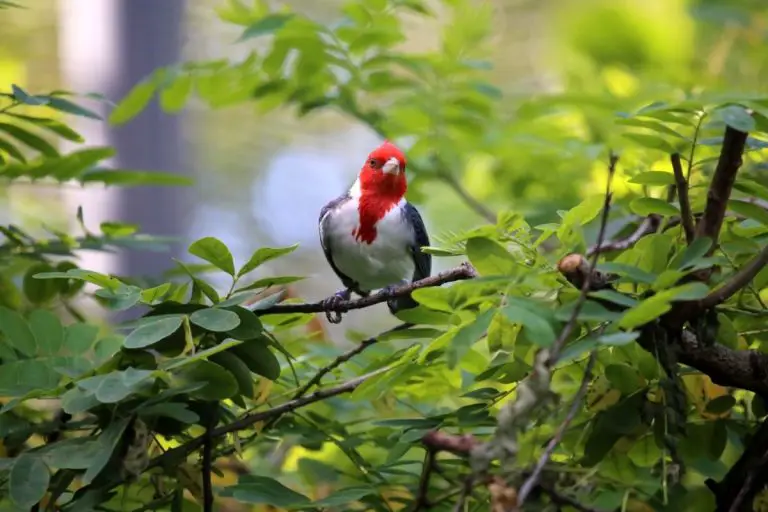
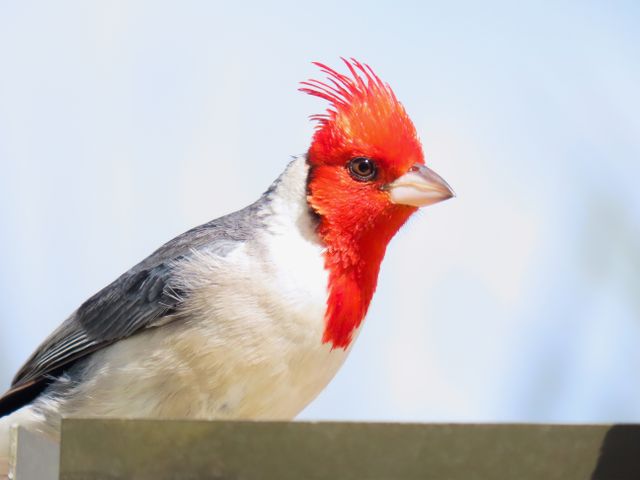
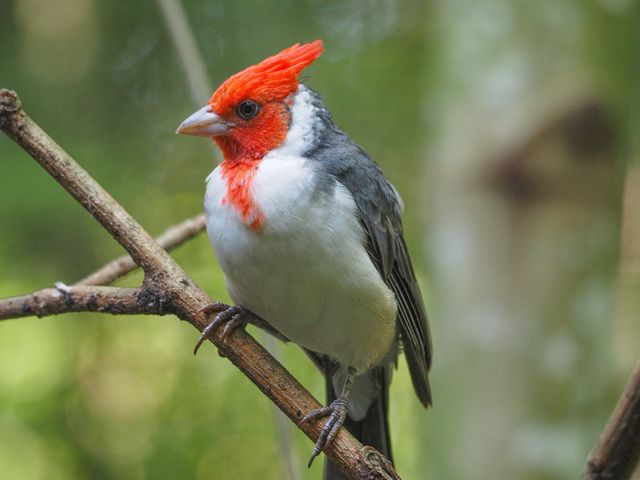
The Red-crested Cardinal is the bird most people mean when they ask about a red headed bird in Hawaii. According to the Cornell Lab of Ornithology, adults show a brilliant red head, throat, and pointed crest set off by a clean white collar, gray upperparts, and a white belly. The bill is silver-gray and the legs are dark. Juveniles wear a duller orange-brown head and a dark bill, which often confuses new birders.
This species measures about 19 cm (7.5 in) long. Despite its name and appearance, it is not a true cardinal at all. Cornell and the State of Hawaii’s birding-trails program both place it in the tanager family, Thraupidae, so its resemblance to North American cardinals is a case of similar coloring rather than close kinship. Its native range runs through northern Argentina, Bolivia, southern Brazil, Paraguay, and Uruguay.
In Hawaii it favors parks, lawns, gardens, and open dry forest, foraging on the ground for seeds, fruit, and insects. It is tame, conspicuous, and easy to attract with seed scattered on open ground. The species is common in lowland areas on all the main islands and is also known widely as the Brazilian Cardinal.
Yellow-billed Cardinal (Paroaria capitata)
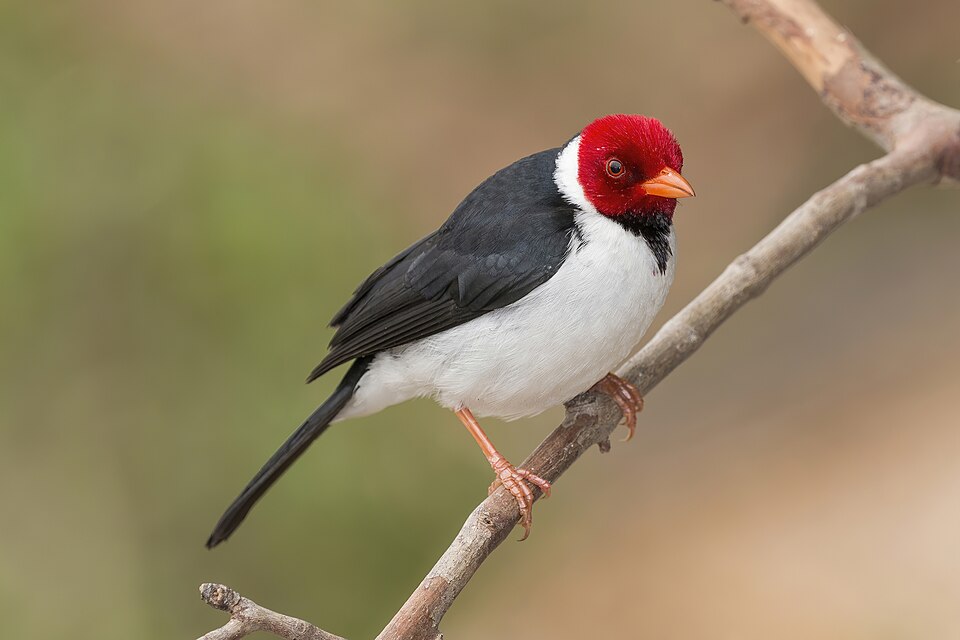
The Yellow-billed Cardinal is the Red-crested Cardinal’s close cousin and its most common point of confusion. According to eBird, it has a glowing red head, a gray to blackish back, white underparts, and a clean white half-collar, but two features set it apart: a bright yellow to orange bill and the lack of any crest. A black throat patch gives the impression of a small dark bib below the red head.
It is a slightly smaller bird than the Red-crested Cardinal. The Birds of the World account from the Cornell Lab notes that it is a species of streamside and wetland edges, often feeding right at the water’s edge around ponds, marshes, and flooded ground. Where the two Paroaria cardinals overlap, the Red-crested tends to take drier, shrubbier habitat while the Yellow-billed stays closer to water.
In Hawaii this cardinal is established almost entirely on Hawaii Island, the Big Island, where it spread along the Kona and Hilo coasts after first being noted in the early 1970s. Like its relative, it forages on the ground in pairs or small flocks and adapts readily to people, turning up in waterside towns and resort grounds.
Northern Cardinal (Cardinalis cardinalis)
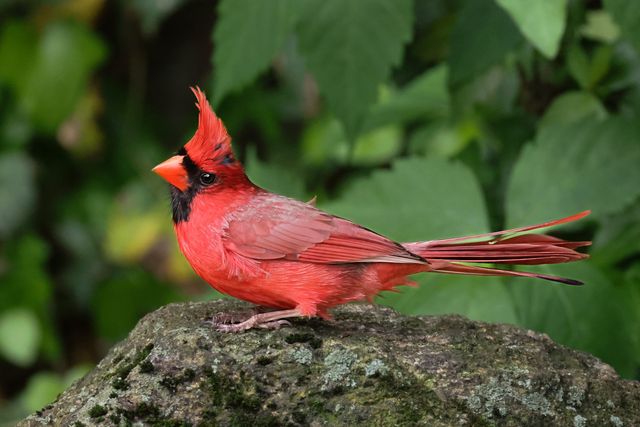
The Northern Cardinal is the only true cardinal, family Cardinalidae, among Hawaii’s red headed birds, and the only one most mainland visitors recognize on sight. Adult males are vivid red overall with a tall pointed crest, a red-orange conical bill, and a sharp black face mask. Females are warm brown with red tints in the crest, wings, and tail, and a gray face. This species runs about 21 to 23 cm (8.3 to 9.1 in) long.
It is native to eastern North America, not to Hawaii. As recorded in the Pyle checklist, Northern Cardinals were introduced to the islands beginning in 1929, with several hundred birds released across Kaua’i, O’ahu, and Hawaii Island over the following years. They established quickly and are now common statewide.
In Hawaii the Northern Cardinal occupies gardens, thickets, forest edges, and shrubby areas with dense cover. Males sing a clear, whistled series and are among the first voices in the dawn chorus. The species takes readily to feeders, where black oil sunflower seed is the reliable favorite.
Red Avadavat (Amandava amandava)
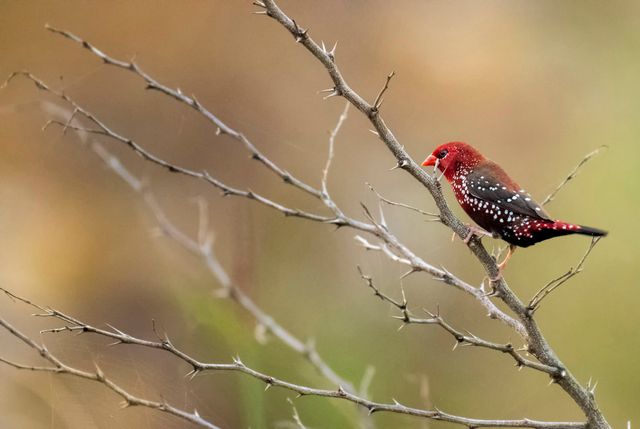
The Red Avadavat is the smallest red headed bird on this list and one of the most striking when seen well. A breeding male is largely brilliant scarlet, including the head, dotted with small white spots that earn the bird its common nickname, the strawberry finch. The bill is red year round. According to the Cornell Lab, females and nonbreeding males are far plainer, with grayish-brown upperparts, buffy underparts, and a dark mask through the eye, so the dazzling red plumage is mostly a seasonal, male feature.
This is a tiny bird, roughly 10 cm (4 in) long, in the waxbill family, Estrildidae. Its native range covers the open grasslands of tropical Asia, and it was a popular cage bird, which is how it reached many parts of the world. In Hawaii it became established in the early 1900s, first on O’ahu and later on Kaua’i and Hawaii Island.
Red Avadavats are social grass-seed eaters, traveling in small flocks through tall grass, crop edges, and marshy ground, often near water. They are easiest to find in open grassy areas rather than in yards, and they are not a typical feeder bird.
Native Crimson Honeycreepers
Hawaii’s only truly native red headed birds are honeycreepers, an endemic group descended from a single finch ancestor that diversified into more than fifty species. Most are gone. The two profiled here are the red ones a visitor still has a real chance of seeing, and both demand a trip into cool, high-elevation native forest.
‘I’iwi (Drepanis coccinea)
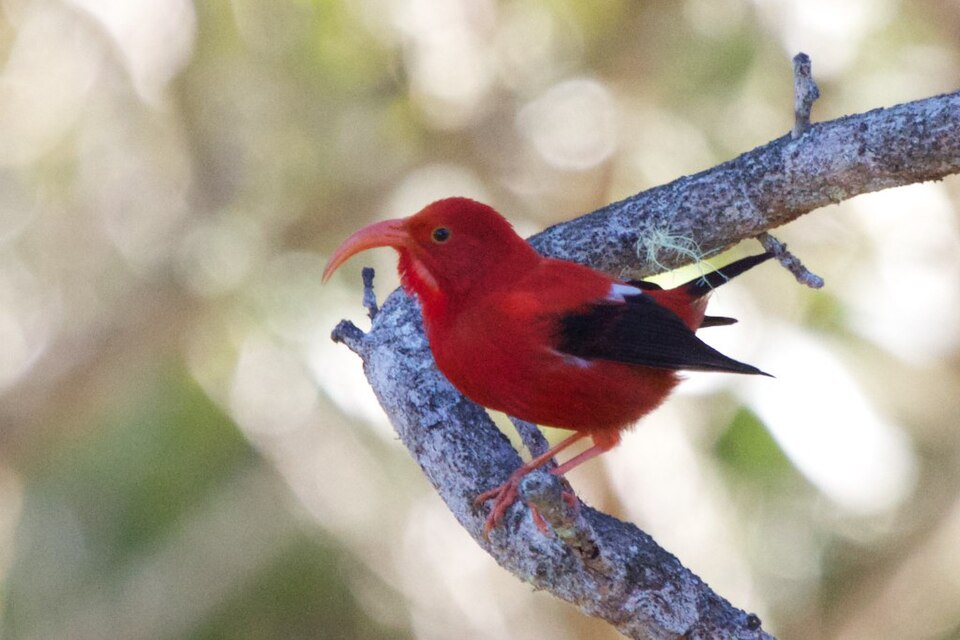
The ‘I’iwi, or scarlet honeycreeper, is one of the most recognizable symbols of native Hawaii. According to eBird, the adult is a brilliant scarlet bird with black wings and tail and a long, strongly curved, salmon-colored bill used to drink nectar. Juveniles are a mottled green, yellow, and orange, looking so different that they are easy to misidentify. The U.S. Fish and Wildlife Service gives its total body length as about 14 cm (5.5 in). The species is now placed in the genus Drepanis, though older sources, including some U.S. Fish and Wildlife Service pages, still list it under its former name, Vestiaria coccinea.
The ‘I’iwi is endemic to Hawaii and now lives mainly in high native forest on Hawaii Island, Maui, and Kaua’i, with only scattered birds on O’ahu and Moloka’i. Its long curved bill evolved alongside tubular native flowers, and it remains an active, noisy presence in the forest canopy, aggressively chasing other birds from flowering ‘ohi’a trees.
Its feathers were prized in traditional Hawaiian featherwork for the ‘ahu’ula, the feathered cloaks, and the mahiole, the feathered helmets, of the ali’i, the chiefly class. Today the ‘I’iwi is federally listed as threatened and is highly vulnerable to avian malaria, the conservation story explored below.
‘Apapane (Himatione sanguinea)
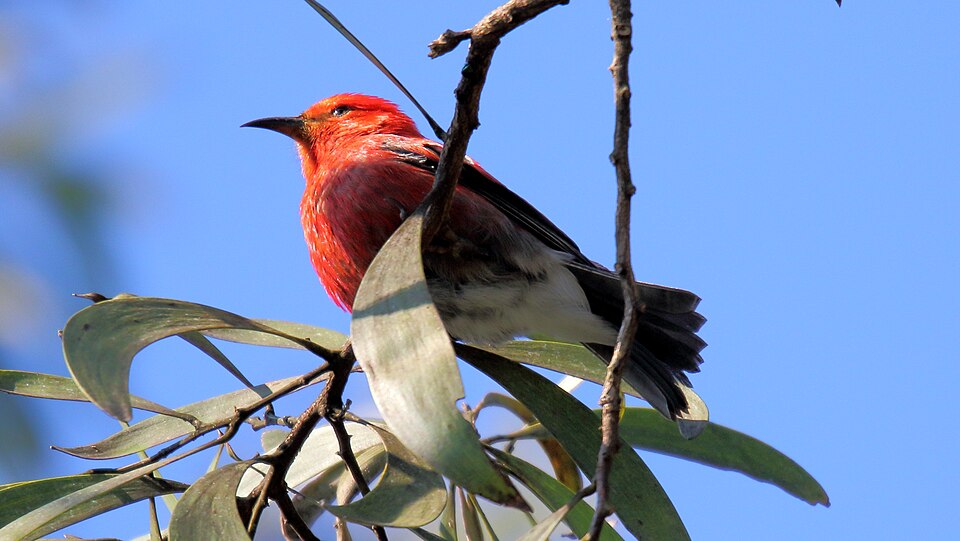
The ‘Apapane is the most abundant and widespread of the surviving Hawaiian honeycreepers, and the red native bird a visitor is most likely to encounter. According to the Cornell Lab, adults are a deep crimson with contrasting black wings and tail and snowy-white feathers beneath the tail. The bill is black and only slightly curved, shorter than the ‘I’iwi’s. Immature birds are a splotchy mix of gray, olive, and pale red. The ‘Apapane is small, about 13 cm (5.1 in) long.
This species is endemic to Hawaii and occurs on all the main forested islands. It is closely tied to the native ‘ohi’a tree, Metrosideros polymorpha, feeding on nectar from its blossoms and serving as an important pollinator. ‘Apapane are nomadic, moving long distances and even between islands to track flowering trees, and they are noisy and conspicuous, with both sexes singing through the year.
The species is currently assessed as Least Concern, with a population estimated above 1.5 million birds, the largest of any honeycreeper. Even so, it shares the same threats as its rarer relatives and is itself a carrier of avian malaria within the forest.
Telling the Look-alikes Apart
Three pairings cause most of the confusion among Hawaii’s red headed birds. The table below summarizes the field marks that separate them.
| Comparison | Quick distinction |
|---|---|
| Red-crested Cardinal vs Yellow-billed Cardinal | Red-crested has a pointed crest and a silver-gray bill; Yellow-billed has no crest, a bright yellow bill, and a black throat. |
| Northern Cardinal vs Red-crested Cardinal | Northern Cardinal male is red over the whole body with a black face mask; Red-crested is red only on the head and breast, with gray upperparts and a white belly. |
| ‘I’iwi vs ‘Apapane | ‘I’iwi is scarlet with a long, curved, salmon-colored bill; ‘Apapane is darker crimson with a short, nearly straight black bill and white under the tail. |
Red Bills, Not Red Heads
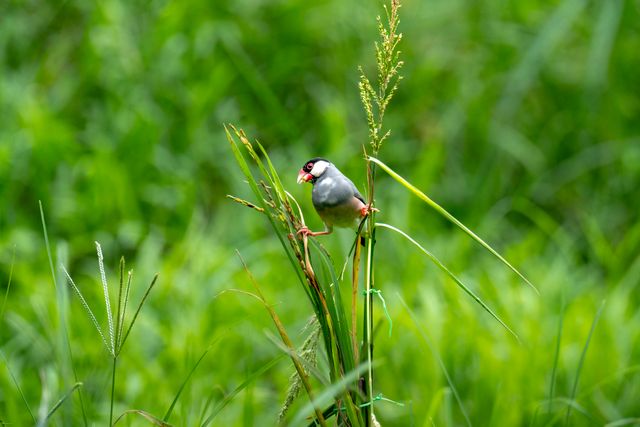
Two more introduced species are worth naming because their red bills lead people to search for them as red headed birds. Neither truly has a red head, but both are common and easily seen.
The Java Sparrow (Padda oryzivora), sometimes called the Java rice bird, has a black head with bold white cheeks, a gray body, and a heavy reddish-pink bill. The State of Hawaii’s birding-trails program notes that it was introduced to O’ahu in the 1960s and spread to other islands. The Common Waxbill (Estrilda astrild) is a small brown, finely barred finch with a vivid red bill and a red mask through the eye, introduced from Africa in the 1970s and now widespread, especially on O’ahu, according to the Cornell Lab. If a bird’s red is concentrated in the bill and face rather than across the crown, one of these two is the likely answer.
Where to See Red Headed Birds in Hawaii
The introduced red headed birds are the easy ones. Red-crested Cardinals are reliable in coastal parks, botanical gardens, resort lawns, and picnic areas on all the main islands, often approaching closely. On Hawaii Island, the waterside parks and historic sites of the Kona coast, including the grounds around Pu’uhonua o Honaunau, are good places to compare Red-crested and Yellow-billed cardinals side by side. Northern Cardinals turn up in almost any shrubby garden or forest edge, and Red Avadavats favor grassy fields and marsh margins, including wetland refuges on O’ahu and Kaua’i.
The native crimson honeycreepers require elevation. On Maui, Hosmer Grove in Haleakala National Park is a classic spot to hear and see ‘Apapane and, with luck, ‘I’iwi in the early morning. On Hawaii Island, the high forests around Hawaii Volcanoes National Park and the Hakalau Forest National Wildlife Refuge hold strong populations. On Kaua’i, the forest trails above Koke’e State Park offer a chance at both species. The State of Hawaii maintains the Hawaii Birding Trails program, which maps accessible sites island by island and is the best starting point for planning a visit.
How to Attract Red Headed Birds to Your Yard
The introduced cardinals are among the easiest birds to bring into a Hawaii garden. Red-crested Cardinals forage on the ground, so a low platform or a scattering of mixed seed and cracked corn on open ground works well. Northern Cardinals prefer black oil sunflower seed from a tray or hopper feeder placed near cover such as a hedge or shrub, where they feel safe. A shallow, clean water source is at least as effective as food in a warm climate, and native or fruiting plants that produce seeds and berries will draw all of these species naturally.
Two points of stewardship matter. First, the native honeycreepers are nectar specialists of high forest and are neither attracted to seed feeders nor appropriate to feed; the way to support them is to protect habitat, not to provision them. Second, the State of Hawaii’s Division of Forestry and Wildlife asks residents never to feed or approach the endangered Nene, the Hawaiian goose, and to keep feeders clean to avoid spreading disease among birds. Responsible feeding means supporting common introduced birds without drawing wildlife into harm.
Conservation: The Real Red Birds Are in Trouble
The contrast at the center of this guide is a conservation story. The red headed birds that are easy to see are introduced and secure, while Hawaii’s irreplaceable native red birds are among the most threatened in the world. Hawaii’s Division of Forestry and Wildlife notes that the islands once held at least 113 endemic bird species and that 71 have been lost, giving Hawaii a grim reputation as a center of bird extinction.
The single greatest threat to the surviving honeycreepers is avian malaria, a disease caused by the parasite Plasmodium relictum and spread by the introduced southern house mosquito, Culex quinquefasciatus. The U.S. Geological Survey reports that this disease has driven dramatic declines and extinctions among native forest birds. For the ‘I’iwi the danger is acute: research summarized in early 2026 found that infected ‘I’iwi face a mortality rate near 90 percent. The disease is also unusually persistent in Hawaii because, as that research showed, most forest birds, native and introduced alike, can pass the parasite to mosquitoes, sustaining transmission across the bird community.
For decades the honeycreepers survived by retreating to high-elevation forest where it was too cool for mosquitoes to thrive. That refuge is now shrinking. As the climate warms, mosquitoes move farther upslope into the last strongholds. On Kaua’i, the ‘Akikiki, a native honeycreeper, is now considered extinct in the wild, driven largely by the disease, and several Maui species could follow within years.
In response, a coalition of state, federal, and nonprofit partners known as Birds, Not Mosquitoes is field-deploying a method called the incompatible insect technique. As the National Park Service and American Bird Conservancy describe it, the project releases lab-reared male mosquitoes carrying a strain of the naturally occurring bacterium Wolbachia that is incompatible with the wild population. When these released males mate with wild females, the eggs fail to hatch, suppressing mosquito numbers over time. The released mosquitoes are all male and do not bite. Since November 2023, partners have released tens of millions of these mosquitoes in honeycreeper habitat on Maui and Kaua’i, increasingly using drones to reach remote forest. Hawaii’s governor marked the urgency by declaring 2024 the Year of the Forest Birds.
The work is not finished, and the outcome is uncertain. But it reframes how to think about the islands’ red birds. The Brazilian Cardinal on a hotel lawn is a pleasant introduction; the scarlet ‘I’iwi in a high ‘ohi’a forest is a living thread of Hawaiian natural and cultural heritage that conservationists are racing to keep from breaking.
Frequently Asked Questions
What is the red headed bird with a crest in Hawaii?
It is almost certainly the Red-crested Cardinal, an introduced South American species also called the Brazilian Cardinal. It has a bright red head and pointed crest, a white collar and belly, gray upperparts, and a silver-gray bill. It is common in parks, lawns, and gardens on all the main Hawaiian islands.
Are cardinals native to Hawaii?
No. None of Hawaii’s three cardinals is native. The Northern Cardinal was introduced from North America beginning in 1929, and the Red-crested and Yellow-billed cardinals were introduced from South America around 1930. The latter two are not even true cardinals; they belong to the tanager family.
How do I tell a Red-crested Cardinal from a Yellow-billed Cardinal?
Look at the bill and the crown. The Red-crested Cardinal has a pointed red crest and a silver-gray bill. The Yellow-billed Cardinal has no crest, a bright yellow bill, and a black throat patch. In Hawaii the Yellow-billed is found mainly on Hawaii Island and usually near water.
Are there any native red birds in Hawaii?
Yes. The native red birds are Hawaiian honeycreepers, chiefly the scarlet ‘I’iwi and the crimson ‘Apapane, both found nowhere else on Earth. Unlike the introduced cardinals, they live mostly in high-elevation native forest and are tied to nectar from native ‘ohi’a trees. The ‘I’iwi is federally listed as threatened.
Where can I see the ‘I’iwi?
The ‘I’iwi is most reliably seen in cool, high native forest. Good locations include Hosmer Grove in Haleakala National Park on Maui, the high forests near Hawaii Volcanoes National Park and Hakalau Forest National Wildlife Refuge on Hawaii Island, and the trails above Koke’e State Park on Kaua’i. Early morning gives the best chance.
Is Hawaii’s state bird a red headed bird?
No. Hawaii’s state bird is the Nene, or Hawaiian goose (Branta sandvicensis), which has a black head and face with a buff-furrowed neck rather than red plumage. It is an endemic, conservation-dependent species that was downlisted from endangered to threatened in 2019 and is best seen at sites such as Hawaii Volcanoes and Haleakala national parks.
Conclusion
The red headed birds of Hawaii tell two stories at once. In the lowlands, introduced cardinals and the strawberry finch bring easy, vivid color to parks and yards, a legacy of deliberate twentieth-century releases that are now a permanent part of island life. In the high forest, the scarlet ‘I’iwi and crimson ‘Apapane carry a far older and more fragile story, one bound up with native ‘ohi’a, traditional Hawaiian culture, and an urgent fight against introduced mosquitoes and disease. Knowing which red bird is which, and why it is here, turns a casual glance into a deeper appreciation of how Hawaii’s bird life came to be and what it will take to keep its most precious members aloft. To learn more about the various birds of Hawaii, check out our our articles: Birds Native To Hawaii, Birds of Hawaii: A Complete Field Guide to the Birds of Maui, and Birds of Hawaii: A Complete Field Guide to the Birds of Kauai.
Works Cited
- Cornell Lab of Ornithology. “Red-crested Cardinal Overview.” All About Birds. https://www.allaboutbirds.org/guide/Red-crested_Cardinal/overview
- Cornell Lab of Ornithology. “Red-crested Cardinal.” Birds of the World. https://birdsoftheworld.org/bow/species/reccar/cur/introduction
- Cornell Lab of Ornithology. “Yellow-billed Cardinal.” eBird. https://ebird.org/species/yebcar
- Cornell Lab of Ornithology. “Yellow-billed Cardinal.” Birds of the World. https://birdsoftheworld.org/bow/species/yebcar/cur/introduction
- Cornell Lab of Ornithology. “Red Avadavat Overview.” All About Birds. https://www.allaboutbirds.org/guide/Red_Avadavat/overview
- Cornell Lab of Ornithology. “Apapane Overview.” All About Birds. https://www.allaboutbirds.org/guide/Apapane/overview
- Cornell Lab of Ornithology. “Iiwi.” eBird. https://ebird.org/species/iiwi
- Cornell Lab of Ornithology. “Common Waxbill Overview.” All About Birds. https://www.allaboutbirds.org/guide/Common_Waxbill/overview
- Cornell Lab of Ornithology. “Java Sparrow Overview.” All About Birds. https://www.allaboutbirds.org/guide/Java_Sparrow/overview
- Pyle, R.L., and P. Pyle. “The Birds of the Hawaiian Islands: Occurrence, History, Distribution, and Status.” B.P. Bishop Museum, Honolulu. Red-crested Cardinal account. https://hbs.bishopmuseum.org/birds/rlp-monograph/pdfs/07-ZOST-ESTR/RCCA.pdf
- Pyle, R.L., and P. Pyle. “The Birds of the Hawaiian Islands.” Bishop Museum. Yellow-billed Cardinal account. https://hbs.bishopmuseum.org/birds/rlp-monograph/pdfs/07-ZOST-ESTR/YBCA.pdf
- Pyle, R.L., and P. Pyle. “The Birds of the Hawaiian Islands.” Bishop Museum. Northern Cardinal account. https://hbs.bishopmuseum.org/birds/rlp-monograph/pdfs/07-ZOST-ESTR/NOCA.pdf
- State of Hawaii. “Red-crested Cardinal.” Hawaii Birding Trails. https://hawaiibirdingtrails.hawaii.gov/bird/red-crested-cardinal/
- State of Hawaii. “Northern Cardinal.” Hawaii Birding Trails. https://hawaiibirdingtrails.hawaii.gov/bird/northern-cardinal/
- State of Hawaii. “Red Avadavat.” Hawaii Birding Trails. https://hawaiibirdingtrails.hawaii.gov/bird/red-avadavat/
- State of Hawaii. “Java Sparrow.” Hawaii Birding Trails. https://hawaiibirdingtrails.hawaii.gov/bird/java-sparrow/
- State of Hawaii Division of Forestry and Wildlife. “Native Birds of Hawai’i.” https://dlnr.hawaii.gov/wildlife/birds/
- U.S. Geological Survey. “‘I’iwi (Drepanis coccinea), or scarlet honeycreeper.” https://www.usgs.gov/media/images/iiwi-drepanis-coccinea-or-scarlet-honeycreeper
- U.S. Fish and Wildlife Service. “‘I’iwi (Vestiaria coccinea).” Species profile. https://www.fws.gov/species/iiwi-vestiaria-coccinea
- Pyle, R.L., and P. Pyle. “Primary Checklist.” The Birds of the Hawaiian Islands: Occurrence, History, Distribution, and Status, Version 2 (2017). B.P. Bishop Museum, Honolulu. https://hbs.bishopmuseum.org/birds/rlp-monograph/PrimaryChecklist.htm
- Animal Diversity Web. “Amandava amandava (red avadavat).” https://animaldiversity.org/accounts/Amandava_amandava/
- Animal Diversity Web. “Estrilda astrild (common waxbill).” https://animaldiversity.org/accounts/Estrilda_astrild/
- Cornell Lab of Ornithology. “Java Sparrow.” Birds of the World. https://birdsoftheworld.org/bow/species/javspa/cur/introduction
- American Bird Conservancy. “As Extinctions Loom, Conservationists Race to Save Vanishing Hawaiian Honeycreepers.” https://abcbirds.org/news/race-to-save-hawaiian-honeycreepers-2022/
- National Park Service. “The Time Is Now: Saving Maui’s Honeycreepers Before It Is Too Late.” https://www.nps.gov/articles/the-time-is-now-saving-maui-s-honeycreepers-before-it-is-too-late.htm
- ScienceDaily. “Almost every forest bird in Hawai’i is spreading avian malaria.” February 2026. https://www.sciencedaily.com/releases/2026/02/260211073016.htm
- ʻApapane. Wikipedia. https://en.wikipedia.org/wiki/%CA%BBApapane