Oregon Birds: A Field Guide to the Beaver State’s Backyard, Forest, and Wetland Species
Oregon is home to 552 recorded bird species, a total confirmed by the Oregon Bird Records Committee in its May 2026 checklist. That figure places the state among the most bird-rich in the country, and it reflects a landscape that packs an extraordinary range of habitats into a single map.
The reason is geography. Oregon sits squarely on the Pacific Flyway, one of the four great North American migration corridors, and its terrain shifts from wave-battered coastline to temperate rainforest, from the snow-capped Cascades to sagebrush high desert. Each of these zones supports its own community of birds, so a birder can move from puffins on a sea stack to sage-steppe sparrows in the space of a single day.
Key Takeaways
- Oregon has 552 recorded bird species as of May 2026, according to the Oregon Bird Records Committee.
- The state bird is the Western Meadowlark (Sturnella neglecta), chosen by Oregon schoolchildren in a 1927 vote and proclaimed by Governor Isaac L. Patterson.
- Oregon lies on the Pacific Flyway, which funnels hundreds of thousands of migrating waterfowl and shorebirds through the state each spring and fall.
- Malheur National Wildlife Refuge and the Klamath Basin refuges rank among the finest waterbird sites in the American West.
- The Marbled Murrelet, a seabird that nests in old-growth forest, was reclassified from threatened to endangered under Oregon law in 2021.
Oregon Birds at a Glance
The table below lists the species profiled in this guide along with other birds you are likely to encounter across the state. Anchor species receive full profiles further down; the remainder appear here with a short note.
| Species | Scientific name | Size | When present | Where to find | Best feeder food |
|---|---|---|---|---|---|
| Dark-eyed Junco | Junco hyemalis | 14 to 16 cm (5.5 to 6.3 in) | Year-round | Yards, forest edges statewide | Millet, sunflower hearts |
| Black-capped Chickadee | Poecile atricapillus | 12 to 15 cm (4.7 to 5.9 in) | Year-round | Woodlands, backyards | Black oil sunflower seeds |
| American Robin | Turdus migratorius | 20 to 28 cm (7.9 to 11 in) | Year-round | Lawns, parks, woodlands | Mealworms, fruit |
| Song Sparrow | Melospiza melodia | 12 to 17 cm (4.7 to 6.7 in) | Year-round | Brushy edges, wetlands | Millet on the ground |
| House Finch | Haemorhous mexicanus | 13 to 14 cm (5.1 to 5.5 in) | Year-round | Towns, suburbs | Black oil sunflower seeds |
| Lesser Goldfinch | Spinus psaltria | 9 to 11 cm (3.5 to 4.3 in) | Mostly spring to fall | Western valleys, weedy fields | Nyjer, sunflower hearts |
| Anna’s Hummingbird | Calypte anna | 10 cm (4 in) | Year-round (west) | Gardens, urban areas | Sugar water (1 to 4 ratio) |
| Spotted Towhee | Pipilo maculatus | 17 to 21 cm (6.7 to 8.3 in) | Year-round | Dense shrubs, leaf litter | Millet, cracked corn on ground |
| Steller’s Jay | Cyanocitta stelleri | 30 to 34 cm (11.8 to 13.4 in) | Year-round | Conifer forests, campgrounds | Peanuts, sunflower seeds |
| California Scrub-Jay | Aphelocoma californica | 28 to 33 cm (11 to 13 in) | Year-round (west) | Oak, suburbs, parking lots | Peanuts, sunflower seeds |
| Northern Flicker | Colaptes auratus | 28 to 31 cm (11 to 12.2 in) | Year-round | Open woods, yards | Suet, ground insects |
| Golden-crowned Sparrow | Zonotrichia atricapilla | 15 to 18 cm (5.9 to 7.1 in) | Fall to spring | Thickets, western yards | Millet on the ground |
| Western Tanager | Piranga ludoviciana | 16 to 19 cm (6.3 to 7.5 in) | Late spring to summer | Open conifer forests | Fruit, occasionally feeders |
| Rufous Hummingbird | Selasphorus rufus | 7 to 9 cm (2.8 to 3.5 in) | Late Feb to Sept | Gardens, forest openings | Sugar water (1 to 4 ratio) |
| Red-tailed Hawk | Buteo jamaicensis | 45 to 65 cm (18 to 26 in) | Year-round | Roadsides, open country | Not a feeder bird |
| Osprey | Pandion haliaetus | 54 to 58 cm (21 to 23 in) | Spring to fall | Rivers, lakes, coast | Not a feeder bird |
| Great Blue Heron | Ardea herodias | 97 to 137 cm (38 to 54 in) | Year-round | Marshes, shorelines | Not a feeder bird |
| Sandhill Crane | Antigone canadensis | 80 to 120 cm (31 to 47 in) | Spring to fall | Wet meadows, Malheur | Not a feeder bird |
| Western Meadowlark | Sturnella neglecta | 19 to 26 cm (7.5 to 10.2 in) | Year-round | Grasslands, especially east | Not a feeder bird |
| European Starling | Sturnus vulgaris | 20 to 23 cm (7.9 to 9.1 in) | Year-round | Towns, farms (introduced) | Suet (often dominates) |
| House Sparrow | Passer domesticus | 15 to 17 cm (5.9 to 6.7 in) | Year-round | Cities, farms (introduced) | Millet, bread scraps |
| Mourning Dove | Zenaida macroura | 23 to 34 cm (9.1 to 13.4 in) | Year-round | Open country, yards | Cracked corn, millet |
| American Crow | Corvus brachyrhynchos | 40 to 53 cm (16 to 21 in) | Year-round | Towns, fields, forests | Peanuts, scraps |
| Common Raven | Corvus corax | 56 to 69 cm (22 to 27 in) | Year-round | Wild country statewide | Not a typical feeder bird |
| Black-billed Magpie | Pica hudsonia | 45 to 60 cm (18 to 24 in) | Year-round | Eastern Oregon | Suet, scraps |
| Chestnut-backed Chickadee | Poecile rufescens | 12 cm (4.7 in) | Year-round | Coastal and moist forests | Sunflower, suet |
| Mountain Chickadee | Poecile gambeli | 13 cm (5.1 in) | Year-round | Cascade and eastern conifers | Sunflower, suet |
| Red-breasted Nuthatch | Sitta canadensis | 11 cm (4.3 in) | Year-round | Conifer forests | Sunflower, suet |
| Bewick’s Wren | Thryomanes bewickii | 13 cm (5.1 in) | Year-round | Brushy western habitats | Suet, mealworms |
| Western Bluebird | Sialia mexicana | 16 to 19 cm (6.3 to 7.5 in) | Year-round | Oak savanna, open country | Mealworms, nest boxes |
| Varied Thrush | Ixoreus naevius | 20 to 25 cm (7.9 to 10 in) | Fall to spring (lowlands) | Damp forests, winter yards | Fruit, ground seed |
| American Goldfinch | Spinus tristis | 11 to 14 cm (4.3 to 5.5 in) | Year-round | Weedy fields, yards | Nyjer, sunflower hearts |
| Pine Siskin | Spinus pinus | 11 to 14 cm (4.3 to 5.5 in) | Mostly fall to spring | Conifers, feeders | Nyjer, sunflower hearts |
| Cedar Waxwing | Bombycilla cedrorum | 14 to 17 cm (5.5 to 6.7 in) | Year-round (nomadic) | Berry trees, edges | Fruit, berries |
| Red-winged Blackbird | Agelaius phoeniceus | 22 to 24 cm (8.7 to 9.4 in) | Year-round | Marshes, field edges | Mixed seed, cracked corn |
| Brown-headed Cowbird | Molothrus ater | 19 to 22 cm (7.5 to 8.7 in) | Spring to fall | Fields, feedlots | Mixed seed (brood parasite) |
| Turkey Vulture | Cathartes aura | 64 to 81 cm (25 to 32 in) | Spring to fall | Soaring over open country | Not a feeder bird |
| Bald Eagle | Haliaeetus leucocephalus | 71 to 96 cm (28 to 38 in) | Year-round | Rivers, lakes, coast | Not a feeder bird |
| American Kestrel | Falco sparverius | 22 to 31 cm (8.7 to 12.2 in) | Year-round | Fence wires, fields | Not a feeder bird |
| California Quail | Callipepla californica | 24 to 27 cm (9.4 to 10.6 in) | Year-round | Brushy edges, yards | Cracked corn, millet on ground |
| Acorn Woodpecker | Melanerpes formicivorus | 19 to 23 cm (7.5 to 9.1 in) | Year-round | Oak woodlands, southwest | Suet |
| Marbled Murrelet | Brachyramphus marmoratus | 24 to 25 cm (9.4 to 9.8 in) | Year-round | Coastal waters, old-growth | Not a feeder bird |
| Tufted Puffin | Fratercula cirrhata | 35 to 41 cm (14 to 16 in) | Spring to summer | Coastal cliffs, sea stacks | Not a feeder bird |
| American Dipper | Cinclus mexicanus | 14 to 20 cm (5.5 to 7.9 in) | Year-round | Fast, clear mountain streams | Not a feeder bird |
Why Oregon Holds So Much Diversity
Oregon’s bird life is a direct product of its geography. The U.S. Environmental Protection Agency divides the state into nine Level III ecoregions, more than most states contain, and each supports a distinct set of species. This variety, combined with relatively mild winters, makes Oregon an important wintering ground for migratory birds moving along the Pacific Flyway.
The western third of the state is defined by two mountain systems and the valley between them. The Coast Range rises just inland from the Pacific, cloaked in dense, moist conifer forest and fringed by estuaries, dunes, and rocky headlands. East of it lies the Willamette Valley, the agricultural lowland where roughly 70 percent of Oregonians live, once a mosaic of wet prairie and oak savanna. Beyond that the Cascade Range climbs to volcanic peaks, splitting the state into a wet west side and a dry east side.
East of the Cascades, the landscape opens into a very different Oregon. The Columbia Plateau, Blue Mountains, and the vast Northern Basin and Range spread across the interior in a sweep of sagebrush steppe, bunchgrass prairie, high desert, and shallow alkaline lakes. Harney County alone is larger than several eastern states combined yet holds fewer than 8,000 people, leaving room for sage-steppe specialists and enormous concentrations of migrating waterbirds.
The Klamath Mountains of the southwest add yet another layer, a rugged, botanically rich region of interior valleys and scenic rivers including the Rogue and the Umpqua. Taken together, these ecoregions explain why a single state can host puffins, sage-grouse, dippers, and desert sparrows within its borders.
The Western Meadowlark: Oregon’s State Bird
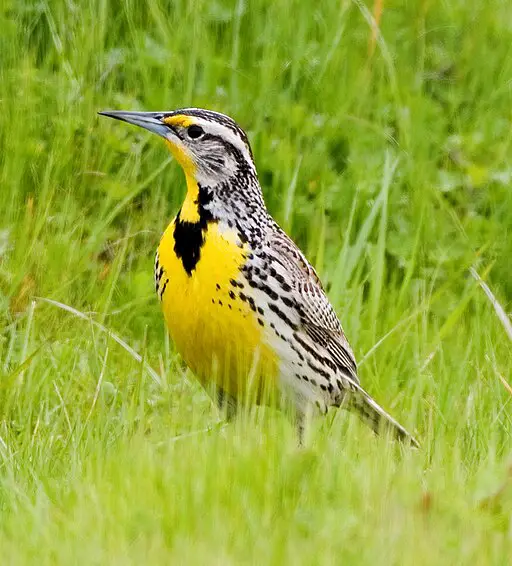
The Western Meadowlark (Sturnella neglecta) is Oregon’s state bird, selected in 1927 through a statewide vote of schoolchildren sponsored by the Oregon Audubon Society and confirmed by a proclamation from Governor Isaac L. Patterson. The species won by a wide margin, drawing about 40,000 of roughly 75,000 votes, and it remains the only Oregon symbol adopted by gubernatorial proclamation rather than by the legislature.
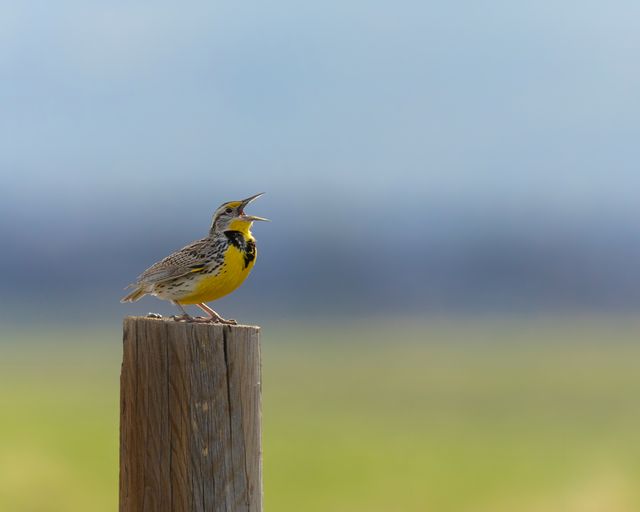
A robin-sized member of the blackbird family, the meadowlark measures 19 to 26 cm (7.5 to 10.2 in) in length according to the National Audubon Society. It is instantly recognizable by its bright yellow underparts crossed with a bold black V and its streaked brown back that provides camouflage in open grassland. The song is the source of its fame: a rich, flute-like series of descending notes that once signaled spring across Oregon farm country.
Meadowlarks favor native grasslands, oak savanna, pastures, and sagebrush shrub-steppe. According to the Oregon Department of Fish and Wildlife, the species remains common in eastern Oregon but has declined sharply in the Willamette Valley, where development, intensive cultivation, and fire suppression have erased much of the prairie it depends upon. The bird builds a domed grass nest on the ground, sometimes with a woven roof and an entrance tunnel.
In 2017, the Oregon Legislature considered replacing the meadowlark with the Osprey. The compromise kept the meadowlark as state bird and named the Osprey Oregon’s state raptor. For a fuller account, see our dedicated profile of the Western Meadowlark.
Common Backyard Birds
These are the species most Oregon residents encounter at feeders, in gardens, and along neighborhood edges. For a deeper treatment of yard visitors, see our planned guide to backyard feeder birds of Oregon.
Dark-eyed Junco (Junco hyemalis)

The Dark-eyed Junco is one of Oregon’s most abundant and recognizable feeder birds. The form seen across most of the state is the “Oregon” junco, a crisp bird with a dark hood, warm brown back, pinkish sides, and white outer tail feathers that flash in flight. Adults measure roughly 14 to 16 cm (5.5 to 6.3 in).
Juncos are ground foragers, hopping beneath feeders and along forest edges in search of small seeds. They breed in coniferous and mixed woodlands, then spread into yards and open country in larger flocks through the colder months. To attract them, scatter millet or sunflower hearts on the ground or on a low platform. Their loose flocks often mix with sparrows, and their soft trilling song is a familiar sound in Oregon woodlands.
Black-capped Chickadee (Poecile atricapillus)

The Black-capped Chickadee is a small, acrobatic favorite of Oregon yards, measuring about 12 to 15 cm (4.7 to 5.9 in). It wears a black cap and bib, white cheeks, and soft gray upperparts, and it announces itself with a clear chick-a-dee-dee-dee call.
Chickadees frequent deciduous and mixed woodlands, parks, and gardens across much of western and central Oregon, often leading mixed foraging flocks of nuthatches and kinglets in winter. They readily use nest boxes and are among the easiest birds to draw to a feeder. Offer black oil sunflower seeds or suet, and expect chickadees to grab a single seed and carry it to a perch to open it. In the Cascades and eastern conifers, the similar Mountain Chickadee replaces it, distinguished by a white eyebrow stripe.
American Robin (Turdus migratorius)

The American Robin is among the most familiar birds in Oregon, a large thrush of 20 to 28 cm (7.9 to 11 in) with a warm brick-red breast, gray back, and dark head. It is a year-round resident found on lawns, in parks, and along woodland edges statewide.
Robins forage on the ground for earthworms and insects, often tilting their heads as they hunt, and switch to berries in fall and winter, when large flocks may descend on fruiting trees. They nest in shrubs, trees, and on building ledges, building neat cups of mud and grass. Robins do not typically visit seed feeders, but they will take mealworms and fruit and are strongly drawn to a birdbath or moving water. Their liquid, caroling song is one of the first sounds of an Oregon spring morning.
Song Sparrow (Melospiza melodia)

The Song Sparrow is a widespread streaky sparrow of 12 to 17 cm (4.7 to 6.7 in), heavily marked below with a dark central breast spot. It haunts brushy edges, marshes, gardens, and streamsides throughout Oregon and is present year-round.
True to its name, the male sings a bright, variable series of notes and trills from an exposed perch, one of the most persistent voices in wet thickets. Song Sparrows forage low, scratching through leaf litter for seeds and insects. They visit yards with dense cover nearby and take millet or mixed seed offered on or near the ground. Their coloration varies across the state, with darker, richer-toned birds along the humid coast and paler forms in the arid interior.
House Finch (Haemorhous mexicanus)

The House Finch is a common finch of towns and suburbs, measuring 13 to 14 cm (5.1 to 5.5 in). Males show rosy red on the head and breast, while females are plain brown and streaked. Both sexes have a stout, seed-cracking bill.
House Finches gather in chattering flocks at feeders and are especially fond of black oil sunflower seeds. They nest in shrubs, hanging planters, and building nooks, adapting readily to human surroundings. Their warbling song, delivered from rooftops and wires, carries a rough buzzy note at the end. Take care to keep feeders clean, as House Finches can be susceptible to a conjunctivitis eye disease that spreads at crowded feeding stations. They are easily confused with the Purple Finch, addressed in the look-alike section below.
Lesser Goldfinch (Spinus psaltria)

The Lesser Goldfinch is a tiny, cheerful finch of western Oregon valleys, measuring just 9 to 11 cm (3.5 to 4.3 in). Males have a black cap, bright yellow underparts, and a greenish or blackish back, while females are duller olive-yellow.
These birds gather in weedy fields, gardens, and edges, feeding on the seeds of thistles, sunflowers, and other composites. They are drawn to nyjer and sunflower hearts, often visiting mesh finch feeders in small flocks. Their twittering, wheezy song frequently incorporates snippets imitated from other species. Lesser Goldfinches are most numerous in the western valleys and become scarcer east of the Cascades. The larger, brighter American Goldfinch, Oregon’s more widespread goldfinch, often shares the same feeders.
Anna’s Hummingbird (Calypte anna)
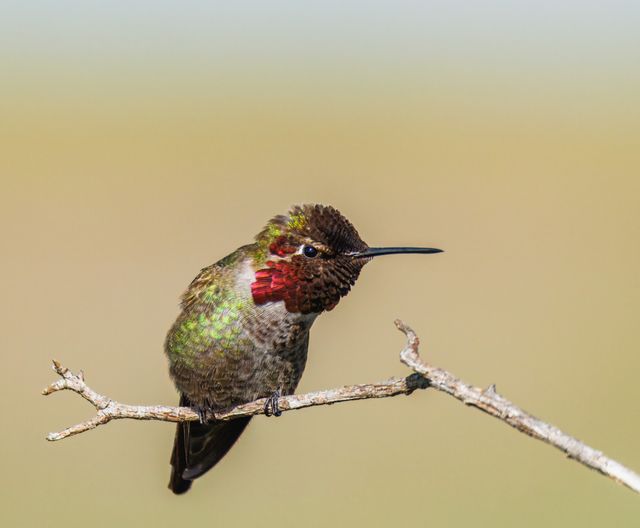
Anna’s Hummingbird is the only hummingbird that stays in Oregon year-round, a hardy species of about 10 cm (4 in) that brightens gardens through the wet winter months. Males flash an iridescent rose-pink crown and throat that can look dull until it catches the light.
According to the National Audubon Society, this species has expanded its range northward in recent decades, aided by garden flowers and feeders, and it now nests as far north as British Columbia. In much of western Oregon, Anna’s may begin nesting as early as December or February. Its song is an unusually complex buzzy warble, and the male performs a steep courtship dive that ends in a sharp popping sound. Support these birds with native plantings such as red-flowering currant and a clean sugar-water feeder kept from freezing in cold snaps.
Spotted Towhee (Pipilo maculatus)
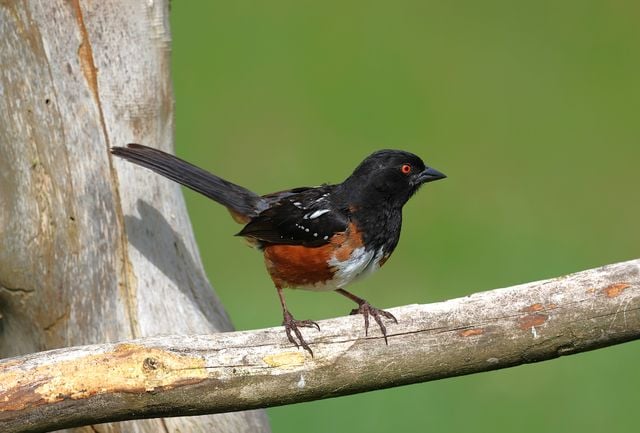
The Spotted Towhee is a striking, robust sparrow of 17 to 21 cm (6.7 to 8.3 in) that skulks in dense shrubs and along brushy edges. Males have a black hood, rufous sides, a white belly, and bold white spots across black wings and back; females are similar but browner.
Towhees forage on the ground with a distinctive two-footed backward scratch, kicking through leaf litter for seeds and insects. They are more often heard than seen, giving a rising chweee call and a buzzy trilled song from within cover. To attract them, provide brushy habitat and scatter millet or cracked corn beneath shrubs. Spotted Towhees are year-round residents across much of Oregon and are among the more rewarding birds to coax into a well-planted yard.
Steller’s Jay (Cyanocitta stelleri)
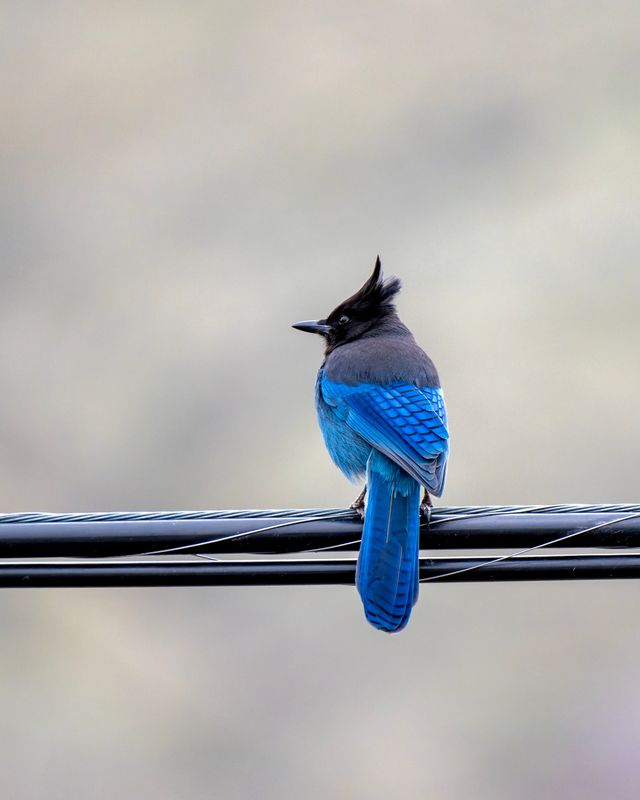
Steller’s Jay is Oregon’s crested forest jay, a bold, deep blue and charcoal bird of 30 to 34 cm (11.8 to 13.4 in) with a shaggy black crest. It is a fixture of coniferous forests, mountain campgrounds, and shaded backyards, particularly in the Coast Range, Cascades, and Klamath Mountains.
Intelligent and vocal, Steller’s Jays give a harsh shaack-shaack-shaack and are skilled mimics, sometimes imitating the scream of a Red-tailed Hawk. They cache seeds and nuts, take peanuts and sunflower seeds readily, and will dominate a feeder while present. They also raid picnic sites without much shyness. Where the forest gives way to oak and suburb in western Oregon, the crestless, brighter blue California Scrub-Jay takes over.
California Scrub-Jay (Aphelocoma californica)
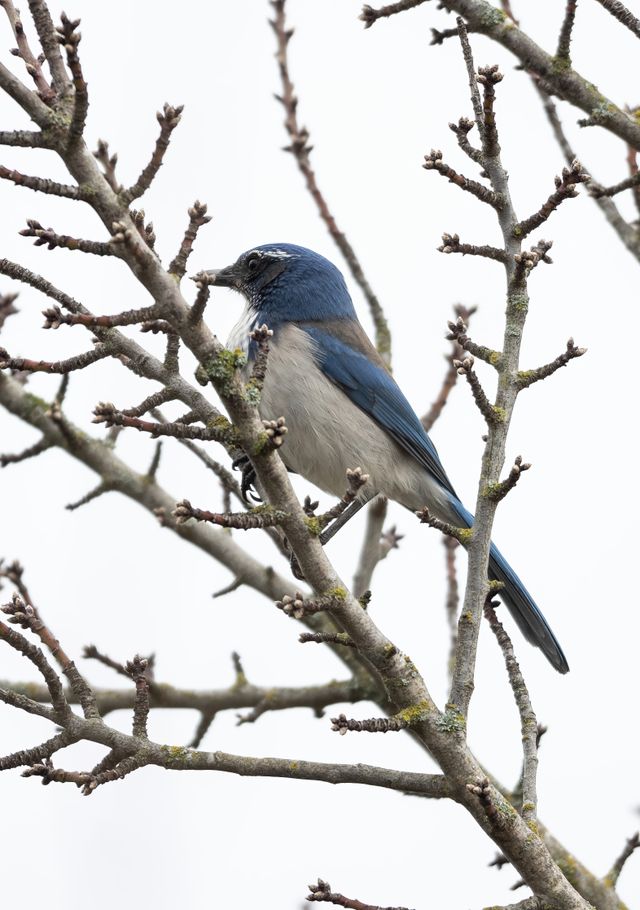
The California Scrub-Jay is a crestless blue jay of western Oregon’s oak woodlands, suburbs, and parks, measuring roughly 28 to 33 cm (11 to 13 in). It shows deep azure above, a pale gray back patch, and a whitish throat framed by a faint blue necklace.
Once limited to southern Oregon, this species has expanded northward and is now a common sight in towns across the western valleys, frequently seen bounding across lawns and parking lots. Scrub-Jays cache acorns by the thousands, playing an outsized role in oak dispersal. They take peanuts and sunflower seeds at feeders and are famously wary and watchful. Their harsh, rising call is a familiar suburban sound west of the Cascades.
Northern Flicker (Colaptes auratus)

The Northern Flicker is a large brown woodpecker of 28 to 31 cm (11 to 12.2 in) often seen foraging on the ground, where it probes for ants and beetles. The western “red-shafted” form shows salmon-red underwings and tail, a gray face, and a black crescent across the breast.
Flickers are widespread across Oregon in open woods, parks, and yards. They drum on resonant surfaces in spring, sometimes including metal chimneys and gutters, and give a loud, ringing kleeer call. They take suet at feeders and will use large nest boxes. Their bounding, undulating flight reveals a white rump patch that helps identify them at a distance. The Northern Flicker is one of several woodpeckers covered more fully in our planned Oregon woodpeckers guide.
Birds of Prey
Oregon’s raptors range from roadside hawks to fish-catching Ospreys and the great owls of the eastern forests. The state is home to more owl species than a hub article can profile in full; for that, see our planned guide to the owls of Oregon.
Osprey (Pandion haliaetus)
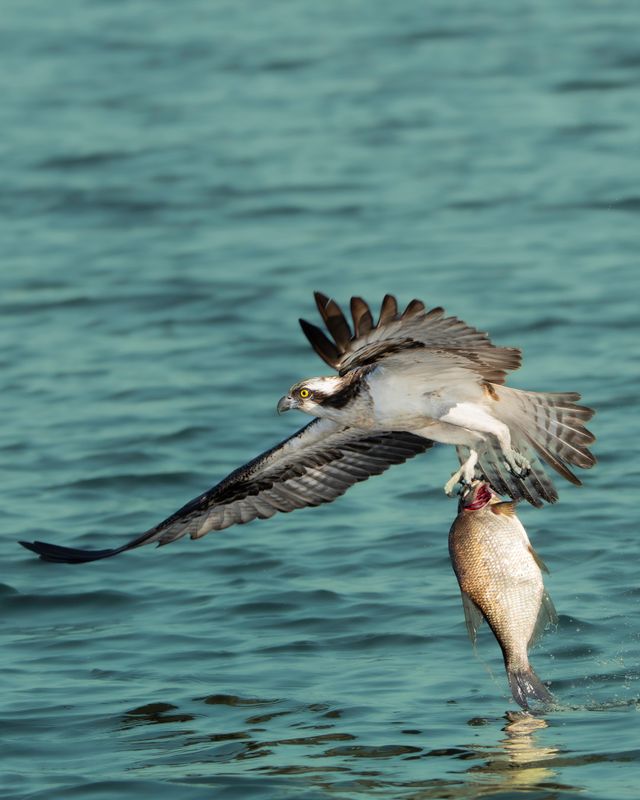
The Osprey is Oregon’s state raptor, designated in 2017, and a spectacular fish hawk of rivers, lakes, and coastal waters. Adults measure about 54 to 58 cm (21 to 23 in) with a wingspan well over 1.5 m (5 ft). The plumage is dark brown above and clean white below, with a bold dark eye-stripe and a distinctive crook to the wing in flight.
Ospreys are present in Oregon mainly from spring through fall, hunting by hovering and then plunging feet-first to seize fish near the surface. They build bulky stick nests atop snags, channel markers, and purpose-built platforms, and pairs often reuse the same nest for years. Their high, whistled calls carry over the water. For a closer look at this species, see our dedicated Osprey profile.
Red-tailed Hawk (Buteo jamaicensis)

The Red-tailed Hawk is Oregon’s most commonly seen large hawk, a broad-winged buteo of 45 to 65 cm (18 to 26 in) frequently spotted perched on fence posts, utility poles, and roadside trees. Adults typically show a pale breast, a streaked belly band, and the rusty upper tail that gives the species its name.
Plumage varies widely, from pale to very dark birds, which can complicate identification. Red-tails hunt small mammals from a perch or while soaring in slow circles, and their harsh, descending scream is so evocative that films often dub it over other raptors, including eagles. They are year-round residents across every Oregon ecoregion, most visible over open country and agricultural land where rodent prey is plentiful.
Water and Wetland Birds
Oregon’s wetlands, from coastal estuaries to high desert marshes, support some of the state’s greatest bird spectacles. Herons stalk the shallows year-round, while cranes and waterfowl arrive in seasonal waves.
Great Blue Heron (Ardea herodias)
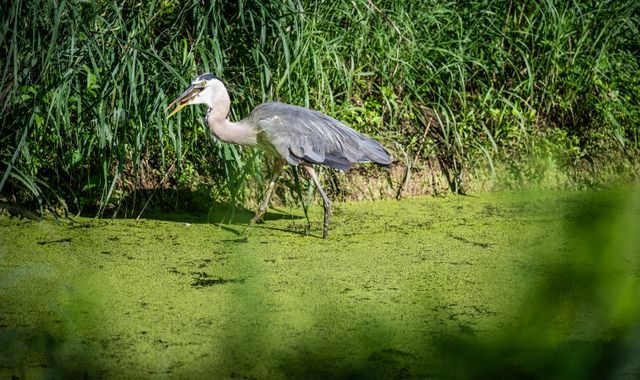
The Great Blue Heron is Oregon’s largest and most familiar wading bird, standing 97 to 137 cm (38 to 54 in) tall with a wingspan approaching 2 m (6.5 ft). Slate-gray overall with a white face, black head plume, and a heavy dagger of a bill, it is a year-round presence along marshes, rivers, estuaries, and even urban ponds.
Herons hunt with patience, standing motionless before striking at fish, frogs, and small mammals with a lightning thrust of the neck. They nest colonially in tall trees, forming rookeries that may hold dozens of stick nests. In flight, the heron folds its neck into an S and trails its long legs behind, distinguishing it from cranes, which fly with necks outstretched. Learn more in our full Great Blue Heron profile.
Sandhill Crane (Antigone canadensis)
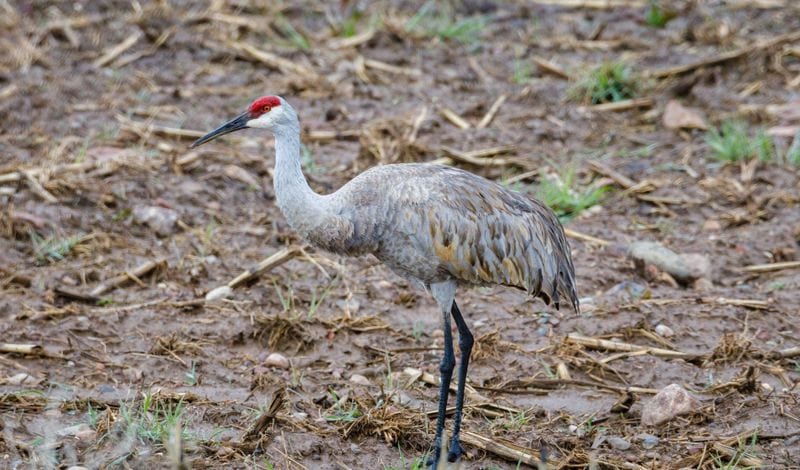
The Sandhill Crane is a tall, stately gray bird of 80 to 120 cm (31 to 47 in) with a red crown and a bustle of feathers over the rump. Its rolling, bugling call carries for remarkable distances across open wetland.
Cranes gather in wet meadows and grain fields, feeding on tubers, seeds, and invertebrates. Malheur National Wildlife Refuge is a stronghold: the U.S. Fish and Wildlife Service reports that the refuge supports more than 20 percent of Oregon’s breeding population of greater Sandhill Cranes. Unlike herons, cranes fly with necks fully extended and often perform elaborate leaping dances during courtship. Spring and fall bring the greatest numbers to Oregon’s high desert basins and the Klamath area.
Woodland and Grassland Specialties
Beyond the backyard, Oregon’s forests and open country hold birds that reward a short trip out of town. These species are strongly tied to particular habitats.
Western Tanager (Piranga ludoviciana)
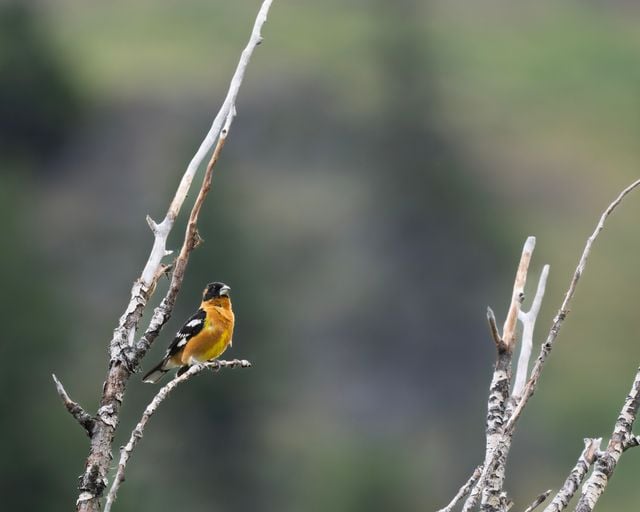
The Western Tanager is one of Oregon’s most brilliantly colored summer birds, a species of 16 to 19 cm (6.3 to 7.5 in) in which breeding males combine a flame-orange head, bright yellow body, and black wings and back. Females and non-breeding birds are a subtler yellow-green.
Tanagers arrive in late spring and breed in open coniferous and mixed forests across much of the state, foraging high in the canopy for insects and, later in the season, fruit. Despite their tropical appearance they can be surprisingly easy to overlook among the foliage until the male’s burry, robin-like song gives him away. They occasionally visit yards for fruit or at birdbaths during migration, offering western Oregon birders a flash of color from May into summer.
Notable Migrants
Migration transforms Oregon twice a year. Some visitors pass through briefly; others settle in for a season. Two are worth singling out for backyard birders.
Rufous Hummingbird (Selasphorus rufus)
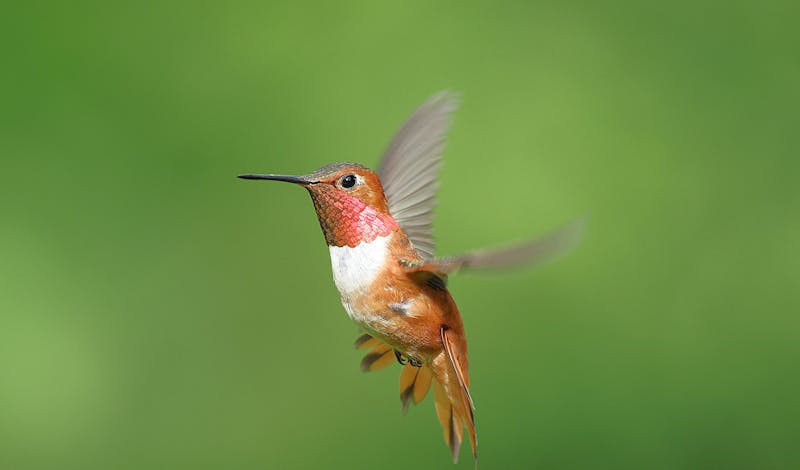
The Rufous Hummingbird is Oregon’s most widespread breeding hummingbird, a small, fiery migrant of 7 to 9 cm (2.8 to 3.5 in). Males glow coppery orange with a fierce orange-red throat, while females are green above with rufous flanks and tail.
Rufous Hummingbirds are famous for their long migration and their bold temperament, aggressively defending flowers and feeders against larger birds. According to the National Audubon Society, they move north early, reaching Oregon by the end of February in the mildest years, with numbers building through March and April. A second pulse passes south through the mountains in mid to late summer. Keep a clean feeder and native tubular flowers ready by late February in western Oregon. For the full picture of the state’s four regular hummingbirds, see our planned Oregon hummingbirds guide.
Golden-crowned Sparrow (Zonotrichia atricapilla)
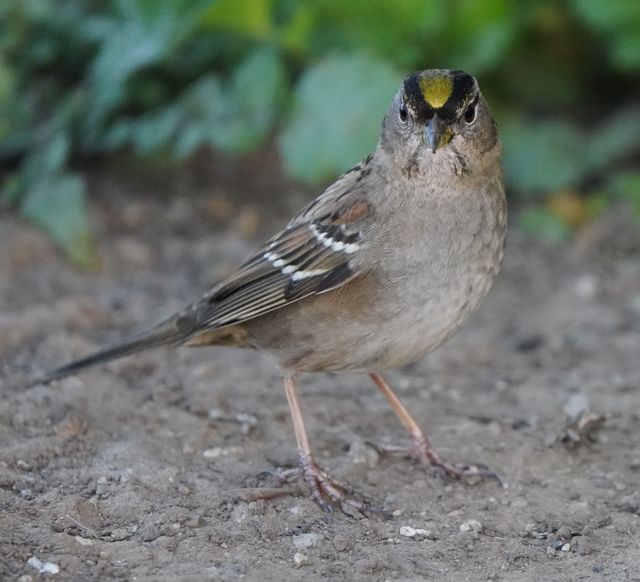
The Golden-crowned Sparrow is a large, handsome sparrow of 15 to 18 cm (5.9 to 7.1 in) that winters commonly in western Oregon. Breeding adults show a black crown split by a golden-yellow center stripe; winter birds are plainer, with a dusky wash and a muted gold forecrown.
These sparrows arrive in fall and stay through spring, foraging in loose flocks through thickets, hedgerows, and brushy yards. They scratch on the ground for seeds and take millet offered low or scattered beneath shrubs. Their plaintive, descending three-note whistle, sometimes rendered oh-dear-me, is a characteristic sound of the western Oregon winter. Come April, most depart north to breed in Alaska and western Canada.
Look-alike Species
A few Oregon species are regularly confused. The table below highlights the field marks that separate the most commonly mistaken pairs.
| Confused pair | How to tell them apart |
|---|---|
| Downy Woodpecker (Dryobates pubescens) vs. Hairy Woodpecker (Dryobates villosus) | The Downy is smaller with a short, stubby bill roughly a third the width of its head; the Hairy is noticeably larger with a long, heavy bill nearly as long as its head is wide. |
| House Finch (Haemorhous mexicanus) vs. Purple Finch (Haemorhous purpureus) | Male House Finches show red concentrated on the head and breast with brown streaks on the flanks; male Purple Finches look dipped in raspberry, with color washing over the back and no crisp streaking below. |
| Steller’s Jay (Cyanocitta stelleri) vs. California Scrub-Jay (Aphelocoma californica) | Steller’s Jay has a tall black crest and dark charcoal front and favors conifer forest; the Scrub-Jay is crestless, brighter blue, and pale below, and favors oak and suburbs. |
Crows and ravens are another frequent source of confusion in Oregon. Our comparison of crows and ravens breaks down the size, tail shape, and voice differences in detail.
What to See When
Oregon rewards birders in every season, though the cast changes through the year. The table below summarizes the highlights.
| Season | What to look for |
|---|---|
| Spring (March to May) | Peak northbound migration; Rufous Hummingbirds return, Ospreys reoccupy nests, warblers and tanagers arrive, waterfowl stage at Malheur and the Klamath Basin. |
| Summer (June to August) | Breeding season; seabirds nest on coastal cliffs, meadowlarks sing in eastern grasslands, tanagers and flycatchers fill the forests. |
| Fall (September to November) | Southbound migration; shorebirds crowd the coast and interior lakes, sparrows and juncos return to yards, waterfowl numbers build. |
| Winter (December to February) | Wintering flocks; Golden-crowned Sparrows and Varied Thrushes in western yards, eagles along rivers, large waterfowl concentrations, resident Anna’s Hummingbirds at feeders. |
Notable Birding Locations
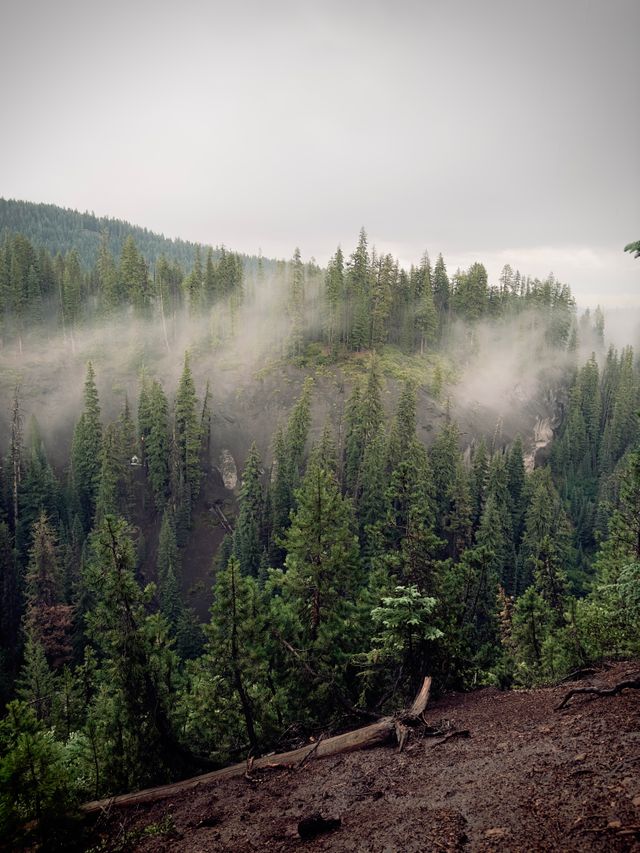
Oregon offers world-class birding across every region. The following hotspots are among the most productive and accessible.
Malheur National Wildlife Refuge, in the high desert of Harney County, was established in 1908 by President Theodore Roosevelt and now records more than 340 bird species. Its wetlands draw enormous concentrations of waterfowl, cranes, and songbirds, with the richest variety from late winter through the end of May.
The Klamath Basin refuges, straddling the Oregon and California border, form a critical pinch point on the Pacific Flyway and host spectacular numbers of waterfowl and wintering Bald Eagles.
Fort Stevens State Park, at the mouth of the Columbia River, combines beach, jetty, dune, and forest habitats and is a reliable spot for coastal and migrating birds.
The central Oregon coast from Newport to Bandon offers the greatest year-round diversity of seabirds and shorebirds, including nesting Tufted Puffins on offshore rocks. In the interior, the Cascade Lakes and central Oregon high desert near Bend hold mountain and sage-steppe specialties within a short drive of one another.
How to Attract Birds to Your Yard
A well-planned Oregon yard can draw a surprising range of species. The most effective approach combines food, water, native plants, and nesting sites.
For seed feeders, black oil sunflower seeds attract the widest variety of finches, chickadees, jays, and grosbeaks, while nyjer draws goldfinches and siskins and millet scattered low suits juncos, sparrows, and towhees. Suet supports woodpeckers, nuthatches, and flickers, especially in cool weather. A sugar-water feeder, mixed at one part white sugar to four parts water with no dye, supports Anna’s Hummingbirds year-round in the west and Rufous Hummingbirds in the warmer months.
Water is often the single most powerful draw. A clean birdbath, especially one with moving or dripping water, attracts robins, waxwings, tanagers, and many species that never touch a feeder.
Native plants do the most lasting good. Red-flowering currant, native honeysuckle, serviceberry, and Oregon grape provide nectar, berries, and the insects that nesting birds need. Nest boxes sized correctly can host chickadees, Western Bluebirds, and swallows.
The Oregon Department of Fish and Wildlife encourages practices that keep birds safe: clean feeders regularly to prevent disease, take feeders down temporarily if sick birds appear, and keep cats indoors. Following that guidance protects the very birds a feeding station is meant to enjoy.
Conservation in Oregon
Oregon’s bird diversity comes with real conservation challenges, and several current stories show both the threats and the responses underway.
The most dramatic recent events have unfolded in the Klamath Basin, where prolonged drought and limited water deliveries have concentrated waterbirds into shrinking, warm wetlands. Those conditions favor avian botulism, a paralytic disease caused by the soil bacterium Clostridium botulinum. According to reporting by Oregon Public Broadcasting, the worst outbreak in the region’s history killed at least 60,000 birds in 2020, and further large die-offs have struck in recent years, prompting emergency water releases and a field hospital run by wildlife rehabilitators and volunteers, including the Bird Alliance of Oregon.
Forest birds face a different pressure. The Marbled Murrelet (Brachyramphus marmoratus), a small seabird that nests high in old-growth conifers within a few miles of the coast, has declined as its ancient forest habitat has been logged and fragmented. The species was listed as threatened under the federal Endangered Species Act in 1992. In 2021, the Oregon Fish and Wildlife Commission reclassified it from threatened to endangered under state law, a decision the American Bird Conservancy and other groups had long sought. The Cornell Lab of Ornithology’s 2025 State of the Birds report lists the murrelet as a Tipping Point species that has lost more than half its population over the past 50 years.
Grassland birds tell a quieter version of the same story. Even Oregon’s state bird, the Western Meadowlark, has declined steeply in the Willamette Valley as prairie has given way to development and intensive agriculture. These trends underscore why habitat protection, from old-growth forest to native grassland, sits at the heart of bird conservation in the state.
There are hopeful signs as well. The California Condor, absent from Oregon since 1904, is edging back toward its historic range through a reintroduction program led by the Yurok Tribe in partnership with the U.S. Fish and Wildlife Service. In May 2026, a young condor became the first to fly free in Oregon skies in more than a century, and the Nez Perce Tribe has begun planning a separate reintroduction in the Hells Canyon area on the Oregon and Idaho border.
Frequently Asked Questions
What is the most common backyard bird in Oregon?
The Dark-eyed Junco is among the most common backyard birds in Oregon, abundant at feeders and along forest edges statewide. Other frequent yard visitors include the Black-capped Chickadee, American Robin, House Finch, and Song Sparrow. Local abundance varies between the wetter west side and the drier east side of the state.
What is the state bird of Oregon?
The state bird of Oregon is the Western Meadowlark (Sturnella neglecta), a grassland songbird known for its bright yellow breast, black V, and rich, flute-like song. Oregon schoolchildren chose it in a 1927 vote, and Governor Isaac L. Patterson made it official by proclamation. In 2017 the state added the Osprey as its official state raptor.
When do hummingbirds arrive in Oregon?
Anna’s Hummingbirds live in western Oregon year-round, so they are present in all seasons. Migratory Rufous Hummingbirds return early, reaching the Oregon coast and Willamette Valley by late February or early March in most years, with arrivals later in eastern and higher-elevation areas. Keeping a clean feeder up by late February helps catch the first arrivals in the west.
What is the largest bird in Oregon?
Among regularly occurring species, the Great Blue Heron and Sandhill Crane are among the tallest birds in Oregon, and the Bald Eagle and Golden Eagle are the largest raptors. North America’s largest land bird, the California Condor, with a wingspan of roughly 2.9 m (9.5 ft), is native to Oregon but vanished from the state after the last wild bird was recorded near Drain in 1904. Following the Yurok Tribe’s reintroduction program in nearby Northern California, a young condor known as B9 flew into southern Oregon in May 2026, the first free-flying condor documented in the state in more than a century.
Where are the best places to go birding in Oregon?
Malheur National Wildlife Refuge in the high desert and the Klamath Basin refuges on the California border are two of the finest waterbird sites in the West. The central Oregon coast from Newport to Bandon offers the greatest seabird and shorebird diversity, while Fort Stevens State Park and the Cascade Lakes near Bend add coastal and mountain specialties.
How many bird species are found in Oregon?
Oregon has 552 recorded bird species as of May 2026, according to the Oregon Bird Records Committee, which maintains the official state checklist. The total includes year-round residents, seasonal breeders, wintering birds, migrants, and rare vagrants documented over many decades.
Conclusion
Oregon’s 552 recorded bird species are the natural product of a state that reaches from Pacific sea stacks to sagebrush basins, all threaded by the great Pacific Flyway. That geographic range means a birder here can meet chickadees and juncos in a suburban yard, a meadowlark on an eastern fence post, an Osprey over a river, and puffins on a coastal cliff, often in the same trip.
The same diversity carries responsibility. Botulism in the Klamath Basin, the decline of the old-growth-dependent Marbled Murrelet, and the fading song of the meadowlark in the Willamette Valley all point to habitat as the deciding factor in the future of Oregon’s birds. Watching, learning, and stewarding native habitats are the surest ways to keep this abundance intact.
To go deeper, explore our profile of the Western Meadowlark, and watch for our forthcoming spoke guides to Oregon’s owls, hummingbirds, woodpeckers, and backyard feeder birds.
Works Cited
- Oregon Bird Records Committee. “One-page Checklist of Oregon Birds (552 species), May 2026.” Oregon Birding Association. https://oregonbirding.org/wp-content/uploads/2026/05/one-page-checklist-2026May.pdf
- Oregon Bird Records Committee. “Oregon Bird Records Committee.” Oregon Birding Association. https://oregonbirding.org/oregon-bird-records-committee/
- Oregon Encyclopedia. “Oregon State Symbols.” https://www.oregonencyclopedia.org/articles/oregon_state_symbols/
- Oregon Encyclopedia. “Western Meadowlark.” https://www.oregonencyclopedia.org/articles/western_meadowlark/
- Oregon Department of Fish and Wildlife. “Western Meadowlark (Sturnella neglecta).” Oregon Conservation Strategy. https://www.dfw.state.or.us/conservationstrategy/docs/Meadowlark_factsheet.pdf
- Oregon Conservation Strategy. “Ecoregions.” https://www.oregonconservationstrategy.com/ecoregions/
- National Audubon Society. “Anna’s Hummingbird.” Audubon Field Guide. https://www.audubon.org/field-guide/bird/annas-hummingbird
- National Audubon Society. “When to Expect Hummingbirds at Your Feeders and Flowers This Spring.” https://www.audubon.org/magazine/when-expect-hummingbirds-your-feeders-and-flowers-spring
- U.S. Fish and Wildlife Service. “Malheur National Wildlife Refuge: Species.” https://www.fws.gov/refuge/malheur/species
- Oregon Public Broadcasting. “A botulism outbreak in the Klamath Basin has killed about 20,000 migratory birds this summer.” https://www.opb.org/article/2024/08/30/southern-oregon-klamath-basin-migratory-birds-die-botulism/
- Oregon Public Broadcasting. “Wildlife rehabilitators treat birds one by one, as botulism outbreak at a Klamath Basin refuge drags on.” https://www.opb.org/article/2024/10/15/klamath-basin-oregon-refuge-botulism-outbreak-wildlife-rehabilitators-treat-birds/
- Oregon Wild. “Welcoming Back California Condors.” https://oregonwild.org/resource/california-condors/
- Rogue Valley Times. “Condor flies into Oregon for first time in over 120 years.” https://rv-times.com/2026/06/04/condor-flies-into-oregon-for-first-time-in-over-120-years/
- National Audubon Society. “Western Meadowlark.” Audubon Field Guide. https://www.audubon.org/field-guide/bird/western-meadowlark
- Bird Alliance of Oregon. “Marbled Murrelet.” https://birdallianceoregon.org/our-work/protect/habitat-and-wildlife/imperiled-species/marbled-murrelet/
- American Bird Conservancy. “Conserving Marbled Murrelets.” https://abcbirds.org/news/marbled-murrelet-conservation/
- Cornell Lab of Ornithology. “Marbled Murrelet Life History.” All About Birds. https://www.allaboutbirds.org/guide/Marbled_Murrelet/lifehistory