Texas Backyard Birds: A Field Guide to the Species at Your Feeders
Texas is home to 678 recorded bird species as of June 7, 2026, according to the Texas Bird Records Committee of the Texas Ornithological Society, the highest state total in the United States. A meaningful share of those species pass through backyards, and a smaller, dependable group of common backyard birds visits feeders across the state throughout the year.
That abundance is no accident. Texas sits astride the Central Flyway, the great interior migration corridor that carries millions of migratory birds between Canada and Latin America, and the Lone Star State spans ten distinct ecoregions where eastern forests, western deserts, and southern subtropical brushlands converge. This hub introduces the birds you are most likely to see in Texas yards, explains where and when to find them, and links to deeper guides on owls, doves, and color-based identification.
Key Takeaways
- The Northern Mockingbird (Mimus polyglottos) has been the official state bird of Texas since 1927 and lives year-round across the entire state.
- Texas has recorded 678 bird species as of 2026, per the Texas Bird Records Committee, more than any other U.S. state.
- The Northern Cardinal is among the most common and recognizable backyard birds in Texas, present in every season.
- Spring, from March through May, is the best season for backyard birding in Texas because migration overlaps with the breeding season.
- High Island on the Texas Gulf Coast is one of North America’s most famous spring migration hotspots.
At-a-Glance: Texas Backyard Birds
The table below lists the anchor species profiled in this guide along with additional common backyard birds worth recognizing. Sizes are given as body length. Feeder food notes indicate the offering most likely to attract each species.
| Species | Scientific name | Size | When present | Where to find | Best feeder food |
|---|---|---|---|---|---|
| Northern Cardinal | Cardinalis cardinalis | 21 to 23 cm (8.3 to 9.1 in) | Year-round resident | Statewide; thickets, yards | Black oil sunflower seeds |
| Northern Mockingbird | Mimus polyglottos | 20 to 28 cm (8.1 to 11.0 in) | Year-round resident | Statewide; open habitats | Fruit, mealworms, suet |
| Mourning Dove | Zenaida macroura | 23 to 34 cm (9.1 to 13.4 in) | Year-round resident | Statewide; open ground | White millet, cracked corn |
| White-winged Dove | Zenaida asiatica | 29 to 31 cm (11.4 to 12.2 in) | Mostly year-round; expanding | Central and South Texas towns | Sunflower, cracked corn |
| Blue Jay | Cyanocitta cristata | 25 to 30 cm (9.8 to 11.8 in) | Year-round resident | Eastern half; oak woodlands | Peanuts, sunflower seeds |
| Carolina Chickadee | Poecile carolinensis | 11.5 to 13 cm (4.5 to 5.1 in) | Year-round resident | Eastern and central; wooded yards | Sunflower, suet |
| Carolina Wren | Thryothorus ludovicianus | 12.5 to 14 cm (4.9 to 5.5 in) | Year-round resident | Eastern half; dense thickets | Suet, mealworms, peanuts |
| House Finch | Haemorhous mexicanus | 12.5 to 15 cm (4.9 to 5.9 in) | Year-round resident | Statewide; suburban areas | Sunflower, nyjer |
| American Goldfinch | Spinus tristis | 11 to 14 cm (4.3 to 5.5 in) | Winter (nonbreeding) | Statewide in winter | Nyjer, sunflower chips |
| Downy Woodpecker | Dryobates pubescens | 14 to 17 cm (5.5 to 6.7 in) | Year-round resident | Eastern half; wooded areas | Suet, sunflower |
| Red-bellied Woodpecker | Melanerpes carolinus | 22.5 to 27 cm (8.9 to 10.6 in) | Year-round resident | Eastern half; woodland edge | Suet, peanuts |
| Red-tailed Hawk | Buteo jamaicensis | 45 to 65 cm (17.7 to 25.6 in) | Year-round resident | Statewide; open country | Not a feeder bird |
| Cooper’s Hawk | Astur cooperii | 37 to 45 cm (14.6 to 17.7 in) | Year-round resident | Statewide; wooded suburbs | Hunts feeder birds |
| Great Blue Heron | Ardea herodias | 97 to 137 cm (38 to 54 in) | Year-round resident | Statewide; small ponds, wetlands | Not a feeder bird |
| Scissor-tailed Flycatcher | Tyrannus forficatus | 22 to 38 cm (8.7 to 15.0 in) | Spring and summer breeder | Statewide; open habitats, fences | Not a feeder bird |
| Painted Bunting | Passerina ciris | 12 to 14 cm (4.7 to 5.5 in) | Spring and summer breeder | Central, South, East Texas | White millet, sunflower |
| Ruby-throated Hummingbird | Archilochus colubris | 7 to 9 cm (2.8 to 3.5 in) | Spring through fall | Eastern half of Texas | Sugar-water nectar |
| Black-chinned Hummingbird | Archilochus alexandri | 8 to 9 cm (3.1 to 3.5 in) | Spring through fall | Central and western Texas | Sugar-water nectar |
| Tufted Titmouse | Baeolophus bicolor | 14 to 16 cm (5.5 to 6.3 in) | Year-round resident | Eastern Texas; sunflower fan | Sunflower seeds |
| Black-crested Titmouse | Baeolophus atricristatus | 14 to 16 cm (5.5 to 6.3 in) | Year-round resident | Central and western Texas | Sunflower seeds |
| Lesser Goldfinch | Spinus psaltria | 9 to 11 cm (3.5 to 4.3 in) | Year-round in central and west | Central and western Texas | Nyjer |
| Great-tailed Grackle | Quiscalus mexicanus | 38 to 46 cm (15 to 18 in) | Year-round resident | Statewide; towns, parking lots | Cracked corn |
| Red-winged Blackbird | Agelaius phoeniceus | 22 to 24 cm (8.7 to 9.4 in) | Year-round resident | Statewide; marshes, fields | Mixed seed, cracked corn |
| White-throated Sparrow | Zonotrichia albicollis | 15 to 19 cm (5.9 to 7.5 in) | Winter (nonbreeding) | Eastern half in winter | White millet on ground |
| Chipping Sparrow | Spizella passerina | 12 to 15 cm (4.7 to 5.9 in) | Winter and migration | Statewide; lawns, woodland edge | Millet, small seed |
| Dark-eyed Junco | Junco hyemalis | 14 to 16 cm (5.5 to 6.3 in) | Winter (nonbreeding) | Northern and central Texas | Millet on ground |
| Northern Flicker | Colaptes auratus | 28 to 36 cm (11 to 14 in) | Mostly winter; some resident | Statewide; open woodland | Suet, ground foraging |
| Golden-fronted Woodpecker | Melanerpes aurifrons | 22 to 26 cm (8.7 to 10.2 in) | Year-round resident | Central and South Texas | Suet, peanuts, fruit |
| American Robin | Turdus migratorius | 20 to 28 cm (7.9 to 11.0 in) | Winter flocks; some breeders | Statewide; lawns | Fruit, mealworms |
| Cedar Waxwing | Bombycilla cedrorum | 14 to 17 cm (5.5 to 6.7 in) | Winter (nonbreeding) | Statewide; berry trees | Berries, not typical feeders |
| Inca Dove | Columbina inca | 17 to 23 cm (6.7 to 9.1 in) | Year-round resident | Central and South Texas towns | Millet, cracked corn |
| White-breasted Nuthatch | Sitta carolinensis | 13 to 14 cm (5.1 to 5.5 in) | Year-round resident | Eastern and central woodlands | Sunflower, suet |
| Rufous Hummingbird | Selasphorus rufus | 7 to 9 cm (2.8 to 3.5 in) | Fall and winter migrant | Statewide, mostly fall | Sugar-water nectar |
Why Texas Holds So Many Birds: Geography and the Central Flyway
Texas holds more bird species than any other state because it combines enormous size, dramatic habitat variety, and a position at the center of a major migration route. Covering 266,807 square miles (691,027 square kilometers), it is second only to Alaska in land area, and that space contains a great deal of climatic variation. Annual rainfall ranges from about 8 inches (20 cm) in the deserts of far West Texas to roughly 56 inches (142 cm) in the swamps of East Texas.
The state is generally divided into ten ecoregions: the Piney Woods, the Gulf Prairies and Marshes, the Post Oak Savannah, the Blackland Prairies, the Cross Timbers, the South Texas Plains, the Edwards Plateau, the Rolling Plains, the High Plains, and the Trans-Pecos. This is a crossroads where eastern habitats meet western ones and southern subtropical habitats meet northern temperate ones. The pine-oak forests and bottomland forest of East Texas support very different birds than the thorn scrub of the South Texas Plains or the juniper-oak canyons of the Edwards Plateau, the region commonly known as the Texas Hill Country.
Layered on top of this geography is the Central Flyway, one of four principal migration corridors in North America. This flyway funnels migratory birds down the interior of the continent, from the boreal forests of Canada across the Great Plains to the Texas Gulf Coast and onward to Mexico, Central America, and South America. Because so many species concentrate along this route, Texas serves as a seasonal waystation for a large fraction of North America’s migratory birds, and backyards along the way receive a steady turnover of visitors as the seasons change.
The State Bird of Texas: Northern Mockingbird
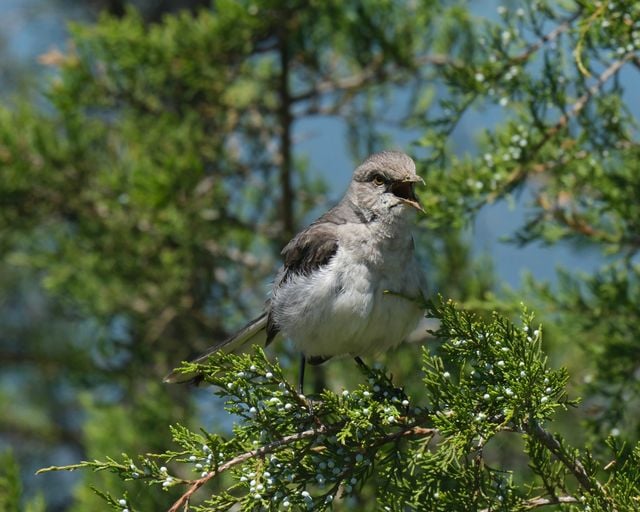
The state bird of Texas is the Northern Mockingbird (Mimus polyglottos), designated by the state legislature in 1927. It is a medium-sized, slender songbird, dull gray above with paler underparts, and it flashes white wing patches and white outer tail feathers in flight. It lives year-round throughout Texas and is one of the most frequently noticed birds in the state.
The mockingbird earns its name and its scientific epithet, polyglottos, meaning “many-tongued.” It imitates the songs of numerous other birds, and it will also mimic sounds such as squeaky hinges and barking dogs. Unmated males sing the most, sometimes through the night, and both sexes sing in autumn to defend winter feeding territories. Females appear to favor males with the largest repertoire of different songs. The species occupies nearly every habitat in Texas, from desert to forest to city, and it readily defends yards and gardens with conspicuous displays and diving attacks on intruders.
Common Backyard Birds of Texas
The following species are the birds Texas residents encounter most often at feeders, in gardens, and along suburban streets. For a dedicated treatment of the state’s smaller songbirds, see the companion guide to small backyard birds of Texas.
Northern Cardinal (Cardinalis cardinalis)
The Northern Cardinal is one of the most recognizable backyard birds in Texas and a year-round resident statewide. The male is brilliant red with a black mask around the face and a pointed crest; the adult female is warm buff-brown with red highlights in the wings, tail, and crest. Both sexes measure 21 to 23 cm (8.3 to 9.1 in) in length.
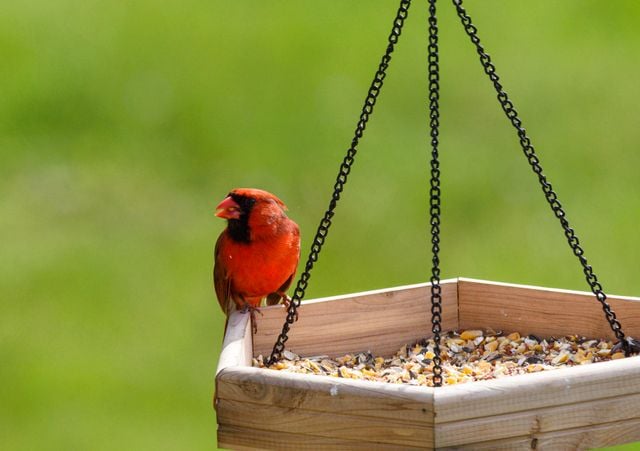
Cardinals favor woodland edges, dense thickets, and shrubby yards, where they forage low and nest in tangles of vegetation. Their diet centers on seeds, but it also includes insects and fruit, and pairs often remain together on territory throughout the year. Few feeder birds are easier to attract. A platform or hopper feeder stocked with black oil sunflower seeds, placed near protective cover, will draw cardinals reliably. Their clear, whistled song, often rendered as cheer cheer cheer or birdy birdy birdy, carries across neighborhoods in early spring.
Mourning Dove (Zenaida macroura)
The Mourning Dove is a slender, long-tailed dove and one of the most abundant birds in Texas, present year-round across the state. It is soft grayish-brown with black spots on the wings and a pale, tapering tail edged in white. Length ranges from 23 to 34 cm (9.1 to 13.4 in), including the long tail.

Mourning Doves thrive in open habitats, agricultural land, suburban areas, and towns, and they visit yards to feed on the ground beneath feeders. Their diet is almost entirely seeds. They are strong, fast fliers, and their wings produce a distinctive whistling sound on takeoff. The soft, mournful cooing that gives the species its name is often mistaken for an owl. To attract Mourning Doves, scatter white millet or cracked corn on the ground or offer it on a low platform feeder, since these birds prefer to feed in the open rather than cling to hanging feeders.
White-winged Dove (Zenaida asiatica)
The White-winged Dove is a plump, brownish-gray dove marked by a bold white stripe along the edge of each folded wing, which flashes as a broad white band in flight. It measures 29 to 31 cm (11.4 to 12.2 in) in length and shows a small black mark on the cheek and orange-red eyes at close range.
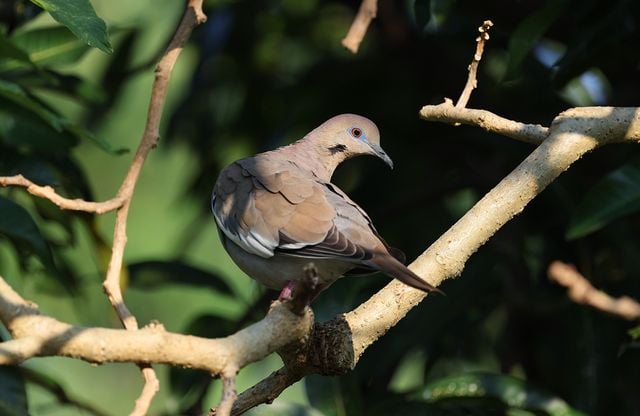
Once largely restricted to South Texas and the Rio Grande Valley, the White-winged Dove has expanded dramatically northward and is now a common sight in Central Texas cities and beyond. It frequents towns, suburban areas, and native brushlands, feeding on seeds, grains, and fruit, and it is a familiar visitor to platform feeders stocked with sunflower or cracked corn. Its cooing song is often described as sounding like who cooks for you. The species is a good example of a bird whose range has shifted as urban plantings and feeders have spread across the state.
Blue Jay (Cyanocitta cristata)
The Blue Jay is a large, crested songbird, bright blue above with a white face and underparts and a black necklace across the throat. It measures 25 to 30 cm (9.8 to 11.8 in) in length and is common in the eastern half of Texas, where oak woodlands and wooded suburbs provide its preferred habitat.
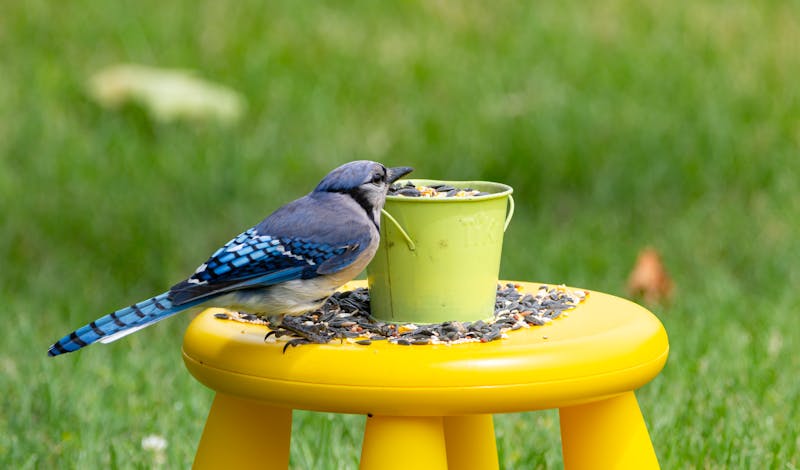
Blue Jays are intelligent, social, and vocal. They cache acorns and other nuts, an activity that helps disperse oak trees, and they are known to imitate the calls of hawks. Their diet includes acorns, seeds, insects, and occasionally the eggs or nestlings of other birds. At feeders they favor peanuts in the shell, whole corn, and sunflower seeds, and a sturdy platform or hopper feeder suits their size. Though sometimes considered aggressive at feeders, their bold coloration and complex vocalizations make them a favorite among backyard bird watchers in East Texas.
Carolina Chickadee (Poecile carolinensis)
The Carolina Chickadee is a tiny, active songbird with a black cap and black bib set off by white cheeks, gray upperparts, and pale underparts. It measures just 11.5 to 13 cm (4.5 to 5.1 in) in length and is a year-round resident across the eastern and central portions of Texas.
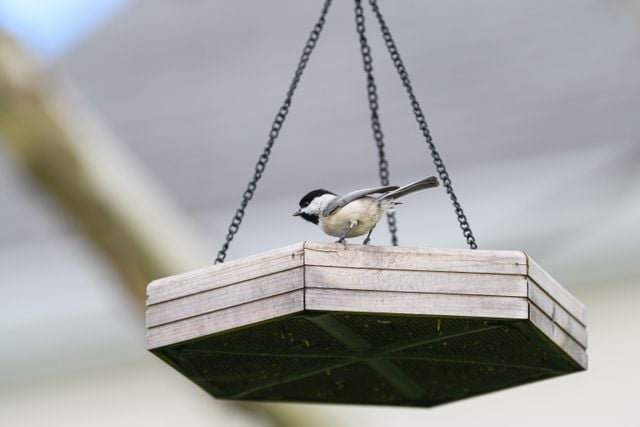
This is the chickadee of most of Texas. The similar Black-capped Chickadee (Poecile atricapillus) barely reaches the state and is not a typical Texas backyard bird, so a small black-and-white chickadee at a Texas feeder is almost always a Carolina Chickadee. It frequents wooded yards, parks, and forest edges, foraging acrobatically for insects, spiders, seeds, and berries. Chickadees readily use feeders, taking sunflower seeds one at a time and often caching them, and they visit suet in cold weather. They also accept nest boxes with a small entrance hole, which makes them one of the more rewarding little birds to host in a Texas yard.
Carolina Wren (Thryothorus ludovicianus)
The Carolina Wren is a compact, rich reddish-brown wren with a bold white eyebrow stripe and a habit of cocking its tail upward. It measures 12.5 to 14 cm (4.9 to 5.5 in) in length and is a year-round resident of the eastern half of Texas, extending into Central Texas.
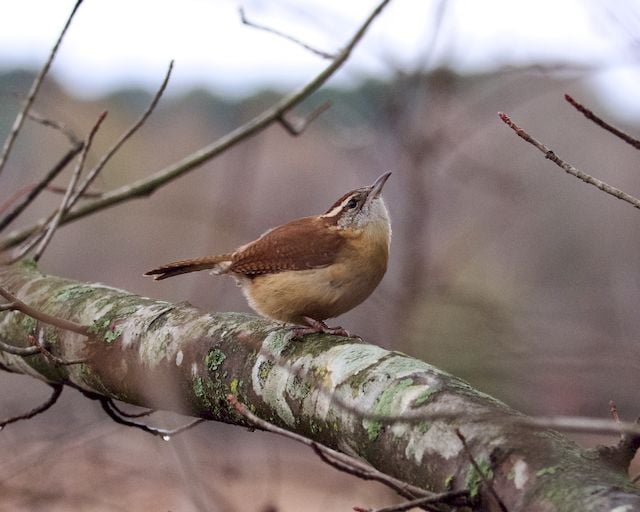
For such a small bird, the Carolina Wren has a remarkably loud, ringing song, frequently written as teakettle teakettle teakettle. It favors dense thickets, brush piles, and shrubby yards, where it probes bark, leaf litter, and crevices for insects and spiders. It is one of the more insect-dependent feeder visitors, so suet, mealworms, and shelled peanuts attract it more reliably than seed alone. Carolina Wrens are curious and will investigate porches, garages, and hanging planters, sometimes nesting in unexpected nooks close to human activity.
House Finch (Haemorhous mexicanus)
The House Finch is a small, streaky finch and one of the most widespread backyard birds in Texas, present year-round statewide. The male House Finch shows red on the head, throat, and upper breast, with brown streaking on the flanks; the female is plain grayish-brown with blurry streaks. Length ranges from 12.5 to 15 cm (4.9 to 5.9 in).
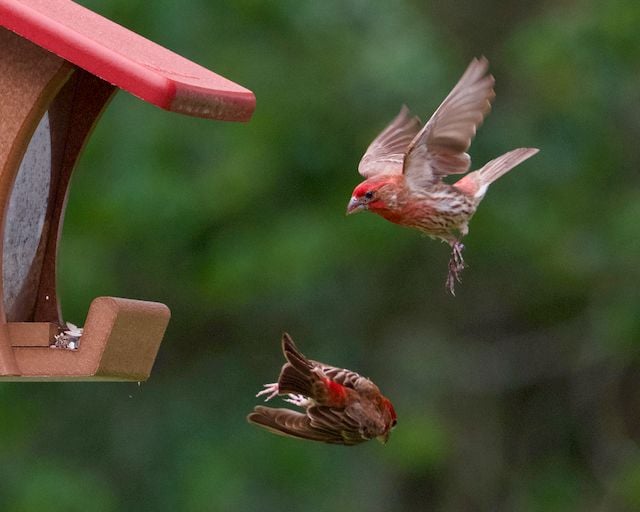
House Finches are highly social and thrive in suburban areas, town centers, and around buildings, often nesting in hanging baskets and ledges. Their diet is dominated by seeds, buds, and fruit. They are among the easiest birds to bring to a yard, gathering readily at tube feeders and hoppers stocked with black oil sunflower seeds or nyjer. Their cheerful, warbling song and long, tumbling phrases are a common sound of Texas neighborhoods throughout the year. The red of the male comes from pigments in its food, so diet can shift some males toward orange or yellow.
American Goldfinch (Spinus tristis)
The American Goldfinch is a small finch best known to Texans as a winter visitor, arriving in flocks that brighten feeders from late fall through early spring. In winter plumage, the birds seen in Texas are mostly dull olive-brown and buff with blackish wings and pale wingbars, lacking the vivid yellow of the breeding male. Length ranges from 11 to 14 cm (4.3 to 5.5 in).
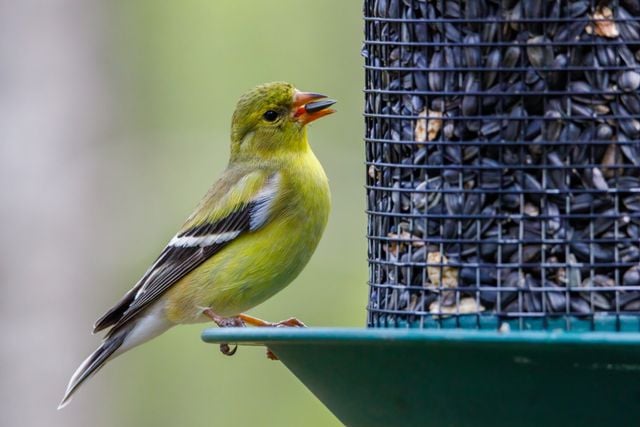
American Goldfinches are almost strictly seed eaters, favoring small seeds of thistles, sunflowers, and other composites. In winter yards they gather in active, twittering groups. To attract them, offer nyjer (thistle) seed in a fine-ported tube feeder or sunflower chips, and expect numbers to build during cold spells. Because they breed to the north and in cooler parts of their range, most goldfinches in Texas depart by late spring, making them a seasonal highlight rather than a year-round resident across most of the state.
Woodpeckers of Texas Backyards
Woodpeckers are among the most sought-after feeder visitors in the state. Two species dominate backyard sightings in the eastern half of Texas. For the full range of Texas woodpeckers, including the Ladder-backed and Pileated, see the planned guide to woodpeckers of Texas.
Downy Woodpecker (Dryobates pubescens)
The Downy Woodpecker is the smallest woodpecker in North America and a familiar year-round resident in the eastern half of Texas. It is boldly patterned in black and white, with a white back, checkered wings, and white spots; males show a small red patch on the back of the head. Length ranges from 14 to 17 cm (5.5 to 6.7 in), and the bill is notably short and stubby.
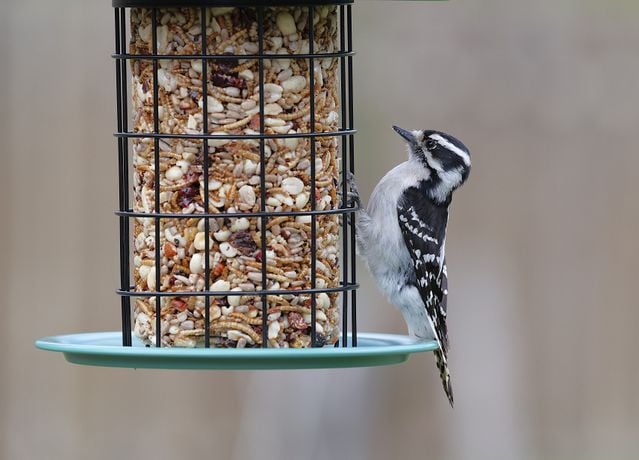
Downy Woodpeckers inhabit wooded areas, parks, and suburban yards with mature trees. They forage on trunks, branches, and even weed stems for insects and larvae, and they supplement this with seeds and berries. Now placed in the genus Dryobates under current taxonomy, the Downy Woodpecker readily visits suet feeders and also takes sunflower seeds and shelled peanuts. Its gentle pik note and descending whinny are common woodland sounds. A suet cage near trees is the surest way to host this small woodpecker through the year.
Red-bellied Woodpecker (Melanerpes carolinus)
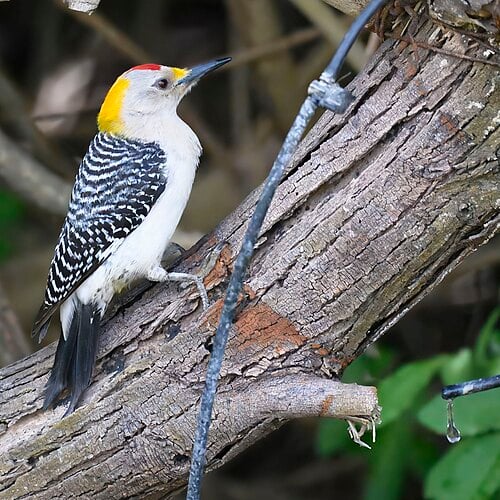
The Red-bellied Woodpecker is a medium-sized woodpecker of the eastern half of Texas, present year-round in woodland and shady suburbs. Despite its name, the pale red wash on the belly is easy to miss; the most obvious features are the boldly barred black-and-white back and, on the male, a red cap running from the bill to the nape. Length ranges from 22.5 to 27 cm (8.9 to 10.6 in).
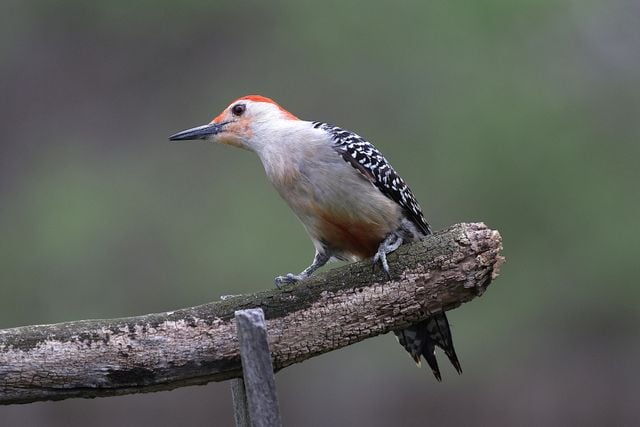
This woodpecker favors bottomland forest, pine-oak forests, and wooded neighborhoods along the woodland edge. Its diet is varied, including insects, spiders, acorns, fruit, and seeds, and it will wedge nuts into bark crevices to break them open. At feeders it takes suet, peanuts, and sunflower seeds, and its rolling, churring call is a distinctive sound of East Texas yards. Providing suet and leaving mature or dead trees standing where safe both help attract and support this adaptable species.
Birds of Prey in the Backyard
Even suburban Texas yards attract raptors, particularly where feeders concentrate smaller birds. Two hawks account for most backyard sightings. A dedicated guide to the owls of Texas covers the state’s nocturnal raptors separately.
Red-tailed Hawk (Buteo jamaicensis)
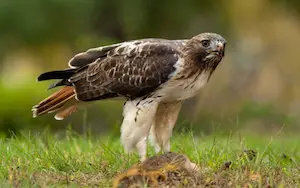
The Red-tailed Hawk is the most commonly seen large hawk in Texas, a year-round resident found statewide in open country and along highways. Adults are broad-winged and stocky, brown above and pale below with a streaked band across the belly, and most show the brick-red upper tail that gives the species its name. Length ranges from 45 to 65 cm (17.7 to 25.6 in), with females noticeably larger than males.
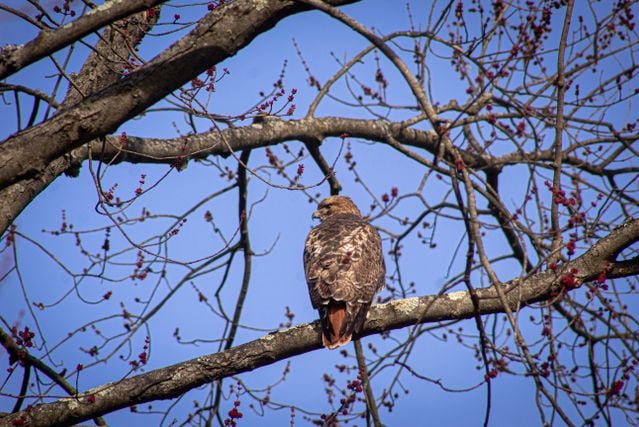
This large bird hunts from perches and while soaring, taking rodents, rabbits, reptiles, and other small animals. Its presence near yards reflects healthy populations of the prey it controls, and its raspy, descending scream is widely recognized. Red-tailed Hawks are not feeder birds, but they frequently perch on utility poles and tall trees at the edges of neighborhoods, agricultural land, and open habitats. Observing one hunting over a field is one of the more accessible raptor experiences for Texas bird watchers.
Cooper’s Hawk (Astur cooperii)
The Cooper’s Hawk is a medium-sized, agile hawk that has adapted well to wooded suburbs, where it hunts the very songbirds that gather at feeders. Adults are blue-gray above with fine reddish barring below, a dark cap, and a long, banded tail; length ranges from 37 to 45 cm (14.6 to 17.7 in). Under current taxonomy the species has been moved to the genus Astur, so it is now written Astur cooperii rather than the older Accipiter cooperii.
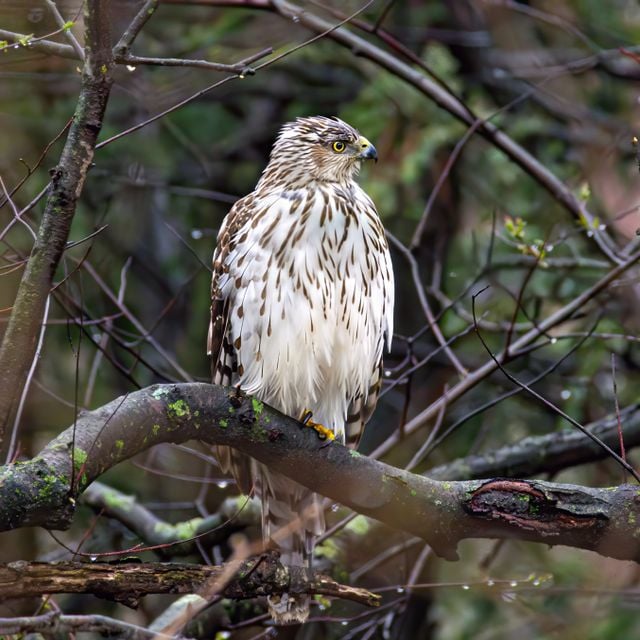
Cooper’s Hawks are built for maneuvering through trees, with short, rounded wings and a long tail that acts as a rudder. They prey mainly on medium-sized birds, and a hawk that appears suddenly at a quiet feeder is often this species. Rather than a problem, a hunting Cooper’s Hawk is a sign of a functioning backyard ecosystem. If one begins visiting frequently, pausing feeding for a week or two usually encourages it to move on.
Water and Wetland Birds Near the Yard
Yards near small ponds, creeks, and wetlands attract water birds that never visit feeders. The Great Blue Heron is the most conspicuous. For a fuller treatment of the state’s waders, see the planned guide to herons and egrets of Texas.
Great Blue Heron (Ardea herodias)
The Great Blue Heron is the largest and most widespread wading bird in Texas, a year-round resident found near water statewide. It is tall and long-legged, blue-gray overall with a white face, a black plume behind the eye, and a heavy, spearlike yellow bill. Standing height and body length range from about 97 to 137 cm (38 to 54 in), and the wingspan is far greater.
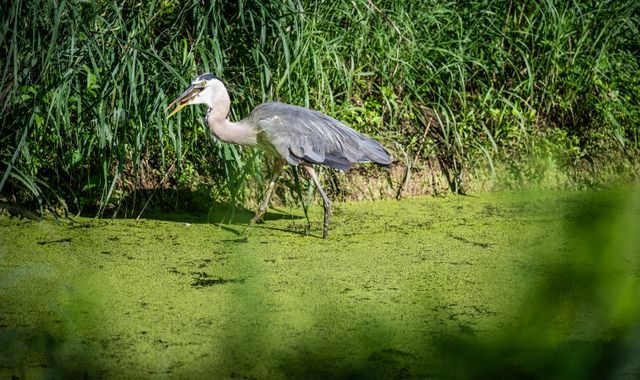
This heron hunts by standing motionless or wading slowly in shallow water, then striking with its bill to seize fish, amphibians, reptiles, and small mammals. It frequents the margins of small ponds, lakes, rivers, and coastal marshes, and it will visit ornamental garden ponds, sometimes to the dismay of fish keepers. Great Blue Herons often nest in colonies in tall trees near water. Their slow, deliberate flight, with the neck folded back and legs trailing, makes them easy to identify even at a distance.
Woodland and Grassland Specialties
Beyond the feeder regulars, several open-country and woodland-edge species define the character of Texas birding. Two stand out for their beauty and visibility.
Scissor-tailed Flycatcher (Tyrannus forficatus)
The Scissor-tailed Flycatcher is a striking spring and summer breeder across Texas, unmistakable for its extraordinarily long, forked tail. The body is pale gray with salmon-pink sides and flanks, and the tail can nearly double the bird’s length. Including the tail, length ranges from 22 to 38 cm (8.7 to 15.0 in).
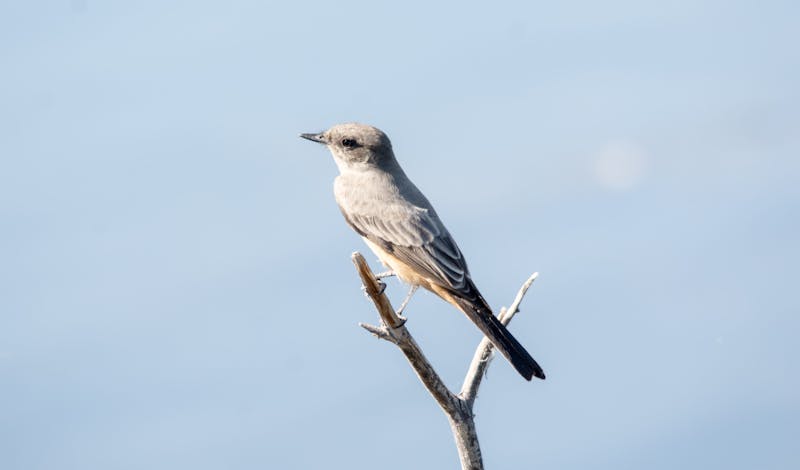
This elegant flycatcher favors open habitats, agricultural land, and roadsides, where it perches conspicuously on fences and wires and sallies out to catch insects in midair. It is one of the most beloved warm-weather birds of the state and a signature sight of the Texas roadside from spring through early fall. Although it does not visit feeders, it is easily observed in open country. Males perform a dramatic aerial courtship display, tumbling through the sky with the long tail streaming. Most Scissor-tailed Flycatchers depart Texas for Mexico and Central America by autumn.
Painted Bunting (Passerina ciris)
The Painted Bunting is among the most vividly colored birds in North America and a prized spring and summer breeder in Central, South, and East Texas. The adult male is unmistakable, with a blue head, bright red underparts, and a green back; the female and immature birds are a uniform bright yellow-green, unlike almost any other small bird. Length ranges from 12 to 14 cm (4.7 to 5.5 in).
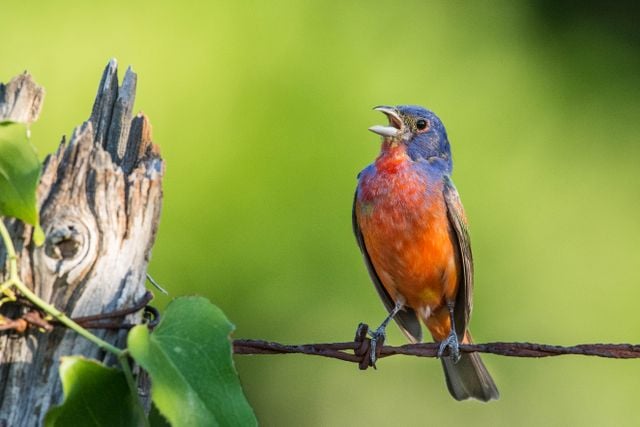
Painted Buntings favor dense thickets, brushy field edges, and woodland edge habitats, where males sing from partly hidden perches. Their diet is mostly seeds during much of the year, shifting to insects in the breeding season. They can be attracted to yards near suitable cover with white millet and small sunflower seeds, especially in feeders placed close to shrubs. Because the species has experienced long-term population concerns, hosting Painted Buntings responsibly, with clean feeders and nearby native cover, supports both enjoyment and stewardship.
Notable Migrants: Hummingbirds
Hummingbirds are the most anticipated migratory birds in Texas yards, and two species account for the majority of backyard sightings. For guidance on every hummingbird recorded in the state, including rarer western visitors, see the planned guide to hummingbirds of Texas.
Ruby-throated Hummingbird (Archilochus colubris)
The Ruby-throated Hummingbird is the common breeding hummingbird of the eastern half of Texas, present from spring through fall. The male shows a brilliant iridescent red throat, called a gorget, that can look black in poor light, with a green back and pale underparts; the female lacks the red throat and is green above and whitish below. Length ranges from 7 to 9 cm (2.8 to 3.5 in).
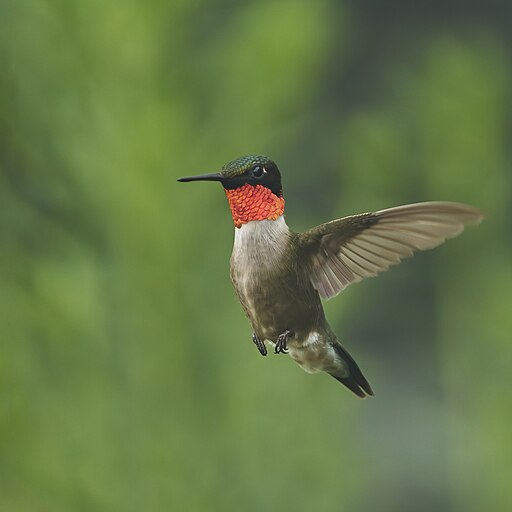
This tiny migrant winters in Mexico and Central America and returns to Texas beginning in late February and March, with numbers building through spring. It feeds on flower nectar and small insects and defends feeders aggressively. A simple sugar-water solution of one part white sugar to four parts water, offered in a clean feeder with no dye, attracts this species reliably. Ruby-throated Hummingbirds are among the highlights of the East Texas warm season, and fall migration brings a second surge of activity.
Black-chinned Hummingbird (Archilochus alexandri)
The Black-chinned Hummingbird is the counterpart of the Ruby-throated across Central and western Texas, present from spring through fall. The male has a black throat bordered below by a thin band of iridescent violet that is visible only in good light; the female is green above and pale below and is very difficult to distinguish from a female Ruby-throated. Length ranges from 8 to 9 cm (3.1 to 3.5 in).
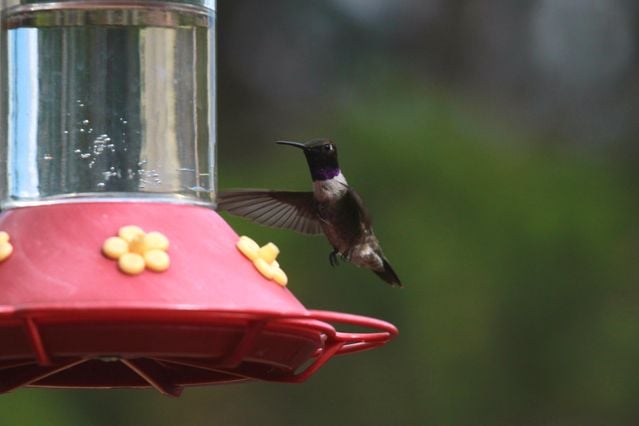
This adaptable hummingbird breeds from the Texas Hill Country westward to El Paso and beyond, occupying canyons, riparian corridors, and suburban gardens. In West Texas, the arrival of the first Black-chinned Hummingbirds around late March signals the start of spring, with numbers surging into early April. Like other hummingbirds, it feeds on nectar and small insects and comes readily to sugar-water feeders. Where its range overlaps with the Ruby-throated in Central Texas, careful observation of the males is often the only reliable way to separate the two.
Look-Alike Species: How to Tell Them Apart
Several Texas backyard birds are frequently confused. The table below summarizes the most useful field marks for the pairs that cause the most trouble.
| Confused pair | Key difference | Notes |
|---|---|---|
| Downy vs. Hairy Woodpecker | Downy has a short, stubby bill; Hairy has a long bill nearly as long as its head is wide | Both black and white; Hairy (Dryobates villosus) is larger, 18 to 26 cm (7.1 to 10.2 in) |
| House Finch vs. Purple Finch | House Finch male has red concentrated on head and breast with brown streaks on flanks; Purple Finch male is more raspberry-red overall | Purple Finch (Haemorhous purpureus) is a less common winter visitor |
| Mourning Dove vs. White-winged Dove | Mourning Dove has a long pointed tail and no wing stripe; White-winged Dove has a rounded tail and a bold white wing stripe | White-winged shows a broad white wing band in flight |
Seasonal Guide: What to See When in Texas
Backyard bird watching in Texas changes with the seasons, and the table below outlines what to expect through the year. Because the state’s winters are mild across much of its range, many species remain present when they would have moved on farther north.
| Season | What to look for |
|---|---|
| Spring (March to May) | Peak migration overlaps breeding; hummingbirds arrive, Painted Buntings and Scissor-tailed Flycatchers return, warblers pass through |
| Summer (June to August) | Breeding season for resident and migrant species; hummingbirds active; young birds appear at feeders |
| Fall (September to November) | Southbound migration; a second hummingbird surge including Rufous Hummingbird; sparrows and waterfowl begin arriving |
| Winter (December to February) | American Goldfinches, White-throated Sparrows, Dark-eyed Juncos, and other northern visitors join year-round residents |
Notable Birding Locations Across Texas
Texas offers some of the finest birding in North America, and several locations rank among the continent’s best. High Island, on the upper Texas Gulf Coast, is one of the most famous spring migration sites in the country; when weather forces migrants down after their overnight flight across the Gulf of Mexico, warblers, tanagers, orioles, and buntings can fill its woodlots in remarkable numbers.
The Lower Rio Grande Valley is consistently ranked among the top birding destinations in North America, offering South Texas and Mexican specialties found nowhere else in the United States. Bentsen-Rio Grande Valley State Park anchors the World Birding Center, a network of sites along the river where species such as Green Jay and Plain Chachalaca are regular. In Central Texas, the Balcones Canyonlands National Wildlife Refuge in the Texas Hill Country was established in part to protect the breeding habitat of the endangered Golden-cheeked Warbler (Setophaga chrysoparia), which nests only in Texas.
The pine forests and lakes of East Texas offer excellent birding as well, from the bottomland forest of the Piney Woods to reservoirs and preserves scattered across the region. Local hotspots frequently mentioned by East Texas birders include Tyler State Park, the Mineola Nature Preserve, and the shorelines of large reservoirs such as Lake Fork, Lake Tyler, and Toledo Bend Reservoir. Many of these sites are well documented on eBird, the Cornell Lab of Ornithology platform, which provides current species lists and seasonal activity for locations statewide.
How to Attract Birds to Your Texas Yard
Attracting more birds to a Texas yard comes down to food, water, cover, and native plants. Offering the right foods brings in the widest variety of feeder birds. Black oil sunflower seeds appeal to the greatest number of species, from Northern Cardinals to chickadees and finches. White millet scattered on the ground or a low platform draws Mourning Doves, sparrows, and buntings. Nyjer seed in a fine tube feeder attracts goldfinches, suet supports woodpeckers and wrens, and clean sugar water in a nectar feeder brings hummingbirds through the warm months.
Water is often overlooked but powerfully effective. A shallow birdbath with fresh, clean water, ideally with a dripper or mister to create movement, attracts species that may ignore feeders entirely. Native plants provide the natural seeds, berries, nectar, and insects that birds evolved to use, and they support the insect populations that nearly all backyard birds need to raise their young. Planting native trees, shrubs, and wildflowers suited to your region does more for birds over time than feeders alone. Nest boxes sized for chickadees, titmice, and wrens can add breeding species to a yard.
Responsible feeding matters for the birds’ health. Feeders and birdbaths should be cleaned regularly to prevent the spread of disease, seed should be kept dry and free of mold, and feeders should be spaced to reduce crowding. If sick birds appear or a disease outbreak is reported in your area, temporarily taking feeders down and cleaning them thoroughly is the recommended response. Placing feeders either very close to windows or well away from them reduces collisions.
Conservation: Why Texas Backyards Matter
Backyard birding in Texas connects directly to a larger conservation story. A landmark 2019 study estimated that North America has lost nearly 3 billion birds, roughly 29 percent of its total abundance, since 1970. Because fully a third of North America’s migratory birds migrate through, breed in, or winter in Texas each year, the choices Texans make in their yards and communities carry outsized weight for the continent’s bird populations.
Texas Parks and Wildlife supports bird conservation through public programs, including the Great Texas Birding Classic, described as one of the largest and longest-running birdwatching tournaments in the country. Held each spring during peak migration, the month-long event raises funds for habitat and bird conservation projects statewide. In 2025 the tournament ran from April 15 to May 15, drew more than 1,300 participants on 226 teams, and directed 60,000 dollars toward conservation and birding projects chosen by the winning teams.
Individual actions add up. Providing native plants, clean water, and safe feeding stations, keeping cats indoors, and reducing nighttime lighting during migration all reduce pressure on birds. Backyard observations submitted to community science platforms such as eBird also feed directly into the datasets researchers use to track how bird populations are changing across Texas and beyond.
Frequently Asked Questions
What is the most common backyard bird in Texas?
The Northern Cardinal and the Mourning Dove are among the most common backyard birds in Texas, both present year-round across the state. Northern Mockingbirds and House Finches are also extremely widespread. The exact leader varies by region and season, but cardinals and doves are dependable at feeders nearly everywhere in Texas.
What is the state bird of Texas?
The state bird of Texas is the Northern Mockingbird (Mimus polyglottos), designated in 1927. It is a gray, medium-sized songbird famous for imitating the songs of other birds and other sounds. It lives year-round throughout the state and occupies nearly every habitat, from desert to city.
When do hummingbirds arrive in Texas?
Hummingbirds begin arriving in Texas in late February and March, with numbers building through spring. Ruby-throated Hummingbirds return to the eastern half of the state first, while Black-chinned Hummingbirds reach Central and West Texas, including El Paso, around late March. Hanging a clean nectar feeder by early March is a good way to catch the first arrivals.
What is the largest bird in a Texas backyard?
The Great Blue Heron is the largest bird likely to appear near a Texas yard, standing 97 to 137 cm (38 to 54 in) tall and frequenting small ponds and wetlands. Among true feeder-area birds, the Red-tailed Hawk and Great-tailed Grackle are among the largest. Wild Turkeys and Sandhill Cranes (Antigone canadensis) can appear in rural yards in some regions.
What can I feed birds to attract the most species in Texas?
Black oil sunflower seeds attract the widest variety of Texas backyard birds, including cardinals, chickadees, titmice, and finches. Adding white millet for ground-feeding doves and sparrows, nyjer for goldfinches, suet for woodpeckers, and sugar water for hummingbirds broadens the range further. Fresh, clean water in a birdbath increases visits from species that do not use feeders.
Are Blue Jays common in Texas?
Blue Jays are common year-round residents in the eastern half of Texas, particularly in oak woodlands and wooded suburbs. They become scarcer westward across the state, where drier, more open country limits the wooded habitat they prefer. In East Texas they are frequent, bold visitors to feeders offering peanuts and sunflower seeds.
Conclusion
Texas rewards backyard bird watching like few other places, combining the highest state species total in the country with a location at the heart of the Central Flyway and a mosaic of ten ecoregions. A modest set of common backyard birds, led by the Northern Cardinal, the Mourning Dove, and the state’s own Northern Mockingbird, forms the dependable core of what most Texans will see, while seasonal migrants such as hummingbirds, Painted Buntings, and wintering finches keep the cast changing through the year. Whether you watch from a suburban patio in Central Texas or a wooded lot in the East Texas Piney Woods, the same principles apply: offer good food and clean water, plant native, and observe with care.
From here, explore the deeper guides in this series, including the small backyard birds of Texas, the owls of Texas, the woodpeckers of Texas, and the color-based identification guides for the state. Each builds on this overview to help you identify, attract, and steward the remarkable birdlife of the Lone Star State.
Works Cited
- Texas Bird Records Committee, Texas Ornithological Society. “Texas State List.” Accessed 2026. https://www.texasbirdrecordscommittee.org/texas-state-list
- Texas Parks and Wildlife Department. “Northern Mockingbird (Mimus polyglottos).” https://tpwd.texas.gov/huntwild/wild/species/mockbird/
- Texas Parks and Wildlife Department. “Texas Ecoregions.” https://tpwd.texas.gov/education/hunter-education/online-course/wildlife-conservation/texas-ecoregions
- Texas Parks and Wildlife Department. “Migratory Flyways of North America, Central Flyway.” https://tpwd.texas.gov/huntwild/wild/birding/migration/flyways/central/
- Texas Parks and Wildlife Department. “The Great Texas Birding Classic.” https://tpwd.texas.gov/events/great-texas-birding-classic/
- Texas Parks and Wildlife Department. News Release, August 13, 2025. “Record Breaking Participation During 29th Great Texas Birding Classic.” https://tpwd.texas.gov/newsmedia/releases/?req=20250813a
- National Audubon Society. “Birding in Texas.” https://www.audubon.org/news/birding-texas
- Cornell Lab of Ornithology. “Nearly 3 Billion Birds Gone.” https://www.birds.cornell.edu/home/bring-birds-back/
- Rosenberg, K. V., et al. 2019. “Decline of the North American avifauna.” Science. https://www.science.org/doi/10.1126/science.aaw1313
- Texas State Library and Archives Commission. “Texas State Symbols.” https://www.tsl.texas.gov/ref/abouttx/symbols
- Cornell Lab of Ornithology, All About Birds. “Northern Cardinal Identification.” https://www.allaboutbirds.org/guide/Northern_Cardinal/id
- Cornell Lab of Ornithology, All About Birds. “Cooper’s Hawk Identification.” https://www.allaboutbirds.org/guide/Coopers_Hawk/id
- Cornell Lab of Ornithology, All About Birds. “Great Blue Heron Identification.” https://www.allaboutbirds.org/guide/Great_Blue_Heron/id
- eBird (Cornell Lab of Ornithology). “Mineola Nature Preserve, Wood County, Texas.” https://ebird.org/hotspot/L698120
- Texas Parks and Wildlife Department. “Birds of Tyler State Park: A Field Checklist.” https://tpwd.texas.gov/publications/pwdpubs/media/pwd_bk_p4508_0039c.pdf
More Birds to Explore
- Small Southwestern Birds Of Prey
- Hawks In Texas
- Orioles In Texas
- Swallows In Texas
- Doves In Texas
- Herons In Texas
- Texas Owl Sounds
- Kite Birds In Texas
- Night Birds In Texas
- Texas Birds Of Prey
- Yellow Birds In Texas
- Green Birds In Texas
- Parrots In Texas
- Black Birds In Texas
- Large Birds In Texas
- Small Birds In Texas
- Common Birds In Texas
- Red Birds In Texas
- White Birds In Texas