California Backyard Birds: A Complete Field Guide to the Golden State’s Feeder and Garden Species
California backyard birds range from the year-round Anna’s Hummingbird and acorn-hoarding California Scrub-Jay to seasonal visitors such as the White-crowned Sparrow and Yellow-rumped Warbler, drawn to bird feeders, native plantings, and water across the state’s varied landscapes. As of 26 May 2026, the California Bird Records Committee recognized 695 species on the official state list, the richest of any state in the United States, and a meaningful share of that diversity turns up in gardens, city parks, and suburban yards. This guide profiles the most common backyard birds of the Golden State, from seed-eating birds at the feeder to the insect hunters and nectar feeders of the surrounding hills.
That abundance is no accident. California sits along the Pacific Flyway, one of the four major North American migratory corridors, and stretches across an unusually wide range of habitats, from the California coast and interior valleys to oak woodlands, chaparral, high mountains, and desert. No other part of the western U.S. packs so many different bird species into its residential areas, parks, and gardens. This guide serves as a hub for identifying the wild birds you are most likely to host, understanding when they appear, and learning how to welcome them responsibly. It profiles the anchor species in depth and routes you to focused guides for owls, hummingbirds, and birds grouped by color.
Key Takeaways
- California’s official state list totals 695 species as of 26 May 2026, according to the California Bird Records Committee, the highest of any U.S. state.
- The state bird is the California Quail (Callipepla californica), designated California’s official avian emblem in 1931.
- The House Finch, California Scrub-Jay, and Anna’s Hummingbird rank among the most frequently reported backyard birds statewide.
- Anna’s Hummingbird is a year-round resident across much of lowland California and does not migrate, so feeders can stay active in every month.
- California lies on the Pacific Flyway, and the cooler months bring an influx of sparrows, juncos, and warblers to gardens and feeders.
California Backyard Birds at a Glance
The table below lists the anchor species profiled in this guide along with additional common yard visitors. Sizes give total length. Seasonality reflects general lowland patterns and varies by region.
| Species | Scientific name | Size | When present | Where to find | Best feeder food |
|---|---|---|---|---|---|
| House Finch | Haemorhous mexicanus | 13 to 14 cm (5.1 to 5.5 in) | Year-round | Yards, towns, farms | Black oil sunflower |
| Lesser Goldfinch | Spinus psaltria | 9 to 11 cm (3.5 to 4.3 in) | Year-round | Gardens, weedy edges | Nyjer, sunflower chips |
| California Scrub-Jay | Aphelocoma californica | 27 to 31 cm (11 to 12 in) | Year-round | Oak woods, suburbs | Peanuts, sunflower |
| Anna’s Hummingbird | Calypte anna | 10 to 11 cm (3.9 to 4.3 in) | Year-round | Gardens, coastal scrub | Sugar water (1:4) |
| Mourning Dove | Zenaida macroura | 23 to 34 cm (9.1 to 13.4 in) | Year-round | Open ground, wires | Millet, cracked corn |
| Dark-eyed Junco | Junco hyemalis | 14 to 16 cm (5.5 to 6.3 in) | Mostly winter in lowlands | Ground under feeders | Millet, sunflower chips |
| White-crowned Sparrow | Zonotrichia leucophrys | 15 to 16 cm (5.9 to 6.3 in) | Mostly winter | Brushy edges, gardens | Millet, mixed seed |
| California Towhee | Melozone crissalis | 21 to 25 cm (8.3 to 9.8 in) | Year-round | Chaparral, yards | Ground-scattered seed |
| Northern Mockingbird | Mimus polyglottos | 21 to 26 cm (8.3 to 10.2 in) | Year-round | Suburbs, hedgerows | Suet, fruit, mealworms |
| Black Phoebe | Sayornis nigricans | 16 to 18 cm (6.3 to 7.1 in) | Year-round | Near water, gardens | Insects (no feeder) |
| American Crow | Corvus brachyrhynchos | 40 to 53 cm (15.8 to 20.9 in) | Year-round | Everywhere | Peanuts, kitchen scraps |
| Oak Titmouse | Baeolophus inornatus | 13 to 14 cm (5.1 to 5.5 in) | Year-round | Oak woodlands | Sunflower, suet |
| American Robin | Turdus migratorius | 20 to 28 cm (7.9 to 11 in) | Year-round | Lawns, parks | Fruit, mealworms |
| Yellow-rumped Warbler | Setophaga coronata | 12 to 14 cm (4.7 to 5.5 in) | Winter and migration | Trees, shrubs | Suet, bark butter |
| Cooper’s Hawk | Astur cooperii | 37 to 45 cm (14.6 to 17.7 in) | Year-round | Wooded suburbs | Hunts feeder birds |
| Red-tailed Hawk | Buteo jamaicensis | 45 to 65 cm (17.7 to 25.6 in) | Year-round | Open country, poles | Not a feeder bird |
| Acorn Woodpecker | Melanerpes formicivorus | 19 to 23 cm (7.5 to 9.1 in) | Year-round | Oak woodlands | Suet, sunflower |
| Northern Flicker | Colaptes auratus | 28 to 31 cm (11 to 12.2 in) | Year-round to winter | Woodland edges, lawns | Suet, ants (ground) |
| California Quail | Callipepla californica | 24 to 27 cm (9.4 to 10.6 in) | Year-round | Chaparral, brushy edges | Ground-scattered grain |
| Steller’s Jay | Cyanocitta stelleri | 30 to 34 cm (11.8 to 13.4 in) | Year-round in conifers | Mountain and coastal forest | Peanuts, sunflower |
| American Goldfinch | Spinus tristis | 11 to 14 cm (4.3 to 5.5 in) | Year-round to winter | Weedy fields, gardens | Nyjer, sunflower chips |
| Golden-crowned Sparrow | Zonotrichia atricapilla | 15 to 18 cm (5.9 to 7.1 in) | Winter | Brushy yards | Millet, mixed seed |
| Song Sparrow | Melospiza melodia | 12 to 17 cm (4.7 to 6.7 in) | Year-round | Wet thickets, gardens | Ground seed |
| Spotted Towhee | Pipilo maculatus | 17 to 21 cm (6.7 to 8.3 in) | Year-round | Leaf litter, chaparral | Ground seed |
| Bushtit | Psaltriparus minimus | 11 cm (4.3 in) | Year-round | Shrubs, oak scrub | Suet |
| Bewick’s Wren | Thryomanes bewickii | 13 to 14 cm (5.1 to 5.5 in) | Year-round | Brush, gardens | Suet, mealworms |
| Chestnut-backed Chickadee | Poecile rufescens | 12 cm (4.7 in) | Year-round | Coastal and conifer forest | Sunflower, suet |
| Cedar Waxwing | Bombycilla cedrorum | 14 to 17 cm (5.5 to 6.7 in) | Winter, irregular | Fruiting trees | Berries (no feeder) |
| Western Bluebird | Sialia mexicana | 15 to 18 cm (5.9 to 7.1 in) | Year-round | Oak savanna, parks | Mealworms, nest boxes |
| European Starling | Sturnus vulgaris | 20 to 23 cm (7.9 to 9.1 in) | Year-round (introduced) | Towns, farms | Suet, scraps |
| House Sparrow | Passer domesticus | 15 to 17 cm (5.9 to 6.7 in) | Year-round (introduced) | Cities, feeders | Mixed seed |
Geography and the Pacific Flyway: Why California Holds So Many Birds
California owes its avian richness to two forces working together: position and terrain. The state anchors the southern half of the Pacific Flyway, the western migratory highway that funnels waterfowl, shorebirds, and songbirds between Arctic and Neotropical breeding and wintering grounds. Millions of birds pass through or pause in California each year, and many linger through the winter, which is why yards fill with sparrows and juncos once the weather cools.
Terrain does the rest. California spans more than ten degrees of latitude and climbs from below sea level in the desert to above 4,000 m (13,000 ft) in the Sierra Nevada. Between those extremes lie the Pacific coast and its fog belt, the Coast Ranges, the vast Central Valley, the oak-studded foothills, the high conifer forests of the Sierra Nevada and Cascades, and the Mojave and Colorado deserts. Each supports a distinct community of birds.
For backyard birders, three habitat types matter most. Oak woodlands and savannas, which ring the Central Valley and cover much of the foothills, produce the acorn crops that sustain scrub-jays, titmice, and woodpeckers. Chaparral and coastal sage scrub, the dense drought-adapted shrublands of the hills, shelter towhees, wrentits, and quail. And the suburban mosaic of lawns, ornamental plantings, and water features has itself become prime habitat, especially for adaptable species such as the House Finch and Anna’s Hummingbird. Regional differences matter too. Southern California and San Diego County run warm and coastal, Central California blends valley and foothill, and the far north is cooler and wetter, so the exact mix of backyard birds shifts as you travel across the state of California, a great place to watch birds in every season.
The State Bird: California Quail
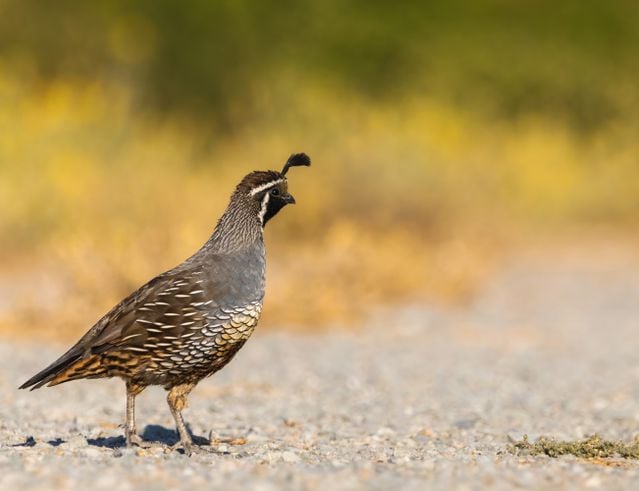
California’s state bird is the California Quail (Callipepla californica), designated the official bird and avifaunal emblem of the state in 1931. A plump, ground-dwelling game bird with a forward-drooping topknot of six feathers, it is one of the most recognizable birds of the state’s brushy country and a welcome, if shy, visitor to rural and suburban yards near cover.
The California Quail measures 24 to 27 cm (9.4 to 10.6 in) long, with a wingspan of 32 to 37 cm (12.6 to 14.6 in) and a weight of 140 to 230 g (4.9 to 8.1 oz), placing it between a robin and a crow in size. Males wear rich gray and brown plumage with a black face outlined boldly in white, while females are plainer brown and lack the strong head markings. Both sexes show a scaled pattern of cream and chestnut across the belly and carry the comma-shaped head plume, longer in males.
The legislation adopting the quail was signed by Governor James Rolph on 12 June 1931 and took effect that August. The species is intensely social, gathering in groups called coveys that can number from 20 to more than 100 birds in fall and winter, and its bright, three-note Chi-ca-go call is a signature sound of the chaparral. Coveys often post a sentinel, frequently an adult male, to watch for danger while the rest forage on the ground. Quail favor chaparral, sagebrush, oak woodlands, and foothill forests, and they take readily to city parks, suburban gardens, and farmland edges wherever shrubby cover is close at hand.
Common Backyard Birds
The species below are the birds most Californians encounter at feeders and in gardens. Most are small birds with round heads, short bills, and the plump build typical of feeder birds. Each profile gives size in metric and imperial units, a plain-language description, habitat, behavior, diet, and, where relevant, how to attract it.
House Finch (Haemorhous mexicanus)

The House Finch is arguably the default backyard bird across lowland California, a small, sparrow-sized finch measuring 13 to 14 cm (5.1 to 5.5 in) long. Adult males show variable red on the head, throat, and rump, ranging from pale orange to deep crimson depending on diet, over a streaky brown body. Females are plain brown with blurry streaking below and lack the red entirely.
House Finches gather in noisy, cheerful flocks and sing a long, warbling series of notes year-round. Native to the West but now found across the continent, they thrive in towns, farmyards, and suburbs, nesting in hanging plants, wreaths, and building ledges. Their diet is heavily vegetarian, dominated by seeds, buds, and fruit, which makes House Finches one of the easiest of California’s seed-eating birds to attract. Offer black oil sunflower seeds in tube feeders or a hopper, and expect them to become steady daily visitors at your bird feeders.
Lesser Goldfinch (Spinus psaltria)
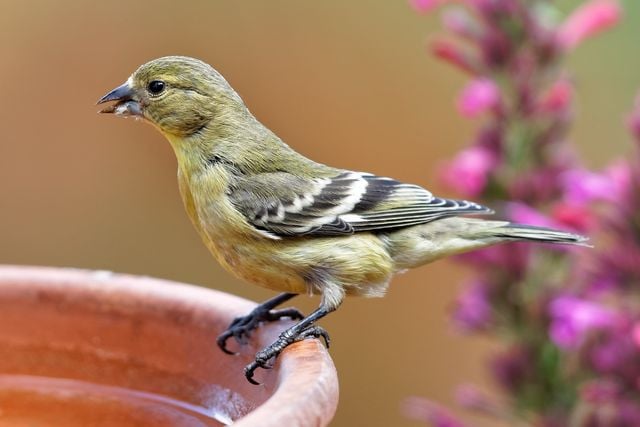
The Lesser Goldfinch is a tiny, active finch of gardens and weedy edges, measuring just 9 to 11 cm (3.5 to 4.3 in). Males have a black cap over a green or blackish back, with bright yellow underparts, while females are a softer olive-yellow. Their tinkling, wheezy song and the plaintive, downslurred call notes often reveal small flocks overhead before they are seen.
These goldfinches feed almost entirely on small seeds, especially those of sunflowers, thistles, and other composites, and they cling acrobatically to seed heads and feeder ports alike. To draw them in, offer nyjer seed, sometimes sold as thistle, in a fine-mesh tube or nyjer feeder, or sunflower chips. They often flock with American Goldfinches at nyjer feeders and watering spots. Planting native sunflowers and leaving spent seed heads standing provides a natural food source and encourages the birds to stay through the season.
California Scrub-Jay (Aphelocoma californica)
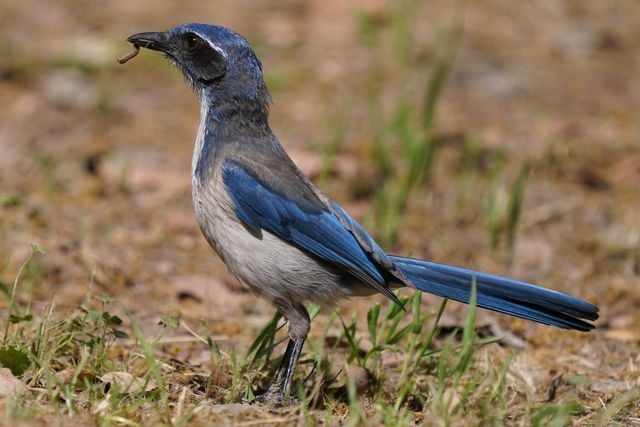
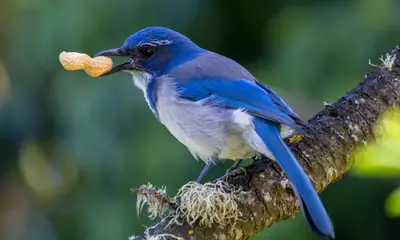
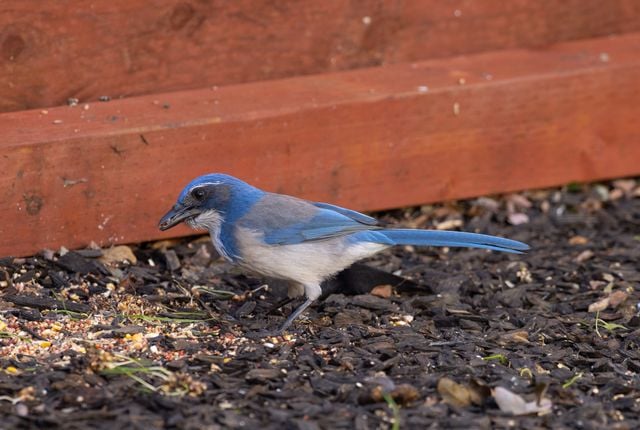
The California Scrub-Jay is the bold blue jay of the state’s lowlands, roughly 27 to 31 cm (11 to 12 in) long with a wingspan near 39 cm (15 in) and a weight around 80 g (2.8 oz). It combines a deep azure head, wings, and long tail with a gray-brown back, clean white underparts, and a blue breast band across the chest. Its rounded, crestless head and long tail separate it at a glance from the crested Steller’s Jay. The species was split from the interior Woodhouse’s Scrub-Jay in 2016.
Scrub-jays are intelligent, curious, and famous for caching acorns, which they hammer open with a stout, hooked bill. A single jay may hide thousands of nuts each fall and recall the locations months later. They have been documented stealing acorns from Acorn Woodpecker granaries and from other jays, and they check that no rival is watching before hiding their own. Nonmigratory and quick to visit yards, they favor peanuts in the shell and sunflower seed. A California study recorded one individual living at least 15 years.
Anna’s Hummingbird (Calypte anna)
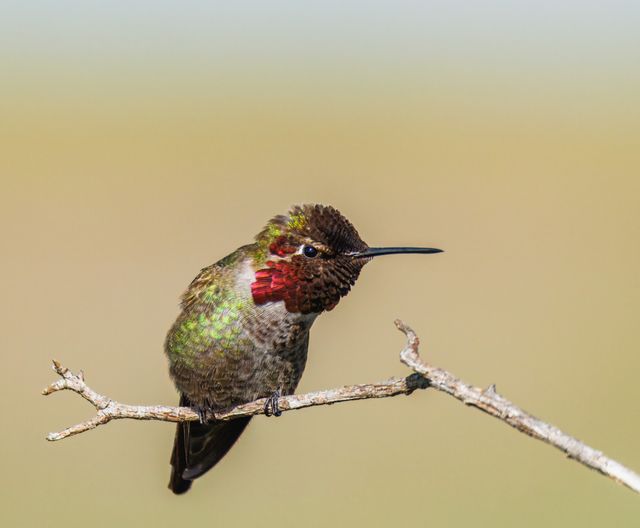
Anna’s Hummingbird is the most common hummingbird along the Pacific Coast and, unusually for the family, a year-round resident across much of lowland California. It is a stocky hummingbird about 10 to 11 cm (3.9 to 4.3 in) long, mostly emerald green and gray. Adult males are unmistakable when the light catches the iridescent rose-pink that covers the entire crown and throat, an extended gorget that reads as dull brown or gray in shadow. Females show green upperparts and a small central throat patch.
The species expanded its range dramatically beginning in the early twentieth century, spreading from Southern California and Baja north to British Columbia. Ornithologists attribute this expansion to the planting of exotic flowering trees, such as eucalyptus, and to the spread of hummingbird feeders across residential areas. Anna’s feed on nectar and small insects and often defend a feeder or flowering shrub aggressively. Because they do not migrate here, a feeder can stay up in every month. Mix one part white table sugar to four parts water, and avoid honey and food coloring.
Mourning Dove (Zenaida macroura)

The Mourning Dove is a slender, long-tailed dove measuring 23 to 34 cm (9.1 to 13.4 in) from bill to tail tip. Soft grayish-brown overall, it has a small round head, dark spots on the wing, and a long, pointed tail edged in white. Its mournful, owl-like cooing gives the bird its name, and its wings produce a distinctive whistle on takeoff.
Mourning Doves are among the most widespread birds in North America and a familiar sight on wires, fences, and open ground throughout California. They feed almost entirely on seeds, foraging on the ground rather than perching at feeders. To welcome them, scatter millet or a mixed seed on a ground tray or on the ground beneath a hanging feeder, and provide a shallow, clean water source. Their gentle presence and constant cooing make them a fixture of the suburban soundscape.
Dark-eyed Junco (Junco hyemalis)
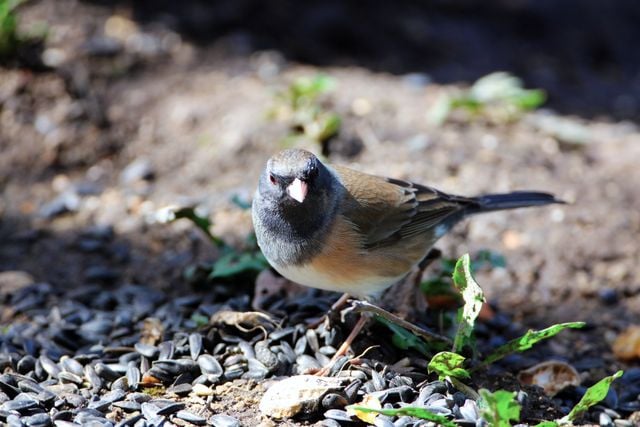
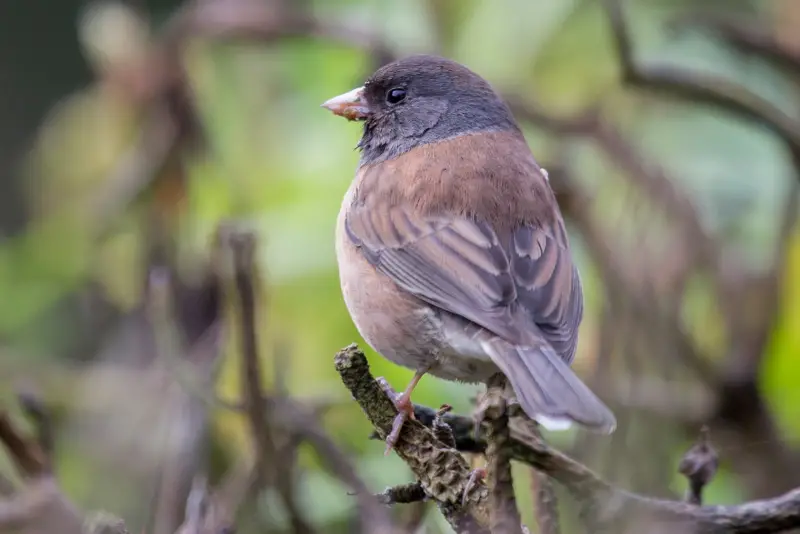
The Dark-eyed Junco is a crisp, small sparrow measuring 14 to 16 cm (5.5 to 6.3 in). The form common in California, often called the “Oregon” junco, has a dark hood, warm brown back and flanks, and a clean pink bill, with white outer tail feathers that flash in flight. In much of lowland California juncos are primarily cool-season visitors, descending from higher elevations and northern breeding grounds as winter sets in, though they breed in the state’s mountains year-round.
Juncos are ground foragers that shuffle and hop beneath shrubs and feeders, picking up fallen seed. They arrive in large flocks and are one of the classic signs of the changing season for California feeder-watchers. Offer white millet and sunflower chips on the ground or on a low tray, and keep a brushy corner nearby for cover. A layer of leaf litter left under hedges gives them the sheltered foraging they prefer.
White-crowned Sparrow (Zonotrichia leucophrys)
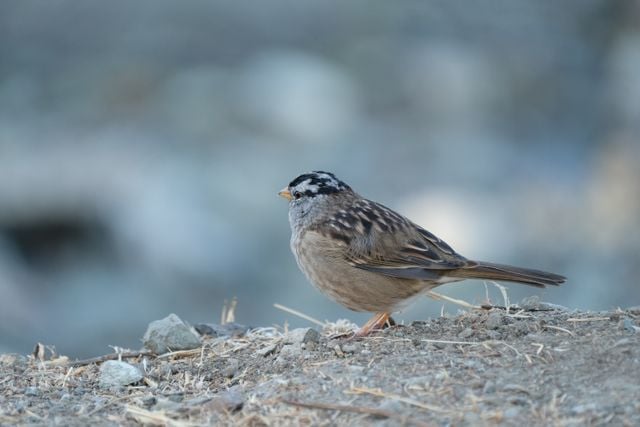
The White-crowned Sparrow is a handsome, upright sparrow measuring 15 to 16 cm (5.9 to 6.3 in), best known as a winter visitor to gardens across much of the state. Adults have a pale gray face and breast topped by bold black and white stripes on the crown, along with a pink or yellowish bill. Immatures wear tan and brown head stripes in place of black and white.
These sparrows arrive in fall and form loyal flocks that return to the same brushy yards each winter, often mixing with Golden-crowned Sparrows and juncos. Their clear, whistled song, frequently heard even in the cool months, is a familiar sound of California hedgerows. White-crowned Sparrows feed mainly on seeds and forage on the ground, so millet and mixed seed scattered near cover suit them well. A tangle of native shrubs at the garden edge gives them the escape cover that keeps a flock returning.
California Towhee (Melozone crissalis)
The California Towhee is a plain but characterful bird of chaparral and gardens, measuring 21 to 25 cm (8.3 to 9.8 in). Warm matte brown overall, it shows a subtle rusty wash under the tail and around the face, and a stout, seed-cracking bill. What it lacks in color it makes up for in personality, often heard giving a sharp, metallic chink note from deep in a shrub.
California Towhees forage on the ground with a distinctive two-footed backward scratch that kicks aside leaf litter to expose seeds and small insects. Pairs stay together on their territories year-round and may live for many years. Endemic in range to California and adjacent Baja and Oregon, they are quintessential birds of the state’s brushy country. They rarely use hanging feeders but readily take seed scattered on the ground near cover. A dense native shrub or hedge is the single best way to make a yard attractive to them.
Northern Mockingbird (Mimus polyglottos)
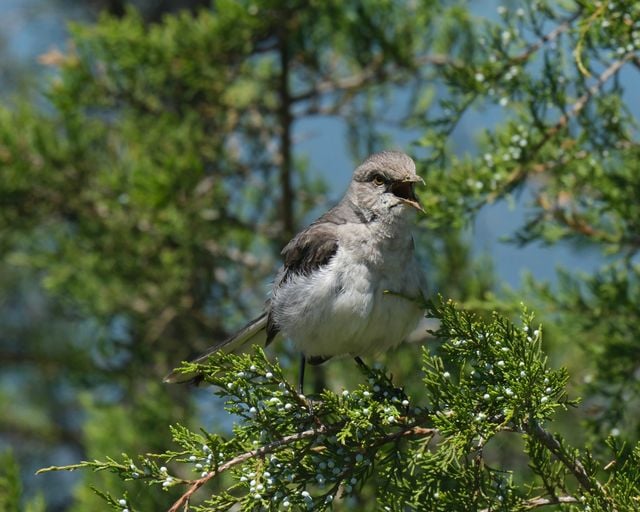
The Northern Mockingbird is a slim, long-tailed gray songbird measuring 21 to 26 cm (8.3 to 10.2 in), with white wing patches that flash conspicuously in flight. Gray above and paler below, it is best identified by voice and behavior: an accomplished mimic, it strings together the songs of other birds and even mechanical sounds into long, tireless performances, sometimes late into a moonlit night.
Mockingbirds are bold and territorial, defending fruiting shrubs and feeders against all comers, including much larger birds. They favor suburbs, hedgerows, and open areas with scattered trees. Their diet shifts seasonally between insects in the warmer months and fruit in fall and winter. They generally ignore seed but will visit for suet, mealworms, and fruit such as raisins or halved apples. Planting native berry-producing shrubs offers the most reliable draw and supports them through the lean season.
Black Phoebe (Sayornis nigricans)
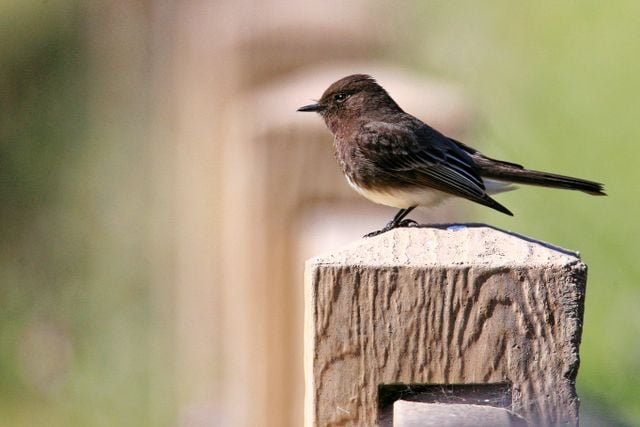
The Black Phoebe is a tidy, sooty-black flycatcher with a clean white belly, measuring 16 to 18 cm (6.3 to 7.1 in). It perches upright and low, wagging and pumping its tail, then sallies out to snatch insects from the air before returning to the same perch. Its soft, whistled tee-hee, tee-ho song is a common sound near water.
Black Phoebes are closely tied to water, and any garden with a pond, fountain, birdbath, or even a regularly watered lawn is likely to host one. They build mud nests under eaves, bridges, and overhangs, often returning to the same site year after year. Because they are strictly insectivorous, they do not visit seed or suet feeders. The way to attract them is indirect but effective: add a water feature, avoid pesticides that suppress insect populations, and leave an overhang where a pair might nest.
American Crow (Corvus brachyrhynchos)
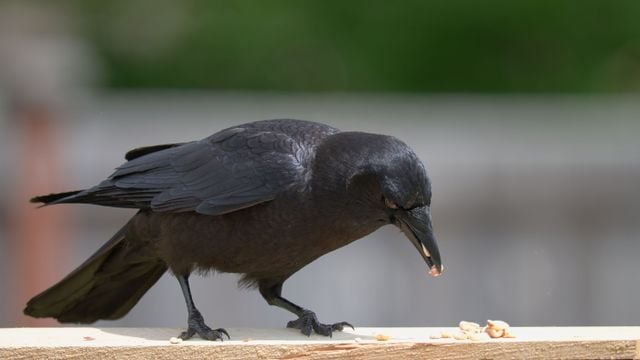
The American Crow is a large, glossy black bird measuring 40 to 53 cm (15.8 to 20.9 in), familiar throughout California from city centers to farmland. All black, including the bill and legs, it is distinguished from the larger Common Raven by its smaller size, fan-shaped tail, and flat caw rather than the raven’s deep croak. Crows are among the most intelligent of birds, capable of using tools, recognizing individual human faces, and solving novel problems.
Highly social, American Crows gather in family groups and, in winter, in large flocks and communal roosts that can number in the thousands. They are omnivores that eat almost anything, from insects and grain to carrion and human refuse, which helps explain their success in urban areas. While many people welcome their intelligence and antics, crows can dominate a feeding station. They readily take peanuts and kitchen scraps offered on the ground or on a platform.
Oak Titmouse (Baeolophus inornatus)
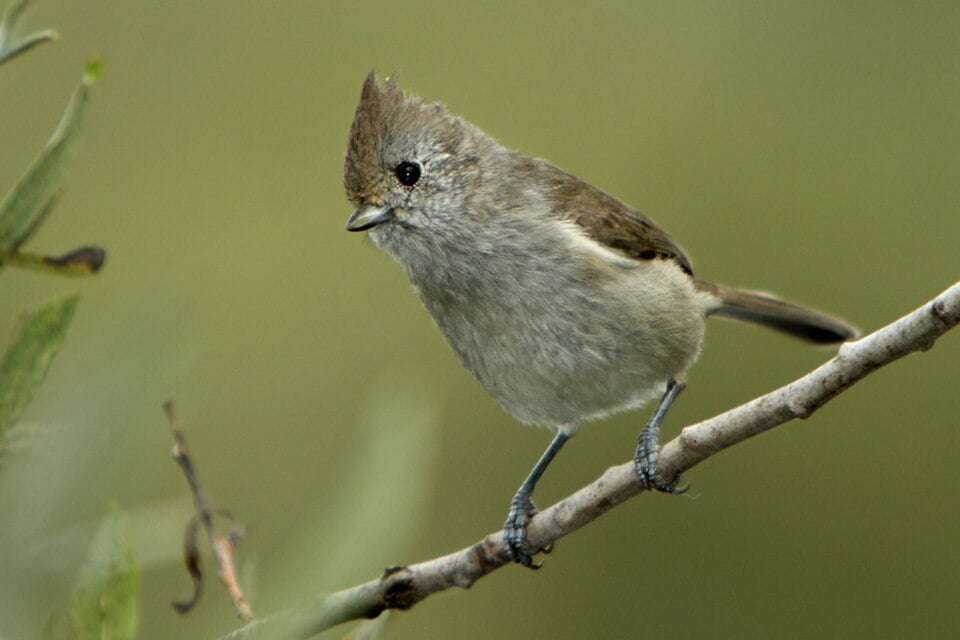
The Oak Titmouse is a small, plain gray-brown songbird measuring 13 to 14 cm (5.1 to 5.5 in), distinguished by a small crest it often raises and large dark eyes. It lacks bold markings, and its understated appearance belies an energetic, vocal personality. Its scratchy, whistled song rings through California’s oak country in spring, and pairs call constantly as they forage.
Nearly endemic to California, the Oak Titmouse is tightly bound to oak and oak-pine woodlands, and its presence is a good sign that a neighborhood retains mature oaks. Pairs hold territories year-round and mate for life. The birds glean insects and spiders from bark and foliage, supplement with acorns and seeds in the cooler months, and cache food for later. They come readily to feeders for sunflower seed and suet and will use nest boxes. Preserving oaks and offering a nest box are the surest ways to keep them close.
American Robin (Turdus migratorius)
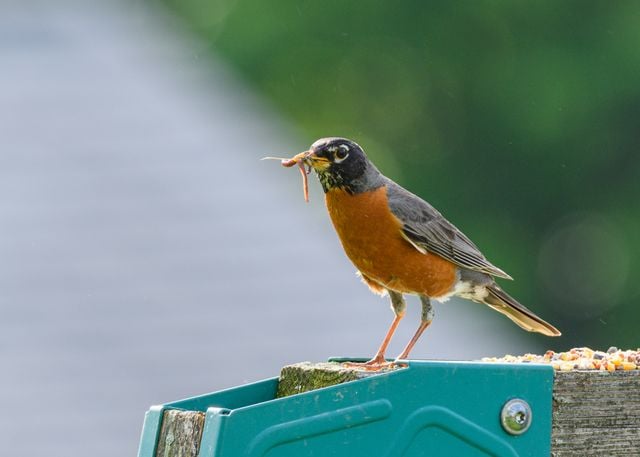
The American Robin is a large, familiar thrush measuring 20 to 28 cm (7.9 to 11 in), with a warm brick-red breast, dark gray back, and a bright yellow bill. Males are richer in color than the somewhat paler females. Robins are birds of lawns and open ground, where they run and pause in short bursts, cocking the head to hunt earthworms and insects by sight.
Robins are present across California year-round, though their numbers and movements shift with the seasons as birds gather into roving winter flocks that descend on fruiting trees. Their cheerful, caroling song is one of the first sounds of the breeding season. In summer they eat mainly invertebrates, switching to berries and fruit in fall and winter. They do not take seed but will come to mealworms and fruit, and they use open birdbaths freely. A lawn kept free of pesticides and a few native fruiting trees will support them well.
Birds of Prey
Raptors are part of a healthy backyard bird community. Two species in particular, together with the Red-shouldered Hawks that patrol wooded neighborhoods, are regular presences in California’s suburbs and open country.
Cooper’s Hawk (Astur cooperii)

Cooper’s Hawk is a medium-sized woodland hawk measuring 37 to 45 cm (14.6 to 17.7 in), with females noticeably larger than males. Adults have blue-gray upperparts, fine reddish barring below, a dark cap, and a long, banded tail rounded at the tip. This species is a skilled ambush hunter of other birds, and it has adapted so thoroughly to suburbs that feeder stations have become part of its hunting range. Recent taxonomic work moved Cooper’s Hawk from the genus Accipiter to Astur.
Seeing a Cooper’s Hawk snatch a dove or finch at a feeder can be unsettling, but it is a natural part of the ecosystem and a sign that the yard supports enough prey to attract a top predator. There is no need to intervene. If activity concentrates unwanted attention, moving feeders closer to dense cover gives smaller birds better escape routes. Over time, a resident hawk simply becomes another species on the yard list.
Red-tailed Hawk (Buteo jamaicensis)
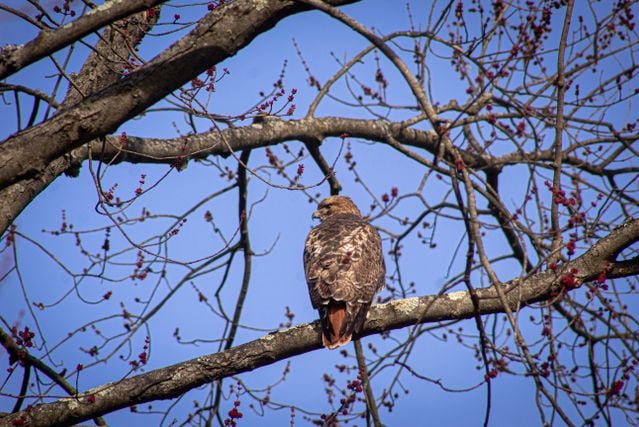
The Red-tailed Hawk is California’s most familiar large raptor, a broad-winged buteo measuring 45 to 65 cm (17.7 to 25.6 in) with a wingspan of 114 to 133 cm (about 3.7 to 4.4 ft). Plumage varies widely, but most adults show a pale breast, a streaked belly band, and the brick-red upper tail that gives the species its name. Its scream, a harsh descending keeeer, is so evocative that filmmakers routinely dub it over footage of other raptors.
Red-tailed Hawks hunt from utility poles, fence posts, and soaring flight, taking mostly rodents and other small mammals. They are birds of open country, roadsides, and woodland edges rather than feeder visitors, but they are a common sight over suburban California and often nest in tall trees within cities. Their preference for rodent prey makes them valuable allies in gardens, another reason to avoid rodenticides, which can poison the hawks that eat affected animals.
Woodland and Grassland Specialties
California’s oak woodlands support several distinctive birds that spill readily into adjacent yards. Two woodpeckers are especially characteristic.
Acorn Woodpecker (Melanerpes formicivorus)
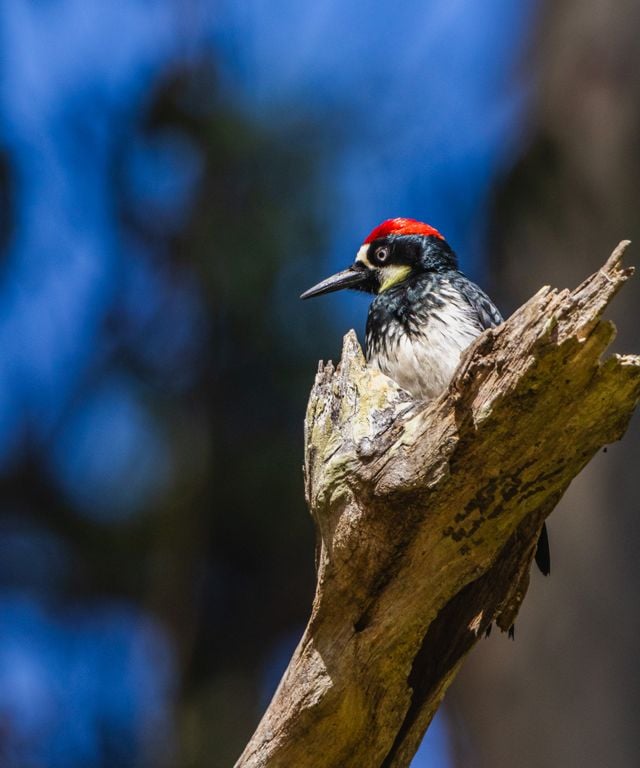
The Acorn Woodpecker is a striking, clown-faced woodpecker measuring 19 to 23 cm (7.5 to 9.1 in), with a black back, white rump, red crown, and a bold white-and-black face pattern that recalls a theatrical mask. It is one of the most social woodpeckers in the world, living in cooperative family groups that share territory, nesting, and food stores.
The species is famous for its granaries: dead trees, poles, and even wooden buildings drilled with thousands of small holes, each fitted with a single acorn. Group members defend and maintain these stores across generations. Acorn Woodpeckers are tied to oak woodlands and are common wherever mature oaks persist, including many suburban neighborhoods and city parks. They eat acorns, insects, and sap, and they will visit yards for suet and sunflower seeds. Retaining oaks and tolerating a few dead limbs, where safe, keeps this charismatic bird in the neighborhood.
Northern Flicker (Colaptes auratus)

The Northern Flicker is a large brown woodpecker measuring 28 to 31 cm (11 to 12.2 in), unusual in its habit of feeding on the ground. The western “red-shafted” form common in California shows salmon-red underwings and undertail, a gray face, a brown crown, and a black crescent across the breast over a spotted belly. In flight, a white rump patch flashes conspicuously.
Flickers are ant specialists, using a long, barbed tongue to lap ants and their larvae from lawns and open soil, which is why they are so often seen hopping across the ground rather than clinging to trunks. They are present year-round in much of California, with numbers boosted in winter by birds moving down from the mountains and north. At feeders they take suet readily. Leaving an unsprayed lawn where ants can thrive, and offering suet in cold weather, will draw them in.
Notable Migrants
Beyond the year-round residents, seasonal movements along the Pacific Flyway deliver waves of visitors to California yards. Warblers, sparrows, finches, and roving flocks of Cedar Waxwings swell garden numbers from fall through spring, and their seasonal occurrence is one of the pleasures of the birding year.
Yellow-rumped Warbler (Setophaga coronata)
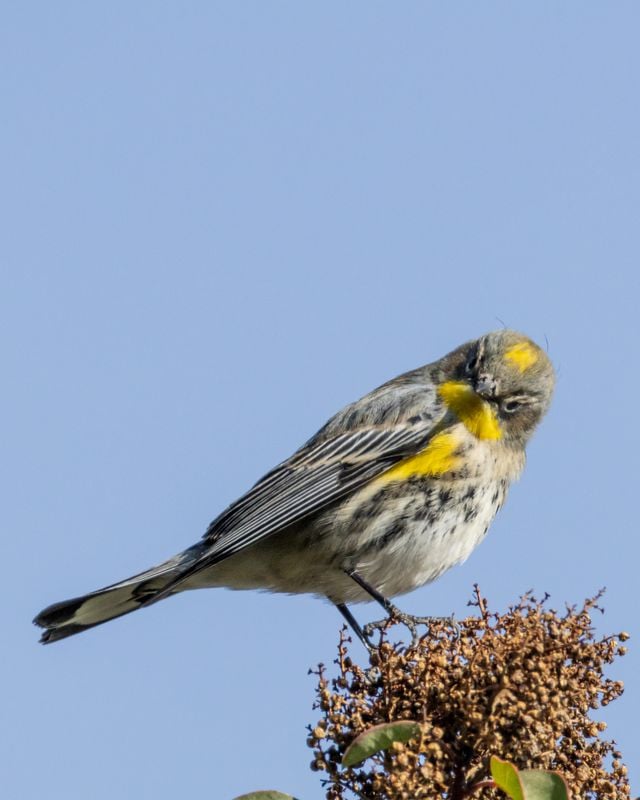
The Yellow-rumped Warbler is the warbler most likely to appear in a California yard, especially from fall through spring, and it measures 12 to 14 cm (4.7 to 5.5 in). The western “Audubon’s” form shows a yellow throat, yellow patches on the sides and crown, and the bright yellow rump that gives the species its enduring nickname. Winter birds are muted gray-brown but always show that telltale yellow rump.
This warbler is exceptionally adaptable for its family. Unlike most warblers, which depend on insects and leave for the tropics in winter, the Yellow-rumped can digest the waxy berries of wax myrtle, juniper, and poison oak, which allows large numbers to winter in California. It flits actively through trees and shrubs, sallying for insects and gleaning berries. It is one of the few warblers that will visit feeders, taking suet and bark-butter spreads. Native berry-producing shrubs and a suet feeder offer the best chance of hosting one.
Look-Alike Species: Telling Confusing Pairs Apart
Several California backyard birds are regularly mistaken for one another. The table below highlights the most frequent points of confusion and the field marks that separate each pair.
| Pair | Key difference |
|---|---|
| California Scrub-Jay vs. Steller’s Jay | Scrub-jay has a rounded, crestless head and blue-and-gray body with a white throat. Steller’s Jay is darker, with a tall black crest and a blackish head and chest. |
| House Finch vs. Purple Finch | Male House Finch shows red concentrated on the head and chest over a brown, streaky body. Male Purple Finch looks washed in raspberry over the whole head and back, with cleaner, unstreaked flanks. |
| Lesser Goldfinch vs. American Goldfinch | Lesser Goldfinch has a dark or greenish back and dark undertail. Breeding male American Goldfinch is bright lemon-yellow with a black forehead and white undertail coverts. |
| White-crowned Sparrow vs. Golden-crowned Sparrow | White-crowned shows crisp black and white crown stripes and a pink or yellow bill. Golden-crowned has a dull golden central crown bordered in black and a darker bill. |
Field Guides for Identifying California Backyard Birds
A good field guide makes identification faster and more reliable, especially when separating look-alike species. Two classic works remain the standard for North American birders. The Sibley Guide to Birds, written and illustrated by David Allen Sibley, pairs an accurate illustration of each plumage with concise range and behavior notes, and the Sibley Guide is prized for showing subtle differences between closely related birds. The Peterson Field Guide series, founded by the pioneering bird illustrator Roger Tory Peterson, introduced the system of arrows pointing to key field marks, and Peterson’s backyard birds titles remain approachable entry points for newcomers.
A regional guide focused on the western U.S., paired with the free Merlin Bird ID app from the Cornell Lab of Ornithology, will cover nearly every species in this article. For hands-on learning, joining a local Audubon chapter or a community bird walk is a fun way to sharpen your eye for different species alongside experienced birders.
What to See When: A Seasonal Calendar
Backyard activity in California shifts through the year with breeding, migration, and winter influxes. The table summarizes the general pattern for lowland gardens; timing runs earlier in the south and later at higher elevations.
| Season | What to expect |
|---|---|
| Spring (March to May) | Resident song peaks; Anna’s Hummingbird already nesting; migrant warblers, orioles, and grosbeaks pass through; House Finches and towhees pair up. |
| Summer (June to August) | Fledglings appear at feeders; hummingbird activity high; robins and finches feed young; quail coveys break into family groups. |
| Fall (September to November) | Wintering sparrows, juncos, and Yellow-rumped Warblers arrive; berry crops draw thrushes and waxwings; feeder traffic climbs. |
| Winter (December to February) | Peak feeder season; White-crowned and Golden-crowned Sparrows and juncos in flocks; Anna’s Hummingbird visible and singing; raptors follow the crowds. |
Notable Birding Locations Across California
While backyards are the focus of this guide, a short trip to a nearby hotspot can add dozens of species to your year. California’s public lands and preserves offer some of the finest birding in North America.
Point Reyes National Seashore, north of San Francisco, is one of the most species-rich sites in the country and a magnet for migrants and vagrants each fall. The San Joaquin and Sacramento valley wildlife refuges, including the Sacramento National Wildlife Refuge Complex, host spectacular concentrations of wintering waterfowl and cranes along the Pacific Flyway. In the south, the Salton Sea draws enormous numbers of waterbirds and shorebirds, while coastal wetlands such as the Bolsa Chica Ecological Reserve concentrate herons, terns, and shorebirds within easy reach of urban Orange County. Oak woodland preserves throughout the Coast Ranges and Sierra foothills are the places to seek Acorn Woodpecker, Oak Titmouse, and California Scrub-Jay in their core habitat.
How to Attract Birds to Your California Yard
A welcoming yard combines three essentials: food, water, and cover, ideally built around native plants suited to the local climate.
For food, black oil sunflower seeds in tube feeders or a hopper attract the widest range of species, from House Finches to titmice and jays. Different birds have different favorite foods, so add nyjer seed for goldfinches, suet for woodpeckers, mockingbirds, and warblers, and a ground tray of millet for doves, sparrows, and juncos. A hummingbird feeder filled with sugar water mixed at one part sugar to four parts water serves Anna’s Hummingbird year-round; skip honey and dye, and clean the feeder regularly. Rotating fresh bird seed and keeping backyard feeders clean will keep the birds returning.
Water is often the single most powerful draw, since every bird needs to drink and bathe and many that ignore feeders will still use a birdbath. A shallow basin with a gentle slope, kept clean and refreshed, will attract species that seed never will, and moving water from a dripper or small fountain is especially effective. Black Phoebes and warblers in particular respond to water.
Native plants tie the whole system together. Oaks, native sunflowers, currants, manzanita, toyon, and ceanothus provide food and shelter that match what local birds evolved with, and they support the insects that nearly all species need to raise their young. Nest boxes sized for titmice, chickadees, wrens, and bluebirds add breeding habitat where natural cavities are scarce. In much of California the common chickadee at these boxes is the Chestnut-backed Chickadee, since Black-capped Chickadees occur mainly in the far northeast of the state. Watch for non-native European Starlings, spangled with small white spots in fresh winter plumage, and House Sparrows, which compete aggressively for nest boxes; entrance holes sized for smaller native species help keep them out.
Finally, feed responsibly. Clean feeders and baths regularly with a dilute bleach solution to prevent disease, especially during outbreaks, and space feeders to reduce crowding. If the California Department of Fish and Wildlife issues guidance to take down feeders during a disease event such as salmonellosis, follow it promptly. Keeping cats indoors and marking windows to prevent collisions protects the very birds a good yard works to attract.
Conservation: The Tricolored Blackbird and the Value of Backyard Habitat
California’s backyard birds are, for the most part, adaptable and secure, but the wider bird community faces real pressure, and one of the state’s most closely watched conservation stories shows both the risk and the reason for hope. The Tricolored Blackbird (Agelaius tricolor), a colonial species that forms the largest breeding colonies of any North American songbird, was listed as threatened under the California Endangered Species Act in 2019 after decades of decline driven by wetland loss, the destruction of nesting colonies during grain harvest, and pesticide use.
The species is tracked by a statewide survey conducted roughly every three years since 1994, one of the more remarkable community-science efforts in the state. That survey recorded a low of about 145,000 birds in 2014, then a partial rebound to roughly 218,000 in 2022 and about 229,000 in 2025, though the most recent figure remains only around 58 percent of the population estimated in 2008. Much of the recovery followed a 2015 agreement to protect most agricultural nesting colonies, together with public and private partnerships that compensate dairy farmers to delay harvest until young birds fledge. The gains have been uneven across the state, strong in the northern San Joaquin Valley and along the Central Coast, but Southern California colonies have continued to decline.
The Tricolored Blackbird is not a typical feeder bird, but its story carries a lesson for every backyard birder. Individual gardens add up. Native plantings, clean water, pesticide-free lawns, and safe feeding create a connected patchwork of habitat that supports birds across a landscape increasingly shaped by people. Much of that work is coordinated by the National Audubon Society, a non-profit organization whose California chapters partner with landowners and agencies on projects like the tricolored recovery. Participating in community-science projects such as the Great Backyard Bird Count and Project FeederWatch turns a backyard into a data point that helps scientists track the health of California’s wild birds.
Frequently Asked Questions
What is the most common backyard bird in California?
The House Finch is among the most common birds reported at backyard feeders across California, appearing in towns, suburbs, and farmland statewide throughout the year. Other frequent visitors include the Mourning Dove, Anna’s Hummingbird, and California Scrub-Jay. Local abundance varies with habitat, so a yard near oak woodland may host more scrub-jays and titmice, while an urban garden may be dominated by finches and doves.
What is the state bird of California?
California’s state bird is the California Quail (Callipepla californica), adopted as the official bird and avifaunal emblem of the state in 1931. It is a plump, ground-dwelling bird recognized by its forward-drooping head plume and its clear Chi-ca-go call. The state bird is not the California Condor, a common point of confusion.
When do hummingbirds arrive in California?
In much of lowland California, hummingbirds are present all year because Anna’s Hummingbird is a resident species that does not migrate, so feeders can stay up in every month. Migratory species add to the mix seasonally: Allen’s Hummingbird returns to the coast very early, often in late winter, while Rufous and Black-chinned Hummingbirds typically pass through or arrive in spring. Keeping a clean feeder through the winter supports resident Anna’s during the cool months.
What is the largest backyard bird in California?
Among common backyard and neighborhood birds, the Red-tailed Hawk and the American Crow are the largest regular visitors, with the Red-tailed Hawk reaching a wingspan of up to about 133 cm (4.4 ft). The Common Raven, larger still, frequents many areas as well. Wild Turkeys, introduced and now widespread, are heavier than any of these and increasingly turn up in rural and suburban yards.
Are there Blue Jays in California?
True Blue Jays (Cyanocitta cristata) are birds of the eastern and central United States and are only rare visitors to California. The blue birds most Californians see in the yard are different species: the crestless California Scrub-Jay of lowland gardens and the crested, deep-blue Steller’s Jay of mountain and coastal forests. The Western Bluebird, a separate species entirely, adds another splash of blue across open oak country.
How do I attract more birds to my yard in California?
The most effective approach combines native plants, clean water, and varied food. Plant oaks, native sunflowers, toyon, and manzanita to provide natural food and the insects birds need to raise young, offer black oil sunflower seed and a sugar-water feeder, and add a shallow, regularly cleaned birdbath. Water often draws more species than food alone, and reducing pesticide use and keeping cats indoors makes any yard safer and more productive.
Which backyard birds in California stay all winter?
Many of California’s backyard birds are year-round residents, including the House Finch, California Scrub-Jay, Anna’s Hummingbird, California Towhee, Oak Titmouse, and Northern Mockingbird. Winter also brings an influx of visitors from the north and from higher elevations, notably Dark-eyed Juncos, White-crowned and Golden-crowned Sparrows, and Yellow-rumped Warblers, which makes the cool months the busiest feeder season of the year.
Conclusion
California’s extraordinary bird diversity, the richest of any U.S. state at 695 recorded species, reaches all the way into the backyard. From the resident Anna’s Hummingbird and acorn-caching California Scrub-Jay to the winter flocks of sparrows and juncos that arrive along the Pacific Flyway, the state offers a year-round parade of species for anyone willing to put out a feeder, a birdbath, and a few native plants. Understanding what to expect, and when, turns casual watching into a deeper connection with the seasons.
That connection carries a responsibility. Thoughtful feeding, native plantings, pesticide-free gardening, and participation in community science help sustain not only the familiar feeder birds but also vulnerable species such as the Tricolored Blackbird, whose partial recovery shows what coordinated conservation can achieve. To go deeper, explore our companion guides to California’s owls, its hummingbirds, and its birds grouped by color, and put what you learn to work in your own patch of the Golden State, where these feathered friends are never far from the window.
Works Cited
- California Bird Records Committee. Official California Checklist (updated 26 May 2026). https://www.californiabirds.org/checklist.asp
- Cornell Lab of Ornithology. California Quail Identification. All About Birds. https://www.allaboutbirds.org/guide/California_Quail/id
- NETSTATE. California State Bird: California Valley Quail (text of the 1931 designating act). https://www.netstate.com/states/symb/birds/ca_valley_quail.htm
- Cornell Lab of Ornithology. Anna’s Hummingbird Overview. All About Birds. https://www.allaboutbirds.org/guide/Annas_Hummingbird/overview
- Cornell Lab of Ornithology. Anna’s Hummingbird Life History. All About Birds. https://www.allaboutbirds.org/guide/Annas_Hummingbird/lifehistory
- National Park Service. Anna’s Hummingbird. https://www.nps.gov/articles/anna-s-hummingbird.htm
- National Audubon Society. Anna’s Hummingbirds Are Expanding Their Range With Human Help. https://www.audubon.org/news/annas-hummingbirds-are-expanding-their-range-human-help
- Cornell Lab of Ornithology. California Scrub-Jay Overview. All About Birds. https://www.allaboutbirds.org/guide/California_Scrub-Jay/overview
- Cornell Lab of Ornithology. California Scrub-Jay Life History. All About Birds. https://www.allaboutbirds.org/guide/California_Scrub-Jay/lifehistory
- National Audubon Society. California Scrub-Jay Field Guide. https://www.audubon.org/field-guide/bird/california-scrub-jay
- Tricolored Blackbird Portal, University of California, Davis. About Tricolored Blackbirds (statewide survey population estimates). https://tricolor.ice.ucdavis.edu/about-tricolored-blackbirds
- California Fish and Wildlife Scientific Journal. Tricolored blackbird survey methods (2019 CESA threatened listing). https://journal.wildlife.ca.gov/2024/06/06/tricolored-blackbird-survey-methods/
- Colibri Ecological Consulting, LLC. 2025 Tricolored Blackbird Statewide Survey (December 2025), prepared for Audubon California (statewide estimate of about 229,000 adults). https://tricolor.ice.ucdavis.edu/sites/g/files/dgvnsk3096/files/inline-files/2025%20Tricolored%20Blackbird%20Statewide%20Survey%20Final%20Report%2001%2008%202026.pdf
- Tricolored Blackbird Portal, University of California, Davis. News (2022 statewide estimate of 218,000). https://tricolor.ice.ucdavis.edu/news
- National Audubon Society. Saving the Iconic Tricolored Blackbirds of California’s Central Valley. https://www.audubon.org/california/projects/saving-iconic-tricolored-blackbirds-of-californias-central-valley
- Cornell Lab of Ornithology. House Finch Identification. All About Birds. https://www.allaboutbirds.org/guide/House_Finch/id
- Cornell Lab of Ornithology. Lesser Goldfinch Overview. All About Birds. https://www.allaboutbirds.org/guide/Lesser_Goldfinch/overview
- Cornell Cooperative Extension. Mourning Dove (Home Grown Facts, Cornell Lab measurements). https://s3.amazonaws.com/assets.cce.cornell.edu/attachments/22813/Doves-Mourning-2012.pdf
- Cornell Lab of Ornithology. Dark-eyed Junco Identification. All About Birds. https://www.allaboutbirds.org/guide/Dark-eyed_Junco/id
- Cornell Lab of Ornithology. California Towhee Identification. All About Birds. https://www.allaboutbirds.org/guide/California_Towhee/id
- Cornell Lab of Ornithology. Black Phoebe Identification. All About Birds. https://www.allaboutbirds.org/guide/Black_Phoebe/id
- Cornell Lab of Ornithology. American Crow Identification. All About Birds. https://www.allaboutbirds.org/guide/American_Crow/id
- Cornell Lab of Ornithology. American Robin Identification. All About Birds. https://www.allaboutbirds.org/guide/American_Robin/id
- Cornell Lab of Ornithology. Yellow-rumped Warbler Identification. All About Birds. https://www.allaboutbirds.org/guide/Yellow-rumped_Warbler/id
- Cornell Lab of Ornithology. Cooper’s Hawk Overview. All About Birds. https://www.allaboutbirds.org/guide/Coopers_Hawk/overview
- Cornell Lab of Ornithology (Birds of the World). Cooper’s Hawk (Astur cooperii), version 1.2 (genus reassignment from Accipiter). https://birdsoftheworld.org/bow/species/coohaw/cur/introduction
- Cornell Lab of Ornithology. Red-tailed Hawk Nest Bird Cams FAQ (measurements). https://www.allaboutbirds.org/news/bird-cams-faq-red-tailed-hawk-nest/
- Cornell Lab of Ornithology. Acorn Woodpecker Identification. All About Birds. https://www.allaboutbirds.org/guide/Acorn_Woodpecker/id
- Cornell Lab of Ornithology. Northern Flicker Identification. All About Birds. https://www.allaboutbirds.org/guide/Northern_Flicker/id
More Birds to Explore
- California Quail
- Night Birds In California
- Where To Birdwatch In Los Angeles
- California Owl Sounds
- Herons In California
- Common Birds In California
- Small Birds In California
- Large Birds In California
- Blue Birds In California
- Red Birds In California
- Oriole Birds In California
- Swallows In California
- Doves In California
- Yellow Birds In California
- Parrots In California
- California Birds Of Prey