Florida Backyard Birds: A Field Guide to the Sunshine State’s Feeder and Yard Species
Florida is home to 545 species of birds recorded on the official state list, one of the highest totals of any state in the country. For the person watching a feeder or a birdbath, a smaller and more predictable cast appears again and again, and this guide focuses on those Florida backyard birds: the cardinals, jays, doves, woodpeckers, and seasonal visitors most likely to land within view of a window.
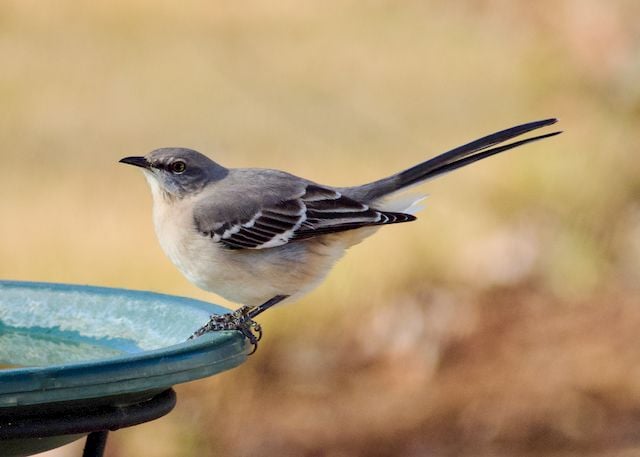
The state owes its diversity to geography. Florida sits at the southeastern tip of the continent along the Atlantic Flyway, one of North America’s four great migratory corridors, and its peninsula tapers from temperate pine forests in the north into subtropical wetlands and mangroves in the south. That gradient, combined with a mild climate and abundant water, means many yards host resident species year round while also collecting migrants and wintering birds that breed far to the north.
Key Takeaways
- Florida’s official state list holds 545 extant bird species, as of the 2024 list maintained by the Florida Ornithological Society Records Committee.
- The state bird is the Northern Mockingbird (Mimus polyglottos), designated in 1927 and found in all 67 Florida counties.
- Winter is the busiest backyard season across most of the peninsula, when resident species are joined by American Robins, warblers, and finches escaping northern cold.
- The Florida Scrub-Jay (Aphelocoma coerulescens) is the only bird species found nowhere on Earth but Florida, and it is federally listed as threatened.
- Black oil sunflower seed in a tube or hopper feeder is the single most reliable way to draw the widest range of Florida backyard birds.
At a Glance: Common Florida Backyard Birds
The table below lists the species profiled in this guide along with additional yard birds you are likely to encounter. Species given a full profile below are marked with their category; the remainder appear here as quick reference.
| Species | Scientific name | Size | When present | Where to find | Best feeder food |
|---|---|---|---|---|---|
| Northern Cardinal | Cardinalis cardinalis | 21 to 23 cm (8.3 to 9.1 in) | Year round resident | Shrubby yards statewide | Black oil sunflower seed |
| Blue Jay | Cyanocitta cristata | 25 to 30 cm (9.8 to 11.8 in) | Year round resident | Oak and suburban yards | Peanuts, sunflower seed |
| Northern Mockingbird | Mimus polyglottos | 21 to 26 cm (8.3 to 10.2 in) | Year round resident | Open yards, hedges | Fruit, mealworms |
| Mourning Dove | Zenaida macroura | 23 to 34 cm (9.1 to 13.4 in) | Year round resident | Open ground, wires | Cracked corn, millet |
| Red-bellied Woodpecker | Melanerpes carolinus | 23 to 27 cm (9.1 to 10.6 in) | Year round resident | Wooded yards | Suet, sunflower seed |
| Downy Woodpecker | Dryobates pubescens | 14 to 17 cm (5.5 to 6.7 in) | Year round resident | Trees and shrubs | Suet, sunflower seed |
| Carolina Wren | Thryothorus ludovicianus | 12 to 14 cm (4.7 to 5.5 in) | Year round resident | Brush piles, undergrowth | Suet, mealworms |
| Tufted Titmouse | Baeolophus bicolor | 14 to 16 cm (5.5 to 6.3 in) | Year round, mainly north and central | Wooded yards | Sunflower seed |
| Carolina Chickadee | Poecile carolinensis | 11.5 to 13 cm (4.5 to 5.1 in) | Year round, mainly north and central | Wooded yards | Sunflower seed, suet |
| Common Grackle | Quiscalus quiscula | 28 to 34 cm (11 to 13.4 in) | Year round resident | Lawns, open areas | Mixed grain, corn |
| Boat-tailed Grackle | Quiscalus major | 26 to 43 cm (10.2 to 16.9 in) | Year round resident | Coasts, marshes, parking lots | Mixed grain |
| Red-winged Blackbird | Agelaius phoeniceus | 17 to 23 cm (6.7 to 9.1 in) | Year round resident | Marsh edges, feeders in winter | Mixed seed, corn |
| Painted Bunting | Passerina ciris | 12 to 14 cm (4.7 to 5.5 in) | Winter in south, summer in northeast | Dense cover near feeders | White millet |
| Eastern Bluebird | Sialia sialis | 16 to 21 cm (6.3 to 8.3 in) | Year round resident | Open country, nest boxes | Mealworms |
| Ruby-throated Hummingbird | Archilochus colubris | 7 to 9 cm (2.8 to 3.5 in) | Spring to fall, some winter in south | Flowering yards | Nectar (4 parts water to 1 sugar) |
| Red-shouldered Hawk | Buteo lineatus | 43 to 61 cm (16.9 to 24 in) | Year round resident | Wooded suburbs | Not a feeder bird |
| White Ibis | Eudocimus albus | 56 to 68 cm (22 to 26.8 in) | Year round resident | Lawns, wet fields | Not a feeder bird |
| American Robin | Turdus migratorius | 20 to 28 cm (7.9 to 11 in) | Winter, in large flocks | Lawns, berry trees | Fruit, mealworms |
| Yellow-rumped Warbler | Setophaga coronata | 12 to 14 cm (4.7 to 5.5 in) | Winter | Wax myrtle, shrubs | Suet |
| American Goldfinch | Spinus tristis | 11 to 13 cm (4.3 to 5.1 in) | Winter | Feeders, weedy edges | Nyjer, sunflower chips |
| Common Ground-Dove | Columbina passerina | 15 to 18 cm (5.9 to 7.1 in) | Year round resident | Sandy open ground | Millet, cracked corn |
| Eurasian Collared-Dove | Streptopelia decaocto | 29 to 33 cm (11.4 to 13 in) | Year round, non-native | Towns, feeders | Mixed grain |
| Brown Thrasher | Toxostoma rufum | 23 to 30 cm (9.1 to 11.8 in) | Year round resident | Dense shrubs | Ground seed, suet |
| Gray Catbird | Dumetella carolinensis | 21 to 24 cm (8.3 to 9.4 in) | Winter | Thickets, fruiting shrubs | Fruit, jelly |
| Northern Flicker | Colaptes auratus | 28 to 31 cm (11 to 12.2 in) | Year round resident | Open woods, lawns | Suet, ants on ground |
| Pileated Woodpecker | Dryocopus pileatus | 40 to 49 cm (15.8 to 19.3 in) | Year round resident | Mature forest edges | Suet |
| Blue-gray Gnatcatcher | Polioptila caerulea | 10 to 11 cm (3.9 to 4.3 in) | Year round in south, migrant north | Tree canopy | Insects only |
| House Finch | Haemorhous mexicanus | 13 to 14 cm (5.1 to 5.5 in) | Year round, non-native | Towns, feeders | Sunflower, Nyjer |
| European Starling | Sturnus vulgaris | 20 to 23 cm (7.9 to 9.1 in) | Year round, non-native | Towns, lawns | Suet, scraps |
| House Sparrow | Passer domesticus | 15 to 17 cm (5.9 to 6.7 in) | Year round, non-native | Buildings, feeders | Mixed seed |
| Brown-headed Cowbird | Molothrus ater | 19 to 22 cm (7.5 to 8.7 in) | Year round resident | Fields, feeders | Mixed seed |
| Great Blue Heron | Ardea herodias | 97 to 137 cm (38 to 54 in) | Year round resident | Ponds, canals | Not a feeder bird |
| Roseate Spoonbill | Platalea ajaja | 71 to 86 cm (28 to 34 in) | Year round in south | Coastal shallows | Not a feeder bird |
| Sandhill Crane | Antigone canadensis | 100 to 122 cm (39 to 48 in) | Year round resident | Prairies, wet lawns | Not a feeder bird |
Why Florida Holds So Many Birds
Florida’s bird diversity is a product of position, climate, and habitat variety. The peninsula projects nearly 800 km (about 500 mi) into warm subtropical seas, forming a natural funnel for birds moving along the Atlantic Flyway between breeding grounds in the north and wintering grounds in the Caribbean and Latin America. Migrants concentrate along the coasts and at the southern tip, where land runs out before the long water crossings.
The state also packs several distinct regions into a compact space. The Panhandle and North Florida hold longleaf pine flatwoods, hardwood hammocks, and river swamps that resemble the wider Southeast. Central Florida contains ancient sand ridges, including the Lake Wales Ridge, where dry scrub supports species found nowhere else. South Florida shifts into subtropical terrain, with the vast freshwater marshes of the Everglades, cypress strands, and coastal mangroves. Each region carries its own community of birds, and the boundaries between them shift with the seasons.
Water ties the whole system together. Florida’s lakes, rivers, retention ponds, and estuaries support herons, ibises, and other wading birds that spill readily into suburban settings. A backyard bordering a canal or pond in Central Florida or along the Gulf Coast may host a broader range of species than a comparable yard almost anywhere else in North America.
The State Bird of Florida: Northern Mockingbird
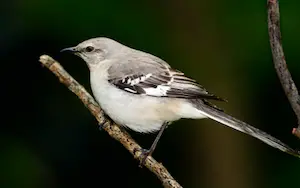
The state bird of Florida is the Northern Mockingbird (Mimus polyglottos), designated by Senate Concurrent Resolution No. 3 during the 1927 legislative session and approved on April 23 of that year. The resolution praised the bird’s song, and the species occurs in every one of Florida’s 67 counties throughout the year.
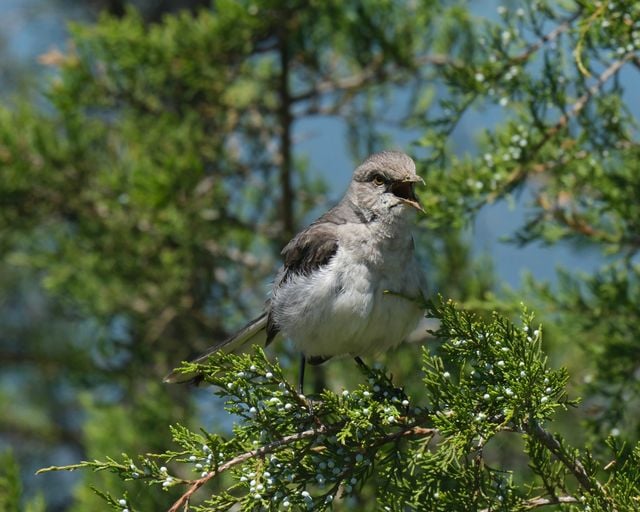
The mockingbird is a slender gray songbird, roughly 21 to 26 cm (8.3 to 10.2 in) long, with a long tail and bold white wing patches that flash in flight. Both sexes look alike. It favors open ground with scattered shrubs, which makes lawns, hedgerows, parking lots, and city parks ideal habitat.
Its defining trait is vocal. The mockingbird strings together imitations of other birds, and often mechanical sounds, repeating each phrase several times before moving to the next. Unmated males may sing through the night, especially under a bright moon. Mockingbirds are also fiercely territorial and will dive at cats, hawks, and people who stray too near a nest. In the yard they take insects from short grass and eat berries in fall and winter, and they come readily to fruit and mealworms though rarely to seed.
Common Backyard Birds
Northern Cardinal (Cardinalis cardinalis)
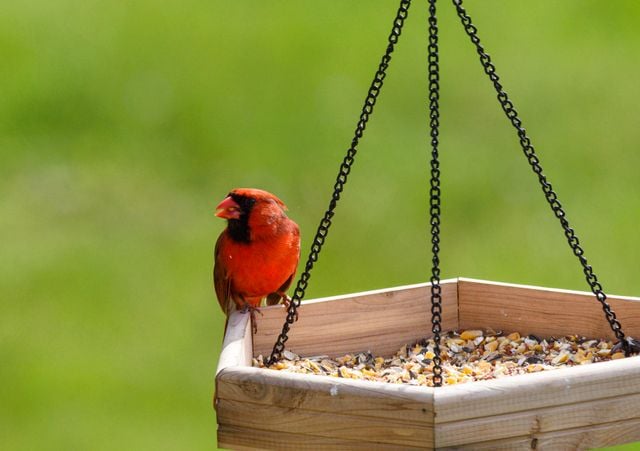
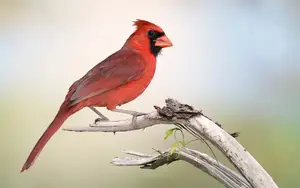
The Northern Cardinal is among the most recognizable Florida backyard birds and a year round resident statewide. The male is brilliant red with a pointed crest and a black mask around a heavy orange bill. The female is warm buff brown with red highlights and shares the same distinctive crest. Adults measure 21 to 23 cm (8.3 to 9.1 in).
Cardinals favor the edges of yards where shrubs and small trees meet open ground, and they nest in dense cover such as hedges and tangles. They forage low, often on the ground, and their thick bills are built for cracking seeds. Both sexes sing a clear whistled series, and pairs frequently stay together through the year. To attract them, offer black oil sunflower seed on a platform or hopper feeder set near protective cover, where cardinals feel safe lingering at dawn and dusk.
Blue Jay (Cyanocitta cristata)
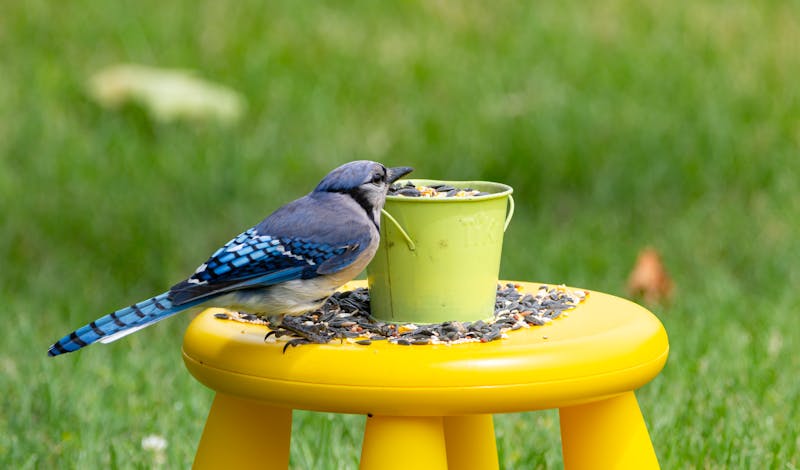
Blue jays are bold, intelligent, and among the most conspicuous residents of Florida yards, especially where oaks grow. The plumage is soft blue above and pale below, marked with black barring, a black necklace, white wing patches, and a prominent crest. Adults are 25 to 30 cm (9.8 to 11.8 in) long.
Highly social, blue jays move in family groups and announce themselves with a ringing jay jay call, though they also give a surprisingly accurate imitation of hawk screams. They cache acorns by the thousands, and in doing so help plant future oak forests. At feeders they prefer whole peanuts and sunflower seed and favor a sturdy platform or hopper that can hold their weight. A yard with mature oaks and a peanut feeder will rarely be without them.
Mourning Dove (Zenaida macroura)

The Mourning Dove is a slim, soft brown dove named for its low mournful cooing. It is a year round resident found in open and suburban areas across the state, often perched on wires or walking on the ground beneath feeders. Adults measure 23 to 34 cm (9.1 to 13.4 in), much of that length in the long, pointed tail, and their wings produce a distinctive whistle on takeoff.
Mourning doves feed almost entirely on seeds and prefer to forage on the ground or on a broad platform rather than clinging to a hanging feeder. Scattered cracked corn, white millet, and mixed seed will draw them, and they often arrive in small flocks. Because they nest readily in yard trees and shrubs, mourning doves may raise several broods across a long Florida breeding season.
Carolina Wren (Thryothorus ludovicianus)
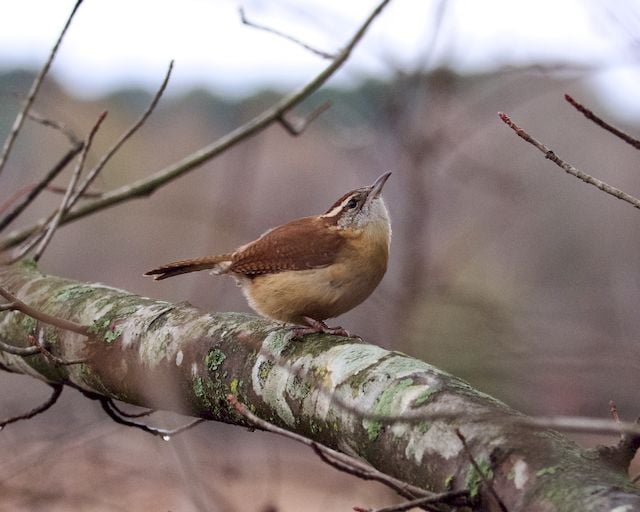
The Carolina Wren is a small, energetic, rich brown bird with a bold white eyebrow stripe and a tail often cocked upright. Despite its size of only 12 to 14 cm (4.7 to 5.5 in), it produces a loud, ringing teakettle-teakettle-teakettle song that carries across a yard. It is a common year round resident throughout Florida.
These wrens haunt brush piles, dense shrubs, woodpiles, and cluttered corners of the garden, gleaning insects and spiders from bark and leaf litter. They are famously curious and will investigate porches, garages, and hanging plants, sometimes nesting in unexpected containers. Carolina wrens do not eat much seed, but they take readily to suet and mealworms, particularly in cooler months. Leaving a brush pile or an untidy hedge in one corner of the yard gives them the cover they prefer.
Tufted Titmouse (Baeolophus bicolor)
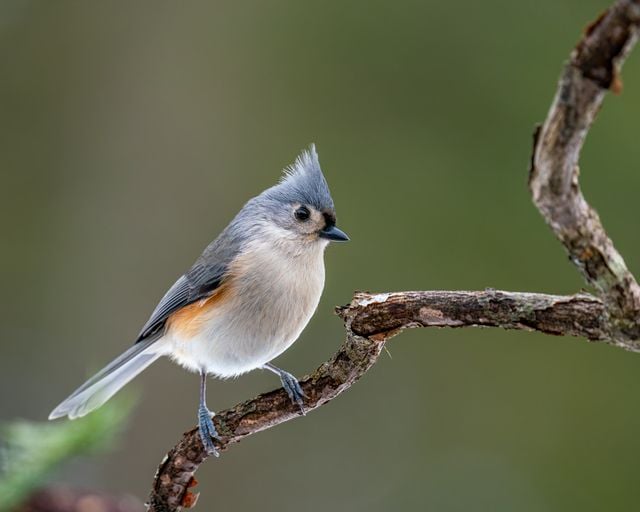
The Tufted Titmouse is a small, soft gray bird with a pointed crest, large dark eyes, and a peach wash along its flanks. It measures 14 to 16 cm (5.5 to 6.3 in) and is most common in the wooded yards of North and Central Florida, becoming scarcer toward the far south.
Titmice are active and vocal, giving a clear whistled peter-peter-peter that is one of the signature sounds of a wooded Florida yard. They often travel in mixed flocks with chickadees and small woodpeckers, especially in the winter months. At feeders they favor sunflower seed, typically grabbing a single seed and carrying it to a branch to hammer open. They also take suet and will use nest boxes, making them a rewarding species to plan a yard around.
Carolina Chickadee (Poecile carolinensis)
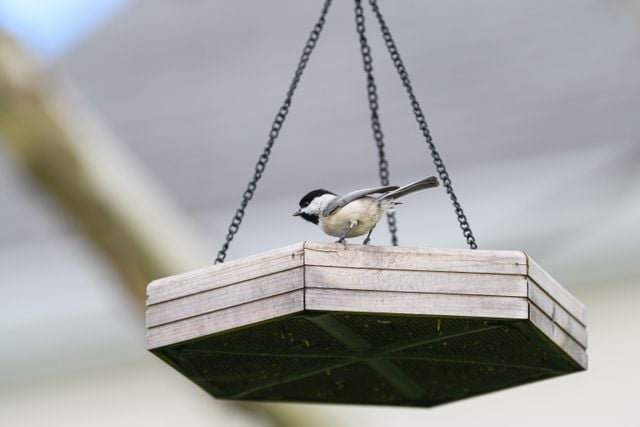
The Carolina Chickadee is the small, tame, black-capped visitor of wooded yards in North and Central Florida. It has a black cap and bib, white cheeks, and gray upperparts, and it measures just 11.5 to 13 cm (4.5 to 5.1 in). This is the only chickadee species in Florida, so the closely related black-capped chickadee of the north need not enter the identification.
Chickadees are acrobatic and fearless, often the first birds to discover a new feeder. They move through the canopy in small flocks, frequently alongside titmice and nuthatches, and their buzzy calls help hold these mixed groups together. They favor sunflower seed and suet and, like titmice, tend to take one seed at a time. Carolina chickadees readily accept nest boxes with a small entrance hole, which also excludes larger competitors.
Common Grackle (Quiscalus quiscula)
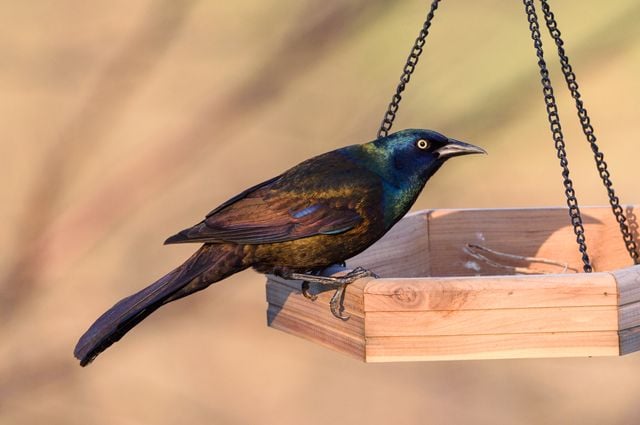
The Common Grackle is a long-tailed blackbird whose dark plumage shows a glossy blue and bronze iridescent sheen in good light. Adults measure 28 to 34 cm (11 to 13.4 in) and have piercing pale yellow eyes. Grackles are year round residents and often gather in large flocks, particularly outside the breeding season.
They forage boldly on lawns and in open areas, walking with an upright posture and eating almost anything, from seeds and grain to insects and scraps. At feeders they can arrive in numbers and dominate a platform. Along the coast and in marshy areas, watch for the larger Boat-tailed Grackle, whose exaggerated keel-shaped tail and larger size distinguish it. Offering seed in tube feeders with short perches, rather than open trays, can help smaller birds share the yard when grackle flocks move through.
Woodpeckers of the Florida Yard
Red-bellied Woodpecker (Melanerpes carolinus)

The Red-bellied Woodpecker is the most frequently seen woodpecker in most Florida yards. It has a boldly black-and-white barred back, a pale face and underparts, and a red cap and nape. The reddish wash on the belly that gives the bird its name is often hard to see. Adults measure 23 to 27 cm (9.1 to 10.6 in).
These woodpeckers work along tree trunks and larger limbs, probing bark for insects and taking fruit, nuts, and seeds. Their rolling churr call is a common sound in wooded neighborhoods. At feeders they readily take suet and sunflower seed and will visit hopper and platform feeders sturdy enough to hold them. A dead limb left standing, where safe to do so, provides both foraging and nesting habitat and increases the odds of a resident pair.
Downy Woodpecker (Dryobates pubescens)

The Downy Woodpecker is the smallest woodpecker in North America and a common resident of Florida yards with trees. It measures just 14 to 17 cm (5.5 to 6.7 in), with a white back, black-and-white checkered wings, and a short bill. Males show a small red patch on the back of the head that females lack.
Downies are nimble and will work thin twigs and stems that larger woodpeckers cannot, often joining winter flocks of chickadees and titmice. They take insects from bark and are enthusiastic visitors to suet feeders, also accepting sunflower seed and peanuts. Because of their small size they are easy to overlook, but a suet cage hung near cover will usually draw them within days. They should not be confused with the larger, longer-billed Hairy Woodpecker, a point addressed in the look-alike comparison below.
Colorful Feeder Visitors
Painted Bunting (Passerina ciris)
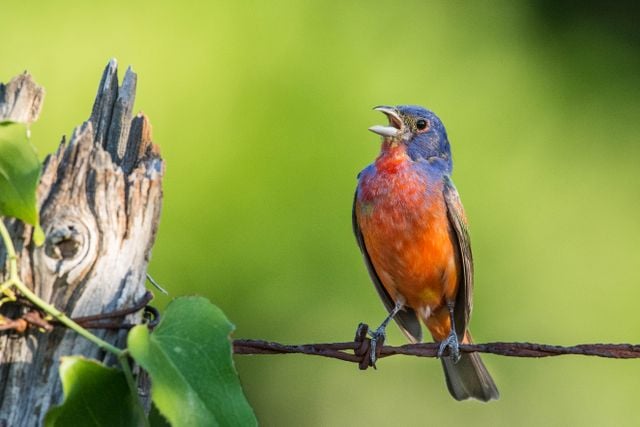
The male Painted Bunting is often called the most beautiful bird in North America, with a blue head, green back, and vivid red underparts. The female and immature birds are a uniform bright yellow-green, unlike any other Florida yard bird. Adults are small, 12 to 14 cm (4.7 to 5.5 in). Painted buntings winter in South Florida and breed in coastal scrub of the northeast, so their presence shifts with the season.
These shy birds favor dense cover and often feed at the edges of a yard rather than in the open. White millet is the preferred food, offered in a tube or hopper feeder placed close to shrubs where the buntings can retreat. In areas where they winter, a quiet yard with reliable seed and thick cover can host them for weeks, and their arrival is a highlight of the Florida birding calendar.
Eastern Bluebird (Sialia sialis)
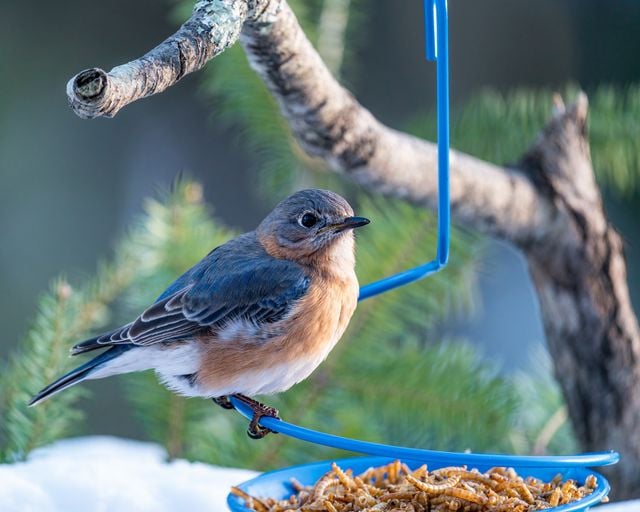
The Eastern Bluebird is a small thrush of open country, with the male showing a deep blue back and a warm rust-orange breast, and the female a softer, grayer version of the same pattern. Adults measure 16 to 21 cm (6.3 to 8.3 in). Bluebirds are year round residents statewide, most common where lawns, pastures, and golf courses meet scattered trees.
They hunt insects by dropping from a low perch to the ground, and in cooler months they add berries to their diet. Bluebirds rarely eat seed, but they come to mealworms and will nest in boxes placed in open areas away from heavy tree cover. A properly sited nest box, facing an open field or lawn, is the single most effective way to attract a breeding pair, and boxes with predator guards greatly improve nesting success.
Ruby-throated Hummingbird (Archilochus colubris)
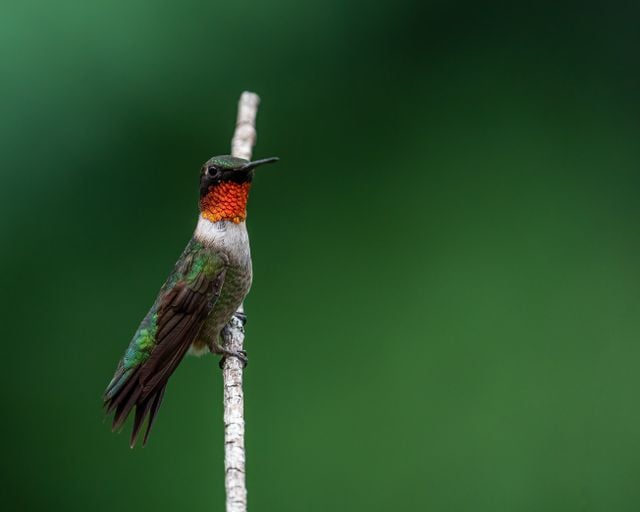
The Ruby-throated Hummingbird is the default hummingbird of Florida yards. The male has a glittering emerald back and an iridescent red throat that can look black in poor light, while the female is green above and pale below. These are tiny birds, 7 to 9 cm (2.8 to 3.5 in). Most arrive in late February and March, breed through the warm months, and depart in fall, though some remain through winter at the southern tip of the state and along the Gulf Coast.
Hummingbirds feed on flower nectar and small insects, and they defend rich food sources aggressively. A nectar feeder filled with a solution of four parts water to one part sugar, with no dye, will draw them, provided it is cleaned often in the Florida heat. Native flowering plants such as firebush (Hamelia patens) and scarlet sage (Salvia coccinea) offer the best long-term draw.
Birds of Prey in the Neighborhood
Red-shouldered Hawk (Buteo lineatus)
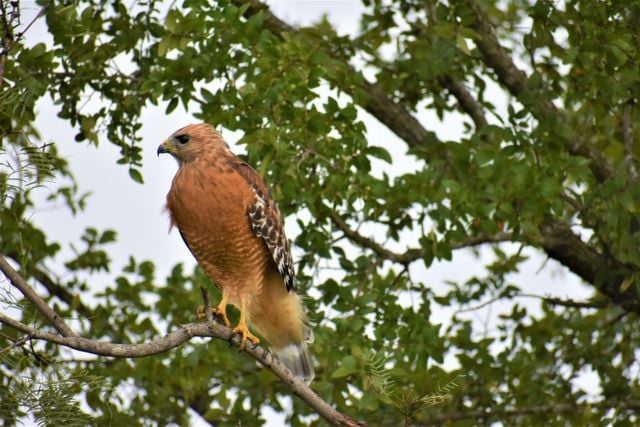
The Red-shouldered Hawk is the hawk most Florida residents see in their neighborhoods. It is a medium-sized raptor, 43 to 61 cm (16.9 to 24 in) long, with reddish barred underparts, black-and-white checkered wings, and a boldly banded tail. Its loud, repeated kee-rah scream is a familiar sound in wooded suburbs, and blue jays imitate it convincingly.
Red-shouldered Hawks hunt from perches, dropping onto frogs, lizards, snakes, large insects, and small mammals, and they adapt well to yards with mature trees and nearby water. They are not feeder birds, but a busy feeder can attract one indirectly, since the concentration of small birds and rodents provides hunting opportunities. Seeing a hawk in the yard is a sign of a healthy local food web rather than a problem, and the smaller birds usually resume feeding once it moves on.
Water and Wetland Visitors
White Ibis (Eudocimus albus)
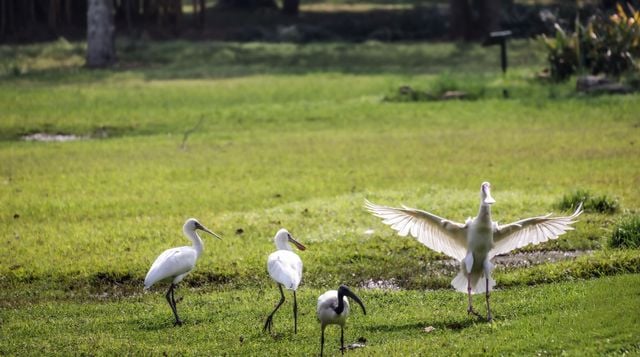
Few birds capture the Florida backyard experience like a flock of White Ibis probing a suburban lawn. Adults are white with black wingtips, a long down-curved red bill, and red legs, and they measure 56 to 68 cm (22 to 26.8 in). Immature birds are mottled brown and white. They are year round residents, most numerous in Central and South Florida.
White Ibis feed by probing soft ground and shallow water for insects, crayfish, and other small prey, and short irrigated lawns often suit them well. They move in loose flocks and can appear in neighborhoods far from obvious wetlands. Larger wading birds share this habit of visiting yards near water: the stately Great Blue Heron (Ardea herodias) stalks retention ponds and canals, and in the south the pink Roseate Spoonbill (Platalea ajaja) may appear at coastal shallows. None of these visit feeders, but a yard with water nearby will draw them.
Winter Visitors and Migrants
American Robin (Turdus migratorius)
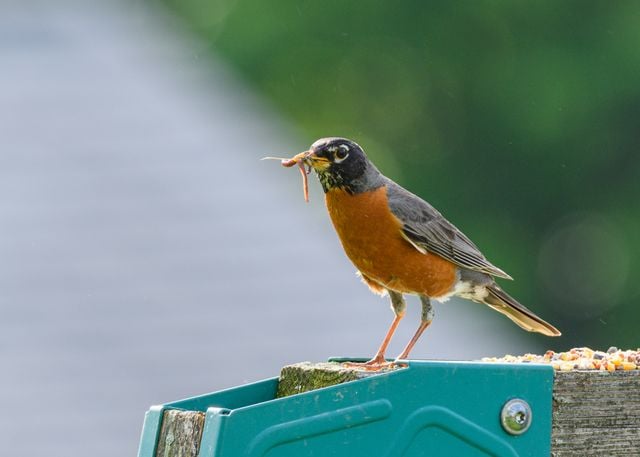
In much of the country the American Robin signals spring, but in Florida it is a bird of winter, arriving in large flocks from the north. It is a familiar gray-brown thrush with a brick-red breast and a yellow bill, 20 to 28 cm (7.9 to 11 in) long. Robins are scarce or absent in the Florida summer and can number in the hundreds or thousands during cold snaps.
Rather than probing lawns for worms as they do farther north, Florida’s wintering robins concentrate on fruit, descending on hollies, palms, wax myrtle, and other berry-laden trees and stripping them in noisy groups. They rarely visit seed feeders, but a yard with native fruiting trees can host spectacular numbers. Their sudden mass arrival, often in January or February, is one of the reliable signs of a Florida winter.
Yellow-rumped Warbler (Setophaga coronata)

The Yellow-rumped Warbler is by far the most common wintering warbler in Florida yards. In its subdued winter plumage it is brownish and streaked, but the bright yellow rump patch that gives the bird its name remains visible, along with yellow patches on the sides. Adults measure 12 to 14 cm (4.7 to 5.5 in). They arrive in fall and depart by spring.
These warblers are unusually flexible eaters for their family. In addition to insects they digest the waxy berries of wax myrtle and bayberry, which lets them winter farther north and in greater numbers than most warblers, and which draws them to native shrubs in Florida yards. They also come to suet feeders, sometimes in small flocks, flicking through shrubs and low trees. Their sharp chek call note often reveals them before they are seen.
American Goldfinch (Spinus tristis)
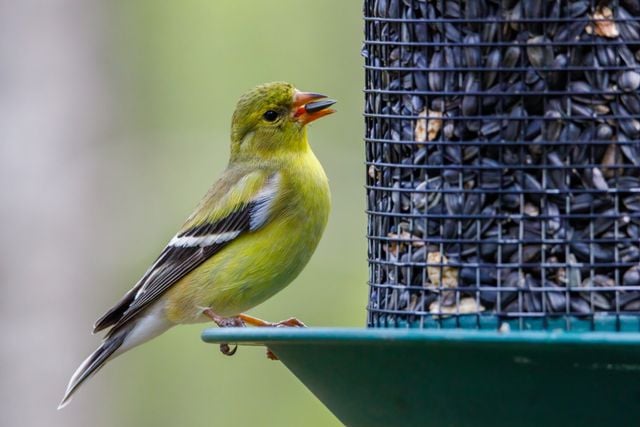
The American Goldfinch is a small winter finch that reaches Florida in drab, non-breeding dress rather than the bright yellow of its northern summer. Winter birds are soft brownish-olive with blackish wings and pale wing bars, measuring 11 to 13 cm (4.3 to 5.1 in). They arrive in fall and are most numerous from late winter into early spring, sometimes in sizable flocks.
Goldfinches are seed specialists and are strongly drawn to Nyjer, also called thistle, offered in a fine mesh or tube feeder, as well as to sunflower chips. They often descend on feeders in tight groups and can empty a feeder quickly. Because they linger into spring, patient watchers may see some birds begin to molt into brighter plumage before they depart, a preview of the golden summer color that Florida yards otherwise miss.
Look-Alike Species: Telling Them Apart
Several Florida yard birds are easy to confuse. The table below compares the three pairs that most often cause identification trouble.
| Pair | Key difference | Additional clues |
|---|---|---|
| Downy vs Hairy Woodpecker | Downy is small (14 to 17 cm) with a short, stubby bill; Hairy is larger (18 to 26 cm) with a bill nearly as long as its head is wide | Downy has black spots on white outer tail feathers; Hairy’s are clean white. Downy is far more common at feeders |
| Common vs Boat-tailed Grackle | Common Grackle is smaller with a shorter tail and pale yellow eye statewide; Boat-tailed is larger with a long keel-shaped tail | Boat-tailed favors coasts and marshes; the female Boat-tailed is warm brown, unlike the all-dark Common Grackle |
| American vs Fish Crow | Nearly identical by sight; voice is the reliable clue | American Crow gives a clear caw; Fish Crow gives a nasal, two-note uh-uh. Fish Crow is common near water statewide |
What to See When: A Seasonal Guide
Florida’s backyard birding shifts through the year, with winter offering the greatest variety across most of the peninsula.
| Season | What to expect in the yard |
|---|---|
| Spring (March to May) | Ruby-throated Hummingbirds arrive and set up; migrants pass through; resident species begin nesting and singing |
| Summer (June to August) | Resident breeders are active; young cardinals, jays, and mockingbirds appear at feeders; hummingbirds nest |
| Fall (September to November) | Migration peaks; warblers, catbirds, and other travelers move through; first wintering birds arrive |
| Winter (December to February) | Busiest feeder season; American Robins, Yellow-rumped Warblers, American Goldfinches, and Painted Buntings join residents, often in large flocks |
Notable Birding Locations Near Florida Yards
Florida rewards the birder willing to venture beyond the yard, and several sites rank among the finest in the country.
Merritt Island National Wildlife Refuge, on the Atlantic coast near Titusville, is renowned for wading birds, waterfowl, and one of the strongholds of the Florida Scrub-Jay. Everglades National Park protects the vast subtropical wetlands of the far south and its specialty wading birds and raptors. The Corkscrew Swamp Sanctuary near Naples, managed by Audubon, preserves old-growth bald cypress and a famous boardwalk through prime habitat. On the Gulf Coast, Fort De Soto Park in Pinellas County is a celebrated migration trap, and the J.N. Ding Darling National Wildlife Refuge on Sanibel Island offers close views of ibises, spoonbills, and herons. Inland, the Circle B Bar Reserve in Polk County and the scrub of the Ocala National Forest reward day trips from most of Central Florida.
How to Attract Birds to Your Florida Yard
The most effective way to draw a wide range of Florida backyard birds is to combine food, water, and native plantings rather than relying on a single feeder.
For food, black oil sunflower seed is the best all-purpose choice, appealing to cardinals, chickadees, titmice, woodpeckers, and finches. Offer it in a tube feeder to suit smaller birds and in a hopper or platform feeder for cardinals, jays, and doves. White millet on a low platform draws doves and buntings, Nyjer in a fine feeder brings goldfinches, and suet supports woodpeckers, wrens, and wintering warblers. A nectar feeder mixed at four parts water to one part sugar, kept clean in the heat, serves hummingbirds.
Water may matter even more than food in Florida, and a shallow birdbath with a dripper or mister will attract species that never touch a feeder, including warblers and thrushes. Refresh it often to keep it clean.
Native plants close the loop by supplying insects, fruit, and cover. Firebush (Hamelia patens), beautyberry (Callicarpa americana), wax myrtle, and native oaks are strong choices that support both resident and migratory birds. Nest boxes sized for bluebirds, chickadees, and titmice add breeding habitat where natural cavities are scarce.
A few stewardship practices protect the birds a yard attracts. Keep cats indoors, since free-roaming cats are a leading cause of songbird deaths. Clean feeders and baths regularly to reduce the spread of disease, and take feeders down for a time if sick birds appear. The Florida Fish and Wildlife Conservation Commission also advises against feeding certain wild birds, including the Florida Scrub-Jay, because handouts disrupt natural behavior and can increase the risks these birds face.
Conservation: The Florida Scrub-Jay and Its Data
Florida’s signature conservation story belongs to the Florida Scrub-Jay (Aphelocoma coerulescens), the only bird species endemic to the state, meaning it is found nowhere else in the world. It is a crestless blue and gray jay of the dry oak scrub that grows on ancient sandy ridges, and it lives in cooperative family groups in which grown offspring help raise the next generation.
The scrub-jay depends on habitat kept open by periodic fire, and both fire suppression and the loss of scrub to development have driven a steep, long-term decline. According to Audubon, the population has fallen by roughly 90 percent since the early twentieth century, and the U.S. Fish and Wildlife Service listed the species as federally threatened in 1987. The Florida Department of Environmental Protection estimates the current population at about 7,700 to 9,300 birds. The Florida Fish and Wildlife Conservation Commission identifies habitat destruction, fragmentation, and fire suppression as the primary threats and points to prescribed burning as essential to recovery.
Community science provides much of the data that guides this work. Audubon Florida coordinates Jay Watch, a program in which trained volunteers survey scrub-jays each summer at more than 46 sites across 19 counties, measuring nesting success and counting birds. Those figures help land managers decide where to burn and restore habitat, and they feed directly into the status reviews required for a federally listed species. The effort shows how backyard-scale attention to birds connects to the larger task of keeping a uniquely Floridian species from vanishing.
Frequently Asked Questions
What is the most common backyard bird in Florida?
The Northern Cardinal and Northern Mockingbird are among the most common and widespread backyard birds in Florida, both present year round across the entire state. Mourning Doves and Blue Jays are also nearly universal in yards, while Red-bellied Woodpeckers are the woodpecker most people see. Which one dominates a given yard depends on its habitat and feeders.
What is the state bird of Florida?
The state bird of Florida is the Northern Mockingbird (Mimus polyglottos), designated in 1927 by a resolution of the state legislature. It is a gray songbird known for imitating other birds and for singing at night, and it occurs in all 67 Florida counties. Four other states also claim the mockingbird as their state bird.
When do hummingbirds arrive in Florida?
Ruby-throated Hummingbirds, the state’s main species, typically arrive from late February into March and remain through the warm breeding months. Some Ruby-throated Hummingbirds also spend the winter at the southern tip of Florida and along the Gulf Coast, so leaving a clean nectar feeder up year round can support both migrants and winter birds.
What is the largest bird in a Florida backyard?
Among birds that regularly visit yards, the Sandhill Crane (Antigone canadensis) is the largest, standing over a metre (about 4 ft) tall and often walking across lawns in Central Florida. Great Blue Herons are similarly tall and frequent ponds and canals. True backyard feeder birds are all far smaller, with the Common Grackle and Blue Jay among the larger regular feeder visitors.
Why do I see so many robins in winter but not summer?
The American Robin is a winter visitor to most of Florida, arriving in large flocks from the north and departing before summer. Wintering robins gather at fruiting trees such as hollies and wax myrtle rather than feeding on lawns, which is why they often appear suddenly in noisy groups and then move on once the berries are gone.
How do I keep grackles and non-native birds from taking over my feeders?
Using tube feeders with short perches favors smaller songbirds over large flocks of Common Grackles, European Starlings, and House Sparrows, which struggle to feed there. Offering safflower seed, which many songbirds accept but grackles and starlings tend to avoid, can also help, as can removing spilled seed from the ground where flocks gather.
Conclusion
Florida’s backyards sit at the meeting point of temperate and subtropical worlds, and the birds that visit them reflect that richness. A single yard may host cardinals and mockingbirds year round, hummingbirds through the warm months, and flocks of robins, warblers, and goldfinches in winter, all against a backdrop of ibises on the lawn and a hawk screaming from a nearby tree. Learning even a dozen of these species turns an ordinary window into a seat at one of the most diverse bird communities in North America.
The same qualities that make Florida’s birdlife so rewarding also make it fragile, as the story of the Florida Scrub-Jay shows. Thoughtful feeding, native plantings, and support for habitat conservation let anyone with a yard take part in protecting it. For deeper coverage of particular groups, see the companion guides to Florida’s owls, wading birds, backyard hawks, and birds by color, each of which explores a corner of this larger picture.
Works Cited
- Florida Ornithological Society Records Committee. FOS Bird Checklist. https://fosbirds.org/fos-bird-checklist/
- Florida Department of State. Florida State Bird. https://dos.fl.gov/florida-facts/florida-state-symbols/state-bird/
- Florida Fish and Wildlife Conservation Commission. Florida Scrub-Jay. https://myfwc.com/wildlifehabitats/profiles/birds/songbirds/florida-scrub-jay/
- Florida Department of Environmental Protection. Florida Scrub-Jay Is One of a Kind. https://floridadep.gov/comm/press-office/content/florida-scrub-jay-one-kind
- National Audubon Society. Volunteers Are Providing the Data Needed to Manage Florida’s Endemic Bird. https://www.audubon.org/news/volunteers-are-providing-data-needed-manage-floridas-endemic-bird
- Audubon Florida. Audubon’s Florida Scrub-Jay Program Enters 20th Year. https://www.audubon.org/florida/news/audubons-florida-scrub-jay-program-enters-20th-year
- National Audubon Society. Florida Scrub-Jay, Audubon Field Guide. https://www.audubon.org/field-guide/bird/florida-scrub-jay
- Cornell Lab of Ornithology. Ruby-throated Hummingbird Range Map, All About Birds. https://www.allaboutbirds.org/guide/Ruby-throated_Hummingbird/maps-range
- Cornell Lab of Ornithology. Northern Cardinal Identification, All About Birds (representative of the species accounts used for size and behavior throughout). https://www.allaboutbirds.org/guide/Northern_cardinal/id/
- Cornell Lab of Ornithology. Northern Mockingbird Identification, All About Birds. https://www.allaboutbirds.org/guide/Northern_Mockingbird/id
- Cornell Lab of Ornithology. My Feeders Are Being Overrun with Starlings and Blackbirds. What Can I Do? All About Birds. https://www.allaboutbirds.org/news/my-feeders-are-being-overrun-with-starlings-and-blackbirds-that-eat-all-the-food-and-keep-smaller-birds-away-what-can-i-do/
- U.S. Fish and Wildlife Service. Migratory Bird Program Administrative Flyways (Atlantic Flyway Council membership includes Florida). https://www.fws.gov/partner/migratory-bird-program-administrative-flyways
- American Bird Conservancy. Avian Superhighways: The Four Flyways of North America. https://abcbirds.org/news/four-flyways-of-north-america/
More Birds to Explore
- Northern Mockingbird
- Hawks In Florida
- Black And White Birds In Florida
- Diving Birds In Florida
- Water Birds In Florida
- Florida Gulf Coast Birds
- Wading Birds In Florida
- Sandpipers In Florida
- Florida Birds With Long Legs
- Florida Birds With Long Beaks
- Oriole Birds In Florida
- Swallows In Florida
- Doves In Florida
- Herons In Florida
- Florida Owl Sounds
- Kite Birds In Florida
- Night Birds In Florida
- Florida Birds Of Prey
- Parrots In Florida
- Common Birds In Florida
- Large Birds In Florida
- Blue Birds In Florida
- Red Birds In Florida
- Small Birds In Florida
- Shore Birds In Florida
- Black Birds In Florida
- White Birds In Florida
- Pink Birds In Florida