Mourning Dove: North America’s Most Hunted Bird and Gentle Garden Visitor
Mourning Dove
North America’s Most Hunted Bird and Gentle Garden Visitor
Zenaida macroura
ORDER: Columbiformes
FAMILY: Columbidae
Introduction
A soft, mournful cooing drifts through the morning air, but don’t be fooled by its melancholy name—the Mourning Dove (Zenaida macroura) is one of North America’s most successful and resilient bird species! With an estimated fall population of approximately 346 million birds in the United States alone (Seamans, 2024), these graceful creatures have mastered the art of survival in an ever-changing landscape. Despite being the most frequently hunted bird species in North America (Cornell Lab of Ornithology, n.d.), Mourning Doves continue to thrive from southern Canada to central Mexico.
Their remarkable adaptability is just one of the many qualities that make them fascinating subjects for observation. When I first noticed the opportunity to research these gentle birds that visit my neighborhood daily, I was amazed to discover their incredible breeding capacity—raising up to six broods per year in warm climates, more than any other native North American bird (Audubon, n.d.). In this comprehensive guide, I aim to take you along with me to explore the Mourning Dove in all its understated elegance. Together, we’ll discover everything from their symbolic significance across cultures to their remarkable reproductive strategies. We’ll also cover identification tips, their complex social behaviors, dietary habits, and the unique whistling sound their wings make in flight.
By the time you finish reading this guide, I hope you’ll gain a newfound appreciation for the Mourning Dove. Whether you’re watching them perch on telephone wires in your neighborhood or listening to their distinctive cooing at dawn, you’ll never look at these common yet extraordinary birds the same way again!
Myths and Legends
Throughout history, the Mourning Dove has held various symbolic meanings across different cultures, though its cultural significance is generally more subtle than that of more dramatic birds like crows or eagles. The dove’s gentle nature and mournful call have made it a universal symbol of peace, love, and the soul’s journey.
In Christian tradition, doves represent the Holy Spirit and divine peace, with their pure white eggs symbolizing new beginnings and spiritual rebirth. The Mourning Dove’s faithful pair bonding, where breeding pairs often mate for life (Mass Audubon, n.d.), has made them symbols of devotion and marital fidelity in Western culture.
Native American perspectives on the Mourning Dove vary among tribes, but many associate the bird with rain and agricultural abundance, likely due to their presence in farming areas. Some tribes consider the dove’s call a sign of impending rain, while others view it as a messenger between the earthly and spiritual realms.
In contemporary culture, the Mourning Dove’s mournful cooing has inspired countless poets and musicians, who often use the bird as a metaphor for loss, longing, or gentle remembrance. Their peaceful nature and soft colors have made them enduring symbols of tranquility in gardens and natural spaces across North America.
Classification
The Mourning Dove belongs to the family Columbidae, which includes all pigeons and doves worldwide. This diverse family comprises over 300 species found on every continent except Antarctica. Members of the Columbidae family share several characteristics including a compact body structure, small heads, short necks, and the unique ability to produce “crop milk” to feed their young.
The Mourning Dove is classified within the genus Zenaida, which consists of seven species of doves found primarily in the Americas. The genus name honors Zénaïde Laetitia Julie Bonaparte, wife of the French ornithologist Charles Lucien Bonaparte. Members of the Zenaida genus are characterized by their medium size, long pointed tails, and preference for open habitats.
Full Classification:
Kingdom: Animalia
Phylum: Chordata
Class: Aves
Order: Columbiformes
Family: Columbidae
Genus: Zenaida
Species: Z. macroura
The species name “macroura” comes from the Greek words “makros” (long) and “oura” (tail), referring to the bird’s distinctive long, pointed tail that sets it apart from other North American doves.
Physical Characteristics and Identification
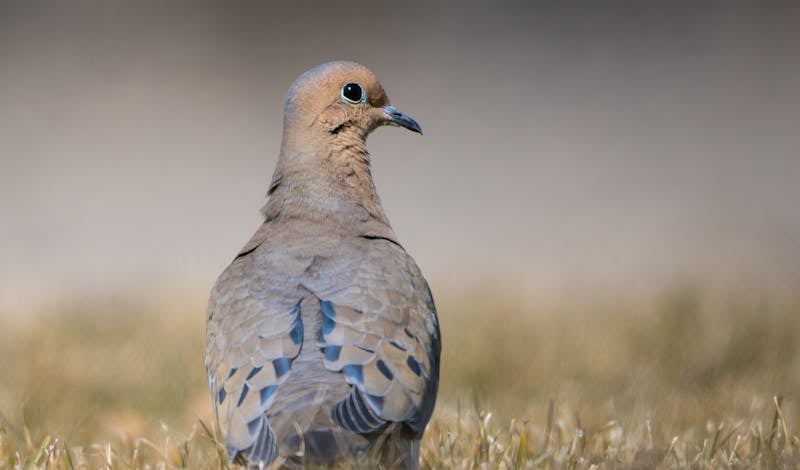
The Mourning Dove is a graceful, slender-tailed, small-headed dove measuring approximately 12 inches (30 cm) from bill to tail tip (Audubon, n.d.). These medium-sized birds have a wingspan ranging from 17 to 19 inches and weigh just over 4 ounces (Indiana DNR, 2006). Their streamlined build and fast, bullet-straight flight make them unmistakable in the air.
Both sexes are similar in appearance, displaying soft, muted colors that blend beautifully with their surroundings. They are grayish-brown on their backs with buff-colored undersides (Indiana DNR, 2006). Adult males show a subtle pinkish wash on the chest and blue-gray coloring on the crown, while females appear duller and more uniformly brown (Audubon, n.d.). Black spots mark their wings and appear behind their eyes, creating a distinctive facial pattern. The outer tail feathers display white tips that are clearly visible during flight, particularly during takeoff and landing.
One of the most distinctive features of the Mourning Dove is the whistling or whinnying sound produced by their wing feathers during takeoff and landing (Mass Audubon, n.d.). This characteristic sound, combined with their long, pointed tail, helps distinguish them from other similar-sized birds. Juvenile doves can be identified by buff-colored tips on their primary feathers, giving them a scaly appearance that persists until their first molt at approximately three months of age (Indiana DNR, 2006).
Habitat and Distribution
Mourning Doves breed from southern Canada throughout the continental United States into Mexico, Bermuda, the Bahamas, Greater Antilles, and in scattered locations in Central America (Seamans, 2024). Although they winter throughout much of their breeding range, the majority winter in the southern United States, Mexico, and south through Central America to western Panama.
These highly adaptable birds are found in almost any kind of open or semi-open habitat in temperate parts of North America, including forest clearings, farmland, suburbs, prairies, and deserts (Audubon, n.d.). They may be most common in edge habitats having both trees and open ground, though they also thrive in some treeless areas. Mourning Doves consistently avoid unbroken forest, preferring areas that provide a combination of feeding, nesting, and roosting opportunities.
Agricultural landscapes particularly attract Mourning Doves, as these areas provide abundant food sources and suitable nesting sites. They are normally attracted to open areas where they nest along pastures, field edges, and clearings (Indiana DNR, 2006). The expansion of agricultural land and suburban development across North America has likely contributed to the species’ success, as these human-modified landscapes often create ideal dove habitat.
Fresh surface water is a daily requirement for Mourning Doves, with natural sources including streams, ponds, and puddles (Indiana DNR, 2006). They prefer water sources with minimal surrounding vegetation, allowing them to drink safely while maintaining visibility for predator detection.
Breeding, Family Structure, and Nesting Patterns
Mourning Doves have one of the most extended breeding seasons of any North American bird. Courtship activities begin in late winter (late February/early March) with egg laying beginning in late April/early May (Indiana DNR, 2006). In warm climates, they may raise up to six broods per year, more than any other native bird (Audubon, n.d.). This prolific breeding is necessary to maintain population levels, as average mortality rates can be as high as 60% for adults and 70% for juveniles (Indiana DNR, 2006).
Nests are constructed of loosely fit twigs and grass, typically placed 5 to 15 feet high in trees and shrubs (Indiana DNR, 2006). Trees with fairly large horizontal limbs are preferred, as well as conifers, which provide level support for the flimsy nest structure. The male leads the female to potential nest sites, with the female making the final choice (Audubon, n.d.). Both sexes contribute to nest construction, with the male selecting and delivering materials while the female builds the nest.
The normal clutch size is two pure white eggs with very little gloss (Indiana DNR, 2006). Incubation lasts approximately 14 days, with both parents participating—the male typically sits on the nest during the day while the female takes the night shift, ensuring the nest is rarely left unattended. Young doves (called squabs) are fed a diet of “pigeon milk” for approximately three days before seeds gradually replace this high-protein substance secreted by the crop lining of both parents (Indiana DNR, 2006).
After 14 days, the young leave the nest, achieving independence 5 to 9 days later. Within 2 to 3 weeks of fledging, most young will have left the nest area completely (Indiana DNR, 2006). The parents often begin a new nesting cycle soon after the young have fledged, continuing their reproductive efforts throughout the breeding season.
Intelligence and Cognitive Abilities
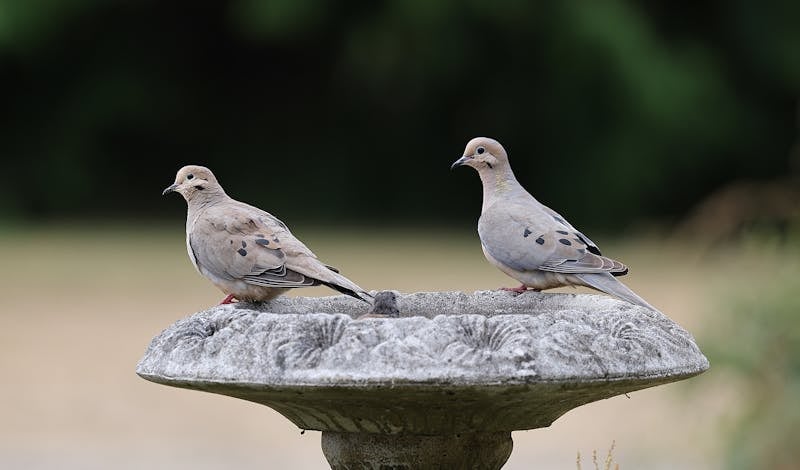
While Mourning Doves may not possess the problem-solving abilities of corvids or parrots, they demonstrate their own forms of intelligence adapted to their ecological niche. Their success as one of North America’s most abundant birds suggests considerable cognitive adaptability.
Mourning Doves exhibit excellent spatial memory, regularly returning to productive feeding sites and water sources. They can remember the locations of multiple feeding areas and adjust their foraging patterns based on seasonal availability. Their ability to thrive in human-modified landscapes demonstrates behavioral flexibility and learning capacity.
These birds show sophisticated predator awareness and escape strategies. The characteristic whistling sound produced by their wings during takeoff may serve as an alarm signal to other doves, suggesting a level of social communication about threats. Their preference for open ground feeding areas with clear sightlines indicates strategic thinking about safety while foraging.
Mourning Doves also demonstrate complex social behaviors, particularly during the breeding season. Their courtship displays, mate selection, and cooperative parenting require coordination and communication between pairs. The fact that many pairs mate for life (Mass Audubon, n.d.) suggests the ability to recognize and remember individual partners across breeding seasons.
Dietary Preferences
Mourning Doves are almost exclusively granivorous, with seeds comprising approximately 99% of their diet (Audubon, n.d.; Indiana DNR, 2006). Unlike many ground-feeding birds, doves do not scratch or dig for food—they are strictly sight feeders, eating only what is visible and accessible on sparsely covered or bare ground (Indiana DNR, 2006).
Preferred wild food sources include seeds from foxtail, ragweed, pigweed, and various grasses. When available, they readily consume agricultural grains including corn, sorghum, millet, wheat, and oil-type sunflowers (Indiana DNR, 2006). This dietary flexibility allows them to exploit both natural and human-modified habitats effectively.
Mourning Doves have evolved an efficient feeding strategy where they quickly fill their crop with seeds, then digest them while resting in a safe location (Audubon, n.d.). A single dove’s crop can hold an impressive amount of seeds—one recorded instance found 17,200 bluegrass seeds in a single crop.
Essential to their seed-based diet is the regular consumption of grit (sand or gravel), which doves store in their gizzard to help grind the hard seeds they consume (Indiana DNR, 2006). They actively seek out sources of grit, often visiting roadsides or gravel areas specifically for this purpose. Occasionally, Mourning Doves consume snails and, very rarely, insects, though these represent less than 1% of their diet (Audubon, n.d.).
Communication and Vocalization
The Mourning Dove’s name derives from its distinctive call—a soft, mournful cooing that sounds like “coo-ah, coo, coo, coo” (Audubon, n.d.). This melancholy sound is one of the most familiar bird calls in North America and serves multiple communication functions within dove society.
Males use their cooing primarily during the breeding season as a territorial advertisement and mate attraction display. The perch coo, delivered from an exposed perch, can carry considerable distances and helps establish breeding territories. Males also produce a shorter greeting coo when approaching their mate at the nest.
Beyond vocalizations, Mourning Doves communicate through various visual displays. During courtship, males perform dramatic flight displays, flying up with noisy wingbeats before going into a long circular glide with wings fully spread and slightly bowed down (Audubon, n.d.). On the ground, males approach females with a stiff gait, chest puffed out, while bowing and giving emphatic cooing songs.
The whistling or whinnying sound produced by their wings during takeoff serves as an additional form of communication (Mass Audubon, n.d.). This sound may function as an alarm signal, alerting other doves to potential danger. The ability to produce this sound appears to be under voluntary control, as doves taking off in non-threatening situations often do so silently.
Conservation Status
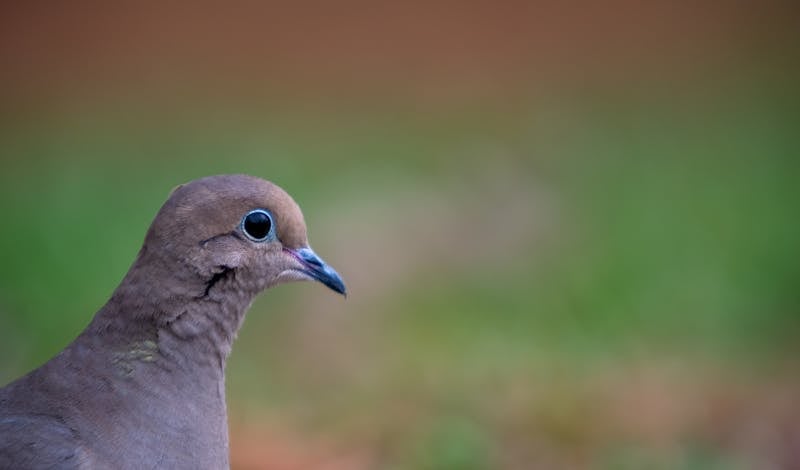
Despite being the most frequently hunted species in North America (Cornell Lab of Ornithology, n.d.), Mourning Dove populations remain robust. The most recent population estimates indicate approximately 346 million mourning doves in the United States as of September 1, 2023 (Seamans, 2024). Population distribution varies by management unit: Eastern Management Unit (EMU) with 88.5 million, Central Management Unit (CMU) with 201.9 million, and Western Management Unit (WMU) with 55.1 million birds.
The Breeding Bird Survey data shows mixed trends across different regions. Over the past 58 years (1966-2023), populations increased in the EMU but decreased in both the CMU and WMU. However, the most recent 10-year trends (2014-2023) show declining populations in the EMU, stable populations in the CMU, and increasing populations in the WMU (Seamans, 2024).
In the 2023-24 hunting season, approximately 16.8 million Mourning Doves were harvested by about 1 million hunters who spent approximately 3.3 million days afield (Seamans, 2024). Despite this substantial harvest, the species maintains healthy populations due to their remarkable reproductive capacity and adaptability.
Mourning Doves are managed as a game species in approximately 37 of the lower 48 states (Indiana DNR, 2006), though some states, including Massachusetts, provide full protection for the species (Mass Audubon, n.d.). The species benefits greatly from the increasing popularity of backyard bird feeders, which help these ground-foraging birds survive lean times, particularly in northern regions where increasing numbers now overwinter.
European settlement of the continent, with its opening of forests and creation of agricultural lands, probably helped this species increase substantially (Audubon, n.d.). Their ability to thrive in human-modified habitats positions them well for continued success despite ongoing environmental changes.
Conclusion
I hope by now you can appreciate why Mourning Doves deserve far more recognition than they typically receive. Their soft, mournful calls and gentle demeanor bring a peaceful presence to our neighborhoods that we often take for granted. From their remarkable reproductive capacity—raising up to six broods annually—to their faithful pair bonds and cooperative parenting, Mourning Doves demonstrate that common birds can lead extraordinary lives.
What I find most captivating about Mourning Doves is their quiet resilience. Despite being the most hunted bird in North America, facing mortality rates of up to 70% for juveniles, and living an average of just over one year, they maintain robust populations through sheer adaptability and reproductive determination. They’ve turned human landscape modifications to their advantage, thriving in the agricultural and suburban environments we’ve created.
These birds are incredibly accessible for observation. You don’t need specialized equipment or remote locations to study them—they’re perched on telephone wires, foraging beneath bird feeders, and nesting in backyard trees across the continent. Next time you hear that distinctive mournful coo or see the flash of white tail feathers as a dove takes flight with whistling wings, take a moment to appreciate these remarkable survivors.
Even with healthy populations exceeding 346 million birds across North America, Mourning Doves face ongoing challenges from habitat loss, climate change, and hunting pressure. Yet their adaptability and close association with human environments suggest they’ll continue to thrive alongside us.
If you’re inspired to support your local Mourning Dove community, consider scattering millet or other small seeds on platform feeders or the ground, and ensure fresh water is available daily. Plant dense shrubs or evergreen trees to provide nesting sites (Cornell Lab of Ornithology, n.d.). Whether you’re an experienced birder or someone who simply enjoys the gentle cooing outside your window, understanding Mourning Doves will deepen your connection to the natural world that surrounds us every day.
References
Audubon. (n.d.). Mourning Dove. National Audubon Society Field Guide. https://www.audubon.org/field-guide/bird/mourning-dove
Cornell Lab of Ornithology. (n.d.). Mourning Dove overview. All About Birds. https://www.allaboutbirds.org/guide/Mourning_Dove/overview
Indiana Department of Natural Resources. (2006). Mourning Dove: Wildlife management fact sheet. Division of Fish and Wildlife. https://www.in.gov/dnr/fish-and-wildlife/files/WMFS_Mourning_Dove.pdf
Mass Audubon. (n.d.). Mourning Doves. Massachusetts Audubon Society. https://www.massaudubon.org/nature-wildlife/birds/mourning-doves
Seamans, M. E. (2024). Mourning dove population status, 2024. U.S. Department of the Interior, Fish and Wildlife Service, Division of Migratory Bird Management. https://www.fws.gov/sites/default/files/documents/2024-08/mourning-dove-population-status-report-2024.pdf
South Carolina Department of Natural Resources. (n.d.). Wildlife – Mourning Dove research and management in South Carolina. https://www.dnr.sc.gov/wildlife/dove/