Waterbird and Shorebird Symbolism: Meaning Behind 24 Species
From coastal cliffs to marshland reeds, waterbirds and shorebirds carry symbolism tied to tides, migration, and resilience. This guide covers the meaning behind 24 species that make their lives on and around water, from the long-haul Albatross to the wetland-dwelling Shoebill. Jump to any species below.
Jump to a Species
- Albatross
- Anhinga
- Bittern
- Booby
- Curlew
- Frigatebird
- Gannet
- Ibis
- Jacana
- Killdeer
- Limpkin
- Puffin
- Roseate Spoonbill
- Sandpiper
- Screamer
- Seagull
- Shoebill
- Skimmer
- Snipe
- Tern
- Tropicbird
- Trumpeter
- Sunbittern
- Nene
Albatross Meaning and Symbolism
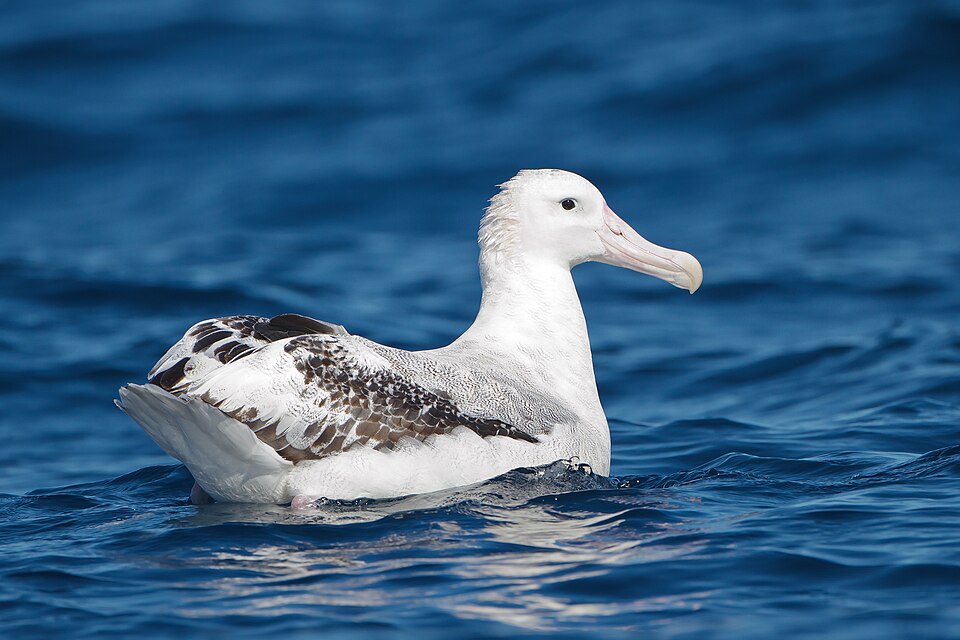
I only ever encountered an albatross secondhand — through Coleridge’s poem, forced on me in high school, long before I understood anything about the actual bird — and like a lot of people, I absorbed “albatross around the neck” as a phrase for guilt-driven burden without ever really connecting it to a real animal. It took years before I found out the actual bird behind that phrase is, if anything, one of the more genuinely impressive fliers on the planet, which makes the metaphor’s total detachment from the real creature almost funny in hindsight. Bottom line Albatrosses carry two very different symbolic meanings: sailors historically treated them as good omens and protective spirits at sea, while the modern English phrase “an albatross around one’s neck” — meaning a heavy, inescapable burden of guilt — comes directly from a single, extremely influential poem and represents nearly the opposite reading. Sailors’ original view: good luck, not a curse For centuries, sailors regarded albatrosses as good omens, sometimes believed to carry the souls of drowned sailors, and killing one was widely considered to invite terrible luck upon a ship. Albatrosses were a familiar, almost comforting presence on long ocean voyages specifically because they can travel enormous distances over open water and were often seen as a sign that land, or at least favorable conditions, might not be far off. How the poem flipped the symbolism entirely Samuel Taylor Coleridge’s 1798 poem “The Rime of the Ancient Mariner” is almost single-handedly responsible for the modern “burden” meaning: in the poem, a sailor shoots an albatross for no good reason, breaking the very taboo described above, and is punished by his crew by having the dead bird hung around his neck as a mark of guilt, bringing a curse down on the entire ship.
Anhinga Meaning and Symbolism
The first time I saw an Anhinga perched on a branch with its wings fully spread and completely motionless, I assumed it was injured or drying out after some accident. It turns out that pose is just Tuesday for this bird, and it’s the entire reason people started calling it the “snakebird.” The short answer Anhingas are associated with patience and a kind of eerie stillness, symbolism drawn from two real, distinctive behaviors: swimming with only their long, snake-like neck above the waterline, and perching for extended periods with wings spread wide to dry. A body built without waterproofing Unlike most waterbirds, Anhingas lack the oil-gland waterproofing that keeps other birds buoyant and dry, which actually helps them dive and swim with minimal effort underwater, but leaves their feathers thoroughly soaked afterward, forcing the long wing-spread drying posture that gave the bird its motionless, almost statue-like reputation. A neck built for spearfishing That same neck responsible for the “snakebird” nickname houses a specialized hinge mechanism in the vertebrae that lets the Anhinga snap its head forward with startling speed and force, spearing fish clean through with its sharply pointed bill rather than grabbing them, a hunting technique that’s more surgical strike than typical bird fishing. Something to carry with you The Anhinga’s reputation for eerie stillness and patience is really just two unrelated adaptations, non-waterproof feathers and a spear-hunting neck, that happen to look, from a distance, like deliberate and unsettling calm.
Bittern Meaning and Symbolism
I once stood in a marsh for ten minutes trying to find the source of a strange, deep, repetitive thumping sound that resembled someone driving a stake into wet ground, before a guide finally pointed out an American Bittern standing perfectly still a few feet away, camouflaged so completely against the reeds that I’d been staring right past it the entire time. The quick take Bitterns are associated in older European folklore with ghosts, witches, and the eerie unseen edges of the marsh, symbolism built almost entirely on their strange booming call and their habit of being heard constantly while almost never being seen. The sound of an invisible bird The bittern’s call has earned it folk names across English and Irish tradition like “bog-bumper,” “bull of the bog,” and “thunder pumper,” all attempts to describe a deep, resonant, faintly unnatural sound produced by air forced through a specialized esophagus. Because the bird making that sound is so rarely actually seen, older rural communities living near wetlands understandably filled in the gap with ghost stories and warnings about the supernatural creatures said to haunt the bog at night. The best camouflage trick in the marsh The bittern’s near-invisibility isn’t an accident. When it senses a threat, instead of flying off like most birds, it freezes with its bill pointed straight up and its streaked brown-and-white plumage aligned vertically with the surrounding reeds, sometimes swaying gently in sync with the wind-blown marsh grass to complete the illusion. It’s one of the most effective camouflage displays documented in any bird. The bigger picture The bittern earned its ghostly reputation the honest way — by being loud enough to unsettle anyone within earshot while staying essentially invisible to the naked eye, a combination almost engineered to produce folklore.
Booby Meaning and Symbolism
Blue-footed Boobies performing their exaggerated, high-stepping courtship walk on a rocky outcrop always draws a crowd of tourists laughing at how deliberately silly the display looks, which is more or less the same reaction that gave the bird its unflattering name centuries ago. In short Boobies are loosely associated with clumsiness and comic awkwardness thanks to an unfortunate name, symbolism that badly undersells a bird whose actual hunting and courtship behavior is remarkably sophisticated. A name born from a misunderstanding “Booby” likely derives from the Spanish “bobo,” meaning foolish or clumsy, a reputation earned because the birds show little fear of humans on land and can appear awkward and ungainly walking on rocky nesting colonies, a stark contrast to their behavior in the air and water where they’re anything but clumsy. A genuinely precise hunter In the water, boobies are exceptional plunge-divers, folding their wings back and dropping from significant heights to spear into the ocean at high speed after fish, with specialized air sacs in the skull cushioning the impact, a hunting technique requiring real precision that has nothing in common with the fumbling reputation baked into the bird’s common name. The Blue-footed Booby’s foot-stepping courtship dance, meanwhile, is now understood by researchers as an honest signal of health, since foot color brightness directly reflects diet quality. A closing thought The booby’s name is arguably the least accurate reputation on this list — a bird written off centuries ago as clumsy on land turns out to be a precision diver in the water and a genuinely sophisticated communicator during courtship.
Curlew Meaning and Symbolism
The first time I heard a curlew’s long, bubbling, downward-sliding call rolling across an open mudflat at dusk, I understood immediately why so many older coastal and moorland communities described the sound as mournful or otherworldly. It doesn’t sound like most other birds, and that strangeness did a lot of the cultural work. What it comes down to Curlews are associated in British and Irish folklore with grief, prophecy, and the supernatural, symbolism drawn almost entirely from their haunting, far-carrying call and their habit of moving and calling at dusk and through the night. A call built for bad omens In parts of Britain and Ireland, curlews were sometimes linked to the “Seven Whistlers,” a folk belief involving night-flying birds whose calls were thought to foretell death or disaster, and Celtic tradition in some regions associated the curlew’s cry with the souls of the drowned or the restless dead. None of that required any dramatic behavior from the bird itself — the call alone, heard disembodied across a dark marsh, was enough. A real and urgent story behind the eerie reputation Curlews are also, right now, one of the most rapidly declining wading bird groups in Europe, with the Eurasian Curlew’s population collapsing due to changes in farming and land drainage across their breeding moorlands. The bird’s long, curved bill, perfectly adapted for probing deep into mud for invertebrates, is increasingly a shape people encounter mainly in conservation appeals rather than on the mudflats themselves. What to make of it The curlew earned its ghostly folklore honestly, through a call distinctive enough to unsettle people who couldn’t see the bird making it, and that same bird is now facing a real and measurable disappearance across much of its former range.
Frigatebird Meaning and Symbolism
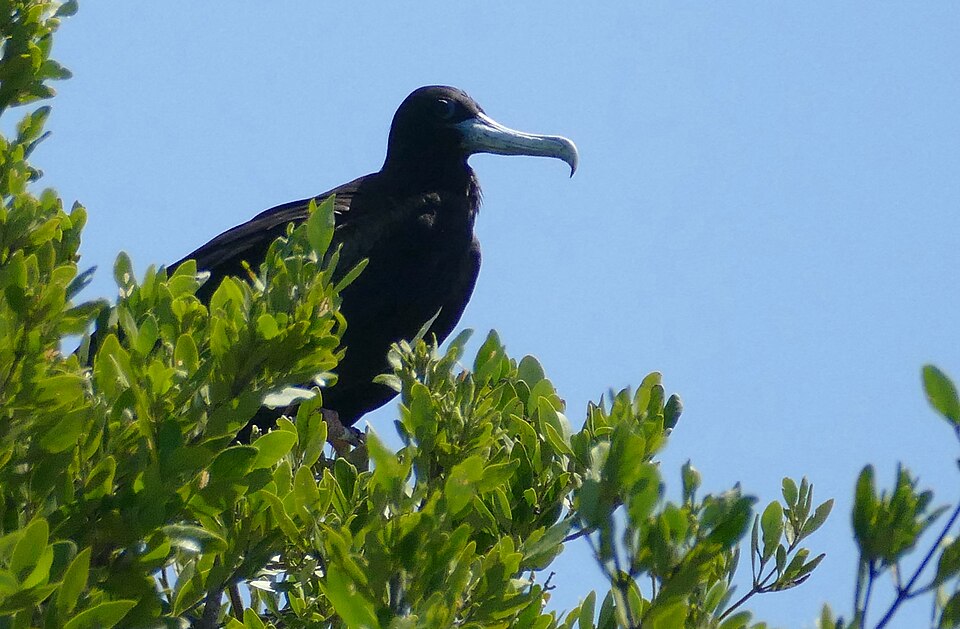
Watching a male Magnificent Frigatebird inflate a bright red throat pouch to roughly the size of a beach ball during a courtship display, I understood immediately why early sailors treated this bird as something worth stopping to watch. The quick take Frigatebirds are associated with piracy, endurance, and dramatic courtship display, symbolism drawn from their genuine habit of stealing food from other seabirds and from one of the most visually striking mating displays in the bird world. A reputation for theft that’s scientifically accurate Frigatebirds frequently harass other seabirds mid-flight, forcing them to drop or regurgitate freshly caught fish which the frigatebird then catches in midair, a behavior called kleptoparasitism that’s real enough to have earned the species its naval-raider name across multiple languages, long before modern ornithologists gave the behavior a formal term. A body built to stay airborne for weeks Despite that thieving reputation, frigatebirds are also genuinely extraordinary fliers in their own right: researchers tracking Great Frigatebirds found individuals remaining continuously airborne for more than two months at a stretch, sleeping in brief microsleeps while soaring on rising air currents, since their feathers aren’t waterproof enough to allow safe landing on the ocean surface. The bigger picture The frigatebird’s piratical reputation captures only half the story — the same bird known for stealing other seabirds’ catches is also capable of staying aloft for weeks at a time, landing only when it absolutely has to.
Gannet Meaning and Symbolism
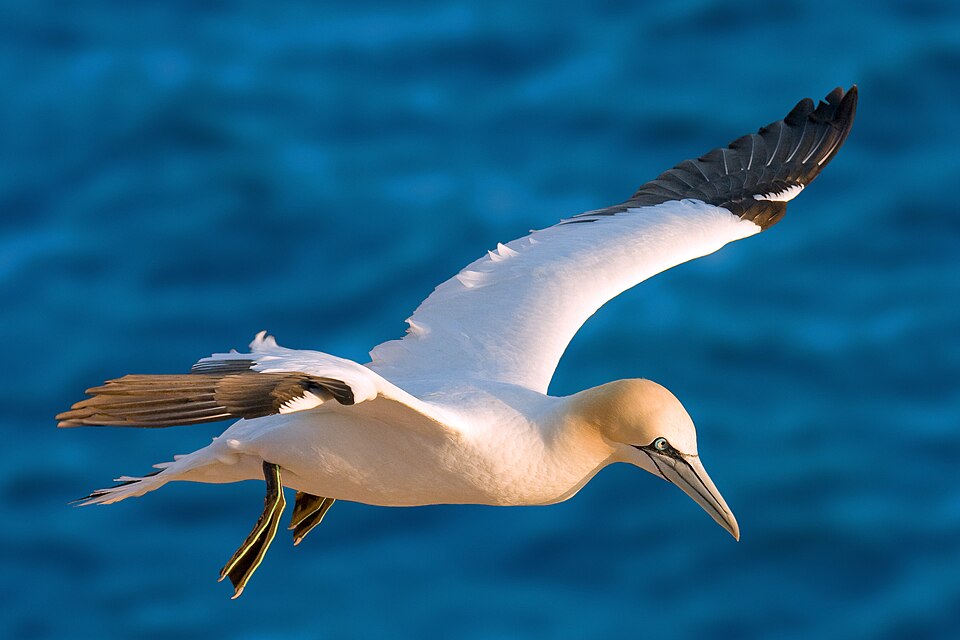
Standing on a Scottish cliff top watching thousands of Northern Gannets fold their wings and drop from 100 feet into the sea below, one after another in a nearly continuous stream, is one of the more genuinely dramatic things I’ve witnessed in birdwatching, and it’s exactly the behavior that built the bird’s reputation. Bottom line Gannets are associated with speed, precision, and single-minded focus, symbolism built almost entirely around one dramatic and well-documented behavior: high-speed plunge-diving into the ocean from significant heights in pursuit of fish. A dive built to survive its own impact force Gannets dive from heights of up to 100 feet, hitting the water at speeds estimated around 60 miles per hour, an impact that would seriously injure most animals but which gannets survive thanks to reinforced skulls, no external nostrils, and internal air sacs in the face and chest that cushion the shock, a genuine anatomical adaptation built specifically around that one violent motion. A colony that runs on precise personal space Gannet breeding colonies, some holding tens of thousands of pairs on a single cliff face, function on remarkably precise spacing, with each pair defending a nest site exactly as far from its neighbors as two gannets can reach with outstretched, jabbing beaks, producing colonies that look chaotic from a distance but are actually organized down to the inch. One more thing The gannet’s reputation for speed and precision is grounded in real, survivable violence — a bird built with reinforced anatomy specifically to hit the ocean at highway speed and come back up with a fish.
Ibis Meaning and Symbolism
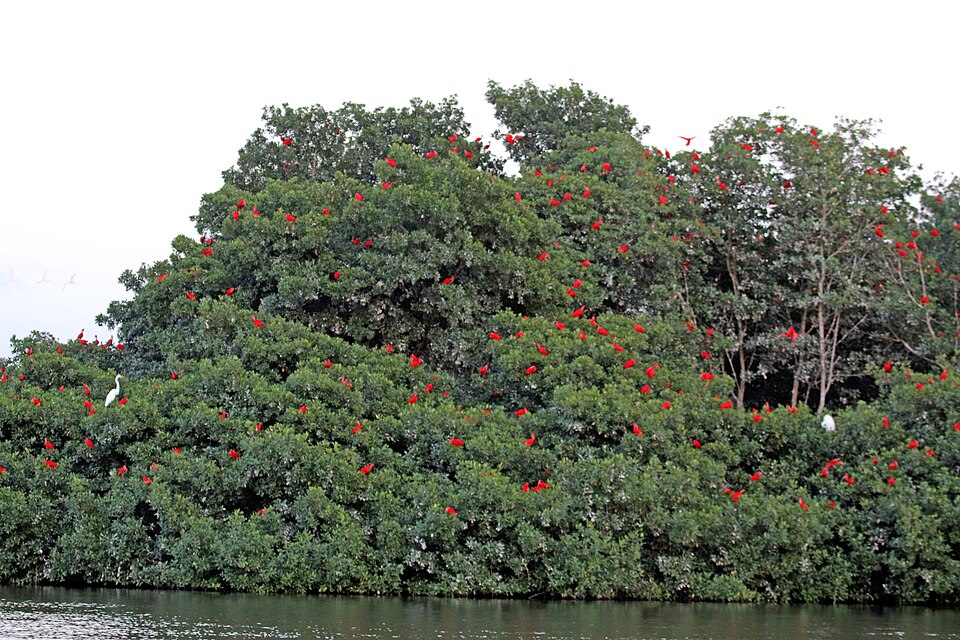
I saw my first White Ibis in a drainage canal behind a strip mall in Florida, calmly probing the mud with its long curved bill while shoppers walked past without a second glance, and it struck me as an odd fate for a bird that ancient Egyptians once considered sacred enough to mummify by the millions. Few birds have fallen quite that far in perceived status while staying exactly the same animal the whole time. In short Ibises are most strongly associated with wisdom, the moon, and sacred knowledge, almost entirely because of the Sacred Ibis’s central role in ancient Egyptian religion as the animal representation of Thoth, the god of writing, wisdom, and the moon. Thoth and the ibis-headed god of knowledge Thoth, one of the most important gods in the Egyptian pantheon, was typically depicted with the head of a Sacred Ibis and credited as the inventor of writing, mathematics, and the moon calendar — making the ibis one of the most intellectually prestigious animal associations in the ancient world, on a similar level to the falcon’s connection to Horus described elsewhere in this series. Ibises were considered so sacred that ancient Egyptians mummified enormous numbers of them as religious offerings; archaeologists have discovered underground galleries containing an estimated millions of mummified ibises at sites like Saqqara, reflecting the sheer scale of the religious practice built around this one bird. Why the ibis specifically got tied to the moon and wisdom The exact reasoning ancient Egyptians used isn’t fully documented, but the ibis’s curved bill was sometimes linked visually to the crescent moon, and its methodical, probing feeding behavior in shallow water and mud may have read as careful, deliberate investigation — a fitting visual metaphor for a god associated with careful record-keeping and knowledge. The bird’s seasonal appearance along the Nile, tied to the river’s flooding cycle that ancient Egyptian agriculture depended on entirely, likely reinforced its association with calendars, cycles, and the kind of predictive knowledge Thoth represented.
Jacana Meaning and Symbolism
Watching a Jacana walk casually across a mat of floating lily pads without so much as a ripple of disturbance, as if the water simply wasn’t there, earned the bird its popular nickname on the spot the first time I saw it happen. The quick take Jacanas are associated with balance, lightness, and an almost supernatural ease of movement, symbolism built directly on the real physical adaptation that earned the bird its common nickname, the “Jesus bird,” for its apparent ability to walk on water. Feet built like snowshoes Jacanas have dramatically elongated toes and claws that distribute their body weight across a much larger surface area than a typical bird’s foot, allowing them to walk across floating vegetation like lily pads and water hyacinth without breaking through, the same basic physics behind a snowshoe rather than any actual water-walking. A mating system flipped from most of the bird world Jacanas practice a genuinely unusual mating system called polyandry, where a single female mates with multiple males, each of whom independently incubates a separate clutch of eggs and raises the chicks alone, a near-total reversal of the typical parenting roles seen across most bird species. The bigger picture The Jacana’s “walking on water” reputation is a straightforward description of real, specialized anatomy rather than any exaggeration, and the bird backs up that unconventional first impression with an equally unconventional approach to raising its young.
Killdeer Meaning and Symbolism
A Killdeer nested in the gravel of a parking lot at my old job, which sounds like a joke but is exactly the kind of place this species actually prefers, and every single day for weeks I watched the same bird throw itself into a limping, wing-dragging performance the moment anyone walked too close to a nest that, as far as I could tell, was just a few pebbles arranged slightly differently than the rest of the lot. It’s one of the most committed acting performances in the entire animal kingdom, and it’s exactly what built the bird’s whole symbolic reputation. Bottom line Killdeer are widely associated with protective sacrifice and clever deception used for good purposes — symbolism drawn directly from their extraordinary “broken-wing display,” in which a parent fakes a severe injury to lure predators away from a nest, risking its own apparent vulnerability entirely for its offspring’s safety. The broken-wing act, and why it works When a predator approaches a Killdeer nest too closely, a parent will suddenly flop away from the nest dragging one wing along the ground, crying out as if badly injured, and appearing to be an easy, struggling target — deliberately drawing the predator’s attention and pursuit away from the eggs or chicks. Once the parent has led the threat a safe distance from the nest, it abruptly “recovers” and flies off, leaving the predator without a meal and the nest undiscovered. This display is convincing enough that it has fooled generations of well-meaning humans into thinking they’d found an injured bird, when in fact they were watching a healthy parent perform a genuinely elaborate piece of theater. Why deception here reads as admirable rather than sinister Unlike the cuckoo’s brood-parasitism deception (covered elsewhere in this series), which benefits the deceiver at another bird’s direct expense, the Killdeer’s deception is entirely self-sacrificing: the performing parent puts itself at real risk, faking injury directly in front of a predator, purely to protect its young.
Limpkin Meaning and Symbolism
Camping near a Florida wetland, I woke up convinced someone nearby was being genuinely, seriously hurt, before realizing the blood-curdling wail echoing through the dark was coming from a single wading bird a hundred yards away. That’s just what a Limpkin sounds like. What it comes down to Limpkins are associated with grief and unsettling nighttime sound, symbolism built almost entirely around a piercing, wailing call that has startled more than one unsuspecting camper into thinking something was seriously wrong nearby. A diet that explains the name The Limpkin’s name actually comes from its slightly awkward, limping gait, a quirk in how it walks rather than any injury, and that walk is directly tied to its diet: Limpkins specialize almost exclusively in apple snails, extracting the snail from its shell using a bill with a slight rightward curve and a gap near the tip built specifically for that one task. A voice built to carry across a swamp at night The Limpkin’s wailing call, sometimes described as sounding like a woman screaming, carries remarkably far across open wetland at night, a genuinely effective long-distance communication tool for a bird spread thinly across large marsh territories, even though the effect on a nearby camper is closer to pure alarm than admiration. What to make of it The Limpkin’s eerie reputation is earned entirely through sound rather than appearance — a bird whose name comes from an ordinary walking quirk but whose voice is distinctive enough to have unsettled generations of people camping near Florida wetlands.
Puffin Meaning and Symbolism
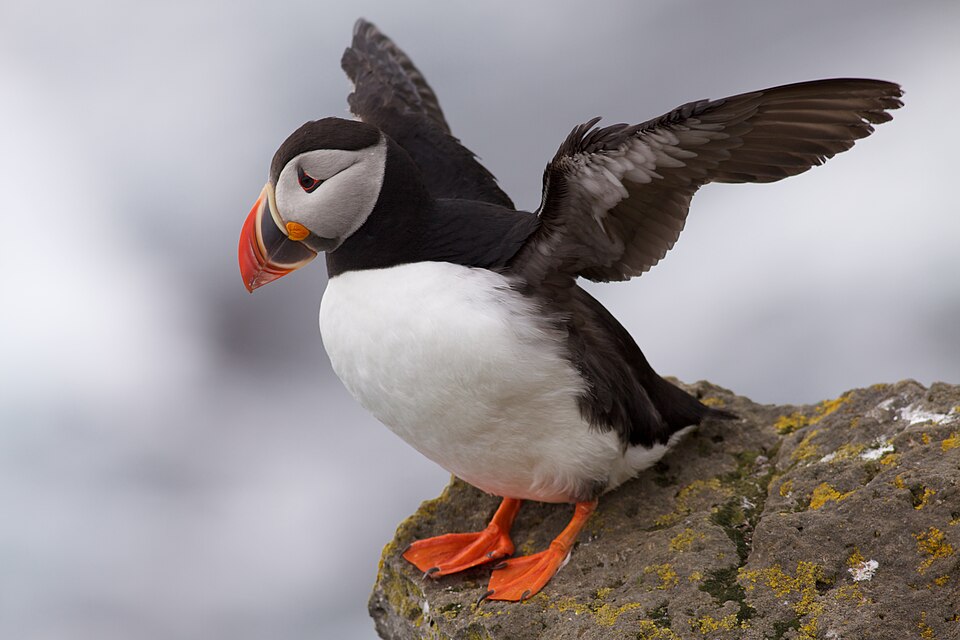
A friend who does seabird research in Iceland once told me that puffins spend nearly all year alone at sea, far from any cliff or colony, which genuinely surprised me — every photo I’d ever seen showed them standing around in tightly packed groups looking like the most sociable bird alive. That contradiction turned out to be exactly right: puffins really do live a kind of double life, and it shapes almost everything people read into them symbolically. The quick take Puffins are widely associated with resilience, balance, and the coexistence of solitude and community — symbolism drawn from their unusual life cycle, which alternates between months of complete isolation on the open ocean and a breeding season spent in dense, highly social cliffside colonies. A genuinely split lifestyle Atlantic Puffins spend roughly eight months of the year entirely at sea, alone, far from land, riding out open-ocean conditions and diving for fish without any of the social behavior people typically associate with the species. Then, for a few months each breeding season, they return to the same crowded cliffside colonies (often the same colony, and sometimes the same burrow, they used in previous years) packed shoulder to shoulder with thousands of other puffins, suddenly highly social and cooperative. That dramatic, repeating shift between total solitude and intense community is unusual enough among birds that it’s become the core of most modern puffin symbolism: a reminder that solitude and social belonging aren’t necessarily opposites, just different seasons of the same life. The famous bill isn’t just decoration A puffin’s brightly colored bill, one of its most recognizable features, is actually seasonal: the vivid orange outer sheath grows in specifically for breeding season and is shed afterward, leaving a duller, smaller bill for the rest of the year when there’s no mate to attract. This seasonal transformation adds another layer to the “balance” symbolism — even the bird’s most iconic visual feature comes and goes with the same social rhythm as its lifestyle, rather than being a fixed, permanent trait.
Roseate Spoonbill Meaning and Symbolism
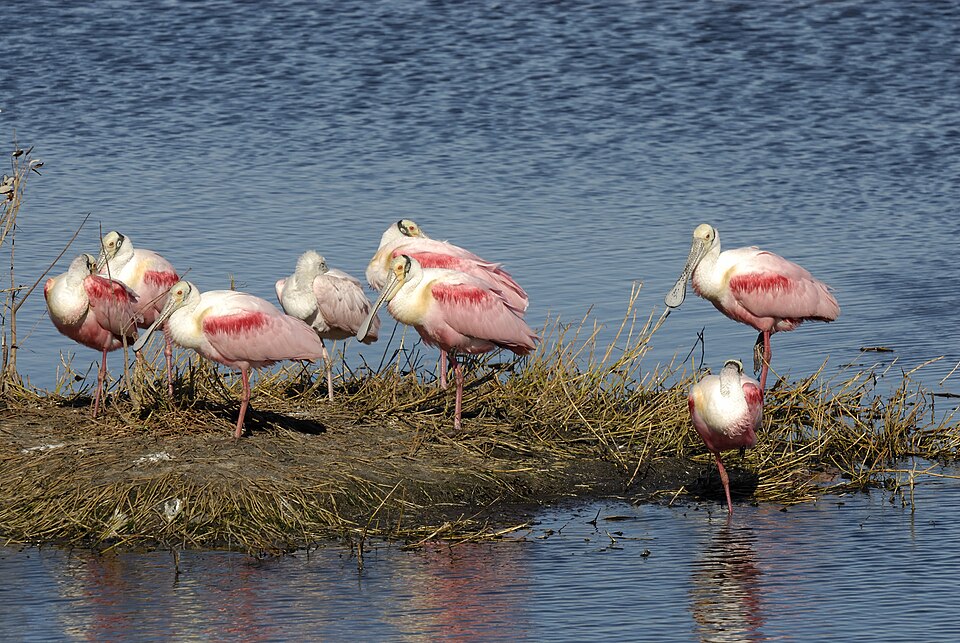
A flock of Roseate Spoonbills lifting off a Gulf Coast mudflat, all bright pink against gray water, is dramatic enough that more than one person has mistaken the sight for flamingos, an understandable mix-up that turns out to share a real biological root. At a glance Roseate Spoonbills are associated with vivid, almost improbable beauty and are frequently confused with flamingos, symbolism and confusion both rooted in the same real biological source: a pink color that comes entirely from diet rather than any pigment the bird produces itself. A color borrowed, not built Like flamingos, Roseate Spoonbills get their pink coloring from carotenoid pigments in the crustaceans and small aquatic invertebrates they eat, meaning the bird’s signature color is directly tied to diet and habitat quality, a genuinely shared trait between two unrelated species that both happen to specialize in carotenoid-rich prey. A bill shaped for a very specific hunting technique The spoon-shaped bill that gives the species its name is swept side to side through shallow water, sensing prey by touch rather than sight and snapping shut the instant something brushes the sensitive bill tip, a hunting method suited to murky water where visual hunting simply wouldn’t work. The takeaway The spoonbill’s flamingo-like reputation isn’t a coincidence or a case of mistaken identity built on nothing — both birds independently arrived at the same pink coloring through the same dietary mechanism, a genuine convergence rather than a resemblance.
Sandpiper Meaning and Symbolism
There’s a particular kind of hypnotic quality to watching a small flock of sandpipers chase the edge of retreating waves on a beach, darting forward to probe the wet sand and then racing back just ahead of the next wave, over and over, for as long as you’re willing to stand there and watch. Bottom line Sandpipers are loosely associated with playfulness, presence, and balance between two worlds, symbolism drawn from their constant, rhythmic movement along the boundary between land and sea rather than from any deep-rooted mythology. A life lived on the edge, literally Sandpipers forage almost exclusively in that narrow, ever-shifting strip where waves meet shoreline, probing wet sand for small invertebrates exposed and buried again with every swell. That constant back-and-forth, always in motion, always tracking a boundary that never stays still, is probably the single biggest reason the bird has become a fairly common visual shorthand in art and photography for balance, mindfulness, and living fully in a fleeting moment. Extraordinary flights hidden inside an ordinary-looking bird What that quick, twitchy shoreline behavior disguises is real long-distance capability: several small sandpiper species, including the Semipalmated Sandpiper, make nonstop transoceanic flights of well over 2,500 miles from eastern Canada to South America, fueled entirely by fat reserves built up in the days before departure with no chance to stop, rest, or refuel along the way. One more thing The sandpiper’s image as a small, restless bird living entirely in the present moment sits right next to a much less visible truth — that same restless energy is also what powers some of the longest nonstop flights of any bird its size.
Screamer Meaning and Symbolism
Hearing a Southern Screamer’s call roll across an Argentine wetland for the first time, loud enough to carry more than a mile in open country, made the bird’s blunt common name feel less like a joke and more like the most literal, accurate label any bird on this list has ever received. Quick answer Screamers are associated in South American wetlands with sheer vocal power and territorial dominance, symbolism built entirely around a call loud enough to be one of the most far-carrying sounds produced by any bird on the continent. A call that genuinely lives up to the name Screamer calls have been documented carrying well over a mile across open wetland terrain, a volume produced by a large trachea and powerful vocal anatomy that the bird uses constantly to maintain contact with its mate and to declare territory, making screamers one of the loudest wetland birds in the Americas by a wide margin. Skin built with its own air pockets Screamers have an unusual anatomical quirk: a layer of small air pockets embedded directly under their skin, connected to the respiratory system, that produce an audible crackling sound when the bird is handled, an adaptation whose exact function remains debated among researchers but which is unique enough to be a genuine identifying trait of the family. Putting it together The screamer’s name is about as literal as bird names get — an animal whose call was loud enough that early observers simply described what they heard, and whose actual measured volume backs up every bit of that reputation.
Seagull Meaning and Symbolism
I used to think seagulls were just the birds that steal your fries at the beach, until I watched a flock of them ride a thermal above a parking lot for a solid twenty minutes without a single wingbeat, drifting in slow, effortless circles like they had nowhere else to be. It’s a strange contrast — the same bird that will aggressively mug a toddler for a sandwich is also capable of that kind of unhurried, almost meditative flight, and both sides show up in how people have symbolically read gulls over time. Bottom line Gulls (commonly, if inaccurately, called “seagulls” as a catch-all) are widely associated with freedom, versatility, and resourcefulness, largely because of their strong flight ability and their unusual capacity to thrive in an enormous range of environments, from open ocean to inland parking lots hundreds of miles from any coast. Why “freedom” specifically Gulls spend an enormous amount of time in effortless, soaring flight, using thermals and wind currents to stay aloft with minimal energy expenditure, which reads visually as an almost carefree relationship with the sky in a way that more purposeful, direct fliers don’t convey as clearly. Jonathan Livingston Seagull, Richard Bach’s 1970 novella about a gull who pursues flight for its own sake rather than just survival, cemented gulls specifically (rather than any other seabird) as a modern symbol of self-determination and transcending ordinary limitations — a strikingly literary reading for a bird more commonly associated with dumpsters. The resourcefulness reading is not an exaggeration Gulls are genuinely among the most behaviorally flexible birds in the world. Many species will eat nearly anything — fish, insects, eggs, garbage, discarded human food, other birds’ chicks — and have adapted successfully to environments as different as remote sea cliffs, landfills, city rooftops, and inland lakes far from any ocean.
Shoebill Meaning and Symbolism
The first photo I ever saw of a Shoebill, standing motionless with its enormous, clog-shaped bill and an unblinking stare directly at the camera, looked so deliberately unsettling that I assumed it had to be digitally altered. It’s just what the bird looks like. Cutting to it Shoebills are associated in parts of East and Central Africa with prehistoric mystery and are frequently described online as “dinosaur-like” or ancient-looking, symbolism built directly on a genuinely unusual appearance and an extremely deliberate, almost eerie hunting style. A statue that suddenly isn’t one Shoebills hunt by standing completely motionless in swampy water for extremely long stretches, sometimes remaining still for hours, before launching an explosive, full-body strike at lungfish or other prey the instant it surfaces, a hunting method built entirely around patience so extreme it can look, to an observer, like the bird has stopped functioning altogether. A bill built like a genuine tool The massive, broad bill that gives the bird its name is sharp-edged and hooked at the tip, capable of decapitating prey and slicing through tough vegetation, a far more functional and mechanically serious tool than its almost comically oversized appearance initially suggests. Putting it together The Shoebill’s prehistoric, almost artificial-looking reputation holds up under real observation — a bird whose eerie stillness and startling strike are both genuine hunting adaptations, not an illusion created by an unusual face.
Skimmer Meaning and Symbolism
Watching a Black Skimmer fly low over calm water with its oversized lower bill slicing a perfectly straight line through the surface, snapping shut the instant it touched a fish, looked less like normal bird feeding behavior and more like a purpose-built machine doing exactly the one job it was designed for. Bottom line Skimmers are associated with precision and specialized purpose, symbolism built entirely around one of the most distinctive and mechanically unusual bills in the bird world, an adaptation used for a hunting technique found in almost no other bird. A bill built asymmetrically on purpose Skimmers are the only birds in the world with a lower mandible noticeably longer than the upper one, an asymmetry that looks like a deformity but is actually a precise tool: the bird flies low with its lower bill slicing through the water’s surface, snapping the upper bill shut the instant it contacts a fish, feeding entirely by touch rather than sight. Pupils built for a different kind of hunting Skimmers are most active feeding at dusk, dawn, and even at night, and their eyes have vertically elongated, cat-like pupils, an unusual trait among birds that likely helps reduce glare off water during low-light hunting, another piece of anatomy built specifically around this one very particular feeding method. One more thing The skimmer’s reputation for precision isn’t a stretch — it’s a bird whose entire bill shape, feeding schedule, and even pupil structure are all independently built around one extremely specific hunting technique found almost nowhere else in the bird world.
Snipe Meaning and Symbolism
A hunting guide once explained to me that “snipe hunt” became a classic prank phrase specifically because the bird itself is so genuinely hard to find and flush, a real difficulty turned into a joke at some unlucky newcomer’s expense. At a glance Snipe are loosely associated with elusiveness, trickery, and being nearly impossible to pin down, symbolism drawn directly from the real-world difficulty of spotting and flushing a bird whose entire survival strategy depends on staying hidden. The origin of a very old prank The “snipe hunt,” a classic practical joke where a newcomer is sent off with a bag and vague instructions to catch a nonexistent or impossibly elusive bird, takes its name from the real Wilson’s Snipe, a wading bird so well camouflaged in marsh grass and so quick and erratic in flight when flushed that experienced hunters genuinely struggled to bag one. The joke works because the underlying difficulty is real. An unexpectedly loud way of being invisible Despite that elusiveness, male snipe produce one of the stranger sounds in North American birdlife during courtship displays: a haunting, tremulous “winnowing” noise made not with the voice but by air rushing past specialized outer tail feathers during a steep aerial dive, audible from a considerable distance even though the bird itself remains almost impossible to see. The takeaway The snipe’s reputation for being maddeningly hard to find isn’t an exaggeration invented for a prank — it’s a fair description of a bird whose camouflage and evasive flight are good enough to have generated an entire category of practical joke.
Tern Meaning and Symbolism
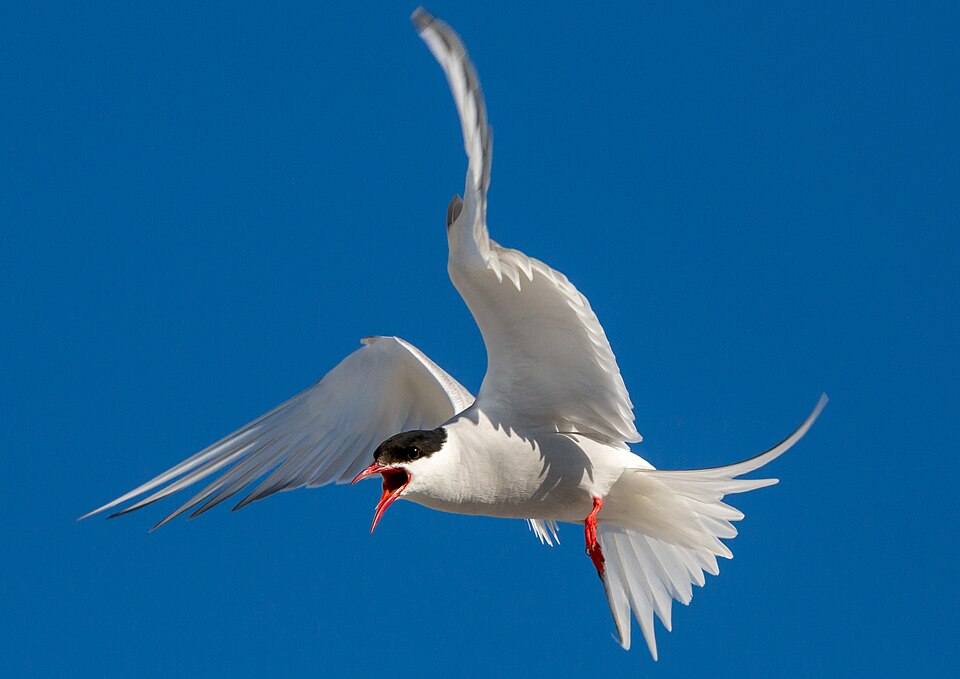
Watching an Arctic Tern hover and dive along a rocky coastline, it’s easy to assume you’re looking at a fairly ordinary seabird having a fairly ordinary day. What that bird is actually capable of, migration-wise, makes almost every other animal on the planet look sedentary by comparison. In short Terns, and the Arctic Tern above all, are widely associated with endurance, freedom, and tirelessness, symbolism grounded directly in a documented migratory feat that’s difficult to fully process even with the research sitting right in front of you. The longest migration of any animal on Earth Arctic Terns breed in the Arctic during the northern summer and then fly to Antarctic waters for the southern summer, effectively chasing daylight from pole to pole and back again every single year. Tracking studies using tiny geolocators have put the round-trip distance at roughly 44,000 miles for some individuals, meaning a tern that lives twenty or thirty years, which isn’t unusual for the species, may fly a total distance equivalent to multiple trips to the moon and back over its lifetime. A bird that sees more daylight than any other creature alive Because that migration route chases summer at both ends of the planet, Arctic Terns experience more daylight hours over the course of a year than any other animal on Earth, a genuinely unique ecological niche built entirely around never quite letting the sun set on their year. A closing thought The tern’s reputation for endurance isn’t folklore or exaggeration built up over centuries — it’s a straightforward description of an animal that, on a yearly basis, does something no other creature on the planet manages to do.
Tropicbird Meaning and Symbolism
A White-tailed Tropicbird trailing its impossibly long central tail streamers behind it in flight looked, from a distance over open ocean, less like a seabird and more like some kind of living kite, drifting far from any visible land. In short Tropicbirds are associated with grace, endurance, and life spent almost entirely at sea, symbolism built on the species’ extraordinarily long tail streamers and its genuinely remarkable ability to stay airborne over open ocean far from any coastline for extended periods. Streamers that can outmeasure the bird itself The elongated central tail feathers found in adult tropicbirds can approach or even exceed the length of the bird’s entire body, a dramatic ornamental feature used in aerial courtship displays where pairs fly together in synchronized loops, their streamers trailing visibly behind them. A life spent almost entirely over open water Outside of breeding, tropicbirds spend the overwhelming majority of their lives far out over open ocean, sometimes hundreds of miles from the nearest landmass, coming ashore only to nest on remote tropical islands and cliffs, a lifestyle that makes them one of the more genuinely pelagic seabird groups, rarely seen by anyone who isn’t specifically out on the water looking. A closing thought The tropicbird’s elegant, almost kite-like reputation is earned honestly — a seabird built with ornamental tail streamers for display and a life history built almost entirely around distance from land.
Trumpeter Meaning and Symbolism
A group of Gray-winged Trumpeters foraging together through the Amazon undergrowth stayed in such tight, coordinated formation that they reminded me less of a flock of birds and more of a small, disciplined patrol, which turns out to be a fairly accurate read of how they actually operate. Cutting to it Trumpeters are associated in parts of the Amazon with cooperation and tight-knit group loyalty, symbolism drawn from genuinely complex social structures and a deep, resonant call produced by an unusually long, coiled windpipe. A voice built by an oversized windpipe The trumpeter’s name comes from its deep, booming, ventriloquial call, a sound made possible by an elongated, coiled trachea similar in principle to the anatomy that gives cranes and some other birds their unusually resonant, far-carrying voices, disproportionate to the bird’s fairly modest body size. A genuinely complex social system for a ground bird Trumpeters live in stable, cooperative groups with a dominant breeding pair supported by subordinate helpers, often related offspring from previous broods, who assist in defending territory and sometimes even in raising chicks, a level of social cooperation that’s relatively uncommon among ground-dwelling tropical birds. Putting it together The trumpeter’s reputation for tight social bonds holds up under real observation — a bird whose deep, unmistakable call comes from genuinely unusual anatomy, produced by groups that function with a level of internal cooperation most birds never approach.
Sunbittern Meaning and Symbolism
A Sunbittern standing still along a Central American riverbank looks unremarkable, mostly brown and gray, until it opens its wings in a threat display and reveals a pattern so vivid and eye-like that the transformation genuinely startled me the first time I saw it happen. The gist Sunbitterns are associated with sudden, dramatic transformation and hidden beauty, symbolism built entirely around a real defensive display: plain, camouflaged wings that open to reveal a brilliant pattern resembling giant eyes or a setting sun. A display built to look like something much bigger When threatened, a Sunbittern spreads its wings and tail to display large orange, chestnut, and black eye-like patterns that, combined with the bird’s raised posture, are thought to mimic the appearance of a much larger animal or create a startling, disorienting flash of color and pattern intended to give a predator pause. A bird placed in its own lonely branch of the tree of life Sunbitterns are evolutionarily distinctive enough that they’re currently placed in their own family with only one other close relative, the Kagu of New Caledonia on the opposite side of the planet, a genetic relationship that puzzled researchers for years given how geographically separated the two species are. Last thought The Sunbittern’s reputation for hidden, sudden beauty is built on a real and specific defensive display — a plain-looking bird that reveals an almost theatrical pattern the instant it feels threatened, then closes back up into camouflage just as fast.
Nene Meaning and Symbolism
Watching a Nene waddle across a Hawaiian lava field with its partially webbed feet, clearly built for gripping rock rather than swimming, I understood why this goose ended up looking so different from its Canada Goose relatives despite the resemblance in the face. The gist The Nene, Hawaii’s state bird, is associated with resilience and homecoming, symbolism grounded almost entirely in a modern conservation story: the species dropped to as few as 30 individuals by the 1950s before an intensive captive-breeding and reintroduction effort brought it back from the edge of extinction. An island bird that stopped needing water Descended from Canada Goose ancestors that colonized the Hawaiian islands hundreds of thousands of years ago, the Nene evolved in near isolation on volcanic terrain with little standing water, and Native Hawaiian tradition regarded the bird as a significant presence in the islands’ unique upland ecosystems well before Western conservation science existed. The biology behind the myth That reduced webbing between the toes is a real adaptation for walking on rough lava rock rather than swimming, and Nene spend far less time in water than most geese, grazing instead on shrubs and berries across sparse volcanic slopes. The 1950s recovery effort, led by conservationist Peter Scott using birds bred in captivity, remains one of the earliest successful examples of what became a template for modern endangered species recovery programs. Last thought The Nene’s symbolism as a survivor isn’t a stretch — a wild population that bottlenecked to roughly 30 birds and now numbers in the thousands is about as literal a comeback story as conservation biology has to offer.
Sources
Species identification and behavior details are cross-checked against the Cornell Lab of Ornithology’s All About Birds, the National Audubon Society, and eBird.