Blue Jay: Mythology, Habitat, Diet, and More
Blue Jay
Mythology, Habitat, Diet, and More
Cyanocitta cristata
ORDER: Passeriformes
FAMILY: Corvidae
A blue jay cleared my whole backyard feeder in about four seconds flat once, and it never even landed. It screamed a red-shouldered hawk call so convincingly that every chickadee, finch, and sparrow scattered for cover — then it strolled in and had the feeder to itself. That’s a blue jay (Cyanocitta cristata) for you: a large, crested songbird in the crow family, all bright blue upperparts and a bold black necklace, with a call repertoire that apparently includes a passable impression of the exact predator it’s trying to scare off. This guide covers identification, range, diet, nesting, the folklore attached to the bird across different cultures, and the two things that set it apart from most backyard birds — its habit of quietly reforesting whole hillsides one buried acorn at a time, and that gift for mimicry.
It rewards close attention, mostly because it hides its best material in plain sight. The blue in its feathers isn’t pigment at all — it’s a trick of light scattering off feather structure, which is why a crushed blue jay feather turns brown in your hand. And a single bird can bury thousands of acorns in one autumn, more than it will ever dig back up, which is one of the quieter reasons eastern oak forests exist where they do.
Key Takeaways
- The Blue Jay is a large, crested member of the corvid (crow and jay) family, native to forests, woodlots, parks, and suburban yards across eastern and central North America.
- Its blue color is structural rather than pigmented: it arises from the way light scatters within the feather, and the only true pigment present is brown melanin.
- It ranks among the most intelligent backyard birds, and its habit of caching acorns is credited with helping oak forests spread across the continent after the last ice age.
- It is an accomplished vocal mimic, frequently imitating the screams of Red-shouldered and Red-tailed Hawks.
- The International Union for Conservation of Nature (IUCN) lists the Blue Jay as Least Concern, with a global breeding population estimated at about 17 million as of 2020, according to Partners in Flight.
Quick Facts
| Attribute | Detail |
|---|---|
| Common name | Blue Jay |
| Scientific name | Cyanocitta cristata |
| Order | Passeriformes |
| Family | Corvidae |
| Length | 25 to 30 cm (9.8 to 11.8 in) |
| Wingspan | 34 to 43 cm (13.4 to 16.9 in) |
| Weight | 70 to 100 g (2.5 to 3.5 oz) |
| Range | Eastern and central North America, from southern Canada south to Florida and eastern Texas |
| Primary habitat | Deciduous and mixed forests, forest edges, woodlots, parks, and suburban yards, often near oaks |
| Conservation status (IUCN) | Least Concern |
Mythology, Symbolism, and Cultural Significance
The Blue Jay has carried meaning for as long as people have shared its woods, though the documented record is narrower and more specific than the abundance of online “symbolism” pages suggests. The most reliably traceable cultural history begins with naming. The English naturalist Mark Catesby illustrated and described the bird he called the “Blew Jay” in his 1731 work on the natural history of Carolina, Florida, and the Bahamas, and Carl Linnaeus drew on that account when he entered the species into formal scientific nomenclature in 1758. The modern genus name, Cyanocitta, joins the Greek roots for “blue” and “chattering bird,” so the scientific name itself preserves an old and accurate impression: a blue bird that will not be quiet.

In contemporary popular culture, the Blue Jay reads as a symbol of boldness, watchfulness, and communication, qualities that follow naturally from its conspicuous color, its alarm calls, and its large vocal repertoire. Its habit of storing food for the winter is often cited, in modern symbolic interpretation, as an emblem of foresight and preparation. These readings are widely held today, but they are best understood as present-day folk interpretation rather than as the teaching of any single, documented tradition.
A note of care is warranted regarding Indigenous traditions. Several well-known “Bluejay the trickster” story cycles were recorded among Pacific Northwest nations, including Chinook and Salishan peoples, where the jay appears as a boastful, clever, and sometimes foolish figure. The eastern Blue Jay, however, does not live in that region; the jay of those Northwest stories is almost certainly a related western species. These narratives belong to the specific nations that hold them and are properly learned from their own cultural keepers, so this guide notes their existence without claiming them for Cyanocitta cristata or flattening distinct traditions into one. Within the eastern Blue Jay’s actual range, jays were often regarded with a mixture of admiration for their intelligence and wariness of their noise and nest-robbing, but specific, attributable accounts tied to this species require careful sourcing and are not asserted here beyond what can be supported.
The bird’s bold character has also made it a durable cultural icon in a lighter sense. The Toronto Blue Jays, a Major League Baseball team, are perhaps the most visible example of the species lending its name and its reputation for spirited assertiveness to popular culture.
Classification and Physical Characteristics
The Blue Jay belongs to Corvidae, the family of crows, ravens, magpies, and jays, a group renowned across the animal kingdom for problem-solving and social complexity. Its full taxonomy runs as follows.
| Rank | Classification |
|---|---|
| Kingdom | Animalia |
| Phylum | Chordata |
| Class | Aves |
| Order | Passeriformes |
| Family | Corvidae |
| Genus | Cyanocitta |
| Species | Cyanocitta cristata |
Taxonomic authorities including the Integrated Taxonomic Information System and the 2025 AviList recognize four subspecies: C. c. bromia of southern Canada and the northern United States, which is the migratory northern form; C. c. cristata of the eastern United States; C. c. semplei of southern Florida; and C. c. cyanotephra of the interior southern Great Plains. The boundaries between them are not sharp, the populations intergrade where their ranges meet, and at least one recent treatment regards the species as monotypic, recognizing no subspecies at all.
In the field, the Blue Jay is unmistakable. It is a large songbird, noticeably bigger than an American Robin and smaller than an American Crow, measuring 25 to 30 cm (9.8 to 11.8 in) long with a wingspan of 34 to 43 cm (13.4 to 16.9 in) and a weight of 70 to 100 g (2.5 to 3.5 oz). The upperparts are various shades of blue, the underparts white to pale gray, and a crisp black “necklace” crosses the upper breast and frames the face. The wings and tail are barred with black and marked with white, and a bold white wingbar and white tail corners flash in flight. Crowning the head is a pointed crest that the bird raises and lowers at will. The sexes look alike, and males average only about three percent larger than females.
The blue itself is one of the natural world’s elegant illusions. Blue Jay feathers contain no blue pigment. The color is structural, produced when light scatters through specialized cells in the feather, while the only pigment present is melanin, which is brown. Crush a blue feather and the structure collapses, and with it the blue. This is the same phenomenon, known as structural coloration, that lends so many “blue” birds their color.
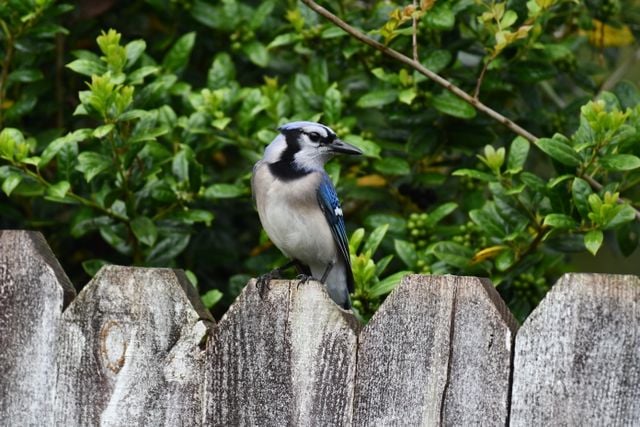
A handful of look-alikes can cause momentary confusion, though range usually settles the question. The Steller’s Jay (Cyanocitta stelleri) of western forests is darker, with a blackish head and crest, and the two species overlap only at the western fringe of the Blue Jay’s range. The Florida Scrub-Jay (Aphelocoma coerulescens) lacks a crest and the bold black necklace and is restricted to Florida scrub. Beyond the United States, no other crested blue jay shares the Blue Jay’s combination of necklace, crest, and white-marked wings within its core range.
Habitat and Distribution
The Blue Jay occupies forests of nearly every kind across its range, but it shows a clear preference for oak woods and for the edges where forest meets opening. It is more abundant along woodland edges, in woodlots, and in towns than in the depths of unbroken forest, and it has adapted readily to human landscapes, becoming a fixture of parks, gardens, and tree-lined neighborhoods, particularly where oaks or bird feeders are present.
Geographically, the species ranges from southern Canada through the eastern and central United States, south to Florida and eastern Texas. Its western boundary lies roughly at the eastern foothills of the Rocky Mountains, where the drier habitats favored by the Steller’s Jay begin. In recent decades the Blue Jay has expanded somewhat to the northwest, appearing as a rare but regular winter visitor along parts of the northern Pacific coast.
Migration is one of the bird’s genuine puzzles. The Blue Jay is the only New World jay that undertakes regular north-and-south movements, yet its migration remains poorly understood even after decades of study. Some individuals stay put year-round across the entire range, while others travel, sometimes in loose daytime flocks of a few dozen to a few hundred birds along the Great Lakes and Atlantic coasts. The proportion of the population that migrates is probably less than twenty percent, and analyses of banded birds indicate no consistent age difference between those that move and those that remain. An individual may migrate one autumn, winter in the north the next year, and migrate again the year after. The timing appears tied to weather and to the abundance of winter food, especially the acorn crop, which produces the irregular, large-scale flights that ornithologists describe as irruptive (meaning sudden and uneven from year to year rather than steady).
Breeding, Nesting, and Family Life
Blue Jays are socially monogamous, and pairs commonly remain together throughout the year and across multiple seasons, sharing territory defense and the work of raising young. Courtship often involves small groups, and once a pair forms, both members gather nesting material, with the male tending to do more of the gathering and the female more of the building.
The nest is an open cup of twigs, grass, and sometimes mud, lined with fine rootlets, and it is typically placed in the crotch or thick outer branches of a deciduous or coniferous tree, usually 3 to 7.6 m (10 to 25 ft) above the ground. The birds favor twigs snapped from living trees, and they will travel considerable distances for fresh rootlets, gathering them from recently dug ditches, fallen trees, and disturbed soil.
A clutch holds 2 to 7 eggs, bluish or light brown with brownish spots, and the pair raises a single brood each year. Only the female incubates, over a period of 17 to 18 days, while her mate provides all of her food during this time. For the first 8 to 12 days after the young hatch, the female broods them and the male delivers food for both her and the nestlings; the female then joins the foraging, though the male continues to provide the larger share.
The young leave the nest at 17 to 21 days old. In the days just before fledging, individual nestlings may wander up to about 4.6 m (15 ft) from the nest, and parents will often decline to feed a wanderer until it returns. This is the stage at which well-meaning people frequently discover an apparently “abandoned” baby jay; in most cases the bird is not abandoned at all, and returning it to or near the nest allows the parents to resume care. Fledglings remain with and are fed by their parents for at least a month, sometimes two, with considerable variation in how quickly each young bird becomes independent.

Diet and Foraging
The Blue Jay is an omnivore with broad and opportunistic tastes, and its diet shifts with the seasons. Across the year, plant matter dominates: acorns, other nuts, fruits, and grains together make up the great majority of what it eats, while insects account for roughly 22 percent of the annual diet, rising in importance during the warmer months. The bird gleans insects from foliage, takes nuts and seeds in trees and shrubs and on the ground, and will also eat small dead or injured vertebrates.
A persistent reputation for raiding the nests of other birds deserves a measure of correction. Blue Jays do occasionally take eggs and nestlings, but the behavior is far rarer than folklore implies. In one classic examination of 530 Blue Jay stomachs, traces of bird eggs or nestlings appeared in only six, despite a deliberate search for any such remains. The species is, on the whole, a far less aggressive feeder than its loud manner suggests, and in one Florida study it was regularly dominated at feeders by woodpeckers, grackles, squirrels, and even doves and cardinals.

When feeding, a Blue Jay typically holds a seed or nut beneath its feet and hammers it open with its stout bill. Its most consequential foraging behavior, however, is caching, the storing of food for later. That habit, and what it has meant for the forests of an entire continent, deserves a section of its own.
Communication and Vocalization
Few backyard birds are as vocal, or as varied, as the Blue Jay. Its best-known sound is a loud, ringing call often written as jay jay, which gives the bird its name, but this is only one entry in an immense vocabulary that also includes musical whistles, soft clicks, rattles, and a quiet, complex “whisper song” delivered at close range. Most of these calls are given from a perch within a tree, and a jay crossing open ground, especially during migration, usually does so in silence.
Vocal signals work hand in hand with visual ones. The crest is a mood indicator: held low when a bird is calm, incubating, or among family, and raised when it is excited or aggressive. When a Blue Jay squawks in alarm, the crest is almost always erect. This pairing of sound and posture allows jays to communicate finely with one another, and the highly variable black markings of the face and “necklace” may even help individual birds recognize one another.
The Bird That Plants Oak Forests
If the Blue Jay had only one claim to greatness, it would be this: it is, in a real sense, a planter of oaks. The connection runs through the bird’s remarkable caching behavior. A Blue Jay can carry several acorns at once by storing two or three in its throat and upper esophagus, an expandable area often called the gular pouch, holding another in its mouth and a fifth in the tip of its bill. Loaded this way, it ferries acorns from oak to storage site, where it buries them one by one for the lean months ahead.
The numbers are astonishing. In one study, six radio-tagged Blue Jays each cached between 3,000 and 5,000 acorns in a single autumn. Many of those buried acorns are recovered and eaten, but many are not, and a buried acorn left undisturbed in soil is an acorn well placed to germinate. Because jays carry acorns away from the parent tree, sometimes over considerable distances, and because they show a striking ability to select sound acorns over those infested by weevils, their forgetfulness becomes a forestry service. The Cornell Lab of Ornithology credits the Blue Jay’s fondness for acorns, and its accuracy in choosing and burying viable ones, with helping oak trees spread northward across the continent after the retreat of the last glaciers.
This is intelligence put to ecological work. Like other corvids, the Blue Jay is a quick learner with a strong spatial memory and a flexible, problem-solving mind, and its caching is not random scattering but a managed larder. Tool use has not been reported in wild Blue Jays, but captive birds have used strips of newspaper to rake food pellets toward their cages, a small but telling sign of the family’s resourcefulness. The result is one of the more elegant partnerships in North American natural history: a bird that feeds itself and, in the missing of its own hidden meals, helps grow the very forests it depends upon.
A Gift for Mimicry
The second trait that distinguishes the Blue Jay is its talent for imitation, and in particular its uncanny impressions of birds of prey. In the wild, Blue Jays frequently mimic the screaming calls of the Red-shouldered Hawk and the Red-tailed Hawk, and they sometimes copy other species as well. Captive birds have been known to imitate human speech and even the meow of a cat.
Why a jay should mimic a hawk is a question with more than one plausible answer, and the behavior may serve different purposes in different moments. One idea holds that a convincing hawk scream warns other jays of a genuine predator nearby. Another, more opportunistic explanation is that a jay arriving at a crowded feeder may give a hawk call to send smaller birds scattering, clearing the way to the food, although most displaced birds return quickly once the ruse passes. Whatever the function, the skill is real and often startling. A listener who hears what sounds like a Red-shouldered Hawk somewhere in the trees, only to watch a Blue Jay flap into view, has met one of the species’ most memorable tricks.
Conservation Status
The Blue Jay is classified as Least Concern by the IUCN, a designation reflecting its wide range, large population, and adaptability to human-altered landscapes. Partners in Flight estimated a global breeding population of about 17 million as of 2020, and the species scores 9 out of 20 on the Continental Concern Score, placing it among birds of low conservation concern.
That favorable status comes with a note of nuance. According to the North American Breeding Bird Survey, Blue Jay numbers declined by an estimated 0.6 percent per year between 1966 and 2019, a cumulative decline of roughly 27 percent over that span. The species remains common and is in no immediate danger, but the long-term trend is a reminder that even abundant, familiar birds can lose ground gradually. The most frequent human-associated cause of death recorded for Blue Jays is predation by domestic cats and dogs.
What helps the Blue Jay is, in large part, what helps backyard birds generally: keeping cats indoors, maintaining native trees and especially oaks, and supporting the woodland edges and mature trees the species favors. As a conservation-minded observer, planting an oak is among the most lasting gifts one can offer this bird, since a single tree feeds and shelters jays for generations and, in time, may itself owe its existence to a jay that planted an ancestor.
How to Attract or Observe Blue Jays
Blue Jays are among the easier birds to welcome, in part because they are bold, adaptable, and fond of the foods many people already offer. A few simple measures make a yard considerably more inviting.
Offer the foods they prefer. Blue Jays are especially drawn to whole peanuts, sunflower seeds, and acorns, and they readily use platform feeders and hopper feeders that give their large bodies room to land. Suet is taken as well, particularly in colder months. Because jays hammer food open while holding it underfoot, sturdy, stable feeding surfaces serve them better than small clinging perches.
Provide water and cover. A birdbath, kept clean and ice-free in winter, draws jays reliably, and a yard with mature trees, especially oaks, supplies both natural food and nesting sites. Native plantings that produce nuts, berries, and the insects jays feed to their young will support the species across the full year.
Observe with patience and a light touch. Blue Jays are active and conspicuous, often announcing themselves before they appear, so listening is half the work. Their habit of mobbing hawks and owls, gathering to scold a predator loudly, frequently reveals not only the jays but the very predator they have found. For anyone keeping a feeder, the jay also performs a quiet service, since its alarm calls alert the whole yard, the observer included, that a hawk is near.
Frequently Asked Questions
What does it mean when you see a Blue Jay?
In contemporary popular symbolism, a Blue Jay is widely read as a sign of boldness, clear communication, and watchfulness, with its food-storing habit sometimes taken as an emblem of foresight. These interpretations are modern folk associations rather than the documented teaching of any single tradition, and the specific meanings held by particular Indigenous nations belong to those nations and their own cultural keepers.
Are Blue Jays aggressive?
Blue Jays look and sound assertive, but they are less aggressive than their reputation suggests. They will scold and mob hawks and owls and occasionally dominate feeders, yet studies show they are themselves frequently displaced at feeders by woodpeckers, grackles, squirrels, and other birds. Genuine nest-robbing does occur but is uncommon.
Do Blue Jays migrate?
Some do and some do not. The Blue Jay is the only New World jay that migrates regularly, but probably fewer than twenty percent of the population moves in any given year, and the same individual may migrate one year and stay north the next. The behavior appears tied to weather and to the size of the autumn acorn crop.
What do Blue Jays eat?
Blue Jays are omnivores whose diet is dominated by acorns, other nuts, seeds, fruits, and grains, with insects making up roughly a fifth of the annual intake. They occasionally take small vertebrates and, rarely, eggs or nestlings. At feeders they favor peanuts, sunflower seeds, and suet.
Why are Blue Jays blue?
A Blue Jay is blue because of how light behaves in its feathers, not because of blue pigment. Tiny structures within the feather scatter light to produce the blue we see, a phenomenon called structural coloration, while the feather’s only actual pigment is brown melanin. Crushing the feather destroys the structure and the blue vanishes.
How long do Blue Jays live?
Blue Jays are relatively long-lived for a songbird, and the oldest known wild individual reached at least 26 years and 11 months. That record bird, documented by the Cornell Lab of Ornithology from banding data, was banded in 1989 in the Newfoundland and Labrador region and recovered there in 2016. Most Blue Jays live far shorter lives, with predation by hawks, owls, cats, and dogs taking a steady toll.
Can Blue Jays mimic hawks?
Yes. Blue Jays are skilled vocal mimics and regularly imitate the calls of Red-shouldered and Red-tailed Hawks. The imitation may warn other jays of a real predator or, at a feeder, briefly scatter smaller birds so the jay can feed.
Conclusion
That backyard racket is worth paying attention to. A blue jay is loud and conspicuous enough to notice without trying, and rich enough, on closer acquaintance, to repay a lifetime of watching. Its blue is an optical trick, its calls are a language we’re still learning to read, and its quiet autumn habit of burying acorns it’ll never dig back up has helped shape the forests of a continent. Common doesn’t mean ordinary. The jay screaming at your feeder is proof of it.
To go further, explore the state hubs for the regions where the Blue Jay is a year-round resident, and pair this guide with our backyard feeding and native-planting resources to make your own yard a place this bold, intelligent bird will return to season after season.
Works Cited
- Cornell Lab of Ornithology. “Blue Jay Overview.” All About Birds. https://www.allaboutbirds.org/guide/Blue_Jay/overview
- Cornell Lab of Ornithology. “Blue Jay Identification.” All About Birds. https://www.allaboutbirds.org/guide/Blue_Jay/id
- Cornell Lab of Ornithology. “Blue Jay Life History.” All About Birds. https://www.allaboutbirds.org/guide/Blue_Jay/lifehistory
- Smith, K. G., K. A. Tarvin, and G. E. Woolfenden (2020). “Blue Jay (Cyanocitta cristata), version 1.0.” In Birds of the World, Cornell Lab of Ornithology. https://birdsoftheworld.org/bow/species/blujay/cur/introduction
- National Audubon Society. “Blue Jay.” Audubon Field Guide. https://www.audubon.org/field-guide/bird/blue-jay
- Encyclopaedia Britannica. “Blue jay.” https://www.britannica.com/animal/blue-jay
- Integrated Taxonomic Information System (ITIS). “Cyanocitta cristata (Linnaeus, 1758).” https://www.itis.gov/servlet/SingleRpt/SingleRpt?search_topic=TSN&search_value=179680
- Native Languages of the Americas. “Native American Bluejay Mythology.” https://www.native-languages.org/legends-bluejay.htm