Pennsylvania Birds: A Guide to the Keystone State’s Common Birds
Pennsylvania sits at a crossroads of geography and migration that makes it one of the richest birding states in the eastern United States. Forests blanketing more than half the commonwealth, a 43-mile (69 km) stretch of Lake Erie shoreline, the Appalachian ridge system, and three major river corridors combine to produce a mosaic of habitats capable of supporting an extraordinary range of species. Whether you are watching backyard birds of Pennsylvania at a feeder in Pittsburgh or scanning a rocky ridge for raptors in Berks County, the Keystone State consistently rewards attention.
The Pennsylvania Ornithological Records Committee (PORC) recognized 457 species in its most recent official checklist published in 2024, 447 of them accepted as Class I records. That figure reflects the state’s position squarely on the Atlantic Flyway, one of North America’s four primary migratory corridors, which channels millions of birds through Pennsylvania each spring and fall. From the Appalachian range in the center to the Delaware River on the east and the Lake Erie shoreline in the northwest, the state offers birders an almost unparalleled variety of habitat, season, and spectacle within a single geographic boundary.
Key Takeaways
- Pennsylvania’s official bird list stands at 457 species as of the Pennsylvania Ornithological Records Committee’s seventh edition checklist (2024), making it one of the most species-rich states in the eastern United States.
- The state game bird is the Ruffed Grouse (Bonasa umbellus), officially designated by the Pennsylvania legislature in 1931.
- Pennsylvania lies along the Atlantic Flyway; spring migration peaks in May, while fall raptor migration along the Kittatinny Ridge runs from August through December.
- Presque Isle State Park in Erie County holds the highest single-site species total in the state, with more than 339 species documented on its peninsula.
- Hawk Mountain Sanctuary in Berks County has conducted the world’s longest-running hawk migration count since 1934, averaging around 18,000 raptors counted per autumn season.
At-a-Glance Species Table
|
Species |
Scientific Name |
Size |
When Present |
Where to Find |
Best Feeder Food |
|---|---|---|---|---|---|
|
Northern Cardinal |
Cardinalis cardinalis |
21-23 cm / 8-9 in |
Year-round resident |
Woodland edges, suburbs |
Black-oil sunflower seeds |
|
Black-capped Chickadee |
Poecile atricapillus |
12-15 cm / 5-6 in |
Year-round resident |
Forests, suburbs |
Black-oil sunflower, suet |
|
American Goldfinch |
Spinus tristis |
11-13 cm / 4-5 in |
Year-round resident |
Open fields, gardens |
Nyjer (thistle) seed |
|
Dark-eyed Junco |
Junco hyemalis |
14-16 cm / 5.5-6.5 in |
Winter (Oct-Apr) |
Forest edges, feeders |
Millet, cracked corn |
|
Downy Woodpecker |
Dryobates pubescens |
14-17 cm / 5.5-6.7 in |
Year-round resident |
Forests, parks, suburbs |
Suet, peanuts |
|
Red-tailed Hawk |
Buteo jamaicensis |
45-65 cm / 18-26 in |
Year-round resident |
Open country, roadsides |
N/A |
|
Bald Eagle |
Haliaeetus leucocephalus |
70-102 cm / 28-40 in |
Year-round resident |
Rivers, lakes, reservoirs |
N/A |
|
Great Blue Heron |
Ardea herodias |
97-137 cm / 38-54 in |
Year-round (breeds spring-summer) |
Wetlands, rivers, ponds |
N/A |
|
Ruby-throated Hummingbird |
Archilochus colubris |
7-9 cm / 2.8-3.5 in |
Late April-October |
Gardens, woodland edges |
Nectar (4:1 water-sugar) |
|
Scarlet Tanager |
Piranga olivacea |
16-19 cm / 6.3-7.5 in |
May-September |
Mature hardwood forest |
N/A |
|
Ruffed Grouse |
Bonasa umbellus |
40-50 cm / 15.7-19.7 in |
Year-round resident |
Young forest, brushy areas |
N/A |
|
Cerulean Warbler |
Setophaga cerulea |
11-12 cm / 4.3-4.7 in |
May-August |
Mature upland forest canopy |
N/A |
Geography, Ecoregions, and the Atlantic Flyway
Pennsylvania’s extraordinary bird diversity is not accidental. The state encompasses a remarkable variety of habitat within its roughly 119,000 square kilometers (46,000 square miles), and its position at the junction of several major geographic features makes it a convergence point for species from multiple ecological traditions.
The Appalachian range runs diagonally across the state from northeast to southwest, forming a series of parallel ridges and valleys that are among the most significant landforms for bird migration in the eastern half of North America. These ridges act as “leading lines” for raptors, channeling broad-winged hawks, golden eagles, ospreys, and falcons along predictable corridors every autumn. The Kittatinny Ridge, the southernmost of these features, is recognized as a globally significant migration flyway and Pennsylvania’s largest Important Bird Area (Pennsylvania Game Commission, 2024).
To the north and northwest, the Allegheny Plateau supports extensive hardwood and mixed forests where forest-interior species such as the Cerulean Warbler, Wood Thrush, and Canada Warbler breed in reasonable numbers. The northwestern corner opens onto a 43-mile (69 km) stretch of Lake Erie shoreline, a feature with outsized importance for migratory shorebirds, waterfowl, and passerines that use the lake as a barrier-and-concentration effect during both spring and fall passage.
The southeastern lowlands, including the Delaware River corridor and the broad piedmont valleys, provide agricultural landscapes, tidal wetlands, and urban green spaces that support a distinct set of species. The Susquehanna River, flowing through the heart of the state, forms part of the watershed connecting the Chesapeake Bay to interior Pennsylvania and serves as a critical stopover within the Atlantic Flyway (Susquehanna National Heritage Area, 2024).
Audubon Pennsylvania has designated 86 Important Bird Areas (IBAs) across the commonwealth, collectively encompassing more than two million acres of public and private land. Pennsylvania, in fact, developed the first statewide IBA program in the United States in 1996, a distinction that reflects the depth of the state’s commitment to bird conservation (Audubon Pennsylvania, n.d.).
For birders seeking a useful visual reference, ecoregion maps produced by the U.S. Environmental Protection Agency and the Pennsylvania Natural Heritage Program show how habitat types shift across the state, providing a practical planning tool for finding specific groups of wild birds in different seasons.
Pennsylvania’s State Game Bird: The Ruffed Grouse
Ruffed Grouse (Bonasa umbellus)
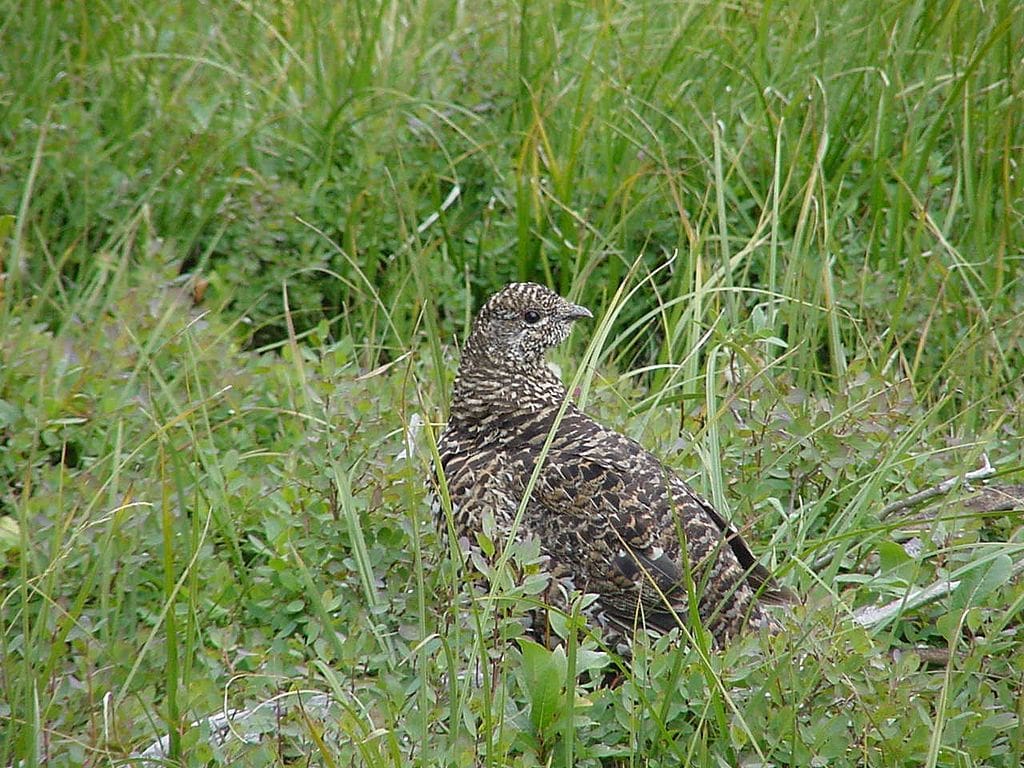
The Ruffed Grouse has held the designation of Pennsylvania’s official state game bird since June 22, 1931, when the state legislature adopted it alongside the Eastern Hemlock as the official state tree. Often called the partridge by local hunters, it was originally championed for this designation by the General Federation of Women’s Clubs, reflecting a broad cultural appreciation for the species that spanned hunting and non-hunting communities alike (Pennsylvania Game Commission, 2024).
Size: 40-50 cm (15.7-19.7 in) in length; wingspan 50-64 cm (19.7-25.2 in); weight approximately 450-750 g (1-1.65 lb).
The Ruffed Grouse presents in two color morphs, gray and brown, both displaying elaborate barring and speckling that provides excellent camouflage among leaf litter and dappled forest light. Males possess a distinctive black or dark-brown neck ruff that they erect during courtship, giving the species its common name. The fan-shaped tail carries a subterminal dark band that is especially visible during display.
The species is found throughout much of Pennsylvania wherever brushy, young forests less than 20 years old exist within a larger wooded landscape. It is particularly associated with aspen stands, birch thickets, and the mixed hardwood regeneration that follows timber harvesting. In winter, Ruffed Grouse become almost entirely dependent on the dormant flower buds and catkins of aspens, birches, and wild cherries.
The male’s famous “drumming” display, produced by beating wings rapidly against the air to create a low-frequency pulse, serves both to attract females and to advertise territory. This sound, often likened to a distant engine starting and accelerating, can travel up to 400 meters (a quarter of a mile) through the forest. Drumming peaks during March and April.
Ruffed Grouse do not visit feeders, but they can be found on public land throughout the state, particularly in areas managed by the Pennsylvania Game Commission for young-forest habitat.
Common Backyard Birds of Pennsylvania
Pennsylvania’s suburbs, rural properties, and city parks host a reliable core of year-round and seasonal species that form the foundation of most residents’ bird identification skills.
Northern Cardinal (Cardinalis cardinalis)
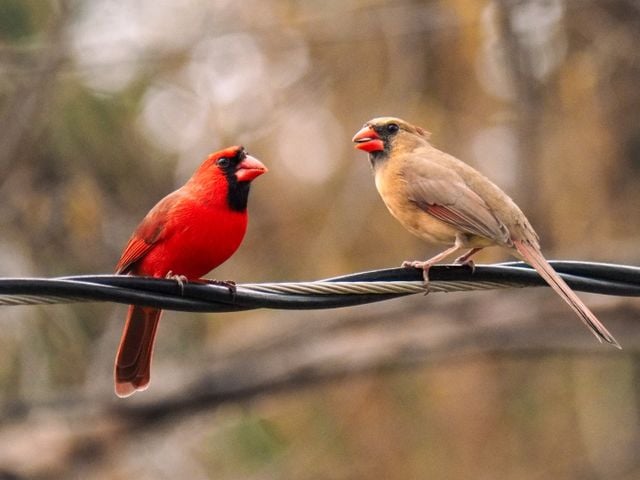
Size: 21-23 cm (8.3-9.1 in); wingspan 25-31 cm (9.8-12.2 in).
The Northern Cardinal ranks among the most familiar species for backyard birders across the state. Males are unmistakably brilliant red with a prominent crest, heavy orange-red bill, and black mask. Females are warm brown with reddish tinges on the crest, wings, and tail, and are often overlooked by newer observers unfamiliar with the species’ sexual dimorphism.
Cardinals are year-round residents throughout Pennsylvania, frequenting woodland edges, hedgerows, suburban gardens, and brushy areas. They are non-migratory and will visit feeders throughout the coldest winter months. Black-oil sunflower seeds offered in platform feeders or tube feeders with trays attract them reliably.
Cardinals eat seeds, fruit, and insects, foraging primarily at ground level or in low shrubs. Males sing a rich, whistled cheer cheer cheer or weet weet weet year-round, and females also sing, a trait uncommon in North American songbirds.
Black-capped Chickadee (Poecile atricapillus)

Size: 12-15 cm (4.7-5.9 in); wingspan 16-21 cm (6.3-8.3 in).
The Black-capped Chickadee is one of the most recognizable and beloved backyard birds in Pennsylvania. Its jet-black cap and throat, bright white cheeks, gray back, and buffy flanks make it easy to identify at any season. The Carolina Chickadee (Poecile carolinensis) is nearly identical and is also present in Pennsylvania, primarily in the southern and southeastern parts of the state; where both species occur, look for differences in wing feather edging and listen carefully to the call notes, as the two species do interbreed in their contact zone.
Black-capped Chickadees are year-round residents statewide, forming loose foraging flocks with other small birds in winter. They cache seeds individually across a wide area and can recall the location of each cache for weeks. At feeders, they accept black-oil sunflower seeds, suet, peanut hearts, and nyjer. They also readily adopt nest boxes with a 28 mm (1.1 in) entrance hole.
Their call, chick-a-dee-dee-dee, varies in the number of “dee” notes depending on the level of perceived threat, a form of information encoding studied extensively by researchers.
American Goldfinch (Spinus tristis)

Size: 11-13 cm (4.3-5.1 in); wingspan 19-22 cm (7.5-8.7 in).
The American Goldfinch is a year-round resident of Pennsylvania and among the most visually striking visitors to backyard feeders. Breeding males are a vivid canary yellow with black wings showing two white bars, a black cap, and a white rump. Females and winter-plumaged birds are olive-yellow to brownish, with the same wing pattern retained throughout the year.
Goldfinches are among the latest breeders of any North American songbird, often waiting until mid-July or August to nest when thistles and native plants are producing the seeds they prefer for feeding nestlings. They are almost exclusively seed eaters and show a strong preference for nyjer (often called thistle) and hulled sunflower seeds in tube feeders.
Look for them in weedy fields, roadsides, open woodland, and suburban gardens. Their undulating flight and bright per-chik-oree call are reliable identification cues even when color is not visible.
Dark-eyed Junco (Junco hyemalis)

Size: 14-16 cm (5.5-6.3 in); wingspan 18-25 cm (7.1-9.8 in).
The “slate-colored” form of the Dark-eyed Junco is the common winter visitor across Pennsylvania, arriving in October and departing by April. A small breeding population persists in the higher elevations of the Poconos and the northern tier. In winter, juncos descend in large numbers from northern forests and the higher Appalachians, foraging in flocks on the ground beneath feeders and along brushy edges.
Males are uniformly dark gray above with a sharply defined white belly; females are browner. The white outer tail feathers flash conspicuously in flight, a reliable field mark. Juncos eat small seeds scattered on the ground or on low platform feeders, favoring millet and cracked corn. Their high-pitched trilling song is sometimes heard even in winter.
Downy Woodpecker (Dryobates pubescens)

Size: 14-17 cm (5.5-6.7 in); wingspan 25-31 cm (9.8-12.2 in).
The Downy Woodpecker is the smallest woodpecker found in North America and one of the most common species in Pennsylvania throughout all seasons. It is largely black and white, with a white back stripe, spotted wings, and a short, stubby bill that distinguishes it from the nearly identical but substantially larger Hairy Woodpecker (Dryobates villosus). Males carry a small red patch on the back of the head.
Downies inhabit a wide range of wooded areas, from mature forests to suburban backyards with shade trees. They forage by excavating insect larvae from bark and wood, and visit suet feeders, peanut feeders, and black-oil sunflower feeders year-round. Their rapid, descending whinny call and soft pik note are among the most familiar sounds of Pennsylvania woodlands.
Red-bellied Woodpecker (Melanerpes carolinus)
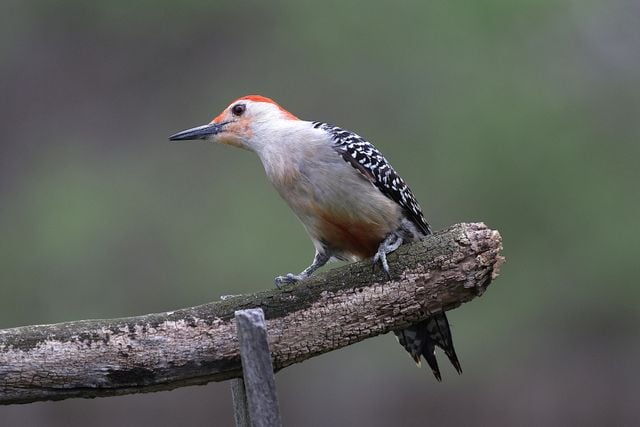
Size: 22-27 cm (8.7-10.6 in); wingspan 38-46 cm (15-18 in).
Despite its name, the Red-bellied Woodpecker displays only a faint pinkish wash on the belly that is often invisible in the field. The more useful field marks are the brilliant red cap (extending from bill to nape in males, only on the nape in females) and the finely barred black-and-white back. Its loud, rolling churr call is a signature sound of Pennsylvania woodlands.
Once primarily a southern species, the Red-bellied Woodpecker has expanded its range steadily northward over the past several decades and is now a common year-round resident throughout Pennsylvania. It uses suet feeders readily and also visits peanut and sunflower feeders. In wooded areas, look for it excavating nest cavities in dead trees and foraging on bark surfaces for insects, seeds, and berries.
Ruby-throated Hummingbird (Archilochus colubris)
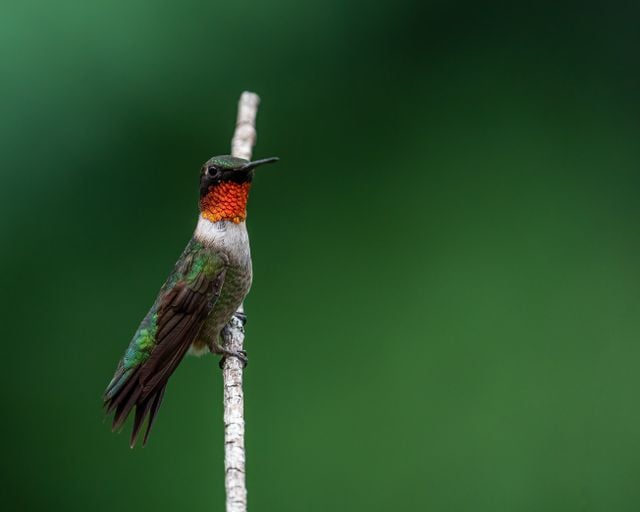
Size: 7-9 cm (2.8-3.5 in); wingspan 8-11 cm (3.1-4.3 in); weight 2-6 g (0.07-0.21 oz).
The Ruby-throated Hummingbird is the only hummingbird species that breeds regularly in Pennsylvania and the only one likely to be encountered in the eastern part of North America. Males display a brilliant iridescent ruby-red throat (gorget) that can appear black in poor light, along with an iridescent green back and white underparts. Females and immatures lack the gorget and show a white throat.
According to the Pennsylvania Game Commission, ruby-throats arrive in Pennsylvania in late April in the southern part of the state and into May farther north, with males typically preceding females by one to two weeks. The timing often coincides with the blooming of wild columbine. Most individuals depart by late September or October, though stragglers occasionally linger.
Hummingbirds beat their wings more than 50 times per second, a rate that creates the distinctive humming sound for which the family is named. They feed on nectar from tubular flowers and also capture small insects for protein. Attract them with a clean feeder filled with a solution of one part white granulated sugar dissolved in four parts water; avoid red food coloring and honey, both of which can harm the birds.
Native plantings of native trumpet vine (Campsis radicans), cardinal flower (Lobelia cardinalis), and bee balm (Monarda didyma) are excellent supplement to feeders for hummingbird habitat in Pennsylvania gardens.
Birds of Prey in Pennsylvania
Pennsylvania supports a rich raptor community, with species present in every season representing hawks, eagles, falcons, and owls across every ecological zone in the state.
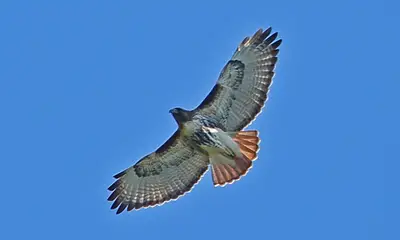
Red-tailed Hawk (Buteo jamaicensis)

Size: 45-65 cm (17.7-25.6 in); wingspan 110-141 cm (43-56 in).
The Red-tailed Hawk is the most frequently seen hawk in Pennsylvania and arguably the most recognizable bird of prey in North America. Adults display the eponymous brick-red tail on their upper surface, a field mark visible in flight from considerable distance. The streaked belly band across an otherwise pale underside is another reliable identification point. Plumage varies considerably, from the pale “Eastern” form to rare dark morphs.
Red-tailed Hawks are year-round residents across all of Pennsylvania, perching conspicuously on fence posts, telephone poles, and bare treetops along roadsides. They hunt primarily by watching from elevation and stooping on small mammals, particularly meadow voles. Their high, descending keeeeeer scream is the call most often dubbed over film and television footage of other raptor species.
During fall migration, Red-tailed Hawks become concentrated along the Appalachian ridges, where they are regularly counted at hawk watch sites across the state. Late October through November represents the peak passage for this species.
Bald Eagle (Haliaeetus leucocephalus)
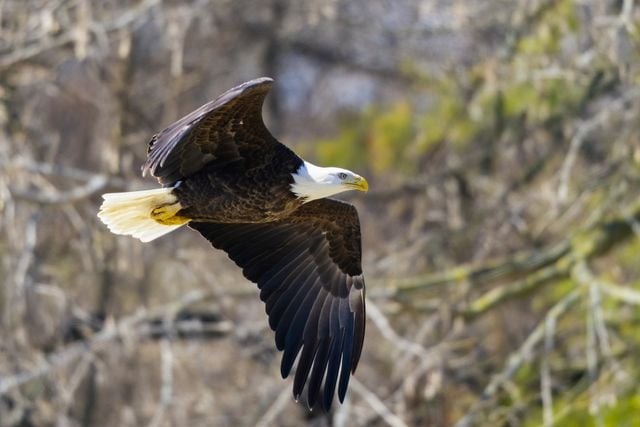
Size: 70-102 cm (27.6-40 in); wingspan 168-244 cm (66-96 in).
The recovery of the Bald Eagle in Pennsylvania is one of the great conservation success stories in the state’s history. The Pennsylvania Game Commission documented only three active nests in the late 1970s, when the species was still suppressed by the effects of DDT-induced reproductive failure and persecution. Today the state supports more than 300 active nests, distributed primarily along major rivers, lakes, and reservoirs (Pennsylvania Game Commission, 2024). The second Atlas of Breeding Birds documented a staggering 949 percent increase in breeding Bald Eagles between the first atlas period (1983-89) and the second (2004-09).
Adult Bald Eagles are unmistakable, with their white head and tail, dark brown body, and massive yellow bill. Immature birds, which do not acquire full adult plumage until their fifth year, are largely dark brown with variable white mottling on the wings and body and are frequently confused with Golden Eagles by newer observers.
Bald Eagles are year-round residents, though numbers increase in winter as northern birds move south. Look for them roosting communally near open water in cold months, and soaring in pairs over nest sites from late January onward.
Osprey (Pandion haliaetus)
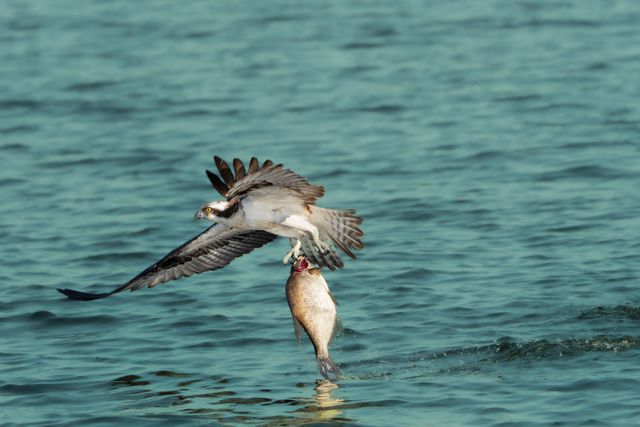
Size: 50-66 cm (19.7-26 in); wingspan 127-180 cm (50-71 in).
The Osprey is a distinctive fishing raptor with no close relatives, placed in its own family. Its coloration, dark brown above and white below with a dark eye stripe, along with its habit of plunging feet-first into water to capture fish, makes it nearly unmistakable. In flight, the long wings show a characteristic crook at the wrist, giving the bird a gull-like profile.
Ospreys are summer residents and migrants in Pennsylvania, present from March through October. They nest near lakes, rivers, and reservoirs, often on man-made platforms erected for their benefit. The Susquehanna River, the Delaware River, and the Lake Erie shoreline all support breeding populations. During migration, concentrations can be observed at sites along the Kittatinny Ridge.
Cooper’s Hawk (Accipiter cooperii)

Size: 35-50 cm (13.8-19.7 in); wingspan 62-90 cm (24-35 in).
The Cooper’s Hawk is a medium-sized accipiter (a group of short-winged, long-tailed hawks that specialize in pursuing birds and small mammals through dense vegetation) found throughout Pennsylvania year-round. Adults are slate-gray above with finely barred rusty-orange underparts and a rounded, dark-banded tail with a white terminal band. Immatures are brown above with coarse streaking below.
Cooper’s Hawks have become increasingly common in suburban and urban areas, where they prey on birds attracted to feeders. This association has been documented across the state and reflects the species’ capacity to exploit human-modified landscapes. If birds suddenly scatter from your feeder, a Cooper’s Hawk is often the cause.
The Sharp-shinned Hawk (Accipiter striatus), which passes through Pennsylvania in large numbers during migration, is nearly identical to the Cooper’s Hawk. See the look-alike table below for guidance on separating the two.
Water and Wetland Birds
Great Blue Heron (Ardea herodias)
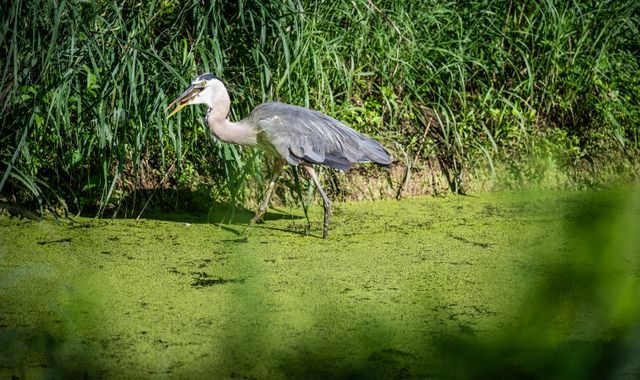
Size: 97-137 cm (38-54 in); wingspan 167-201 cm (65.7-79.1 in); weight 1.8-3.6 kg (4-8 lb).
The Great Blue Heron is the largest heron found in North America and one of the most visually arresting birds in Pennsylvania’s avifauna. Its combination of slate-gray upperparts, white face with a black stripe extending into a wispy plume, and long yellow-orange bill makes it instantly recognizable even at distance. In flight, it assumes a characteristic shape with neck folded in an S-curve and legs trailing behind, unlike the straight-necked flight of the Sandhill Crane.
Great Blue Herons breed in colonial rookeries (called heronries) in tall trees near water across Pennsylvania. They are present year-round in the southern and central parts of the state, though northern populations may move south in response to ice cover on feeding areas. They stand motionless at water’s edge or in shallow water waiting to strike fish, frogs, crayfish, and other aquatic prey with explosive speed. A lone heron standing in a farm pond or suburban retention basin is a familiar sight throughout much of the state.
Canada Goose (Branta canadensis)
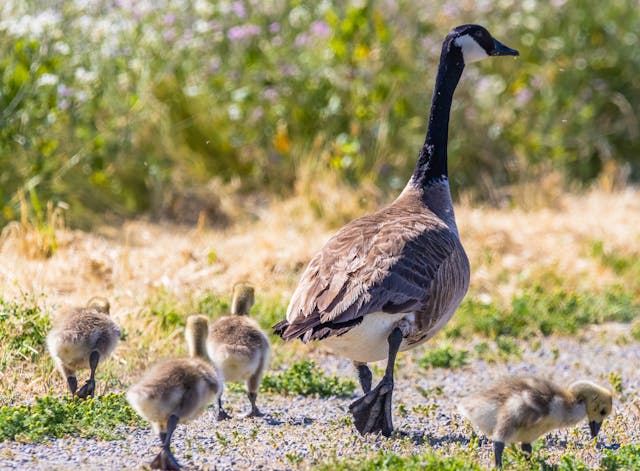
Size: 75-110 cm (29.5-43.3 in); wingspan 127-185 cm (50-73 in).
The Canada Goose is one of the most widely recognized birds in Pennsylvania and throughout North America. Its black head and neck, white chin patch, brown body, and V-formation flight are familiar to virtually all Pennsylvanians. The species has adapted extensively to human-modified landscapes, and resident (non-migratory) populations now inhabit parks, golf courses, and suburban lawns year-round across much of the state. Migratory populations passing through in spring and fall can form flocks numbering in the thousands, particularly at sites like Middle Creek Wildlife Management Area in Lancaster County.
Woodland and Grassland Specialties
Wild Turkey (Meleagris gallopavo)

Size: 76-125 cm (30-49 in); wingspan up to 144 cm (57 in); weight 2.7-11 kg (6-24 lb).
The Wild Turkey is the largest game bird in Pennsylvania and a common sight across the state’s forested and agricultural landscapes. Males are iridescent bronze-brown with a bare, warty red head, fleshy wattles, and a beard of hair-like feathers on the breast. Females are smaller and duller. Turkeys forage on the ground for acorns, seeds, berries, and insects, and roost in trees at night.
Pennsylvania’s Wild Turkey population was devastated by over-hunting and habitat loss in the 19th century before successful restoration efforts by the Pennsylvania Game Commission brought the birds back to all 67 counties.
Wood Thrush (Hylocichla mustelina)

Size: 19-21 cm (7.5-8.3 in); wingspan 30-40 cm (11.8-15.7 in).
The Wood Thrush is widely regarded as one of the finest singers in North America. Its flute-like, spiraling song, often rendered as ee-oh-lay with complex harmonics, echoes through Pennsylvania’s mature hardwood forests from May through July. The bird itself is stocky and warm-toned, with a rich cinnamon-brown head and back, white underparts, and bold dark brown spots covering the breast and flanks.
Pennsylvania’s forests support an estimated 9 percent of the global Wood Thrush breeding population, giving the state a particular conservation responsibility for this species (Brandywine Conservancy, n.d.). Populations have declined significantly in recent decades due to habitat loss on both the breeding grounds and the wintering grounds in Central America, as well as brood parasitism by Brown-headed Cowbirds where forest fragmentation allows cowbirds access to forest-interior nests.
Scarlet Tanager (Piranga olivacea)

Size: 16-19 cm (6.3-7.5 in); wingspan 25-30 cm (9.8-11.8 in).
The Scarlet Tanager is among the most visually spectacular birds of the Pennsylvania summer. Breeding males are a brilliant scarlet red with jet-black wings and tail, a combination that seems almost tropical in the context of a northeastern oak forest. Females and fall-plumaged males are olive-yellow with dark wings and are far more cryptic. The species’ burry, somewhat robin-like song, sometimes described as sounding like a robin with a sore throat, is often heard before the bird is seen high in the canopy.
Scarlet Tanagers are neotropical songbirds, arriving from their South American wintering grounds in early May and departing by October. Pennsylvania holds an estimated 17 percent of the global Scarlet Tanager breeding population, a proportion that places the state among the most important breeding areas for this species in the world (Waterlandlife.org / Pennsylvania Natural Heritage Program, 2023). Mature, contiguous oak and mixed hardwood forests are the preferred breeding habitat.
Notable Migrants
Cerulean Warbler (Setophaga cerulea)

Size: 11-12 cm (4.3-4.7 in); wingspan 19-20 cm (7.5-7.9 in).
The Cerulean Warbler is one of the most urgently declining forest-interior songbirds in Pennsylvania and across its range. Males are a distinctive sky blue above with white underparts crossed by a narrow blue necklace; females are blue-green above with yellowish underparts. The species breeds in the canopy of mature upland oak forests and bottomland sycamore stands, making it frustratingly difficult to observe despite the male’s buzzy, ascending song.
Between the first Pennsylvania Breeding Bird Atlas period (1983-89) and the second (2004-09), the Cerulean Warbler lost an estimated 28 percent of its state breeding population (Pennsylvania Game Commission, n.d.). Long-term population declines exceed 70 percent continent-wide since Breeding Bird Survey monitoring began. The species is classified as a “High-level Concern” species in Pennsylvania and as a Bird of Conservation Concern by the U.S. Fish and Wildlife Service.
Canada Warbler (Cardellina canadensis)

Size: 12-15 cm (4.7-5.9 in); wingspan 17-22 cm (6.7-8.7 in).
The Canada Warbler is a striking neotropical migrant that breeds locally in Pennsylvania’s cool, shrubby, stream-edge habitats in the northern tier and the Pocono Plateau. Males are gray above with lemon-yellow underparts and a distinctive necklace of black spots across the chest. Females are patterned similarly but with less distinct markings. The species is a bird of dense undergrowth near water, often singing from low perches in rhododendron thickets and mountain laurel.
Canada Warbler populations have declined significantly across their range, driven by habitat loss both in Pennsylvania’s breeding areas and on their South American wintering grounds.
Blackpoll Warbler (Setophaga striata)
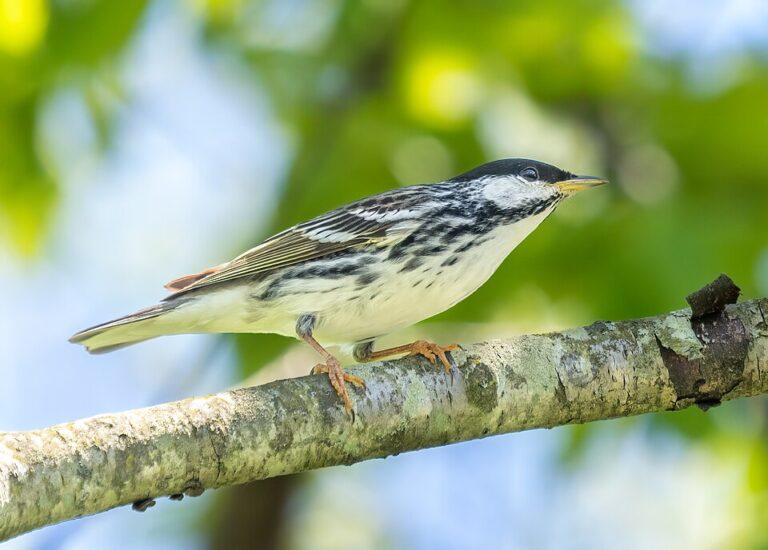
Size: 12-15 cm (4.7-5.9 in); wingspan 20-23 cm (7.9-9.1 in).
The Blackpoll Warbler passes through Pennsylvania in large numbers during spring migration, typically in late May, as one of the last warblers to arrive each year. Breeding males are boldly patterned with a black cap, white cheeks, and heavy black streaking on white underparts. In fall, birds molt into an olive-yellow plumage that presents significant identification challenges.
While the Blackpoll is primarily a migrant through Pennsylvania, a very small and rare breeding population exists at the highest elevations in the state, a relict outpost of the species’ boreal breeding range. The Pennsylvania Ornithological Records Committee classifies the Blackpoll as a state-endangered breeding bird (Pennsylvania Game Commission, n.d.).
Baltimore Oriole (Icterus galbula)

Size: 17-22 cm (6.7-8.7 in); wingspan 23-32 cm (9-12.6 in).
The Baltimore Oriole is one of the most eagerly anticipated arrivals of spring in Pennsylvania, typically appearing in early to mid-May. Males are a vivid flame-orange and black; females are yellow-orange and brownish-black. Orioles weave distinctive hanging basket nests from plant fibers, suspended from the tips of branches in tall deciduous trees.
They feed on nectar, fruit, and insects, and readily visit feeders stocked with orange halves, grape jelly, and nectar feeders. Their rich, flute-like whistled song is a characteristic sound of Pennsylvania’s late spring mornings. Most depart by September as they begin their southward journey toward Central America.
Broad-winged Hawk (Buteo platypterus)

Size: 34-44 cm (13.4-17.3 in); wingspan 81-100 cm (32-39 in).
The Broad-winged Hawk creates one of the most celebrated spectacles in Pennsylvania ornithology. Each September, tens of thousands funnel southward along the Appalachian ridges in tightly packed swirling groups called “kettles,” with some single-day counts at Hawk Mountain Sanctuary and other ridge sites exceeding 10,000 individuals. Adults display a boldly banded black-and-white tail and finely barred rufous underparts. In migration, the compact, chunky shape with pointed wingtips distinguishes it from other buteos.
Broad-winged Hawks breed in mature deciduous and mixed forests throughout Pennsylvania, arriving in late April and departing almost entirely by mid-October. The September passage through the state’s ridge system is one of the landmark events in North American bird migration.
Look-Alike Species Comparison
| Species Pair | Key Differences |
|---|---|
| Downy Woodpecker vs. Hairy Woodpecker | Both are black-and-white woodpeckers with males having a red nape patch. The Downy (smaller, 14-17 cm) has a short, stubby bill less than half the length of the head; the Hairy (larger, 18-26 cm) has a long, chisel-like bill nearly equal to the head length. The Hairy’s outer tail feathers are pure white; the Downy’s often show faint black spotting. |
| Cooper’s Hawk vs. Sharp-shinned Hawk | Both are slender accipiters with barred underparts. The Cooper’s is crow-sized and shows a rounded tail tip and a larger, blockier head that projects well beyond the wings in flight. The Sharp-shinned is smaller (roughly jay-sized), with a squared or notched tail and a small, barely projecting head. Bill size and overall impression are often more reliable than individual field marks alone. |
| American Crow vs. Common Raven | Both are all-black corvids, but size differs markedly: the Crow is roughly 45-53 cm (17-21 in) while the Raven reaches 54-67 cm (21-26 in). The Raven has a heavier, curved bill, a wedge-shaped (rather than rounded) tail in flight, and a deeper, resonant prronk call versus the Crow’s familiar caw. Ravens have expanded in Pennsylvania in recent decades and are now breeding regularly in the northern tier. |
Seasonal Birding Calendar
| Season | Key Events | Target Species |
|---|---|---|
| Winter (December-February) | Waterfowl peak at Lake Erie and Susquehanna River; irruptive species from the north appear; communal roosts of crows and starlings; resident owls begin calling | Dark-eyed Junco, White-throated Sparrow, Snow Goose, Tundra Swan, Rough-legged Hawk, Snowy Owl (irruptive), Great Horned Owl |
| Spring (March-May) | Waterfowl migration peaks in March; shorebirds peak in April at Presque Isle; wave warblers and neotropical songbirds arrive May 5-20; breeding season begins; hummingbirds arrive late April | Ruby-throated Hummingbird, Scarlet Tanager, Baltimore Oriole, 30+ warbler species, Broad-winged Hawk, Osprey, shorebirds at Presque Isle |
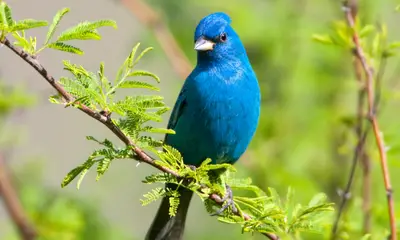
| Summer (June-August) | Breeding season for resident and neotropical species; Wood Thrush, Cerulean Warbler, and Canada Warbler hold territory; shorebird return migration begins August; Bald Eagle young fledge | Ruffed Grouse, Wood Thrush, Cerulean Warbler, Eastern Bluebird, Indigo Bunting, Ruby-throated Hummingbird, Great Blue Heron, Gray Catbird, Pine Warbler |
| Fall (September-November) | Peak raptor migration at Hawk Mountain and Kittatinny Ridge; snow geese arrive at Middle Creek in November; migratory songbirds pass through; waterfowl move to open water | Broad-winged Hawk (September), Golden Eagle, Osprey, Sharp-shinned Hawk, Snow Goose, White-throated Sparrow, warblers in mixed flocks |
Top Birding Hotspots in Pennsylvania
Presque Isle State Park, Erie County
A 3,200-acre (1,300 ha) peninsula arching into Lake Erie from the city of Erie, Presque Isle State Park is the premier birding location in Pennsylvania and one of the finest in the entire country. BirdWatching magazine has consistently rated it among the top sites nationally, and more than 339 species have been documented on the peninsula. Its location on the Atlantic Flyway creates a “concentration effect” in both spring and fall: northbound migrants following the Lake Erie shoreline in spring reach the tip of the peninsula and concentrate in remarkable numbers, while southbound birds in fall see the peninsula as their first landfall after crossing the lake. Warbler migration peaks in mid-May and again in September; migratory shorebirds peak in April and September; and waterfowl numbers peak in March and from late November through December. Gull Point, the eastern tip of the peninsula, is the only location in Pennsylvania where the federally threatened Piping Plover (Charadrius melodus) has nested (Presque Isle Audubon, n.d.).
Hawk Mountain Sanctuary, Berks County
Straddling the Kittatinny Ridge in eastern Pennsylvania, Hawk Mountain Sanctuary was established in 1934 as the world’s first sanctuary specifically designated to protect birds of prey. Before that, gunners gathered on the ridge each autumn and shot raptors by the thousands. Today it hosts the world’s longest-running raptor migration count, conducted annually from August 15 through December 15. The count averages approximately 18,000 raptors per autumn season, with single-day peaks of more than 3,000 birds possible during the height of Broad-winged Hawk passage in September (Hawk Mountain Sanctuary, n.d.). This renowned site is staffed by trained counters who help visitors identify species and learn about the dynamics of migration. It is a principal focus of conservationists studying the passage of raptors over Pennsylvania.
Middle Creek Wildlife Management Area, Lancaster County
Located in Lancaster County, Middle Creek is best known for the spectacular late-winter staging of Snow Geese (Anser caerulescens) and Tundra Swans (Cygnus columbianus). From mid-February through mid-March, tens of thousands of Snow Geese gather here as they migrate northward along the Atlantic Flyway, producing one of the most dramatic wildlife spectacles available to any Pennsylvania birder. The site also supports excellent waterfowl and songbird diversity throughout the year.
John Heinz National Wildlife Refuge at Tinicum, Philadelphia County
Located within the city of Philadelphia, the John Heinz NWR at Tinicum is known as America’s First Urban Refuge. Its 1,200 acres (486 ha) include approximately 200 acres of tidal marsh, the largest freshwater tidal marsh remaining in the commonwealth. More than 300 species have been recorded, making it one of the most productive urban birding sites in the eastern United States. The U.S. Fish and Wildlife Service manages water levels at the refuge to maximize habitat value for migratory shorebirds and waterfowl at different times of year (Pennsylvania Game Commission, n.d.).
Waggoner’s Gap Hawk Watch, Cumberland County
Situated on the narrow crest of the Kittatinny Ridge along the Cumberland-Perry County line, Waggoner’s Gap is one of Pennsylvania’s premier prominent bird-viewing areas for fall raptors, particularly renowned for its high Golden Eagle numbers in late October and November. Experienced counters staff the site daily from August through December, recording more than 1,000 hours of migration data each season. Bald Eagle sightings have increased sharply at this location in recent years, with more than 500 recorded in some recent seasons (Pennsylvania Game Commission, 2024).
Bake Oven Knob, Lehigh County
A rocky prominence along the Kittatinny Ridge in State Game Land 217, Bake Oven Knob is one of the world’s longest-running raptor migration study locations, with more than 50 years of continuous hawk counts. Its records average approximately 194 Bald Eagles and 96 Golden Eagles annually during the fall count season, and the site is managed in partnership with the Lehigh Gap Nature Center (Pennsylvania Game Commission, 2024).
Delaware Water Gap National Recreation Area, Monroe County
Straddling the Pennsylvania-New Jersey border along a 40-mile (64 km) stretch of the Delaware River, this National Recreation Area provides varied habitat for breeding neotropical songbirds, migratory shorebirds at river flats, and wintering waterfowl. Its Appalachian Trail ridgeline sections are productive for spring and fall songbird migration.
How to Attract Birds to Your Yard
Transforming a Pennsylvania backyard into a productive habitat for wild birds involves more than setting out a feeder, though feeders are a valuable and accessible starting point. The Pennsylvania Game Commission’s safe-feeding guidance and recommendations from Audubon Pennsylvania emphasize a layered approach that combines food, water, shelter, and native plantings.
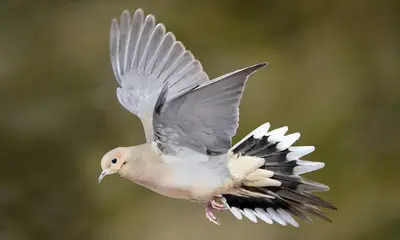
For feeder foods, black-oil sunflower seeds are the single most versatile choice, attracting cardinals, chickadees, nuthatches, finches, and woodpeckers. Nyjer (thistle) seed in tube feeders with small ports brings American Goldfinches and Pine Siskins. Suet cakes attract Downy and Red-bellied Woodpeckers, nuthatches, and chickadees year-round and are especially valuable in winter when insects are unavailable. Peanuts in shell or hulled draw Blue Jays, woodpeckers, and titmice. Platform feeders with millet attract Dark-eyed Juncos, White-throated Sparrows, and Mourning Doves.
Fresh, clean water is as important as food. A simple birdbath placed near shrubs for cover will attract far more species than food alone. In winter, a heated birdbath or a de-icer to keep water open substantially increases its value.
Native plantings provide the most sustainable and ecologically valuable bird habitat. Pennsylvania’s native plants, such as native serviceberries (Amelanchier spp.), viburnums (Viburnum spp.), native oaks (Quercus spp.), and coneflowers (Echinacea spp.), produce insects, fruit, and seeds that feed a far wider range of species than feeders alone can. Removing invasive plants such as Oriental bittersweet, Japanese barberry, and multiflora rose from your property improves habitat quality by allowing native food plants to establish.
Nest boxes benefit cavity-nesting species including Eastern Bluebirds (Sialia sialis), Tree Swallows (Tachycineta bicolor), Carolina Wrens (Thryothorus ludovicianus), and Black-capped Chickadees. Boxes should be placed at appropriate heights, cleaned out each fall, and monitored to manage House Sparrow intrusion.
The Pennsylvania Game Commission recommends cleaning feeders at least twice monthly with a dilute bleach solution (one part bleach to nine parts water) to prevent salmonellosis and other diseases that can spread among concentrations of birds. Feeders should be taken down or cleaned promptly during disease outbreaks in your area. For more tips on attracting birds to your backyard, read our article The Ultimate Guide to Backyard Birding: Tips and Tricks for Bird Enthusiasts.
Conservation: Challenges and Progress
Pennsylvania’s bird populations reflect both the gains achievable through focused conservation and the persistent pressures that continue to threaten species across the state. The Pennsylvania Wildlife Action Plan, updated in 2015, identifies 90 bird species as Species of Greatest Conservation Need (SGCN), nearly a quarter of them forest-interior birds that depend on large, intact woodland blocks (Pennsylvania Game Commission, 2015).
The bald eagle recovery stands as one of the most concrete success stories. From just three active nests documented in the late 1970s, Pennsylvania now supports more than 300 nesting pairs, a transformation driven by the federal ban on DDT in 1972, strict legal protection under the Bald and Golden Eagle Protection Act, and targeted management by the Pennsylvania Game Commission (Pennsylvania Game Commission, 2024). The second Atlas of Breeding Birds recorded a 949 percent increase in breeding Bald Eagles between the first and second atlas periods.
In contrast, several forest-interior neotropical songbirds face continuing challenges. The Cerulean Warbler has declined by an estimated 28 percent in Pennsylvania between the first and second breeding bird atlas periods, and by more than 70 percent continent-wide since Breeding Bird Survey monitoring began (Pennsylvania Game Commission, n.d.). The Wood Thrush and Canada Warbler show negative trends in multiple parts of their ranges. Researchers attribute these declines to a combination of habitat loss and fragmentation on the breeding grounds, Brown-headed Cowbird brood parasitism (Brown-headed Cowbirds, obligate brood parasites, lay their eggs in the nests of more than 220 host species, causing hosts to raise cowbird young at the expense of their own offspring), and extensive deforestation on the South and Central American wintering grounds.
Brown-headed Cowbirds (Molothrus ater) expand their reach wherever forest is fragmented, because they depend on open, edge habitat for foraging but penetrate adjacent forests to parasitize nests. Population declines in cerulean warblers, wood thrushes, and other interior-forest birds are linked to this combination of forest loss and cowbird access (Waterlandlife.org / Pennsylvania Natural Heritage Program, 2023).
Audubon Pennsylvania and the Pennsylvania Game Commission work through the state’s 86 Important Bird Areas to identify, monitor, and protect the most critical habitats in the commonwealth. The Kittatinny Ridge IBA, the largest in the state, is a particular focus of coordinated efforts between Audubon, the Game Commission, the Department of Conservation and Natural Resources (DCNR), and private landowners to maintain the ridge as a functional migratory corridor.
Pennsylvania’s forests also harbor responsibility species, birds whose global range overlaps substantially with the state. Approximately 17 percent of all Scarlet Tanagers in the world breed in Pennsylvania, and approximately 9 percent of all Wood Thrushes breed in the state (Brandywine Conservancy, n.d.). The Gray Catbird (Dumetella carolinensis), a widespread summer resident of shrubby forest edges whose mewing call is one of the signature sounds of Pennsylvania summers, nests in large numbers statewide. The Pine Warbler (Setophaga pinus), a year-round resident in stands of mature pitch pine and other conifers, is among the few warblers that winters regularly in the commonwealth. This concentration of globally significant breeding populations gives Pennsylvania an outsized role in the conservation of these species.
Citizen science tools such as eBird (managed by the Cornell Lab of Ornithology) and the Merlin Bird ID app provide accessible entry points for birders of all experience levels to contribute data and improve their bird identification skills. Pennsylvania’s third Breeding Bird Atlas, running from 2024 to 2029, invites volunteers to survey their local blocks and contribute to a statewide dataset that will track changes in bird populations and distributions over the coming years.
Frequently Asked Questions
What is the most common bird in Pennsylvania?
The Northern Cardinal (Cardinalis cardinalis) appears on the highest percentage of bird checklists submitted in Pennsylvania, appearing on approximately 44 percent of eBird checklists from the state. Year-round residents such as the American Crow, Downy Woodpecker, and Blue Jay are also among the most frequently encountered species by Pennsylvania birdwatchers.
What is Pennsylvania’s state bird?
The Ruffed Grouse (Bonasa umbellus) is Pennsylvania’s official state game bird, designated by the state legislature in 1931. It was previously the state game bird before being elevated to this status, and it remains the only bird symbol officially recognized by Pennsylvania law. The Ruffed Grouse is found in brushy, young-forested habitats throughout the commonwealth.
When do hummingbirds arrive in Pennsylvania?
Ruby-throated Hummingbirds (Archilochus colubris) typically arrive in the southern part of Pennsylvania in late April, with birds reaching the northern part of the state by early May. Males generally precede females by one to two weeks. The Pennsylvania Game Commission notes that arrival timing often coincides with the blooming of wild columbine. Most hummingbirds depart by late September or October, though a small number of stragglers may linger into November.
What is the largest bird in Pennsylvania?
The Bald Eagle (Haliaeetus leucocephalus), with a wingspan reaching up to 244 cm (96 inches) and a body length of up to 102 cm (40 inches), is the largest bird regularly seen in Pennsylvania. The Wild Turkey (Meleagris gallopavo), the heaviest land bird in the state, can weigh up to 11 kg (24 lb) and is also among the most impressive in terms of physical presence.
When is the best time to go birding in Pennsylvania?
Spring migration, roughly from late April through late May, is widely considered the most rewarding period for birding in Pennsylvania. This is when the greatest diversity of species is present simultaneously: neotropical songbirds such as warblers, tanagers, and orioles are arriving in breeding plumage, hummingbirds have returned, and shorebird activity peaks at sites like Presque Isle. Fall raptor migration along the Kittatinny Ridge, particularly in September and October, is equally spectacular for a different reason.
Are Bald Eagles common in Pennsylvania?
Yes, Bald Eagles have become increasingly common in Pennsylvania following decades of successful conservation management. From only three active nests in the late 1970s, the state now supports more than 300 nesting pairs distributed along major rivers, lakes, and reservoirs. They are present year-round and can be found regularly at sites like the Susquehanna River, Lake Erie, and numerous reservoirs. Winter brings additional eagles from farther north, making the cold months an excellent time for eagle observation at known roost sites.
Conclusion
Pennsylvania’s avian richness reflects the convergence of geography, ecology, and conservation effort that few states can match. The Appalachian ridge system channels millions of migrating raptors and songbirds each year; the Lake Erie shoreline concentrates migratory shorebirds and waterfowl; and more than 16 million acres of forest, including the rich hardwood forests of the Allegheny Plateau and the northern tier, provide nesting habitat for some of the most significant breeding populations of neotropical songbirds in the world.
The Keystone State’s birding culture is deep and well-organized, supported by the Pennsylvania Society for Ornithology, local Audubon chapters, the Pennsylvania Game Commission, and a vast network of eBird contributors. Whether you are building bird identification skills at a backyard feeder, consulting a field guide to prepare for a day at Hawk Mountain, or contributing data to Pennsylvania’s ongoing third Breeding Bird Atlas, there is no shortage of opportunity, community, or purpose in the state’s birding life.
Conservation challenges remain real: the Cerulean Warbler, Wood Thrush, Canada Warbler, and a host of other neotropical songbirds face ongoing population declines tied to habitat loss and fragmentation. The work of the Pennsylvania Game Commission, Audubon Pennsylvania, and the state’s 86 Important Bird Areas represents a serious and sustained commitment to reversing these trends.
At the same time, the Bald Eagle recovery offers a clear proof of concept: when the right legal protections, habitat management, and public awareness are combined, Pennsylvania’s birds can recover. That story, repeated in the expansion of breeding Common Ravens, the return of Osprey to many river corridors, and the steady growth of the state’s IBA network, provides a genuine foundation for optimism about the coming years.
Works Cited
Pennsylvania Ornithological Records Committee. (2024). Official list of the birds of Pennsylvania, seventh edition.Pennsylvania Society for Ornithology. https://pabirds.org/porc-pennsylvania-bird-list/
Pennsylvania Game Commission. (2024). Raptor migration. Commonwealth of Pennsylvania. https://www.pa.gov/agencies/pgc/wildlife/wildlife-viewing/birding/raptor-migration
Pennsylvania Game Commission. (2024). Ruffed grouse. Commonwealth of Pennsylvania. https://www.pa.gov/agencies/pgc/wildlife/discover-pa-wildlife/ruffed-grouse
Pennsylvania Game Commission. (2024). Bald eagle watching. Commonwealth of Pennsylvania. https://www.pa.gov/agencies/pgc/wildlife/wildlife-viewing/birding/bald-eagle-watching
Pennsylvania Game Commission. (n.d.). Wood warblers. Commonwealth of Pennsylvania. https://www.pa.gov/agencies/pgc/wildlife/discover-pa-wildlife/wood-warblers
Pennsylvania Game Commission. (n.d.). Birding. Commonwealth of Pennsylvania. https://www.pa.gov/agencies/pgc/wildlife/wildlife-viewing/birding
Pennsylvania Game Commission. (2015). Pennsylvania wildlife action plan. Commonwealth of Pennsylvania. https://www.pa.gov/agencies/pgc/wildlife/wildlife-action-plan
Hawk Mountain Sanctuary. (n.d.). Autumn hawk migration. https://www.hawkmountain.org/visit/events/autumn-hawk-migration
Pennsylvania Department of Conservation and Natural Resources. (n.d.). Wildlife watching at Presque Isle State Park.Commonwealth of Pennsylvania. https://www.pa.gov/agencies/dcnr/recreation/where-to-go/state-parks/find-a-park/presque-isle-state-park/wildlife-watching
Audubon Pennsylvania. (n.d.). Pennsylvania’s Important Bird Area program. https://pa.audubon.org/birds/pennsylvanias-important-bird-area-program
Waterlandlife.org / Pennsylvania Natural Heritage Program. (2023). Forest interior birds: Species at risk in Pennsylvania.https://waterlandlife.org/wildlife-pnhp/species-at-risk-in-pennsylvania/forest-interior-birds/
Brandywine Conservancy and Museum of Art. (n.d.). Protecting Important Bird Areas.https://www.brandywine.org/conservancy/conserve-land/protecting-important-bird-areas
Bird Town Pennsylvania. (2024). Important Bird Area? What’s that? https://birdtownpa.org/important-bird-area/
Susquehanna National Heritage Area. (2024). RiverRoots: Atlantic flyway. https://susqnha.org/riverroots-atlantic-flyway/
Presque Isle Audubon. (n.d.). Festival of the Birds at Presque Isle. https://www.presqueisleaudubon.org/festival-of-the-birds-at-presque-isle/
National Audubon Society. (n.d.). Birding in Pennsylvania. https://www.audubon.org/news/birding-pennsylvania
Cornell Lab of Ornithology. (n.d.). All About Birds: American Goldfinch.https://www.allaboutbirds.org/guide/American_Goldfinch/
Cornell Lab of Ornithology. (n.d.). All About Birds: Northern Cardinal.https://www.allaboutbirds.org/guide/Northern_Cardinal/
Cornell Lab of Ornithology. (n.d.). Birding escapes: Presque Isle, Pennsylvania. All About Birds. https://www.allaboutbirds.org/news/birding-escapes-presque-isle-pennsylvania/