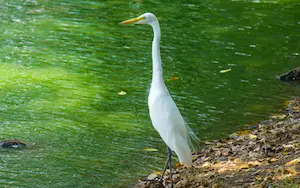
Texas Birds: A Complete Guide to What Lives, Breeds, and Migrates Through the Lone Star State
Texas is home to roughly 677 recorded bird species, the most of any state in the United States, according to the Texas Bird Records Committee of the Texas Ornithological Society (as of August 14, 2025). That total reflects a simple geographic truth: few places on the continent gather as many habitats, and as many migratory routes, in one political boundary.
The state sits at a crossroads where eastern forests meet western deserts and northern temperate grasslands meet subtropical brushlands pushing up from Mexico. It also lies in the heart of the Central Flyway, the great migratory corridor that funnels millions of birds between Canada and the Neotropics each spring and fall. The result, for anyone with a feeder, a pair of binoculars, or a weekend to spare, is a remarkably deep and varied list of birds to find.
Key Takeaways
- The Northern Mockingbird (Mimus polyglottos) has been the official state bird of Texas since 1927.
- Texas has approximately 677 documented bird species as of August 2025, per the Texas Bird Records Committee, the highest state total in the country.
- Texas lies within the Central Flyway, and the upper Gulf Coast also receives birds arriving across the Gulf of Mexico in spring.
- Aransas National Wildlife Refuge on the central coast is the wintering home of the only self-sustaining wild flock of Whooping Cranes (Grus americana).
- The Golden-cheeked Warbler (Setophaga chrysoparia) is the only bird species whose breeding range is entirely within Texas.
Texas Birds at a Glance
The table below lists the species profiled in this guide along with additional notable birds that round out the Texas list. Profiled species are described in full further down; the remaining entries are summarized here for quick reference.
| Species | Scientific name | Size | When present | Where to find | Best feeder food |
|---|---|---|---|---|---|
| Northern Cardinal | Cardinalis cardinalis | 21 to 23 cm (8.3 to 9.1 in) | Resident | Yards, woodland edges statewide | Black oil sunflower, safflower |
| Northern Mockingbird | Mimus polyglottos | 21 to 26 cm (8.3 to 10.2 in) | Resident | Open ground, hedges statewide | Suet, fruit, mealworms |
| Carolina Wren | Thryothorus ludovicianus | 12.5 to 14 cm (4.9 to 5.5 in) | Resident | Brushy yards, east and central Texas | Suet, mealworms, peanuts |
| House Finch | Haemorhous mexicanus | 13 to 14 cm (5.1 to 5.5 in) | Resident | Towns and suburbs statewide | Sunflower, nyjer |
| White-winged Dove | Zenaida asiatica | about 29 cm (11 in) | Resident, expanding | Cities, south and central Texas | Cracked corn, millet, sunflower |
| Blue Jay | Cyanocitta cristata | 25 to 30 cm (9.8 to 11.8 in) | Resident | Woodlands, east and central Texas | Peanuts, sunflower, corn |
| Golden-fronted Woodpecker | Melanerpes aurifrons | about 24 cm (9.4 in) | Resident | Mesquite and oak, central and south Texas | Suet, sunflower, fruit |
| Black-crested Titmouse | Baeolophus atricristatus | 14 to 16 cm (5.5 to 6.3 in) | Resident | Hill Country and central Texas | Sunflower, peanuts, suet |
| Red-tailed Hawk | Buteo jamaicensis | 45 to 65 cm (17.7 to 25.6 in) | Resident | Roadsides, poles, open country statewide | Not a feeder bird |
| Great Blue Heron | Ardea herodias | 97 to 137 cm (38 to 54 in) | Resident | Ponds, rivers, coastal flats statewide | Not a feeder bird |
| Scissor-tailed Flycatcher | Tyrannus forficatus | 22 to 38 cm (8.7 to 15 in) with tail | Spring to fall | Fences and wires, prairies statewide | Not a feeder bird |
| Painted Bunting | Passerina ciris | 12 to 14 cm (4.7 to 5.5 in) | Spring to fall | Brushy edges, central and east Texas | White millet, sunflower |
| Green Jay | Cyanocorax yncas | about 27 cm (11 in) | Resident | Brushlands, Rio Grande Valley | Sunflower, peanuts, fruit |
| Great Kiskadee | Pitangus sulphuratus | 25 to 28 cm (9.8 to 11 in) | Resident | Wooded waterways, south Texas | Fruit, suet |
| Ruby-throated Hummingbird | Archilochus colubris | 7 to 9 cm (2.8 to 3.5 in) | Spring to fall, some winter | Gardens, east Texas, coast | Sugar water (four parts water to one part sugar) |
| Yellow-rumped Warbler | Setophaga coronata | 12 to 14 cm (4.7 to 5.5 in) | Winter | Woodlands and yards statewide | Suet, fruit |
| Black-chinned Hummingbird | Archilochus alexandri | 8 to 9 cm (3.1 to 3.5 in) | Spring to fall | Central and west Texas gardens | Sugar water |
| Rufous Hummingbird | Selasphorus rufus | 7 to 9 cm (2.8 to 3.5 in) | Migration and winter | Coast and east, often at feeders | Sugar water |
| Turkey Vulture | Cathartes aura | 64 to 81 cm (25 to 32 in) | Resident and migrant | Soaring over open country statewide | Not a feeder bird |
| Black Vulture | Coragyps atratus | 56 to 74 cm (22 to 29 in) | Resident | Soaring, often near towns statewide | Not a feeder bird |
| Crested Caracara | Caracara plancus | 50 to 65 cm (19.7 to 25.6 in) | Resident | Open brush and ranchland, south Texas | Not a feeder bird |
| American Goldfinch | Spinus tristis | 11 to 13 cm (4.3 to 5.1 in) | Winter | Yards and weedy fields statewide | Nyjer, sunflower chips |
| Cedar Waxwing | Bombycilla cedrorum | 14 to 17 cm (5.5 to 6.7 in) | Winter | Fruiting trees statewide | Fruit, berries |
| Dark-eyed Junco | Junco hyemalis | 14 to 16 cm (5.5 to 6.3 in) | Winter | Ground under feeders, north and central | Millet, cracked corn |
| Ladder-backed Woodpecker | Dryobates scalaris | 16 to 19 cm (6.3 to 7.5 in) | Resident | Mesquite and desert scrub, central and west | Suet, sunflower |
| Downy Woodpecker | Dryobates pubescens | 14 to 17 cm (5.5 to 6.7 in) | Resident | Woodlands and yards, east and central | Suet, sunflower |
| Red-bellied Woodpecker | Melanerpes carolinus | 23 to 27 cm (9.1 to 10.6 in) | Resident | Woodlands, east and central Texas | Suet, sunflower, peanuts |
| Northern Flicker | Colaptes auratus | 28 to 36 cm (11 to 14 in) | Mostly winter | Lawns and open woods statewide | Suet, ground seed |
| Sandhill Crane | Antigone canadensis | 80 to 120 cm (31 to 47 in) | Winter | Playas and fields, Panhandle and coast | Not a feeder bird |
| Roseate Spoonbill | Platalea ajaja | 71 to 86 cm (28 to 34 in) | Mostly resident | Coastal marshes and flats | Not a feeder bird |
| Green Kingfisher | Chloroceryle americana | 19 to 20 cm (7.5 to 7.9 in) | Resident | Clear streams, south and central Texas | Not a feeder bird |
| Purple Gallinule | Porphyrio martinica | 26 to 37 cm (10 to 15 in) | Mostly summer | Freshwater marshes, east and coast | Not a feeder bird |
| Brown-headed Cowbird | Molothrus ater | 19 to 22 cm (7.5 to 8.7 in) | Resident | Fields and feedlots statewide | Mixed seed on ground |
| Whooping Crane | Grus americana | about 1.5 m (5 ft) tall | Winter | Aransas area, central coast | Not a feeder bird |
| Golden-cheeked Warbler | Setophaga chrysoparia | 11 to 13 cm (4.3 to 5.1 in) | Spring to summer | Juniper and oak, Hill Country | Not a feeder bird |
| Black-capped Vireo | Vireo atricapilla | 11 to 12 cm (4.3 to 4.7 in) | Spring to summer | Shrubby canyons, Edwards Plateau | Not a feeder bird |
Why Texas Holds So Many Birds: Geography and the Central Flyway
Texas owes its avian diversity to scale and position. The Texas Parks and Wildlife Department divides the state into ten natural regions, including the Piney Woods of the east, the Gulf Prairies and marshes, the Post Oak Savannah, the Blackland Prairies, the Cross Timbers, the South Texas Plains, the Edwards Plateau, the Rolling Plains, the High Plains, and the Trans-Pecos. Annual rainfall ranges from about 20 cm (8 in) in the far western deserts to roughly 140 cm (56 in) in the eastern swamps, a gradient that supports an extraordinary spread of plant communities and, with them, birds.
This is, in the department’s framing, a crossroads where eastern habitats meet western ones and southern subtropical habitats meet northern temperate ones. A birder can find eastern woodland species such as the Blue Jay in east Texas, desert specialists in the Trans-Pecos, and tropical species such as the Green Jay and Great Kiskadee in the Rio Grande Valley, all without leaving the state.
Layered on top of this geography is migration. Texas lies in the center of the Central Flyway, one of four major North American migratory corridors (Texas Parks and Wildlife Department). During spring, many Neotropical migrants cross the Gulf of Mexico and make their first landfall along the upper Texas coast, while birds following the Mississippi and Atlantic flyways may turn west along the Gulf as well. Fall migration reverses the flow, sending raptors, shorebirds, and songbirds south through the state. For much of the year, then, the Texas bird list is not static. It changes week to week as residents are joined by, or replaced by, travelers.
The State Bird of Texas: Northern Mockingbird
The state bird of Texas is the Northern Mockingbird (Mimus polyglottos), designated in 1927 at the request of the Texas Federation of Women’s Clubs. It was one of the earliest official state birds adopted in the country.
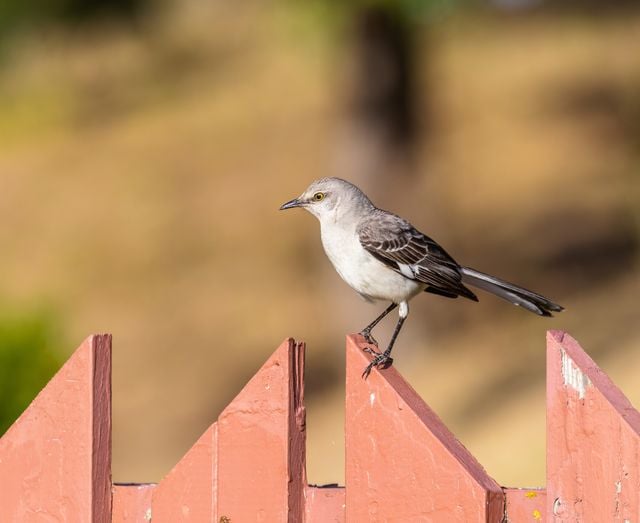
The Northern Mockingbird is a slim, long-tailed gray songbird measuring 21 to 26 cm (8.3 to 10.2 in) in length, with whitish underparts and bold white wing patches that flash as it flies. It is found across the entire state in nearly every season, in cities and on the open prairie alike, which is precisely the quality the 1927 legislature praised when it called the bird a fighter for the protection of its home.
Its signature trait is vocal mimicry. A single male may learn a large repertoire of phrases, borrowing the songs of other birds and weaving them into long, repeating sequences, often well into the night during the breeding season. Mockingbirds are fiercely territorial, readily chasing larger birds and even cats away from a nest. They favor open ground with scattered shrubs and fruiting plants, and they will visit yards for suet, fruit, and mealworms more readily than for seed.
Common Backyard Birds
These are the species most Texans encounter at feeders and in yards, the backbone of the state’s everyday birdlife.
Northern Cardinal (Cardinalis cardinalis)

The Northern Cardinal is among the most recognized backyard birds in Texas, present statewide as a year-round resident. The male is brilliant red with a black face mask and a tall crest; the female is a warm buff-brown with red highlights and the same crest and heavy orange bill. Adults measure 21 to 23 cm (8.3 to 9.1 in).
Cardinals favor woodland edges, brushy thickets, and suburban yards with dense cover for nesting. They feed heavily on seeds and fruit, using that strong conical bill to crack hard shells, and add insects during the breeding season. To attract cardinals, offer black oil sunflower seed or safflower on a platform or hopper feeder, and keep shrubby cover nearby. Their clear, whistled song carries well, and both sexes sing, which is somewhat unusual among North American songbirds.
Carolina Wren (Thryothorus ludovicianus)
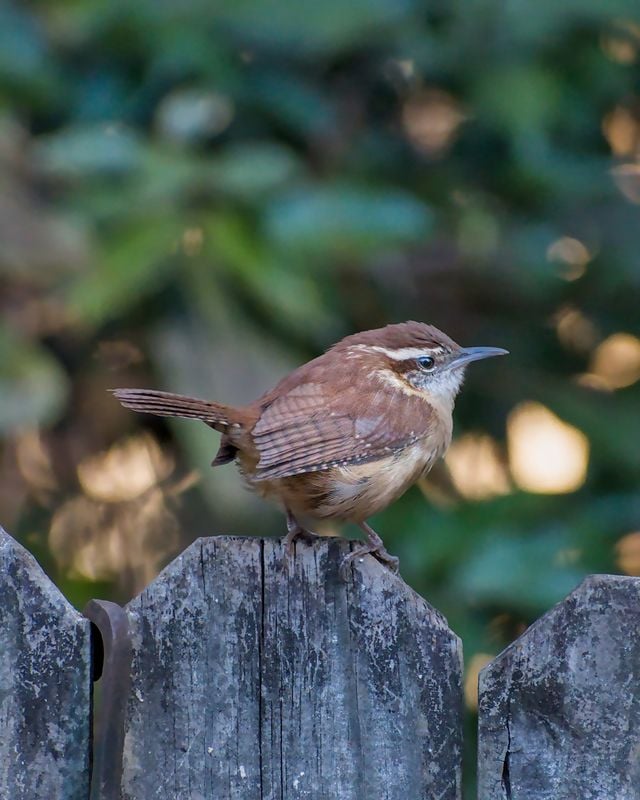
The Carolina Wren is a small, energetic, rich rufous-brown bird with a bold white eyebrow stripe and a tail often held cocked upward. It measures 12.5 to 14 cm (4.9 to 5.5 in) and is a resident across east and central Texas, expanding where brushy cover allows.
For its size, the Carolina Wren is remarkably loud. Males deliver a ringing, repeated phrase often rendered as teakettle-teakettle-teakettle. These wrens prefer tangled vegetation, brush piles, and yards with dense plantings, where they probe bark and leaf litter for insects and spiders. They nest in cavities and crevices, including hanging baskets, mailboxes, and other nooks around houses. At feeders they take suet, mealworms, and peanuts more often than seed, and they will use a brush pile or native shrubs as foraging habitat year-round.
House Finch (Haemorhous mexicanus)
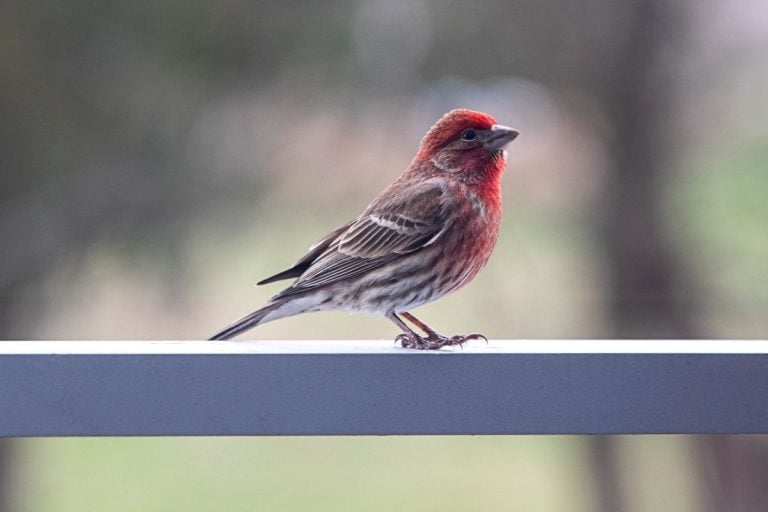
The House Finch is a small, streaky brown finch in which the male shows variable red on the head, throat, and chest. Adults measure 13 to 14 cm (5.1 to 5.5 in). It is a common resident of towns and suburbs statewide and is among the birds most likely to appear first at a new feeder.
House Finches are sociable and often arrive in small flocks. They eat seeds, buds, and fruit, and the red pigment in males comes from carotenoids in their diet, so color intensity varies with food. To attract them, offer sunflower seed or nyjer at tube or hopper feeders. Because House Finches gather in numbers and can be prone to a transmissible eye disease, clean feeders regularly to reduce the spread of illness, a point the next section returns to in more detail.
White-winged Dove (Zenaida asiatica)
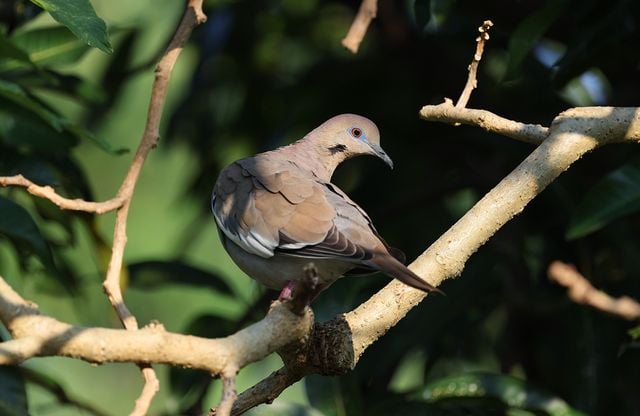
The White-winged Dove is a plump, gray-brown dove with a bold white stripe along the closed wing and a small blue eye-ring. It measures about 29 cm (11 in). Once concentrated in the Lower Rio Grande Valley, the species has expanded its range markedly in recent decades, especially in urban areas such as San Antonio and Austin.
White-winged Doves give a hooting, rhythmic call often likened to the phrase who cooks for you. They feed on seeds, grains, and fruit, and readily visit platform feeders and the ground beneath them for cracked corn, millet, and sunflower. Their spread into Texas cities makes them one of the more visible examples of a southern species moving north, and they are now a familiar sight on power lines and rooftops across much of the state.
Blue Jay (Cyanocitta cristata)

The Blue Jay is a bold, crested blue-and-white bird with black barring on the wings and tail and a black necklace across the chest. It measures 25 to 30 cm (9.8 to 11.8 in) and is a resident of woodlands, parks, and yards across east and central Texas, becoming scarcer to the west.
Blue Jays are loud, intelligent, and social. They cache acorns and other nuts, an activity that helps disperse oak seeds, and they are quick to announce hawks and owls with harsh alarm calls. They sometimes imitate the calls of hawks, which can momentarily clear a feeder of smaller birds. To attract Blue Jays, offer whole peanuts, sunflower seed, or cracked corn on a sturdy platform. In the brushlands of south Texas, the Blue Jay is largely replaced by its tropical relative, the Green Jay.
Golden-fronted Woodpecker (Melanerpes aurifrons)
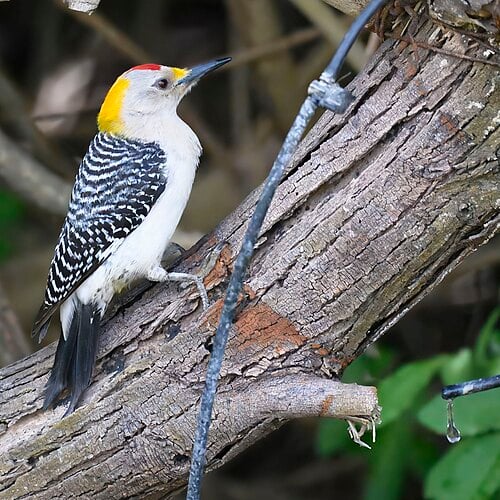
The Golden-fronted Woodpecker is a clean, barred black-and-white woodpecker with a golden-orange nape and, in males, a red crown patch. It measures about 24 cm (9.4 in) and is a characteristic resident of central and south Texas, favoring mesquite, oak, and riparian woodland.
This species largely replaces the similar Red-bellied Woodpecker across much of central and southern Texas, and the two overlap in a band where care is needed to tell them apart. Golden-fronted Woodpeckers feed on insects, fruit, and seeds, and they will come to suet, sunflower, and fruit at feeders. They are vocal and conspicuous, often calling a rolling churr from a high snag. Their presence is one of the clearest signs that a birder has crossed from the eastern woodlands into the drier, brushier country of central and south Texas.
Black-crested Titmouse (Baeolophus atricristatus)
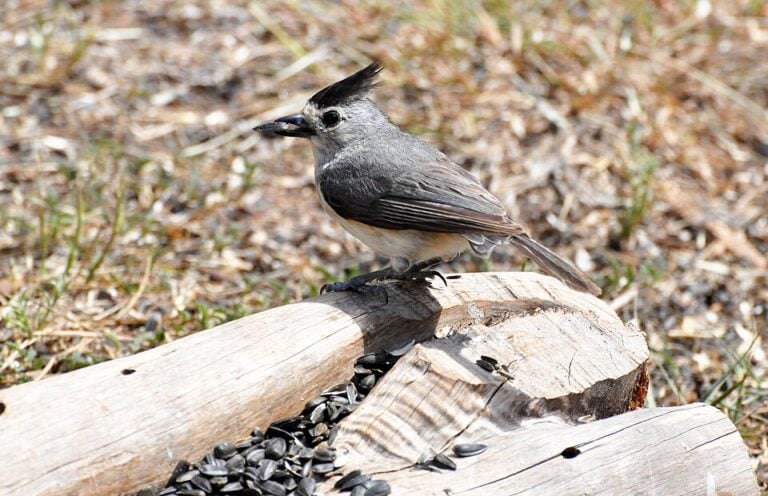
The Black-crested Titmouse is a small, active gray bird with a pointed black crest and a pale forehead, measuring 14 to 16 cm (5.5 to 6.3 in). It is a resident of the Texas Hill Country and much of central and southern Texas, where it replaces the Tufted Titmouse of the eastern part of the state.
These titmice travel in pairs and small family groups and frequently join mixed flocks with chickadees and warblers in winter. They are confiding at feeders, taking single seeds and flying off to wedge and hammer them open. Offer sunflower seed, peanuts, and suet to draw them in, and provide nest boxes, which they will readily use. The clean swap from black-crested to tufted as one travels east makes this small bird a useful regional marker for Texas birders.
Birds of Prey
From roadside hawks to soaring vultures, Texas raptors are among the most visible large birds in the state.
Red-tailed Hawk (Buteo jamaicensis)

The Red-tailed Hawk is the most familiar large hawk in Texas, a broad-winged raptor of open country seen perched on poles, fences, and dead trees along nearly every rural road. Adults measure 45 to 65 cm (17.7 to 25.6 in) in length with a wingspan of roughly 1.1 to 1.3 m (3.7 to 4.4 ft). Most adults show the brick-red upper tail that gives the species its name, though plumage varies widely.
Red-tailed Hawks hunt rodents, rabbits, reptiles, and other small animals, often hunting from a perch and dropping onto prey. They are present year-round across the state and are joined in winter by migrants from the north. Their slow, soaring flight and rising, raspy scream are widely recognized, and the call is so evocative that it is frequently dubbed over footage of other raptors in film and television.
Two scavenging birds share the Texas skies and are easily told apart in flight: the Turkey Vulture (Cathartes aura), which holds its wings in a shallow V and teeters as it soars, and the Black Vulture (Coragyps atratus), which holds flatter wings, shows white wingtips, and flaps more often. In the open brush and ranchland of south Texas, the Crested Caracara (Caracara plancus), a long-legged member of the falcon family, is often seen on the ground or perched low; it is known in regional folklore as the Mexican eagle.
Water and Wetland Birds
Texas wetlands, from coastal marshes to inland playas, support a deep roster of waders, waterfowl, and shorebirds. Many are best explored in a dedicated coastal or wetland guide, but a few stand out.
Great Blue Heron (Ardea herodias)
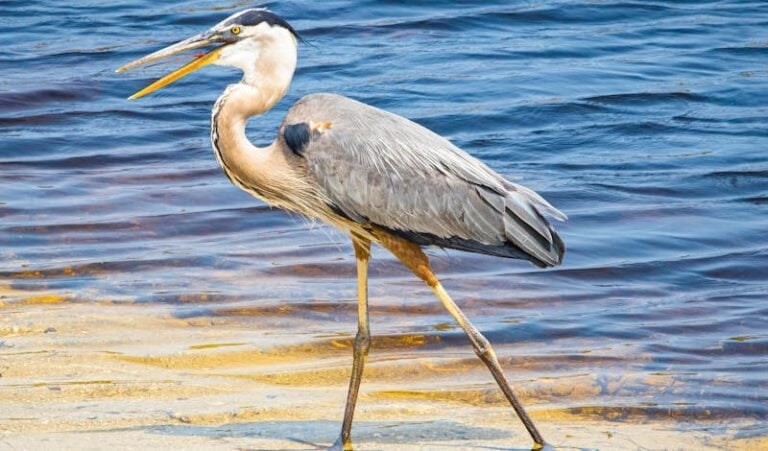
The Great Blue Heron is the largest and most widespread heron in Texas, a tall, long-necked wading bird of blue-gray plumage that stands patiently at the edges of ponds, rivers, marshes, and coastal flats. It measures 97 to 137 cm (38 to 54 in) in length and is a resident statewide wherever shallow water and fish are found.
Great Blue Herons hunt by standing or stalking slowly, then striking with a fast thrust of the bill to seize fish, frogs, and other prey. In flight they fold the neck into an S shape and trail their long legs behind. They nest colonially in tall trees in groups called rookeries, sometimes alongside egrets and other waders. Though tied to water rather than feeders, the Great Blue Heron is one of the large birds most Texans can find close to home.
The Roseate Spoonbill (Platalea ajaja), a flamingo-pink wader with a spatulate bill, feeds in coastal shallows by sweeping its bill side to side. The Sandhill Crane (Antigone canadensis) winters in large numbers on Panhandle playas and along the coast, its rolling bugle carrying for great distances. In the Rio Grande Valley and Hill Country streams, the small Green Kingfisher (Chloroceryle americana) hunts from low perches over clear water, while freshwater marshes in the east and along the coast host the vividly colored Purple Gallinule (Porphyrio martinica), which walks across floating vegetation on long toes. The flagship wetland bird of the state, the Whooping Crane, is covered in the conservation section below.
Woodland and Grassland Specialties
These species give Texas birding much of its distinct character, including several tropical birds that reach the United States almost nowhere else.
Scissor-tailed Flycatcher (Tyrannus forficatus)
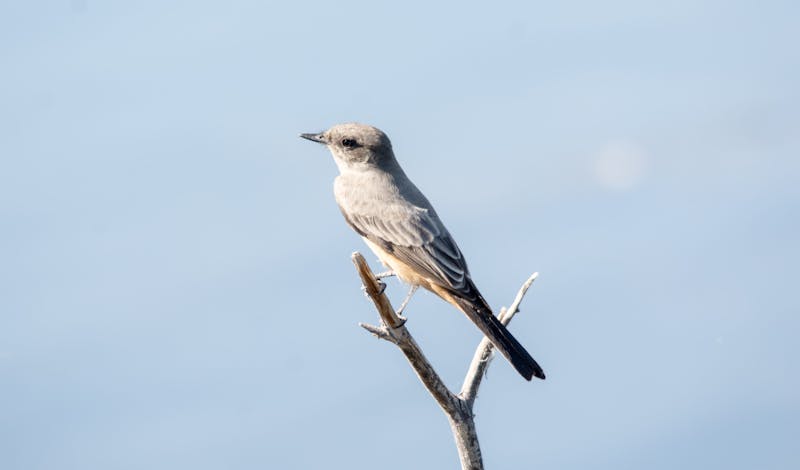
The Scissor-tailed Flycatcher is one of the most elegant and recognizable birds of the Texas warm season, a pale gray flycatcher with salmon-pink flanks and a dramatically long, forked tail. Including the tail streamers, a male can measure up to about 38 cm (15 in). It arrives in spring and departs in fall, when birds gather in large pre-migration flocks.
These flycatchers favor open prairies, ranchland, and roadsides, where they perch on fences and wires and sally out to catch insects in midair, the long tail opening and closing like scissors. They are widespread across the state in the breeding season and are a signature sight of the Texas grasslands. Though they do not visit feeders, a yard near open country with scattered perches and few pesticides can host them through the warmer months.
Painted Bunting (Passerina ciris)

The male Painted Bunting is often called one of the most colorful birds in North America, with a blue head, red underparts, and a green back. The female and immature birds are a uniform bright green, unlike any other small finch in the state. Adults measure 12 to 14 cm (4.7 to 5.5 in). Painted Buntings are spring-to-fall residents of brushy edges across central and eastern Texas.
Despite the male’s brilliance, Painted Buntings can be surprisingly hard to see, preferring to feed and sing from within dense cover. They eat seeds and insects and will visit feeders stocked with white millet, especially where brushy habitat is close by. The species has experienced long-term declines in parts of its range, which makes protecting the scrubby habitat it depends on a meaningful local contribution to its future.
Green Jay (Cyanocorax yncas)
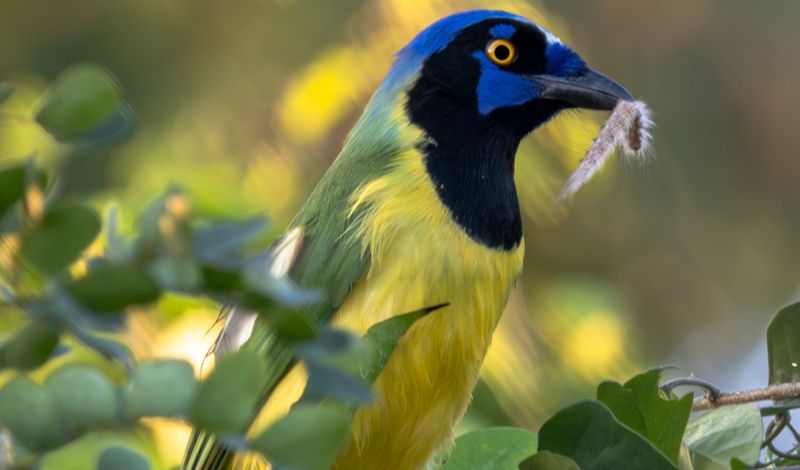
The Green Jay is a tropical jay that reaches the United States only in south Texas, a striking bird with a green body, blue-and-black head, and yellow outer tail feathers. It measures about 27 cm (11 in) and is a resident of the brushlands and woodlands of the Rio Grande Valley, where it is a highlight for visiting birders.
Green Jays move in noisy family groups and give an extraordinary variety of calls, including rattles, clicks, and an alarm-like ringing note. They feed on insects, seeds, fruit, and acorns, and they readily visit feeders in the Valley for sunflower, peanuts, and fruit. Along with the Great Kiskadee, the Green Jay is one of the species that draws birders from across the country to the southern tip of Texas, and it anchors much of the region’s nature tourism.
Great Kiskadee (Pitangus sulphuratus)
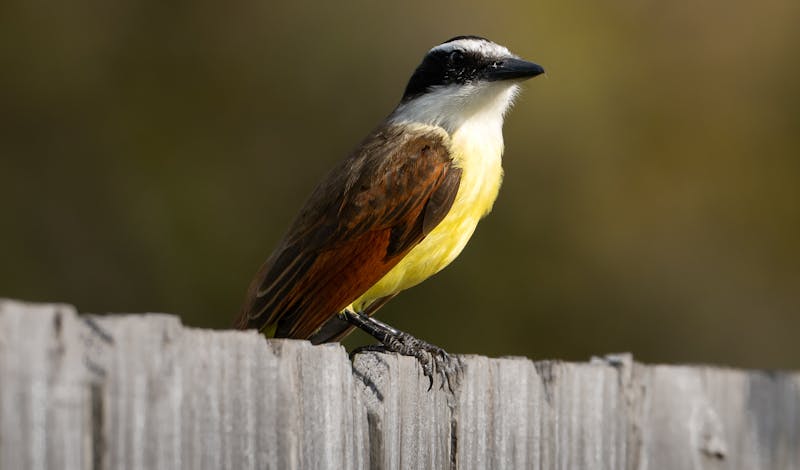
The Great Kiskadee is a large, boldly patterned flycatcher with a bright yellow belly, rufous wings, and a black-and-white striped head. It measures 25 to 28 cm (9.8 to 11 in) and is a resident of wooded waterways and brushlands in south Texas, particularly the Rio Grande Valley.
The bird is named for its loud, ringing call, often written as kis-ka-dee, which announces its presence long before it is seen. Unusually for a flycatcher, the Great Kiskadee is a generalist that catches insects in the air, plucks fruit, and even plunges into shallow water for small fish. It is conspicuous, vocal, and unafraid of people, making it one of the easier south Texas specialties to find. Like the Green Jay, it is a tropical species at the northern edge of its range here.
Notable Migrants
Migration transforms the Texas bird list each spring and fall. Two groups stand out for backyard birders: hummingbirds and wintering warblers.
Ruby-throated Hummingbird (Archilochus colubris)
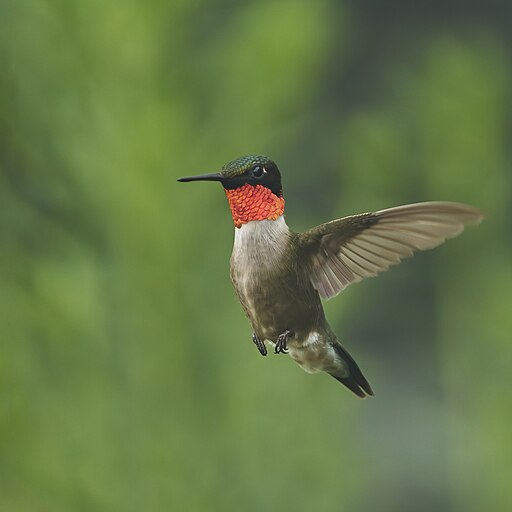
The Ruby-throated Hummingbird is the common breeding and migrant hummingbird of eastern Texas, a tiny green-backed bird in which the male shows a brilliant red throat in good light. It measures 7 to 9 cm (2.8 to 3.5 in). First arrivals reach the Texas coast in late winter, and the species moves through and breeds across the eastern part of the state before heading south again in fall.
Ruby-throated Hummingbirds feed on nectar and small insects and are fiercely territorial at flowers and feeders. To attract them, hang a clean nectar feeder filled with a solution of four parts water to one part white sugar, with no dye, and refresh it every few days in hot weather. In central and western Texas, the similar Black-chinned Hummingbird is the more common breeder, and along the coast and east, the Rufous Hummingbird appears in migration and even winters in some yards.
Yellow-rumped Warbler (Setophaga coronata)

The Yellow-rumped Warbler is the most abundant and widespread wintering warbler in Texas, a small, active songbird best identified in winter by the bright yellow patch on its rump. It measures 12 to 14 cm (4.7 to 5.5 in) and is present across the state from fall through spring, often in loose flocks.
Unlike most warblers, which leave the United States in winter, the Yellow-rumped Warbler can digest the waxy fruit of bayberry and similar plants, which allows it to winter much farther north. In Texas it forages in woodlands, brushy edges, and yards, gleaning insects and taking berries, and it will sometimes visit suet and fruit at feeders. Its abundance and adaptability make it a reliable winter companion for Texas birders and a useful species for learning to track seasonal change in the local bird community.
Look-Alike Comparisons
A few Texas species pairs are commonly confused. The table below highlights the field marks that separate them.
| Species pair | Quick distinction |
|---|---|
| Turkey Vulture vs Black Vulture | The Turkey Vulture has a red head, long wings held in a shallow V, and a teetering, rocking flight; the Black Vulture has a gray head, broader wings held flat, white wingtips, and faster, flapping flight. |
| Golden-fronted Woodpecker vs Red-bellied Woodpecker | The Golden-fronted has a golden-orange nape and a clean white rump and is the expected bird in central and south Texas; the Red-bellied has a red nape extending toward the crown and barred central tail feathers and dominates farther east. |
| Ruby-throated Hummingbird vs Black-chinned Hummingbird | The male Ruby-throated shows a ruby-red throat, while the male Black-chinned shows a black throat with a thin violet base; the two also separate largely by range, with Ruby-throated common in the east and Black-chinned common in central and west Texas. |
What to See When: A Seasonal Guide
Texas birding rewards attention to the calendar. The table below summarizes the broad seasonal patterns, recognizing that timing shifts with latitude and weather across so large a state.
| Season | What to look for |
|---|---|
| Spring (March to May) | Returning migrants cross the Gulf and arrive along the coast; hummingbirds and flycatchers return; Hill Country specialties such as the Golden-cheeked Warbler sing on territory. |
| Summer (June to August) | Breeding residents and summer visitors are active; Painted Buntings and Scissor-tailed Flycatchers are widespread; south Texas specialties are present year-round. |
| Fall (September to November) | Fall migration sends raptors, shorebirds, and songbirds south; hawk flights build along the coast; Scissor-tailed Flycatchers gather in flocks before departing. |
| Winter (December to February) | Wintering sparrows, waterfowl, and warblers arrive; Whooping Cranes and Sandhill Cranes settle on the coast and Panhandle; Yellow-rumped Warblers and American Goldfinches are common in yards. |
Notable Birding Locations
Texas offers an exceptional range of public birding sites, and the Texas Parks and Wildlife Department maintains a network of driving routes through the Great Texas Wildlife Trails to connect them. A few stand out.
Aransas National Wildlife Refuge, on the central coast near Austwell, was established in 1937 and now protects more than 115,000 acres (about 465 square kilometers) of coastal habitat. It is best known as the wintering home of the last wild migratory flock of Whooping Cranes and attracts more than 400 bird species (U.S. Fish and Wildlife Service).
Bentsen-Rio Grande Valley State Park and the broader World Birding Center network in the Lower Rio Grande Valley are the premier places in the United States to find tropical specialties such as the Green Jay, Great Kiskadee, and Green Kingfisher.
The Edwards Plateau and Texas Hill Country, including Balcones Canyonlands National Wildlife Refuge near Austin, hold the state’s two breeding specialties of conservation note, the Golden-cheeked Warbler and the Black-capped Vireo.
On the upper Texas coast, the four High Island sanctuaries owned by Houston Audubon are world famous for spring migration. Peak season runs from mid-March to mid-May, and the largest numbers occur during a fallout, when a fast-moving cold front grounds exhausted Gulf-crossing songbirds in the coastal woodlots; nearly 400 species have been recorded on the sanctuaries (Houston Audubon). The nearby Bolivar Peninsula adds shorebirds and waders.
In the Trans-Pecos, Big Bend National Park anchors the desert and mountain birding of far west Texas. More than 450 bird species have been recorded there, more than at any other national park in the country, and the Chisos Mountains, a forested sky island rising from the Chihuahuan Desert, are the only place in the United States where the Colima Warbler nests (National Park Service).
How to Attract Birds to Your Texas Yard
A productive bird yard rests on four elements: food, water, cover, and safe management. Match feeders to the birds you hope to draw. Black oil sunflower seed appeals to the widest range of species, including cardinals, finches, titmice, and chickadees; nyjer draws goldfinches; suet brings woodpeckers and wrens; and white millet on or near the ground suits doves, sparrows, and buntings. For hummingbirds, a nectar feeder filled with four parts water to one part white sugar, with no red dye, is all that is needed.
Water is often the single most effective addition to a yard, since it attracts species that never visit feeders. A shallow bath or a small pond with moving water will pull in migrants and residents alike. Native plantings extend the benefit further: berry-producing shrubs, seed-bearing wildflowers, and nectar plants feed birds directly and support the insects that nearly all species rely on to raise young. The Texas Parks and Wildlife Department promotes this approach through its Texas Wildscapes program, which encourages landowners to create habitat with native vegetation.
Safe management matters as much as generosity. Clean feeders and birdbaths regularly with a dilute bleach solution and let them dry, since dirty feeders can spread disease among crowded birds such as House Finches. Refresh hummingbird nectar every few days in hot weather. Position feeders either very close to windows or well away from them to reduce collisions, and keep cats indoors to protect the birds a yard attracts. Nest boxes sized for chickadees, titmice, and wrens add nesting opportunities where natural cavities are scarce.
Conservation in Texas: Recovery and Vigilance
Texas hosts some of the most closely watched conservation stories in North American birding, and they cut in different directions, a reminder that recovery is possible but never guaranteed.
The Whooping Crane (Grus americana), North America’s tallest bird at about 1.5 m (5 ft), offers the most dramatic example. The only self-sustaining wild migratory flock winters at and around Aransas National Wildlife Refuge after breeding in Canada’s Wood Buffalo National Park, some 4,000 km (about 2,500 mi) to the north. The U.S. Fish and Wildlife Service estimated a record 557 cranes in the 2024 to 2025 winter survey, including at least 41 juveniles, the first time the Aransas-Wood Buffalo population was estimated to exceed 550 birds (U.S. Fish and Wildlife Service, 2025). That figure is remarkable given that the population fell to roughly 14 to 15 adults in the early 1940s, and it reflects decades of habitat protection and cross-border cooperation.
The Black-capped Vireo (Vireo atricapilla), a small songbird of shrubby canyons on the Edwards Plateau, shows a similar arc. Listed as endangered in 1987 when only a few hundred birds were known, it recovered through habitat management, prescribed fire, and control of the nest-parasitizing Brown-headed Cowbird, and it was removed from the endangered species list in 2018. Surveys since have estimated more than 22,000 birds across its range (U.S. Fish and Wildlife Service).
By contrast, the Golden-cheeked Warbler (Setophaga chrysoparia) remains endangered. It is the only bird species whose breeding range lies entirely within Texas, nesting solely in the mature juniper-and-oak woodlands of the Hill Country, where it strips bark from Ashe juniper to build its nest (U.S. Fish and Wildlife Service). Listed in 1990, it continues to lose habitat to the rapid growth of the Austin and San Antonio region. Its situation underscores why protecting native woodland on the Edwards Plateau remains an active conservation priority rather than a finished task.
Organizations such as the Texas Ornithological Society, local Audubon chapters including Travis Audubon, The Nature Conservancy, and the American Birding Association support this work through monitoring, habitat protection, and education. For backyard birders, the most direct contributions are local: native plantings, clean feeders, and support for the parks and refuges that hold the state’s most vulnerable species.
Conclusion
Texas earns its standing as the most bird-rich state in the country through sheer breadth, a meeting place of eastern woodlands, western deserts, northern grasslands, and subtropical brush, all knit together by the Central Flyway. That diversity is visible at every scale, from the Northern Cardinal at a suburban feeder to the Whooping Crane wintering on the central coast, and from the tropical Green Jay of the Rio Grande Valley to the Golden-cheeked Warbler singing in a Hill Country canyon.
For the reader starting out, the path forward is straightforward: learn the common backyard birds first, watch how the list shifts with the seasons, and let curiosity pull you toward the state’s remarkable specialties and hotspots. Deeper guides to the state’s owls, hummingbirds, water birds, and birds by color and region build on this overview, and the story of the Northern Mockingbird, the state bird since 1927, is a natural next step.
Frequently Asked Questions
What is the most common backyard bird in Texas?
Several species compete for the title depending on region and season, but the Northern Cardinal, Northern Mockingbird, House Finch, and White-winged Dove are among the birds most consistently reported at Texas yards and feeders statewide. In winter, Yellow-rumped Warblers and American Goldfinches become common additions. Regional differences are real, so a yard in the Rio Grande Valley will host very different common birds than one in the Panhandle.
What is the state bird of Texas?
The state bird of Texas is the Northern Mockingbird (Mimus polyglottos), designated in 1927. It is a gray, long-tailed songbird known for mimicking the songs of other birds and for being found throughout the state in all seasons. Texas was one of the first states to adopt an official state bird.
When do hummingbirds arrive in Texas?
Hummingbirds typically return to Texas in late winter and early spring. The first arrivals reach the upper Texas coast in late February and early March, and hummingbird migration continues through May as birds move north and inland (Houston Audubon). To be ready, clean and hang nectar feeders by late February in southern and coastal areas, filled with a solution of four parts water to one part white sugar.
What is the largest bird in Texas?
The Whooping Crane (Grus americana) is the tallest bird in Texas and in North America, standing about 1.5 m (5 ft) tall with a wingspan near 2.1 m (7 ft). It is present in the state in winter, primarily around Aransas National Wildlife Refuge on the central coast. The Great Blue Heron is a much more widespread tall wading bird that Texans can find near water year-round.
What tropical birds can be seen in Texas?
South Texas, especially the Lower Rio Grande Valley, hosts tropical species that reach the United States almost nowhere else, including the Green Jay (Cyanocorax yncas) and the Great Kiskadee (Pitangus sulphuratus). These birds, along with the Green Kingfisher and many others, make the Valley one of the most sought-after birding destinations in the country.
What is the rarest bird in Texas?
Among regularly occurring species, the Golden-cheeked Warbler (Setophaga chrysoparia) and the wintering Whooping Crane (Grus americana) are the most notable rare and protected birds. The Golden-cheeked Warbler is endangered and breeds only in the Texas Hill Country, while the Whooping Crane belongs to a small, closely monitored wild flock that winters on the central coast.
Works Cited
- Texas Bird Records Committee, Texas Ornithological Society. Texas State List. https://www.texasbirdrecordscommittee.org/texas-state-list
- Texas Bird Records Committee, Texas Ornithological Society. Home (running state list tally). https://www.texasbirdrecordscommittee.org/
- Texas Ornithological Society. Texas Bird Records Committee. https://www.texasbirds.org/birding-resources/texas-bird-records-committee/
- Texas Parks and Wildlife Department. Texas Ecoregions. https://tpwd.texas.gov/education/hunter-education/online-course/wildlife-conservation/texas-ecoregions
- Texas Parks and Wildlife Department. Migratory Flyways of North America. https://tpwd.texas.gov/huntwild/wild/birding/migration/flyways/
- Shackelford, C. E., Rozenburg, E. R., Hunter, W. C., and Lockwood, M. W. Migration and the Migratory Birds of Texas. Texas Parks and Wildlife Department. https://tpwd.texas.gov/publications/pwdpubs/media/pwd_bk_w7000_0511.pdf
- Texas Parks and Wildlife Department. Great Texas Wildlife Trails. https://tpwd.texas.gov/huntwild/wildlife/wildlife-trails
- U.S. Fish and Wildlife Service. 2025 Wintering Whooping Crane Count. https://www.fws.gov/press-release/2025-06/2025-wintering-whooping-crane-count
- U.S. Fish and Wildlife Service. Aransas National Wildlife Refuge. https://www.fws.gov/refuge/aransas
- Houston Audubon. High Island Sanctuaries: Visitor Information. https://houstonaudubon.org/conservation/sanctuaries/high-island/visitor.html
- Houston Audubon. Spring Migration. https://houstonaudubon.org/programs/birding/resources/spring-migration.html
- National Park Service. Big Bend Bird Studies. https://www.nps.gov/articles/big-bend-bird-studies.htm
- U.S. Fish and Wildlife Service. Black-capped Vireo Surveys Show Continued Recovery. https://www.fws.gov/story/2023-09/black-capped-vireo-surveys-show-continued-recovery
- U.S. Fish and Wildlife Service. Black-capped Vireo (Vireo atricapilla). https://www.fws.gov/species/black-capped-vireo-vireo-atricapilla
- U.S. Fish and Wildlife Service. Species Profile: Golden-cheeked Warbler (Setophaga chrysoparia). https://ecos.fws.gov/ecp/species/33
- Cornell Lab of Ornithology, All About Birds. Golden-cheeked Warbler Overview. https://www.allaboutbirds.org/guide/Golden-cheeked_Warbler/overview
- NETSTATE. Texas State Bird: Mockingbird. https://www.netstate.com/states/symb/birds/tx_mockingbird.htm