Nighthawk and Whip-poor-will Sounds: How to Identify 6 Nightjars by Their Calls
The first sign is usually a sound with no obvious owner. A flat, nasal buzz drops out of the dusk sky above a ball field, or a three-note phrase starts up in the woods behind the house and simply does not stop. Both are nightjars, the family of long-winged, wide-mouthed insect hunters that includes the nighthawks, the whip-poor-wills, Chuck-will’s-widow and the Common Poorwill. They are famously easier to hear than to find, and the sounds are the best way to tell the six common North American species apart.
This guide goes species by species, with a recording for the ones where a properly licensed one exists, plus the practical stuff that decides what you are actually hearing: the time of night, the season, the habitat and the part of the country. If you are still working out whether your mystery sound is a nightjar at all, start with our broader guide to the sounds of night birds, or read what bird screams at night if the sound was harsh or frightening rather than rhythmic.
Quick sound ID: nighthawks and whip-poor-wills
| Bird | What it sounds like | When and where |
|---|---|---|
| Common Nighthawk | A nasal, buzzy “peent” from the air; a deep whoosh (“boom”) from a diving male | Dusk and dawn, summer, over towns, fields and open woods across most of the continent |
| Lesser Nighthawk | A soft, steady, toad-like trill or whirring; rarely a whinny | Dusk, night and dawn, dry deserts and brushy country of the Southwest |
| Eastern Whip-poor-will | Three even, snappy notes, “whip-poor-WILL,” repeated without a break | Dusk, dawn and moonlit nights, dry deciduous or mixed woods in the East |
| Mexican Whip-poor-will | The same name, but lower, lazier and less snappy; a low “quirt” note | Pine-oak mountains of the Southwest and Mexico |
| Chuck-will’s-widow | A four-part, slower, lower song with a stressed middle note | Early night and early morning, pine and oak woods of the Southeast |
| Common Poorwill | A soft, two-note “poor-will,” sometimes with a faint third note | Dusk to dawn, dry open slopes and desert country of the West |
Why nightjars sound so different from everything else
Nightjars catch flying insects such as moths and beetles in a wide, bristle-fringed mouth, so most of their living happens in poor light. That is why you hear them in the first half hour after sunset and again before dawn, and why moonlit nights tend to be busy. They also nest and roost on the ground, with plumage that looks like dead leaves, bark and gravel. A bird that lies still on leaf litter all day and does its feeding in the dark has little use for bright plumage, and a lot of use for a voice that carries.
Two basic kinds of sound come out of the family. The nighthawks (genus Chordeiles) fly high at dusk and make short buzzy or trilling calls from the air or ground. The whip-poor-wills, Chuck-will’s-widow and the poorwill sing from the ground, a low branch or a road edge, repeating a simple phrase over and over. Keep that split in mind and half the identification is already done.
Common Nighthawk (Chordeiles minor)
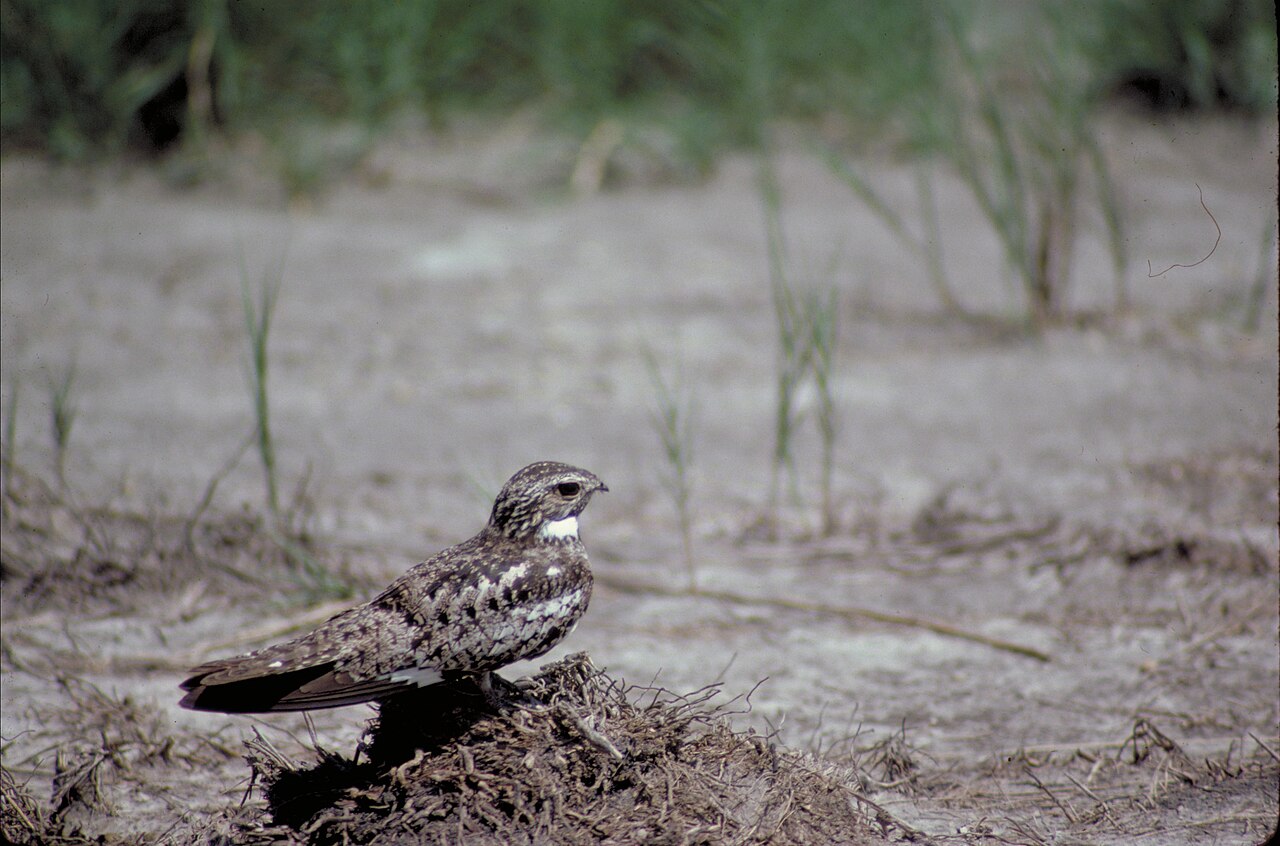
Most people who search for “nighthawk sound” are describing the Common Nighthawk, and it is the one most likely to be overhead while you are standing in a parking lot. The call is a nasal, buzzy “peent,” sometimes written “beernt,” given in flight. It is a short, flat note, a little like a toy horn, and it repeats at irregular intervals as the bird patrols back and forth. Despite the name, this is not a true hawk and it does not sound like one.
The vocal activity is tied to the clock. Peak calling is reported 30 to 45 minutes after sunset, and birds also hunt at dawn. In the north, where summer evenings run late, that can mean you are still outside when they start. Males add a second kind of sound during the breeding season: a hoarse “auk auk auk” during courtship, and the famous dive.
The “boom” is not a call
If you hear a sudden, deep “vroom” that seems to come from nowhere, like a car passing on a highway, you are very likely hearing a male nighthawk diving. He drops, then flexes his wings sharply downward at the bottom of the dive, and the air rushing through the longest wing feathers makes the sound. It is made by the wings, not the throat. Audubon notes that it sounds more like a whoosh than a boom, and that only males do it. It is a spring and summer sound, tied to courtship and territory.
Sound of Common Nighthawk (flight calls, recorded in Honduras):
Recording: Oliver Komar, XC484751, CC BY-SA 4.0, recorded in Honduras.
Where and when
The Common Nighthawk breeds from southeast Alaska across Canada and south through most of the United States. It winters in South America, so the sound is seasonal. Northbound birds start moving at the end of February, with late arrivals into mid-June, and southbound migration runs from mid-July into early October. In between, the bird turns up in a surprising range of places: forests, prairies, deserts, beaches and cities. Nesting happens on bare ground, including gravel, which is why flat gravel rooftops became a nesting habitat in towns. Their numbers have fallen by around 60 percent over the past half-century, according to Audubon, so hearing one over your street is worth noticing.
If you are in the Southeast, our night birds in Florida guide covers what else might be calling after dark.
Lesser Nighthawk (Chordeiles acutipennis)
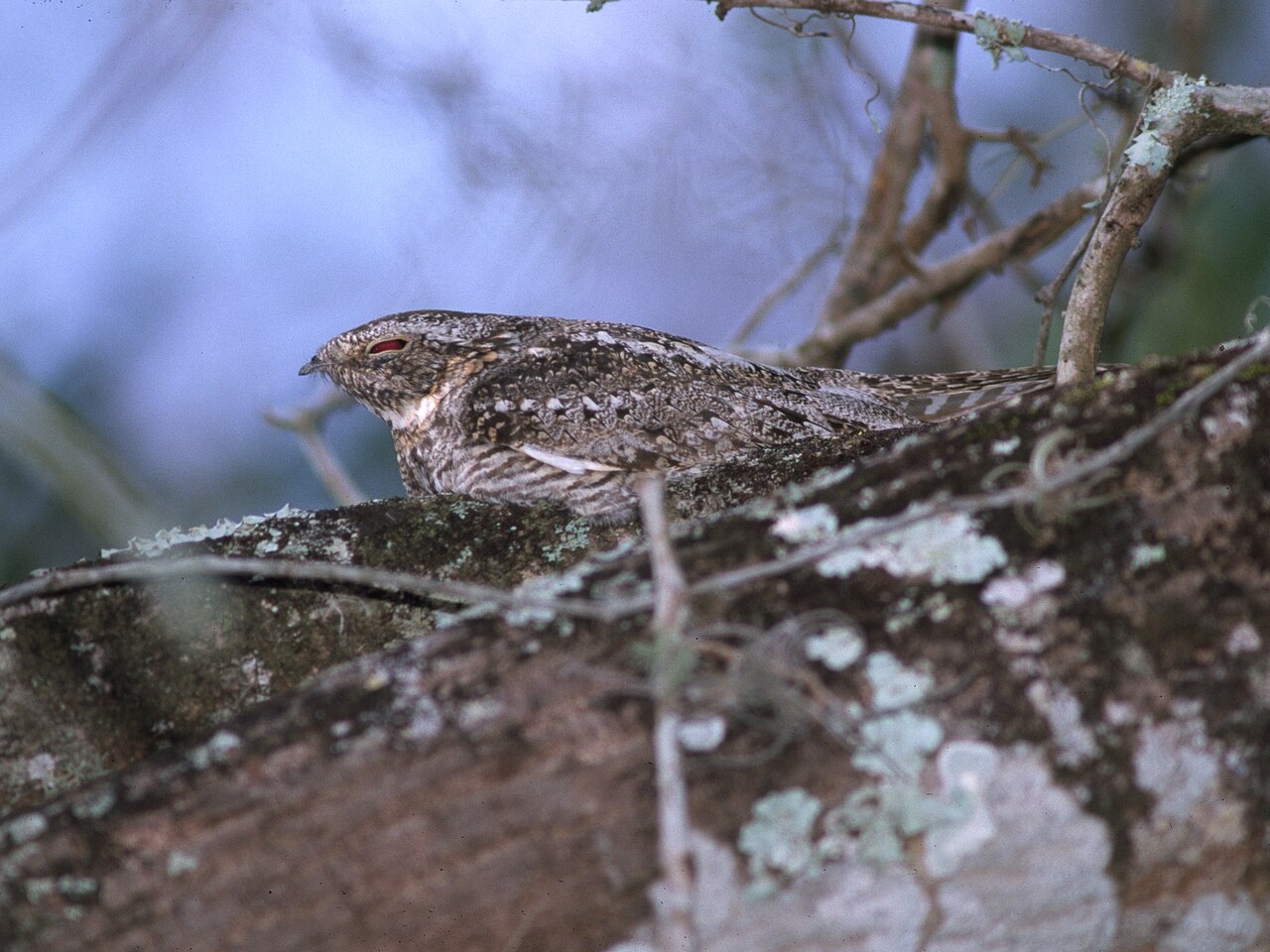
The Lesser Nighthawk is the quiet one. Where the Common Nighthawk makes a sharp “peent,” this species gives a soft, sustained, tremolo whirring that Audubon describes as very difficult to locate. Other accounts compare it to a toad’s trill, with trills that can run for 7 to 13 seconds and sometimes continue for minutes. It also gives an occasional low, laugh-like whinny, but not often.
That trill is the cleanest separator. If the sound is a steady purr from low over the ground, in dry open country, it is not the Common Nighthawk’s “peent.” It is also lower in the sky: Lesser Nighthawks hunt close to the ground, scooping insects over deserts, grasslands and brushy country, and they are more common than Common Nighthawks at low elevations and in drier areas where the two overlap. In flight, Lesser is slightly smaller and buffier, with a less deeply forked tail, though in the dark you will rely on the voice.
Its U.S. range is the arid Southwest, from California through Arizona and New Mexico into Texas. For local lists, see our guides to night birds in Arizona and night birds in Texas.
Listen to Lesser Nighthawk: we did not find a recording of this species under a license we can embed, so here is the species page on xeno-canto, where you can browse and play recordings directly.
Eastern Whip-poor-will (Antrostomus vociferus)
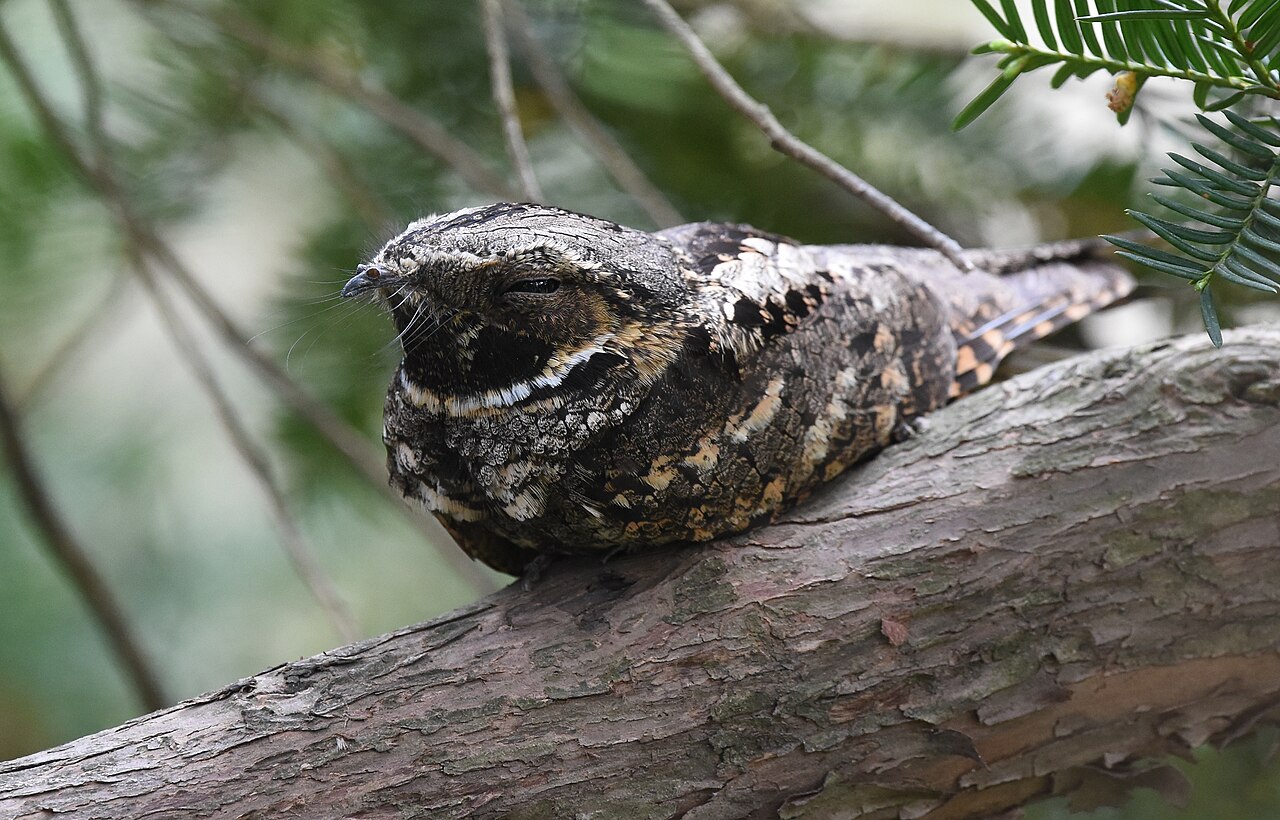
This is the nightjar that named itself. The song is three clear notes, “whip-poor-WILL,” with the stress on the last one, and every cycle is almost the same length as the one before. The effect is mechanical, which is part of why it can drive light sleepers up the wall. Audubon notes a very crisp “cluck” just before the first note that most people never notice, though you may catch it when the bird is close.
It sings at dusk and again before dawn, and on moonlit nights it can go for a long time. Missouri Department of Conservation notes that whip-poor-wills typically give 50 to 100 repetitions of the song at a stretch, with counts sometimes exceeding 1,000 in a row. Audubon’s species account says an observer once documented more than 1,000 consecutive songs without a pause. The singers are males, and the song advertises a territory and a mate.
Sound of Eastern Whip-poor-will (song, recorded in North Carolina):
Recording: steve, XC905500, CC BY-SA 4.0.
Habitat, range and the moon
The Eastern Whip-poor-will breeds in deciduous or mixed woods across central and southeastern Canada and the eastern United States, then winters in the southeastern U.S., eastern Mexico and Central America. It likes open understory, dry leaf litter and a canopy that lets some light through. It nests right on the ground among dead leaves, usually laying two eggs. The moon matters: research summarized by Audubon found adults feeding young mostly on nights when the moon is more than half full, when moonlight makes foraging easier.
The bird is in trouble. Missouri Department of Conservation reports that the Eastern Whip-poor-will has fallen by 69 percent in the last 50 years, and the species is now listed as Near Threatened. Habitat loss, pesticide use and a drop in large moths and beetles are suspected, though no single cause has been proven. Because the call is so hard to miss, the absence of a song that used to be there is itself a signal. If you have been thinking about folklore around this bird, we also cover that in whip-poor-will meaning and symbolism.
Mexican Whip-poor-will (Antrostomus arizonae)
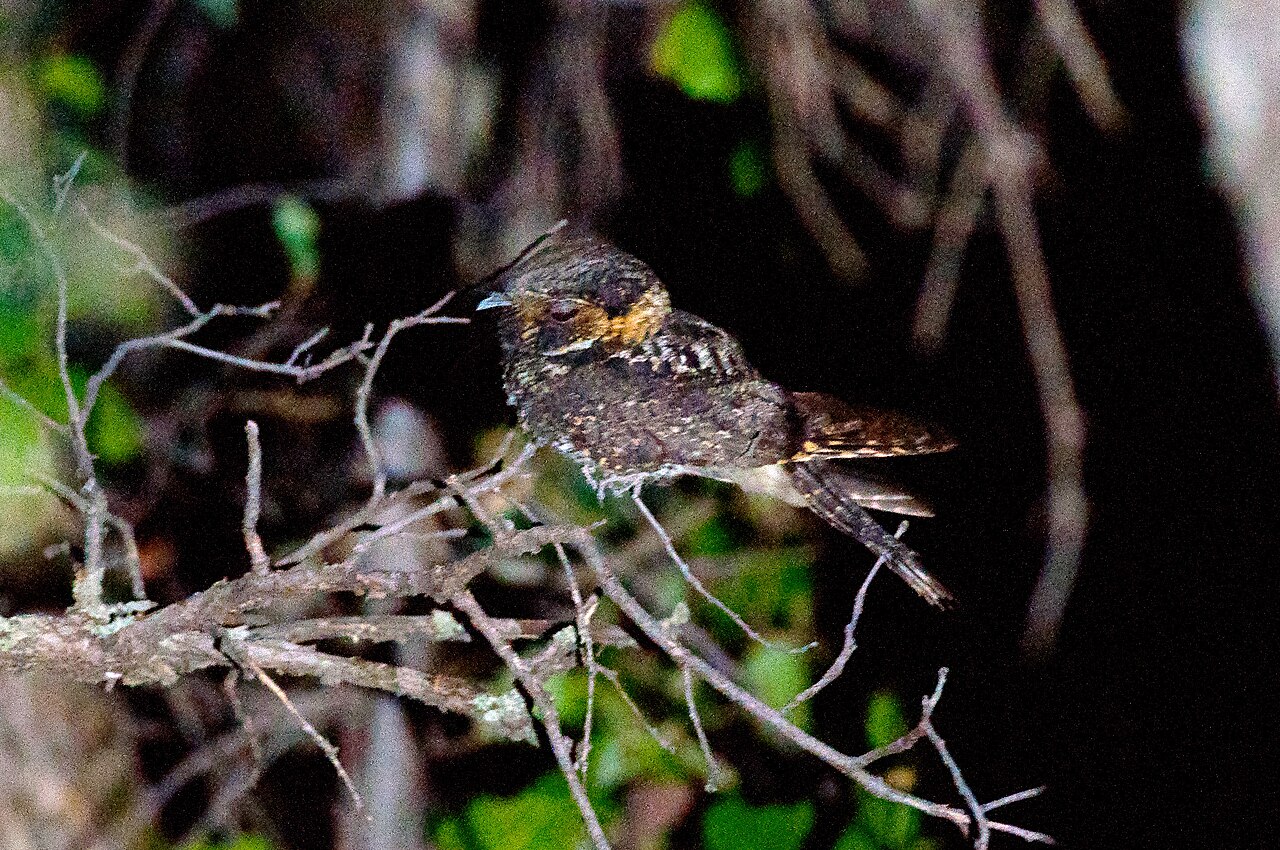
Until 2010 the Mexican Whip-poor-will was lumped with the eastern bird as a single species. They were separated because of differences in genetics, appearance and voice. The Mexican song uses the same word but is lower in pitch, less snappy and slightly lazier, so if you have a recording of both in front of you the difference is easy to hear. It also gives a single, low, mellow “quirt” or “queerp” note, plus growls.
The easiest way to know which one you have is geography. In the United States, the Mexican Whip-poor-will breeds in the pine-oak mountains of the Southwest, while the Eastern lives well to the east, so overlap in the field is not usually a problem. It favors semi-arid to moist oak and pine forests at middle to upper-middle elevations. See night birds in Arizona for the places where it is most often found.
Sound of Mexican Whip-poor-will (song, recorded in Madera Canyon, Arizona):
Recording: Ryan Douglas, XC1005232, CC BY-SA 4.0.
Chuck-will’s-widow (Antrostomus carolinensis)
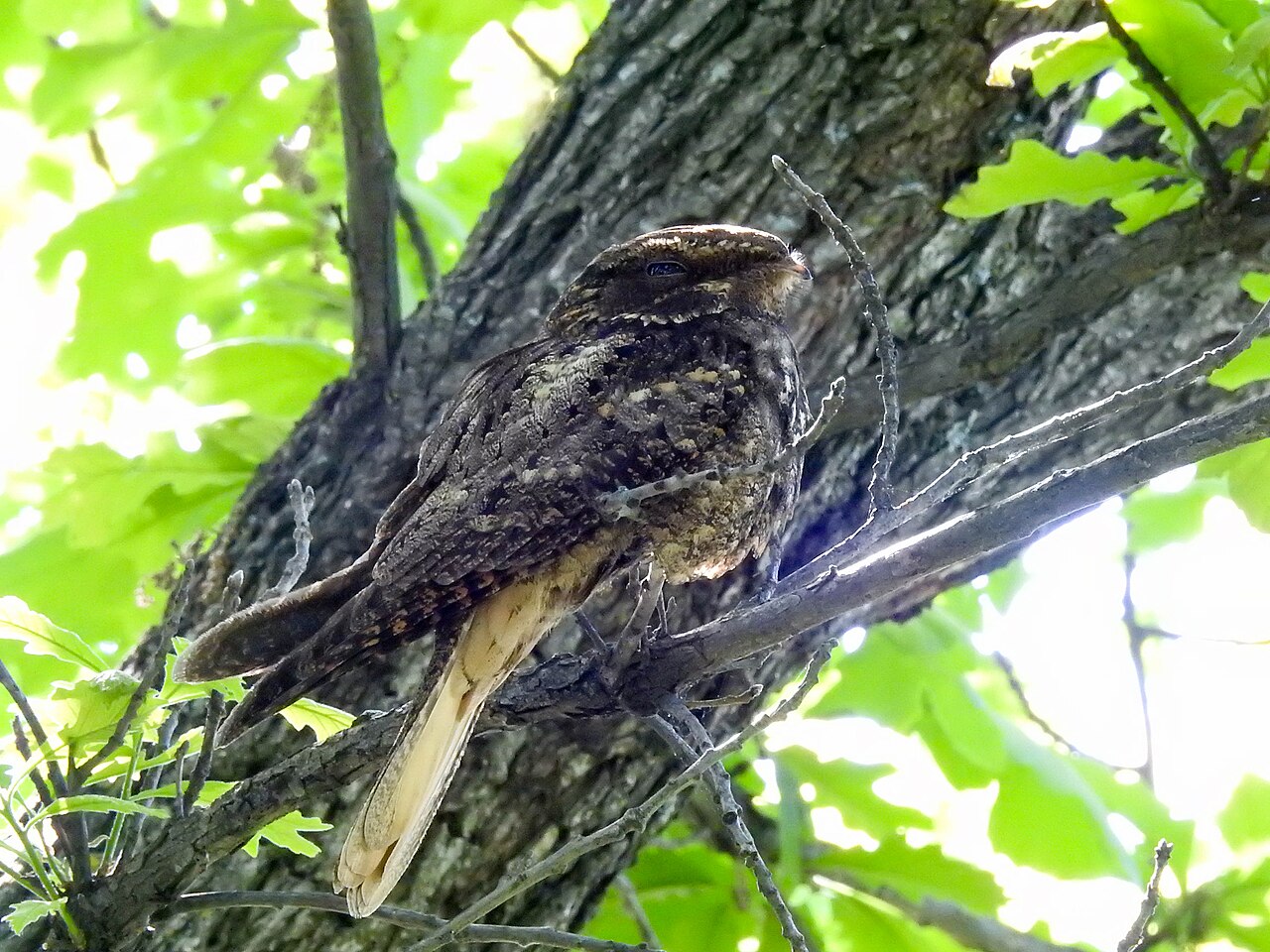
Chuck-will’s-widow is the biggest nightjar in North America, 28 to 33 centimeters long with a wingspan of 58 to 66 centimeters, and it has the slowest, deepest song of the group. The name is the song: a vibrating middle note between two shorter ones, usually written “chuck-will’s-WID-ow.” The phrase is slower, lower pitched and less piercing than a whip-poor-will’s, and the opening “chuck” is often faint from any distance. The first note is a soft sound, so it is easy to hear just “will’s-WID-ow.”
It sings during the early part of the night and again in the early morning, and it can repeat the phrase many times in a row. Missouri Department of Conservation puts the longest runs at more than 800 consecutive songs. The population has dropped by 63 percent in the last 50 years, according to the same source.
Sound of Chuck-will’s-widow (song, recorded in North Carolina):
Recording: steve, XC1000236, CC BY-SA 4.0.
The breeding range covers the southeastern United States, from southern Virginia, southern Ohio and Missouri south to the Gulf Coast and central Texas, with small isolated populations farther north. In winter it moves to the West Indies, Central America and northwestern South America. It uses swamp edges, pine woods and rocky uplands. Unlike the others, it has been recorded eating small birds and bats, swallowing them whole, in addition to the usual moths and beetles. In Texas, the night birds in Texas guide is a good place to see how it fits into the local chorus.
Common Poorwill (Phalaenoptilus nuttallii)
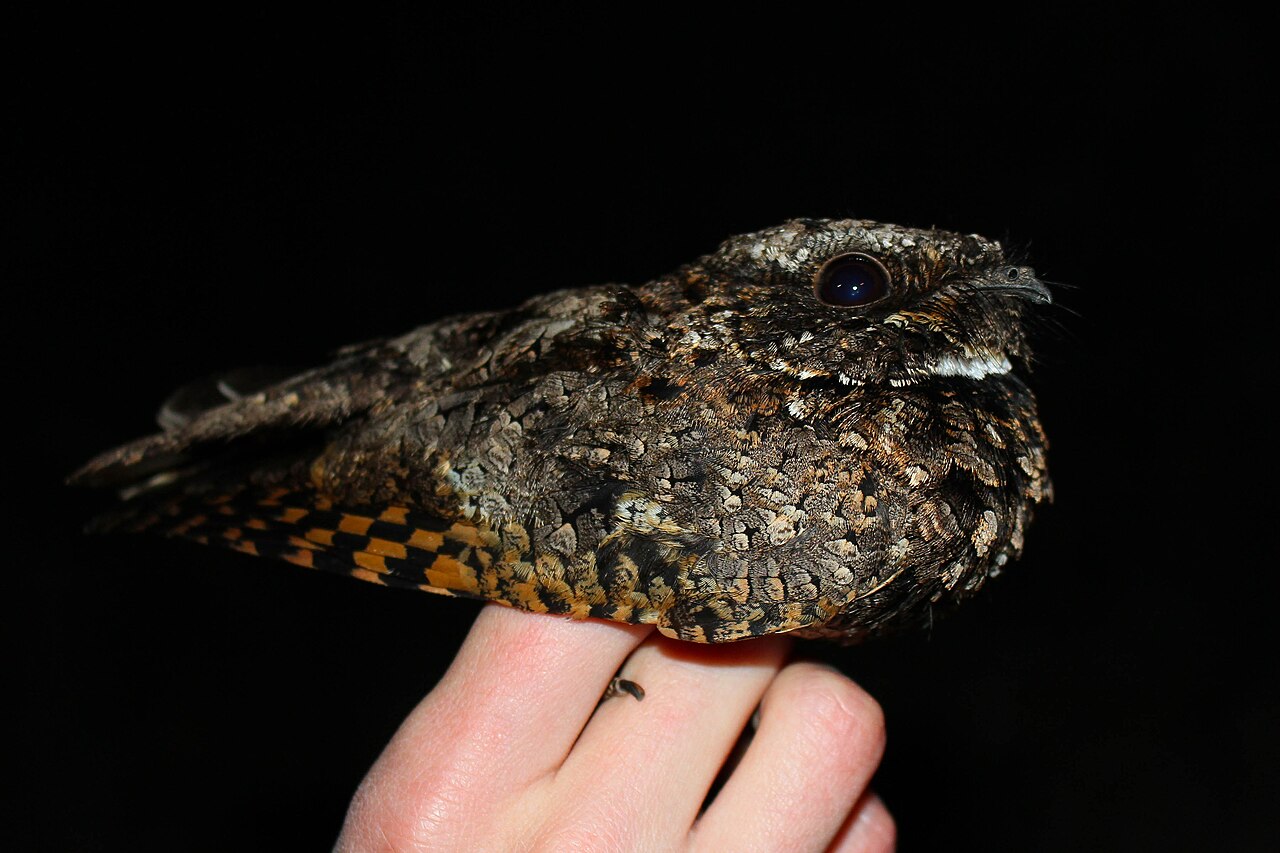
The poorwill is the smallest North American nightjar, about 18 centimeters long, and its voice is the gentlest. The song is a soft “poor-will,” given at dusk and through the night. At close range a faint third note can be heard, so the phrase becomes “poor-will-low.” The sound is mellow and lower-key than anything an Eastern Whip-poor-will produces, and it carries over dry, open ground rather than through a forest.
It lives from British Columbia and southeastern Alberta through the western United States to northern Mexico, on dry, open slopes, rocky mesas, desert washes and scrubby pine. The poorwill is the only bird known to go into torpor for extended periods, lasting weeks to months. The Hopi name for it, hölchko, means “the sleeping one.” Audubon estimates a population of around 1.7 million birds, with numbers probably stable.
Sound of Common Poorwill (song, recorded in South Dakota):
Recording: Jonathon Jongsma, XC254485, CC BY-SA 4.0.
Colorado and the interior West are good places to listen for it. Our night birds in Colorado guide has more on what else calls in that country.
How to tell them apart in the field
Start with the structure of the sound, then use place and season to narrow the choice.
- A short buzzy note from the air, not a repeated phrase: a nighthawk. A sharp “peent” is the Common; a steady soft trill low over dry ground is the Lesser.
- A deep whoosh from above at dusk: a male Common Nighthawk finishing a dive. No other nightjar does this.
- A snappy three-note phrase, over and over, from the woods: a whip-poor-will. East of the Great Plains, it is the Eastern. In the pine-oak mountains of the Southwest, it is likely the Mexican.
- A slower, lower, four-part phrase from the Southeast: Chuck-will’s-widow. If it sounds almost like a whip-poor-will in slow motion, this is why.
- A soft two-note “poor-will” on dry western ground: Common Poorwill.
Overlap does happen. In the Southeast, whip-poor-wills and Chuck-will’s-widows can sing within earshot of each other, and a rule that helps is to count notes and judge the tempo: the whip-poor-will is quicker and sharper, Chuck-will’s-widow slower and heavier. In the Southwest, a Mexican Whip-poor-will and a poorwill may both be present in the same canyon, but the poorwill’s song is much softer and doesn’t have the full whip-poor-will phrase. Recording a short clip on your phone and comparing it with a clean example is almost always faster than arguing with yourself in the dark.
Why they sing the same phrase hundreds of times
The whip-poor-will and Chuck-will’s-widow are the extreme case. Males sing to claim and defend a territory and to attract a mate, and the song is the main way they do both when nobody can see anybody. The repetition has a practical edge: a loud, simple, identical phrase is easy for a mate or rival to locate and to recognize as the same bird. Moonlight tends to help, because brighter nights are better for foraging and more singing happens when there is enough light to feed on.
The stamina is real, not an exaggeration. Counts of more than 1,000 consecutive songs for whip-poor-will and over 800 for Chuck-will’s-widow are recorded by the Missouri Department of Conservation. Most birds in a stretch of woodland will not do that every night, but a singer that has found good conditions can go for a long time. For why night calling happens at all, see why birds chirp at night.
Why you hear them but almost never see them
A nightjar spends the day on the ground or lengthwise along a branch, with its eyes half closed and plumage that looks like bark, dead leaves and gravel. Its outline is broken up, and it relies on keeping still. After sunset it is active, but the only moment most people see it is when a car headlight catches a pair of red eyes on a road shoulder: nightjars have a reflective layer at the back of the eye, the tapetum lucidum, that produces eyeshine. A bird seen in the open is usually a Common Nighthawk, because it flies at dusk when there is still some light, hunting high over fields and towns. The ground and branch-sitting species sing from a spot you will probably never find without a spotlight.
If you want to see a nightjar, go to a place with a known population in the early evening, stay still and listen for the direction of the song, then scan low branches and the ground edge with a red-filtered light. Do not play recordings to draw a bird in during nesting season. It pulls a singing male away from feeding or from the nest and adds up over a night, particularly for declining species like whip-poor-wills.
Frequently asked questions
What does a nighthawk sound like?
A Common Nighthawk gives a nasal, buzzy “peent” while flying, most often around dusk. A male diving in courtship also makes a deep whooshing “boom” with his wings, which is not a vocal sound. A Lesser Nighthawk is quieter and gives a soft, steady, toad-like trill.
Is the nighthawk’s “boom” a call?
No. The boom is produced by air rushing through the wing feathers at the bottom of a courtship dive. Only males do it, and it is mostly heard on spring and summer evenings.
What is the difference between a whip-poor-will and a Chuck-will’s-widow?
Both repeat their names for long stretches. The whip-poor-will’s song is three quick, sharp notes with the stress on the last one. Chuck-will’s-widow’s is slower and lower, with a vibrating middle note between two shorter ones. Chuck-will’s-widow is also the larger bird and is a Southeastern species, while the Eastern Whip-poor-will ranges farther north.
What is the difference between the Eastern and the Mexican Whip-poor-will?
They were considered one species until 2010. The Mexican bird sings a lower, less snappy, lazier version of the song, and it also gives a single mellow “quirt” note. Range is the easiest guide: Mexican in the Southwest mountains, Eastern in the East.
What time of night do these birds call?
Nighthawks are most vocal in the 30 to 45 minutes after sunset and also hunt at dawn. Whip-poor-wills and Chuck-will’s-widows call in the early night and early morning, and a bright moon can keep them going. The poorwill calls from dusk to dawn.
Why are whip-poor-wills so hard to find?
Their mottled plumage matches leaf litter and bark, they roost on the ground or along a branch in daylight, and they sing from spots that are hard to see in the dark. Their song is easy to hear, but the bird usually isn’t.
The short version
Listen for the structure first. A buzzy “peent” from the air is a nighthawk, a trill low over desert is a Lesser, a crisp three-note phrase from the woods is a whip-poor-will, a slower four-part phrase in the Southeast is Chuck-will’s-widow, and a soft “poor-will” on dry western slopes is the poorwill. After that, the time of night, the habitat and the region will settle most of the doubts. For the full cast of night callers, owls included, go back to the sounds of night birds guide.
Sources
- Audubon, “The Big Boom Theory That Could Help Conserve Common Nighthawks” and Audubon Field Guide entries for Eastern Whip-poor-will, Common Poorwill and Lesser Nighthawk.
- Missouri Department of Conservation, “The Silencing of Missouri’s Iconic Nightjars,” Missouri Conservationist, August 2020.
- Wikipedia entries for Common Nighthawk, Lesser Nighthawk, Eastern Whip-poor-will, Mexican Whip-poor-will, Chuck-will’s-widow and Common Poorwill.
- Xeno-canto recordings by the credited recordists, used under the licenses shown beside each one.