Project FeederWatch: How to Sign Up and Start Counting This Season
Every November, a few hundred thousand feeders across North America turn into data points. Project FeederWatch, run jointly by the Cornell Lab of Ornithology and Birds Canada, asks ordinary backyard birders to count what shows up at their feeders on a regular schedule, then log it online. The data has been piling up since 1987, and it’s one of the main reasons researchers can say with confidence how winter finch populations are shifting, where avian diseases like salmonellosis or House Finch eye disease are spreading, and which species are expanding or retreating across the continent.
None of that requires any special skill. If you can tell a chickadee from a sparrow and you’re willing to sit by a window with a notebook (or a phone) twice a week, you have what it takes. Here’s what the project actually involves and how to get set up before the season opens.
What Project FeederWatch Is, in Plain Terms
FeederWatch is a citizen-science program, not a casual checklist app. The difference matters: instead of logging every bird you see whenever you happen to see it, you follow a specific counting protocol so your numbers can be compared against everyone else’s. That consistency is what makes the dataset useful to scientists instead of just being a pile of anecdotes.
The season runs from November 1 through April 30 each year, covering the stretch when feeders matter most to birds and when counts are easiest to make sense of, since there’s less leaf cover and less competing natural food. You don’t watch every day. You pick count days on your own schedule, as often as once a week, and the project does the rest.
The Counting Method
This is the part people get wrong if they skip the instructions, so it’s worth spelling out. A FeederWatch count period is two consecutive days of your choosing. During those two days, for each species, you record the highest number of that species you see at one time — not a running total of every individual that passed through.
So if six goldfinches show up at 8 a.m. and a different four goldfinches show up at 3 p.m., you don’t report ten. You report whichever single moment had the most goldfinches on screen at once, because that avoids double-counting birds that just left and came back. It takes one or two sessions to get the habit, and after that it’s fast.
You’re not restricted to a single feeder, either. The count applies to the “count site,” which can include your feeders, nearby trees, shrubs, and the ground around them — basically your whole yard or watching area, defined when you register the site.
How to Sign Up
- Go to feederwatch.org and find the “Join” or “Sign Up” link. New participants create an account through the Cornell Lab’s Lab Account system, which is shared across several Cornell citizen-science projects (eBird, Merlin, NestWatch), so if you already use one of those, you may already have a login.
- Pay the participation fee or make a donation. US residents pay $18 a year, which covers the research and participant materials. Canadian residents support the project through a donation to Birds Canada instead of a flat fee. The fee is what keeps the project running — it’s not a paywall for data access, since FeederWatch results are published openly.
- Register your count site. You’ll be asked for your location and a short description of your watching area — feeder type, habitat, that sort of thing. This context gets attached to your counts and matters for the science, since a count from a rural Minnesota farm means something different than one from a Chicago balcony.
- Pick your count schedule. Decide whether you’re going to count weekly, every other week, or less often. There’s no wrong frequency, but a schedule you can actually stick to beats an ambitious one you abandon in December.
- Submit your counts online or through the app. Data goes in either through the FeederWatch website or the mobile app, both of which walk you through entering species and peak counts for your two-day period.
What You Get for Participating
Beyond the satisfaction of contributing to a forty-year dataset, participants get a few concrete things:
- A research kit with a bird-tracking calendar and identification materials to help new participants get oriented.
- Access to “Winter Bird Highlights,” an annual summary report that breaks down what FeederWatchers saw that season — regional trends, unusual sightings, and how the winter compared to previous years.
- An optional full-color poster or calendar featuring feeder birds, which has become something of a yearly collectible among longtime participants.
- Your own data, visualized. The website lets you pull up your own historical counts, so after a few seasons you can see your own yard’s trends the same way researchers see continental ones.
Getting Your Feeders Ready
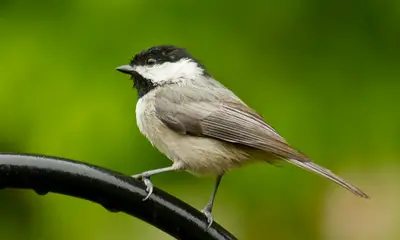
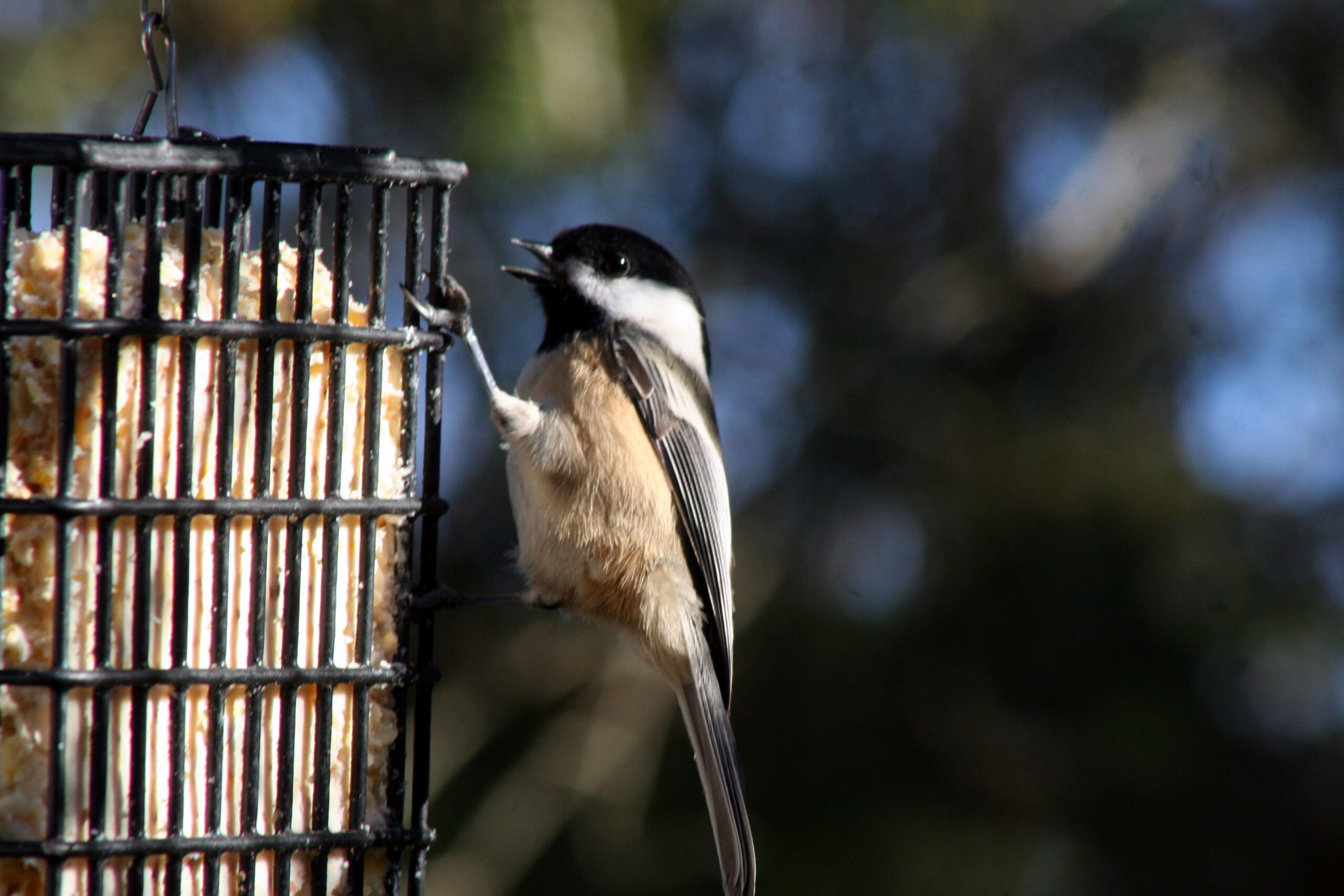
If you’re setting up a count site from scratch, it helps to have feeders established and birds already visiting before your first count day, rather than starting cold in November. Black-capped Chickadees, the bird in the photo above, are a good indicator species to watch for — they’re common at suet and sunflower seed feeders across most of the northern and central US and Canada, and they tend to be among the first birds to find a new feeder. If you’re still deciding what to put out and when, our winter bird feeding guide covers seed types, suet, and timing in more detail.
It also helps to know what you’re likely to see before you start counting, so misidentifications don’t creep into your data. Our rundown of birds that stay through winter in the northern US is a reasonable starting point if you’re in that region, covering the year-round residents and the winter visitors that drop down from farther north.
A Few Practical Notes
Counts are meant to reflect ordinary conditions, so most participants skip a count day if a storm or unusual event (a hawk working the yard, a predator scattering everyone) would badly skew the numbers — the instructions cover how to handle edge cases like that. You’re also not required to identify every bird perfectly; the project has resources for reporting birds you can only identify to a general type, and your regional FeederWatch contacts can help with tricky IDs.
One thing that trips up first-year participants: the two count days don’t have to be a weekend, and they don’t have to be the same two days every time. Flexibility is the point. The only hard rule is that the two days in a given count period are consecutive.
Why It’s Worth Doing
A single yard’s data doesn’t tell you much on its own. But multiplied across tens of thousands of participating sites over nearly four decades, FeederWatch has documented real shifts — range expansions for species like the Eurasian Collared-Dove, the spread and ebb of House Finch eye disease, and fine-grained pictures of how winter finch irruptions move across the continent in years when northern seed crops fail. None of that comes from expensive instruments. It comes from people sitting at their windows, counting carefully, on a schedule they chose themselves.
If you’ve got a feeder up and a notebook handy, the only real barrier left is November 1.