Types of Herons: How to Identify the Herons, Egrets and Bitterns of North America
Standing at the edge of a marsh with binoculars, most people sort long-legged wading birds into two piles: the big gray one and the white ones. That works for about five minutes. Then a small blue bird turns out to be white, a white bird has yellow feet, and something streaky and brown freezes in the cattails with its bill pointed at the sky. The herons, egrets and bitterns of North America are all one family (Ardeidae), but they vary enough in size, color and habit that a little structure helps a lot.
This guide covers the twelve regularly occurring species north of Mexico, grouped the way they are easiest to separate in the field: the big ones, the white egrets, the small blue-gray herons, the night-herons and the bitterns. For each, you get the marks that matter, the habitat it prefers, and the look-alikes it is most often confused with. Two points before the list: egrets are not a separate family, since the word is mostly a convention for the white, plume-wearing herons, and a few rarities (such as vagrant Old World species) turn up now and then but are not covered here.
Quick ID: start with size and bill
- Big and gray-blue, with a pale, heavy bill: Great Blue Heron.
- Big and white, yellow bill, black legs: Great Egret.
- Medium and white, black bill, yellow feet: Snowy Egret.
- Medium and white, two-toned blue-gray and black bill, greenish legs: Little Blue Heron (white juvenile).
- Small, stocky and white, short yellow bill, often in a pasture: Cattle Egret.
- Slim blue-gray with a white belly and a white stripe up the front of the neck: Tricolored Heron.
- Shaggy-necked, pink-billed and dashing around in shallow salt water: Reddish Egret.
- Small, dark and hunched, with short yellow-orange legs: Green Heron.
- Stocky, black-capped, red eye: Black-crowned Night-Heron.
- Stocky, gray, striped black-and-white head with a pale crown: Yellow-crowned Night-Heron.
- Streaky brown, bill up in the reeds: American Bittern, or the much smaller Least Bittern.
The big gray-blue heron
Great Blue Heron (Ardea herodias)
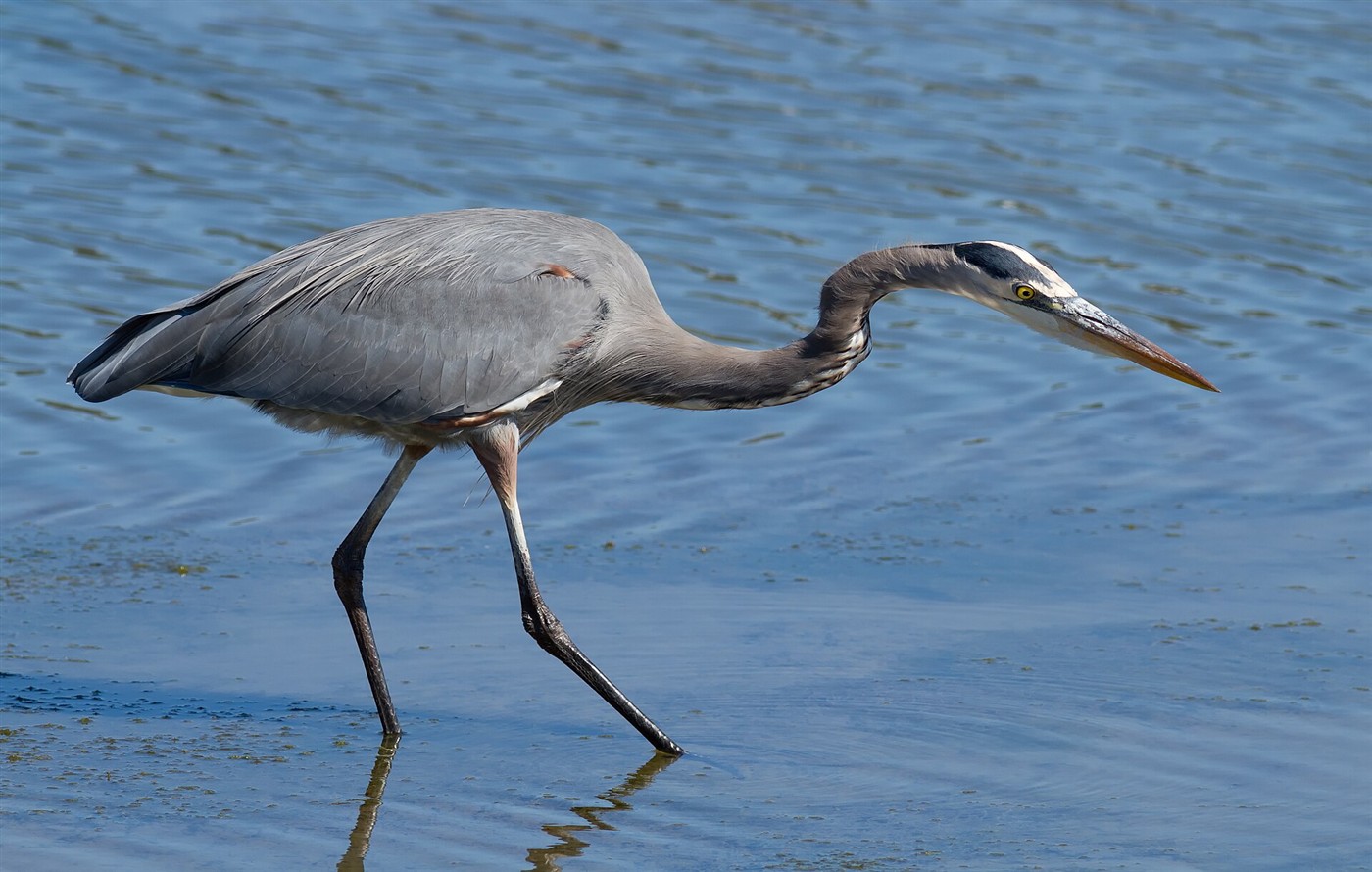
This is the heron most people mean when they say “heron,” and it is the largest of the group in North America. Length runs roughly 36 to 54 inches with a wingspan of about 66 to 79 inches, and a good-sized bird can look almost cartoonishly tall when it stands upright. The body is blue-gray, the neck has a rusty tint with black-and-white streaking down the front, and a black stripe runs from above the eye back into plumes behind the head. The bill is dull yellowish, shifting toward orange at the start of the breeding season, and the legs are gray, also going orange-ish in spring.
Juveniles are duller, with a blackish-gray crown rather than the white face and black head plumes of an adult. They lack the plumes and the bill is a dull gray-yellow. That dark crown is the quickest way to tell a young bird from an adult.
It is the most widespread heron on the continent, from Alaska and southern Canada all the way south into Central America. It will use almost any shallow water: freshwater and saltwater marshes, mangroves, flooded meadows, lake edges and shorelines. The hunting style is the classic one, wading very slowly, then a sudden strike with the bill at a fish or frog. In flight it folds its neck into an S, which separates it from cranes, which fly with the neck straight out.
One thing to know in south Florida: the all-white form known as the Great White Heron lives there and in the Caribbean. It is bigger than the typical bird and favors salt water. It is easy to mistake for a Great Egret, but the bill is heavier and the legs are pale yellowish rather than black.
The white egrets
Three species are white all their lives (Great Egret, Snowy Egret and Cattle Egret), and two more can be white at times: juvenile Little Blue Herons and the white morph of the Reddish Egret. Always check bill color and leg color first. Size alone misleads, because a Great Egret next to a Snowy Egret looks obvious but one by itself on a mudflat does not.
Great Egret (Ardea alba)
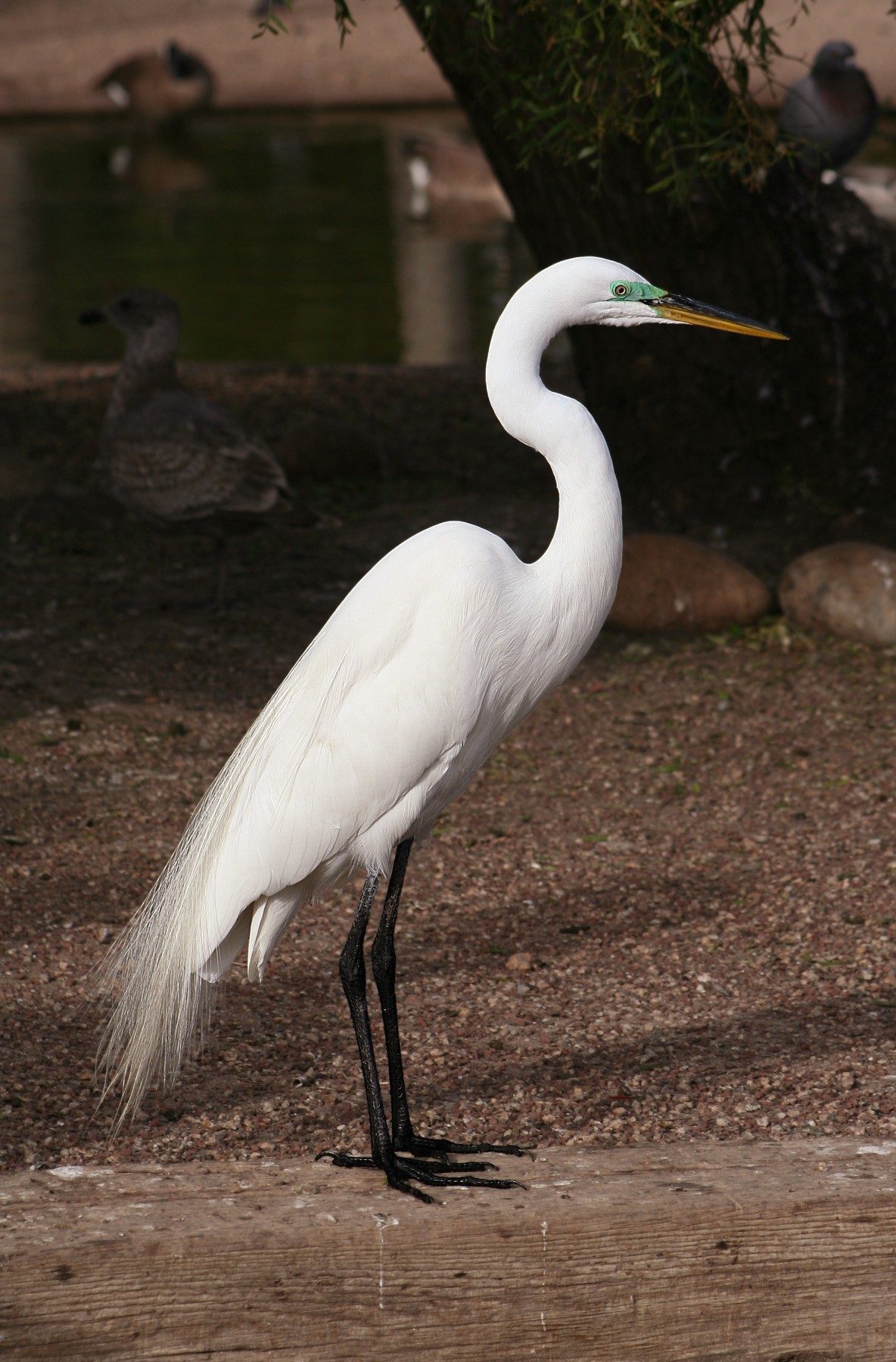
Tall, all white, with a yellow bill and black legs and feet. It stands about as upright as a Great Blue Heron, with length around 31 to 41 inches and a wingspan of roughly 52 to 67 inches. In breeding season, long, delicate plumes called aigrettes trail from the back. Those plumes are the reason the species was hunted heavily in the late 1800s to decorate hats, and the great egret later became the symbol of the National Audubon Society.
You will find it in marshes, lake edges, wet fields and tidal flats. It walks with its neck extended and wings tucked close, and often stands motionless for long stretches before a lightning-fast stab. It has expanded its range into Canada since the plume-hunting era ended. Its bill is the quickest tell against a Snowy Egret: the Great Egret’s is thick, dagger-shaped and yellow, while the Snowy’s is thin and black.
Snowy Egret (Egretta thula)
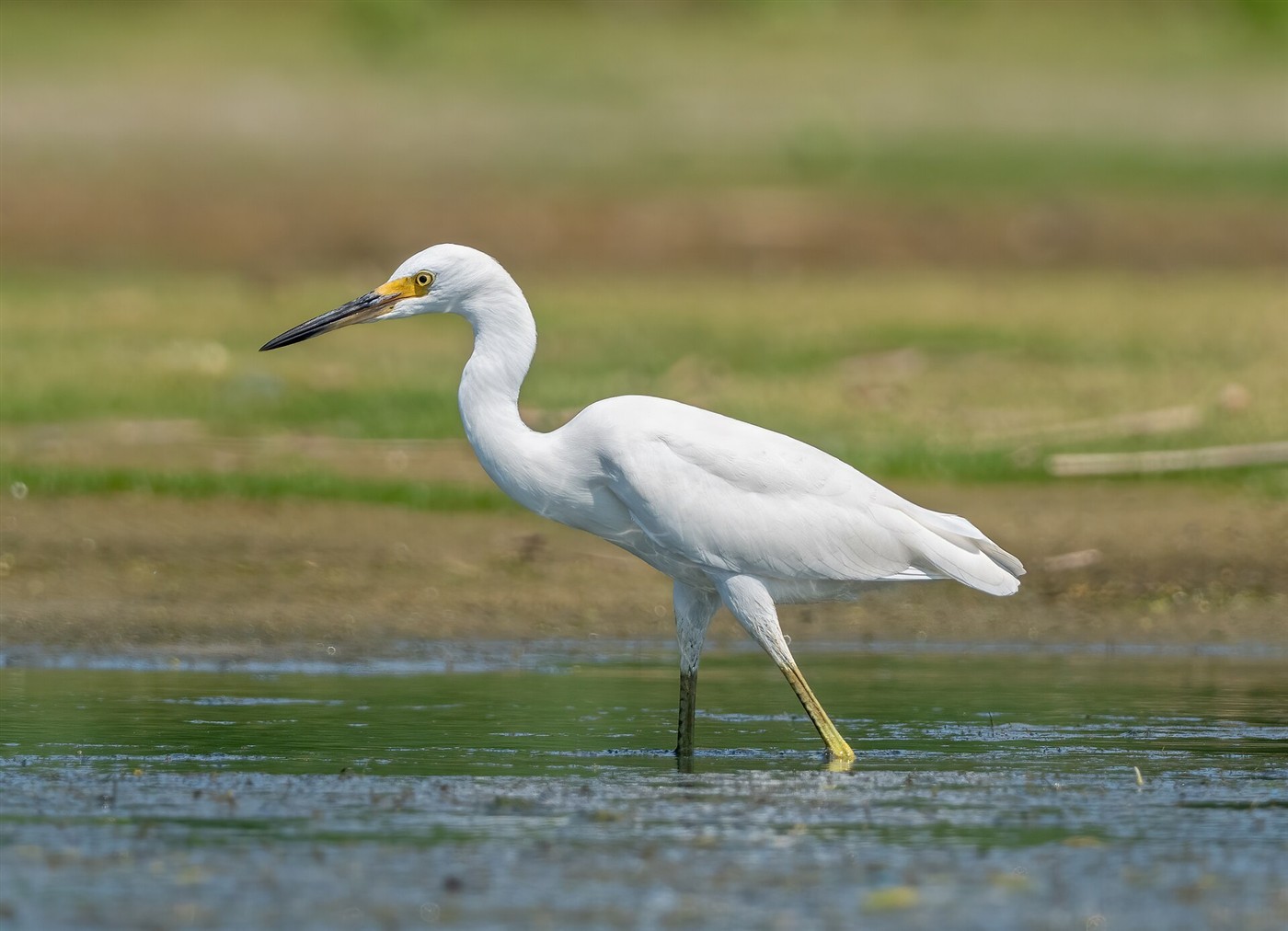
Smaller and lighter than a Great Egret, about 22 to 26 inches long. The field marks are a slim black bill, yellow patch of skin between the bill and the eye (the lores), black legs and bright yellow feet. Birders have long called the feet “golden slippers,” and it is the most reliable mark. Breeding adults grow long, shaggy plumes on the head, neck and back. Juveniles are duller, with greenish rather than clean black legs, which can make them look like a Little Blue Heron at first glance. The Snowy’s all-black bill is the difference.
It is the busiest feeder of the white egrets. A Snowy will shuffle or run its feet in shallow water to flush prey, sway its head, flick its wings, vibrate its bill, and occasionally hover over the surface. It occupies marshes, riverbanks, lakeshores and estuaries, and resides year-round in Florida and farther south, while northern birds migrate.
Cattle Egret (Bubulcus ibis)
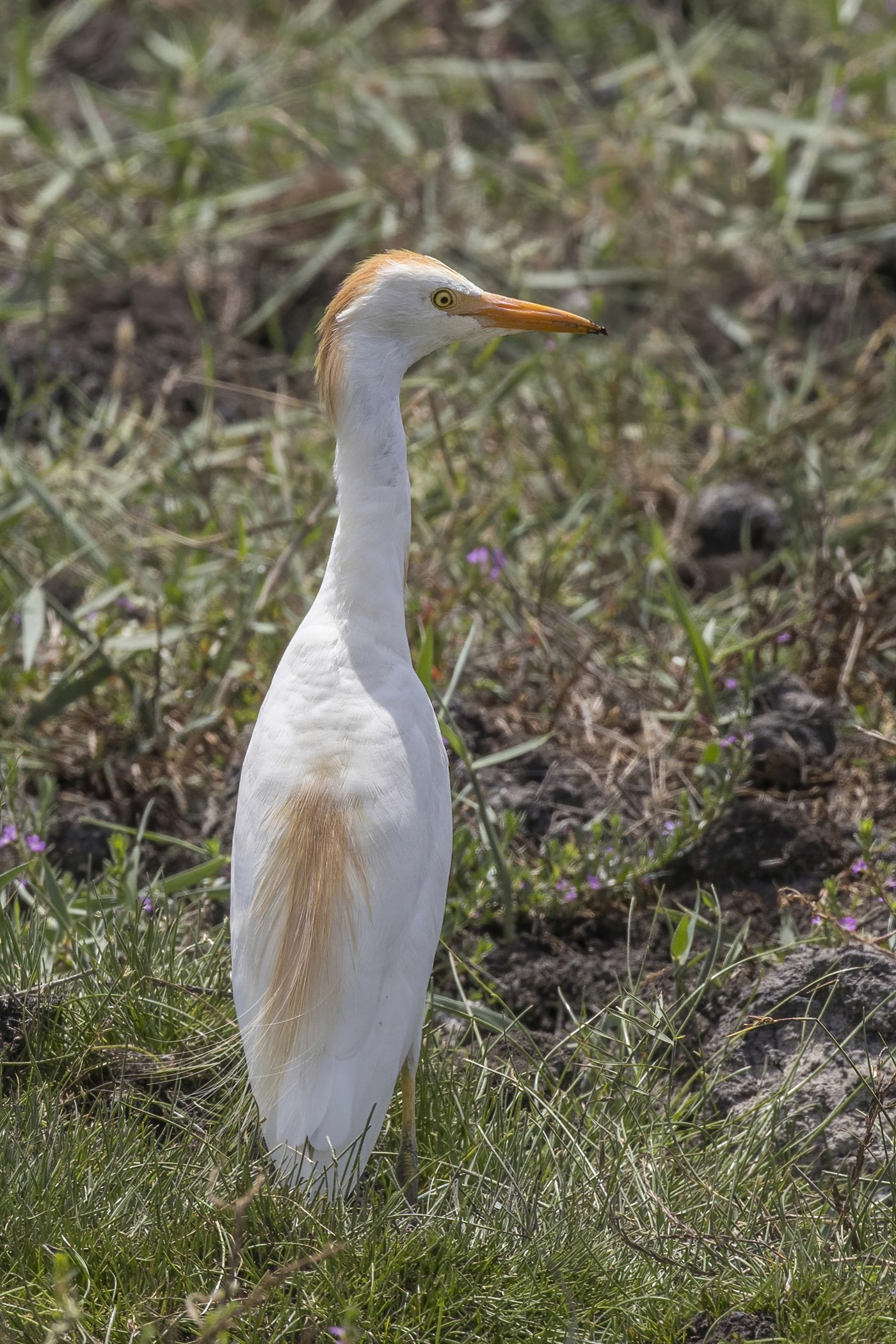
Smaller and stockier than the other white egrets, at roughly 18 to 22 inches long, with a short thick neck, a heavy-jawed look and a short yellow bill. Non-breeding birds are white with grayish-yellow legs. In breeding season they put on orange-buff plumes on the crown, breast and back, and the bill, legs and eyes turn bright red briefly. The photo above shows the buff plumage.
The habitat is what gives it away. Unlike most herons, the Cattle Egret thrives in drier, open country, and it often follows cattle, horses and tractors, catching insects and small animals stirred up by the animals. If a white heron is walking beside a cow in a pasture, it is almost certainly this one.
It is also a recent arrival. It was first noted in South America in the late 1800s, reached North America in 1941, was breeding in Florida by 1953 and was nesting in Canada by 1962. That is an unusually quick expansion for any bird.
Medium blue-gray and rusty herons
Little Blue Heron (Egretta caerulea)
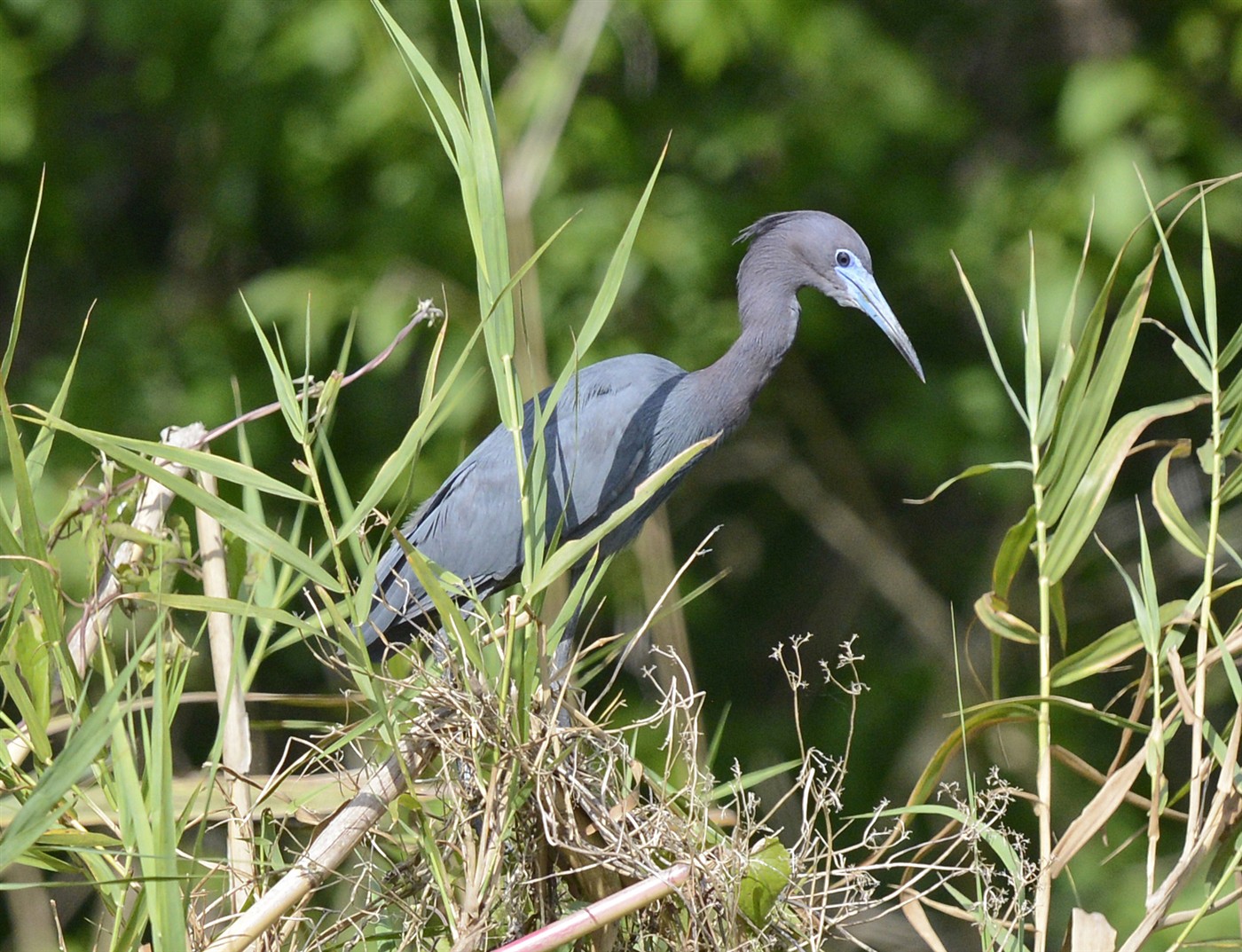
Adults are a uniform slate blue with a maroon-purple head and neck that turns darker red in the breeding season. The best field mark at any age is the bill: light blue-gray at the base with a black tip. Legs are greenish most of the year. At about 22 to 29 inches, it is a compact, slow-moving bird.
The wrinkle is the juvenile plumage. Young Little Blue Herons are almost entirely white, with darker tips on the wing feathers, which is why they are so often mistaken for Snowy Egrets. A bird in transition shows a patchwork of white and slate-blue feathers, sometimes called a “calico” bird. Look for the greenish legs and the two-toned bill instead of black legs and yellow feet. Little Blues also hunt differently, standing or walking slowly and waiting for prey rather than chasing it.
The range covers the southeastern U.S. and Gulf Coast, as well as mangroves, swamps, salt marshes and estuaries across much of the Americas, with some populations that disperse north in summer.
Tricolored Heron (Egretta tricolor)
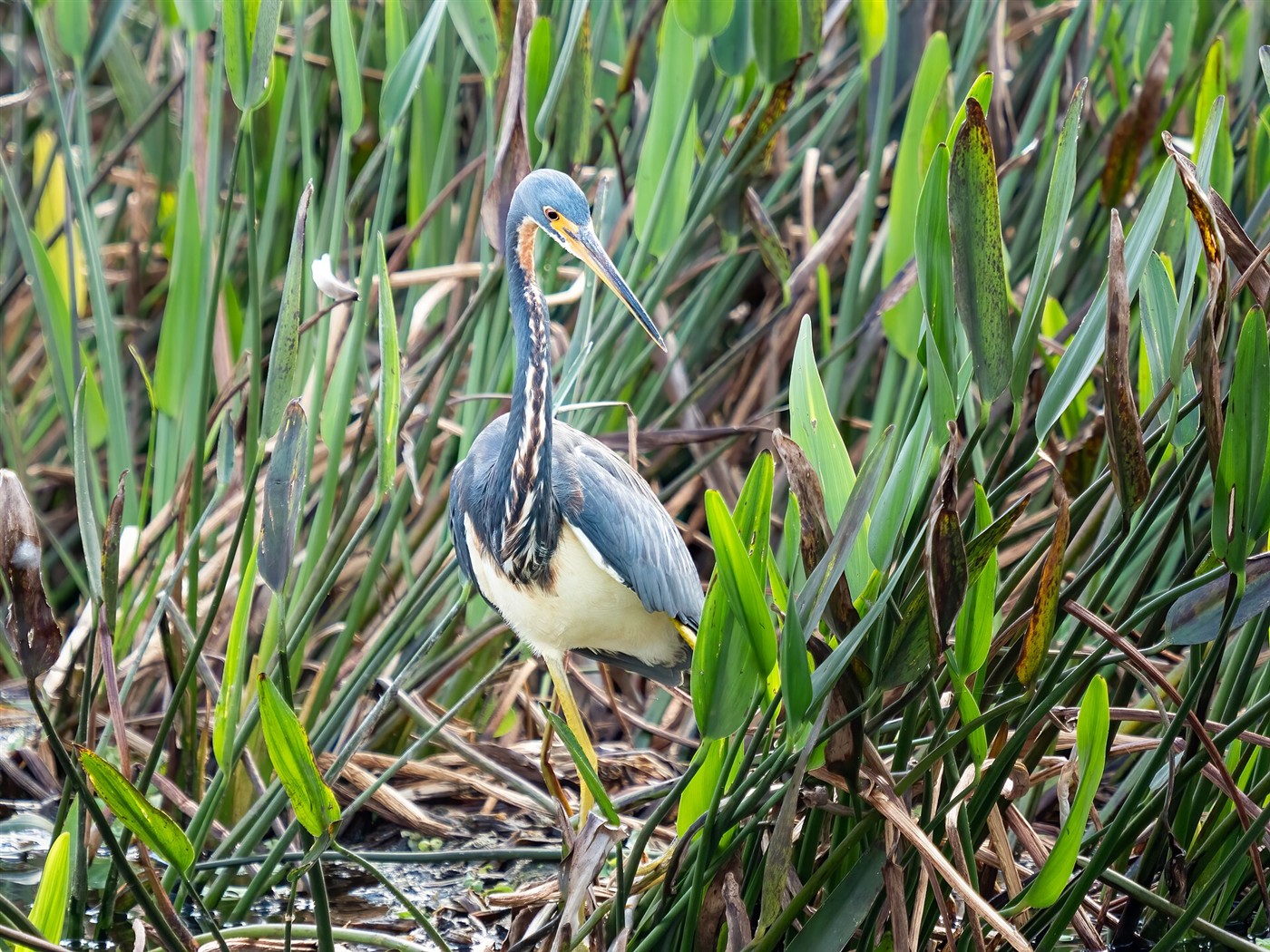
The “three colors” are blue-gray on the head, neck and back, a bright white belly, and a white stripe running down the front of the neck. That white belly is the quickest way to separate it from a Little Blue Heron. The bill is long and thin, yellowish to gray with a black tip, and legs shift from dark yellow to pink in breeding season. Length is roughly 22 to 30 inches, and the wingspan about 38 inches. Breeding birds grow blue plumes on the head and neck and buff ones on the back.
It is typically more solitary while foraging than other North American herons and likes to wade belly-deep in water. The diet is almost entirely fish. Look for it along the Atlantic and Gulf coasts, in swamps and other coastal wetlands.
Reddish Egret (Egretta rufescens)
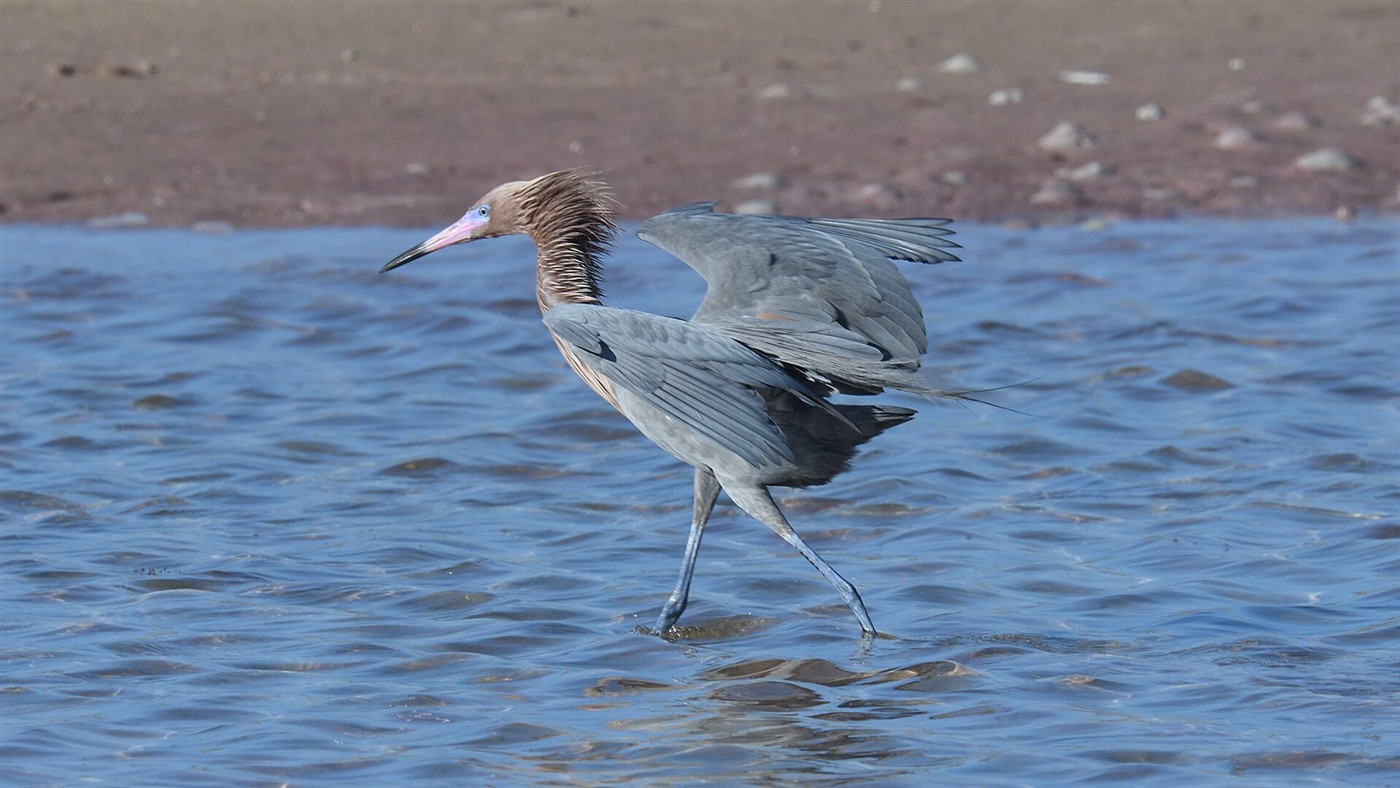
You will not forget a Reddish Egret once you have watched one hunt. It is a medium-large egret, about 27 to 32 inches long with a wingspan of roughly 46 to 49 inches, with a pink bill tipped in black and bluish-black legs. It comes in two color morphs. The dark morph is slate-blue with a shaggy rusty-red head and neck, while the white morph is entirely white. White-morph birds are the ones that cause trouble, because they resemble a Great Egret or Snowy Egret. Look for the pink, black-tipped bill and the shaggy look of the neck.
What makes it special is the foraging. A Reddish Egret stalks mudflats and shallow lagoons with a drunken, energetic gait, running, spinning, and lurching with its wings half open. It also does “canopy feeding,” holding the wings out like an umbrella to cut glare on the water and to shade prey.
It is much scarcer than the other species here. In the United States it is mostly a Gulf Coast bird, especially Texas, and globally it is classified Near Threatened. Texas lists it as a threatened species.
The small, dark heron
Green Heron (Butorides virescens)
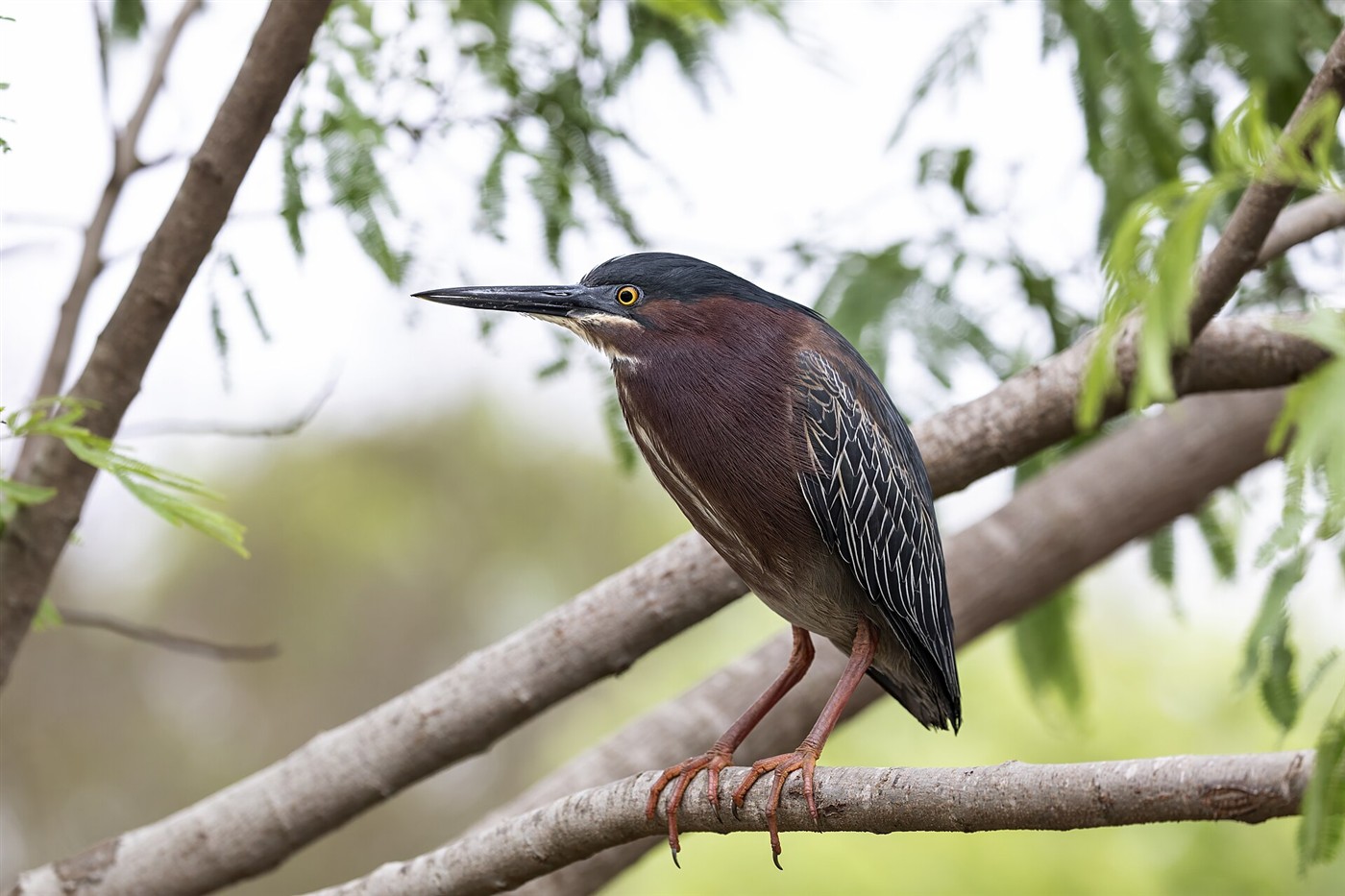
Easily overlooked, because the bird is small, roughly 16 to 18 inches long, and tends to hunch on a branch over the water. The cap is glossy greenish-black, the back and wings are iridescent green-gray, the neck is deep chestnut with a white stripe down the front, and the short legs are yellow to orange. The shaggy crest often shows when the bird is startled. Juveniles are duller, with brown and white streaking on the front, and greenish-yellow legs.
The Green Heron frequents ponds, creeks, canals, lake edges and wooded wetlands, often in places where larger herons would not bother. It is one of the few birds known to use tools, dropping bread crusts, insects or other items on the water as bait to attract fish. When flushed it gives a loud, sharp kyow.
The night-herons
Both night-herons are stocky and short-necked, with thick bills and hunched postures. They stand still at the water’s edge, and many roost in trees during the day and hunt around dusk. Learn the two adults, and then deal with the streaky brown juveniles, which are the real challenge.
Black-crowned Night-Heron (Nycticorax nycticorax)
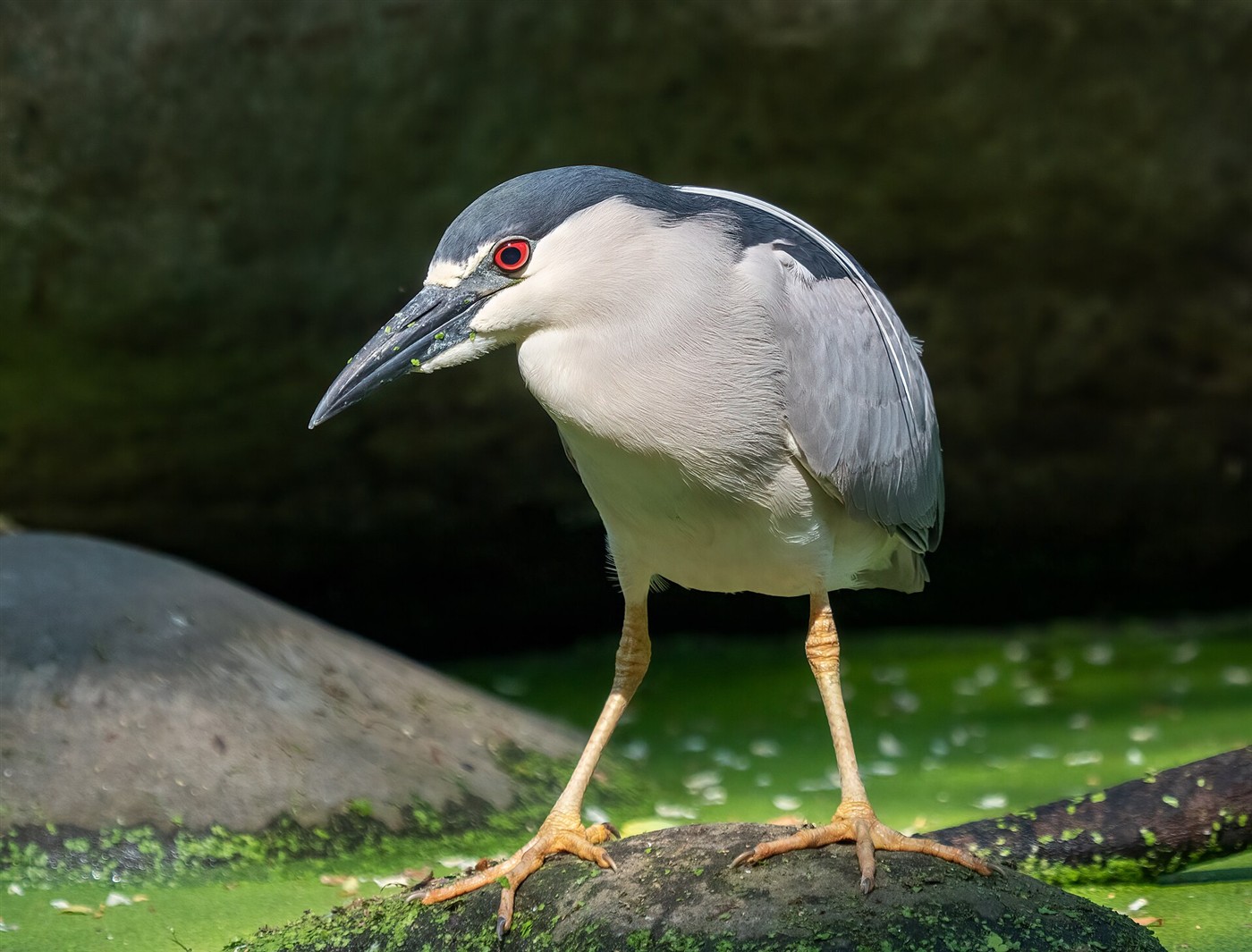
Adults have a black cap and back, pale gray wings, whitish underparts, a red eye and short yellow legs. They are about 23 to 26 inches long, with a wingspan of roughly 41 to 46 inches. Immature birds are dull gray-brown with numerous pale teardrop-shaped spots on the head, wings and back, and orange eyes. The calls are commonly written as quok or woc, and it is often heard before it is seen as it flies overhead at dusk.
It is found in both fresh and salt water, nests in colonies in trees or protected sites on the ground, and is one of the most widely distributed herons in the world. Its prey includes fish, crustaceans, frogs, insects and even small mammals and birds.
Yellow-crowned Night-Heron (Nyctanassa violacea)
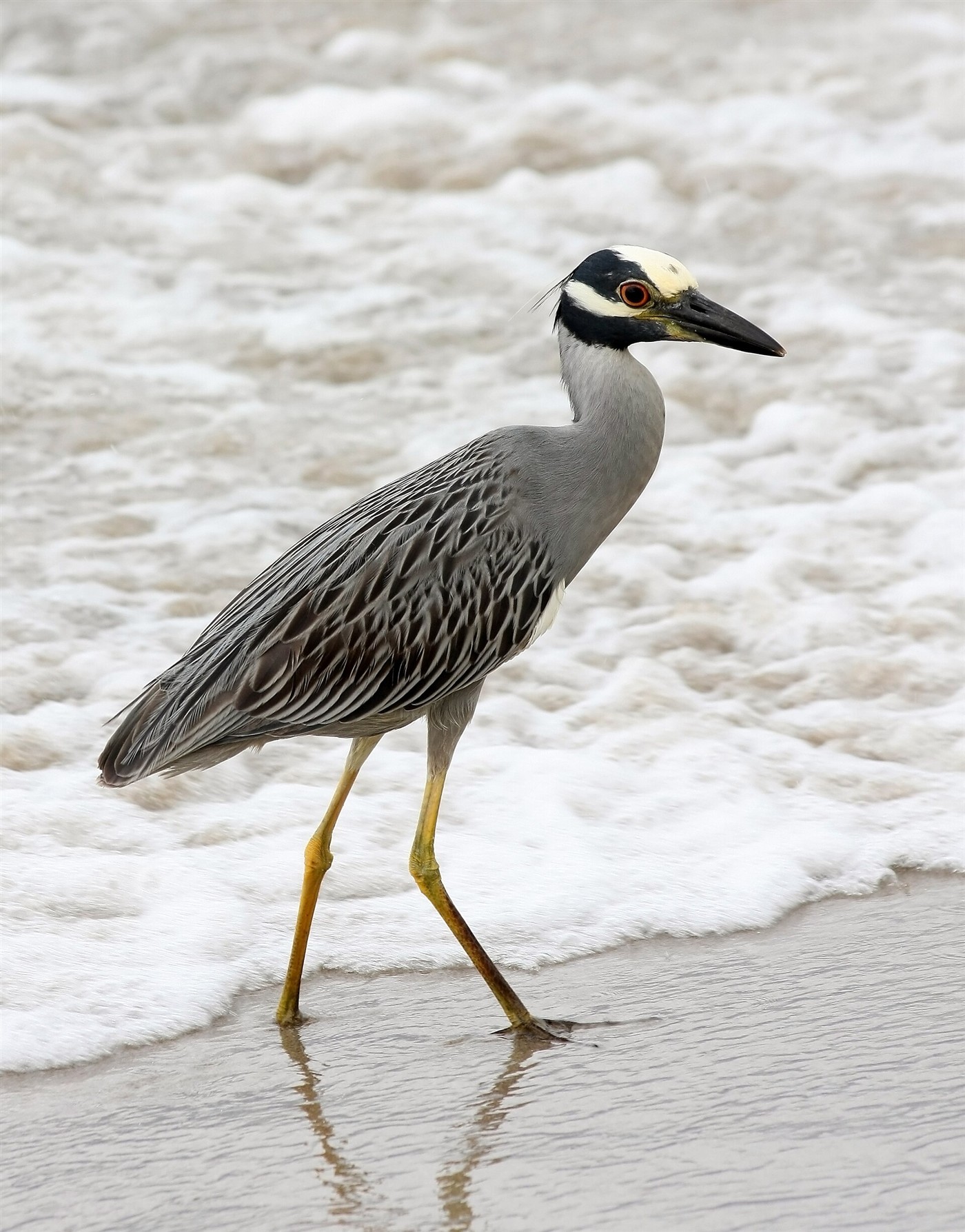
A handsome bird: smooth gray-blue body with black-scaled wing feathers, a black head with bold white cheeks, and a pale yellow-cream crown. The legs are long and yellow, turning pink or reddish in courtship. Length is about 21 to 28 inches. It looks taller and leggier than a Black-crowned Night-Heron, which is another helpful clue.
It is strongly tied to crustaceans, mainly crabs and crayfish, which is why you often see it along tidal creeks, mangroves and bayous in the Southeast, as well as along freshwater shorelines near homes in wooded neighborhoods. Unlike the Black-crowned, it is not widespread worldwide: it lives only in the Americas, from the southern United States south to Peru and Brazil.
Juveniles are brownish-gray with fine spots and streaks, and full adult plumage takes about three years. To separate a young Yellow-crowned from a young Black-crowned, look at the build and the spotting. Yellow-crowned is longer-legged and has finer, smaller spots against a grayer background, and the bill is all dark and proportionately thicker. Black-crowned has bigger, more teardrop-like pale spots and a yellower base to the bill.
The bitterns
Bitterns are the secretive members of the family. Both North American species live in dense marsh vegetation, which makes them far more often heard than seen.
American Bittern (Botaurus lentiginosus)
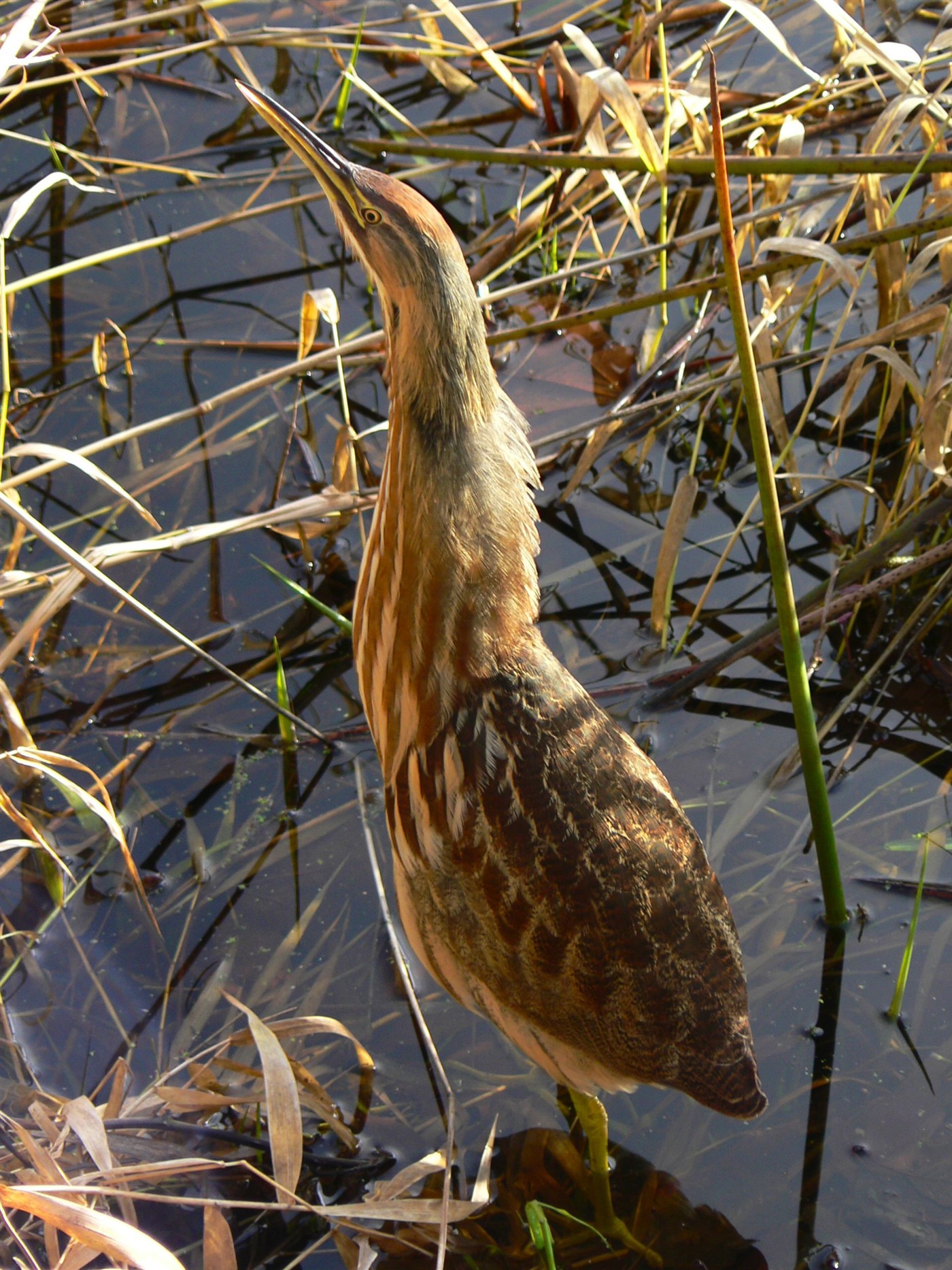
A stocky, streaky brown heron roughly 23 to 33 inches long, with a yellowish-green bill and legs, a chestnut cap and a black stripe on the side of the neck. The streaking runs vertically down the front, which is the biggest difference from a juvenile night-heron, whose pattern is spotted rather than striped from chin to belly.
When it senses danger, it freezes with the bill pointed straight up and sways slightly, so that it looks like a stalk of dry marsh grass. The photo above shows the posture. Its song, a deep, liquid pumping call that has been compared to an old pump, is made by gulping air and inflating the esophagus. It is active mostly at dawn, dusk and night.
It breeds across southern Canada and the northern and central United States and winters along the Gulf Coast, in Florida and in the Caribbean. It uses cattail marshes, bogs and the vegetated edges of shallow lakes and ponds. It is considered Least Concern globally, although numbers have declined in southern parts of its range with the loss of wetland habitat.
Least Bittern (Ixobrychus exilis)
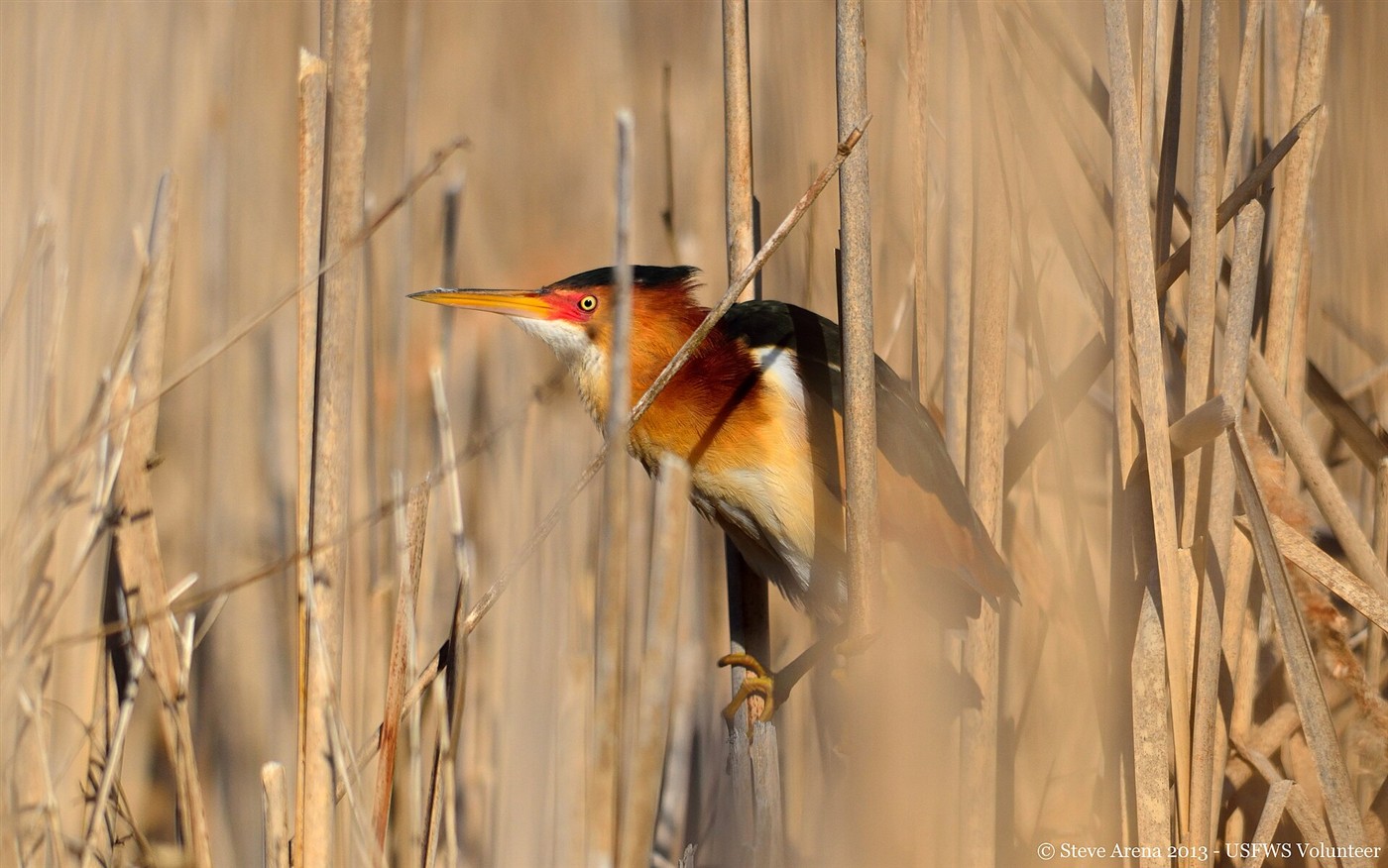
Tiny for a heron, only about 11 to 14 inches long and weighing roughly 2 to 3.5 ounces, which makes it one of the lightest herons in the world. Males have a glossy greenish-black back and cap; females are brown in those places. In both sexes you see a rich chestnut neck, a buff wing patch that flashes in flight, a yellow bill and white streaks on the shoulders.
It clings to reed stems with long toes, straddling two plants and picking fish, insects and frogs with quick jabs. When alarmed it freezes with the bill up and sways like the wind-blown reeds. Most people see one when it flushes low across the top of a cattail marsh, showing the buff wing patch, then dives back down. Patience at the edge of a dense marsh at dawn is the best strategy.
Common mix-ups, settled
- Great Egret versus Snowy Egret: bill color and size. Yellow bill and black feet means Great; black bill and yellow feet means Snowy.
- Snowy Egret versus white juvenile Little Blue Heron: check the bill and legs. A two-toned bill and greenish legs mean Little Blue; a black bill with yellow lores and yellow feet means Snowy.
- Little Blue Heron versus Tricolored Heron: white belly and white throat stripe mean Tricolored.
- Juvenile night-heron versus American Bittern: spots mean night-heron, solid vertical streaks mean bittern.
- White Reddish Egret versus Snowy or Great Egret: look for a pink bill with a black tip, and shaggy neck plumes.
Where and when to look
Most of the species above overlap in coastal and southern wetlands, where it is possible to see eight or nine in a single morning in places like the Florida Gulf Coast or the Texas coast. Farther north the list shrinks to a core group of Great Blue Heron, Great Egret, Green Heron, Black-crowned Night-Heron and the bitterns, with Snowy and Little Blue Herons appearing in summer in many states.
Early morning and late afternoon give the best light and the most feeding activity. Move slowly, let the bird settle, and watch how it hunts as well as how it looks; the behavior often decides a tricky ID before you ever get a good look at the bill.
For region-specific lists, our state guides cover herons in Florida, herons in Texas and herons in California. If you are working through lookalikes on the water, our guides to birds with long legs and white water birds are good companions to this one.