Birds That Sing at Dawn: The Order of the Morning Chorus in North America
In late May, in a patch of eastern woods, the first bird usually starts when the sky is still the color of slate. One voice, then a second one a few yards off, then a ragged stack of overlapping songs that builds for roughly an hour before the sun clears the trees. That is the dawn chorus, and it has a loose running order. The order is not fixed, and anyone who says the same five species always go first is smoothing over a messy reality.
Most of what ranks highly in search results is written about British birds. This guide is for the United States and Canada. It lays out which North American species tend to sing first, how that changes between spring and summer and between regions, why birds do this at all, and how to learn the voices. It also flags where the evidence comes from one observer on one hillside. If the dark hours before the chorus are what you are really curious about, our guides to the sounds of night birds and to nighthawk and whip-poor-will sounds cover the shift before this one.
Quick ID: the dawn singers and what they sound like
The “dawn slot” column is based on the timed morning records cited in the sections below. Treat it as a tendency, not a schedule.
| Bird | What it sounds like | Typical dawn slot |
|---|---|---|
| American Robin | Rich, caroling phrases rising and falling, “cheer-up, cheerily” | Among the first, roughly an hour before sunrise in the East and Pacific Northwest records |
| Song Sparrow | Three short notes, then a varied trill | Very early; in some records it precedes the robin |
| Chipping Sparrow | A flat, dry trill on one pitch, like a sewing machine | Very early; trills come hurried and short at first |
| Eastern Phoebe | A burry, two-part “fee-bee” | Early, in the first group of flycatchers |
| Eastern Wood-Pewee | A plaintive, slurred “pee-a-wee,” repeated | Early; averaged about an hour before sunrise in one New Hampshire series |
| Wood Thrush | Low notes, then a flute-like “ee-oh-lay,” then a trill | Mid-chorus; singing intensity peaks just before sunrise |
| Northern Cardinal | Clear, whistled phrases (“purdy, purdy, purdy”), repeated and varied | Early to mid-chorus (ninth in one famous list) |
| Carolina Wren | A loud, rolling “tea-kettle, tea-kettle, tea-kettle” | Part of the Southeast chorus; not timed in the studies we found |
| Eastern Towhee | “Drink-your-tea,” the last note a long trill | Not timed in the studies we found |
| Ovenbird | A loud, ringing “teacher, teacher, teacher” that grows in volume | The first warbler, but only about half an hour before sunrise |
| Red-eyed Vireo | Short, endlessly repeated, question-and-answer phrases | Late starter (about 20 minutes before sunrise), then sings all day |
| Black-capped Chickadee | Two clear whistled notes, the second lower | Late in a New Hampshire series, near the end of the pre-sunrise group |
| Mourning Dove | A low, mournful “coo-ah, coo, coo, coo” | Mid-list in Leopold’s Wisconsin record |
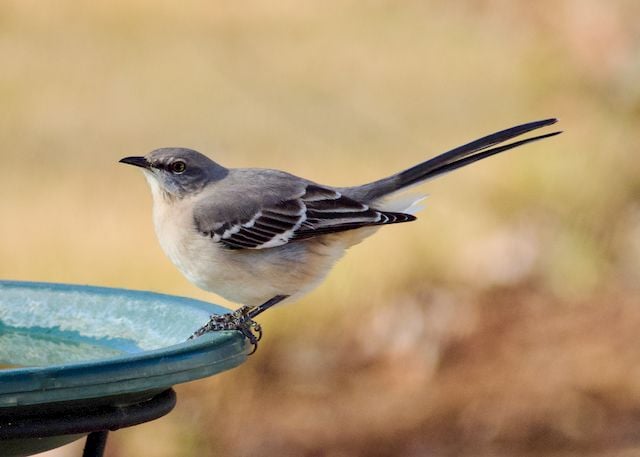
| Northern Mockingbird | Long strings of phrases, each repeated three or more times | Often already singing overnight; hands off to the dawn crowd |
| Swainson’s Thrush | Flute-like, upward-spiraling song | Early in a Pacific Northwest dawn record |
What the timed records actually show
Almost everything we know about the order comes from people who got up in the dark with a notebook. Four sets of records disagree in useful ways.
New Hampshire, 1902 to 1911
Horace W. Wright’s 1912 paper in The Auk is still the most detailed old record. He listened from a driveway with open lawn around it, at about 1,600 feet in the White Mountains, on 15 mornings between late May and early July, starting before any bird sang. The earliest sunrise on his dates was 4:02 (standard time), and 33 species averaged a first song before then. The averages ran Song Sparrow 2:56, Chipping Sparrow 2:58 and American Robin 3:02, about an hour ahead of the sun. He put the Alder Flycatcher at 3:03, the Eastern Wood-Pewee at 3:06, the Ovenbird (the first warbler) at 3:29, and both Black-capped Chickadee and Red-eyed Vireo at 3:43. A whip-poor-will was still calling from the valley while he waited.
Massachusetts: a rebuttal
Francis H. Allen answered in 1913 with notes from near Boston, dating back to 1883. His Robin averaged 3:04, almost identical to Wright’s. But his Song Sparrows averaged 3:17 and Chipping Sparrows 3:21, well behind the robin, and he suspected Wright’s sparrows were unusually early risers. He also put the Eastern Kingbird and Tree Swallow near the front. His own conclusion still holds: more observations from more places are needed before anyone generalizes.
Wisconsin, 1940
Aldo Leopold’s June 1, 1940 notes near Baraboo, as retold by Indiana Audubon, give a seventeen-bird sequence: American Robin, Field Sparrow, Indigo Bunting, Eastern Wood-Pewee, Song Sparrow, Gray Catbird, Eastern Bluebird, Great Crested Flycatcher, Northern Cardinal, Wood Thrush, Mourning Dove, Ring-necked Pheasant, Eastern Meadowlark, Brown Thrasher, Warbling Vireo, House Wren and Blue Jay. Leopold also noticed birds started earlier on clear days and later on overcast ones.
Ontario, the modern version
Adrianna Bruni, Daniel Mennill and Jennifer Foote (2014, Journal of Ornithology) describe theirs as the first comprehensive study of dawn chorus start-time variation in North American birds. They recorded six species at a rural site at Echo Bay, Ontario. The order of first song was Alder Flycatcher, Song Sparrow, White-throated Sparrow, American Robin, Eastern Phoebe, then Black-capped Chickadee. Birds began earlier on nights with a full or third-quarter moon and as the temperature at nautical twilight rose, and later with cloud cover and precipitation.
The dawn-to-sunrise timeline
Put the records side by side and a rough pattern appears for late May and June in the eastern half of the continent. The minute counts are anchored to Wright’s and Allen’s averages (sunrise at 4:02 in New Hampshire, 4:07 near Boston); yours will shift with latitude, weather and moon.
| Minutes before sunrise (approx.) | What is going on | Who you are likely to hear |
|---|---|---|
| Before the first glow | The night shift | Whip-poor-will, nighthawks, owls and, in warmer regions, a mockingbird that never stopped |
| 75 to 65 | First glimmer in the east; a few isolated songs, often one bird at a time | Song Sparrow, Chipping Sparrow, Alder Flycatcher, Barn Swallow, a robin cackling awake |
| 65 to 55 | A robin breaks into continuous song and others join; flycatchers add voices | American Robin, Eastern Phoebe, Eastern Wood-Pewee, Eastern Kingbird (Allen) |
| 55 to 35 | The chorus thickens; the thrushes come in | Hermit Thrush (about 55 min), Veery, Wood Thrush (earliest record about 37 min); cardinals and doves join in this stretch of Leopold’s list, though neither was timed by Wright |
| 35 to 15 | Warblers and vireos arrive | Ovenbird (about 33 min), American Redstart (about 16 min), Black-capped Chickadee and Red-eyed Vireo (about 19 min) |
| Sunrise and after | Chorus peaks, then thins as birds start foraging | Late warblers, Bobolink, woodpeckers, Chimney Swift |
The shape matters more than the minutes: sparrows, flycatchers and thrushes lead, warblers and vireos trail. In Wright’s record five warbler species did not start until after sunrise.
Spring versus summer
There are really two choruses. In early spring, from February or March, the loud voices belong to birds that stay through winter or return early. The American Robin sings from late February or early March, and mockingbird males begin in late January to February. Eastern Phoebes are one of the first migrants back, arriving in mid to late March. That early chorus is thin.
By May the long-distance migrants have arrived. The Eastern Wood-Pewee shows up from late April through early June. Wood Thrush, Ovenbird and Red-eyed Vireo are back on their breeding grounds, and the chorus adds layers. On his fullest mornings, Wright logged 29 or 30 different voices. Wright, Allen and Leopold all recorded between late May and early July, when Wright says birds sing most freely and are settled for nesting.
In July and August the chorus thins. Robins keep going into late July or early August, and some, especially in the East, sing occasionally into September. Allen adjusted his records back to the solstice, because sunrise creeps later every day after June 21 and a simple clock-time comparison would mislead.
Timing also shifts with the nesting cycle. An Ontario study of Eastern Phoebes found males began to sing significantly earlier when females were fertile, and sang longer during the fertile and incubation stages than while feeding young.
The order changes by region
East and Midwest
The old records cover this territory, and the pattern is the one in the timeline: robins and sparrows lead, flycatchers join, thrushes and cardinals follow, warblers and vireos finish. Some species also change what they sing at dawn; the Hitchcock Center for the Environment notes that Eastern Wood-Pewees add a third vocalization then, and puts the start of singing in western Massachusetts at about 4:30 a.m. in late May and June.
The South
In middle Georgia, wildlife writer Terry W. Johnson reports that the American Robin often opens the chorus, with songs often starting around 4 a.m. and the volume peaking about an hour before daylight. His list of participants reads like a southern yard: Northern Cardinal, Carolina Wren, Northern Mockingbird, Brown Thrasher, vireos, Eastern Bluebird, Eastern Wood-Pewee and Wood Thrush. The chorus also overlaps with the night shift, since mockingbirds sing through much of the night in nesting season and Chuck-will’s-widow calls in the early morning.
The West
We found fewer timed records from the West. One careful 2026 morning is worth setting out in full: Stephen Chase’s report from Point Whitehorn Marine Reserve in northwest Washington (June 16, sunrise 5:08), posted to the Whatcom Birds listserv. Olive-sided Flycatcher was first at 4:05, then Willow Flycatcher (4:06), Northern Rough-winged Swallow (4:08), American Robin and distant White-crowned and Song Sparrows (4:09), Swainson’s Thrush (4:10), Spotted Towhee (4:11), Yellow Warbler (4:13), and Western Wood-Pewee, Dark-eyed Junco and Savannah Sparrow (4:15). Black-headed Grosbeak came in at 4:38, Warbling Vireo at 4:43, and Bewick’s Wren at 5:03. It is one morning, not a rule, but it looks familiar: a robin about an hour before sunrise, flycatchers and sparrows in front, a vireo and a wren well behind.
We did not find timed records for the desert Southwest, the Great Plains or the boreal forest, so we will not guess at their order. For Canada, the Ontario studies above are the best reference.
Why birds sing at dawn
Nobody has proven a single reason. The Hitchcock Center article counts more than a dozen hypotheses and says there is little data to choose among them. The ones that come up most are these.
- Territory and mate advertising. Males announce an occupied territory and show females who is fit. Song output at dawn is often an honest signal of male quality, and females can compare their mate against his neighbors, according to Marini and colleagues (2020) summarizing the literature. This is the most commonly cited explanation.
- Low light. Insect-eating birds cannot forage well in near darkness, so singing is a good use of the dead time. Wright thought birds waited for the first glimmer of light.
- Internal rhythms. Circadian clocks and hormones push song to peak around dawn.
- Sound that carries. The popular idea is that cool, still, humid morning air lets a song travel farther. A 2025 study from the Cornell Lab of Ornithology’s K. Lisa Yang Center for Conservation Bioacoustics, in Philosophical Transactions of the Royal Society B, tested this “acoustic transmission” idea across 69 species at 43 sites in India’s Western Ghats and found little support for it. That was a tropical forest, so it does not settle North America, but treat “sound carries” as a hypothesis, not a fact.
Artificial light
Moonlight, warmth, cloud and rain nudge start times, as the Ontario study showed, but streetlights do far more. Mark Miller’s 2006 study in The Condor, which covered sites from rural Pennsylvania to Washington, D.C., found robins in areas with a lot of artificial light often began their chorus during true night, and in the most urban sites they were singing about two hours and forty-five minutes earlier than in the darkest areas.
Species by species: how to tell them apart
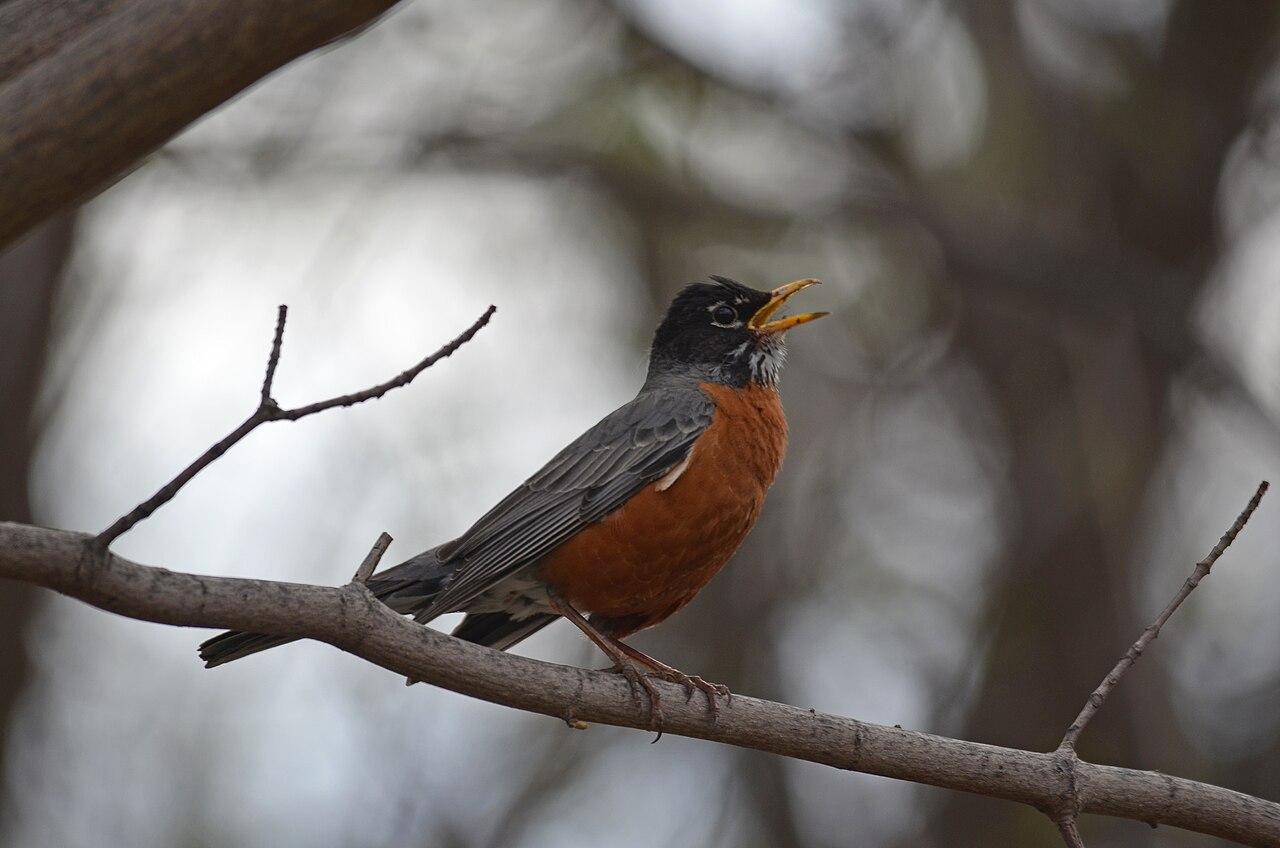
American Robin (Turdus migratorius)
The robin is the standard first-light singer in nearly every record above. The song is a series of rich, caroling notes rising and falling in pitch, usually written “cheer-up, cheerily.” Our American Robin guide has more on the bird itself.
Sound of American Robin (song, recorded in Minnesota):
Recording: Jonathon Jongsma, XC75499, CC BY-SA 3.0.
Song Sparrow (Melospiza melodia)
A Song Sparrow phrase opens with three short notes followed by a varied trill. Individual birds have several versions, but “notes, notes, notes, then a trill” is the clue. In Wright’s record this is a bird that starts before the robin; in Allen’s, well after.
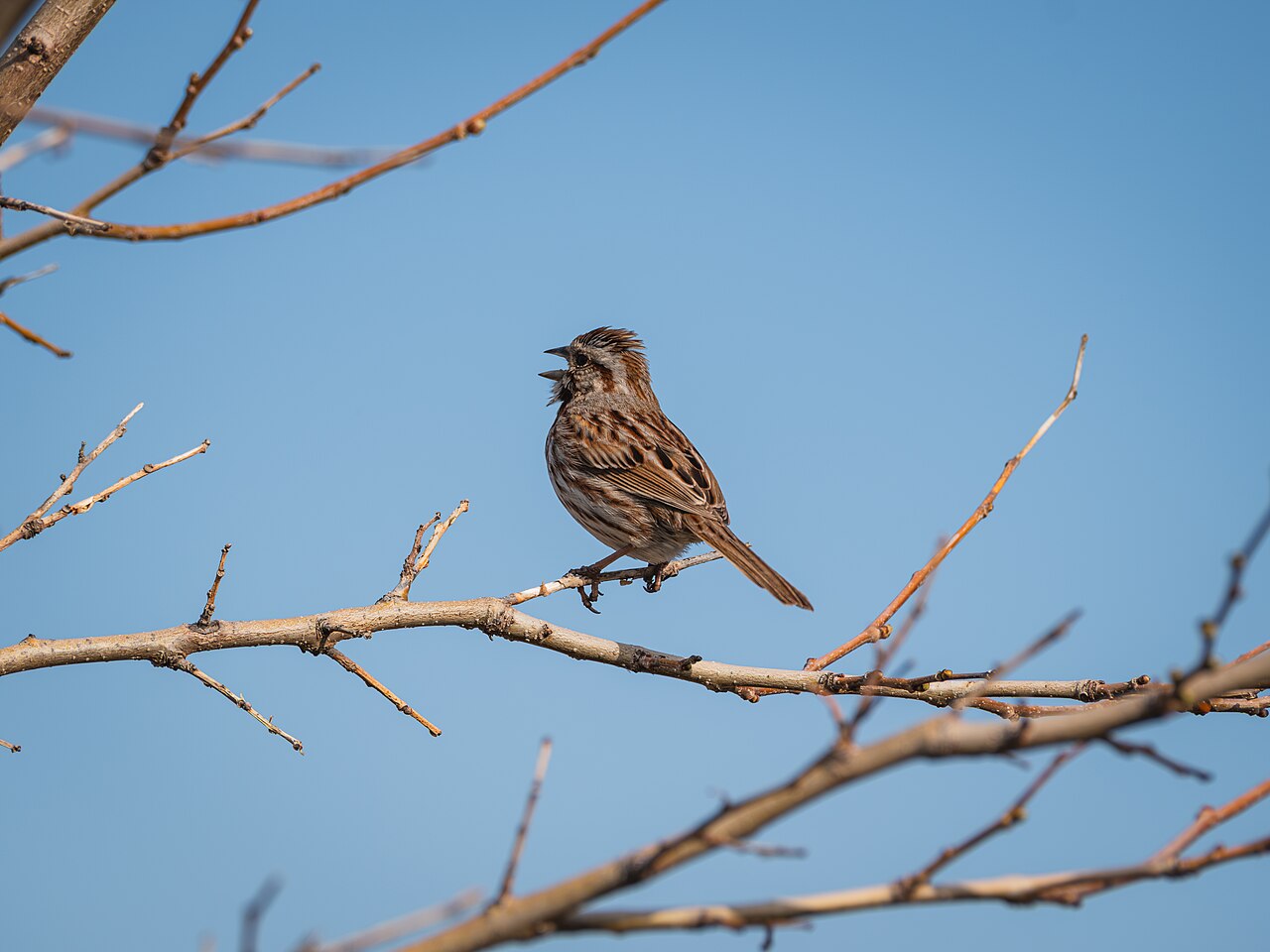
Sound of Song Sparrow (song, recorded in Maryland):
Recording: Ryan Douglas, XC1005250, CC BY-SA 4.0.
Chipping Sparrow (Spizella passerina)
The Chipping Sparrow’s song is a thin, musical trill all on one note, like a sewing machine, according to Audubon. At dawn it changes. Both Wright and Allen noticed that early trills are shorter and come one after another in a hurried, excited run, unlike the relaxed trill you hear at noon. Dark-eyed Juncos and Pine Warblers also trill on one pitch, so check the bird before you commit.
Sound of Chipping Sparrow (song, recorded in Minnesota):
Recording: Jonathon Jongsma, XC320440, CC BY-SA 4.0.
Eastern Phoebe (Sayornis phoebe)
The phoebe says its name in a two-note “fee-bee.” It is among the earliest migrants to return in spring, arriving in mid to late March, and it nests on bridges and buildings and pumps its tail while perched. In the Ontario study it sat fifth of six, behind the robin and ahead of the chickadee.
Sound of Eastern Phoebe (song, recorded in Minnesota):
Recording: Jonathon Jongsma, XC178126, CC BY-SA 4.0.
Eastern Wood-Pewee (Contopus virens)
A mournful, whistled “pee-a-wee” given in a series, with a plain “pe-wee” call that rises at the end. In Wright’s series the pewee averaged first song at 3:06. It is a gray-olive woodland flycatcher with two pale wing bars.
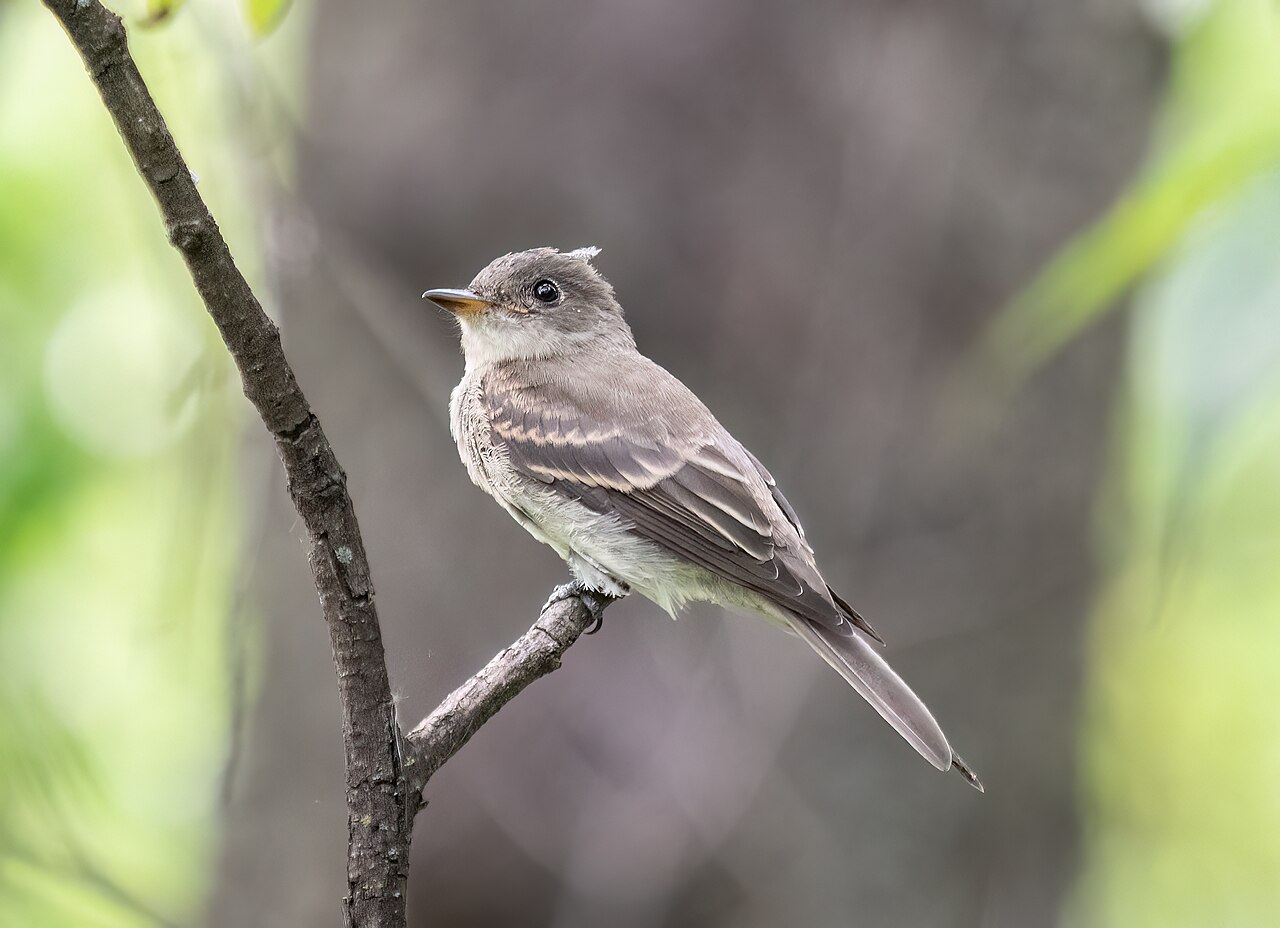
Sound of Eastern Wood-Pewee (song, recorded in Minnesota):
Recording: Jonathon Jongsma, XC136047, CC BY-SA 3.0.
Wood Thrush (Hylocichla mustelina)
The Wood Thrush has a three-part song: two to six low notes, a loud middle phrase usually written “ee-oh-lay,” then a trill-like finish. It can sing two notes at once, which gives the song its ethereal, flute-like quality. Males sing at dawn and dusk, often from high perches early in the season, and singing peaks just before sunrise. A short “bup, bup, bup” is its alarm call, which you may hear if you get too close.
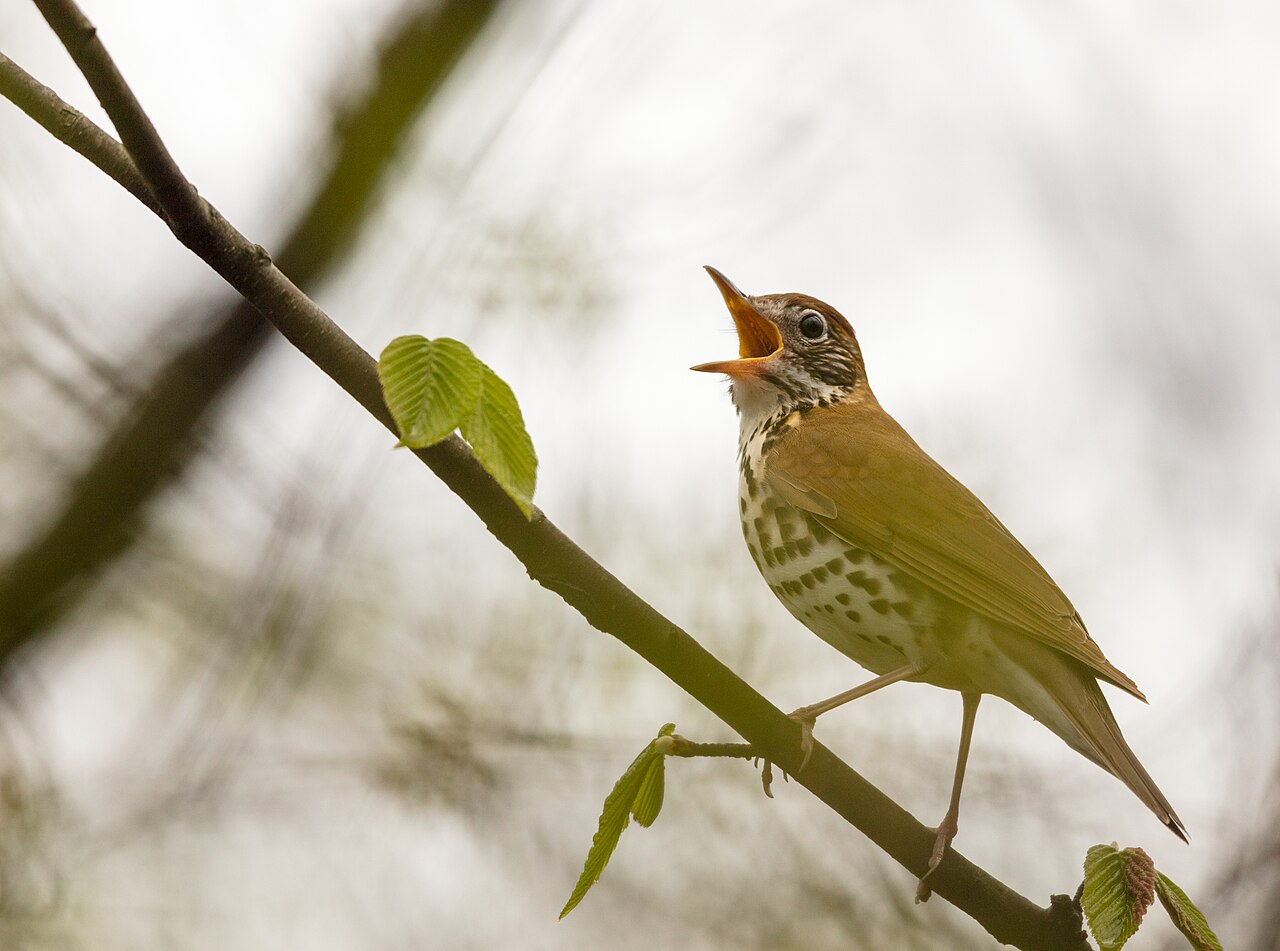
Sound of Wood Thrush (song, recorded in Minnesota):
Recording: Jonathon Jongsma, XC178133, CC BY-SA 4.0.
Northern Cardinal (Cardinalis cardinalis)
Cardinals sing clear, whistled phrases, repeated several times and then varied, written as “cheeeer-a-dote” or “purdy, purdy, purdy… whoit, whoit, whoit.” Unlike most songbirds, female cardinals sing about as readily as males. Males sing loudly from high perches to defend a territory. See our Northern Cardinal guide.
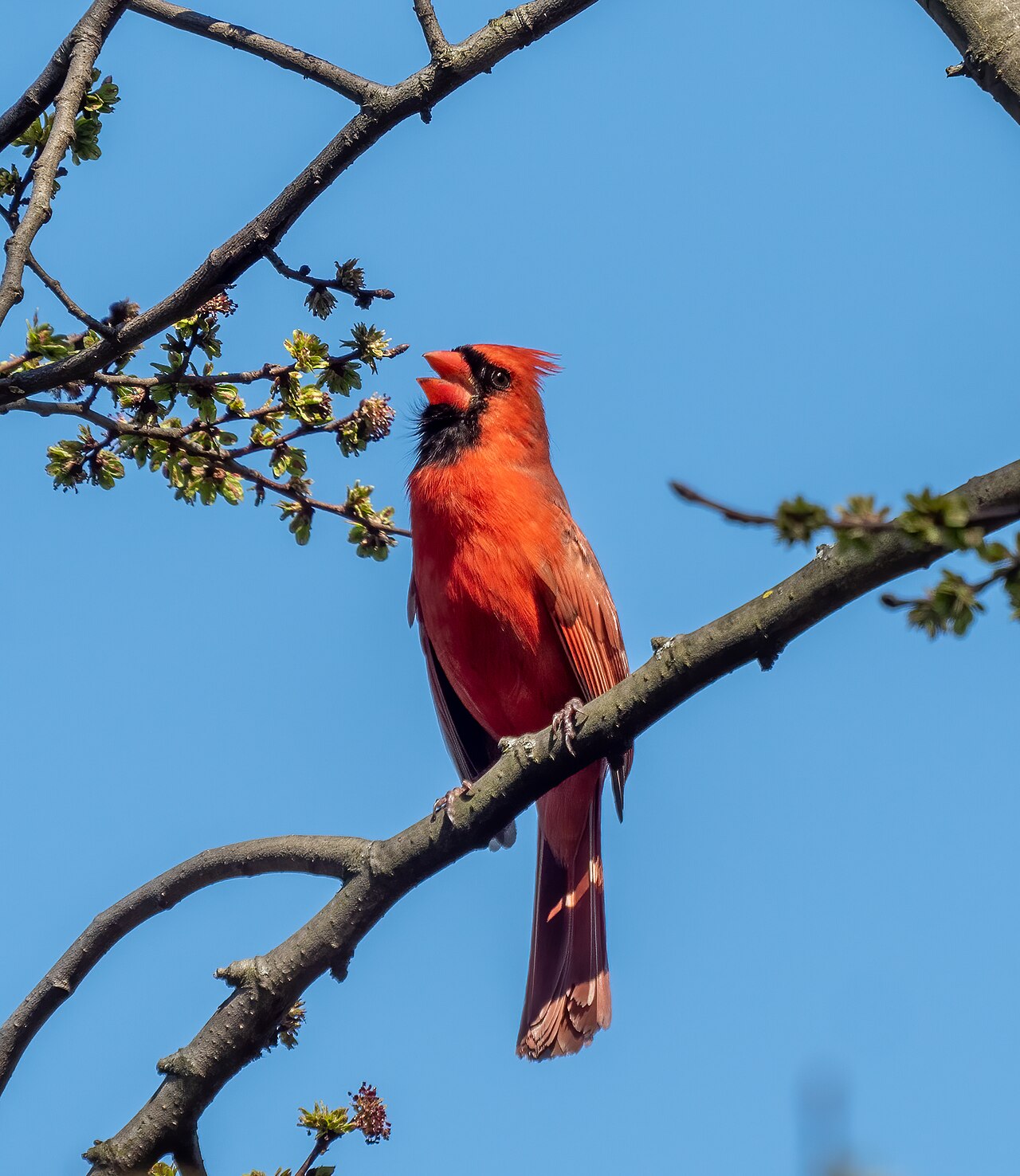
Sound of Northern Cardinal (song, recorded in North Carolina):
Recording: steve, XC797998, CC BY-SA 4.0.
Carolina Wren (Thryothorus ludovicianus)
The Carolina Wren sings a loud, whistled “tweedle-tweedle-tweedle” or “tea-kettle, tea-kettle, tea-kettle, tea,” all day and in every season. Pairs often duet, the female adding a chattering note while the male sings. Because it sings in every season and at every hour, the wren tells you little about the time, but it is a reliable voice to learn first. See our Carolina Wren guide for more.
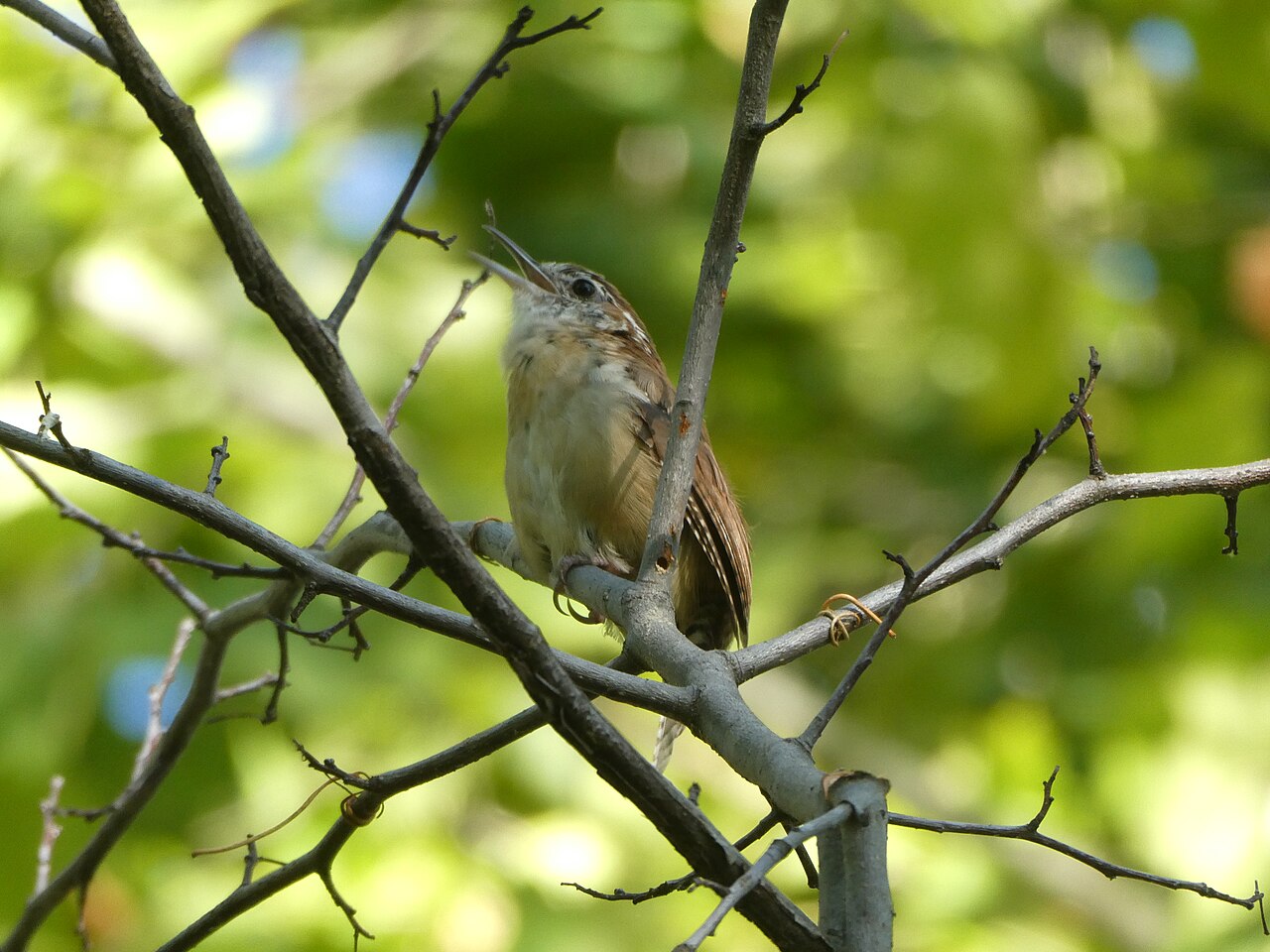
Sound of Carolina Wren (song, recorded in Vermont):
Recording: Matthias Sirch, XC384609, CC BY-SA 4.0.
Ovenbird (Seiurus aurocapilla)
A ground-nesting warbler of mature deciduous and mixed forest, the Ovenbird sings a loud series that increases in volume, “teacher, teacher, teacher,” about eight times. Males also give a sweet, chattering flight song in the air at twilight. In Wright’s records it was the first warbler to sing, but only about half an hour before sunrise, behind most of the thrushes and sparrows.
Sound of Ovenbird (song, recorded in Minnesota):
Recording: Jonathon Jongsma, XC77882, CC BY-SA 3.0.
Four more voices to know
Eastern Towhee sings introductory notes and a trill, usually rendered “drink-your-teeaaa,” from brushy edges and open woods. Audubon notes the northeastern population has declined seriously in recent decades. Listen on the xeno-canto species page.
Red-eyed Vireo gives short question-and-answer phrases from the canopy, with less than a second between songs, and holds the record for most songs by a bird in one day, more than 20,000, according to Wikipedia. It is a late starter at dawn (about 3:43 against a 4:02 sunrise in Wright’s records) but does not quit when the chorus fades. Listen on the xeno-canto species page.
Black-capped Chickadee sings two clear whistled notes, the second lower. It is a permanent resident across Alaska, Canada and the northern United States, and it started late in both the Ontario study and Wright’s list. Listen on the xeno-canto species page.
Mourning Dove males sing a low, mournful “coo-ah, coo, coo, coo.” The dove sat eleventh in Leopold’s list; our Mourning Dove guide has the full story, and recordings are on the xeno-canto species page.
Swainson’s Thrush (Catharus ustulatus)
In the Washington morning above, Swainson’s Thrush started one minute after the robin and one minute before the Spotted Towhee. The song is flute-like and rises in a spiral, and it is a good West Coast and northern species to learn alongside the robin.
Sound of Swainson’s Thrush (song, recorded in Colorado):
Recording: jordan, XC563220, CC BY-SA 4.0.
The night-to-dawn handoff
The chorus does not start from silence. Overnight, the Northern Mockingbird is the songbird most likely to still be going. Audubon describes its song as a long series of musical and grating phrases, each repeated three or more times, and says it carries on all day in the nesting season and often all night as well. Our guide to what bird screams at night covers the mockingbird’s after-dark side in more detail.
Sound of Northern Mockingbird (song, recorded in North Carolina):
Recording: steve, XC884705, CC BY-SA 4.0.
The nightjars are the other half of the handoff. Eastern Whip-poor-wills sing at dusk and again before dawn, and Wright heard one call from the valley while he waited for his first songbird. Common Nighthawks are also active at dusk and dawn; the nighthawk and whip-poor-will guide covers the full nightjar cast. Why night calls happen at all is covered in why birds chirp at night.
Sound of Eastern Whip-poor-will (song, recorded in North Carolina):
Recording: steve, XC905500, CC BY-SA 4.0.
How to learn the chorus
You do not need to untangle 30 voices in one go. A workable approach:
- Start with three birds. Pick the robin, the cardinal and whichever of the Carolina Wren, Song Sparrow or Chipping Sparrow lives near you. Learn them from the recordings above until you can say what each one sounds like without looking at a name.
- Go out earlier than feels reasonable. In the records above, the first songs begin about 60 to 80 minutes before sunrise. Choose a calm, clear morning in May or June, when the chorus is fullest, and get settled before the first bird sings.
- Write down times, not just names. Wright did this with a block of paper and a small lantern. A phone notes app works. Log the time each new species joins. After five or six mornings you will have your own local order, which is more useful than any published list.
- Check yourself. Cornell’s Merlin Bird ID app can listen and suggest species by converting sound into a spectrogram, but accuracy drops with wind and background noise. Treat it as a second opinion. Our beginner’s guide to bird watching covers the other basics.
How to record the dawn chorus with a phone
A phone is good enough to capture a single singer and settle an argument later. The eBird and Macaulay Library smartphone guidance boils down to a few rules:
- Get closer. The nearer you are to the bird, the better the recording, so do not try to record the whole chorus from the porch and hope for the best.
- Point the microphone at the bird and keep background noise behind you.
- Stay still and quiet. Phones pick up handling noise, talking and footsteps better than distant birdsong. Hold the phone gently or rest it on something steady.
- Record in WAV if you can. Uncompressed files give better results than MP3 or M4A. Merlin’s recorder uses WAV.
- Record at least 30 seconds and, at the end, say the species and what the bird was doing.
One more rule: do not play recordings back to draw a singing bird in. In the breeding season that pulls a male off his territory and away from feeding or nest duty.
Frequently asked questions
What bird sings first in the morning?
There is no single answer. In the timed records from New Hampshire, Massachusetts, Wisconsin, Georgia and Washington, the American Robin is first or near first, with sparrows and flycatchers close behind. In the Ontario study, the Alder Flycatcher was first and the Song Sparrow second.
What time do birds start singing at dawn?
In late spring and early summer, the earliest singers start roughly 60 to 80 minutes before sunrise. In the Washington example, sunrise was 5:08 and the first bird sang at 4:05. Latitude, date, cloud cover and moonlight all move the clock.
Why do birds sing so loudly at dawn?
The most commonly cited reasons are advertising a territory and showing mate quality. Low light that limits foraging and internal body rhythms are also proposed. The idea that sound carries better in cool, calm air is popular, but a 2025 tropical-forest study found little support for it.
Why is a bird singing at 3 a.m.?
Often it is a mockingbird, which can sing through the night in breeding season, or a robin living under artificial light. Robins in brightly lit areas have been recorded singing about two hours and forty-five minutes earlier than those in dark areas. Moonlight also makes birds start earlier.
Do all birds join the dawn chorus?
No. Some barely join in, and warblers tend to start later than sparrows and thrushes. Even birds thought not to take part sometimes do: an Algoma University study using automated recorders found Brown Creepers singing before sunrise, mostly from April through early June.
The short version
Sparrows, flycatchers and robins start the chorus, thrushes and cardinals fill it out, warblers and vireos come in last, and the exact order depends on where you stand, the date, the weather and the moon. Learn three songs, get out early, write down what you hear and when, and in a few weeks you will have your own timetable. For the night shift before it, see our sounds of night birds hub.
Sources
- Wright, H. W. 1912. “Morning Awakening and Even-Song.” The Auk 29(3): 307-327.
- Allen, F. H. 1913. “More Notes on the Morning Awakening.” The Auk 30(2): 229-235.
- Bruni, A., D. J. Mennill and J. R. Foote. 2014. “Dawn chorus start time variation in a temperate bird community: relationships with seasonality, weather, and ambient light.” Journal of Ornithology 155: 877-890.
- Bruni, A. and J. R. Foote. 2014. “Dawn singing of Eastern Phoebes varies with breeding stage and brood number.” The Wilson Journal of Ornithology.
- Marini, K. L. D., S. Nadon and J. R. Foote. 2020. “Dawn singing in Brown Creeper (Certhia americana).” Canadian Field-Naturalist 134(2): 117-124.
- Miller, M. W. 2006. “Apparent effects of light pollution on singing behavior of American Robins.” The Condor 108: 130-139; National Wildlife Federation, “Good Day, Streetlight,” 2007.
- Ramesh, V. and colleagues, 2025, Philosophical Transactions of the Royal Society B, as reported by KAXE public radio, “A new study knocks down a popular hypothesis about why birds sing at dawn.”
- Johnson, T. W., Georgia Department of Natural Resources, “Out My Backdoor: A Chorus Made by (and for) Early Birds.”
- Chase, S. 2026. “Dawn Chorus Update #13,” Whatcom Birds listserv (North Cascades Audubon), June 16, 2026.
- Indiana Audubon Society, “The Dawn Chorus” (2026), retelling Aldo Leopold’s June 1, 1940 notes.
- Hitchcock Center for the Environment, “The ‘dawn bout’: Why do the birds wake me up so early?”
- Audubon Field Guide entries for American Robin, Song Sparrow, Chipping Sparrow, Black-capped Chickadee, Mourning Dove, Carolina Wren, Eastern Towhee and Northern Mockingbird; Wikipedia entries for American Robin, Eastern Wood-Pewee, Eastern Phoebe, Wood Thrush, Northern Cardinal, Ovenbird, Red-eyed Vireo and Northern Mockingbird.
- eBird Help Center / Macaulay Library, “Smartphone recording tips.”
- Xeno-canto recordings by the credited recordists, used under the licenses shown beside each one.