What Bird Is Singing That Pretty Song? How to Identify It (and 12 of North America’s Most Beautiful Singers)
You are standing in the yard, or on a trail, or at an open window, and something starts up in the trees. It is a run of liquid notes that climbs, hangs, and falls away, and it is lovely enough that you stop what you are doing. You look up and see nothing. The singer is somewhere in the leaves, and the song is already over before you can decide what to call it.
The good news is that a song like that leaves more clues than it seems to. Time of year, habitat, the shape of the phrase, and whether the bird repeats itself will narrow the field to a handful of species in a couple of minutes. This guide walks through that process, then profiles twelve of the best-known “pretty” singers in North America, with an audio clip for each so you can compare what you heard. Beauty is a matter of taste, and the Cornell Lab of Ornithology has run its own piece on the most beautiful bird song in North America without crowning a single winner, so treat the list as the usual suspects, not a ranking.
If your mystery singer woke you in the dark, start with our guides to the sounds of night birds and to the birds that sing at dawn. This one is for daytime and evening singers, the ones you notice on a spring walk.
Start with the clues you actually have
You may not have heard the whole song, and you may not have a recording. You almost certainly know four things, and each of them cuts the candidate list sharply.
- Season. Many of the most admired singers are summer residents. The Wood Thrush, Veery and Baltimore Oriole spend the winter in the tropics, so a thrush-like song in January is not one of them. Most of the bird music in the eastern United States arrives between March and June, is fullest in late spring, and thins out through July. Robins start singing as early as late February or early March and carry on into July or August.
- Time of day. The best singing is early morning and again around dusk. Some birds sing through the whole day, such as the Red-eyed Vireo, which our dawn guide describes as a late starter that then keeps going.
- Habitat. Is the sound coming from deep, damp woods, a thicket, a fence line, an open field, or your own garden hedge? Wood Thrushes and Veeries favor shady, moist woodland. Meadowlarks sit in open grassland. Carolina Wrens and cardinals live in tangles at the edge of your yard.
- Region. A Western Meadowlark in Georgia would be a surprise, and so would a Carolina Wren in Montana. Even a rough location removes several candidates.
Write the clues down before you open an app, for example “dense woods near a creek, mid-May, evening.”
Describe the sound: a short vocabulary
Birders reuse a handful of words, and they sort songs into families quickly.
- Flute-like. Smooth, pure, rounded notes with little buzz or rasp, often with a hollow quality. Thrushes and meadowlarks live here.
- Whistled. Clear single tones, like a person whistling, usually slurring up or down. Cardinals, orioles and white-throated sparrows.
- Bubbling or warbling. A fast, tumbling stream of notes that runs together. House Wrens and, in a more liquid way, Western Meadowlarks.
- Phrases repeated. The bird sings the same short unit several times, pauses, then starts a new one. Cardinals and Carolina Wrens work this way, as does the Brown Thrasher, which doubles each phrase.
- Rising, falling, or spiraling. Does the song climb, drop, or loop? The Veery’s song drops in a downward spiral. A robin’s phrases go up and down in a quick, wobbly way.
Then ask whether the bird repeated each phrase, and how many times. That alone separates many look-alikes.
The beautiful singers, by sound quality
The audio clips below come from xeno-canto, a shared library of wild bird recordings, and each is used under a Creative Commons license with the recordist credited. Most birds sing a repertoire, so one clip is a sample, not the only version you will hear.
Flute-like and ethereal
This is the group people usually mean when they say a bird song is beautiful. These are the thrushes and the meadowlarks.
Wood Thrush
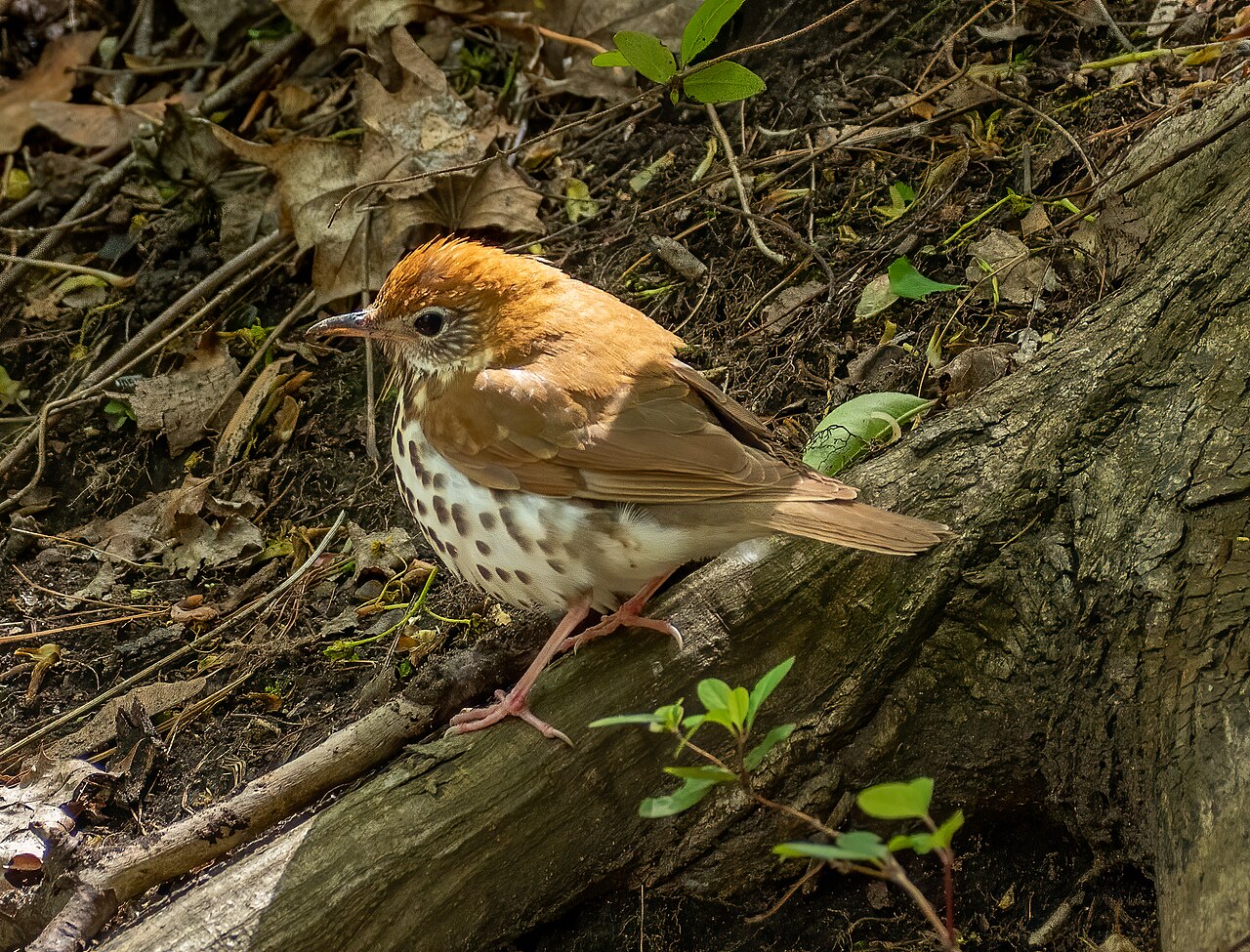
The male’s song has three parts: a few soft, low notes, a loud phrase often written “ee-oh-lay,” and a trill that seems to come from nowhere in particular. Wikipedia notes that the male can sing two notes at once, which gives the song its ethereal, flute-like quality. Audubon calls the song a series of rich, melodious, flute-like phrases. It sings in mature, damp deciduous or mixed woods. The bird reaches the U.S. Gulf Coast in the first week of April, pairs form by mid-April to early May, and the song carries through the summer; fall migration begins in mid-August. It winters from southern Mexico to Panama. Look-alikes: the Hermit Thrush and Veery are smaller and less boldly spotted, and the Brown Thrasher has streaks, yellow eyes and a longer tail.
Recording: Philip Vanbergen, XC364559, CC BY-SA 4.0.
Hermit Thrush
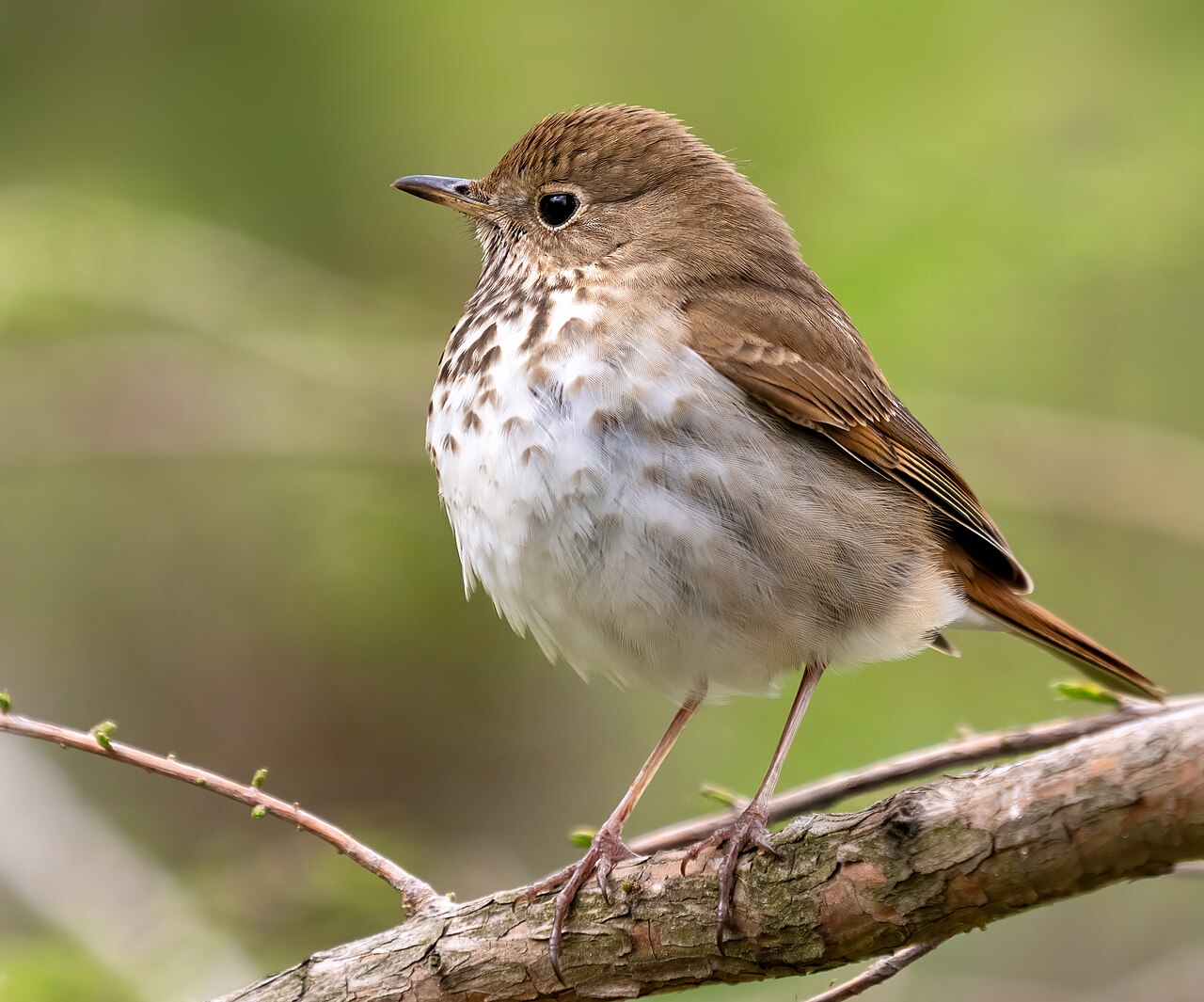
Audubon describes the song as a series of clear, musical phrases, each on a different pitch, opening with a piping note and ending in a reedy tremolo. Wikipedia describes several descending phrases in a minor key, repeated at different pitches. Each phrase is followed by a pause, then a version at a different pitch. It breeds in coniferous or mixed woods across Canada, southern Alaska, and the northeastern and western United States. It is the only spotted thrush normally found in North America in winter, but the sources we checked describe the song only in the breeding season. The reddish tail is the best visual clue, and Swainson’s Thrush is the bird it is most often confused with.
Recording: steve, XC801743, CC BY-SA 4.0.
Veery
Audubon calls the Veery’s song a rich downward spiral with an ethereal quality, and Wikipedia describes it as breezy, downward-spiraling and flute-like. It sounds less like a melody than a coin rolling down a funnel. Veeries breed in humid deciduous forests with dense understory, usually near streams, and sing from a low, concealed perch. They spend less than half the year in North America and winter in South America. Eastern birds are warm tawny with a pale, plain face; western birds are duller, with more chest spotting.
Recording: Maxwell Smith, XC420943, CC BY-SA 4.0.
Western and Eastern Meadowlark
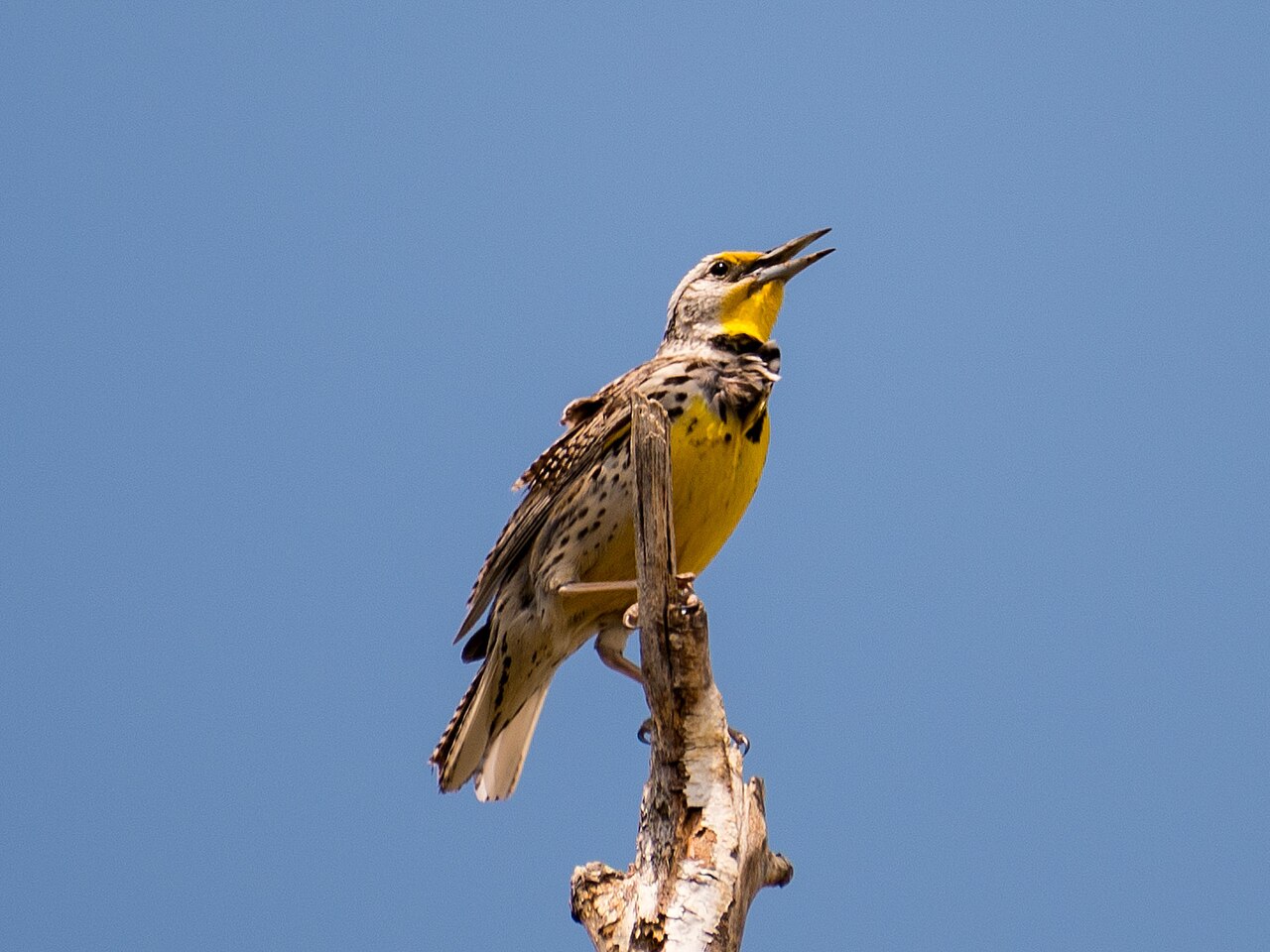
The two meadowlarks look almost identical and sound completely different, which is why birders say they are best told apart by voice and range. Audubon describes the Western Meadowlark’s song as a rich, flute-like jumble of gurgling notes, usually descending the scale. The Eastern Meadowlark’s song is, by Audubon’s description, a clear, mellow whistle, written “see-you, see-yeeeer,” which Wikipedia calls pure, melancholy whistles. Both live in open grassland and pastures; where they overlap, the Western prefers shorter, drier grass. Northern Westerns migrate south for winter, while the Eastern stays all year across much of its range. Read more about the bird in our Western Meadowlark profile and its meaning and symbolism.
Western Meadowlark
Recording: Jonathon Jongsma, XC254455, CC BY-SA 4.0.
Eastern Meadowlark (a very short clip, so press play twice)
Recording: Diana Doyle, XC700409, CC BY-SA 4.0.
Clear whistles
Whistled songs are the easiest to remember, because you can imitate them.
Northern Cardinal
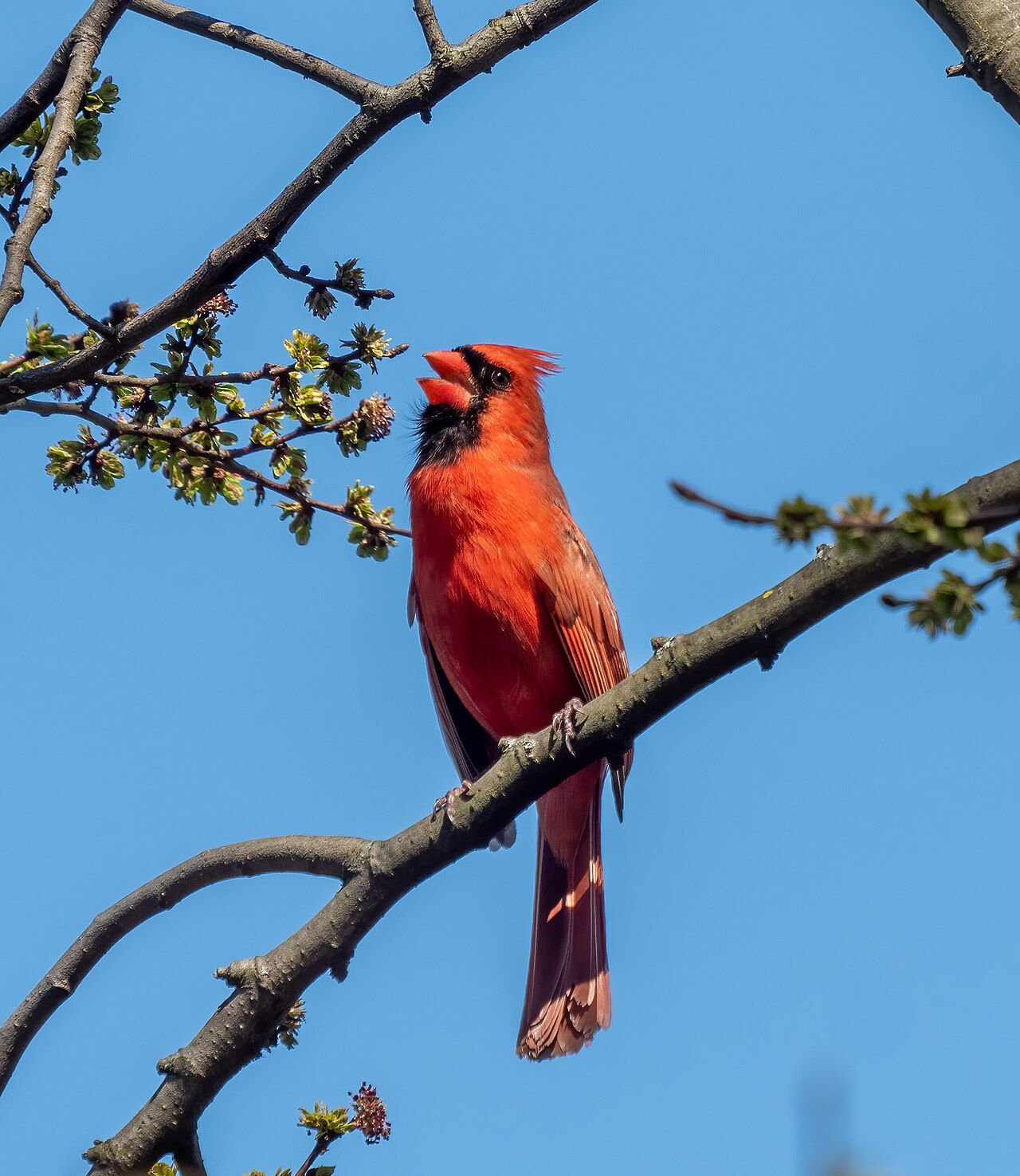
Cardinal song is made of clear whistled patterns that the bird repeats several times, then varies. Audubon puts it as “what-cheer, cheer, cheer” or “purty-purty-purty-purty,” which is the standard answer to the question of what bird sings “pretty pretty pretty.” Females sing too, mostly in spring before nesting. Cardinals do not migrate, so they are one of the few birds on this list you can hear in January, and they live in woodland edges, thickets and suburban gardens. For more, see our Northern Cardinal guide and the cardinal symbolism post.
Recording: Eric B, XC569289, CC BY-SA 4.0.
White-throated Sparrow
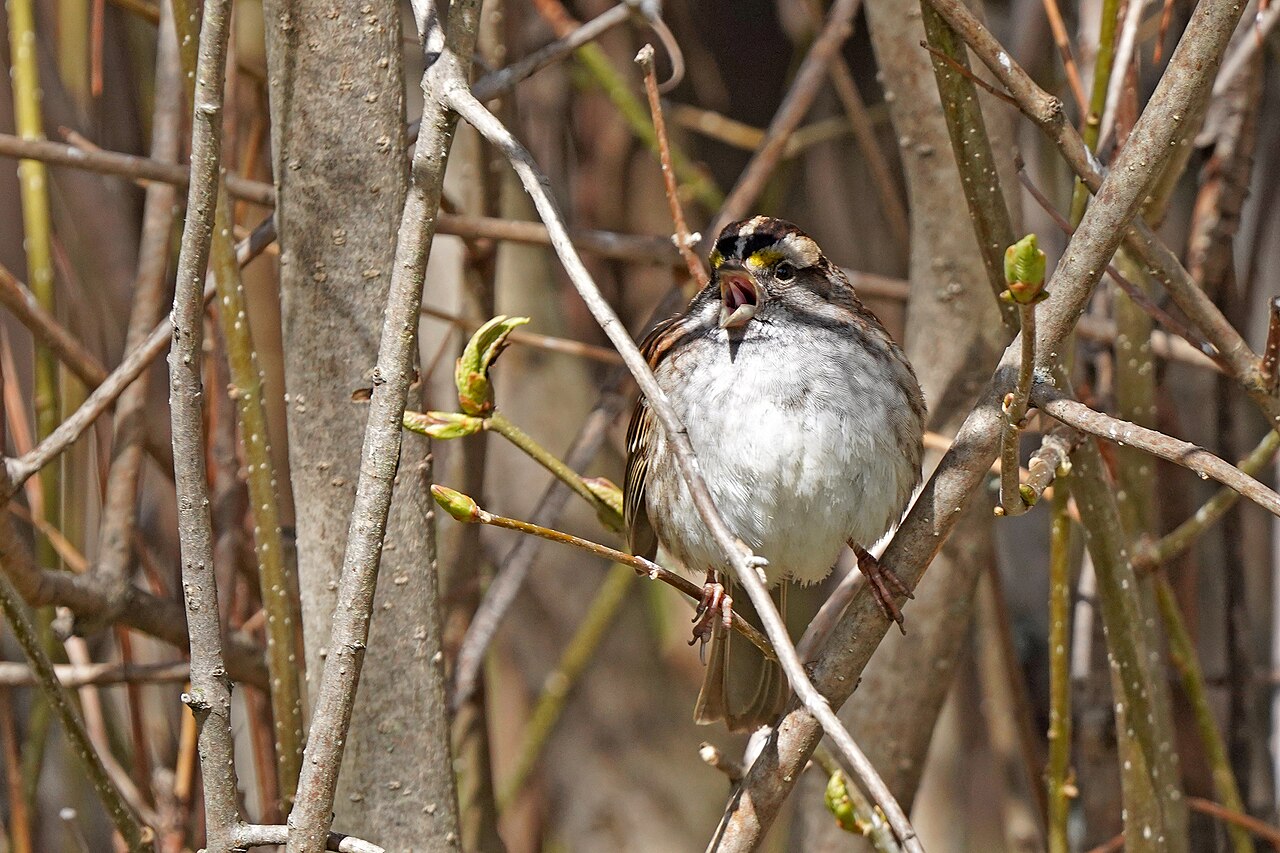
This is a thin, sweet, wavering whistle, and Audubon gives it as “Poor Sam Peabody, Peabody, Peabody” or “Sweet, sweet Canada, Canada, Canada.” The bird breeds in thickets and undergrowth of conifer and mixed woodland in the north, and winters in dense low cover in forest edges, suburbs and parks across the eastern United States and, in smaller numbers, the West. It migrates mostly at night and relatively late in fall. The similar-looking White-crowned Sparrow lacks the white throat patch and yellow lores.
Recording: Jonathon Jongsma, XC139570, CC BY-SA 3.0.
Baltimore Oriole
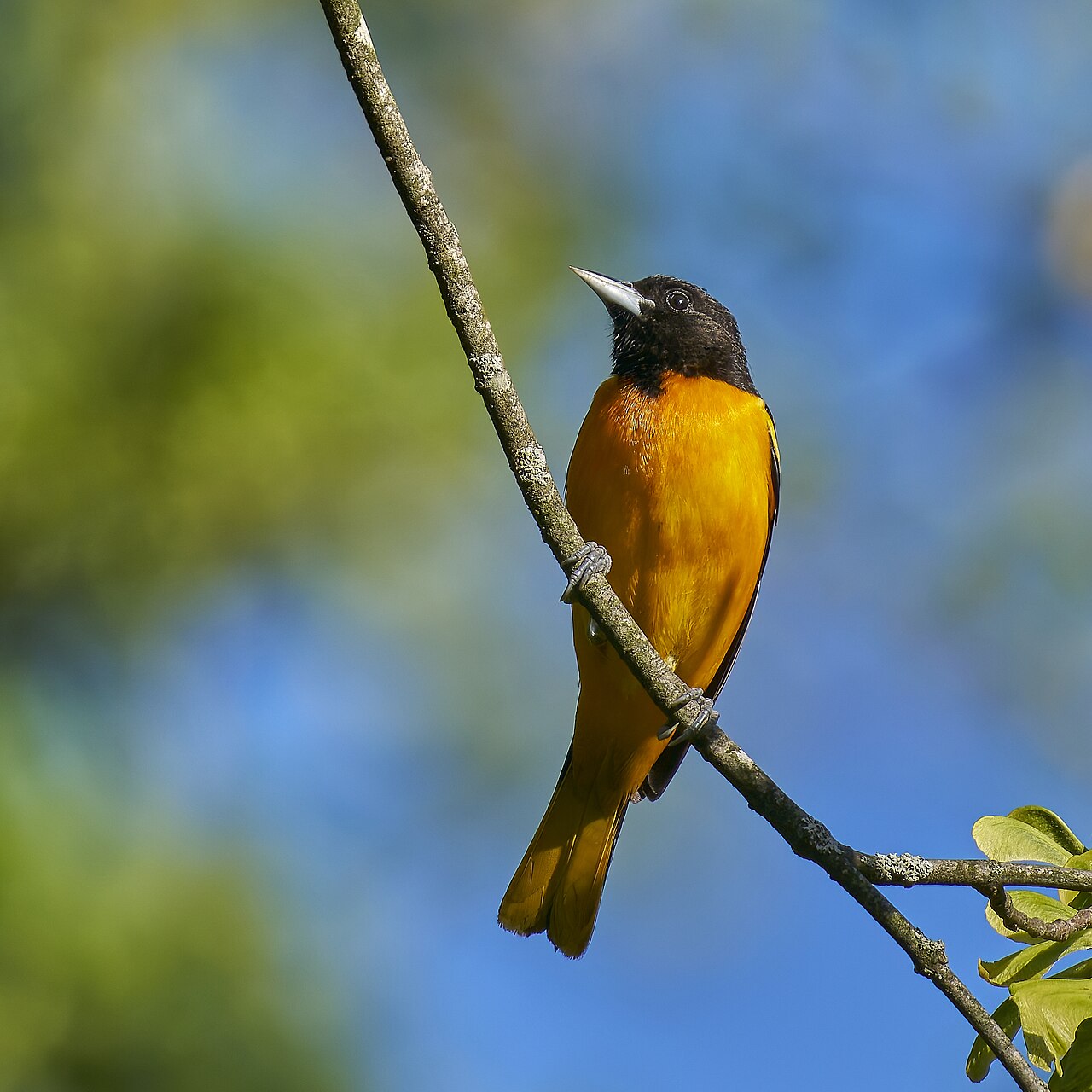
Audubon describes clear, flute-like whistled single or double notes in short, distinct phrases, with a lot of variation from bird to bird. Wikipedia transcribes pieces of it as “tyew, pyeer, peededoo.” The oriole sings from high in large, leafy trees such as elms, in open woods and along rivers. It is a summer bird: many leave in July and August for the tropics. In the Great Plains, the Baltimore Oriole meets the Bullock’s Oriole of the West and the two interbreed, and the Orchard Oriole is another eastern relative to rule out. See the oriole symbolism post for the cultural side.
Recording: Jonathon Jongsma, XC178046, CC BY-SA 4.0.
Bubbling and warbling
House Wren
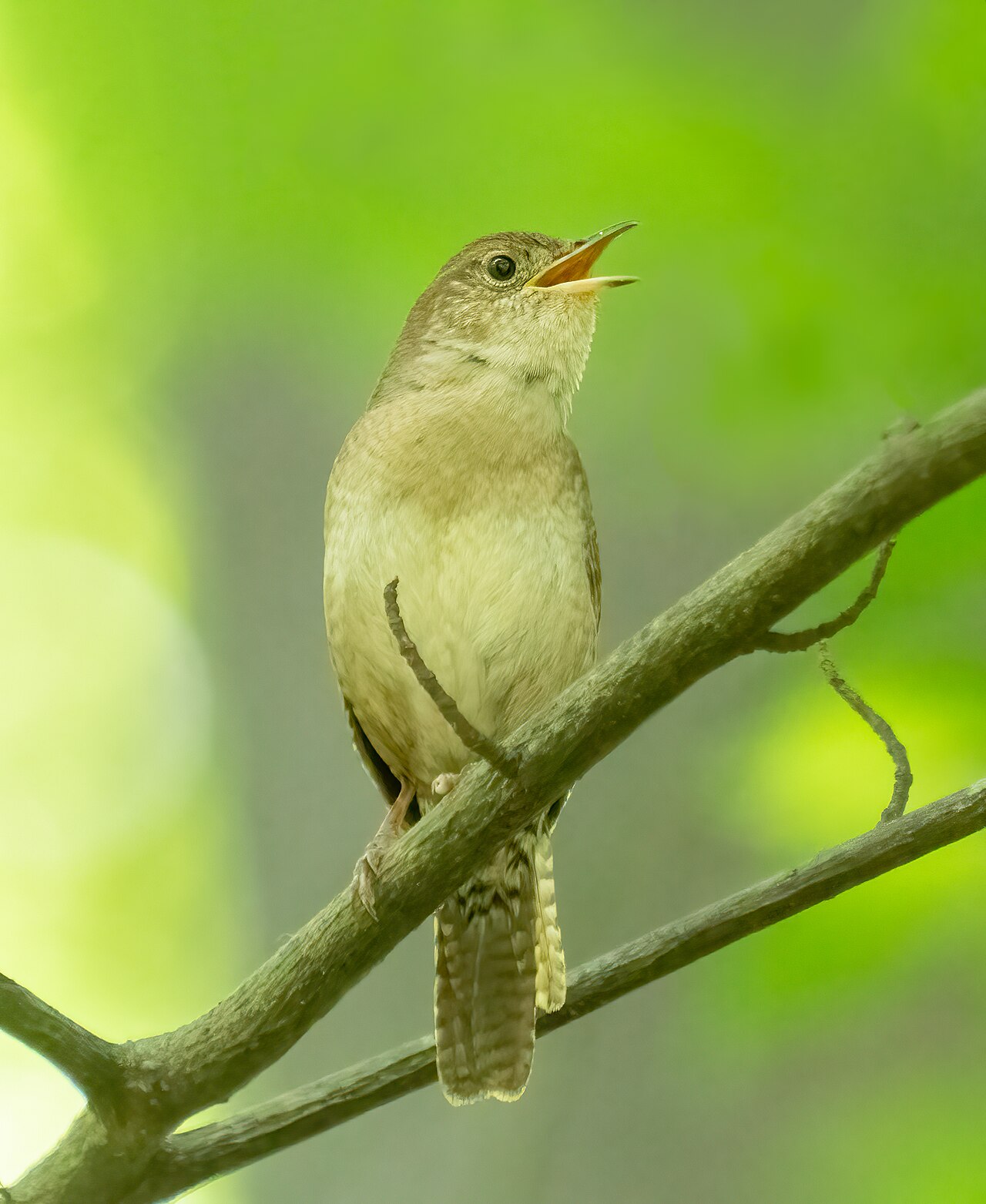
Wikipedia calls the House Wren’s song rich and bubbly and notes that it is commonly heard during the nesting season but rarely afterwards. House Wrens return to their breeding grounds in late April to May and leave in September or early October, and they nest in cavities, including birdhouses and old woodpecker holes, across most suburban areas in their range. A Carolina Wren is larger, with a much more obvious pale eyebrow stripe and a longer bill, and its song is made of loud, repeated phrases, not a tumbling stream. Our guide to small birds with a loud song covers more of them.
Recording: radrat, XC558995, CC BY-SA 4.0.
Carolina Wren
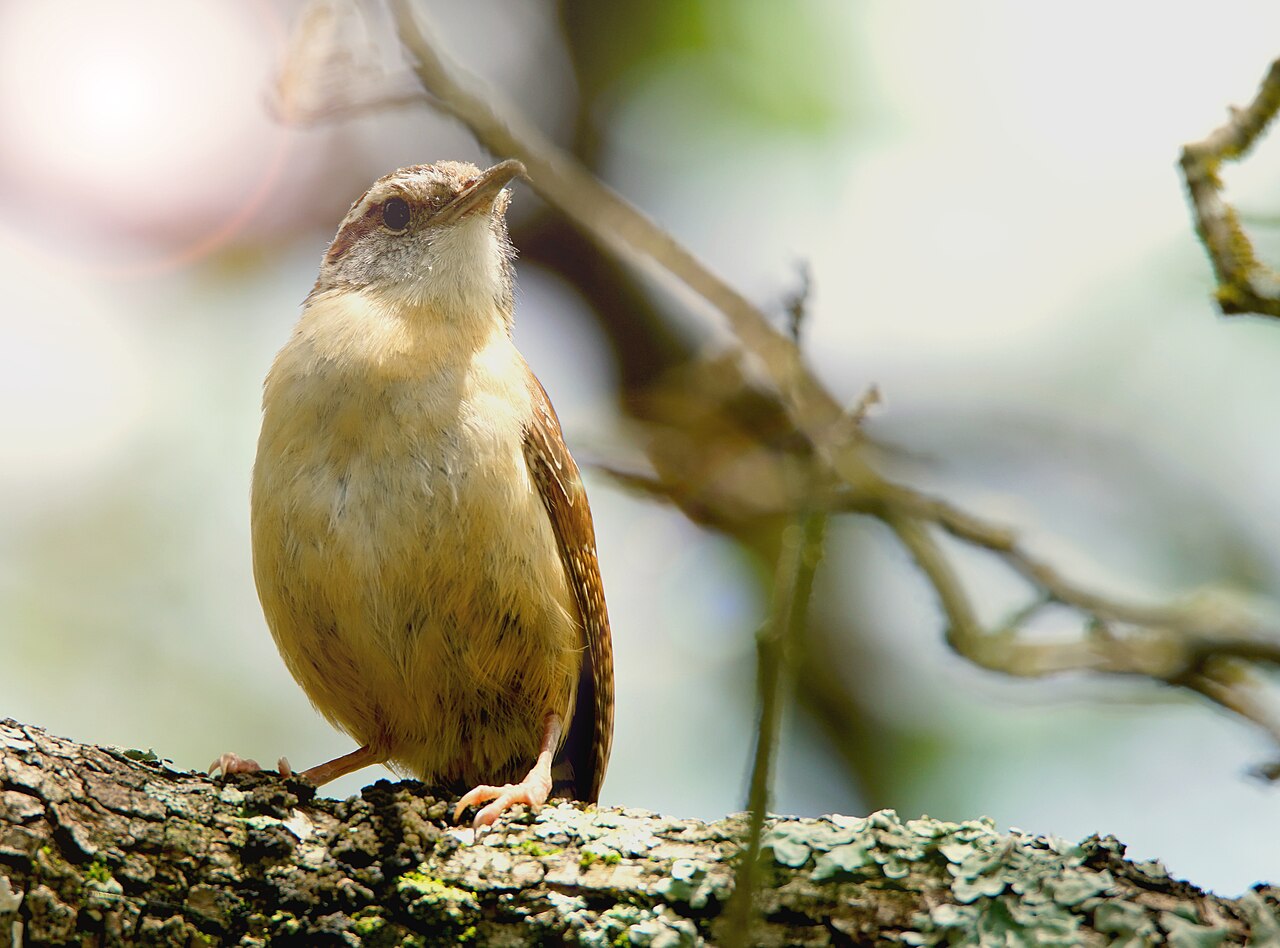
Audubon calls it a loud whistled “tweedle-tweedle-tweedle” or “tea-kettle, tea-kettle, tea-kettle, tea,” sung all day long in all seasons. Wikipedia adds that only males sing, with a repertoire averaging thirty-two phrase patterns. It is a bird of tangles, undergrowth, suburbs, gardens and brushy edges, found across the eastern United States and into extreme southern Ontario, and it stays put all year, so winter is a good time to meet it. Audubon’s song guide lists the Common Yellowthroat as a sound-alike, but the wren’s song has a strong, abrupt accent. Bewick’s Wren is smaller, with a longer tail, grayer above and whiter below, and the Carolina lacks the white tail corners that mark Bewick’s, so look at the tail. See our Carolina Wren guide and the wren symbolism post.
Recording: steve, XC870688, CC BY-SA 4.0.
Rich and varied
American Robin
Audubon describes a series of rich caroling notes, rising and falling in pitch, in a pattern often put as “cheer-up, cheerily, cheer-up, cheerily.” Wikipedia calls it a cheery carol made of discrete units, often repeated and spliced together with brief pauses. Audubon’s song guide says robin phrases have fast pitch changes that sound wobbly, in a regular rhythm; the Rose-breasted Grosbeak sings slower, smoother slurs in an irregular rhythm. Robins sing from late February or early March through late July or early August, and some, mostly in the East, sing now and then into September. Our American Robin guide has the rest.
Recording: Jonathon Jongsma, XC175222, CC BY-SA 4.0. The recording is tagged call, song and whisper song, so listen for the long caroling phrases.
Brown Thrasher
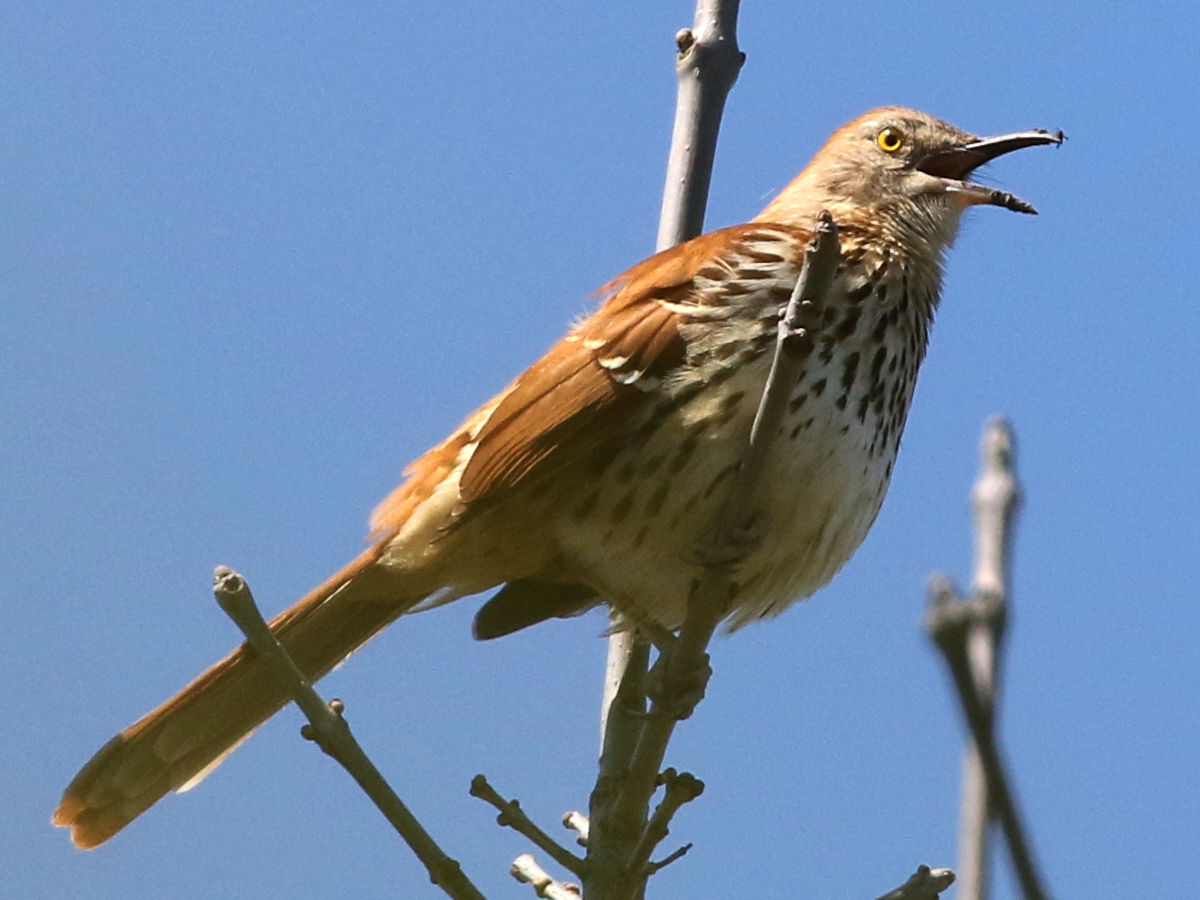
Audubon describes a variety of musical phrases, each repeated twice, sung from prominent perches such as treetops. Wikipedia credits the species with over 1,000 song types, the largest repertoire of any bird by some counts, and notes that it imitates other birds, including Tufted Titmouse, Northern Cardinal, Wood Thrush and Northern Flicker, though it is not as diverse a mimic as the Northern Mockingbird. The doubled phrases are the tell; the mockingbird repeats its phrases three or more times. Thrashers prefer dense low growth, especially thickets at the edges of woods and shrubby swamp edges, and are year-round residents in the south and mostly migratory in the north. In south Texas the Long-billed Thrasher is the one to rule out. For the folklore, see the thrasher symbolism post and the mockingbird post.
Recording: Jonathon Jongsma, XC320485, CC BY-SA 4.0.
Song Sparrow
Audubon describes three short notes followed by a varied trill, with the mnemonic “Madge-Madge-Madge, put-on-your-tea-kettle-ettle-ettle.” Wikipedia says some suburban songs resemble the opening of Beethoven’s Fifth, and a male may know as many as twenty tunes. Because it varies so much, the structure (short notes, then a trill) is a better guide than any mnemonic. Audubon’s song guide lists the Bewick’s Wren as the main sound-alike, noting that the Song Sparrow’s song rarely includes call notes and ends in a buzz. The sparrow lives in thickets, brush, marshes, roadsides and gardens, is present all year across much of its range, and the northern interior birds migrate south for winter.
Recording: Jonathon Jongsma, XC142619, CC BY-SA 3.0.
How to record a bird on your phone
A phone is good enough to capture a single singer. The Merlin and eBird guidance boils down to a few rules.
- Get close, but stay respectful. Merlin recommends getting as close to the bird as you can without disturbing it.
- Point the microphone at the bird. Keep the microphone clean and dry and aimed at the sound, with traffic or running water behind you where possible.
- Beat the wind. Turn your back to the breeze and shelter behind a trunk or building.
- Stay still and quiet for the whole clip.
- Record at least 20 to 30 seconds so you capture several repeats of the phrase. Merlin recommends at least 30 seconds.
- Stay on the trail. The American Birding Association’s code of ethics asks birders to minimize habitat disturbance, and trampling a nesting thicket to get closer defeats the purpose.
- Do not play recordings back at nesting birds. The same code asks you to limit the use of recordings to attract birds and to be especially cautious around active nests. Use your recording to listen, not to call the bird in.
Identify it with free apps
Three free tools from the Cornell Lab of Ornithology cover most of what you need, and they do different jobs.
- Merlin Bird ID (Sound ID). Open Sound ID, point the phone at the singer, and Merlin listens, shows a spectrogram, and suggests species as the audio comes in. Cornell says Sound ID runs on your device without a network connection, but you need to download the regional bird pack first. Treat the result as a suggestion. Distant birds, strong wind and many birds singing at once can lead to mistakes, and Merlin covers a defined and growing list of species, so a bird outside that list cannot be named correctly. Check surprises against a reference recording and the habitat.
- All About Birds. Cornell’s free species guide has photos, range maps and song recordings, so you can confirm Merlin’s suggestion by ear and by habitat.
- eBird. This is where you find out what is likely. Its bar charts show how often a species is reported by week in your county, which helps you rule out a bird that has not arrived yet. You can also keep a list of what you hear.
Once you can name your yard’s singers, the Project FeederWatch guide explains one way to turn backyard watching into counts that scientists can use.
Quick lookup table
Use the table when you remember the sound but not the name. Seasons are broad; your location will shift them.
| Sound | Habitat | Season | Bird |
|---|---|---|---|
| “Ee-oh-lay,” flute-like, then a trill | Damp, mature woods with understory | April to July in the East; winters in Central America | Wood Thrush |
| Piping note, then phrases at rising or falling pitches | Conifer and mixed woods | Breeding season; a few overwinter in the southern US | Hermit Thrush |
| Downward spiral, breezy and flute-like | Damp deciduous woods near streams | Late spring and summer; winters in South America | Veery |
| Rich, gurgling jumble that tends to descend | Open grassland, pastures, prairies | Spring and summer; some stay all year | Western Meadowlark |
| Simple, mellow whistles, “see-you, see-yeeeer” | Grassland, hayfields (East and Midwest) | Year-round across much of its range | Eastern Meadowlark |
| “Purty, purty, purty” or “what-cheer” | Thickets, garden edges, woodland edges | Year-round | Northern Cardinal |
| “Poor Sam Peabody, Peabody, Peabody” | Northern thickets; winter undergrowth and parks | Breeds in the north; winters in the East and South | White-throated Sparrow |
| Flute-like whistles from high in the canopy | Tall shade trees, river groves, open woods | Late spring to midsummer | Baltimore Oriole |
| Bubbling, tumbling run of notes | Yards, edges, nest boxes | Late April to September | House Wren |
| Loud “tea-kettle, tea-kettle, tea-kettle” | Tangles, gardens, brushy edges (East) | Year-round | Carolina Wren |
| Caroling “cheer-up, cheerily” with a wobble | Lawns, woods, farms, towns | Late winter to summer | American Robin |
| Varied phrases, each repeated twice | Dense thickets, woodland edges | Spring and summer in the north; year-round in the south | Brown Thrasher |
| Three short notes, then a trill | Brush, marsh edges, gardens | Year-round in much of the range | Song Sparrow |
Frequently asked questions
What bird has the most beautiful song?
There is no agreed answer, and the Cornell Lab’s article on the most beautiful bird song in North America is worth reading for its take. The thrushes, especially the Wood Thrush, Hermit Thrush and Veery, come up most often, and the meadowlarks and Baltimore Oriole are regular runners-up. The clips above are the quickest way to pick your own.
What bird sings “pretty pretty pretty”?
Most often the Northern Cardinal, whose song Audubon renders as “purty-purty-purty-purty.” Cardinals sing year-round, and females sing too. The Brown Thrasher can imitate a cardinal, so a song that never settles may be a thrasher.
What bird sounds like a whistle?
Several do. The Northern Cardinal, White-throated Sparrow, Baltimore Oriole and Eastern Meadowlark all sing clear, whistled phrases.
What bird sings like a flute?
The thrushes (Wood, Hermit and Veery) and the Western Meadowlark are the standard answers, and Audubon describes the Baltimore Oriole’s song as flute-like too. Hollow, unhurried notes from shady woods usually mean a thrush.
Why do birds sing in the morning?
Nobody has proven a single reason. Territory and mate advertising is the most commonly cited, and low light that limits foraging and internal body rhythms are also proposed. See our guide to the birds that sing at dawn for the order of the morning chorus.
Why does the bird in my yard sound different from the recording?
Songs vary. Wikipedia notes that robin song varies regionally, a Song Sparrow can have many variants of one basic tune, and Audubon notes much individual variation in the Baltimore Oriole. Compare structure (opening note, repeats, ending trill), not exact notes. If your bird sings at night, our guides to what bird screams at night and the nighthawk and whip-poor-will sounds cover the after-dark voices.
The short version
Note the season, habitat and time of day, describe the song in plain words (flute-like, whistled, bubbling, repeated), record 30 seconds if you can, and let Merlin and eBird confirm what your ears suggest. Most of the birds here sing between March and June, so go out then. Wood Thrush, Veery and Baltimore Oriole are gone in winter; the cardinal and Carolina Wren stay all year.
Sources
- Cornell Lab of Ornithology, All About Birds, “What Is the Most Beautiful Bird Song in North America?”
- Audubon Field Guide entries for Wood Thrush, Hermit Thrush, Veery, Western Meadowlark, Eastern Meadowlark, Northern Cardinal, White-throated Sparrow, Baltimore Oriole, Carolina Wren, American Robin, Brown Thrasher and Song Sparrow.
- Audubon magazine, “10 Common Bird Songs Made Less Confusing.”
- Wikipedia entries for Wood Thrush, Hermit Thrush, Veery, Western Meadowlark, Eastern Meadowlark, Northern Cardinal, White-throated Sparrow, Baltimore Oriole, Northern House Wren, Carolina Wren, American Robin, Brown Thrasher and Song Sparrow.
- Macaulay Library, Cornell Lab of Ornithology, “Behind the Scenes of Sound ID in Merlin.”
- Coastal Mountains Land Trust, “Bird Song Identification with the Merlin App”; Sacramento Audubon, “Merlin Sound ID.”
- eBird Help Center, “eBird Bar Charts and Graphs.”
- American Birding Association, Code of Birding Ethics.
- Xeno-canto recordings by the credited recordists, used under the licenses shown beside each one.